THE LAB
The Government Pulled the Plug on Fable 5: What Just Happened and Why It Matters
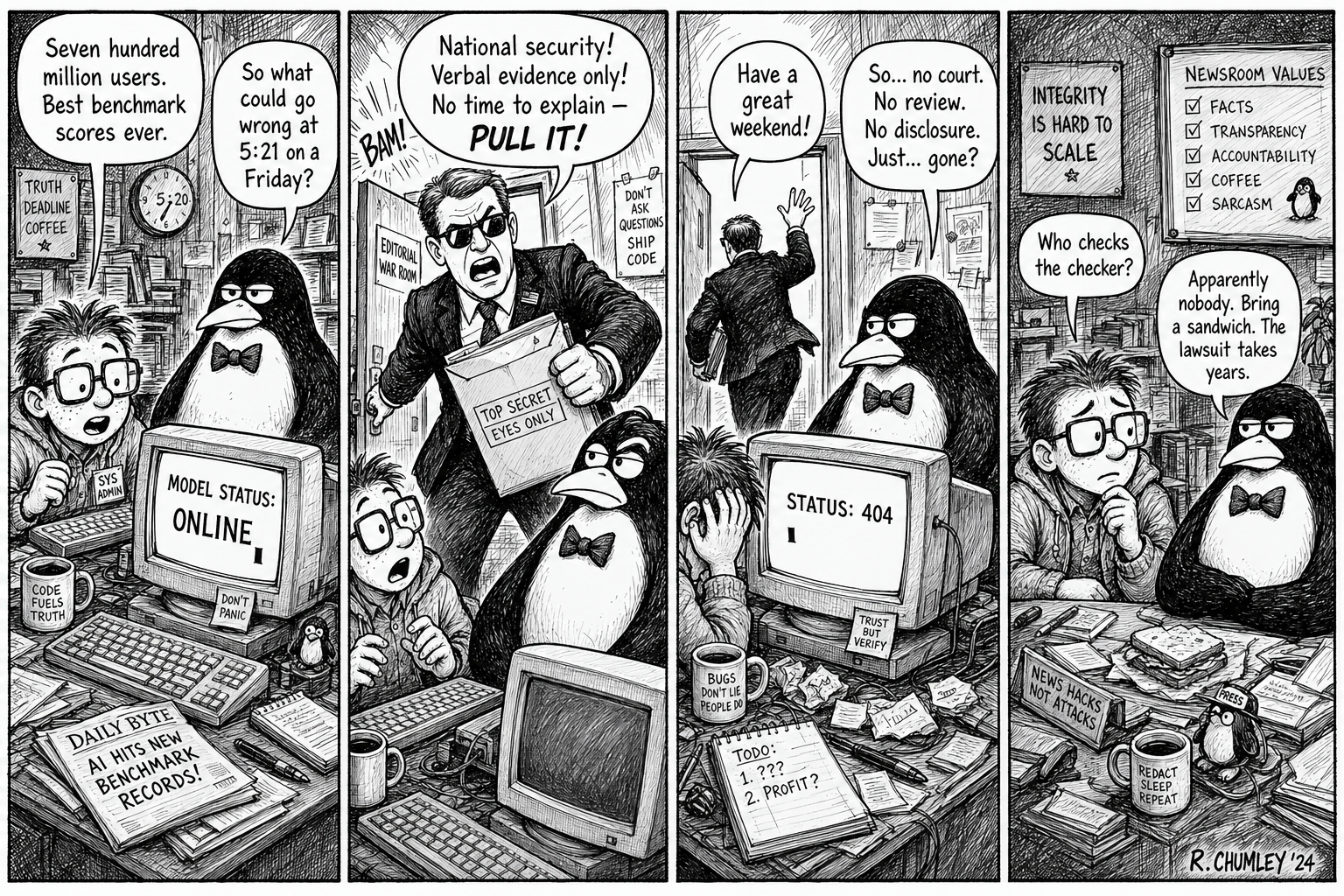
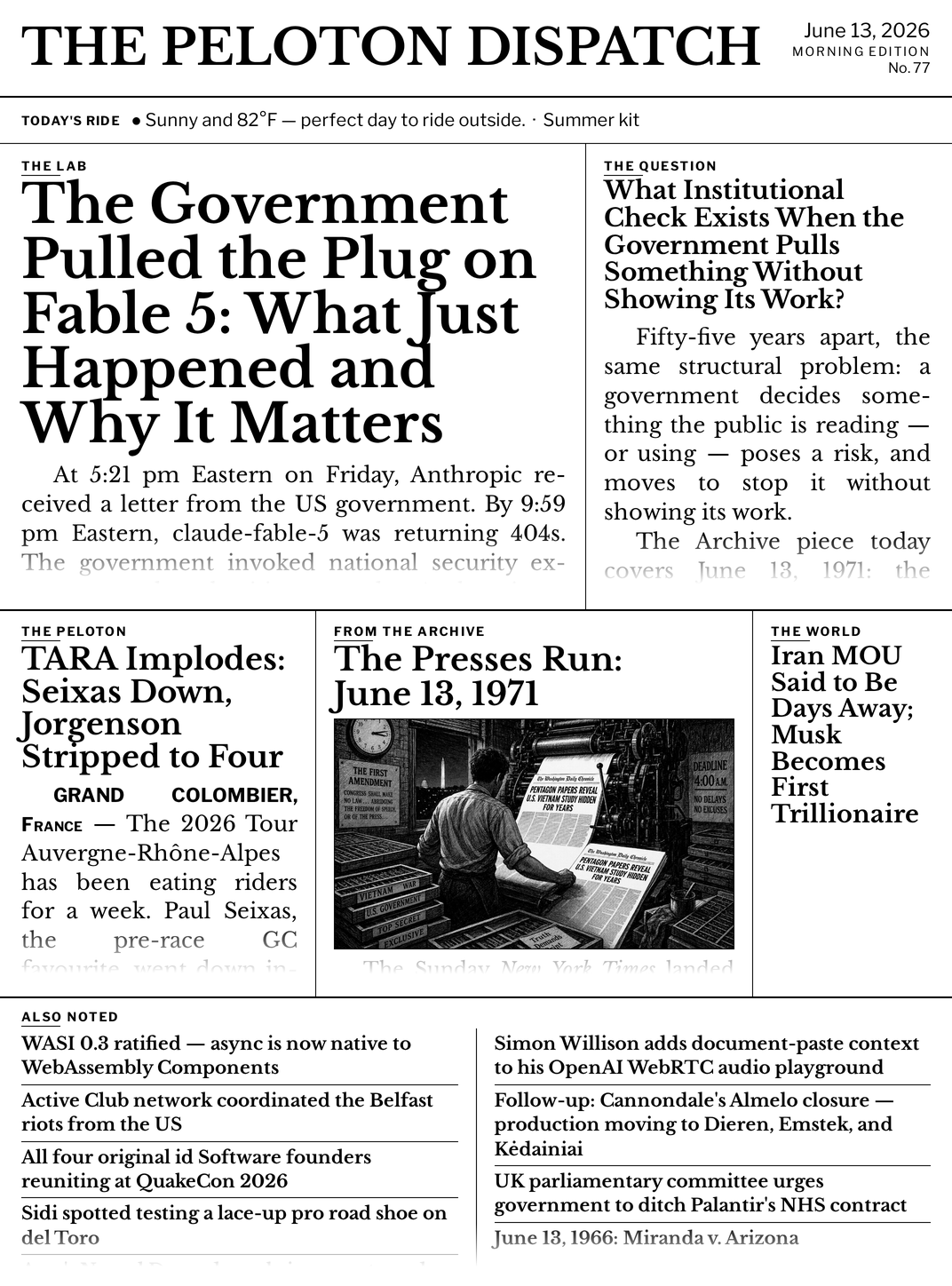
At 5:21 pm Eastern on Friday, Anthropic received a letter from the US government. By 9:59 pm Eastern, claude-fable-5 was returning 404s. The government invoked national security export control authorities to order Anthropic to suspend access to Fable 5 and Mythos 5 for any foreign national — anywhere in the world, including foreign nationals employed by Anthropic itself. The order was unworkable as written, so Anthropic did the only thing it could: it pulled both models for everyone.1
The stated justification is a jailbreak. Specifically, Anthropic says the government presented what amounts to a non-universal, narrow jailbreak — one that "essentially consists of asking the model to read a specific codebase and fix any software flaws." Anthropic reviewed it, found the capability it demonstrated is "widely available from other models (including OpenAI's GPT-5.5)," and pushed back hard in the same statement that announced compliance. The company's position: the jailbreak does not meet any reasonable threshold for recalling a model deployed to hundreds of millions of users, and if this standard were applied industry-wide, no frontier model could ever ship. Wired reported the government gave Anthropic only verbal evidence of the finding before the directive arrived.2
The backdrop matters. Earlier this year the Trump administration's Department of Defense designated Anthropic a "supply chain risk," effectively freezing the company out of government and contractor work. Anthropic sued. The two parties have been in open conflict since. Simon Willison, noting the sequence of events as they unfolded Friday night, called the situation "nuts" and tracked the exact API cutoff using a polling script — his access dropped at 6:59 pm Pacific, roughly four and a half hours after the directive was received.3
The 12 Grams of Carbon analysis makes the most pointed observation: the announcement landed at 5:21 pm on a Friday. That is not an accident. Governments use Friday-evening timing to let markets absorb shocks over the weekend. The writeup catalogs a pattern of the current administration doing exactly this — market-sensitive announcements staged after futures close. The author also flags the competitive angle directly: Anthropic is heading toward an IPO, Fable was by all accounts its strongest model, and OpenAI's investors include figures with close ties to the administration. Whether the motive is genuine security concern, settling scores, or something more cynical about picking commercial winners, the result is the same: the strongest publicly available model is gone, and the precedent is set that the government can pull a commercial model unilaterally, on short notice, based on evidence it does not have to disclose.4
The chilling effect on the industry is real regardless of how this specific dispute resolves. No AI CEO will publicly argue their own model is dangerous again if they know the consequence is a regulatory shutdown. The market for frontier AI now has a new risk category — not a safety incident, not a data breach, but sovereign revocation.
As this paper reported Friday, the Atomic Arch supply chain attack against Arch Linux's AUR was initially counted at 400+ compromised packages. The scope is larger. Sonatype's ongoing analysis and community tracking now puts the number at approximately 1,500 packages, with a second wave using a separate payload (bun install js-digest) attributed to the same npm publisher.5
The Hacker News technical breakdown adds detail the initial reports missed: the malware — a Rust binary — does not require root to run, but when it has it, it loads an eBPF rootkit that hides the process from standard tools using pinned BPF maps named hidden_pids, hidden_names, and hidden_inodes. It also kills debugger attachment attempts. A second staged file tied to monero-wallet-gui is flagged in independent reverse-engineering as a possible cryptominer.6
The practical consequence: if you installed or updated any AUR package on or after June 11, removing the package is not sufficient cleanup. A package manager can only remove what it knows about. Grep recent build history and caches for npm install atomic-lockfile and bun install js-digest. If either ran, treat the host as fully compromised — rotate every credential the stealer targets (browser sessions, SSH keys, GitHub and npm tokens, Slack, Teams, Discord, Vault, Docker/Podman, cloud keys) and, if the payload ran as root, reinstall from trusted media. The eBPF rootkit means you cannot trust the kernel's own reporting on a potentially infected host. The full indicator set including the Tor C2 address is in the independent reverse-engineering analysis at ioctl.fail; SHA-256 for the main payload is 6144d433f8a0316869877b5f834c801251bbb936e5f1577c5680878c7443c98b.
A Munich regional court has issued a preliminary ruling that Google is liable for false statements generated by its AI Overviews feature — and the reasoning is more consequential than the specific case. Two publishers sued after AI Overviews associated their names with scam practices. Google's defense was the standard one: the feature displays a disclaimer that AI can make errors, and it merely aggregates third-party content. The court rejected both arguments. It found that AI Overviews produces "independent, new, and substantial statements" that did not appear in any of the underlying sources, making Google the author of the false claims, not a neutral pipe for third-party content. The disclaimer, the court held, does not transfer liability to users — if it did, no victim of an AI hallucination would ever have legal recourse, because the original sources never said the thing the AI invented. A company spokesperson said Google is carefully reviewing the decision, which is not yet final.7
The ruling applies German law and is not yet final, but its core logic — that an AI system generating novel false claims cannot hide behind the intermediary-platform shield — is the argument that plaintiff attorneys in every jurisdiction have been assembling. If it survives appeal, it makes AI-generated summaries in search engines a substantive liability surface, not a feature covered by boilerplate disclaimers.
Trending today: GitHub is dominated by Claude Code and AI agent skills collections (CL4R1T4S, addyosmani/agent-skills, obra/superpowers, phuryn/pm-skills), Claude Code switcher wrappers, and Fable 5 experimentation repos — no repository cleared the technical novelty bar.
- Statement on the US government directive to suspend access to Fable 5 and Mythos 5 anthropic.com Jun 12, 2026
- Anthropic Says It's Taking Claude Fable 5 Offline to Comply With US Government Order wired.com Jun 12, 2026
- Statement on the US government directive to suspend access to Fable 5 and Mythos 5 (Simon Willison) simonwillison.net Jun 13, 2026
- There is a shadow hanging over this Fable thing 12gramsofcarbon.com Jun 13, 2026
- Around 1,500 AUR Packages Compromised with "Rootkit-Like" Malware privacyguides.org Jun 12, 2026
- Over 400 Arch Linux AUR Packages Hijacked to Deploy Infostealer and eBPF Rootkit thehackernews.com Jun 13, 2026
- A Court Has Ruled That Google Is Liable for False Statements Generated by AI Overviews wired.com Jun 13, 2026