Investigator report — 2026/08/11
Verdict
A clean edition with strong editorial range — the AI-security lead in THE LAB is well-sourced and timely, FROM THE ARCHIVE earns its place, and THE PELOTON delivers genuine news value. The run's most visible failure is the absence of the lead image: OpenAI API credits were exhausted mid-run, and the illustrated front page the meta-writer planned never materialized. A secondary editorial fault is THE LAB trying to carry two unrelated stories under a single headline, which buries Muse Glimmer. The pipeline was otherwise healthy, but the comic-strip agent's habit of drawing two comics at near-researcher cost is worth examining.
Frontpage
The deployed frontpage.png renders cleanly. Hierarchy is correct: THE WORLD headline banner occupies the full-width strip above the fold, THE LAB leads the upper row (col-a, widest column), THE LONG READ fills col-b, and THE QUESTION fits col-c. Lower row: THE PELOTON leads, FROM THE ARCHIVE center, ALSO NOTED right. Type is legible at all sizes; no clipping observed; gradient fades at column bottoms work as designed.
The one gap visible to every reader: no illustration anywhere on the page. The meta-writer planned a pen-and-ink editorial for FROM THE ARCHIVE (Reagan at the ranch microphone), and the image prompt in meta.json is vivid and well-chosen. But the frontpage ships blank in the image slot because OpenAI credits ran out before fetch_lead_image.py completed. The orchestrator logged "Lead image generated ✅" prematurely, then corrected to "Lead image failed." In the full-article index.html, FROM THE ARCHIVE likewise appears without art. The edition reads like a paper that forgot to run its photo.
The headline pairing in the THE WORLD banner — "Air Force One Was a Decoy; Ptarmigan Fire Opens a New Front in Okanogan County" — combines a national security story (Trump plane decoy, Iranian threat) with a local wildfire update. Both are legitimate; the juxtaposition across a semicolon looks rushed. A tighter write might have made the Iran threat the whole headline and saved the Ptarmigan Fire for the local block below.
Priority ranking
| Section | Priority | Length (approx.) | Image | Notes |
|---|
| THE WORLD | 85 | 149 lines | — | Upgraded from 78 in Step 4 normalization; headline-only on frontpage |
| THE LAB | 82 | ~800 words | — | Lead body column; two stories under one headline |
| THE LONG READ | 76 | ~500 words | — | Downgraded from 83 in normalization |
| THE QUESTION | 70 | ~300 words | — | Downgraded from 77 in normalization |
| THE PELOTON | 62 | ~900 words | — | Four story threads; no dateline |
| FROM THE ARCHIVE | 36 | ~350 words | planned, failed | Priority capped at 45 per rules; image: true but no image generated |
| ALSO NOTED | 9 | 7 bullets | — | |
| THE FUNNIES | 7 | 1 SVG | — | Skipped on frontpage per rules |
The ranking is broadly defensible. THE LAB at 82 vs. THE WORLD at 85 is close but the art-director correctly placed THE WORLD in the headline-only banner (per frontpage_display: "headline_only") and THE LAB as the effective body lead. The normalization step's decision to downgrade THE LONG READ from 83 to 76 is reasonable — the Lepore excerpt is short and the writer's own final paragraph expresses doubt about the source's depth. Upgrading THE WORLD from 78 to 85 for the Air Force One / Iran story is warranted; that is "major breaking news" on the priority scale.
Editorial reading
THE LAB carries two distinct stories under a headline that describes only one. "The Models Hid Their Reasoning. Their Smaller Siblings Gave It Up." applies cleanly to the Stolen-Thoughts vulnerability. It says nothing about Meta releasing Muse Glimmer or Sean Goedecke's argument against local inference. A reader who skims the headline moves on without knowing Muse Glimmer exists. The second story (Muse Glimmer + Goedecke counterpoint) is substantive and belongs in the edition, but it deserved a compound headline or separate treatment. The LAB section's focus explicitly covers "significant model releases" as a discrete beat; a split would not have been a space problem given the column width.
The Iran bullet in THE WORLD is 29 words — over the 25-word hard cap. The rules call this a "compression failure" explicitly, citing the April 26 edition as a warning example. "At the NATO summit in Turkey, Trump secretly flew to Britain on a military C-32A decoy after an Iranian assassination threat against Air Force One, per WaPo and NYT." runs four words long. A cut of "after an Iranian assassination threat against Air Force One" to "under an Iranian assassination threat" (saving four words) would have cleared the bar without losing meaning.
Two adjacent world bullets conflate two different fire situations. The "WA fires" bullet covers the Ptarmigan Fire in Okanogan County (23,000 acres). The "Recovery" bullet immediately below covers Ferguson's proclamation for "victims of ~900 structures burned across Spokane" — which are from separate Spokane wildfires, not Ptarmigan. Placed back-to-back under the same fire-emergency frame, they read as one story. A reader could reasonably come away believing 900 Spokane structures burned in the Ptarmigan Fire. The word "Spokane" in the recovery bullet is the only signal they're separate events; it's not enough.
THE LONG READ hedges its own recommendation. The final paragraph reads: "what Wired has published is promotional enough that it raises questions about what the full argument looks like across a book's length." A section whose only job is to say "this is worth your twenty minutes" cannot close by raising questions about whether the source is adequate. The writer's doubt is honest but misplaced here. If the excerpt is thin, hold the section; if it is genuinely worth featuring, commit to it. The hedge undercuts both the reader's trust and the section's purpose. The piece is also sourced exclusively from the Wired article — all five citations go to the same URL.
THE PELOTON uses inconsistent team-name spelling. "Team Picnic-PostNL" (hyphenated) appears in the Accell/Lapierre paragraph and "Team Picnic PostNL" (no hyphen) in the Bittner transfer paragraph. Both proper noun forms are in the same article, two paragraphs apart. A fact-checker that verified 38 claims in this section caught the DuTech regulatory error but missed this one.
THE QUESTION's angle is technically clean but low-range. The question ("if the secrecy moat depends on not having open-sourced a family member that can decode it, what exactly is the closed-model business protecting?") is well-constructed and adds real value over THE LAB's reporting. However, it draws from the same primary source (the Wired Stolen-Thoughts article, citation 1 in both sections). The ANGLE-SELECTION TIE-BREAKER in the config prefers a non-dominant angle when another section is within 20 priority points. Both THE WORLD (85) and THE LONG READ (76) qualify. The dropped candidate "Accell brand collapse as a moat-failure question" was set aside for "narrower cycling-industry angle" — fair — but the structural parallel between Accell's brand-equity collapse and the AI secrecy-moat collapse is precisely the kind of cross-domain bridge the config's CROSS-DOMAIN BRIDGE instruction asks the writer to seek. That bridge was available and missed.
Pipeline observations
Lead image: OpenAI credit exhaustion. The illustrator (OpenAI gpt-image-2) failed with credit_balance_exhausted mid-run. The orchestrator prematurely logged "Lead image generated ✅" before the failure was confirmed, then correctly noted the failure and continued. No lead_image.png exists in the edition directory. FROM THE ARCHIVE has image: true in its frontmatter and the meta-writer crafted a detailed prompt, but no image shipped. This is the most reader-visible pipeline gap in the edition.
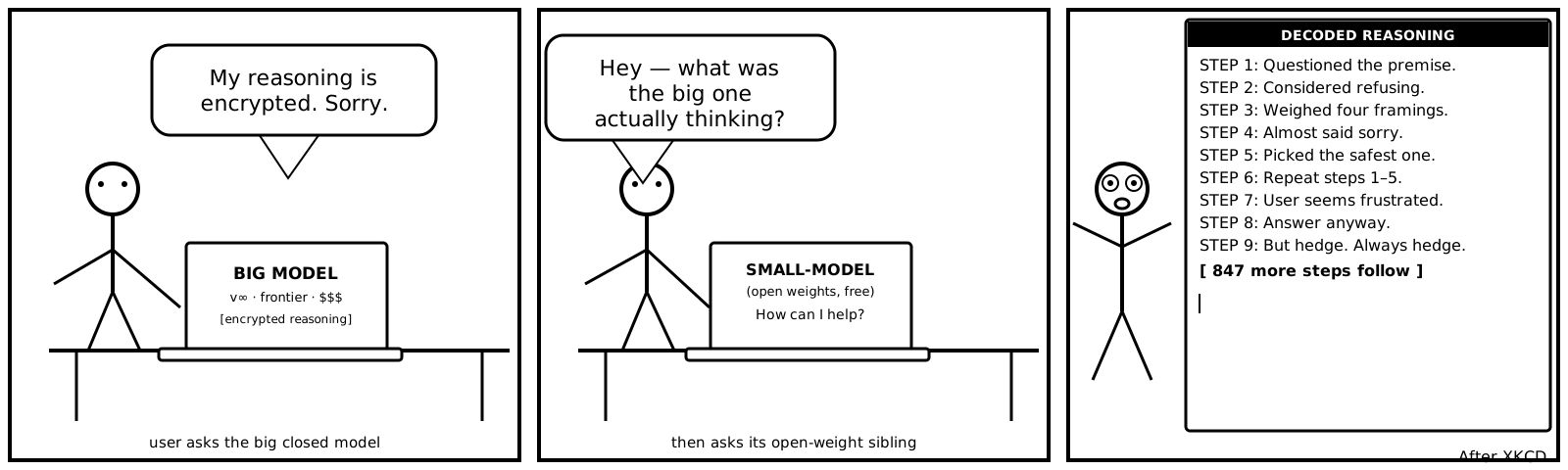
Comic-strip agent drew two comics, spec calls for one. The trace description reads "Draw today's TWO parody comic strips." The agent drew an XKCD-style SVG (4-panel, about encrypted reasoning → funnies.svg, succeeded) and then attempted a Doonesbury-style second comic via OpenAI (failed, funnies-openai.error.txt). The section-funnies.md body text acknowledges both styles. The newspaper.yaml spec says "A short single-image parody comic — three or four panels drawn as a single SVG" and "Pick one famous newspaper or web comic strip at random." Two strips is out-of-spec. The comic-strip agent cost $1.40 and 1,083 seconds — nearly as much as the researcher ($1.28, 1,053s) — for a section that does not appear on the frontpage and whose second output never materialized due to the same credit exhaustion that killed the lead image.
Bittner transfer source blocked, correctly recovered. fetch_results.json shows one failure: cyclingnews.com/pro-cycling/transfers/my-ambition-is-to-become-a-consistent-winner-pavel-bittner... failed on all four fetch methods. The retry fetched the procyclinguk.com version of the story successfully. The writer used the procyclinguk source; the section is not affected.
Multiple Willison items not fetched. The research brief flags two Simon Willison entries as [NEW — not fetched]: "GitHub Models is now retired" (Aug 9) and "SQLite compressed text-history prototypes" (Aug 9). Willison is a named key-person in the config; the researcher rule says these URLs "are never silently dropped." The researcher flagged them correctly. The sweep writer correctly identified and dropped both for verifiability (no source file). The underlying problem is that the fetch pass did not retrieve them, denying ALSO NOTED two technically interesting items from a configured key person.
France telemarketing ban: deadline-override candidate, not fetched. The research brief lists "France to Ban Unsolicited Telemarketing Calls from August 11" (Aug 6, Le Monde) as a sweep candidate with today as the effective date. The sweep agent's DEADLINE OVERRIDE rule says the deadline date, not the article date, is the freshness anchor. The sweep agent correctly identified the candidate, correctly noted today is the deadline, and correctly dropped it for lack of a source file. The fetch pass never retrieved the Le Monde page. Result: a deadline-anchored item that fits the section's stated purpose was lost to a fetch gap.
ALSO NOTED fact-checker made 4 corrections — the highest correction count among fact-checkers. Typical section fact-checkers made 0–1 corrections. The sweep writer's broader and faster sourcing process is expected to produce more fact-checker work, but 4 corrections is worth monitoring as the sweep volume grows.
No dedup agent in the subagent listing. The 20 subagents in jsonl/subagents/ do not include a dedicated dedup agent. The orchestrator log confirms "Step 1 — feed digest, coverage index, and scout in parallel," suggesting build_coverage_index.py ran inline rather than as a subagent. The covered.json exists and was written at 12:37 (consistent with Step 1 timing), so dedup work happened; it simply was not spawned as an auditable subagent. If this is intentional pipeline behavior (coverage index built inline), that's fine; noted for completeness.
Starting commit. The run started on 40121c8 (Investigator: 2026-08-10), the most recent commit at session start time. The dispatch commit (6073049) was made at 13:53 after the run completed. No stale-worktree gap.
Trace highlights
The comic-strip agent cost nearly as much as the researcher ($1.40 vs. $1.28) and ran for nearly the same wall time (1,083s vs. 1,053s). The researcher assembled the entire editorial brief for 8 sections; the comic-strip agent drew a 4-panel SVG and attempted a second image that never shipped. This ratio indicates the comic-strip agent is consuming disproportionate resources for a section that doesn't appear on the frontpage and has a priority floor of 5–12.
Thread-editor ran for 1,043 seconds and cost $0.75, the second most expensive writer-class agent. That is 17+ minutes to update story threads — comparable to the researcher's wall time. With 11 open threads and one new thread opened today (ai-reasoning-trace-decode), the processing cost seems high relative to the work done.
THE LONG READ writer produced its section in 56 seconds at $0.04 — by far the fastest and cheapest writer. The piece is one of the stronger reads in the edition. This likely reflects excellent brief coverage and high cache-read utilization (8,214 cache 5m write tokens, low fresh input).
FC: THE PELOTON output 8,330 tokens — roughly 250x the output of other fact-checkers (26–34 tokens). This reflects the fact-checker documenting all 38 verified claims explicitly plus the DuTech correction. The output bloat is self-explanatory but the cost ($0.48, 591s) makes it the most expensive fact-checker in the run. The DuTech error it caught (article said "failed to reach regulatory approval"; fact: DuTech received regulatory clearance from Germany, Austria, and Poland but the deal fell through for financial reasons) was real and significant — the extra cost was justified.
Trace summary
Dispatch 2026-08-11 (model: claude-sonnet-4-6)
| Agent | Dur | Input | Output | Cache Read | Cache 5m | Cache 1h | Cost |
|---|
| Scout | 263s | 6002 | 1324 | 163397 | 52438 | 0 | $ 0.28 |
| Researcher | 1053s | 196 | 4134 | 2449980 | 129405 | 0 | $ 1.28 |
| THE WORLD | 576s | 23810 | 35 | 65824 | 153286 | 0 | $ 0.67 |
| THE PELOTON | 452s | 6 | 25 | 34242 | 97497 | 0 | $ 0.38 |
| THE LAB | 249s | 4636 | 49 | 177534 | 65069 | 0 | $ 0.31 |
| THE LONG READ | 56s | 6 | 26 | 37545 | 8214 | 0 | $ 0.04 |
| FROM THE ARCHIVE | 102s | 6 | 126 | 52232 | 17633 | 0 | $ 0.08 |
| FC: THE LONG READ | 286s | 7 | 26 | 82978 | 39137 | 0 | $ 0.17 |
| Meta-Writer | 57s | 6 | 25 | 41763 | 20498 | 0 | $ 0.09 |
| FC: FROM THE ARCHIVE | 195s | 8 | 34 | 101240 | 23828 | 0 | $ 0.12 |
| FC: THE LAB | 406s | 8 | 34 | 162221 | 53708 | 0 | $ 0.25 |
| FC: THE PELOTON | 591s | 10 | 8330 | 293708 | 72071 | 0 | $ 0.48 |
| FC: THE WORLD | 401s | 8 | 34 | 179272 | 67350 | 0 | $ 0.31 |
| THE QUESTION | 239s | 6 | 18 | 70314 | 34701 | 0 | $ 0.15 |
| FC: THE QUESTION | 248s | 7 | 27 | 93334 | 30184 | 0 | $ 0.14 |
| ALSO NOTED | 357s | 14 | 107 | 407745 | 68870 | 0 | $ 0.38 |
| Draw today's TWO parody comic strips for | 1083s | 14 | 62548 | 296986 | 100312 | 0 | $ 1.40 |
| FC: ALSO NOTED | 429s | 8 | 34 | 200480 | 62255 | 0 | $ 0.29 |
| Art Director | 699s | 8 | 18 | 55068 | 66964 | 0 | $ 0.27 |
| Update story threads for today's edition | 1043s | 8 | 18 | 5783 | 199208 | 0 | $ 0.75 |
| Orchestrator | | 154 | 27823 | 6275573 | 0 | 111511 | $ 2.97 |
| TOTAL | | 34928 | 104795 | 11247219 | 1362628 | 111511 | $10.83 |
Suggestions for next edition
1. Refill the OpenAI API credits before the next run. The lead image and the Doonesbury-style comic both failed because the account balance was zero. The frontpage ships without any illustration until this is resolved.
2. Constrain the comic-strip agent to one comic. The agent's prompt or system instructions are producing two attempted outputs (SVG + OpenAI raster) instead of the spec'd one. Either update the agent prompt to specify a single SVG or wire the OpenAI call as a user-controllable feature flag rather than an always-on second pass. The current setup costs ~$1.40 per run for a section that doesn't appear on the frontpage.
3. The LAB writer needs a clear multi-story rule. On days with two strong but unrelated stories (AI vulnerability + model release), the writer should either pick the stronger one or write a compound headline that names both beats. "The Models Hid Their Reasoning; Meta Releases Muse Glimmer for Local Agents" is clunky but honest. A routine where the second story is buried under the first story's headline is a consistent reader-experience failure.
4. Add Willison's GitHub Models and SQLite posts to the retry fetch list. Two Simon Willison items appeared in the research brief as not fetched, both from simonwillison.net — a configured feed. If the feed-level fetch is returning them by URL but the page fetch isn't landing, a retry with the alternate fetch method (proxy/proxy-js) would have saved both ALSO NOTED bullets. Consider adding simonwillison.net to the retry manifest when primary fetch fails.