● Sunny and 61°F; wear arm warmers outside today. · arm warmers
THE LAB
A Swift Developer Shaved an IPv4 Parser Down to Fifteen Cycles
Seventy-five instructions. Fifteen cycles. About three nanoseconds on an Apple M6.1 That's the budget Mahdi landed on for parsing an IPv4 address in Swift, in a post this week that reads like someone actually enjoyed the puzzle of getting there.
The problem sounds trivial until you look at what the fast implementations already do to win it. Daniel Lemire and Wojciech Muła's prior art — the stuff most high-performance parsers borrow from — assumes an eighth null byte is sitting there for free, or demands a padded 16-byte input, or leans on lookup tables that only pay off if the right cache lines happen to already be warm. None of that fits Swift's actual contract: a valid IPv4 string is anywhere from 7 to 15 bytes, no padding guaranteed, no null terminator to lean on.1 So Mahdi built something else. He slices the string into three or four overlapping 32- or 64-bit "windows" — one anchored at the front, one at the back, one computed once the dot positions are known — XORs each against a 0x30303030 mask so ASCII digits collapse into their numeric values and dots pop out as the one byte with its fifth bit set, and lets the CPU chew on all the windows in the same cycle because none of them depends on the others finishing first.1 It's SWAR — cramming eight bytes into one 64-bit register instead of looping over them one at a time — paired with instruction-level parallelism: on his benchmarks, the M6 was retiring an average of five instructions per cycle.1 Against Lemire's lookup-table-based sse_inet_aton, which still wins outright, Mahdi's table-free version ranks second on M6 and third on AMD's Zen 5 — close enough, and portable enough, to be the more interesting number.1 The code is going into swift-endpoint, part of an effort to give Swift the kind of unified networking-types layer Go's net/netip and Rust's std::net already have.
OpenBSD's installer notes now point to version 8.0 — disklabel, install80.iso, the same unglamorous CD/USB/PXE instructions the project has shipped twice a year for decades, now repeated across alpha, amd64, arm64, armv7, hppa, i386, landisk, luna88k, macppc, octeon, powerpc64, riscv64, and sparc64.2 There's no changelog on the page itself, just the quiet confirmation that the project is still building for architectures most vendors dropped a decade ago, and still shipping a ports tree over anoncvs for people who want to track -stable by hand.2
Simon Willison flagged Jeremy Scheff's essay on coding agents yesterday, pulling the one line that cuts through the usual ambivalence: for programmers who loved systems that worked, agents are "the gift that keeps on giving";3 for programmers who loved the puzzle itself — the part where "they needed us," where you set the strategy and defined what was possible — the loss is real and not really arguable away.3 THE LONG READ has the full essay today; Willison's contribution is picking the sentence that matters and getting out of the way.
Trending today: trendshift.io's page rendered only site chrome — the JS trending list never resolved to usable data, and the handful of stray links present (generic AI-agent wrappers like busbar and bifrost) cleared no novelty bar.
Suspicious Letters Reached Election Offices in 32 States Before the Midterms, as Seattle Votes to Clear RVs From Its Streets
A week ago today, white powder spilled from an envelope at Louisiana's election office, one of dozens of threatening letters hitting offices in 32 states ahead of midterms.1 Most were intercepted by USPS before arrival and proved harmless; the DSA has denied any role despite its name appearing on one envelope.1 A federal judge ordered former OpenAI engineer Abdulrahman Alfozan held pending trial Monday, citing concerns about his ties to Saudi Arabia and calling the Saudi government's offer to help fund his release "a blank check."2
The Seattle City Council votes this afternoon on an ordinance restricting overnight RV parking on city streets, pairing a new towing rule — vehicles must move every 72 hours or risk being towed without notice — with $5 million for outreach, safe-parking lots, and vehicle storage meant to connect people living in their cars with housing.3 Councilmember Dan Strauss argues the city has built shelter and permanent supportive housing "over parking spots," leaving out people who still have a vehicle; critics at committee called the new permit system too costly and bureaucratic for what it delivers.3
Separately, the Port of Seattle closed its 2026 cruise season Sunday with records across the board: 330 ship calls, nearly 2 million passengers, and an estimated $1.2 billion in regional economic benefit, supporting more than 5,120 jobs.4 MSC Cruises and Virgin Voyages ran their first Seattle seasons, and 66% of ships plugged into shore power at berth — progress toward the port's 2028 target of 100%.4
ON THE TRAIL
Weekend picks (Sat Oct 24–Sun Oct 25):
Trap Lake via Tunnel Creek Trailhead (PCT) — Central Cascades/US 2 West (Index, Skykomish), ≈60–90 min from Issaquah. 1 night / 2 days. Day 1 in: ≈5.8 mi, ≈1,550 ft gain (estimate — half of the reported 11.6 mi / 3,100 ft round trip to Trap Lake and Trap Pass); Day 2 out: same mileage and elevation in reverse. Weather: Sat 53°F / 42°F, 46% | Sun 55°F / 42°F, 32% (US 2 West). This weekend's Trap Lake reports clear all six bars: ice on the PCT is "short... on flat ground," no spikes needed and fully doable in trail runners; the lake has open water access and a privy suggesting sanctioned camping; there's no ford; McBabe's party passed just five other groups all day; and neither trip day clears the 50% precip threshold that would disqualify it. Trap Pass, Trap Lake trip report · Thunder Mountain Lakes, Trap Lake trip report
No other backpacking destination in this week's reports clearly clears all six bars for an overnight — most of the Central and North Cascades candidates with confirmed camping either sit at elevations where Saturday's forecast snow risk is live, or lack a trip report confirming current conditions past the trailhead.
Regional snapshot:
I-90 West (Snoqualmie/North Bend/Issaquah Alps): Dingford Road is "unusually passable right now," opening the steep 4.4-mile Green Ridge Lake round trip (2,100 ft gained in the first mile alone). Report
- US 2 West (Index/Skykomish, Stevens Pass West): Scorpion Mountain's access road is "in really good shape," and the trailhead stayed uncrowded — four other vehicles on a sunny Sunday — with fall color fading but still present. Report
- US 2 East (Stevens Pass/Enchantments): Hikers are now routing Lake Valhalla from the Stevens Pass trailhead instead of Smithbrook Road, which has become "increasingly harrowing" to drive. Report
- Mountain Loop Highway: The Suiattle River Road has reopened, restoring drive-up access to the Huckleberry Mountain trailhead after a long closure. Report
- Rainier (Greenwater/Crystal/White River): Sunday was the last day of the season for Rainier's White River entrance, closing that side of the park's eastside trailheads until spring. Report
- Olympic Peninsula: Lena Lake's trail is "in great shape" with just one blowdown to duck under and open vault toilets, though it's still a busy Sunday draw. Report
EF Let Carapaz Walk Over Budget. Four Other Rosters Rearranged in the Blast Radius.
Jonathan Vaughters didn't dress it up. Richard Carapaz was EF Education-EasyPost's best rider in 2026 — a second career King of the Mountains title at the Tour de France, two stage wins there, a top-five overall at the Vuelta a España — and reportedly had two years left on his contract.1 He's leaving for NSN anyway, and Vaughters told Escape Collective why: "We needed to make some hard decisions," citing higher costs and budget cutbacks.1 Talent like Carapaz's doesn't usually get released mid-deal. This year, it did.
Into that vacancy comes Tao Geoghegan Hart, confirmed Monday on what looks like a one-year contract. The 2020 Giro d'Italia winner broke his leg crashing out of the 2023 Giro and has spent three years at Lidl-Trek rarely troubling top-10s since — his exit, per Cyclingnews, "has been inevitable for some time."2 Geoghegan Hart described a "very interesting, personal conversation" with Vaughters about what might come next. "On a personal level, it's really about trying to refind the condition I had in my best years," he said. Vaughters was blunter about the bet he's making: "Tao is an incredibly gifted rider with the perseverance and stubbornness to come back from a horrific crash injury. While the fruits of his work to come back from injury have not blossomed yet, we are taking the bet that 2027 will be the year that this happens."2
The bigger domino landed a day later at Decathlon CMA CGM, who signed both Pavel Sivakov and Ben O'Connor on Tuesday.34 Sivakov leaves Tadej Pogačar's UAE Team Emirates-XRG after three years supporting the Tour de France wins of 2024 and 2025 and this year's Vuelta before Pogačar's early exit — he signs through 2029.3 O'Connor returns on a two-year deal after two seasons at Jayco AlUla, where he added another Tour stage win but never matched the GC heights of his first Decathlon stint (stage wins at the Tour and Vuelta, second overall at the latter).4 Both moves are explicitly about retention: Decathlon shifted its company base to Switzerland to free up wage-bill room and keep Paul Seixas happy past his contract's 2027 expiry.3
O'Connor's departure leaves Jayco needing a GC leader for a team that, per Cyclingnews, now "looks to be without a serious GC contender for 2027."4 Their answer, also announced Tuesday, is Mikkel Honoré — not a GC rider but a versatile Danish classics hand who missed three months of the 2026 season recovering from a horror crash at the Heylen Vastgoed Heistse Pijl that left him with fractured ribs, vertebrae and a collarbone, a collapsed lung, and an ICU stay.5 He returned to finish second to Mathieu van der Poel at the Tour de Luxembourg and 19th at the Road Worlds in Montreal.5 He's Jayco's ninth new arrival for 2027.5
And at Movistar, Javier Romo agreed to tear up two years of contract to join Netcompany Ineos, who are mid-overhaul with eight signings and nine departures already on the books this winter.6 Romo, 27, has one pro win — a solo breakaway at the 2025 Tour Down Under — but raced five Grand Tours, finished seventh overall at this year's Itzulia Basque Country, and attacked toward Alpe d'Huez on stage one of this year's Tour before finishing 54th overall.6 He's Ineos's third Spanish signing of the window, after Markel Beloki and Benjamin Noval.6
Picnic-PostNL's "culture of fear" reckoning got its sharpest rebuttal yet. John Degenkolb posted on Instagram Monday that across ten years with the team — split between the Argos-Shimano era and his "deliberate return" in 2022 — he never experienced what last week's NOS/De Waaier investigation described.7 "Critical voices must be heard and taken seriously. However, for a fair and balanced assessment, all relevant perspectives should be considered," he wrote, asking reporters Thijs Zonneveld and Nando Boers directly: "Why were voices like mine — and those of many others — left out of the investigation?"7 Zonneveld's reply didn't back down: the paper spoke to 71 current and former riders and staff, he said, and "I respect your point of view … but there are a lot of people who had a different experience than you."7
Soudal-QuickStep — rebranding to Soudal-Safety Jogger for 2027 — is switching bike sponsors after 15 years on Specialized, moving to Merida's Reacto and Time-Warp frames alongside new deals for Shimano Dura-Ace wheels, Continental tires, Prologo saddles, Lazer helmets and Sidi shoes.8 The women's AG Insurance-Soudal squad is part of the same package. Tim Merlier, who closed out Specialized's run with Sunday's final Eneco Tour stage win, patted his Tarmac's frame at the line.8
Two smaller but notable items close the ledger. Daria Pikulik, the Polish track racer who took Omnium silver at the Paris Olympics, accepted a backdated 18-month suspension for missing three anti-doping tests between September 2023 and September 2024; because the ban runs from December 2024 to June 2026, she keeps the medal but has no team for 2027.9 And Elena Cecchini, the five-time Italian national champion and SD Worx-Protime road captain, retired at Sunday's Eneco Tour after 16 pro seasons and 18 Grand Tour starts; Demi Vollering, Lotte Kopecky and Urška Žigart led the tributes on the team's Instagram.10
Housekeeping, for the record: the UCI confirmed Monday that every men's and women's WorldTour team has cleared the 2027 registration bar in some form — Visma-Lease a Bike registered under its parent company's name, "Yellow B.," while sponsor talks continue — though Jayco AlUla and Picnic-PostNL both still have paperwork outstanding, and TotalEnergies' fight to survive past October 31 remains unresolved.11 Separately, TNT Sports and Eurosport extended their EBU rights deal with ASO through 2032, which means the Tour de France won't return to free-to-air UK television before 2033 at the earliest.12
His Business Is Having Its Best Year Ever. He Is Writing Programming's Obituary Anyway.
Jeremy Scheff did not want an AI coding agent. He runs a software business, zengm.com, that is in the middle of one of its best years ever, and he got there the old way — writing the code himself, because he liked it.1 He watched engineers he respected announce they no longer write code, watched non-programmers ship things that used to require a specialist, and held out. "I like programming," he writes. "That's the fun part!"1 Then he tried it anyway, and the essay he wrote afterward is not a tutorial or a productivity testimonial. It is closer to a eulogy, delivered by the corpse.
The eulogy opens as wonder. He hands an agent a bug report and it finds the fault almost instantly. He asks it to make his code faster and it comes back 2x, then 3x faster — he links his own blog posts and a GitHub release tag as the receipts.1 He asks it to do the refactor he'd been avoiding for years, and it just does it. Each example reads like a magic trick, and Scheff plays it that way on purpose, because the trick is the setup for the question that structures the whole piece: "if the AI can refactor my code so easily, did it even matter?"1
That question is the essay's real subject, and it has nothing to do with productivity. Scheff's case for why programming was worth doing was never really about the software that got built. It was about the puzzle — "a puzzle, but the scope was limited only by your imagination," as he puts it, better than crosswords or sudoku because what you made was real and worth money.1 He is explicit that this was also a status arrangement: ordinary people couldn't do the puzzle, so they needed people who could, and the people who could got to set the strategy, the timeline, what was and wasn't possible. "Who are you to question us?" he writes, not quite joking. "We are the ones with the superpower."1 It's an uncomfortable sentence to put in your own obituary, because it's also an admission of what, precisely, is now dead.
What replaces the puzzle, in Scheff's telling, is not nothing — it's "being plugged into the Matrix, gaining new abilities without truly understanding, accomplishing great things with little effort."1 The Matrix metaphor does real work here: the point of The Matrix was never that the simulated world looked fake, it's that it felt completely real while being hollow underneath. Scheff's complaint about vibecoding is the same shape. The code works. The refactor lands. The speedup is real and measurable. And none of it feels like it counts, because counting was always about the climb, not the summit. "It's addictive and meaningless," he writes of the agent. "A good friend, a trusted colleague, a slave" — the last word landing hard enough that he links straight to the New York Times piece on Anthropic's own reckoning with how Claude is treated.1
The essay never argues AI coding agents are bad for business, output, or even for most programmers — he's careful to note plenty of people never liked the puzzle-solving part and are thrilled to be rid of it. What he's grieving is narrower and more personal: a craft whose entire value proposition, for him, was that regular people categorically could not do it, delivered by a machine that makes clear, several times a day, that they now effectively can. He closes by widening the lens from his own job to everyone's: "It will obsolete us. Us programmers now, us humans next?"1
It's worth reading over the status report or the quarterly roadmap, not for its conclusions, which are modest and honestly uncertain, but for its candor about a trade most engineers are still performing in public: insisting the agent is "just a tool" while privately reaching for it before the editor, the way Scheff admits he now does. He never resolves whether that's a loss worth mourning or a convenience worth taking. He just names it precisely, which is rarer than it should be.
Nixon Gave the Same Order Three Times. Two Men Quit Rather Than Carry It Out.
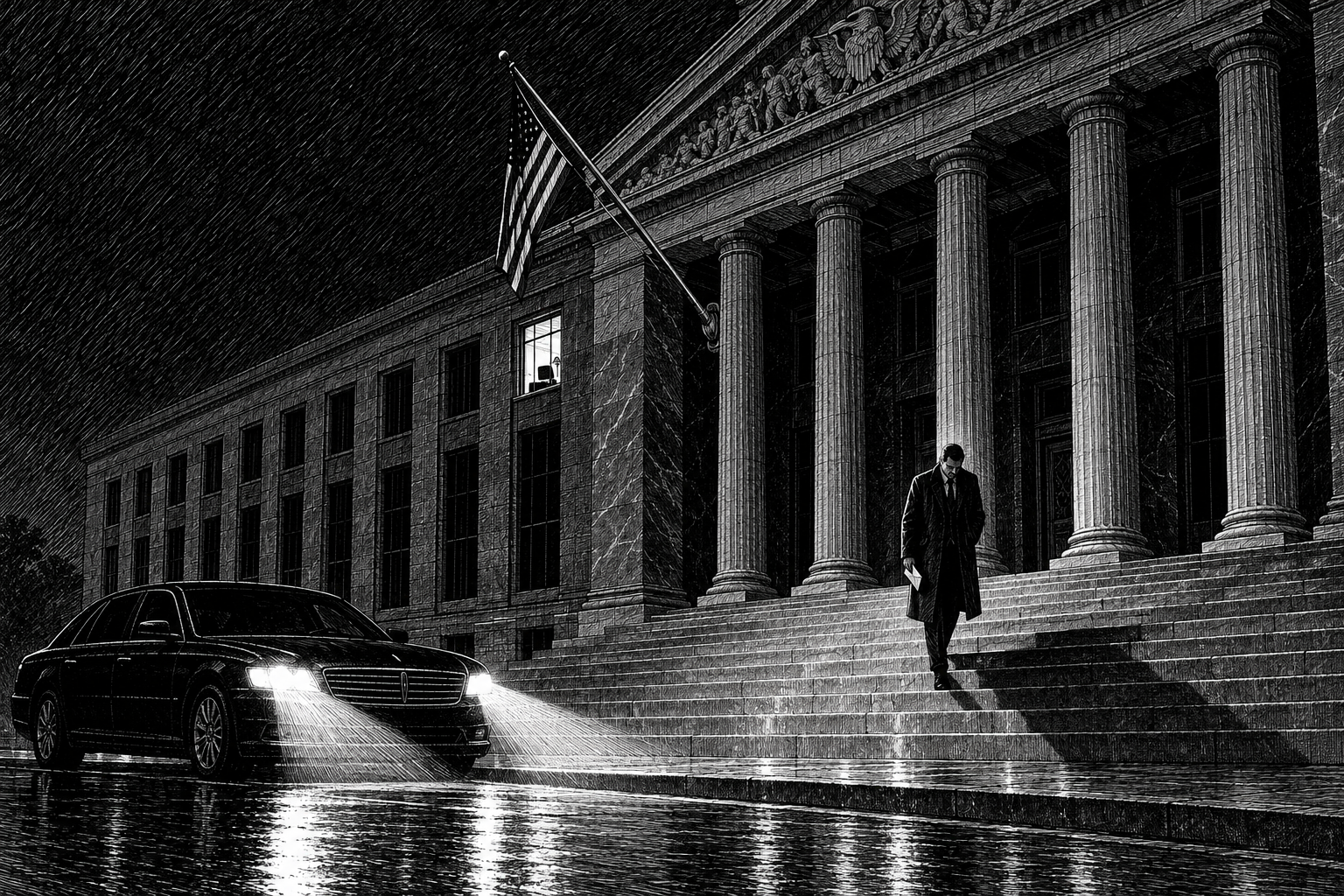
A black sedan idles at the curb outside a dark marble government building at night, headlamps throwing twin cones of light across wet pavement. A lone man in a long overcoat descends the building's broad stone steps, a single folded letter gripped in one hand, his face turned down and unreadable. Rows of tall windows rise above him, nearly all dark, one office lit on an upper floor. A flagpole leans at a diagonal against the pediment's columns. Heavy cross-hatching renders the night sky and the long shadow the car throws across the steps; thin parallel linework on the stone suggests rain-slicked granite. The scene is empty of other figures — just the man, the idling car, and the building looming over both.
The order itself took seconds to give. Fire Archibald Cox. The night before, Nixon had offered a compromise: let a half-deaf Mississippi senator summarize the subpoenaed White House tapes instead of releasing them outright. Cox, the Watergate special prosecutor, turned it down on the evening of October 19, 1973.1 So the next evening, Saturday, October 20, Nixon told Attorney General Elliot Richardson to fire Cox directly. Richardson said no, and resigned on the spot.12
Nixon didn't stop there. He turned to Deputy Attorney General William Ruckelshaus and gave him the same instruction. Ruckelshaus had made the same promise to Congress that Richardson had — that he wouldn't interfere with the special prosecutor absent real cause — and he refused too, resigning in protest. That left the Justice Department's third-ranking official, Solicitor General Robert Bork, as acting head of the department. Bork had made no such promise to anyone. He considered quitting afterward so as not to look like a man who'd done the president's bidding to save his job, but he stayed, got driven to the White House by limousine, and wrote the letter firing Cox himself.1
What makes the sequence more than Watergate trivia is the shape of it: three men, one order, two different definitions of what their job actually obligated them to do. Richardson and Ruckelshaus had each told a congressional committee, on the record, that they wouldn't do exactly this. Bork hadn't — so when the order reached him, there was no prior commitment standing between him and compliance. The dismissal held for about three and a half weeks before a federal judge ruled it illegal; by then the political damage was already done. A plurality of Americans favored impeaching Nixon within a week of that Saturday, his approval rating cratered to 27 percent, and he resigned nine months and twenty days later.1
Bork's reward for staying was a promise from Nixon of the next Supreme Court seat — a promise Nixon never got to keep. Reagan made good on it fourteen years later, in 1987, and the Senate killed the nomination anyway, in a fight bitter enough that "to bork" entered the dictionary as a verb. The institutional fix came faster: the Ethics in Government Act of 1978 exists because Congress decided no attorney general should ever again be able to fire a prosecutor investigating the president on nothing more than the president's say-so.1 The template proved durable enough to get reused: when seven Justice Department officials quit in February 2025 rather than execute an order to drop charges against New York's mayor, reporters quickly reached for the same name — the "Thursday Night Massacre."1
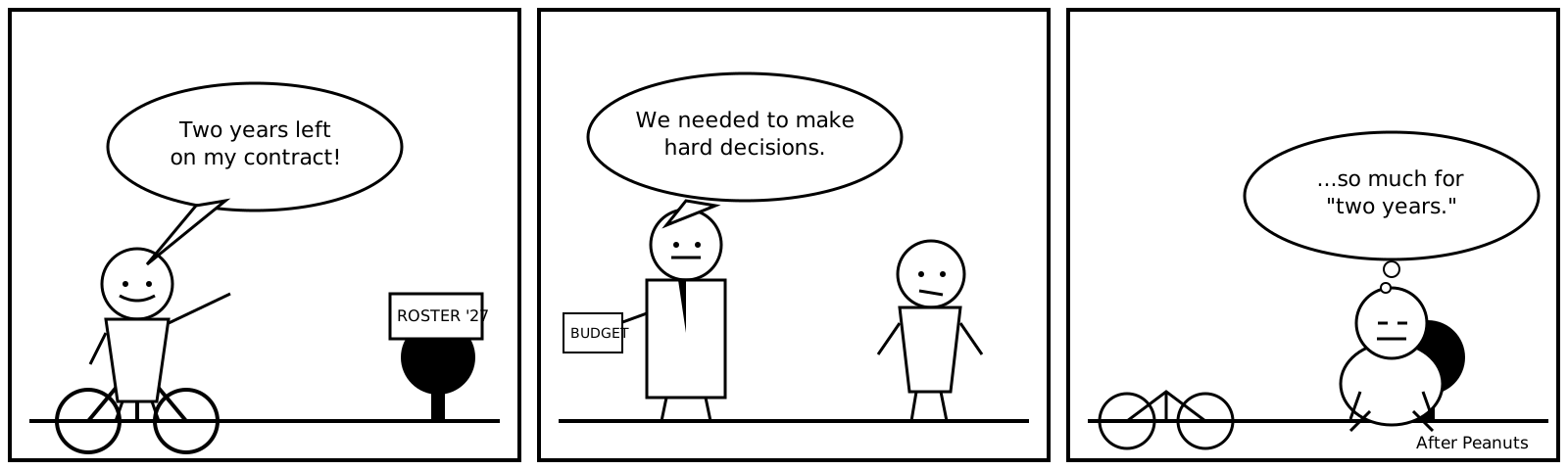
*After Peanuts — on a rider finding out, mid-contract, exactly how much a two-year deal is worth when the budget changes its mind. After Calvin and Hobbes — on asking a tireless companion to fix your code, and discovering the fix landed somewhere you didn't expect.*
A Leadville champion trades gravel for the road — Two-time Leadville 100 winner Melisa Rollins signed a two-year deal with EF Education-Oatly to race a road program in 2027, with the team's GM saying it's still unclear what kind of road racer she'll become. escapecollective.comOct 19, 2026
Movistar's head of racing reportedly doesn't survive his first year — Matt White, who joined Movistar's staff at the end of 2025 after a long stint with Jayco-AlUla, is reportedly out along with sports director Max Sciandri, with Giovanni Visconti reportedly incoming from Jayco as a new sports director. escapecollective.comOct 19, 2026
The Tour de France's Edinburgh opening ceremony will cost you £27 and up — Roughly 9,000 tickets go on sale for the 2027 Tour's Edinburgh Castle team presentation, produced with the Royal Edinburgh Military Tattoo; priority pre-sale opens Friday, general sale Oct. 30. cyclingweekly.comOct 20, 2026
Canyon-SRAM gets a new name after its crypto sponsor vanished — The women's WorldTour team will race as Canyon-SRAM Scalable Capital in 2027, elevating the German digital bank from secondary backer to title sponsor after May's contract termination with zondacrypto, which shut its own website down in April. cyclingnews.comOct 20, 2026
Hong Kong's CTF registration closes today — HKCERT's October newsletter flags that registration for its seventh annual Capture The Flag contest — free entry, open to all local and international participants across four categories — closes Tuesday, October 20. hkcert.orgOct 2026
A Promise to Congress Held in 1973. A Contract Didn't Survive a Budget Review in 2026.
Yesterday, Jonathan Vaughters told Escape Collective exactly why EF Education-EasyPost let Richard Carapaz go with two years still on his contract: budget, not form.1 That contract was supposed to be the thing standing between Carapaz and exactly this outcome. It didn't do the job. The question worth carrying past the transfer-window noise isn't whether EF had the right to release him — they clearly did, or Vaughters wouldn't be explaining it on the record instead of defending it in court. It's what a multi-year contract is actually built to survive, and what it isn't.
Contracts are written to absorb the contingencies both sides can name in advance: injury, form, a rival team's bigger offer. A sponsor's budget tightening is different — it isn't a breach of the agreement, it's the agreement's owner deciding the agreement costs more than it's worth. Nothing in the document stops that, because nothing could; the clause that would need to exist is "we will keep paying you even when we'd rather not," and no employer signs that clause voluntarily. A contract protects you from the other side changing its mind about you. It does very little when the other side changes its mind about itself.
Fifty-three years ago today, three men got the same order from Richard Nixon — fire Archibald Cox — and only two of them had actually promised anyone, on the record, that they wouldn't.23 Elliot Richardson and William Ruckelshaus had each told a congressional committee that they would not interfere with the Watergate special prosecutor without real cause. When the order came, that promise is what they had to break to comply — so they resigned instead. Robert Bork had made no such commitment to anyone, so when the order reached him, there was nothing standing in the way, and he carried it out.
That's the distinction a private-sector contract doesn't have: a public promise, made to a third party with the standing to call you on it later, costs something specific to break. Richardson's resignation wasn't abstract integrity — it was the concrete, narrow cost of violating one sentence he'd said to Congress on the record. Carapaz's contract was just as specific on paper, but it was a promise between two private parties, and when one of them decided it preferred a cheaper roster, there was no third party in the room to make reneging expensive.
Elsewhere in today's edition, a programmer writes about a third kind of arrangement, the weakest of the three: not a contract, not a sworn promise, just an assumption — that a skill would stay scarce enough to keep mattering. Nobody signed anything. Nobody testified to anything. So when the scarcity evaporated, there was nothing to point to, no clause breached, no oath broken — just a quiet discovery that the thing holding the arrangement together was never actually anyone's commitment at all.
Line those three up and the hierarchy is uncomfortable: the explicit public promise held because breaking it had a named cost to a named party. The explicit private contract bent because its only enforcement mechanism was the goodwill of the side that happened to be losing money. The unspoken assumption didn't bend so much as dissolve, because it was never a commitment anyone could be held to in the first place. Worth asking, before you lean on any arrangement to protect your position tomorrow: which of the three it actually is.