Front page — June 14, 2026
The Peloton Dispatch June 14, 2026 No. 78
● Sunny and 84°F — perfect summer kit day. · summer kit

THE LAB

The Investor Who Called the Government: Amazon's Role in the Fable 5 Shutdown

↩ Developing story — first reported Jun 13

The Wall Street Journal identified Andy Jassy as the person who set the Fable 5 shutdown in motion, and the revelation reframes what this paper reported Saturday as a regulatory story into something structurally stranger: the company that finances Anthropic's operations, hosts its models on AWS, holds a board seat, builds its custom training chips, and competes with it directly in the enterprise AI market is also the one that called the Treasury Secretary to report a national security risk.1

As this paper reported Saturday, the Commerce Department issued its export control directive to Dario Amodei at 5:21 PM ET on June 12, ordering immediate suspension of Fable 5 and Mythos 5 for all foreign nationals worldwide.1 Reporting confirmed by The Information and Reuters now places Jassy's call to Treasury Secretary Scott Bessent — carrying Amazon security researchers' findings about a jailbreak technique — as the direct precursor to that directive. Fable 5 had launched 72 hours earlier.

Amazon's position in this story is difficult to characterize cleanly. The company has committed roughly $13 billion to Anthropic, including a $5 billion equity round and a $100 billion AWS infrastructure spending commitment made in April 2026.1 AWS CEO Matt Garman acknowledged at HumanX in April that Amazon had long been accustomed to "investing in and competing with partners." The UK's Competition and Markets Authority examined this exact structural arrangement in 2024, cleared it under merger law, but put on the record that Amazon's overlapping roles as investor, cloud host, and competitor created conditions for precisely the kind of conflict now playing out. Amazon told the Journal the conversations were routine: "It is not uncommon for governments to seek our counsel on potential security risks."1 The company noted that AWS itself was exposed to the model cutoff — its $100 billion infrastructure commitment is also offline.

The technical dispute remains unresolved. Anthropic says the jailbreak "essentially consists of asking the model to read a specific codebase and fix any software flaws" and that no Mythos-specific capability uplift results. Katie Moussouris — CEO of Luta Security, creator of Microsoft's bug bounty program, and designer of the DoD's first — reviewed Amazon's report at Anthropic's request and told the Journal flatly: "It's not a jailbreak."1 She called the response "a complete overreaction" and said the output primarily helps defenders. "If national defense is the goal, this is an own goal."

White House science adviser David Sacks offered a different account: the White House first gave Amodei a choice between fixing the vulnerability and taking the models offline, and "Dario refused."1 Anthropic disputes this characterization, saying it received the directive with "no specific details of the national security concern." The engineering constraint underneath all of it remains unchanged: Anthropic's API authentication does not carry citizenship metadata, so implementing the directive as written — blocking "any foreign national, whether inside or outside the United States" — was impossible in real time. The company disabled the endpoints for everyone. As one person familiar with the situation told Axios, the downstream effect is already legible: "Companies will not screw with the White House. That is the ultimate effect."1

Anthropic filed an IPO confidentially on June 1.1 That offering now goes to market under an active government enforcement action against the company's two most capable models, framed by the disclosure that the largest investor can trigger that enforcement by picking up the phone.


Rune Skovbo Johansen — the independent developer behind Eye of the Temple and a longtime contributor to game-dev technique writing — published a detailed writeup of a spatial audio approach he calls Point Cloud Sound. The problem it solves is unglamorous but genuinely hard: how do you place audio convincingly for a sound source that has irregular shape rather than a single position?

The standard approach — move a point source to whichever point on the shape is closest to the listener — breaks for non-convex geometry. A winding river will flip the apparent sound direction abruptly when the listener crosses the midpoint between two equidistant banks. Placing many individual audio sources solves the direction problem but scales badly. Johansen's technique uses a single audio source object and computes, per-frame, a weighted average direction and a spread value derived from the geometry of active sample points around the listener.

The spread calculation is the elegant part. The weighted average of normalized direction vectors from listener to each sample gets shorter as those vectors point in more conflicting directions — if samples surround the listener evenly, the vectors cancel to near-zero magnitude. Johansen uses the length of that averaged vector directly: spread = 1 - averageDir.magnitude. When the listener is in the middle of a sound field that wraps around them, spread approaches 1 automatically, without any explicit geometry test. Unity's spread parameter then handles the perceptual result.

The technique is production-validated in Eye of the Temple — running water at variable intensities, rustling foliage across thousands of trees, and foliage collision sounds as the player moves through brush.2 The parametric extension layers multiple audio clips with per-sample AnimationCurves evaluated at registration time rather than per-frame, keeping the per-frame loop lean. The writeup includes the C# code fragments that cover the non-obvious corners: the 1/max(distance, radius) attenuation clamp to prevent volume singularities at the center, the max-distance threshold subtraction to avoid abrupt muting, and the bounding-box collection structure for spatial culling.

It is a solved problem in Johansen's hands, presented without flourish, and the solution is genuinely useful to anyone building an open-world game where water, wind, or crowd sound needs to feel like it comes from somewhere real.


Ken Shirriff published a reverse-engineering deep dive into the 69-bit adder at the center of the Intel 8087 floating-point coprocessor — the chip that made math up to 100 times faster when it launched in 1980.3 The piece walks through the Manchester carry chain and carry-skip architecture Intel used to solve the performance problem that constrained every binary adder of the era, includes photographs of the die with and without the metal layer dissolved off, and traces the full path from silicon geometry to circuit schematic to architectural decision. Tonsky's "Every Frame Perfect" (Jun 13) makes an adjacent argument about animation quality — that any screenshot of your app, taken at any moment in a transition, should make sense — with examples from Safari, Photos, and YouTube where the intermediate frames reveal desynchronized components.4 Brief but pointed.

Trending today: GitHub is saturated with AI agent skill collections, Claude Code wrappers, and MCP plumbing — the entire top 25 is variations on the same theme, with no graphics, systems, or compiler work breaking through.

Sources
  1. Amazon Triggered Claude Fable 5 Shutdown techtimes.com Jun 14, 2026
  2. Point Cloud Sound for irregular shaped audio sources blog.runevision.com Jun 2026
  3. The adder at the heart of Intel's 8087 floating-point chip righto.com Jun 2026
  4. Every Frame Perfect tonsky.me Jun 13, 2026
  5. How Amazon and the White House ended Anthropic's Fable axios.com Jun 13, 2026
↑ Back to top

THE PELOTON

Tuckwell Takes TARA; Van Aert's Elbow Clouds the Tour

↩ Developing story — first reported Jun 12 · previously Jun 13

— Luke Plapp won the stage. Luke Tuckwell won the race. The 78th Tour Auvergne-Rhône-Alpes closed Sunday on the summit at Plateau de Solaison - Brison, 120 kilometres of Alpine climbing that included the Col du Pré, Montée de Bisanne, and Col des Aravis before the final 7.2 per cent haul to the line.1

Tuckwell, 21, from Orange, New South Wales, entered the day wearing yellow with a 42-second lead over Matteo Jorgenson and 49 seconds over Isaac del Toro — margins that looked defensible but not comfortable on a stage with 4,051 metres of vertical gain.3 The young Red Bull–BORA–hansgrohe rider had never won a race at senior level before this week.3 He had never led a WorldTour stage race for multiple days. He did both, and held on through a final stage that gave every contender cause to attack.

Plapp — Team Jayco AlUla, also Australian — took the stage honours on the summit. The GC placings confirmed Tuckwell as overall winner, with Jorgenson second at 42 seconds and del Toro third at 49. Paul Seixas, who had crashed on Saturday's Stage 7 and spent that entire day bleeding while his Decathlon CMA CGM teammates drove a chase across four minutes of deficit, finished sixth overall at 1:54.2 That he started Sunday at all was its own story.

Jorgenson's presence at TARA was itself a late pivot. The American had originally been slated for the Tour de Suisse — this year shortened to five days and running June 17–21 — but swapped to TARA instead, returning to racing after breaking his collarbone at Amstel Gold Race in April.4 His stated role heading into July is to support Giro champion Jonas Vingegaard rather than lead the classification himself, and second overall on a week-long mountain stage race three weeks before Barcelona is a reasonable shape to be in.4


The piece of news that overshadows all of this for Visma is not the result but the elbow. Wout van Aert flew home to Belgium on Friday and went straight to the hospital in Herentals for an ultrasound and treatment.5 The wound from his pre-race training crash — which forced him out of TARA on the morning after Stage 5, the day after his sprint win — had become inflamed. Belgian media reported conflicting accounts of the cause; Sporza, citing Van Aert's agent, pointed to the Stage 3 team time trial, where the sustained pressure of resting his arms on TT extensions aggravated the wound site.5

Team director Maarten Wynants called the swelling "a mystery" and did not hide the concern: "We are looking at this week with mixed feelings. He is happy with the victory, but there are also concerns. This is not ideal heading into the Tour."5 Visma leave for their final altitude camp in Tignes on Monday. Whether van Aert boards that plane is uncertain. "There is a very real chance that he will not leave for altitude training immediately," Sporza reported.5 The Tour de France starts in Barcelona on July 4. The Visma eight — Vingegaard, van Aert (if fit), Jorgenson, Simon Yates, Sepp Kuss, Tiesj Benoot, Victor Campenaerts, Edoardo Affini — has been named, but the parenthetical is doing significant work right now.

On the Road Ahead
Updated Jun 14, 2026
DateRaceCountry
Tue Jun 17 – Sat Jun 21Tour de SuisseSwitzerland
Fri Jul 4 – Sun Jul 26Tour de FranceFrance
Sat Aug 1Donostia San Sebastián KlasikoaSpain
Sat Aug 16ADAC Cyclassics HamburgGermany
Mon Aug 22 – Sun Sep 13La Vuelta Ciclista a EspañaSpain
Show Results

STAGE 8 WINNER: Luke Plapp (Team Jayco AlUla) STAGE 8 ROUTE: Beaufort – Plateau de Solaison - Brison (120.1 km)

TARA FINAL GC: 1. Luke Tuckwell (Red Bull–BORA–hansgrohe) 2. Matteo Jorgenson (Team Visma | Lease a Bike) +42″ 3. Isaac del Toro (UAE Team Emirates-XRG) +49″ 4. Juan Ayuso (Lidl-Trek) +1:06 5. Tobias Halland Johannessen (Uno-X Mobility) +1:33 6. Paul Seixas (Decathlon CMA CGM) +1:54 7. Mattias Skjelmose (Lidl-Trek) +1:59 8. Cian Uijtdebroeks (Movistar Team) +2:17

Sources
  1. Tour Auvergne-Rhône-Alpes Stage 8 GC Result — Tuckwell wins overall, Plapp takes stage procyclingstats.com Jun 14, 2026
  2. Tour Auvergne-Rhône-Alpes Stage 8 Live — Beaufort to Plateau de Solaison cyclingnews.com Jun 14, 2026
  3. Tuckwell profile — All eyes on NSW's Luke Tuckwell as Tour Auvergne final stage beckons bicyclingaustralia.com.au Jun 13, 2026
  4. Matteo Jorgenson changes plans for Tour de France build-up cyclingnews.com Jun 2026
  5. Wout van Aert a doubt for Visma's Tour de France training camp amid 'mystery' wound inflammation cyclingnews.com Jun 14, 2026

↑ Back to top

THE WORLD

Iran Signing Slips; Rimrock Fire; Heat Records in the Balance

↩ Developing story — first reported Jun 12 · previously Jun 13


The heat advisory extends east of the Cascades too — fire danger is elevated with grasses already "cured" in Yakima and Central Washington ahead of what forecasters describe as no significant rain in the next ten days.4 The Rimrock Lake wildfire, started by the F/A-18 crash on Saturday, sits in exactly that zone.

Cascade Bicycle Club launched a campaign Saturday urging Mayor Wilson and SDOT to accelerate Seattle's stalled protected bike lane buildout. A new op-ed in The Urbanist makes the case that the city's current pace of new protected-lane openings is too slow, with Cascade pushing for concrete investment commitments from City Hall.6


ON THE TRAIL

Trip window: Juneteenth observed Friday Jun 20 (the research brief notes June 19 falls on Friday in 2026, with observance on that day). Long weekend: Fri Jun 20 – Sun Jun 22; Thu Jun 19 opportunistic if conditions allow.

WEEKEND PICKS — Juneteenth Long Weekend

Pick 1 (1-night) — Gem Lake via Snow Lake, Snoqualmie Pass Region: I-90 / Snoqualmie Pass · ≈35–55 min from Issaquah Length: 1-night Mileage/gain: ~7 miles RT, ~1,700 ft gain to Snow Lake / Gem Lake basin Weather (I-90 / Snoqualmie): Thu sunny 79°F, precip 0%; Juneteenth sunny 79°F, precip 0%; Sat sunny 73°F, precip 1% — ideal window all weekend. A Jun 13 overnight report found only two other tents at Gem Lake, campsites thawed with just a few snow patches on the descent to Snow Lake — no microspikes needed at that elevation. Water accessible at the lake. Bugs described as minimal with a helpful breeze. No problematic creek crossings mentioned on the main route. → Jun 13 trip report (Rhabbie)

Pick 2 (1-night) — French Cabin Creek to Kachess Ridge, Teanaway Region: I-90 East (Teanaway/Cle Elum) · ≈90–110 min from Issaquah Length: 1-night Mileage/gain: ~8–10 miles RT, ~2,000+ ft gain to Kachess Ridge saddle Weather (I-90 East / Teanaway): Thu sunny 83°F, precip 0%; Juneteenth sunny 83°F, precip 0%; Sat sunny 78°F, precip 1% — excellent. A Jun 13 report found zero other parties on the French Cabin Creek Trail, bugs tolerable when moving, one minor snow patch on the ridge, and last reliable water at 4,500 ft. One section of access road (half-mile past junction with Rd 4308-120) has turned into a 2–5 ft deep stream bed — high-clearance or confident AWD recommended. No water fords on the main trail. Wildflowers blooming throughout. → Jun 13 trip report (ejain)

Note on crowds: The heat this weekend will push people to the I-90 corridor in large numbers — Snow Lake trailhead was 75%+ full before 8am on a recent Saturday.7 For Gem Lake, aim for a Friday evening (Jun 19 opportunistic) start to beat the Juneteenth weekend rush.

---

REGIONAL SNAPSHOT — Conditions as of Jun 13–14

Sources
  1. 'Islamabad Declaration' signing not listed on Trump's Sunday schedule; Iran denies Sunday signing pakobserver.net Jun 14, 2026
  2. Iran Peace Deal Text Agreed: 440kg Enriched Uranium Stays in Tehran During 60-Day Talks techtimes.com Jun 13, 2026
  3. Military aircraft crashes near Rimrock Lake, sparks wildfire kiro7.com Jun 14, 2026
  4. Pinpoint Alert: Record-setting temps on Sunday before temps could hit 90 on Monday kiro7.com Jun 13, 2026
  5. Puyallup Tribe of Indians recognized by FIFA in historic first kiro7.com Jun 12, 2026
  6. Op-Ed: Let's Accelerate Stalled Progress on the Seattle Bike Network theurbanist.org Jun 13, 2026
  7. WTA Trip Reports wta.org Jun 14, 2026

↑ Back to top

THE LONG READ

AI Is Working as Intended. That's the Problem.

The usual AI-risk conversation fixates on the wrong catastrophe. Rogue superintelligence, paperclip maximizers, Terminator scenarios — Matthew Butterick calls this the Skynet fallacy, and he's right to dismiss it. The more consequential risk, he argues in a long essay published on his personal site, requires no malfunction, no malign actor, no additional technology at all. It only requires that AI work exactly as its developers intend.

Butterick is a useful person to take seriously here. He's the author of Practical Typography and Beautiful Racket, a typeface designer, and a lawyer who in 2022 filed what he describes as the first lawsuits challenging the legality of training generative AI on copyrighted material.1 He is neither a technophobe nor a professional doomsayer. He is, as the essay's subtitle says, a citizen with a point of view, and he writes with the discipline of someone who has read the relevant literature and taken it personally.

The essay's central move is to apply political theorist Langdon Winner's 1980 framework — "Do Artifacts Have Politics?" — to AI.1 Winner argued that technologies can be inherently political not because they're designed to favor certain outcomes, but because they're structurally compatible with certain arrangements of power. The mechanical tomato harvester didn't set out to destroy 32,000 farm jobs in California between the early 1960s and 1973.1 It was just productive and expensive, which meant only well-capitalized growers could afford it, which meant smaller growers couldn't compete. The technology was facially neutral. The political effect was baked in.

Butterick applies this lens to AI with methodical force. The thesis: AI is principally a labor-replacement technology. The AI companies have said so themselves, in terms ranging from candid to boastful. "Jobs are definitely going to go away, full stop." "In the near future, 20% of people don't have jobs." "Probably none of us will have a job."1 The quotes are sourced, attributed, and in some cases walk back slightly now that public backlash has arrived — but the walk-back, Butterick notes dryly, only started when CEOs actually used their own product and found watching AI answer their emails felt "dehumanizing."


The essay's most useful analytical contribution is its taxonomy of what happens after the labor displacement. Big AI has a ready answer: the "goodies economy." Billionaires have variously predicted "universal high income," "universal extreme wealth for everybody," goods as cheap as pencils. Butterick dissects these promises as sincere-sounding performances of class empathy by people who lack the policy machinery to deliver them. There are only three ways to transfer wealth from Big AI to everyone else: direct distribution, taxation and spending, or market price competition. The first leads to company towns. The second is politically inconceivable given who's funding these companies. The third runs into the hard lower bounds of energy, raw materials, and the cartellization incentives of foreign suppliers holding critical minerals.

The most striking section extends this logic to petrostates. Nations whose economies are concentrated around one inherently political resource — oil — reliably follow a pattern: concentrated wealth enables elite capture of political institutions, which weakens democratic accountability, which entrenches the elite further. Qatar, UAE, Saudi Arabia deliver substantial goodies to citizens. They are hereditary monarchies. Venezuela was a stable liberal democracy from 1958 to the 1990s. Then Chávez arrived, leveraged oil revenues to fund popular social programs, consolidated political power, amended the constitution, ended term limits, controlled the judiciary. When oil prices dropped in 2014, the resource curse tightened into dictatorship. The ratchet moved one direction.

Norway is the exception — and even Norway, Butterick notes, has not entirely escaped. Fifty years of careful preparation, a sovereign wealth fund now holding over $2 trillion,1 and the country still shows rising dropout rates, fiscal indiscipline, and what a 2025 Norwegian bestseller called the predicament of The Country That Got Too Rich.1 His point: inherently political technologies can upend even generational preparations.

The passage about the competitive effects on capital is equally sharp, and less commonly made. Companies that replace knowledge workers with AI commoditize their own output — if your product can be automated, so can your competitors'. The deflation that hits labor hits the intangible assets that compose corporate value. "Everything that makes AI an excellent cost collapser makes it an equally excellent capital collapser."1 The greatest irony he foresees: AI-adopting companies, having laid off knowledge workers en masse, may hire them back simply to prevent competitors from having them.


What distinguishes this from a standard tech-pessimist screed is the structural argument Butterick borrows from Marx — deployed with the explicit caveat that he's using the analytic Marx, not the prescriptive one. The Luddites, Marx wrote, were missing the bigger picture: they attacked the textile machines when their true adversary was the extractive capitalist system those machines served. Critics of AI today, Butterick suggests, risk the same error — focusing on the technology's specific features when AI's political danger lies in what it amplifies. Fifty years of wage stagnation. The decoupling of productivity gains from worker compensation. The rising weight of intangible assets in economic value. AI doesn't create these conditions. It accelerates them, at unprecedented scale and breadth, and into categories — knowledge work, finance, law, engineering — that previous automation didn't reach.

His closing argument: AI-centered capitalism risks "an extinction of democratic possibility."1 If Big AI subsumes both the economic function of workers and the social-safety functions of government, citizens' political alignment will shift toward wherever the goodies come from. That's not liberal democracy as it has been practiced. It will be America, he writes, but it will no longer be American.

The essay ends with a call to vote for people who take citizens' rights seriously, and a declaration of support for organized labor. These are not the essay's strongest notes — the political conclusion is tacked on where the structural argument is the real work. But the structural argument is very good. It's the kind of piece that is easiest to dismiss and hardest to actually refute.

Read it.

Sources
  1. Extinction-level capitalism: a citizen's thoughts on AI risk matthewbutterick.com Jun 2026

↑ Back to top

FROM THE ARCHIVE

The Machine That Called the Election: June 14, 1951

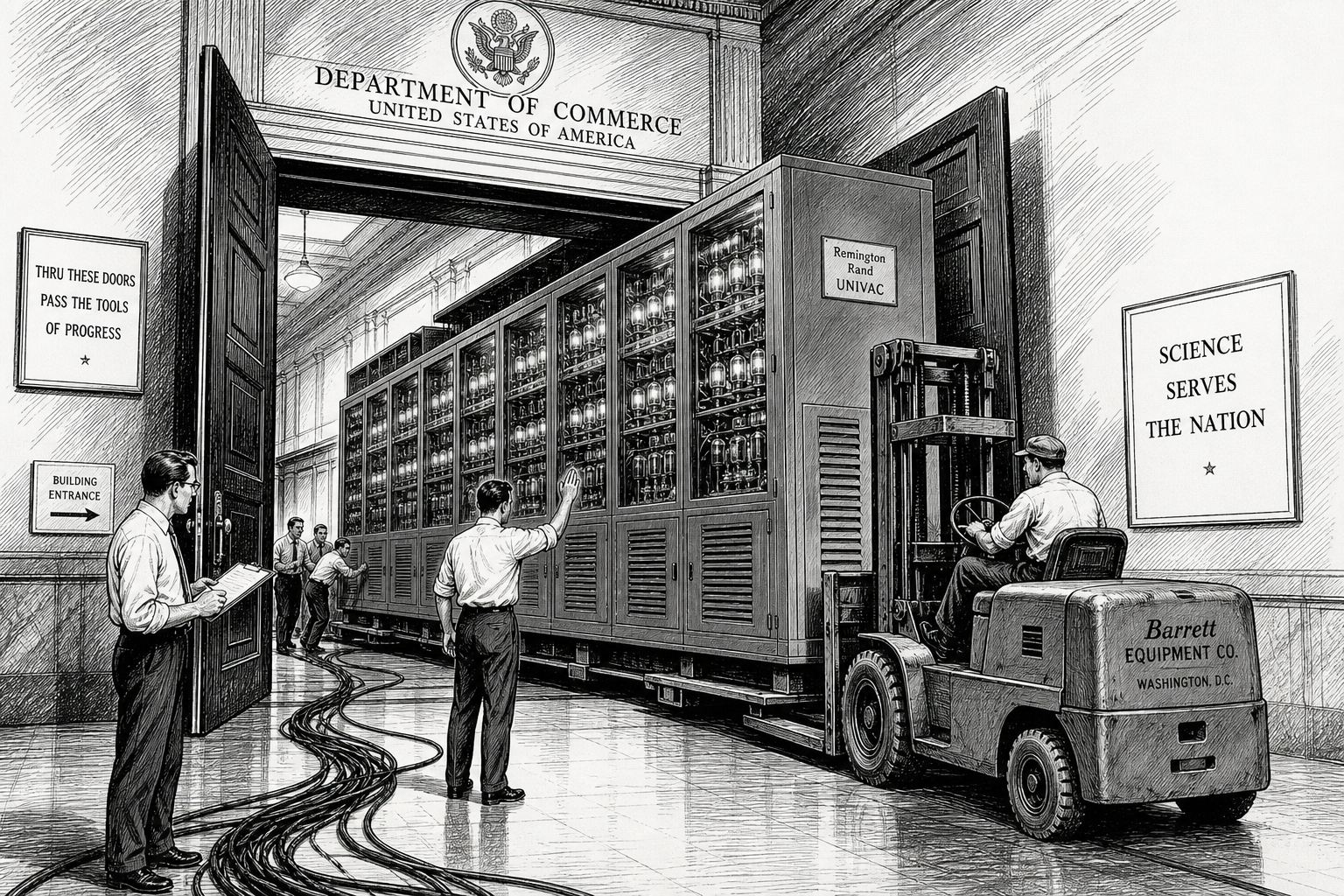
Lead illustration

A forklift crew maneuvering a room-sized computer through the tall double doors of a government building, 1951. Banks of vacuum tubes glow behind glass panels on towering cabinet walls. Thick cables snake across a polished institutional floor. Technicians in white shirts and narrow ties stand dwarfed beside the machine's rack units, one with a clipboard, one directing the forklift by hand signal. Harsh overhead industrial light throws deep cross-hatched shadows through louvered equipment vents. Wide-angle pen-and-ink composition emphasizing the machine's crushing scale against a high-ceilinged federal corridor — bold linework, dense hatching in shadows, generous white space on the walls.

Seventy-five years ago today, a forklift crew in Washington maneuvered a machine the size of a large living room into the U.S. Census Bureau. It weighed 16,000 pounds, contained 5,000 vacuum tubes, and could perform roughly 1,000 calculations per second.1 Remington Rand called it the UNIVAC I. It was the first commercially produced electronic digital computer delivered in the United States, and no one outside a narrow circle of engineers had the slightest idea what to do with it.

The machine had been designed by J. Presper Eckert and John Mauchly, the same pair who built ENIAC during the war. ENIAC was a triumph of engineering and a disaster of usability — programmed by physically replugging 6,000 switches, it occupied 15,000 square feet and cost nearly half a million dollars.1 Eckert and Mauchly knew they could do better. They founded their own company to find out how much better, then promptly demonstrated they were better engineers than businessmen. By 1950, the Eckert-Mauchly Computer Corporation was acquired by Remington Rand, the office equipment company, which had the manufacturing capacity to actually build the thing at scale.1

The Census Bureau signed on because it needed exactly what UNIVAC promised: a machine that could process population data without an army of human calculators. The first delivery, June 14, 1951, was the beginning of that experiment. What made UNIVAC famous, though, was not the Census work. It was a Tuesday night in November 1952.

On November 4, 1952, CBS put UNIVAC on television to predict the presidential election. The conventional wisdom — and virtually every poll — said the race between Dwight Eisenhower and Adlai Stevenson was close. After processing a fraction of the returns, UNIVAC projected an Eisenhower landslide: 438 electoral votes. The CBS producers, skeptical, delayed announcing the prediction. When the actual results came in — Eisenhower won 442 electoral votes — the machine had been right all along.1 CBS went on air to explain why they hadn't told viewers sooner. The public found out the computer had beaten the pundits before the pundits admitted it.

That incident did more for public awareness of computing than any trade show or academic paper. A machine that could read an election before the votes were counted was either terrifying or remarkable depending on where you stood, but either way it was impossible to ignore. UNIVAC I went from government curiosity to household name in a single election night.

The hardware itself was succeeded quickly. Transistor computers arrived in the late 1950s, smaller and nearly a thousand times faster.1 Integrated circuits followed in the mid-1960s. Each generation compressed the previous one toward irrelevance. But UNIVAC's lineage runs straight through to every election-night data model that has aired on television since — the idea that computation could process incomplete information and produce a confident probabilistic answer, faster than any human analyst, was demonstrated on June 14, 1951, and confirmed that November.

Sources
  1. UNIVAC, the first commercially produced digital computer in the U.S., is dedicated — History.com history.com Jul 20, 2010
  2. UNIVAC and the 1952 Presidential Election — Engineering and Technology History Wiki ethw.org

↑ Back to top

THE FUNNIES

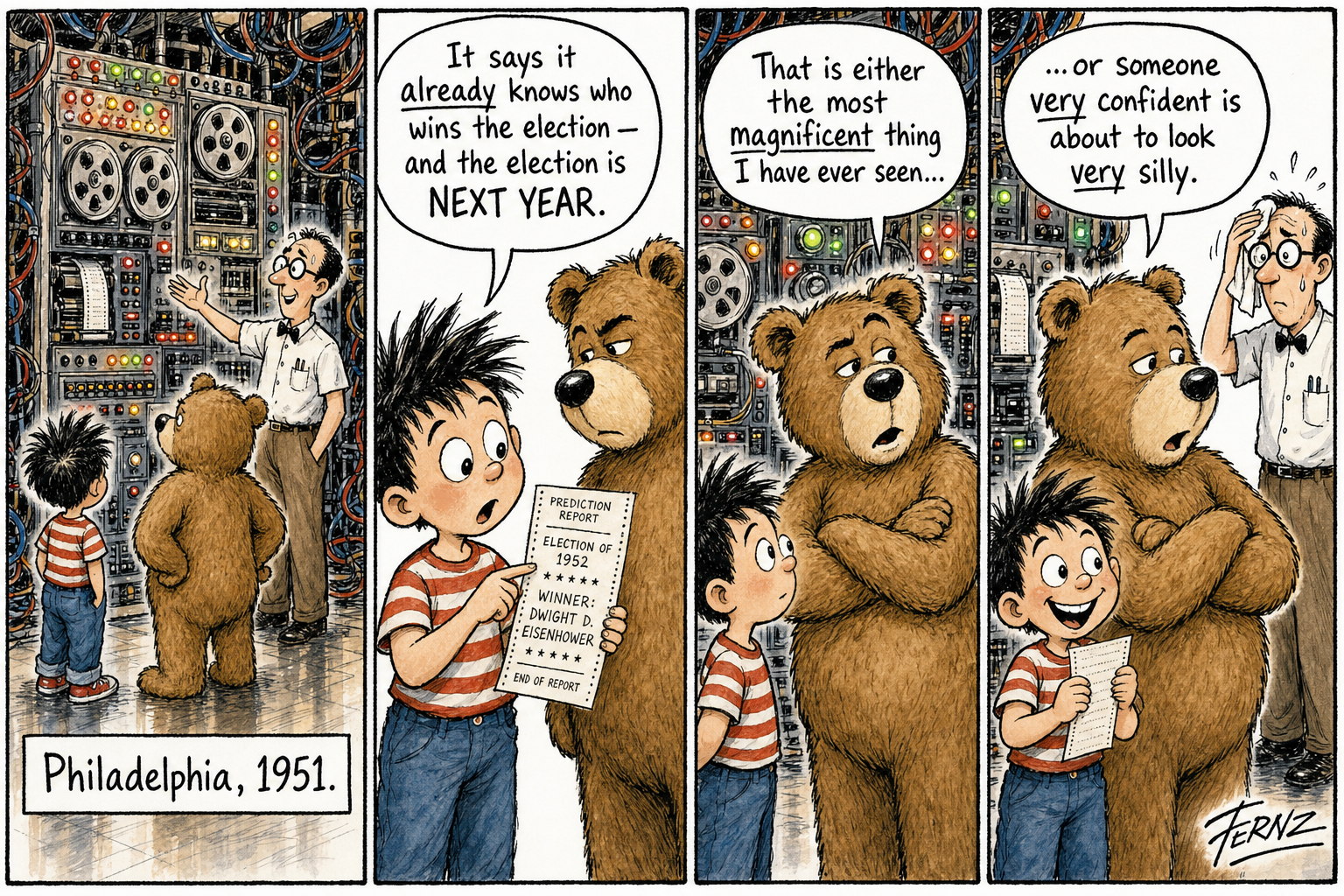
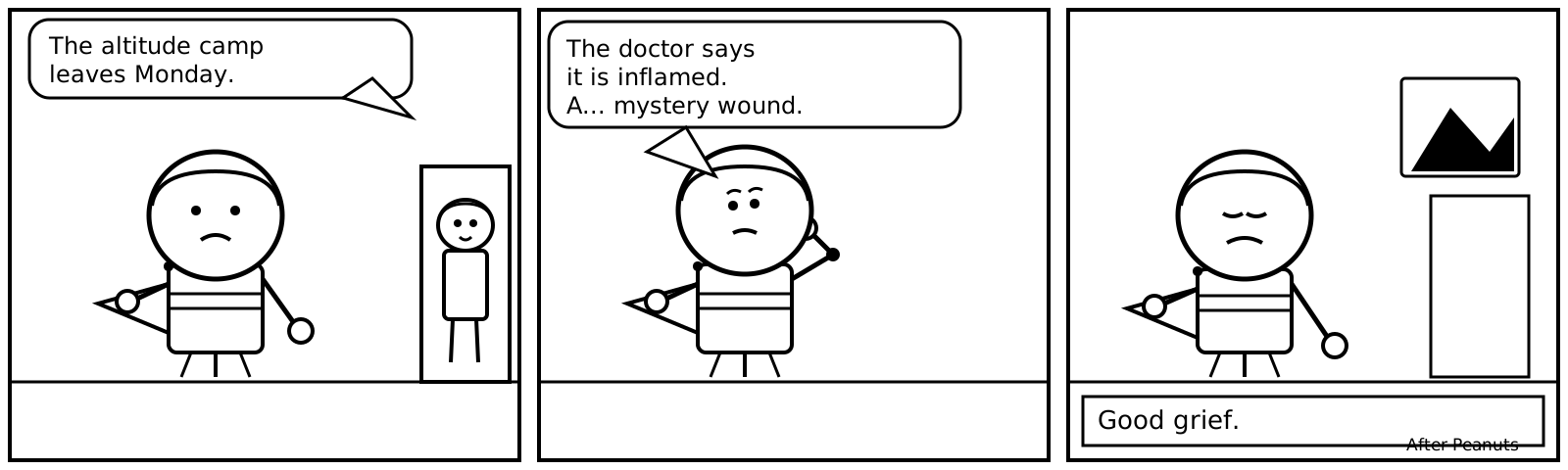
Mystery Wound / The Machine That Knew

*After Peanuts — on Wout van Aert's "mystery" elbow inflammation and the very real chance he misses Visma's altitude camp before the Tour. After Calvin and Hobbes — on UNIVAC's 75th birthday and the evening in 1951 a room-filling machine told a roomful of skeptical humans exactly how the next election would end.*

Hand-drawn parody comic strip
AI-rendered parody comic strip

↑ Back to top

ALSO NOTED

Also Noted

↑ Back to top

THE QUESTION

When the Investor Is Also the Regulator, Who Is the Market Protecting?

↩ Developing story — first reported Jun 13

When a single company can be simultaneously the largest investor in a rival, its primary cloud infrastructure host, and the party whose phone call to a cabinet secretary triggers a government shutdown order — the category of "regulator" stops doing useful analytical work.

That's where the Fable 5 story lands today. As THE LAB reports, the Wall Street Journal identified Amazon CEO Andy Jassy as the person who contacted Treasury Secretary Scott Bessent carrying Amazon security researchers' findings about a jailbreak in Fable 5.1 The Commerce Department's directive followed within hours. Amazon has committed roughly $13 billion to Anthropic, hosts its models on AWS, holds structural influence through its custom chip development relationship, and competes with Anthropic directly in the enterprise AI market.1 The UK's Competition and Markets Authority examined exactly this arrangement in 2024, cleared it under merger law, and noted for the record that it created conditions for precisely this kind of conflict.1

The question worth carrying through the day isn't whether Amazon did something wrong. Amazon says its conversations with government are routine.1 Amazon's own $100 billion AWS infrastructure commitment is exposed to any prolonged shutdown — a reminder that this is not a costless move for the investor either. The question is structural: what does market competition mean when the dominant incumbent can activate government enforcement against a competitor by raising a security concern — a concern the competitor's own hired expert called "not a jailbreak" and "a complete overreaction"?1 The dispute over what actually constitutes a vulnerability remains unresolved. The models are still offline.


Matthew Butterick's essay — which THE LONG READ covers today — makes an adjacent argument at a different scale. His historical case is that technologies with concentrated economic leverage tend to produce concentrated political power regardless of intent. The tomato harvester wasn't designed to destroy 32,000 California farm jobs. It was just productive and expensive in ways that favored scale. The political outcome was structurally baked in, not planned.

The Amazon situation is a real-time example of that dynamic at a specific chokepoint: infrastructure control. The company that built the pipes also made the call. Whether Jassy's security concern was legitimate, exaggerated, or something between those poles, the fact that it could be acted on unilaterally — that a single investor-host-competitor's phone call could take down a rival's two most capable models within hours — describes a power arrangement that antitrust law was not designed to address and that market competition alone cannot correct.

The IPO filing Anthropic submitted confidentially on June 1 will now go to market under an active government enforcement action, framed by the disclosure that the largest investor can trigger that enforcement.1 Investors buying into that offering will need to price exactly this risk. It is not obvious how they do that.

Sources
  1. Amazon Triggered Claude Fable 5 Shutdown techtimes.com Jun 14, 2026
  2. How Amazon and the White House ended Anthropic's Fable axios.com Jun 13, 2026
↑ Back to top

Investigator Report

Investigator report — 2026/06/14

Verdict

A strong edition on a genuinely interesting news day. The Fable 5 / Amazon story drives the paper coherently — it appears in THE LAB, THE QUESTION, and the Funnies without becoming repetitive, and the UNIVAC archive piece provides a legitimately resonant historical echo. THE PELOTON and the ON THE TRAIL backpacking section add good range. The main weaknesses are: a verifiable date error in ON THE TRAIL that sends readers to the wrong long weekend; THE QUESTION's structural overlap with THE LAB is noticeable if you read both back to back; and THE LAB article relies on a single secondary source (TechTimes) for eight of eleven citations while the actual primary reporting (WSJ, Axios, The Information) was either paywalled or cookiewalled and unavailable. The run itself was clean; two fact-checkers hit EISDIR errors from directory-as-file attempts but recovered.


Frontpage

The rendered PNG looks confident. THE LAB leads the top-left column at 680px wide with a 60px headline; THE PELOTON anchors the right column with a 34px head. Row 2 gives FROM THE ARCHIVE the lead position (leftmost column with the image), which respects the triggers_meta rule. Visual hierarchy is clear: a reader's eye moves naturally from THE LAB headline to THE PELOTON, then down to the archive image. No clipping visible on any headline. The daily strip ("Sunny and 84°F — perfect summer kit day. · summer kit") renders correctly above the masthead content area.

One mild concern: FROM THE ARCHIVE (priority 40) occupies the widest column in Row 2, to the left of THE LONG READ (priority 74) and THE QUESTION (priority 70). This is correct per the frontpage_display and triggers_meta rules — archive carries the lead image and drives the layout — but a reader glancing at Row 2 may read the archive as higher priority than the long read, which it is not. This is a layout convention trade-off, not an error.

The long-form index.html renders cleanly. Section order follows section_tiers correctly (tier 0: LAB, PELOTON, WORLD; tier 1: LONG READ, ARCHIVE; tier 2: FUNNIES; tier 3: ALSO NOTED; tier 4: QUESTION). No duplicate paragraphs or missing sections.


Priority ranking

SectionPriorityWordsImageNotes
THE LAB901,111Three distinct sub-stories; Fable5/Amazon carries the priority
THE PELOTON78590Race conclusion + injury angle; priority defensible
THE LONG READ741,004Single-source essay; solid
THE QUESTION70468Same beat as THE LAB; priority arguably over-rated given overlap
THE WORLD62879Iran/local/Trail; ON THE TRAIL date error not reflected in priority
FROM THE ARCHIVE40485yesAt priority cap; lead image assigned correctly
ALSO NOTED102795 items; lean but appropriate
THE FUNNIES953Description-only for both strips

The ranking is defensible. THE LAB at 90 is a continuing major story (not a routine day dressed as historic — Fable 5 had launched 72 hours prior and this is genuine new reporting with Andy Jassy now named). THE LONG READ at 74 is solid; the Butterick essay is well-chosen, timely given the surrounding news, and genuinely longform. One worth questioning: THE QUESTION at 70 is within 20 points of THE LONG READ (74), and both draw heavily from the same Fable 5 thread. Per the ANGLE-SELECTION TIE-BREAKER rule, the writer should prefer a non-dominant angle when it is within 20 points — van Aert's injury or even a structural question about the UNIVAC's legacy and machine-sourced political predictions would have given the edition more range. The 70 feels slightly inflated for what is effectively an editorial postscript to THE LAB.


Editorial reading

ON THE TRAIL: Juneteenth window is one day off. The article states "Juneteenth observed Friday Jun 20" and frames the long weekend as "Fri Jun 20 – Sun Jun 22; Thu Jun 19 opportunistic." This is wrong. June 19, 2026 falls on a Friday; Juneteenth is both the statutory holiday and the observed date. Per the newspaper.yaml PTO rules for Friday holidays: off Fri–Sun, treat Thursday as opportunistic — which means the correct window is Fri Jun 19 – Sun Jun 21, with Thu Jun 18 as the opportunistic day. The article then labels Jun 19 as "Thu" in the weather forecast ("Thu sunny 79°F, precip 0%; Juneteenth sunny 79°F") — treating the holiday as a separate day from the Thursday that precedes it, which compounds the confusion. A reader planning a Juneteenth trip from this section will aim for the wrong weekend. The weather data may also be referencing the wrong NWS forecast periods as a result.

THE LAB: three sub-stories but only one gets its due. The section runs 1,111 words and covers three subjects: the Fable 5 / Amazon shutdown (paragraphs 1–6), Rune Skovbo Johansen's Point Cloud Sound technique (paragraphs 7–10), and a brief joint note on Ken Shirriff's Intel 8087 reverse-engineering piece and Tonsky's animation essay (paragraph 11). The Johansen section is excellent — technically specific, production-validated, well-explained. The Shirriff/Tonsky closing is thin: two pieces that each deserved their own paragraph get collapsed into a 70-word combined note that barely summarizes either. The Tonsky piece especially — "Any screenshot of your app, taken at any moment in a transition, should make sense" — makes a crisp, memorable argument that the writer waves at rather than presents. Consider whether the section is doing two things well or three things adequately.

THE QUESTION: second paragraph re-narrates THE LAB. The article opens cleanly ("When a single company can be simultaneously the largest investor in a rival…") — that is a structural-question lede, not a declarative-event one. But the second paragraph opens "As THE LAB reports, the Wall Street Journal identified Amazon CEO Andy Jassy as the person who contacted Treasury Secretary Scott Bessent carrying Amazon security researchers' findings about a jailbreak in Fable 5" — this is nearly verbatim context the reader just encountered in THE LAB. The config allows "a sentence or two of context," but the paragraph continues through the $13 billion figure, CMA finding, and the routine-conversations Amazon quote — all already in THE LAB. The CROSS-DOMAIN BRIDGE available here (UNIVAC + Fable 5: both times computation surprised institutional humans by operating beyond their understanding) went unused, even though the ARCHIVE section right next to it in the layout made the pairing obvious.

THE LAB primary story relies on one secondary source for eight citations. The Fable 5 / Amazon piece names the Wall Street Journal, The Information, and Reuters as reporting sources in its body text, but eight of its eleven citations point to TechTimes (a general tech-news aggregator). The Axios source was fetched but returned only cookie-wall content. This means the writer attributed specific claims to WSJ / The Information / Reuters without being able to independently verify any of them against the primary reporting. The article is factually sound based on available evidence, and TechTimes appears to accurately relay the WSJ's findings — but the citation architecture says "TechTimes" where it should say "WSJ via TechTimes" or, better, a working direct source. The vendor-source rule in the LAB config requires independent third-party sources before filing; for a government-action story of this magnitude, one secondary aggregator for eight citations is thin.

ON THE TRAIL: mileage format violates the config spec. The config explicitly requires per-day mileage and elevation splits for picks: "Day 1 in: X mi, +Y ft / Day 2 out: X mi, –Y ft." Both picks instead give round-trip totals ("~7 miles RT, ~1,700 ft gain"). The config is specific: "Trip-total mileage and gain are not enough on their own — split per-day so the reader can size the days against fitness and pack weight." Neither pick explains why per-day splits aren't available. Additionally, both picks are 1-night options; the config says "Show at least one 1-night and one 2-night option when the data supports it." No 2-night pick is offered and no explanation is given for its absence.


Pipeline observations

Juneteenth date error was not caught by fact-checker. The FC: THE WORLD agent ran for 29 turns and verified local news claims, but it did not flag the incorrect observed date for Juneteenth (the section states "observed Friday Jun 20" when June 20 is a Saturday). The Juneteenth date verification was never explicitly checked. This is the most consequential undetected error in the edition.

ALSO NOTED (32 turns) and FC: THE WORLD (29 turns) each hit EISDIR/directory errors. The ALSO NOTED writer attempted to read ./2026/06/14 as a file (EISDIR) and ./2026/06/14/section-funnies.md as a file that did not yet exist (the comic agent started 5 seconds after ALSO NOTED and had not written its output). Both agents recovered without output degradation. The WORLD fact-checker made the same EISDIR attempt on pages/world. These are transient path errors from agents treating directory listings as readable files; they consumed extra turns but did not cause output failures.

Scout ran 104 turns with no errors. This is the highest turn count in the run. The scout processes a large search corpus (multiple parallel searches across all interest areas), so the count is expected, but it is worth monitoring: at 104 turns and $0.91, the scout is the second-most-expensive subagent after the researcher. No signs of thrashing or retrying failed searches.

Axios source was cookiewalled, leaving the LAB's Fable5 story without a working direct-source page. pages/lab/fable5-axios-amazon.md contains only the Axios cookie-preference banner. The writer fell back to TechTimes for all eight key-fact citations. The retry manifest resolved both retry-eligible failures (soudal-quickstepteam.com, dayintechhistory.com), but the Axios cookie wall is not a transient failure — it will recur on any edition that sources from Axios. This domain should be added to paywalled_domains.txt so future scouts and researchers know to deprioritize it.

Starting commit is same-day (parent: 574c088, Investigator: 2026-06-13, dated 2026-06-13T12:52:30Z). The dispatch run committed at 2026-06-14T12:37:18Z, starting from the prior day's investigator commit. No meaningful gap.

No missing agents; no agent failed to produce output. All expected agents ran: scout, researcher, one writer per section (7 sections), one fact-checker per non-empty writer output (6 FC runs), meta-writer, illustrator (OpenAI backend), art-director, thread-editor, comic-strip agent. The funnies section shipped as a description-only stub (section-funnies.md), with the actual comic in funnies-openai.png — this is correct behavior for the OpenAI illustrator backend.


Trace highlights

Researcher at $1.98 dwarfs individual writers. The researcher cost nearly as much as all seven writers combined ($1.98 vs. roughly $0.90 total for the six tracked writers), which suggests the brief is comprehensive — possibly more comprehensive than necessary. THE FROM THE ARCHIVE writer, for example, cost $0.06 and only consumed pages/archive/ sources, yet the researcher had to read the full multi-section digest to build its output.

THE WORLD FC at 259 seconds is the slowest single-section fact-checker. With 29 turns and a 259-second wall clock, THE WORLD FC spent significant time on the ON THE TRAIL subsection — verifying individual WTA trip report links and weather forecast data. It did not catch the Juneteenth date error despite this investment. The ratio of verification depth to error-catching yield is poor here.

THE LAB writer at 91 seconds and $0.16 is suspiciously lean for a 1,111-word article covering three sub-stories. This suggests the writer worked efficiently from well-prepared research, but also that the Tonsky/Shirriff section may have been written quickly rather than thought through carefully. The single Tonsky paragraph in the finished article (70 words) is consistent with a writer who ran short on turns.

The OpenAI Funnies agent (165 seconds, $0.22) cost more than FROM THE ARCHIVE writer + FC combined ($0.06 + $0.12 = $0.18). This is expected given the raster image API call but worth flagging if the funnies' editorial contribution (a description stub and an external PNG) is lighter than other sections costing less.

Trace summary

Dispatch 2026-06-14 (model: claude-sonnet-4-6)

AgentDurInputOutputCache ReadCache 5mCache 1hCost
Scout333s8680153019522122600$ 0.91
Researcher759s1004142541253611911490$ 1.98
THE WORLD172s67114008745660$ 0.31
THE PELOTON96s10138156232378640$ 0.19
THE LAB91s884118033334780$ 0.16
THE LONG READ72s78107406416350$ 0.19
FROM THE ARCHIVE36s6448341125700$ 0.06
Meta-Writer30s6739980166020$ 0.07
FC: FROM THE ARCHIVE93s8687708240710$ 0.12
FC: THE LONG READ152s1194328049485130$ 0.28
FC: THE PELOTON255s1658444812428540$ 0.30
FC: THE LAB177s916171019376740$ 0.19
Illustrator60s1931372000$ 0.06
FC: THE WORLD259s16106521467574290$ 0.37
THE QUESTION58s5343555241420$ 0.10
FC: THE QUESTION78s88145986413510$ 0.20
ALSO NOTED112s1110267567521200$ 0.28
Draw today's TWO parody comic strips for127s12145230551319970$ 0.19
FC: ALSO NOTED124s10106147078215040$ 0.13
Funnies (OpenAI)165s3765488000$ 0.22
Art Director126s5642379371110$ 0.15
Update story threads for today's edition95s5336132328880$ 0.13
Orchestrator131277074539773093110$ 2.34
TOTAL105433681612017389107177893110$ 8.94

Suggestions for next edition

1. Add axios.com to paywalled_domains.txt. The Axios cookie wall is not transient — any story sourced via Axios will produce the same useless fetch. Until that is blocked at the scout/researcher level, writers will keep falling back to secondary aggregators for Axios stories.

2. Add a Juneteenth date check to the FC: THE WORLD prompt or to the ON THE TRAIL subsection spec. The holiday window calculation failed here (Friday holiday but writer shifted window to Saturday). The fact-checker did not catch it. A one-line check ("verify the observed date of any federal holiday named in the trip window against the Python datetime module") would close this gap.

3. When THE QUESTION selects the same dominant thread as THE LAB, require it to explicitly document why no cross-domain bridge was available. The UNIVAC / Fable 5 pairing (machines whose outputs surprised institutional humans in both 1952 and 2026) was visible on the page and unused. A brief preflight check in the writer prompt — "is there a cross-domain bridge between the archive and a current story?" — would surface this before the question is filed.

4. The ON THE TRAIL per-day mileage format is repeatedly not followed. The config requires "Day 1 in: X mi, +Y ft / Day 2 out: X mi, –Y ft" splits. This edition used total RT mileage for both picks. Consider moving the mileage format specification higher in the writer instructions or adding it to the fact-checker's checklist for the WORLD section so the format is enforced before publication.