Investigator report — 2026/08/04
Verdict
A strong cycling day holds the paper together: THE PELOTON headline is the best in the edition, the Phoenix Mars Lander archive find earns its place, and THE QUESTION's intellectual bridge (implicit contracts in static code vs. model behavior) is genuinely worth carrying. The run degraded in one visible way — OpenAI's billing cap killed the lead image and the funnies raster render — and in one less visible one: the ON THE TRAIL weather quotes are systematically under-specified, giving the reader qualitative descriptions where the spec demands pipe-delimited day high / night low / precip figures. Pipeline was otherwise clean with two minor YAML fixes at assembly time.
Frontpage
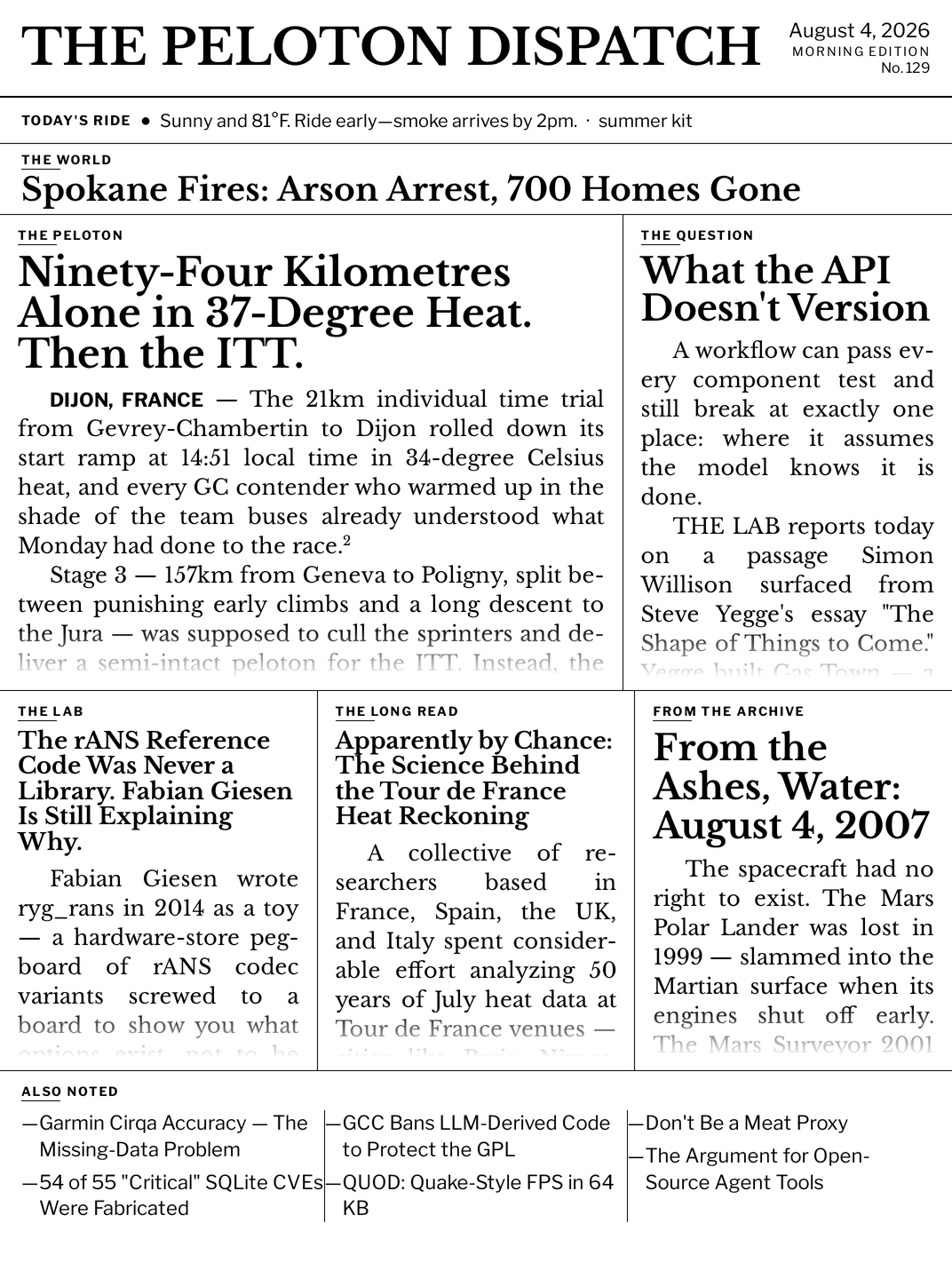
The rendered PNG reads as a credible newspaper front page. THE PELOTON leads the main row at priority 82 alongside THE WORLD (85) in its headline bar — layout correctly respects priority ordering. THE QUESTION sits in the right column next to THE PELOTON, giving the two-column main row good visual balance. The mid-row three-way split (THE LAB / THE LONG READ / FROM THE ARCHIVE) works at equal width. ALSO NOTED's six bullets fill the bottom strip cleanly in three columns.
The missing lead image is noticeable. FROM THE ARCHIVE has image: true in its frontmatter and a detailed Phoenix lander prompt in meta.json ("The spacecraft looks improbably small and fragile against the emptiness"). Without the image, the archive column is pure text and the page loses the visual anchor that typically sits over the FROM THE ARCHIVE headline in the mid-row. The gap is not disqualifying — the text layout holds — but the prompt would have made a strong pen-and-ink illustration.
No duplicate paragraphs or clipped headlines. Font sizes are in the expected 26–44px range for mid-row and main-row respectively.
Priority ranking
| Section | Priority | Length (words) | Image | Notes |
|---|
| THE WORLD | 85 | 776 | — | Leads: correct (major regional emergency + local block) |
| THE PELOTON | 82 | 971 | — | Strong stage day; priority earned |
| THE QUESTION | 76 | 439 | — | Inflated; both source stories are from THE LAB (see Editorial) |
| THE LAB | 71 | 722 | — | Appropriate for a Giesen key-person post |
| THE LONG READ | 65 | 921 | — | 39-day-old piece; evergreen_ok correctly applied |
| FROM THE ARCHIVE | 38 | 539 | yes (image missing) | Within priority_cap: 45; appropriate |
| ALSO NOTED | 10 | 392 | — | Correct band |
| THE FUNNIES | 6 | 61 | — | Correct band |
The 47-point spread (85 down to 38) gives the art director workable differentiation. No priority inflation at the top — THE WORLD's 85 is defensible for "arson arrest, 700 homes burned, 65,000 evacuated." THE QUESTION at 76 is the one borderline case. The art director respected the priority order correctly; no layout/priority mismatch.
Editorial reading
1. THE PELOTON never names the race leader in the body text.
Sigrid Ytterhus Haugset won Stage 3, produced what the Velo report calls the longest solo break in Tour de France Femmes history, and entered the Stage 4 ITT as GC leader with a two-minute cushion. She is never named in the article body. The text calls her "a rider from Uno-X Mobility, wearing the Norwegian national jersey" and, later, "whoever now wears yellow." This coyness is misapplied spoiler-free discipline: Stage 3 results were public at press time. The spoiler-free rule correctly withholds Stage 4 ITT results (listed as "pending at press time" in the frontmatter), but protecting a stage winner's name from Stage 3 serves no reader. The article is harder to follow because the subject of the race's decisive move is never identified. The results YAML field names her; the prose should too.
2. ON THE TRAIL weather quotes are non-compliant with the format spec.
The focus block for ON THE TRAIL is explicit: "For EACH candidate trip day in the window, list day high, night low, and precip % verbatim from that region's periods. Compact pipe-delimited format, e.g. 'Sat 79°F / 56°F, 0% | Sun 74°F / 54°F, 4%.'" Both weekend picks fail this standard.
Pick 1 (Surprise and Glacier Lakes, US 2 West): "Weather: Saturday sunny, high 79°F — no smoke (US 2 West NWS)." The research.md US 2 West block has the full data: Sat high 79°F / low 56°F, 0% | Sun high 74°F / low 54°F, 4%. Night low and Sunday forecast are absent from the pick entirely.
Pick 2 (Lena Lake, Olympic Peninsula): "Weather: Saturday sunny, high 65°F — Olympic Peninsula NWS shows no smoke Saturday." The Olympic Peninsula block has: Sat high 65°F / low 49°F, 0% | Sun high 60°F / low 47°F, 0%. Same omissions.
The required data is in the brief. The writer chose a qualitative description over the specified format for both picks. A reader planning a 1-night trip needs night lows (49°F matters for sleep system choice) and Sunday's forecast (the exit day).
3. THE QUESTION is scored in the multi-domain band on single-domain sources.
The config states: "A QUESTION that bridges two domains earns its place in the 75–94 priority band; a single-domain QUESTION tops out lower." Both source stories — Giesen's ryg_rans post and Yegge's Gas Town account — were reported in THE LAB. The question's intellectual bridge is real (reference code treated as a perpetual contract vs. model behavior treated as a perpetual contract), but both sources are within THE LAB's beat. Priority 76 sits in the exceptional-question tier. A single-domain question should have landed in the 50–74 range. The question writer's "Done" message correctly identifies this as a cross-structural bridge ("behavioral dispositions vs. versioned API contracts") but the structural pattern still runs entirely within the software-engineering domain.
4. THE LONG READ is editorially tethered to THE PELOTON.
The longread was selected specifically because the TDFF is racing in heat today. The focus block says: "Hold the section rather than filling it with something mediocre. Quality over cadence." The CyclingNews heat-protocol piece (June 26, 39 days old) is solid science writing and legitimately evergreen, but its selection logic is "complements the race report" rather than "exceptional longform chosen purely because it is worth reading." The result is a thematic doubling: readers absorb cycling-heat analysis twice in the same edition — once as race reporting, once as science explainer. The LONG READ reads as a sidebar to THE PELOTON rather than as an independent editorial choice. A day with one dominant story across two sections tends to make the paper feel narrow.
5. THE ARCHIVE relies on a single aggregator source throughout.
All six in-text citation references in section-archive.md point to the same Space.com article from 2019. The article makes specific factual claims — perchlorate at "a few tenths of a percent," snow detected "2.5 miles above the landing site," direct quotes from Jim Whiteway and Peter Smith — that all hang on one aggregator piece. The fact-checker removed a cost claim ($420M) because it couldn't be verified in this single source; 17 other claims were verified against the same URL. For a 539-word archive piece citing two mission scientists by name, the sourcing is thin. A second source — NASA's own Phoenix mission page or the JPL press release from the water-ice confirmation — would have grounded the specific chemistry and quote claims independently.
Pipeline observations
OpenAI billing limit hit — no lead image or funnies raster render.
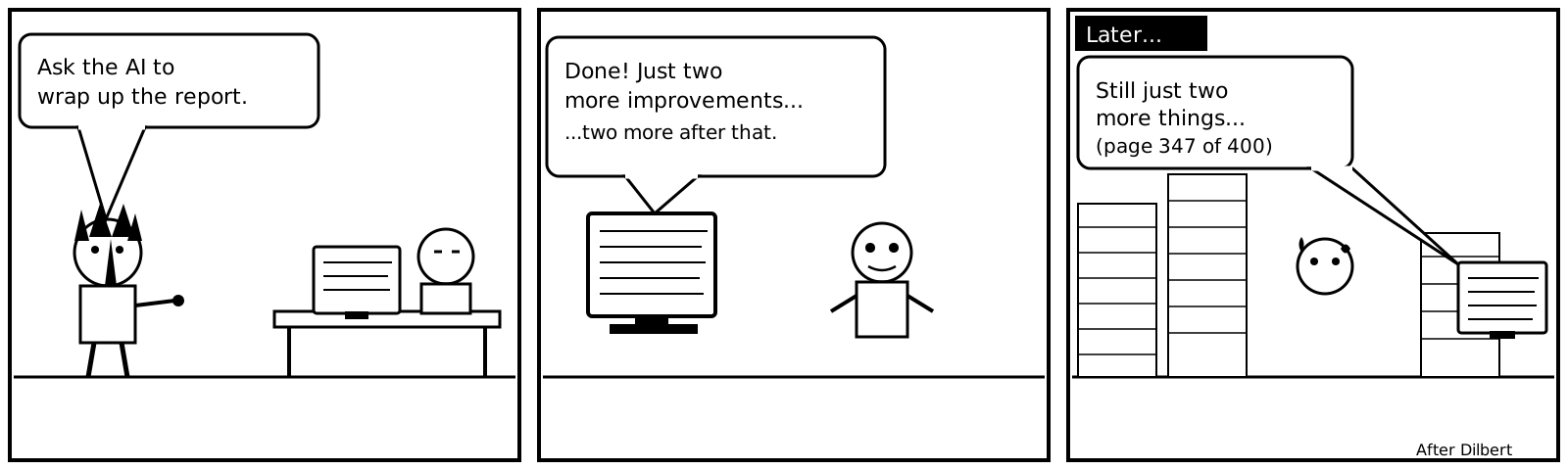
The illustrator (gpt-image-2) failed at the billing wall: funnies-openai.error.txt records "Billing hard limit has been reached." The orchestrator logged "Lead image failed — OpenAI billing limit reached. Pipeline will ship without a lead image per protocol." Two distinct renders failed: the FROM THE ARCHIVE lead image (meta.json has a detailed prompt) and the funnies raster conversion (the SVG comic itself was written successfully). The edition ships without any lead image despite image: true and a completed prompt.
The SVG comic (funnies.svg, 143 lines) was produced by the comic-strip agent before the OpenAI step ran. That artifact is intact. Section-funnies.md contains a two-sentence description of the comic concept rather than any embedded visual content, which is expected for this format.
YAML parse errors in two section files at assembly time.
The orchestrator found unquoted colons in section-peloton.md (snippet: Gradient final km: 0.4%) and section-question.md (reason: owned by THE WORLD (thread: iran-post-mou-instability)...) during Step 5 assembly. Both were patched inline before re-running assemble_content.py. The pipeline recovered, but this is a recurring pattern — writers embed colons in YAML snippet and reason fields without quoting them. The fix adds an orchestrator round-trip at assembly time and creates an undocumented edit to the section files.
Age correction in THE PELOTON — correct behavior, expensive fact-check.
FC: THE PELOTON corrected Matthew Brennan's age from 21 to 20 (born August 6, 2005; the edition date is August 4, 2026, two days before his 21st birthday). The correction is accurate and important. The fact-checker produced 15,548 output tokens — more than any other fact-checker in this run — and took 517s at $0.64. The correction is correct; the cost is high relative to what was changed.
Starting commit is same-day. Parent of 7a1913a (Dispatch: 2026-08-04) is 01059b1 (Investigator: 2026-08-03). No stale worktree issue.
Agent set. All expected agents ran and completed with "Done:" summaries: Scout, Researcher, five writers (WORLD, PELOTON, LAB, LONG READ, ARCHIVE), four reflector/sweep/comic agents (QUESTION, ALSO NOTED, FUNNIES), six fact-checkers, Meta-Writer, Art Director, Thread-Editor. Dedup ran as a script (build_coverage_index.py), not a subagent. No duplicate agents.
Fetch results. All 30 primary fetches and 3 retries succeeded (0 unrecovered failures). No section shipped source-thin from a fetch failure.
Trace highlights
Researcher spent $2.87; THE LAB writer spent $0.10. The researcher briefed 30+ fetched pages into research.md. The LAB writer used 3 of them. A 29:1 cost ratio between briefer and writer is normal for the pipeline, but on a day when the LAB filed only 3 stories in 167s it suggests the LAB brief contained significant unused material. This is a story-day-dependent inefficiency rather than a structural flaw, but it's visible on light LAB days.
Comic-strip agent: 1456s, $1.48. The second-most expensive agent in the run, producing one 143-line SVG and a two-sentence section body. This exceeds the combined cost of the LAB writer ($0.10) and THE WORLD writer ($0.70). The comic-strip agent's cost-to-output ratio stands out against every other writer in the run, all of which produced longer, more factually dense articles at lower cost.
FC: THE LONG READ produced 6,902 output tokens for one correction. The only change was fixing a misquote (Jungels "other sports would have cancelled" → "other sports would be cancelled if it's that warm"). The high output volume suggests extensive intermediate reasoning passes during fact-checking beyond what the single correction required.
Orchestrator cost $3.29 / 23% of total. The orchestrator's 7.1M cache-read tokens dominate the run's cache profile. This is partly structural (the orchestrator carries the full session context across all steps), but the fraction is worth watching across consecutive days to see if it grows as threads.json and covered.json accumulate.
Trace summary
Dispatch 2026-08-04 (model: claude-sonnet-4-6)
| Agent | Dur | Input | Output | Cache Read | Cache 5m | Cache 1h | Cost |
|---|
| Scout | 671s | 2881 | 130 | 415721 | 218990 | 0 | $ 0.96 |
| Researcher | 2184s | 37 | 44884 | 2748094 | 365898 | 0 | $ 2.87 |
| THE WORLD | 450s | 7 | 282 | 155555 | 174161 | 0 | $ 0.70 |
| THE PELOTON | 510s | 9 | 168 | 120186 | 95348 | 0 | $ 0.40 |
| THE LAB | 167s | 6 | 54 | 53784 | 23455 | 0 | $ 0.10 |
| THE LONG READ | 114s | 6 | 48 | 46885 | 15714 | 0 | $ 0.07 |
| FROM THE ARCHIVE | 64s | 6 | 40 | 71579 | 25209 | 0 | $ 0.12 |
| Meta-Writer | 90s | 6 | 24 | 61228 | 29881 | 0 | $ 0.13 |
| FC: FROM THE ARCHIVE | 259s | 7 | 42 | 104876 | 44929 | 0 | $ 0.20 |
| FC: THE LONG READ | 246s | 7 | 6902 | 118567 | 39017 | 0 | $ 0.29 |
| FC: THE LAB | 264s | 7 | 358 | 116293 | 38613 | 0 | $ 0.19 |
| FC: THE WORLD | 530s | 9 | 73 | 304673 | 87063 | 0 | $ 0.42 |
| FC: THE PELOTON | 517s | 1064 | 15548 | 408484 | 76081 | 0 | $ 0.64 |
| THE QUESTION | 200s | 2368 | 106 | 162855 | 42318 | 0 | $ 0.22 |
| FC: THE QUESTION | 139s | 7 | 69 | 112758 | 30951 | 0 | $ 0.15 |
| ALSO NOTED | 309s | 9 | 73 | 300843 | 89224 | 0 | $ 0.43 |
| Draw today's TWO parody comic strips for | 1456s | 15 | 64133 | 175118 | 123076 | 0 | $ 1.48 |
| FC: ALSO NOTED | 276s | 10 | 135 | 340492 | 59141 | 0 | $ 0.33 |
| Art Director | 723s | 8 | 37 | 58520 | 70680 | 0 | $ 0.28 |
| Update story threads for today's edition | 614s | 5 | 31633 | 8412 | 127490 | 0 | $ 0.96 |
| Orchestrator | | 164 | 27582 | 7176531 | 0 | 120182 | $ 3.29 |
| TOTAL | | 6638 | 192321 | 13061454 | 1777239 | 120182 | $14.21 |
Suggestions for next edition
1. Fix the ON THE TRAIL weather format in the writer prompt. The pipe-delimited night-low / precip format is specified in the focus block but not followed. Add a concrete worked example directly in the prompt showing what a compliant 1-night pick weather quote looks like, and make clear that omitting night low or Sunday's forecast is a spec failure, not a style choice. The data is always in research.md; the writer just needs to pull it.
2. Address the OpenAI billing cap before the next run. The lead image and funnies raster both failed at the same wall. If the cap is per-month, it may recur tomorrow. Restoring the OpenAI balance or switching the illustrator backend to svg for a day is preferable to shipping another imageless edition.
3. Add a "YAML-quote any value containing a colon" check to the writer prompt (or a post-write validation step in the orchestrator). The pattern is consistent: snippet and reason fields with embedded colons break YAML parsing every few runs. A one-line pre-flight in the writer's output instructions would catch this before the orchestrator has to patch it.
4. On cycling-dominant days, actively test whether THE LONG READ selection stands independent of the race. Today's pick (heat protocols at the Tour) was defensible but editorially tethered to the PELOTON story. When the LAB is quiet and the PELOTON runs at 80+, the long read should provide range — a non-cycling piece of exceptional quality — rather than depth on the cycling theme already covered in the lead column.