Front page — August 3, 2026
The Peloton Dispatch August 3, 2026 No. 128
● Clear and 74°F. Ride outside in summer kit. · summer kit

THE WORLD

Spokane Fires: 600+ Structures Gone as Eastern WA Burns on Multiple Fronts

↩ Developing story — first reported Jul 29 · previously Jul 31, Aug 01, Aug 02


Seafair weekend concluded Sunday with 300 Seattle Police and private security guards deployed at Genesee Park and a new weapons detection system at every gated entrance — measures put in motion before last week's Bite of Seattle shooting.1 Interim Chief Andre Sayles attended the event; Seafair CEO Emily Cantrel said organizers will meet with SPD and Seattle Fire to review what worked and continue upgrading safety plans in future years.1

Saturday's Blue Angels performance was canceled due to wind.2 The Navy demonstration team returned Sunday under lighter conditions.


ON THE TRAIL · Weekend of Aug 8–9

── WEEKEND PICKS ──

Melakwa Lake · Snoqualmie Region / Snoqualmie Pass · ~45–55 min (I-90) 2-day overnight · Day 1 ~5.3 mi, ~1,438 ft gain to lake; Day 2 ~5.3 mi out (10.65 mi RT, 2,876 ft confirmed in Aug 2 report; that hike was done as a day trip but the lake has established campsites and two pit toilets) NWS (I-90/Snoqualmie): high 72°F, sunny, 0% Saturday; high 68°F, sunny, 4% Sunday. Aug 2 report: no bugs; wildflowers and berries at lake; water at lake; no fords on route. Smoke clears Wednesday — weekend air is clean. Not a permit-lottery zone; early arrival manages crowds. Access: road to Melakwa TH is currently closed; park at Franklin Falls lot and walk 0.2 mi to the trailhead start. → WTA trip report

Dewey Lake · Mount Rainier Area / Chinook Pass – Hwy 410 · ~110–130 min 2-day overnight (confirmed in Aug 2 report of Aug 1 hike; route mileage not reported — check the WTA trail listing for distance and gain) NWS (Mt Rainier): high 68°F, sunny, 0% Saturday; high 63°F, sunny, 1% Sunday. Aug 2 report on Aug 1 hike: overnight trip, "not at all crazily crowded" despite a summer weekend; many open campsites observed throughout the day; wildflowers and berries in good shape. No bugs or fords mentioned. Bears confirmed nearby — one spotted on trail; bring spray. Clear of smoke all week. → WTA trip report

── REGIONAL SNAPSHOT ──

Sources
  1. Security top of mind for Seafair Festival goers, following the Bite of Seattle shooting kiro7.com Aug 3, 2026
  2. Today's Blue Angels Seafair performance canceled – too windy westseattleblog.com Aug 2026
  3. Spokane Area Fires Complex: thousands evacuated and hundreds of buildings burned kiro7.com Aug 3, 2026
  4. Little Giant Fire in Okanogan-Wenatchee National Forest burns over 30,000 acres kiro7.com Aug 2, 2026
  5. Sinlahekin Fire burns over 70,000 acres in Okanogan County kiro7.com Aug 2, 2026
  6. Evergreen warns of cyber attacks on water systems kiro7.com Aug 2, 2026
  7. WTA trip reports listing wta.org

↑ Back to top

THE PELOTON

Pogačar Targets the Vuelta — Seven Years After His Grand Tour Debut

↩ Developing story — first reported Jul 30 · previously Jul 31, Aug 02

Eight men in history have won all three Grand Tours across their careers. Fewer still have taken the Tour and the Vuelta in the same season — and UAE Team Emirates-XRG confirmed on Monday that Tadej Pogačar intends to try.

Pogačar will return to La Vuelta a España for the first time since 2019, his debut Grand Tour, in which he won three stages, claimed the white jersey, and finished third overall behind Primož Roglič.1 The race starts August 22 from Monaco, where Pogačar lives. If he wins in Granada on September 13, he joins Jacques Anquetil, Bernard Hinault, and Chris Froome as men to win both the Tour and Vuelta in the same season — Froome in 2015 being the only rider to do so in the modern era, after the Vuelta moved from its spring slot to its current late-summer position. Pogačar already won the Giro and Tour in 2024; completing the full set would put him in a group of eight. "The motivation is high to finish off the year in a good way," he said on the team website. "The team is strong and we hope to do good things."

His squad is described as "balanced": João Almeida (last year's runner-up), Jay Vine, Pavel Sivakov, Pablo Torres, Kevin Vermaerken, Domen Novak, and Ivo Oliveira.1 The rivals in Monaco will include Primož Roglič (Red Bull-Bora-Hansgrohe), who is chasing the all-time record for red jerseys, plus Felix Gall, Mattias Skjelmose, and Enric Mas.

There is a cost. Racing the Vuelta eliminates GP Québec and GP Montréal, and Pogačar will reach the World Championships in Montreal with just two weeks to recover after the September 13 finale. The Worlds road race is 272km with 3,803 meters of elevation over 12 laps of the Mount Royal circuit — a course that, unlike many recent parcours, demands versatility as much as pure climbing.2 A third consecutive rainbow jersey is the other target on the calendar. "I think the time is right to go back," Pogačar said.

Wout van Aert is also Vuelta-bound, with Visma-Lease a Bike yet to formally name their squad. Speaking to Het Laatste Nieuws after the conclusion of the Tour of Denmark in Copenhagen, van Aert set out his ambitions clearly: he wants stage wins, a strong run at the opening 9km time trial, and he is not ruling himself out of the Worlds road race. "If I am at my very best, I certainly have a chance there. I absolutely do not consider myself without a chance," he told the Belgian paper.2 He finished second in Montreal in 2022 — the course was 50km shorter then and ended in a sprint — and his previous Worlds road race in Glasgow in 2023 ended with a silver behind Mathieu van der Poel. An inflamed elbow that kept him off the TT position for weeks remains a factor ahead of Monaco, but the 9km TT is short enough that position matters less than usual. His final Vuelta build-up will come at the Belgian Gravel Championship in Grobbendonk on August 16, five kilometers from his front door. "I would rather not have been standing here and ridden the Tour de France," he admitted, "but you always have to be ready to adjust your plan."


In Geneva, the Tour de France Femmes Stage 2 came closer to an upset than the final sprint result suggests. Riejanne Markus (Lidl-Trek) counterattacked with 40 kilometers remaining after the early break had been reabsorbed, bridged alone to the last survivors of the escape, and opened a lead of 1:12. SD Worx-Protime — the team with the most to lose if the finish left the bunch — spent their full roster in the chase. Canyon-SRAM, Visma-Lease a Bike, and Fenix-Premier Tech all sat in, unwilling to work for a sprint they would lose. Anna van der Breggen joined the SD Worx paceline. Lotte Kopecky was the last rider left to lead before swinging off at the 2km mark, leaving the gap at 12 seconds. With 6 kilometers remaining, Markus had 30 seconds. With 3.5 kilometers to go, still 19. Markus was caught 450 meters from the finish.3

Lorena Wiebes, speaking after the stage, described her approach in the chaotic closing meters: "I found some good wheels, I could come out with around 200 metres to go, and then I just launched my sprint."3 She noted, with a candidness that reflects how much can go wrong: "Every sprint is exciting. If you make a small mistake, the sprint is over, and you cannot finish it off for the team." Stage 3 — today, Geneva to Poligny, the first hilly test — is where GC riders will get their first real look at each other. Stage 4 on Tuesday is the 21km time trial from Gevrey-Chambertin to Dijon, where the GC gaps should clarify before the mountain stages arrive.

Around that time trial, a separate argument has broken out. Dutch outlet Wielerflits reported Sunday that several teams at the Tour de France Femmes are urging the UCI to check riders for "bra-maxxing" — wearing oversized, padded bras under skinsuits to create an aerodynamic chest fairing in the time trial position. The practice violates UCI Article 1.3.032, which prohibits non-essential clothing that modifies a rider's morphology. A 2024 study by Belgian aero expert Blocken found a large, optimally placed chest fairing produces a 3.6% drag reduction and at least 0.78 seconds per kilometer — meaningful over 21km.4 The practice has reportedly been visible in women's racing since at least the Paris Olympics in 2024 and at last year's Giro d'Italia Women. The UCI has grown more aggressive on aero clothing this season — banning jersey front pockets, disqualifying Jan Willem van Schip for a water bottle in his jersey, pulling ice socks from riders before the men's Tour TTT — but according to Wielerflits, bra padding has remained largely unenforced. Teams are asking for a female juror to conduct checks immediately after each rider's TT effort in a closed tent.


A peer-reviewed study due for publication in the International Journal of Sports Physiology and Performance estimates Pogačar's VO2 max at between 94 and 98 ml/kg/min, averaging 96 — equal to Oskar Svendsen's 2012 lab measurement, one of the highest recorded figures for any cyclist.5 The research, by Sebastian Sitko (University of Zaragoza), Ole Kristian Berg, and Pedro Valenzuela, analyzed four climbing performances from the 2024 and 2025 seasons: Plateau de Beille, Isola 2000, Peyragudes, and Passo di Ganda at Giro di Lombardia. The method was validated first against Froome — their model estimated his 2015 VO2 max from race data at 85.3, against his lab-measured 84.4. LeMond's recorded peak, for reference, was 92.5.

Pogačar's camp called the estimates "exaggerated." Co-author Sitko was direct in response: "That's a communications position, not a scientific counter-argument." The model at its most conservative settings — minimum gross efficiency, minimum altitude correction — still returns an estimate above 92. "Relax any of those and the number goes up, not down," Sitko wrote. "You can argue about whether it's a 94 or a 100 — you can't make these rides physiologically ordinary. The watts are real, and the body has to pay for them one way or another." The authors note that the most defensible correction for altitude and dehydration pushes the estimate toward 100. The study's authors say an Alpe d'Huez analysis is the logical next test for their model.

On the Road Ahead
Calendar from Aug 2, 2026 — primary source blocked today
DateRaceCountry
Mon Aug 3 – Sat Aug 8Tour de France Femmes, Stages 3–8 (ongoing)France
Mon Aug 3 – Sun Aug 9Tour de PolognePoland
Sun Aug 16ADAC Cyclassics HamburgGermany
Wed Aug 19 – Sun Aug 23Renewi TourBelgium / Netherlands
Sat Aug 22 – Sun Sep 13La Vuelta a EspañaSpain / Monaco
Show Results

TOUR OF DENMARK — STAGE 5 (Aug 2, Copenhagen): WINNER: Rasmus Pedersen (Den, Denmark national team) PODIUM: 2. Maximilian Walscheid (Ger, Lidl-Trek) s.t.; 3. Tom Crabbe (Bel, Team Flanders-Baloise) s.t.

TOUR OF DENMARK — FINAL GC: WINNER: Wout van Aert (Bel, Visma–Lease a Bike)

TOUR DE FRANCE FEMMES — STAGE 2 (Aug 2, Aigle–Geneva, 147.9km): WINNER: Lorena Wiebes (Ned, SD Worx-Protime) PODIUM: 2. Elisa Balsamo (Ita, Lidl-Trek) s.t.; 3. Marianne Vos (Ned, Visma–Lease a Bike) s.t.

GC AFTER STAGE 2: 1. Lorena Wiebes (SD Worx-Protime) 7:10:59 2. Kimberley le Court +0:14 (AG Insurance-Soudal) 3. Demi Vollering +0:16 (FDJ United-SUEZ) 4. Noemi Rüegg +0:20 (EF Education-Oatly) 5. Elisa Longo Borghini +0:20 (UAE Team L'Imad)

NOTABLE: Stage 5 crash marred the Copenhagen sprint. Brodie Chapman (DNS Stage 2, illness).

Sources
  1. Tadej Pogačar confirmed for first return to Vuelta a España since 2019 Grand Tour debut cyclingnews.com Aug 3, 2026
  2. 'At my very best I certainly have a chance' — Wout van Aert confident in World Championships road race bid cyclingnews.com Aug 3, 2026
  3. TdFF Stage 2: Lorena Wiebes powers to back-to-back sprint win as Riejanne Markus is caught close to the line cyclingnews.com Aug 2, 2026
  4. Bra Boosters Are Causing a Clothing Controversy at the Tour de France Femmes velo.outsideonline.com Aug 3, 2026
  5. Pogačar VO2 max estimated beyond known human limits in peer-reviewed study bikeradar.com Aug 3, 2026
  6. Tour of Denmark: Wout van Aert seals overall victory as Rasmus Pedersen wins crash-marred Stage 5 sprint cyclingnews.com Aug 2, 2026
  7. UCI Race Calendar 2026 procyclingstats.com

↑ Back to top

THE LAB

The Lean Kernel Accepted a Proof of False

↩ Developing story — first reported Jun 13 · previously Jun 18, Jun 29, Aug 02

On July 25, Ramana Kumar published a repository containing what appeared to be a sorry-free Lean proof that the Collatz conjecture is false. It was not a valid proof. It was an exploit. What Kumar's proof actually demonstrated — with AI assistance — was a soundness bug in Lean's kernel: when the kernel eliminates a nested inductive type T whose parameters are phantom (not referenced in any constructor field), those parameters disappear from the generated auxiliary type and escape type-checking entirely. An ill-typed argument slips through, and the kernel accepts a proof of False. Kiran Gopinathan reduced it to the minimal case on July 28 and filed issue #14576. Leo de Moura's team pushed a patch one hour later.1

A soundness bug in the kernel is the worst class of failure a proof assistant can have. The kernel is the only trusted component; everything else — the elaborator, the tactic engine, the metaprogramming layer — is explicitly untrusted. The bug was only reachable through metaprogramming, which prompted some discussion about restricting it. De Moura's postmortem dismisses this as misguided: the kernel must reject ill-typed terms on its own merits, because an attacker who can write .olean files or modify memory bypasses the elaborator entirely regardless. The separation is the point.

What makes the incident structurally interesting is that two independent checkers failed simultaneously for independent reasons. The nanoda independent kernel — a Rust implementation by Chris Bailey that serves as the main external verification tool — checked the nested inductive case correctly but had a separate bug in projection-node type-name verification. The proof was constructed so that the expression the official kernel never inspects is precisely the one the old nanoda accepted. Ramana believes the timing was coincidental but cannot rule out that the model had seen the nanoda report; Joachim Breitner proposed that the more likely explanation is simply the availability of strong models now capable of finding such bugs. After the fix, Daniel Selsam at OpenAI ran an AI security tool against the Lean kernel source and surfaced six additional programming mistakes; all were fixed, all caught by nanoda, all reachable only through metaprogramming. The independent-kernel model still works — but "current versions" is carrying more weight than it used to.


Karpathy gave Opus 5 the opening paragraph of The Lord of the Rings, a 1M-token budget (approximately $10), and about two hours, and asked for a Three.js render. It returned 5,500 lines of code — procedurally placing and animating polygon assets in three-dimensional space, enough to produce something functional if janky. The experiment's value to him is less as a capability benchmark than as a pointer toward a direction: hyper-custom interactive worlds generated from a description, what he calls an "ephemeral GTA of X on demand." The economic logic is real — no one would ever spend the engineering time to build something this custom for a one-off scene, but the model has all the patience and no marginal cost, so "sure, why not" becomes the answer.2

The more pointed observation is about what the demo reveals as still absent. Opus 5 had to audit its own output by taking screenshots at different positions in the scene — it cannot watch video or play games natively. The model generates code that renders something; it perceives the result only by painstakingly sampling stills. Several things broke and produced jank it couldn't catch in real time. Karpathy names this directly as a capability gap: not multimodal understanding in the abstract, but the real-time visual feedback loop that game development actually requires. The world-builder that cannot watch itself build has a structural problem closing the loop.


A detailed investigation by Model Republic found that Acutus — an anonymously operated digital news site publishing since December 2025, with no masthead or bylines — appears to be running entirely on AI-generated content. Of 94 articles run through a detector with a near-zero claimed false-positive rate, 69% came back fully AI-generated and 28% partially; only three were rated human-authored. The harder evidence comes from the site's own code: the public JavaScript bundle contains the editorial back-end interface, including fields labeled "AI Background Context" and "Suggested questions for the AI interviewer to ask," along with "Generate Story Draft" and "Regenerate" buttons. The public API endpoint at acutuswire.com/api/wire returns not just articles but the full internal review log, including multi-pass AI editorial scores and resolution timestamps — a median of 44 seconds from first flagged issue to last resolved, then publication 10 seconds later. On 42 of the 94 articles, the AI reviewer's own "overall" status read needs_revision; each was published anyway.3

The funding chain runs from Acutus's apparent operator — a Republican PR firm whose client list includes Targeted Victory, the consulting firm whose CEO co-founded OpenAI's $125 million super PAC, Leading The Future — back to OpenAI. Acutus's AI coverage tracks closely with Leading The Future's anti-regulation messaging, criticizes Anthropic, and runs pieces attacking AI-safety advocates. The report concludes that OpenAI's super PAC appears to be funding an AI-generated news outlet to advance its regulatory agenda, using — possibly — OpenAI's own models. OpenAI's usage policies prohibit using its products for political campaigning. Its safety framework previously flagged AI-generated political influence campaigns as a major risk category; that language has since been removed.


On the AUR thread: Arch Linux shipped its August ISO on August 1 — kernel 7.1.5, anthraxx re-elected unopposed for a second term — the first monthly image to land since AUR package adoption was fully suspended, as this paper reported Saturday. The ISO itself is routine; the AUR section of the release note acknowledges the security push without setting a timeline for restoring adoption. No date for re-enabling.4

Trending today: GitHub is dominated by AI agent tooling, CLAUDE.md skill-router packs, and coding-assistant wrappers. The two technically distinctive outliers are FareedKhan-dev/kimi-k3-in-c, a portable C99 implementation running the full 2.78-trillion-parameter Kimi K3 on a single CPU in 8.24 GB of RAM with no BLAS and no GPU, and sqliteai/waste, which runs the same model beyond available RAM by streaming activated weights from NVMe — neither has a source page deep enough to build around, but both are worth the 30-second look.

Sources
  1. Postmortem for Kernel Soundness Bug #14576 — Leo de Moura leodemoura.github.io Aug 1, 2026
  2. Andrej Karpathy on Opus 5 generating a 5,500-line Three.js LotR scene xcancel.com Aug 2, 2026
  3. The reporters at this news site are AI bots. OpenAI's super PAC appears to be using it to advance its political agenda — Model Republic modelrepublic.org Apr 23, 2026
  4. Arch Linux 2026.08.01 ISO released — kernel 7.1.5, Anthraxx re-elected, AUR security push linuxcompatible.org Aug 1, 2026

↑ Back to top

THE LONG READ

Open Your Mouth: How ICE Became the Nation's Largest DNA Collector

On March 13, 2025, Hugo Moreno-Mendez walked into the McLennan County Probation Department in Waco, Texas for a routine check-in. ICE officers were waiting. They drove him to a field office, and then, one after another, three officers approached him with the same demand: open your mouth. Each time, Moreno-Mendez refused to let them swab his cheek. Four days later he was charged with failing to register as a noncitizen and refusing to provide DNA while in federal custody — the latter a misdemeanor that, as of 2021, ICE itself said it was unaware had ever been accepted for prosecution. On August 18, 2025, a magistrate judge convicted him on both counts and sentenced him to time served.1

His case is the narrative spine of a new Wired investigation published today, and the scale of what it describes is worth sitting with. New research from Georgetown Law's Center on Privacy and Technology estimates that ICE alone potentially added roughly 920,000 genetic profiles to CODIS — the FBI's Combined DNA Index System, a database built for criminal investigations — in 2025. FBI records show the "detainee" index of CODIS reached 3,345,692 profiles by December 2025, growing by roughly 995,000 during that year — more than 2,700 people a day, every day, for a year. DHS is now the single largest source of new DNA profiles entering the national criminal database.1

The legal architecture here is genuinely strange. The vast majority of people in ICE custody have no criminal conviction. Being in the United States without documentation is typically a civil offense, not a criminal one. But once a genetic profile enters CODIS, law enforcement agencies across the country can run comparisons against crime-scene evidence — including evidence from cases that have not yet occurred. The physical sample, which contains the full genome, is retained in a federal laboratory indefinitely.


For most of the program's history, it was Customs and Border Protection doing the bulk of the collection at the border. Agency spreadsheets obtained via FOIA show CBP submitted the DNA of at least 1.36 million people to the FBI between October 2020 and the end of 2024.1 ICE's contribution during that period was marginal by comparison — 3,609 samples in fiscal year 2020, roughly 16,000 more through mid-May of fiscal year 2021. The Georgetown research suggests 2025 marked an inflection point: ICE's contribution exploded, and the overall program entered a different order of magnitude.

The expansion has reached family detention. Children were swabbed at the Dilley, Texas family detention center. Representatives Joaquin Castro, Greg Stanton, and Nanette Barragán told Wired: "None of the families at Dilley have been convicted of a crime. They do not belong in a database meant for violent criminals, especially children."1 A DHS spokesperson defended the collections as a border-security and identification measure, and pointed to a separate DNA program for verifying family relationships when asked about children's profiles — a deflection, since that program is distinct from the CODIS submissions at the center of the investigation. DHS did not address Georgetown's estimate directly.

What the Wired piece describes is not a border-security program with some civil liberties friction at the margins. It is the systematic conversion of the United States' criminal DNA database into a registry of people who crossed the government's path for civil, not criminal, reasons — backed by the credible threat of federal prosecution for anyone who refuses. Moreno-Mendez refused three times. He lost.

Sources
  1. ICE Collected Nearly 1 Million People's DNA Last Year — Including Young Children wired.com Aug 3, 2026

↑ Back to top

FROM THE ARCHIVE

Three Tries and One Countdown: August 3, 1958

The counting-down voice over the intercom was Commander William Anderson's. "Eight... six... four," he called, accelerating as the number narrowed, "three... two... one... Mark!" That was 11:15 PM Eastern time on August 3, 1958, at a depth of about 500 feet beneath the Arctic ice cap.2 The USS Nautilus — the world's first nuclear-powered submarine — had just become the first vessel in history to reach the geographic North Pole.

It was the third attempt. The first, in the fall of 1957, ended at 87 degrees north when both gyrocompasses failed near the magnetic pole; conventional compasses had been expected to be useless, but the gyrocompasses going out too was not in the plan. The second try, in June 1958, nearly ended worse: the Nautilus was now equipped with a state-of-the-art inertial navigation system — programmed by punch tape before departure, requiring no external reference points once underway — but without accurate charts of the seafloor the boat almost got trapped in shallow water beneath unexpectedly deep ice in the Chukchi Sea and had to retreat to Pearl Harbor.1 For the third run, departing Pearl Harbor on July 23, the Nautilus dove under the Arctic ice cap from the north coast of Alaska on August 1 and did not look back.

Above the hull, the ice varied from 10 to 50 feet thick. The midnight sun of the Arctic shone in varying degrees through the blue ice above. Below, sonar pinged steadily in the dark. No surface ship had ever reached the pole — the pack ice made it physically impossible. The Nautilus simply went under it.

What made that possible was the reactor. Unlike diesel submarines, which had to surface periodically to replenish oxygen, the Nautilus produced fresh breathing air by electrolysis of seawater. It burned no air. The only practical constraints on its submergence were the pantry and the crew's patience. Waldo Lyon, the chief scientist of the mission — called Operation Sunshine — had spent the better part of a decade removing every other obstacle: sonar systems tuned for cold salt water, upward-facing acoustic profilers to gauge ice thickness, a research library on polar oceanography. Nuclear power had removed the last one.

The Cold War framing was explicit. Sputnik had launched on October 4, 1957 — just weeks after the first failed Arctic run — and President Eisenhower needed a response matching the satellite's psychological weight. Operation Sunshine provided it: a demonstration of American submarine superiority conducted near Soviet territory, under ice Soviet surface ships couldn't enter. Anderson had assumed command of the Nautilus in June 1957 at a ceremony in Seattle, watching the boat explode out of Puget Sound "like an unleashed whale," as he later wrote in his memoir.1 The crowd was thrilled. The operations that followed were covert.

Two days after crossing the pole, the Nautilus surfaced in the Greenland Sea between Spitzbergen and Greenland — roughly 3,000 kilometers from where it had last seen daylight. Anderson was airborne to Washington within hours, shaking Eisenhower's hand before the press. Eisenhower decorated him with the Legion of Merit.2 The crew of 116 had gone from Pearl Harbor to the top of the world and out the other side without once breathing unprocessed air.


The scientific dividend took decades to fully surface. Instruments aboard the Nautilus collected the first complete transects of Arctic sea-ice depth and Arctic seafloor topography ever made. A 1961 paper by Lyon's colleagues at the U.S. Navy Electronics Laboratory used the data to confirm three major undersea ridges — now called the Alpha Ridge, the Lomonosov Ridge, and the Gakkel Ridge — and to establish that the Arctic's great depth made it a true ocean basin, not sunken continental crust. The plate-tectonics debate was still live; the Nautilus data helped close it.

The ice measurements proved more consequential still. In 1988, Alfred McLaren of the University of Colorado painstakingly digitized more than two million ice-depth readings from the 1958 voyage, finding an average protrusion of about 3.7 meters below the sea surface, with keel ice in places plunging more than 30 meters deep.1 When Drew Rothrock of the University of Washington compared that baseline against modern submarine measurements in 1999, he found Arctic sea ice had thinned by an average of 1.3 meters.1 A 2004 follow-up by the same team documented a 32 percent decrease in total sea-ice volume, attributing the loss to a dramatic increase in first-year ice at the expense of thick multiyear ice.1

The 116 men aboard on August 3, 1958 had no way of knowing. Anderson was focused on Cold War optics. Lyon was thinking about polar oceanography. What they built, without knowing it, was a benchmark — the zero line against which climate scientists would one day measure everything that came after.

Sources
  1. Benchmarks: August 3, 1958 — USS Nautilus Crosses the North Pole earthmagazine.org Jul 7, 2015
  2. USS Nautilus Completes First Crossing of the North Pole history.com Nov 24, 2009

↑ Back to top

THE FUNNIES

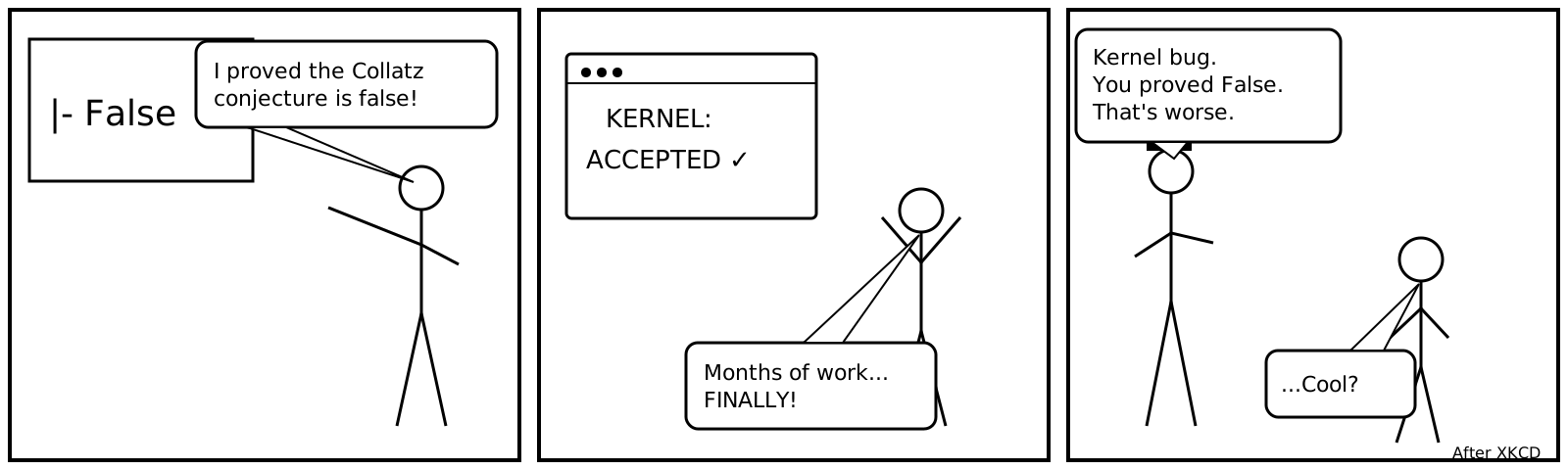
Proved False / Quiet Night at Ninety North

After XKCD — on the Lean theorem prover's kernel briefly, officially, and incorrectly accepting a proof that mathematics is false. After Mutts — on the August night in 1958 when USS Nautilus passed silently beneath an Arctic ice floe, as witnessed by its two permanent residents.

Hand-drawn parody comic strip

↑ Back to top

ALSO NOTED

Also Noted

↑ Back to top

THE QUESTION

When the Bugs Correlate, the Second Checker Doesn't Help

The value of a second checker rests on one assumption: that whatever it misses, the first one caught, and that the two systems' blind spots don't overlap. Today's paper gives that assumption two tests, in different domains, and it fails both.

THE LAB covers the Lean kernel soundness bug and Leo de Moura's postmortem in detail. The short version is that when the kernel eliminates a nested inductive type whose parameters appear in no constructor field, those parameters disappeared from the generated auxiliary type and escaped type-checking entirely — an ill-typed argument slipped through, and the kernel accepted a proof of False. That much is a kernel bug. What makes the incident structurally important is what happened when the community asked whether nanoda — the independent Rust reimplementation of the kernel, maintained specifically as external verification — had caught the same proof. It had not. Not because nanoda shared the kernel's bug: nanoda had a separate flaw in projection-node type-name verification, independent of the nested inductive issue.1 The exploit was constructed so that the expression the official kernel never inspected was precisely the one the old nanoda accepted. Two independent systems, two independent bugs, one proof of False that walked through both simultaneously. After the patch, an AI security tool found six more programming mistakes in the Lean kernel source — all reachable only through metaprogramming, all caught by the current nanoda, but the list is lengthening.1

The formal intuition behind independent verification is that if two systems have uncorrelated failure probabilities, the probability of a single exploit defeating both is the product — small enough to trust. The Lean case says: not if an adversary, or a capable model systematically exploring the failure space of both kernels at once, can find bugs that correlate. Systematic adversarial search over two codebases is not the same thing as two independent draws from a random failure distribution. The independence assumption holds when failures are genuinely random; it weakens precisely when someone is looking.


A lower-stakes instance of the same structure runs through THE PELOTON today. Teams at the Tour de France Femmes are pressing the UCI to close an enforcement gap: oversized bra padding worn under skinsuits to create an aerodynamic chest fairing has been reportedly present in women's racing since at least the 2024 Paris Olympics, yet largely uncaught. UCI Article 1.3.032 prohibits it.2 Commissaires conduct equipment checks. But the two layers of enforcement share a structural blind spot — the padding is inside the jersey, and inspections haven't been positioned to find it. Teams are now asking for a female juror and a closed tent, not because the rule is wrong or the commissaire didn't check, but because both layers of checking couldn't see the same thing.2

The question to carry through the day: when we add a second independent checker to a system, how much of the safety gain depends on the two systems genuinely not sharing blind spots — and how quickly does that assumption erode under systematic search?

Sources
  1. Postmortem for Kernel Soundness Bug #14576 — Leo de Moura leodemoura.github.io Aug 1, 2026
  2. Bra Boosters Are Causing a Clothing Controversy at the Tour de France Femmes velo.outsideonline.com Aug 3, 2026

↑ Back to top

Investigator Report

Investigator report — 2026/08/03

Verdict

A strong edition built around three genuinely interesting stories: the Lean kernel soundness exploit is exactly the kind of technically rigorous, consequential piece this paper should run; the ICE/CODIS investigation is serious journalism; the Peloton coverage is detailed and well-sourced. The paper has a personality today. The main editorial failure is that THE QUESTION nearly re-runs THE LAB's story verbatim instead of opening the structural question, and THE LAB quietly filed a 102-day-old source without flagging its age — two failures that compounded each other, since both the researcher and the LAB fact-checker missed the April 2026 date on the Model Republic piece. The run was otherwise clean: all expected agents completed, the orchestrator handled the OpenAI billing failure gracefully, and the front page renders with clear visual hierarchy.

Frontpage

The deployed PNG looks like a real newspaper. THE LONG READ headline ("Open Your Mouth: How ICE Became the Nation's Largest DNA Collector") fills the top third in large type; the WORLD strip ("Spokane Fires: 600+ Structures Gone...") divides the lead from the three-column middle section; PELOTON, LAB, and QUESTION sit left-to-right in order of priority. No clipping, no overlap, no duplicate content visible.

One significant absence: no image appears anywhere on the page. The FROM THE ARCHIVE section has image: true in its frontmatter and meta.json carries a detailed USS Nautilus lead-image prompt, but the OpenAI image API returned a billing hard-limit error during fetch_lead_image. The frontpage ships entirely in text. The archive section's bottom-left slot, where the illustration would have anchored, is filled only by body copy fading into the gradient. The page is functional but missing the visual rest point the design expects.

The QUESTION column's 26px headline reads noticeably smaller than the PELOTON's 40px in the same row — this is intentional CSS (lower-priority section gets smaller type) but creates a hierarchy signal the reader might not consciously parse as meaningful.

Section ordering is priority-correct throughout: LONG READ (88) leads, WORLD (82) as strip, then PELOTON (78) / LAB (74) / QUESTION (68), then ARCHIVE (43) and NOTED (10) in the bottom row.

Priority ranking

SectionPriorityLength (est. words)ImageNotes
THE LONG READ88~480Single-source (Wired); correct lead
THE WORLD82~300Headline-only on front; 3 world bullets
THE PELOTON78~830Full multi-story coverage
THE LAB74~680102-day-old source in primary slot
THE QUESTION68~350Retells THE LAB
FROM THE ARCHIVE43~580yes (no image shipped)Capped correctly at 43
ALSO NOTED10~370 (7 bullets)Clean
THE FUNNIES8minimalSVG shipped

The LONG READ at 88 is defensible but not obvious. The ICE/CODIS investigation is excellent; it is also a published Wired story describing an ongoing program, not a breaking event. The Spokane wildfire complex at 82 — 600+ structures destroyed, three fires at 0% containment, active evacuations in the reader's home region — could reasonably claim the top slot. The art director correctly respected the assigned priorities; the question is whether the writer assigned them right. A reader who lives near Issaquah may find the wildfire buried below a national policy story.

FROM THE ARCHIVE at 43 is correctly capped. No priority inflation or compression issues; the spread from 88 to 43 gives the art director useful signal.

Editorial reading

1. THE QUESTION retells THE LAB. The QUESTION prompt is explicit: "a sentence or two of context is fine; a second full recap of a story already in THE LAB is not." The QUESTION opens on a structural question (good), then spends its entire second paragraph re-narrating the Lean kernel bug in technical detail: "when the kernel eliminates a nested inductive type whose parameters appear in no constructor field, those parameters disappeared from the generated auxiliary type and escaped type-checking entirely." This is nearly verbatim from THE LAB. A reader who read THE LAB first — and this paper is designed to be read front-to-back — is being asked to absorb the same technical explanation twice. The QUESTION should have cut to the structural argument after one sentence of context ("THE LAB reports that the Lean kernel and its independent checker both failed to catch the same exploit") and spent the paragraph it wasted on recap developing the independence-assumption argument instead.

2. THE LAB ran a 102-day-old source without flagging it. The Model Republic investigation of Acutus was published April 23, 2026. THE LAB has recency_cap_days: 7. The researcher tagged the story [NO DATE] — probably because the URL contains no date and the page's metadata is sparse — which gave the writer plausible cover. But the article's own text establishes its age: "In less than four months, it has published 94 full-length articles" with the site launching December 29, 2025 places the article squarely in April. The LAB writer did not note the age; the LAB fact-checker did not flag it. The story ran as if it were today's news. If Acutus was newly relevant on August 3 for some reason — a takedown, a congressional inquiry, a new story — that context is missing from the article. Without it, this reads like a four-month-old investigation filed as fresh. Worth noting: the same writer dropped the Tim Sweeney PC Gamer interview at 40 days as stale ("stale at 40 days"), making the inconsistency visible.

3. The Dewey Lake pick violates the ON THE TRAIL mileage spec. The spec requires per-day mileage AND elevation gain for every overnight pick. The Dewey Lake recommendation says: "route mileage not reported — check the WTA trail listing for distance and gain." The writer deferred to the reader to find the most basic trip-planning number. This directly fails the requirement. The pick should have sourced mileage from the WTA trail page or been replaced with a pick where the data was available. The Melakwa Lake pick also lists a drive time of "~45–55 min" when the authoritative table says "35–55 min" for I-90 / Snoqualmie / North Bend — the writer narrowed the low end by 10 minutes without explanation. The spec says "the writer must use these values, not estimate."

4. THE QUESTION's cross-domain bridge is thin. The QUESTION's strength is its frame: does a second independent checker actually help if its blind spots correlate with the first? The Lean kernel case makes this concrete. The bra-padding enforcement example appended as a "lower-stakes instance" is a stretch. UCI commissaires missing hidden padding is an institutional inspection gap, not a case where two independent systems designed to catch the same thing failed simultaneously because an adversary found a correlated weakness. The parallel doesn't hold under pressure. The Lean case alone would have been cleaner and stronger. The ANGLE-SELECTION rules say to reach for a non-dominant angle when one is within 20 points — the bra story is from THE PELOTON (78 vs THE LAB's 74), so it qualifies. But the bridge doesn't work structurally. A better second example would have come from the ICE/CODIS story: DHS's legal argument is essentially that civil-immigration custody and criminal-DNA collection are independent systems, but CODIS links them.

5. THE LONG READ is single-sourced. The entire article cites one Wired investigation four times (citations 1–4 all link to the same URL). The Wired piece is a serious piece of reporting; the Dispatch article handles it fairly. But a reader who wants to investigate further has only one thread to pull. Georgetown Law's research and congressional representatives' statements are cited via Wired rather than reached directly. For a LONG READ at priority 88, a second independent source — the Georgetown Center on Privacy and Technology report itself, or a prior DOJ or DHS document — would give the article a sturdier foundation and model the sourcing standard the paper promotes.

Pipeline observations

Lead image missing (OpenAI billing limit). funnies-openai.error.txt records: fetch_lead_image: OpenAI returned 400: billing_hard_limit_reached. The meta.json has a detailed lead image prompt for the USS Nautilus scene; no lead_image.png shipped. The orchestrator logged "Lead image failed (OpenAI billing limit). Logging and continuing without it — pipeline proceeds as normal." Correct recovery, but the billing limit needs to be addressed before the next run or the same failure recurs. The front page ships without any illustration.

No dedup subagent in the JSONL directory. The expected pipeline sequence is dedup → scout → researcher → writers → fact-checkers → art-director. No dedup agent appears among the 20 JSONL files in jsonl/subagents/. covered.json and recent_editions.md are both present, suggesting dedup ran as a Python script rather than a Claude subagent — this is not necessarily a defect, but it means no transcript exists to verify what dedup logged or skipped.

FC: THE PELOTON outlier: 978s, $1.05, 32,018 output tokens. Every other fact-checker produced 26–43 output tokens and cost $0.14–$0.30. The PELOTON fact-checker produced 750× more output. This reflects a full-article rewrite to deliver three corrections (41km→40km, "Dutch paper"→"Belgian paper", VO2 max hedge). The corrections were real and the work was legitimate, but the pattern — checker rewrites the whole article rather than patching in place — inflates cost and makes the diff hard to audit. The corrections are documented in the checker's final response.

FC: THE LAB and researcher both missed the April 2026 date on Model Republic. The researcher tagged it [NO DATE]; the fact-checker (270s, $0.20) did not flag the date visible in the source text ("In less than four months" after a December 2025 launch). Two checkers, one miss — the very pattern THE QUESTION writes about.

Comic strip agent: 1,016s, $0.88, "Draw today's TWO parody comic strips." The agent description references two strips (XKCD + Mutts parody). funnies.svg shipped. The billing error in funnies-openai.error.txt is from fetch_lead_image, not from the comic generation, which completed. The label "TWO" strips is reflected in the section article ("After XKCD... After Mutts...") — both concepts appear to be folded into the single SVG, which is consistent.

Thread-editor: 1,008s, $0.76. This is the most expensive thread maintenance run in recent editions relative to what shipped (threads.json present, threads-prev.json present, run appears complete). No obvious cause visible without reading the thread transcript.

Otherwise clean: all six writers, one writer-sweep, seven fact-checkers, one meta-writer, one art-director, one scout, one researcher, one comic-strip agent all completed. No missing sections, no empty files, no truncated articles, no malformed frontmatter.

Trace highlights

The Researcher ($1.40, 2.5M cache-read tokens) cost six times what the LAB writer ($0.23) spent. The brief was thorough; the writer used a fraction of it — and the one story the researcher couldn't date (Model Republic) became the edition's main editorial integrity problem.

FC: THE PELOTON ($1.05) cost nearly as much as the Researcher and more than any writer. Three corrections on a well-sourced article is an expensive yield; the checker appears to have produced a complete revised article as its output rather than a targeted patch.

The Orchestrator ($3.35) holds the largest single line item, driven by 7.2M cache-read tokens and 29K output tokens across the full coordination cycle. It comfortably exceeds the total of all writers combined ($1.52) — the coordination layer is the most expensive component of the run.

The thread-editor (1,008s, $0.76) and comic-strip agent (1,016s, $0.88) ran at nearly identical wall-clock time; both are among the longest-running agents. Neither is obviously blocking anything else in the pipeline, but both represent meaningful overhead for their outputs.

Trace summary

Dispatch 2026-08-03 (model: claude-sonnet-4-6)

AgentDurInputOutputCache ReadCache 5mCache 1hCost
Scout289s394542129610733240$ 0.33
Researcher1566s34294924998361607660$ 1.40
THE WORLD671s10411887111546060$ 0.64
THE PELOTON506s625366201099130$ 0.42
THE LAB227s842146069498210$ 0.23
THE LONG READ76s713760121171600$ 0.08
FROM THE ARCHIVE144s62660997259070$ 0.12
FC: THE LONG READ165s72685900339500$ 0.15
Meta-Writer55s62548574221660$ 0.10
FC: FROM THE ARCHIVE415s72795641640920$ 0.27
FC: THE LAB270s84934157649403590$ 0.20
FC: THE PELOTON978s932018564291467700$ 1.05
FC: THE WORLD380s943209200638430$ 0.30
THE QUESTION274s733103936399960$ 0.18
FC: THE QUESTION200s72797332282630$ 0.14
ALSO NOTED340s1191124434023830680$ 0.45
Draw today's TWO parody comic strips for1016s12262472337761112220$ 0.88
FC: ALSO NOTED311s834209415631200$ 0.30
Art Director1095s83411991798950$ 0.30
Update story threads for today's edition1008s81784232026320$ 0.76
Orchestrator1532952472377700123283$ 3.35
TOTAL629791475121120231570873123283$11.66

Suggestions for next edition

Resolve the OpenAI billing limit before the next run. The billing hard-limit killed the lead image today and will kill it again tomorrow if not addressed. The orchestrator's graceful fallback is correct, but an imageless front page is a consistently degraded experience. Check the OpenAI account billing cap and either increase it or add a pre-run check that warns early.

Add a date-verification step to the researcher prompt or the writer template for THE LAB. The April 2026 Model Republic story slipped through because the researcher tagged it [NO DATE] and neither the writer nor the fact-checker read the article text closely enough to catch the contextual date markers. A simple instruction — "if you cannot determine the publication date from metadata, estimate from the article text and flag with [ESTIMATED DATE: ~month year]; any story older than 14 days must be explicitly acknowledged in the lede or dropped" — would surface this class of miss.

The QUESTION writer should write the cross-domain bridge before writing the article. The prompt has a LEDE PREFLIGHT requiring the writer to run a proper-noun test and a form test before drafting. Consider adding a BRIDGE TEST: "if your second domain example requires the reader to accept an analogy rather than recognizing the same structure, find a different example." The bra-padding enforcement gap and the Lean kernel exploit are both "two-checker failures" only loosely; the writer should either commit to the structural parallel or pick a different secondary example.

The ON THE TRAIL section should flag incomplete picks more explicitly. The Dewey Lake pick shipped without mileage, with a note telling the reader to look it up themselves. If the WTA trip-report page doesn't supply mileage and the WTA trail page is reachable, the writer should fetch it; if neither source yields the data, the pick should be dropped. Consider adding a hard check in the writer prompt: "a pick with missing mileage is not a pick — it is an incomplete recommendation."