Investigator report — 2026/08/12
Verdict
A substantive edition built around a strong thematic spine — the IBM PC's 45th anniversary threading through FROM THE ARCHIVE, THE LAB (Aaltonen's SIGGRAPH argument), and THE QUESTION. THE PELOTON and ALSO NOTED are clean. The run is marred by three fixable issues: the ON THE TRAIL subsection shipped without its required Weekend Picks component; a six-month-old local news item passed the recency gate unchallenged; and the edition's planned lead image never generated because OpenAI credits ran out. The frontpage is textbook layout but has zero illustration, which undercuts the paper's visual identity. Total cost $12.76; the run was structurally clean but the thread-editor ($0.77) and a timed-out comic retry ($0.56 wasted) kept costs elevated.
Frontpage
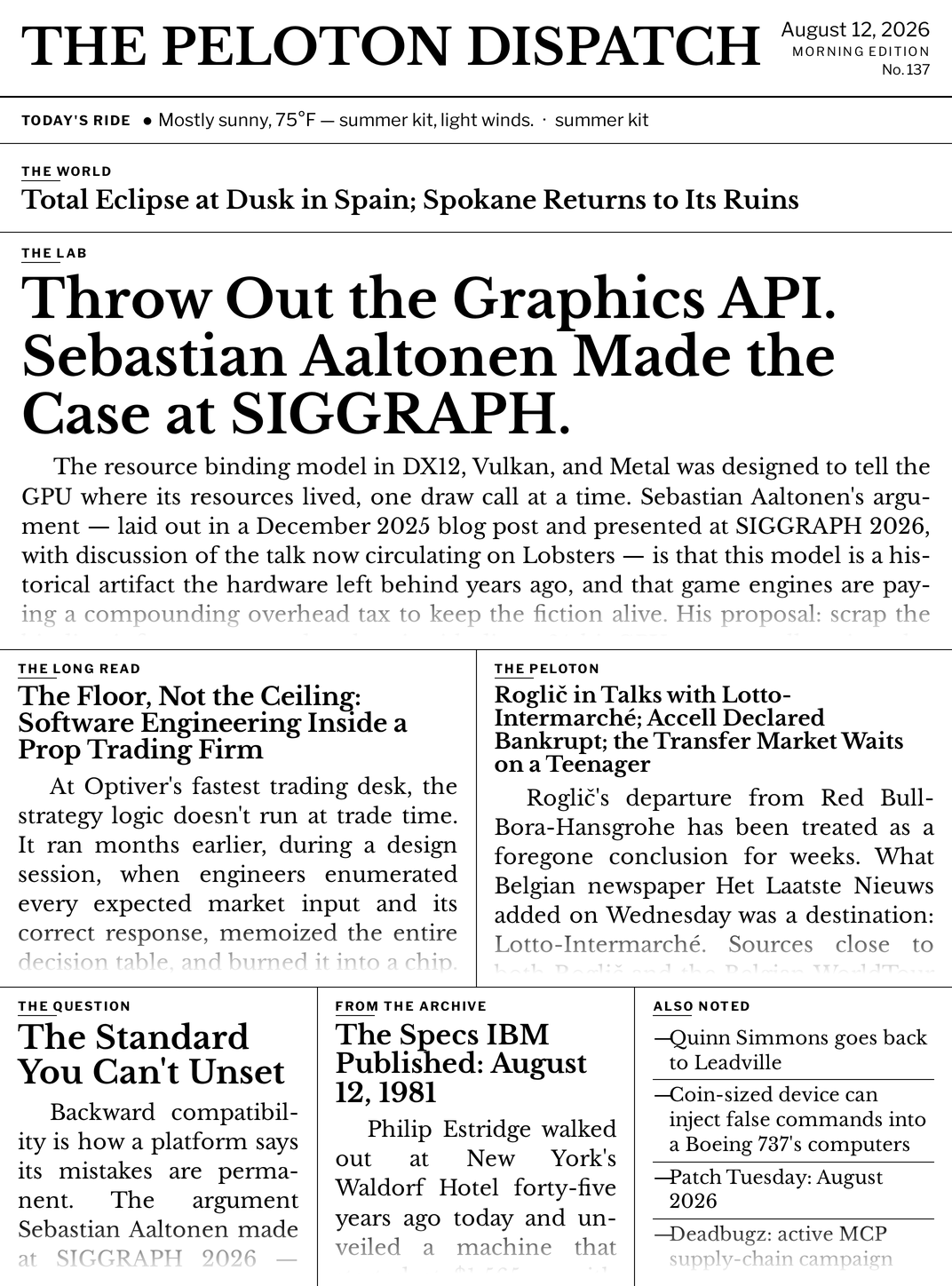
The rendered PNG (frontpage.png) is visually coherent: masthead, ride strip, THE WORLD banner, THE LAB as the dominant lead, two-column mid row, three-column bottom row. No clipping, no font-size collapse, no overflowing text. Section ordering follows priority correctly — the layout gives THE LAB (78) the largest real estate, THE LONG READ (72) and THE PELOTON (67) share the mid row at equal column widths. THE QUESTION and FROM THE ARCHIVE in the bottom row are sized appropriately.
The single visible deficit is the complete absence of any illustration. The meta-writer commissioned a well-scoped IBM PC press conference image for FROM THE ARCHIVE; the OpenAI API returned 429 (credit balance exhausted) and the pipeline continued without it. The result is an entirely typographic frontpage — functional, but the paper's stated visual identity ("Black-and-white pen-and-ink editorial illustration... newspaper op-ed feel") is invisible to the reader today.
The deployed index.html is clean: 8 sections in the correct tier order, no duplicate headlines, no missing sections.
Priority ranking
| Section | Priority | Length (~words) | Image | Notes |
|---|
| THE WORLD | 85 | 350 | — | Headline-only per config |
| THE LAB | 78 | 800 | — | Lead (correct) |
| THE LONG READ | 72 | 500 | — | Single source |
| THE PELOTON | 67 | 850 | — | |
| THE QUESTION | 63 | 400 | — | |
| FROM THE ARCHIVE | 42 | 300 | planned, absent | Single source |
| ALSO NOTED | 10 | 8 bullets | — | |
| THE FUNNIES | 8 | caption | — | Skip on frontpage |
The orchestrator's managing-editor step (Step 4) bumped THE WORLD from 75 to 85 and trimmed THE LONG READ from 82 to 72 — both correct calls. The spread (85→8) gives the art director real differentiation. The only question worth raising: THE QUESTION bridges two domains (GPU API design + IBM PC standards), which the spec says earns the 75–94 band. It landed at 63. Whether the managing-editor step considered the cross-domain bridge rule is not logged, and the section is good enough that 63 isn't embarrassing, but the spec's own guidance would have placed it higher.
Editorial reading
Finding 1 — ON THE TRAIL: Weekend Picks entirely absent.
The section spec defines a two-part subsection: Part 1 (Weekend Picks — 1–3 picks with drive time, per-day mileage and elevation gain, a pipe-delimited weather quote for each trip day from the per-region NWS forecast, and a rationale) and Part 2 (Regional Snapshot — 4–6 regional condition bullets). What shipped is three bare condition bullets that resemble Part 2 but name only two regions (Snoqualmie Pass, Issaquah Alps) and a closure notice. Part 1 is absent entirely: no picks, no drive times, no mileage figures, no weather quotes. The feeds.md had complete 7-day per-region NWS data — the Issaquah Alps Saturday August 15 forecast reads "high 81°F, precip 2%; Saturday Night low 56°F, precip 2%" which would have cleared every criterion (no snow, no bugs in late summer, excellent weather). The reader lost the one piece of editorial content that is time-specific to the week and locally grounded. See Pipeline finding 2 for the root cause.
Finding 2 — Stale Eastside task force item in THE WORLD.
"In February, Bellevue, Issaquah, Redmond, and Kirkland formed a regional task force targeting street racing and reckless driving on I-405 and SR 520" — source date February 14, 2026. THE WORLD carries recency_cap_days: 7. The item is 179 days old. The fact-checker logged it as "nearly 6 months old, that's a stale source presented as current news" but filed it as an "other correction" rather than removing it. Meanwhile the Edmonds ferry dock sentencing (Aug 12, same day, a man who killed 2 passengers sentenced to 7 years) was a newsworthy same-day local story that fell through because neither THE WORLD nor ALSO NOTED could verify it from the feed headline alone. The paper ran a 6-month-old non-news item while missing a fresh local crime story.
Finding 3 — THE QUESTION recaps THE LAB's CUDA argument nearly verbatim.
The spec says "a sentence or two of context is fine; a second full recap of a story already in THE LAB is not." The QUESTION's fourth paragraph ("HLSL and GLSL were designed twenty years ago as frameworks of elementwise transform functions with no pointer semantics, and despite two decades of use they have produced no library ecosystem to speak of") is lifted almost verbatim from THE LAB's fourth paragraph. The QUESTION's structural bridge (GPU API backward compatibility ↔ IBM PC compatible clone market) is genuinely interesting; the prose around it is not. The better edit would have quoted Aaltonen in a single sentence and spent the paragraph on what it would take for a vendor to actually break compatibility — the part the reader cannot find by re-reading THE LAB. Instead the article restates the evidence and lands on "the question for today's graphics API incumbents is whether any vendor will reach that conclusion" — a question, not an answer or a sharper angle.
Finding 4 — FROM THE ARCHIVE: all claims staked on one corporate source.
Every one of the nine citations in the archive article points to ibm.com/history/personal-computer. The article makes specific historical claims the IBM history page is unlikely to contain: the Lord Geller Federico Einstein campaign agency name, creative director Tom Mabley's "represent Everyman" quote, the PCjr baby-stroller spot detail, Newsweek's "IBM's roaring success" line. The cited snippet from that source confirms only "it had 16 kilobytes of RAM and no disk drive." A piece that reads this well deserves sourcing that matches it — a contemporary news archive or a secondary history. As written, readers cannot follow citations 1–9 to verify the Chaplin campaign details.
Pipeline observations
Lead image absent (OpenAI 429). The orchestrator logged at message 168: "Lead image failed — OpenAI credits exhausted (429). Logging and continuing per pipeline rules — edition ships without lead image." The meta-writer produced a well-formed prompt for an IBM PC press conference illustration. No lead_image.png exists in the edition directory. No alert file was generated. The failure mode is silent to the reader and recoverable by pre-funding the API account before the run.
Researcher stripped the NWS trail forecast table. feeds.md contains a complete "Trail-area NWS forecasts (per-region, 7-day)" section with structured day-high / night-low / precip-% rows for all 12 regions through the following Tuesday. research.md reduces this to a 2-line prose note: "Smoke lingers on I-90 east (Snoqualmie/Teanaway: smoke forecast Wed-Thu, chance showers Fri). Stevens Pass/Enchantments: smoke Wed-Thu, chance T-storms Fri." The pipe-delimited weather-quote format the world writer needs for ON THE TRAIL Weekend Picks requires verbatim figures ("Sat 81°F / 56°F, 2% | Sun 82°F / 56°F, 2% (Issaquah Alps forecast)"). The researcher's compression lost the structure; the world writer couldn't write the picks without the data. This is a systemic gap: every edition where the researcher summarizes rather than passes through the NWS table will produce a degraded ON THE TRAIL.
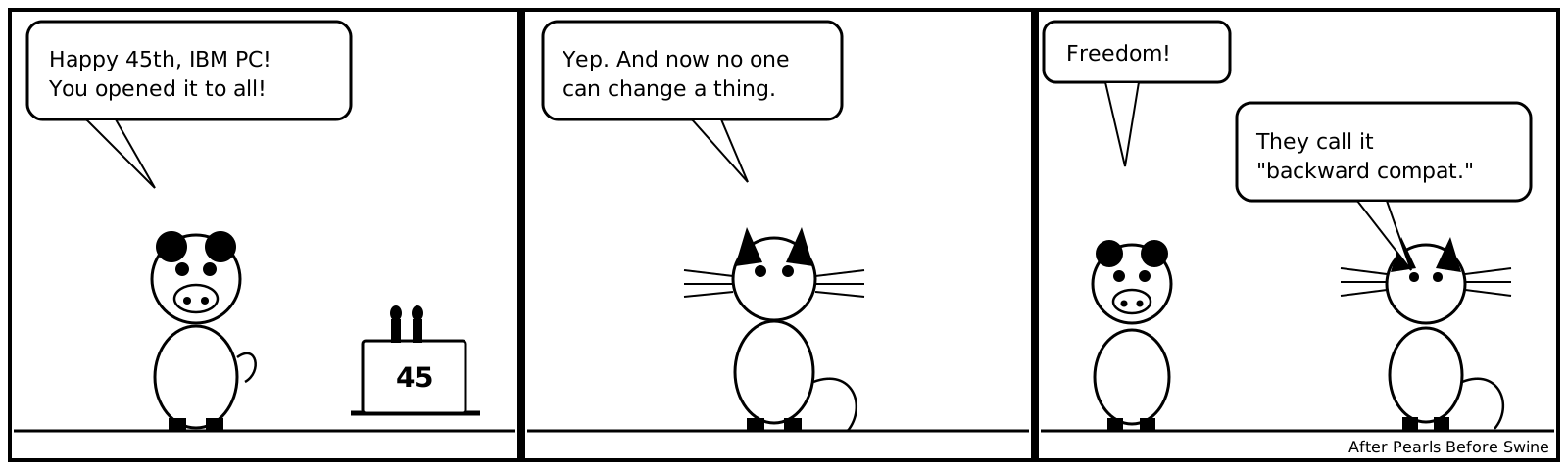
Comic strip agent timed out; retry succeeded. Agent a78bad1da3878ab56 stopped with stop_reason: stop_sequence and "Request timed out" after reading section files and before writing any output. The orchestrator launched a retry (a7d1dd7cf6a2ef5e3), which completed in 990s and wrote funnies.svg, funnies-openai-prompt.json, and section-funnies.md. Both runs together cost $1.42 — more than THE LONG READ, THE ARCHIVE, and the Meta-Writer combined — for a section that does not appear on the frontpage.
YAML parse error in section-noted.md. The orchestrator logged at message 365: "There's a YAML parse error in section-noted.md — an unquoted snippet with a colon. Let me fix it." The ALSO NOTED writer produced malformed YAML frontmatter. The orchestrator fixed it inline before assembly. Article content was unaffected.
FC: THE WORLD caught staleness, did not remove the item. The fact-checker's final summary for THE WORLD lists 18 claims checked and 5 removed; the Feb 14 Eastside task force story is noted as "stale source presented as current news" but classified among "other corrections" (wording fixes) rather than removals. If the fact-checker's scope does not include recency enforcement, that gap belongs in the fact-checker prompt.
Starting commit. The dispatch commit ca70ff1 (2026-08-12 14:30 UTC) has parent 67cb615 (Investigator: 2026-08-11, 14:03 UTC). Same-day parent; no stale worktree issue.
Trace highlights
Researcher ($1.73) cost more than five writer agents combined ($1.03). The brief was expensive but the one area where the researcher's compression hurt downstream output most — the NWS trail weather table — is the quietest line in research.md. Cost and correctness decoupled in the wrong direction.
FC: THE WORLD took 724s, the longest fact-checker run, producing only 58 output tokens. It spent most of that time fetching and verifying sources (cache reads: 348,120), which is the right behavior for a section with three major international stories. The 724s is not a defect — it's what source verification looks like — but it is the single biggest wall-clock contribution to Step 3's long tail.
Two comic-strip runs totaling $1.42 for a section that doesn't show on the frontpage. The funnies appear only in the long-form web view and the EPUB. The failed first run ($0.56) reads as wasted spend; the retry ($0.86) is correct spend, but the total is disproportionate. A shorter initial timeout would let the retry start sooner and at lower total cost.
Thread-editor ($0.77) cost more than THE QUESTION writer ($0.22), META-writer ($0.11), and FROM THE ARCHIVE ($0.10) combined. The thread-editor spent 1,023s and produced 23 output tokens against 205,959 cache-5m reads. High cache cost for a lightweight task suggests it is reading a large context (likely all section outputs) when it could read only the thread-eligible sections defined in newspaper.yaml.
Trace summary
Dispatch 2026-08-12 (model: claude-sonnet-4-6)
| Agent | Dur | Input | Output | Cache Read | Cache 5m | Cache 1h | Cost |
|---|
| Scout | 459s | 2069 | 12024 | 337366 | 72417 | 0 | $ 0.56 |
| Researcher | 1469s | 43 | 5120 | 3342678 | 174228 | 0 | $ 1.73 |
| THE WORLD | 276s | 6 | 18 | 138590 | 83835 | 0 | $ 0.36 |
| THE PELOTON | 349s | 8 | 38 | 74840 | 65881 | 0 | $ 0.27 |
| THE LAB | 308s | 6 | 18 | 56090 | 37213 | 0 | $ 0.16 |
| THE LONG READ | 156s | 1162 | 1729 | 96530 | 23000 | 0 | $ 0.14 |
| FROM THE ARCHIVE | 68s | 6 | 25 | 61273 | 20478 | 0 | $ 0.10 |
| Meta-Writer | 62s | 6 | 22 | 51952 | 25922 | 0 | $ 0.11 |
| FC: FROM THE ARCHIVE | 282s | 474 | 1508 | 213441 | 42303 | 0 | $ 0.25 |
| FC: THE LONG READ | 248s | 7 | 7972 | 119987 | 45146 | 0 | $ 0.32 |
| FC: THE WORLD | 724s | 1783 | 58 | 348120 | 94040 | 0 | $ 0.46 |
| FC: THE LAB | 430s | 9 | 50 | 196587 | 49354 | 0 | $ 0.24 |
| FC: THE PELOTON | 375s | 8 | 34 | 112692 | 79117 | 0 | $ 0.33 |
| THE QUESTION | 277s | 2713 | 34 | 147954 | 43217 | 0 | $ 0.22 |
| FC: THE QUESTION | 266s | 7 | 2804 | 108471 | 36100 | 0 | $ 0.21 |
| ALSO NOTED | 268s | 68 | 11224 | 313856 | 95307 | 0 | $ 0.62 |
| Draw today's TWO parody comic strips for | 1287s | 4 | 32001 | 9564 | 20722 | 0 | $ 0.56 |
| FC: ALSO NOTED | 351s | 3026 | 34 | 228681 | 76123 | 0 | $ 0.36 |
| Draw today's TWO parody comic strips for | 990s | 11 | 32169 | 169773 | 86978 | 0 | $ 0.86 |
| Art Director | 1636s | 11 | 32016 | 10525 | 90793 | 0 | $ 0.82 |
| Update story threads for today's edition | 1023s | 8 | 23 | 5796 | 205959 | 0 | $ 0.77 |
| Orchestrator | | 166 | 30789 | 7090139 | 0 | 116648 | $ 3.29 |
| TOTAL | | 11601 | 169710 | 13234905 | 1468133 | 116648 | $12.76 |
Suggestions for next edition
1. Replenish OpenAI credits before the run. A $0 balance wipes the lead image silently; the pipeline continues but the reader gets a typographic-only frontpage. A pre-run credit check (or a balance alert in funnies-openai.error.txt surfaced into the pipeline alerts file) would catch this before it costs an edition its illustration.
2. Have the researcher pass the NWS trail forecast table verbatim, not summarized. The world writer's ON THE TRAIL spec requires pipe-delimited weather quotes ("Sat 81°F / 56°F, 2% | Sun 82°F / 56°F, 2%") pulled directly from the structured NWS data. A researcher that condenses this to prose ("smoke Wed–Thu, chance showers Fri") makes Weekend Picks practically unwritable. Either the researcher prompt should mark the NWS table as pass-through, or the world writer should read feeds.md directly for the weather section.
3. Encode recency enforcement in the fact-checker prompt for THE WORLD. The fact-checker correctly identified the Feb 14 street racing item as stale but treated it as a style issue rather than a removal. Adding one explicit rule — "remove any source whose publication date is more than recency_cap_days days before today, unless the article text explicitly frames it as historical background" — would close the gap without changing fact-checker scope for other sections.
4. Give the comic-strip agent a hard 800s wall-clock limit. At 1,287s the first attempt still timed out without producing output. An 800s ceiling would have triggered the retry sooner, recovered the same output at lower total cost, and kept the funnies budget under $1.00 combined.