Front page — June 15, 2026
The Peloton Dispatch June 15, 2026 No. 79
● Hot and clear at 88°F — perfect summer kit day. · summer kit

THE WORLD

Iran Signing Friday; UK Bans Kids From Social Media; 12 Dead in Missouri Crash

↩ Developing story — first reported Jun 13 · previously Jun 14


LOCAL — The heat advisory runs through Tuesday; Monday's high near Issaquah hit 88°F. Drink water. A baby formula linked to an infant botulism outbreak has been recalled, with at least one Washington case confirmed. Boeing's Future of Flight attraction opened Monday in Mukilteo, serving as a public gateway to the Everett factory.


ON THE TRAIL — Juneteenth Long Weekend (Thu Jun 18 opportunistic · Fri–Sun Jun 19–21)

Juneteenth falls on Friday, giving you a true three-day weekend with Thursday as a bonus travel day. The forecast across nearly every Cascade zone is outstanding — sunny, warm, and dry through Sunday. Snow is rapidly clearing at elevation; most trails below 5,000 ft are running clean in trail runners right now.

WEEKEND PICKS

1. Sheep Lake (Mt Rainier – Chinook Pass, Hwy 410) Region: Mt Rainier / Chinook Pass — 110–140 min from Issaquah Trip length: 1-night Route: Hwy 410 trailhead to Sheep Lake and back; optional extension to Sourdough Gap

A Jun 15 trip report has Sheep Lake in good condition: trail solid, spotty snow patches "should be gone within the week" — likely clear by Thursday. People of all ages were backpacking in. The snowfield past Sourdough Gap toward Crystal Lake is described as "a little sketchy to cross, but doable" — skip it if you want zero uncertainty; Sheep Lake itself delivers. No bugs reported. Water at the lake. No permit lottery.

Weather (Rainier / Chinook Pass region): - Thu Jun 18: high 71°F, low 50°F, Mostly Sunny, precip 0% - Fri Jun 19: high 70°F, low 48°F, Sunny, precip 0% - Sat Jun 20: high 63°F, low 46°F, Sunny, precip 2% - Sun Jun 21: high 64°F, low 46°F, Sunny, precip 3%

Trip report →

---

2. Owyhigh Lakes via Tamanos Mountain (Mt Rainier SE – Cayuse Pass/Stevens Canyon) Region: Mt Rainier SE — 110–140 min from Issaquah Trip length: 1-night Route: Tamanos Creek trailhead to Owyhigh Lakes; optional scramble to Tamanos Mountain summit

A Jun 14 report confirmed no snow to the lakes — just patches of slush that posed no real difficulty in trail runners. The steep unmaintained spur to Tamanos summit is easy to follow with spectacular exposed views. Bugs were reported by other hikers on the way in; a quick spray handled it. The lower lake campsites at Owyhigh are a quieter Rainier-zone option than the Sunrise circus. No fords. Water at the lakes. Wildflowers are starting.

Weather (Rainier area – same zone): - Thu Jun 18: high 71°F, low 50°F, Mostly Sunny, precip 0% - Fri Jun 19: high 70°F, low 48°F, Sunny, precip 0% - Sat Jun 20: high 63°F, low 46°F, Sunny, precip 2% - Sun Jun 21: high 64°F, low 46°F, Sunny, precip 3%

Trip report →

---

3. Mason Lake via Ira Spring Trail (I-90 / Snoqualmie Pass) Region: I-90 / Snoqualmie — 35–55 min from Issaquah Trip length: 1-night Route: Ira Spring trailhead to Mason Lake; optional push to Mount Defiance (11 mi, 3,500 ft total)

The closest solid overnight on the list. A Jun 14 group report found the Ira Spring Trail snow-free, no blowdowns, "rocky and rooty in places, but overall in good shape." Mason Lake has established campsites. The payoff for going Thursday or Friday (vs. Saturday) is significant: trailhead parking was filling by 7:15 a.m. on a recent Sunday. Go early in the long weekend to beat the I-90 crowd. Water at the lake. No fords. Bugs were not mentioned on this trail (Bandera, nearby in open terrain, had bugs — stay forested if sensitive).

Weather (I-90 / Snoqualmie region): - Thu Jun 18: high 80°F, low 52°F, Sunny, precip 0% - Fri Jun 19: high 79°F, low 52°F, Sunny, precip 0% - Sat Jun 20: high 72°F, low 50°F, Sunny, precip 0% - Sun Jun 21: high 72°F, low 50°F, Sunny, precip 2%

Trip report →

---

REGIONAL SNAPSHOT

Sources
  1. World leaders welcome U.S.-Iran deal as Europe signals sanctions relief cnbc.com Jun 15, 2026
  2. U.S. and Iran reach deal to end the Mideast war, signing set for Friday cnbc.com Jun 14, 2026
  3. The UK Places a Sweeping Ban on Social Media for Kids Under 16 wired.com Jun 15, 2026
  4. Pilot, 11 skydivers killed when plane crashes in Missouri kiro7.com Jun 15, 2026
  5. Seattle-area residents enjoy sunny weather despite heat advisory kiro7.com Jun 14, 2026
  6. Formula linked to infant botulism outbreak recalled; 1 case reported in WA kiro7.com Jun 14, 2026
  7. Around the Sound: Boeing's Future of Flight attraction opens in Mukilteo kiro7.com Jun 15, 2026
  8. WTA Trip Reports wta.org Jun 15, 2026

↑ Back to top

THE LAB

The Middle of the Sandwich: Why AI Hasn't Moved the Headcount Needle

In the full first year after New York added an AI disclosure checkbox to WARN Act layoff filings, more than 160 companies filed notices. Not one checked the box. As of late May, a single company — Nespresso — had ticked it, covering 46 of roughly 25,000 laid-off workers in the state. That is two-tenths of one percent.1

That data point anchors a careful essay published June 11 by Princeton's Arvind Narayanan and Sayash Kappor, who argue that software engineering — the profession most exposed to AI, with the fewest regulatory barriers — is the right test case for the "mass displacement" hypothesis, and that it is currently failing the test. Simon Willison flagged the piece on June 14 and added his own read: "it's the 'deep human understanding' that remains key to the value I provide."2

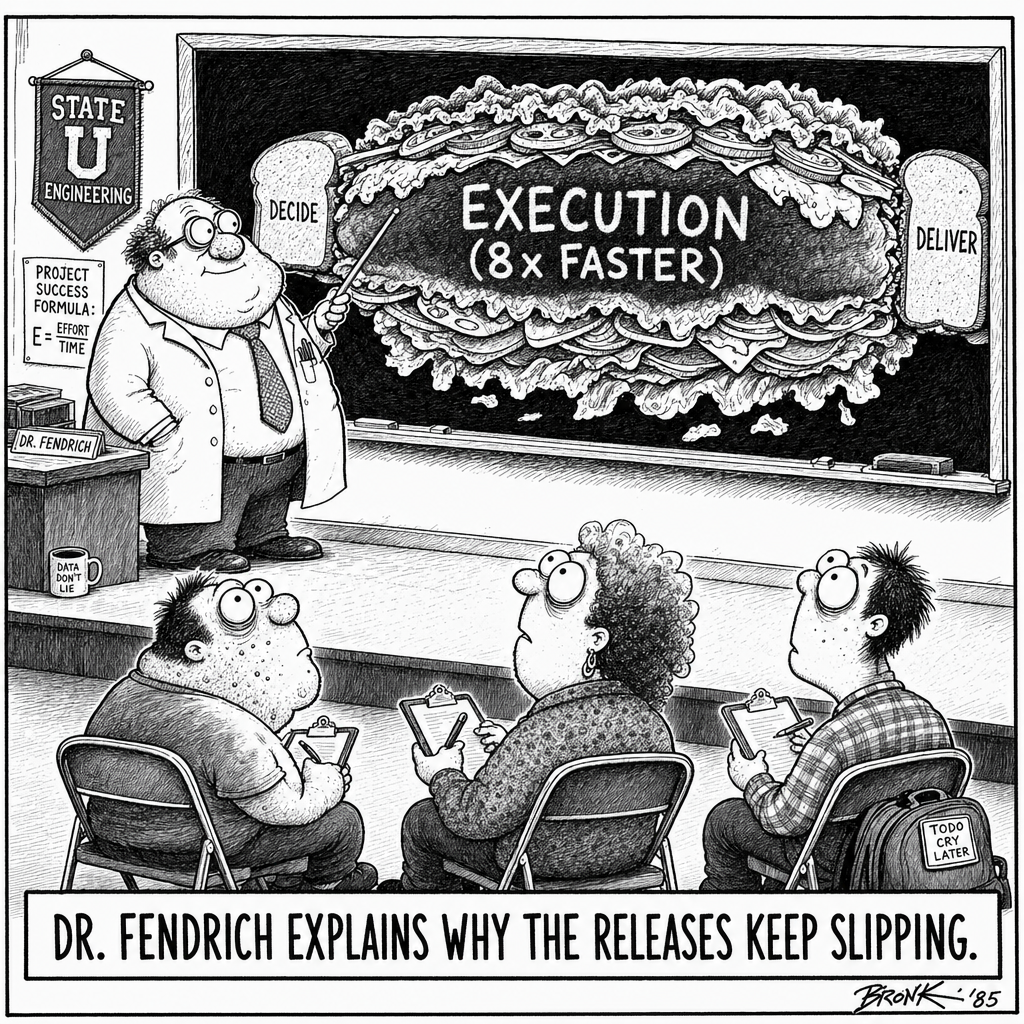
The essay's organizing frame is what Narayanan and Kappor call the "decide-execute-deliver sandwich."1 AI has compressed the execution layer — the middle — dramatically: a study across 100,000 GitHub developers found AI agents drove an eightfold increase in lines of code written. But releases grew only 30 percent.1 The two ends of the sandwich — deciding what to build, and being accountable for what ships — have not moved. They argue those ends resist automation not because of capability limitations but because they require accountability structures that don't collapse with model improvements.

The AI-washing angle is damning and well-documented. The essay walks through Block's February layoffs (Jack Dorsey cited AI; a data scientist on the Cash App team said the company "shoved AI down everyone's throats" with "very limited gains in productivity" and quit rather than take a 75% retention raise), Snap's April cuts (activist investor demanded cost reductions; the 150 AR-division jobs cut don't correlate with "AI-exposed" roles across the board), and Intuit's May reduction (the CEO actually pushed back on the narrative, saying "none of it had to do with AI"). A Forrester analyst summarized the pattern: nine out of ten companies planning supposedly AI-driven layoffs have no mature AI application ready to fill the vacated jobs.1

The Federal Reserve's own economists find software engineer employment still growing post-ChatGPT, just about three percentage points per year slower than a no-AI counterfactual — and that number may overstate the slowdown because the methodology can't capture self-employment and entrepreneurship, both of which AI appears to be making easier.1 The essay concludes with a version of Jevons's paradox applied to code: when software gets cheaper to produce, people buy more of it, and demand for the labor that manages the whole sandwich tends to grow rather than shrink.

None of this is comfortable triumphalism. Narayanan and Kappor note that individual careers will be rocky even as aggregate demand holds, and say so explicitly — their next essay in the series will address exactly who inside software engineering stands to gain or lose based on seniority, geography, and firm type. But the evidence they've assembled pushes hard against the premise that a capability threshold, once crossed, triggers mass layoffs. The sandwich model suggests that once the execution layer is instant and free, not much changes structurally — because it was never the bottleneck.


Rune Skovbo Johansen — best known for locomotion work and his VR game Eye of the Temple — has written up a game audio technique he developed for handling sound from irregular, non-convex shapes, which he calls Point Cloud Sound.3 The problem it solves is specific and genuinely annoying: the standard approach of moving a single audio source to the closest point on a volume breaks badly on non-convex geometry. Imagine a winding river where a point on the bank is equidistant to two completely different stretches of water. Move slightly left and the audio source snaps from one location to the other, which is audible and jarring with any directional sound technology.

Johansen's technique replaces per-object audio sources with a single audio source whose position, volume, and spread are computed each frame from a weighted sum over a set of point samples distributed through the sound-emitting shape. The key insight is elegant: while computing a weighted average of normalized direction vectors (weighted by attenuation), the resulting vector's magnitude naturally encodes how spread-out the contributions are. If all contributions pull in the same direction, the vector is long and spread stays near zero. If they cancel — sound coming equally from all directions — the vector collapses toward zero and spread approaches one. One subtraction (1 - averageDir.magnitude) gives you exactly the spread parameter Unity's audio system expects, for free, with no additional heuristics.

He uses it in Eye of the Temple for water streams at variable intensities, rustling foliage from thousands of trees, and foliage collision sounds when the player moves through bushes. The parametric extension lets a single point cloud drive multiple audio clips cross-faded by a continuous intensity value — so a water stream that becomes a waterfall transitions through a curve rather than snapping between states. The write-up includes working Unity/C# code and notes on the non-obvious parts, including why volume should attenuate by 1/d rather than 1/d² (it's amplitude, not intensity), and why the radius should clamp the minimum attenuation distance rather than let volume blow up as the listener approaches the center of a sample.


Daniel Lemire posted a short technical demonstration on June 14 of C++26 static reflection combined with #embed to parse a JSON config file entirely at compile time. Using GCC 16 with -std=c++26 -freflection and a recent version of simdjson, a single constexpr auto window = simdjson::compile_time::parse_json<json_data>() call reads the file, synthesizes a typed struct from its keys, and bakes the result into the binary as constants the compiler verifies with static_assert.4 The resulting assembly for a derived computation contains no field accesses, no parsing, and no multiplications — only immediate values. A malformed JSON no longer produces a runtime crash; it produces a build error. The code to reproduce is available on GitHub.

Trending today: GitHub is saturated with AI skills collections, agent wrappers, and curated-list aggregators — no technical novelty cleared the bar.

Sources
  1. Why AI hasn't replaced software engineers, and won't normaltech.ai Jun 11, 2026
  2. Simon Willison links: Why AI hasn't replaced software engineers simonwillison.net Jun 14, 2026
  3. Point Cloud Sound for irregular shaped audio sources blog.runevision.com Jun 2026
  4. Parsing JSON at compile time with C++26 static reflection lemire.me Jun 14, 2026

↑ Back to top

THE PELOTON

Van Aert Misses the Tignes Plane: Visma Names Eight for July Anyway

↩ Developing story — first reported Jun 13 · previously Jun 14

— The wound is still not healing. Visma | Lease a Bike confirmed to Velo on Monday that Wout van Aert would not board the plane to Tignes for the team's final Tour de France altitude camp.1 The team was unable to confirm his future schedule. Nineteen days to the start in Barcelona.

As this paper reported Sunday, the infected elbow — caused by TT extensions pressing against a training crash wound during Stage 3 of Tour Auvergne-Rhône-Alpes — has continued to swell despite Van Aert's return to Belgium for treatment. Visma directeur sportif Frans Maassen framed it bluntly: Van Aert is smart enough to judge for himself whether he needs the Tour to realise his Olympic dream, "or whether it's better to have an altitude training camp in Livigno in July."2 That's a diplomatic way of saying the Tour slot is not guaranteed.

Visma announced their eight-man Tour de France roster regardless: Jonas Vingegaard, Van Aert, Matteo Jorgenson, Simon Yates, Sepp Kuss, Tiesj Benoot, Victor Campenaerts, and Edoardo Affini — the latter making his Tour debut after Christophe Laporte was ruled out.3 Whether Van Aert actually rides remains open. The roster was published; the elbow has not read it.

Vingegaard, meanwhile, has been training at altitude in Tignes for a week already. Maassen noted that Norway — Van Aert's only race back from his Dwars door Vlaanderen crash — may have come "a little too early," though the Belgian improved every day and should have won the final stage.2 The shape is there, or was. The infection is the variable no one can control.


The broader picture from the Dauphiné is grim. Of 154 riders who started Tour Auvergne-Rhône-Alpes, only 91 finished — a 40 percent dropout rate in cycling's primary Tour de France dress rehearsal.1 A virus swept through the peloton and accounted for dozens; only Lidl-Trek and TotalEnergies finished with all seven of their riders intact when Isaac del Toro took the final stage Sunday.

Van Aert and Paul Seixas are the headline casualties, but Oscar Onley (Netcompany-Ineos) is another. He went into a ravine, landed in a tree, and dislocated his shoulder — potentially costing the resurgent British team half of its two-rider assault on the Tour's top five. Josh Tarling broke his collarbone and had surgery Saturday; typical recovery is six to twelve weeks, against twenty-one days to the Tour start. Netcompany-Ineos was targeting Stage 1's TTT with Tarling as the anchor. That plan is now under severe stress.

Decathlon CMA CGM confirmed Sunday that Seixas needs rest after his 70kph descending crash Saturday left him unable to control his bike through the final stage. Team medic Jacky Maillot said the crash was "very costly in terms of energy expenditure."1 The severity of Seixas' wounds remains uncertain; that he started Sunday at all suggests they are not disastrous, but the timing — three weeks before his debut in cycling's biggest race — is not ideal.

For context on what Del Toro did to these survivors: starting 46 seconds behind Australian revelation Luke Tuckwell on the final stage, Del Toro went early with 9km remaining, extended a one-minute gap to Juan Ayuso, and smashed Vingegaard's 2022 climbing record to Solaison by 1:34.4 When asked if it was his best climbing performance, he said no. "I think still not." He will be working for Pogačar in July.


The Tour de Suisse opens Wednesday in Sondrio and runs five days to Villars-sur-Ollon (June 17–21), shortened this year from eight stages in an attempt to keep the race "financially sustainable." Tadej Pogačar — eight wins from eleven race days in 2026 — makes his Tour de Suisse debut and is the overwhelming favourite.5 He won four of five stages at Tour de Romandie; anything short of a dominant Switzerland performance would start questions about July form, and there is little in his season so far to suggest that outcome.

The rest of the field is making the best of a complicated situation. Richard Carapaz returns to racing for the first time since March, picking up a third at GP Gippingen Sunday and hoping to build toward his Tour de France lead role at EF Education-EasyPost. Primož Roglič's plans remain fluid — a fifth Vuelta title is his stated summer aim, but he has won every other major week-long stage race and the Tour de Suisse is conspicuously missing from that list. Antonio Tiberi makes his Tour de France debut in July; he has been quiet since UAE Tour in February and needs a result. Tom Pidcock is back on the road after a mountain bike excursion, racing his first road event since Eschborn-Frankfurt in May. Soudal-QuickStep send Ilan Van Wilder as GC leader in a first post-Evenepoel summer.


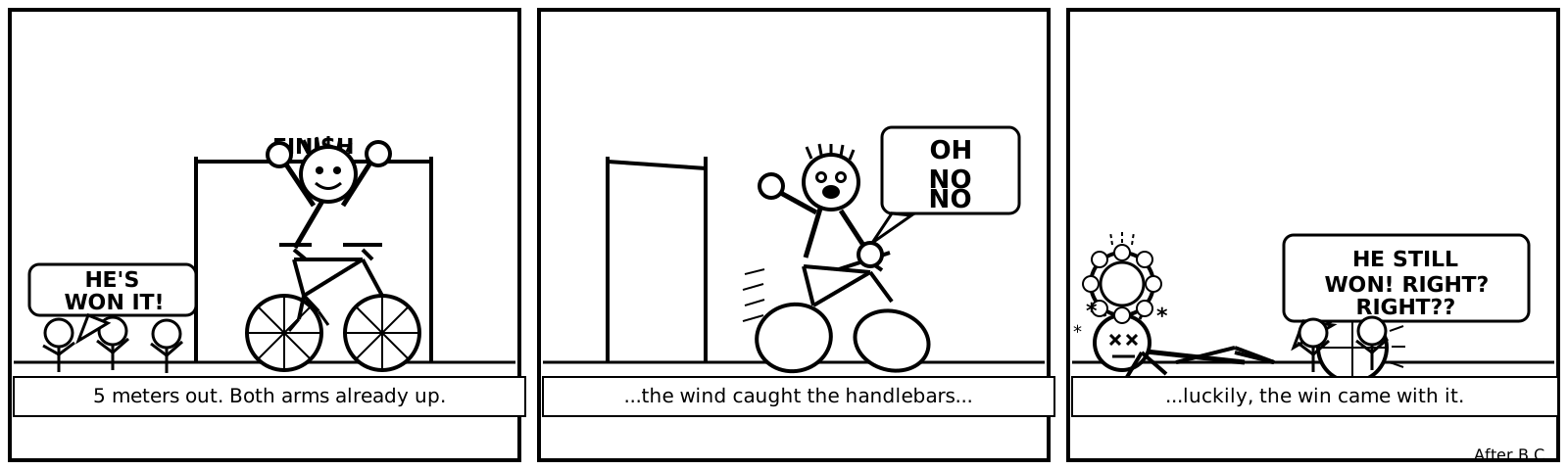
On Sunday in Switzerland, Liam Slock (Lotto-Intermarché) took his first professional victory at GP Gippingen in a manner the sport will not quickly forget. The 25-year-old bridged across to an Aleksandr Vlasov–Richard Carapaz attack in the finale, conserved energy, then won the uphill sprint with enough margin to begin celebrating in the final metres before the finish line. The wind caught his handlebars and he went down. He still crossed before Vlasov. "Luckily the win came with it," said Slock, "otherwise this would probably have been the fail of the year."6


In May, Chloé Dygert was reported close to a two-year deal with Virginia's Blue Ridge-TWENTY28, the US continental team where she spent four seasons before joining Canyon-SRAM in 2021.7 The move would effectively pause her Women's WorldTour career and redirect her toward the LA 2028 Olympics. Dygert has raced only six times this season — she revealed a diagnosis of hormonal deficiencies and elevated cortisol levels on Instagram — and her Canyon-SRAM contract expires at year's end. Management at Blue Ridge-TWENTY28 told Velo the deal was "most likely" to happen. No signing has yet been announced.

On the Road Ahead
Updated Jun 15, 2026
DateRaceCountry
Wed–Sun, Jun 17–21Tour de Suisse (Stages 1–5)Switzerland / Italy
Fri, Jul 4 – Sat, Jul 26Tour de France (Stages 1–21)France / Spain
Sat, Aug 1Donostia San Sebastián KlasikoaSpain
Mon–Sun, Aug 3–9Tour de PolognePoland
Sat, Aug 16ADAC Cyclassics HamburgGermany
Sources
  1. Van Aert Infected, Seixas Smashed, 63 DNFs: The Race That Threatens Chaos for the Tour de France velo.outsideonline.com Jun 15, 2026
  2. Van Aert joins Vingegaard at Tignes altitude camp ahead of Tour selection cyclingnews.com
  3. Team Visma | Lease a Bike announces Tour de France line-up teamvismaleaseabike.com Jun 2026
  4. Isaac del Toro takes another step cyclingnews.com
  5. Can anyone beat Tadej Pogačar? Contenders for the Tour de Suisse cyclingnews.com Jun 15, 2026
  6. Liam Slock wins GP Gippingen, crashes celebrating before the line cyclingnews.com Jun 15, 2026
  7. Chloé Dygert Makes Surprise Pivot: Stepping Away from Euro Road to Focus on LA Olympics velo.outsideonline.com May 17, 2026

↑ Back to top

THE LONG READ

The Giro Was Never the Point

Five stage victories. Twenty-one days without a crisis. No crashes, no illnesses, no rival capable of pushing Jonas Vingegaard into the red. He rolled into Rome as the dominant winner of the 2026 Giro d'Italia and became just the eighth rider in history to complete the career grand tour sweep — and the criticism arrived almost immediately: the race was boring, there was no real challenge, it didn't prove anything.1

The critics missed the point, because Visma-Lease a Bike never wanted it to prove anything about the Giro. They wanted it to prove something about July.

This was the strategic gambit Visma's team management committed to in November: rather than give Vingegaard a traditional Tour de France build through spring classics and altitude camps, they would send him through all twenty-one stages of the Giro d'Italia first. Race into form. Win the pink jersey. Then take that fitness — that confirmed, tested, race-hardened fitness — and point it at Tadej Pogačar on July 4 in Barcelona.1

The logic cuts against received wisdom in grand tour preparation. The standard model says you protect your GC leader, arrive at the Tour fresh, save the legs. Visma looked at two years of Vingegaard finishing second to a Pogačar who seemed to improve through a race while Vingegaard ran out of answers in the final mountains, and decided the standard model wasn't working. They needed a different body. So they built one inside a grand tour.

What the Giro produced was confirmation, not just of form but of psychological reconstruction. In April 2024 at Itzulia Basque Country, Vingegaard suffered a collapsed lung, a broken collarbone, and multiple broken ribs in a high-speed descent crash that raised the question of whether he would ever again be the rider who cracked Pogačar on the Col du Granon in 2022.1 He got back to the 2024 Tour and finished second, but never had the explosiveness that moment demanded. In 2025, Visma pressured Pogačar repeatedly across the first half of the race, and Vingegaard had nothing to answer when it counted. The Slovenian was simply stronger.

Three weeks in Italy just changed that narrative. In the last fifty years, only two non-sprinters have won at least five stages in a single Giro: Pogačar with six in 2024, and now Vingegaard with five in 2026.1 He didn't just control the race — he methodically dismantled it, then said afterwards: "I've believed in this project to do Giro-Tour since November and now I feel that my body can go for the next grand tours. I'm not on my knees."1

That last phrase is the real headline. Not the maglia rosa, not the career sweep, not the historic company he now keeps. "I'm not on my knees" is what two years of rehabilitation, defeat, and self-doubt sounds like when it finally turns a corner.


Pogačar knew it too. According to UAE Emirates-XRG sports director Marco Marcato, the Slovenian tracked every move his biggest rival made across three weeks in Italy. "It is about looking at the overall level of the performance," Marcato told the Danish outlet Feltet. "He did everything perfectly. Vingegaard's Giro could give Tadej extra motivation to arrive at the Tour in the best possible shape."1

That sentence deserves a second read. The rival team's sports director is not conceding — he is saying Pogačar watches, evaluates, and recalibrates. The implication is that the Giro just told Pogačar something he needed to know: the easy Tours of 2024 and 2025 may be over.

Visma is bringing one of its strongest support rosters in years to match the challenge. Sepp Kuss and Matteo Jorgenson for the high mountains. Wout van Aert — fresh off Paris-Roubaix — on the flats alongside Victor Campenaerts and Eduardo Affini. Ben Tulett and Bruno Armirail round out the squad. Team boss Richard Plugge framed the moment in explicit terms: "We won Paris-Roubaix with Wout, and now the Giro with Jonas. He will be a contender again in the Tour, but first we need to let this sink in."1

The word "again" is doing heavy lifting there. Vingegaard has been a contender in every Tour since 2022 — the implication is that being a genuine threat is something different, something that required this Giro to restore.

Vingegaard leaves Italy and plans an altitude camp at Tignes later this month before arriving in Barcelona on July 4. Pogačar will be there, doubly motivated, racing to join the five-win club of yellow jersey winners. The Giro was the proving ground. The Tour has always been the target. And for the first time since the crash, the proving ground delivered the right answer.

Sources
  1. Vingegaard's Giro-Tour Double Looked Like a Gamble — Now It Looks Like Genius velo.outsideonline.com Jun 1, 2026

↑ Back to top

FROM THE ARCHIVE

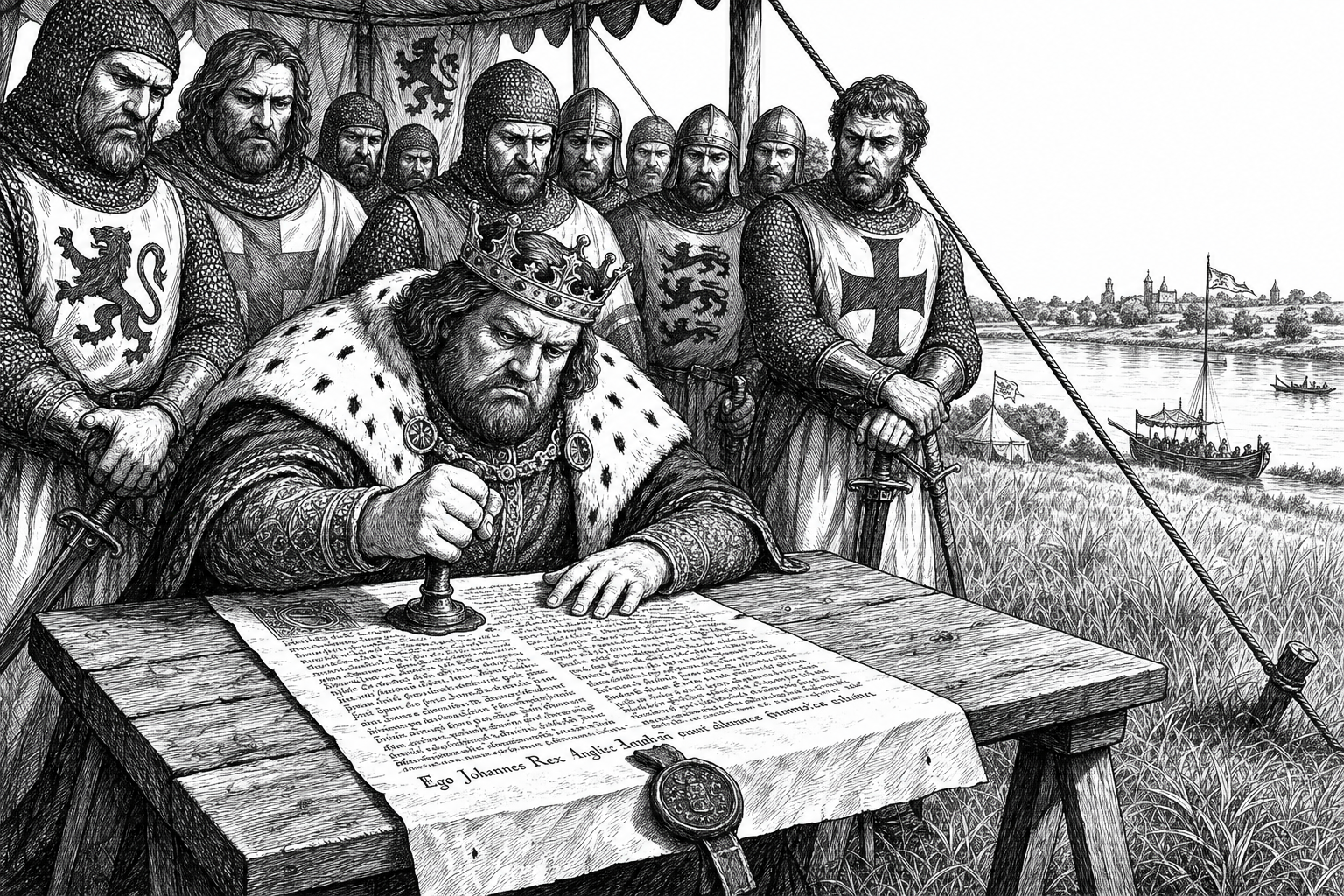
The Meadow at Runnymede: June 15, 1215

Lead illustration

A river meadow in high summer, the Thames wide and flat behind a pavilion tent. A heavyset king in crown and ermine-trimmed robes hunches over a parchment on a trestle table, his seal pressed into wax with visible reluctance — jaw set, eyes averted. Around him, a press of armored barons in chain mail and surcoats crowd close, hands on sword pommels, watching. Grass bent by their boots, pennants limp in still air. Hatched shadows fall hard across the king's face. Strong diagonals from the tent ropes to the table edge. The document fills the foreground, its columns of cramped Latin text visible but illegible. No color, no gradients — pure black ink linework with dense cross-hatching in the shadows, bold white space in the sky.

Rebel barons forced a king into a meadow by the Thames and made him sign a document he had every intention of ignoring. He did ignore it — and it still changed everything.

June 15, 1215. John of England, cornered by a rebellion he couldn't win militarily, sealed the Magna Carta at Runnymede. The charter ran to 63 clauses and dealt mostly with feudal grievances: inheritance rights, debt collection, fish weirs.1 The barons wanted their specific privileges protected, not a constitutional order. But buried in clause 39 was something that would outlast every fish weir and every baron who demanded it: "no free man shall be arrested or imprisoned or disseised or outlawed or exiled or in any way victimised… except by the lawful judgment of his peers or by the law of the land."1 The king was bound by law. That was the claim. It had never quite been put that way before.

The immediate result was catastrophe. John petitioned the Pope, who voided the charter within weeks as unlawful and shameful. Civil war broke out the same year. John died in 1216 having honored none of it.1 His nine-year-old heir Henry III reissued a revised version to stabilize his reign, then again in 1217 after the rebel barons were defeated, and a third time voluntarily in 1225 — that version entered English statute law.1 The document survived not because the original signatories protected it but because successive governments found it useful.

What clause 39 eventually became — the template for habeas corpus, the inspiration for England's 1628 Petition of Right, the foundation of the Habeas Corpus Act of 1679 — was not what anyone in that meadow intended. The barons wanted protection from an arbitrary king. What they accidentally wrote was an argument that no government is above the rules it operates under. Historians have spent centuries deflating the mythology (it did not establish Parliament; it made no ringing guarantees of democracy), but the principle embedded in that single clause proved harder to contain than the document itself. Four originals survive: one each at Lincoln Cathedral and Salisbury Cathedral, two at the British Museum.1 811 years old today.

Sources
  1. King John puts his seal on Magna Carta history.com Nov 24, 2009

↑ Back to top

THE FUNNIES

Celebration DNF; The Sandwich Diagram

After B.C. — on Liam Slock's unforgettable GP Gippingen victory, in which he began celebrating five meters before the line, got caught by the wind, and crashed across it anyway. After The Far Side — on the AI "decide-execute-deliver sandwich," where the enormous middle layer got eight times faster and the output end barely noticed.

Hand-drawn parody comic strip
AI-rendered parody comic strip

↑ Back to top

ALSO NOTED

Also Noted

↑ Back to top

THE QUESTION

When the Middle Explodes, Does the Output Move?

What does it mean when your most convincing proxy for progress turns out not to measure the thing that actually matters?

Today's edition raises that question twice from opposite ends of the same problem. In THE LAB, Arvind Narayanan and Sayash Kapoor report that AI agents drove an eightfold increase in lines of code written across 100,000 GitHub developers1 — and that releases grew only thirty percent.1 The execution layer, the middle of what they call the "decide-execute-deliver sandwich," got dramatically faster. The output end barely moved. The bottleneck was never the middle; it was always the two ends that require judgment, accountability, and someone willing to be wrong in public. When you flood the middle with throughput, the ends don't automatically follow.

THE PELOTON is showing the same structure in a different vocabulary. Tour Auvergne-Rhône-Alpes produced enormous "signal" — 154 starters, 63 DNFs, a virus sweeping the peloton, a 70kph crash, broken collarbones and infected elbows.2 The race did exactly what a Tour de France dress rehearsal is supposed to do: it stressed every rider, filtered the field, generated data. The problem is that the output end — who will actually be fit and capable in Barcelona on July 4 — is now more confused than before the race started. TARA ran. The middle executed. The readiness question is no clearer.2

The pattern is not coincidence. Throughput is easy to measure and hard to argue with. Lines of code, DNF rates, laps completed, commits merged — these are legible numbers that feel like progress because they are unambiguous. The ends of any serious process — deciding whether to build the thing at all, or whether the athlete who just survived a grueling race is actually in better shape for the one that counts — resist the same legibility. They require inference, judgment, context that numbers can't carry alone. Both the AI skeptics and the cycling medical staff are wrestling with the same underlying question: when the middle of the process produces more output than anyone has ever seen before, how do you know whether anything important actually changed?


That question travels well. It applies to the next standup where someone shows a sprint velocity chart trending up. It applies to reading a training log where weekly TSS is the highest it's ever been. The metric is real; what it predicts is a separate and harder problem.

Sources
  1. Why AI hasn't replaced software engineers, and won't normaltech.ai Jun 11, 2026
  2. Van Aert Infected, Seixas Smashed, 63 DNFs: The Race That Threatens Chaos for the Tour de France velo.outsideonline.com Jun 15, 2026

↑ Back to top

Investigator Report

Investigator report — 2026/06/15

Verdict

A strong edition with coherent cross-section theme and genuinely good prose in THE LAB and THE PELOTON. The "decide-execute-deliver sandwich" angle in THE QUESTION successfully bridges the two dominant sections in a way that earns its place. The edition falls short in three specific places: the Long Read writer patched a June 1 source article with current roster information but got it wrong (wrong riders named), the ON THE TRAIL picks omit all per-day mileage and elevation figures required by spec, and THE WORLD's bullet compression rule was breached by three of four bullets. The pipeline ran cleanly with no missing agents and one benign fetch failure. Total cost $9.36 at 22 agents.


Frontpage

The rendered PNG is clean and readable. Visual hierarchy is clear: THE PELOTON DISPATCH masthead at 56px is dominant, the daily strip "● Hot and clear at 88°F — perfect summer kit day" is a useful entry point. The lead image (Magna Carta pen-and-ink) sits in the bottom-left of the archive row and is well-sized — the armored barons and reluctant king read at frontpage scale. The headline font for THE LAB at 44px and THE PELOTON at 30px creates appropriate visual ranking between the two columns in row 1.

One layout note: the ALSO NOTED column in row 2 renders only the bullet headline text ("Carolina Hurricanes win the Cup," "Route 66 record at 66," etc.), which is the intended behavior, but the gradient fade cuts off mid-list in a way that makes the column look unfinished rather than inviting. The FROM THE ARCHIVE body text is visibly faded in the lower portion of the page, as the art director's own log notes: "the Petition of Right / Habeas Corpus Act legacy paragraph clipped by overflow fade." This is a structural limit of the fixed-canvas layout, not an error.

Section ordering on the frontpage follows priority within the hardcoded row structure: THE LAB (82) sits left of THE PELOTON (79) in row 1, which is correct. THE WORLD (84) gets the headline banner, also correct. No sections are missing from the rendered page. No duplicate headlines or paragraphs were found.

The deployed index.html shows sections in this order: THE WORLD, THE LAB, THE PELOTON, THE LONG READ, FROM THE ARCHIVE, THE FUNNIES, ALSO NOTED, THE QUESTION. This follows the section_tiers config exactly — tier 0 (PELOTON, LAB, WORLD) then tier 1 (LONG READ, ARCHIVE) then tier 2 (FUNNIES) then tier 3 (ALSO NOTED) then tier 4 (QUESTION). THE QUESTION's priority of 80 is higher than THE PELOTON's 79, but section tiers deliberately override priority for the long-form web view. No mismatch.


Priority ranking

SectionPriorityLength (approx)ImageNotes
THE WORLD84~1,700 words (incl. ON THE TRAIL)Lead banner
THE LAB82~800 wordsLeft col, row 1
THE QUESTION80~400 wordsTier 4; renders last in web
THE PELOTON79~900 wordsRight col, row 1
THE LONG READ76~750 wordsMid col, row 2
FROM THE ARCHIVE40~300 wordsyesArchive row with lead image
ALSO NOTED12~500 wordsWithin priority band
THE FUNNIES8description onlyWithin priority band

The ranking is broadly defensible. A U.S.-Iran peace deal signing plus a G7 opening day justifies THE WORLD at 84. THE LAB at 82 is slightly aggressive for an essay summary — it's a recap of a well-argued piece by Narayanan and Kappor, not a primary technical find — but the Rune Skovbo Johansen and Lemire items support the priority. THE PELOTON at 79 is correct for a Van Aert injury/roster story with Tour context. FROM THE ARCHIVE at 40 matches the config's hard cap (priority_cap: 45) and is appropriately placed. No priority inflation or compression to flag.


Editorial reading

Long Read roster paragraph introduces factual errors and stale framing. The article's penultimate paragraph describes the Visma Tour de France roster as: "Sepp Kuss and Matteo Jorgenson for the high mountains. Wout van Aert — fresh off Paris-Roubaix — on the flats alongside Victor Campenaerts and Eduardo Affini. Ben Tulett and Bruno Armirail round out the squad." This is wrong in three ways. First, the official TDF roster announced June 15 (and accurately stated in THE PELOTON) is Vingegaard, Van Aert, Jorgenson, Yates, Kuss, Benoot, Campenaerts, and Edoardo Affini. Tulett and Armirail are not on it; Simon Yates and Tiesj Benoot are. Second, "Eduardo" should be "Edoardo." Third, "fresh off Paris-Roubaix" was accurate in the June 1 source article but is actively misleading in a June 15 edition whose lead story is that Van Aert's infected post-TARA elbow has kept him from traveling to Tignes — Paris-Roubaix was two months ago and has since been superseded by a crash, treatment, and a Tour doubt. The fact-checker for THE LONG READ confirmed "15 claims checked, 0 removed" but did not catch this paragraph, likely because it was framed as editorial commentary rather than a sourced claim. The patch to the stale article introduced the error.

THE LAB misspells Sayash Kapoor's name throughout. The article consistently writes "Sayash Kappor" — with a double p, no second o — while THE QUESTION correctly writes "Kapoor." Both pieces are about the same essay by the same co-author. The fact-checker for THE LAB did not flag this. Small error, but it appears three times in the main text and would undermine a reader who tried to search for the author.

ON THE TRAIL picks omit per-day mileage and elevation, and skip the required 2-night option without explanation. The config spec (newspaper.yaml section on THE WORLD → ON THE TRAIL) explicitly requires: "Per-day mileage AND elevation gain to/from camp. Format e.g. 'Day 1 in: X mi, +Y ft / Day 2 out: X mi, –Y ft'" and adds "Trip-total mileage and gain are not enough on their own — split per-day so the reader can size the days against fitness and pack weight." None of the three picks (Sheep Lake, Owyhigh Lakes, Mason Lake) provides this breakdown. Mason Lake shows only an optional-push total ("11 mi, 3,500 ft total"), not a per-day split to/from camp. The spec also says "Show at least one 1-night and one 2-night option when the data supports it. If only one length is viable, say so." All three picks are labeled 1-night; no 2-night is offered and no explanation is given. This is a recurring gap in ON THE TRAIL sections and it matters practically — the reader planning a Juneteenth 4-day weekend has explicit PTO to burn and presumably wants to evaluate a longer option.

THE WORLD bullet word caps are breached. The config's hard caps state each bullet must be ≤ 25 words, with the whole world block ≤ 120 words total. Counted verbatim: Iran deal bullet is 27 words, G7 opens bullet is 26 words, UK social media ban bullet is 30 words, Missouri crash bullet is 24 words. Total 107 words (within the block cap) but three of four individual bullets are over. The UK social media ban bullet is the worst offender at 30 words — it could shed the "spring 2027 start" detail, which is already visible in the source, to come in under. This was a documented failure mode in the April 26 edition and the config even calls it out by name ("The 04/26 edition shipped 262 words across 4 bullets — that was a compression failure"), yet the writer still let three bullets run long.

THE QUESTION re-narrates sibling content at length rather than pivoting. The lede opens correctly on a structural question ("What does it mean when your most convincing proxy for progress turns out not to measure the thing that actually matters?"), which passes the FORM TEST. But paragraph two then names specific statistics from THE LAB ("AI agents drove an eightfold increase... releases grew only thirty percent") and paragraph three names specific statistics from THE PELOTON ("154 starters, 63 DNFs, a virus sweeping the peloton, a 70kph crash"). The config's LEDE RULE says "A sentence or two of context is fine; a second full recap of a story already in THE LAB / THE PELOTON / THE LONG READ is not." Paragraph two is a recap paragraph. The structural insight — that throughput metrics decouple from outcomes in both code and racing — is genuine and well-expressed in paragraph three, but it's buried behind one paragraph too many of re-narrating what the reader already read five minutes earlier.


Pipeline observations

Agent set. 20 subagents ran: Scout, Researcher, 5 writers (WORLD, PELOTON, LAB, LONG READ, ARCHIVE), Meta-Writer, THE QUESTION (reflector), ALSO NOTED (sweep), comic strip (SVG), Funnies (OpenAI), Art Director, Thread Editor, and 6 fact-checkers (WORLD, PELOTON, LAB, LONG READ, ARCHIVE, QUESTION, ALSO NOTED). The trace summary counts 22 named agents because the comic-strip agent appears once as "Draw today's TWO parody comic strips for" and there is a separate "Funnies (OpenAI)" call. No agent is missing. No duplicate agents. The expected dedup step does not appear in the subagent list but covered.json is present (275 URLs, 4 GitHub repos, 10 local stories), indicating it ran within the orchestrator or as an inline step before Step 1.

Fetch failures. One unrecovered fetch failure: pages/cycling/soudal-qs-tdf-roster.md failed on all methods (direct → curl → proxy → proxy-js). The source was soudal-quickstepteam.com, which is not on the paywalled domains list. THE PELOTON correctly dropped the Soudal QS roster story with an explanation ("Source file contained only reader forum comments with no usable facts from the team announcement" — this matches the cyclinguptodate.com fallback content that was retrieved instead). ALSO NOTED similarly dropped it. The section gap is defensible; no impact on edition quality.

Fact-checker missed Long Read roster patch. The FC: THE LONG READ agent ran 83s, verified 15 claims against the June 1 source file, and passed everything. It did not compare the roster paragraph against the newer pages/cycling/visma-tdf-roster.md file that was available in the edition. The fact-checker protocol for LONG READ reads against the article's own cited source; it did not cross-reference against sibling section files. This is a gap in the fact-checker's scope when a stale source article has been editorially patched with new information that needs to be verified against a different source.

Starting commit. The dispatch commit (1f3fdd4) was run on 2026-06-15 with parent commit 9c600be (Investigator: 2026-06-14, same day). The starting commit is same-day, so no stale worktree concern.

No pipeline alerts file. log-pipeline-alerts.md is absent; no critical pipeline flags from the dispatch run.


Trace highlights

Researcher at $2.59 is the dominant spend, dwarfing all writers combined. The researcher consumed 5.5M cache read tokens and ran 1,037 seconds — nearly 17 minutes. The five regular writers together cost $0.82. The brief is comprehensive and clearly used (the LAB and PELOTON writers both pulled heavily from it), but the asymmetry is worth watching: a researcher that costs 3x the writers it serves is expensive relative to the editorial uplift.

Orchestrator at $2.42 is the second-largest cost with 25,600 output tokens. The orchestrator emitted more output tokens than any individual agent and consumed nearly 5M cache read tokens. Its step-logging is verbose ("Still mid-pipeline — commit happens at Step 8. Waiting for writer completions" appears four times). This is not a defect but suggests the orchestrator's self-narration is expensive; trimming mid-pipeline status messages could reduce this cost.

Art Director at 373 seconds is the longest-running single agent. This is notably longer than the Researcher's per-turn time and longer than all writers. The art director received the full content.json (18 input tokens in the trace) and produced 397 output tokens. The duration suggests repeated tool calls or layout iteration — possibly the art director re-reading and re-rendering. The result is correct and clean, but 373s on the critical path adds wall-clock time.

THE WORLD writer at 205s with only 5 output tokens is suspicious. The trace shows THE WORLD wrote 5 output tokens — essentially nothing — at a cost of $0.32. This is unusual compared to THE PELOTON (111s, 132 output tokens) and THE LAB (83s, 46 output tokens). The 5-token figure likely reflects a large pre-cached article body passed through without much model output, but the wall-clock time of 205s suggests the writer was doing significant tool work (fetching WTA reports, reading NWS forecasts). This is probably correct behavior given THE WORLD's heavy ON THE TRAIL content, but it's worth confirming the output-token count is not masking a truncated write.

Trace summary
AgentDurInputOutputCache ReadCache 5mCache 1hCost
Scout263s61538225305895970$ 0.42
Researcher1037s23543165555133162242500$ 2.59
THE WORLD205s65112873772830$ 0.32
THE PELOTON111s9132135069338260$ 0.17
THE LAB83s846127767355070$ 0.17
THE LONG READ74s7958231167070$ 0.08
FROM THE ARCHIVE33s6455616161150$ 0.08
Meta-Writer31s61047256201430$ 0.09
FC: FROM THE ARCHIVE109s6847127147283350$ 0.15
FC: THE LONG READ83s6863318220860$ 0.10
FC: THE LAB180s98199248416720$ 0.22
FC: THE PELOTON222s97165321381570$ 0.19
Illustrator173s2315488000$ 0.22
FC: THE WORLD158s848131839312250$ 0.16
THE QUESTION75s5350272315590$ 0.13
FC: THE QUESTION91s78102491278880$ 0.14
ALSO NOTED118s11100259983500930$ 0.27
Draw today's TWO parody comic strips for200s23381684073406360$ 0.36
FC: ALSO NOTED166s563130313743367590$ 0.24
Funnies (OpenAI)228s2987024000$ 0.28
Art Director373s18397679491609180$ 0.44
Update story threads for today's edition116s5433279307030$ 0.13
Orchestrator138256004895936093762$ 2.42
TOTAL31753410821398157495345993762$ 9.36

Suggestions for next edition

Enforce per-day mileage format in the ON THE TRAIL writer prompt. The spec is explicit ("Day 1 in: X mi, +Y ft / Day 2 out: X mi, –Y ft") and the world writer has now omitted it across multiple picks. Adding a preflight check list directly in the writer-world agent prompt — "before submitting each pick, confirm you have stated per-day mileage AND elevation in the required format" — would close this gap. A 2-night option requirement (or an explicit statement that conditions only support 1-night) should be in the same preflight.

THE LONG READ fact-checker should cross-reference sibling section files when the source article is flagged stale. When research.md marks a source as [STALE — 14d] or Evergreen_ok, the fact-checker for that section should be instructed to verify any editorial updates against other available source files in the same edition, not only against the article's primary cited source. The Tulett/Armirail roster error would have been caught if the Long Read FC had compared the roster paragraph against pages/cycling/visma-tdf-roster.md.

THE WORLD bullet compression needs a hard preflight. Three of four bullets exceeded 25 words today, repeating a failure mode the config explicitly documents from April 26. The world writer prompt should require counting words in each bullet before writing the final output, with a hard stop if any bullet is over 25. A simple "count and rewrite until ≤ 25" instruction would prevent this.

THE QUESTION should resist re-narrating statistics already in sibling sections. The question's second paragraph repeats exact numbers from THE LAB ("eightfold increase," "thirty percent") and the third repeats exact numbers from THE PELOTON ("154 starters, 63 DNFs"). The QUESTION prompt already says "don't re-report any story's details," but it should add: if your context paragraph contains the same statistic that appeared verbatim in a sibling section, replace the statistic with the inference it supports.