SONDRIO, Italy — With 71.5km still to race, Tadej Pogacar looked back at the group trying to stay his wheel, turned back to the road, and rode away. Not a sprint, not a surge — a quiet, measured acceleration that nobody could follow. By the time he crested the Triangia climb, he had the race to himself. He would not see another rider until the finish line.
Stage 1 of the Tour de Suisse was supposed to be a test. Instead, it was a statement: Pogacar is in a different condition than the rest of the field, and after just one of five stages the race for the jersey behind him has already begun. The world champion won by 2:14 over Richard Carapaz, who was himself 15 seconds clear of Andrea Bagioli after soloing for 50km in second place. Primož Roglič, present with a proper start list and nothing to show for it, finished 4:44 down. Mathieu van der Poel, who had been mentioned as a threat for punchy stages, lost 13 minutes.
Pogacar's ride was his 118th career victory, and the tenth win from twelve race days in 2026.1 UAE had set the race up on the Buglio in Monte climb, with Nils Politt and Tim Wellens forcing the pace before Pogacar and Brandon McNulty moved clear. McNulty did one turn, Pogacar looked back, and then it was over. "I didn't have radio at that time, so I didn't know what's going on in the back, so I just kept riding hard," Pogacar said afterward.1 He was also visibly drenched in sweat and spent portions of the solo effort cooling himself with water, scratching his back, and reconnecting his radio — details that say more than any gap time about how unthreatened he was feeling.1 The GC situation ahead of Saturday's 24km time trial and Sunday's mountain finale at Villar-sur-Ollon is, in practical terms, settled.
In the women's race, Elisa Longo Borghini (UAE Team ADQ) attacked solo on the final climb of stage 2 to take the win and the GC lead in Locarno. Kasia Niewiadoma-Phinney had accelerated on the penultimate climb at Fanghi and formed a lead group of five, but the race split again on the descent before Longo Borghini made her decisive move on the 1.2km, 8.9% pitch at Orselina. She had ten seconds at the summit, built it on the descent, and the result was secure before chaos struck the chase: Marlen Reusser and Niewiadoma-Phinney missed a left turn with 3km to go and went off-course, handing second place to Sarah Van Dam, who had narrowly avoided a crash earlier on the descent. Steffi Häberlin finished third after outsprinting the two navigation casualties. "I found myself with a gap and just went straight to the finish line," Longo Borghini said. "It was all or nothing, and this time I succeeded."2
At the Circuit Franco-Belge, Corbin Strong (NSN Cycling Team) took his first win of 2026, out-pacing a group sprint from Anders Foldager (Jayco-AlUla) and Paul Magnier (Soudal-QuickStep), who was racing in his home country a day before his Tour de France selection picture sharpens further.
The full story of Wout van Aert's Tour de France withdrawal, as this paper reported Wednesday, was worse than the initial disclosure. Visma-Lease a Bike's head of performance Mathieu Heijboer confirmed to Belgian media that the decision to operate was not elective. "The wound was surgically cleaned during a check-up on Monday," Heijboer said. "That intervention was truly necessary. Otherwise, there was the possibility of sepsis. The situation was extremely serious."3 Van Aert had spiked a fever, developed an abscess on the elbow, and could no longer bend the joint. By Monday, he had spent a night in the hospital ward in Herentals. The bacterial infection appears to have taken hold when van Aert was riding his time trial position during stage 3 of the Tour Auvergne-Rhône-Alpes — Belgian press floated the theory that contact between the wound and his TT skis introduced the bacteria, though Heijboer said the exact origin remains unknown. Van Aert has been discharged and is receiving daily intravenous antibiotics; the team will announce its revised Tour eight next week. Heijboer named Ben Tulett, Wilco Kelderman, and Bart Lemmen as candidates to fill the spot. "Jonas is also extremely disappointed, because he knows the role Wout played for him in the past in winning the yellow jersey," Heijboer said. "He is an irreplaceable link."3
Romain Bardet will return to Decathlon CMA CGM in January 2027 as Sports Manager, taking responsibility for the full sporting structure from the WorldTour squad down through development and junior programmes. The former Tour de France podium finisher — he rode back-to-back second and third places in 2016 and 2017 — spent nine years with the team before departing for DSM in 2021 and retiring partway through 2025. He will sit above Director of Racing Sebastien Joly and below CEO Dominique Serieys. Reports this week had linked Bardet to a mentorship role with 19-year-old sensation Paul Seixas, but Bardet was direct about the scope: "My responsibility will be to provide the best possible structure for the 30 riders in the WorldTour, the 15 New Gen, and 12 or 13 in the Junior."4 He will have no official role in this year's Tour. The team currently sits fourth in the world ranking.
Oscar Onley has rejoined Netcompany-Ineos at a pre-Tour training camp following last Friday's crash at the Tour Auvergne-Rhône-Alpes, when he went over a roadside barrier and into trees above a ravine on the descent of the Côte d'Héry-sur-Ugine. Team boss Dave Brailsford told Belgian media that Onley landed in the crowns of a tree, which prevented him from falling into a ravine tens of meters deep.5 He dislocated a shoulder and suffered multiple wounds; team staffers and race organisation personnel had to hoist him back up. His Tour de France status remains uncertain — the team's medical staff will make a decision after the Tour de Suisse concludes June 21. Josh Tarling, who fractured his collarbone the same day, is also unresolved. Both decisions hinge on doctors, not the riders.
Chloé Dygert has confirmed she faces two surgeries: a shoulder operation stemming from her crash at Paris-Roubaix Femmes, where rehab failed, and a procedure for a collapsed nasal valve identified in follow-up scans.6 Writing on social media, Dygert described the compounding problems — a RED-S diagnosis, a subsequent virus, adverse blood markers — and said her goals have not changed, only the timeline. Her Canyon-SRAM contract is expected to end, with a move to Virginia's Blue Ridge-TWENTY28 reported as close but not yet announced.
On the Road Ahead
Calendar from Jun 15, 2026 — primary source blocked today
Date
Race
Country
Wed Jun 17 – Sun Jun 21
Tour de Suisse, Stages 2–5 (ongoing)
Switzerland
Fri Jul 4 – Sun Jul 26
Tour de France
France
Sat Aug 1
Donostia San Sebastian Klasikoa
Spain
Mon Aug 3 – Sun Aug 9
Tour de Pologne
Poland
Sat Aug 22 – Sun Sep 13
La Vuelta a España
Spain
Show Results
TOUR DE SUISSE — STAGE 1 (MEN)
WINNER: Tadej Pogacar (UAE Team Emirates-XRG) — 3:28:37
PODIUM: 2. Richard Carapaz (EF Education-EasyPost) +2:22; 3. Andrea Bagioli (Lidl-Trek) +2:39
TOUR DE SUISSE WOMEN — STAGE 2
WINNER: Elisa Longo Borghini (UAE Team ADQ) — solo
PODIUM: 2. Sarah Van Dam (Visma-Lease a Bike) +0:30; 3. Steffi Häberlin (SD Worx-Protime) +0:47
GC LEAD: Longo Borghini
NOTABLE: Roglic (Red Bull-Bora-Hansgrohe) 4:44 down at TdS Stage 1 GC; van der Poel 13:22 back. Reusser and Niewiadoma-Phinney missed a corner in the women's chase, costing podium places.
The Impossible Ask: White House Demands Anthropic Solve Jailbreaking
↩ Developing story — first reported Jun 16 · previously Jun 17
The position the Trump administration has staked out is, by most independent expert assessment, technically impossible. Wired reported Wednesday that officials have told Anthropic the company must actively block all jailbreaks on Fable 5 before the model can come back online — not merely address the specific vulnerabilities the NSA identified, but prevent any future circumvention of its guardrails. "Independent cybersecurity experts have increasingly taken the view that guardrails on AI models are only a stopgap solution, since skilled users and future AI models will find ways to bypass constraints," the report notes.1 The administration's response: that's Anthropic's problem to solve.
The practical standoff is now clearer. Neither the Commerce Department's Center for AI Standards and Innovation nor the NSA has the staff to track down every conceivable jailbreak on every frontier model, three people familiar with discussions told Wired.1 The government wants Anthropic to proactively find and flag vulnerabilities itself. Anthropic has argued for days that the effects of the identified jailbreaks are minimal; the administration says it is past that debate, since the NSA has already confirmed guardrail bypasses in the areas of cybersecurity, chemistry, and biology exist. The ball, as David Sacks put it on X, "is in Anthropic's court."
A second Wired report Wednesday named the trigger: SK Telecom. The South Korean carrier — a $100 million Anthropic investor since 2023 — had been granted access to Claude Mythos under Project Glasswing, Anthropic's controlled early-access program for the model's cybersecurity capabilities.2 When the White House became concerned about SK Telecom's alleged ties to China via its parent conglomerate SK Group, it asked Anthropic to revoke that access. Anthropic immediately complied. The government did not threaten export controls at that point. Then Amazon researchers flagged Fable 5 guardrail vulnerabilities to the administration, and the two concerns compounded. "The confluence of events is what ultimately led the White House to determine that it could not trust Anthropic to safeguard its most advanced AI technology," according to a person close to the administration.2 SK Telecom told a Korean newspaper the "anonymous insider's remarks in foreign media lack verified facts, and our company has no ties to China." A person close to Anthropic said the company views the SK Telecom access and the Amazon-identified vulnerabilities as entirely separate issues, noting that the Lutnick letter ordering the shutdown does not reference the Korean company or China at all.
While negotiations remain deadlocked in Washington, Anthropic CEO Dario Amodei spent Wednesday in Évian-les-Bains at the G7 summit, making the case for a US-led international AI coalition alongside Google DeepMind CEO Demis Hassabis.3 In a closed-door lunch with heads of state including Trump, Amodei called for international cooperation on structured access to frontier models, chip trade excluding China, and coordinated approaches to AI risks in cyber and bioterrorism. Canadian Prime Minister Mark Carney agreed the US could lead. OpenAI CEO Sam Altman also attended and called for "an international forum for discussion that establishes globally accepted standards for testing."3 The CNBC story frames the irony cleanly: Anthropic spent years advocating for exactly the kind of government authority now being wielded against it. Its own public position holds that "the government should have the ability to block unsafe deployments, as part of a statutory process that is transparent, fair, clear, and grounded in technical facts."4 This action, the company says, "does not adhere to those principles."
While Fable 5 stays dark, the open-weights frontier moved. Chinese AI lab Z.ai released GLM-5.2 under an MIT license on June 16, and Artificial Analysis — one of the more credible independent benchmark operations — put it at the top of its Intelligence Index v4.1 with a score of 51, ahead of MiniMax-M3 and DeepSeek V4 Pro at 44 each and Kimi K2.6 at 43.5 The model is a 753B-parameter Mixture of Experts (40B active), carries a 1 million token context window (up from GLM-5.1's 200K), and prices out at $1.40/$4.40 per million input/output tokens — less than a third of GPT-5.5's $5/$30 and well under Claude Opus 4.5-4.8's $5/$25.6 Simon Willison notes it also sits second on the Code Arena WebDev leaderboard, behind only Fable 5, which is notable given the model accepts text only — no image input. The tradeoff is token verbosity: GLM-5.2 uses 43k output tokens per Intelligence Index task, up from GLM-5.1's 26k and noticeably above peers. On agentic performance specifically, Artificial Analysis puts its GDPval-AA v2 score at 1524, ahead of MiniMax-M3 (1418) and DeepSeek V4 Pro max (1328), and effectively level with GPT-5.5 on extended reasoning.5 A genuinely competitive open-weights model at this price point, available across nine third-party providers on OpenRouter alone.
At Unreal Fest this week, Epic announced the shape of Unreal Engine 6: a merger of UE5 and Unreal Engine for Fortnite (UEFN) into a single unified engine, with Early Access targeted for late 2027.7 The headline architectural shift is the replacement of C++ with Verse as the primary scripting language; Blueprints and the Actors system are being deprecated once the new framework matures, with conversion tooling promised. Epic EVP Marcus Wassmer frames UE6 around a third idea beyond UE4's openness and UE5's world-building: "evolving how we ship and operate them." The practical implication, reading between the lines, is deep Fortnite integration as a distribution and monetization layer — Epic's stated goal is portable content and "shared economies" across games using open standards like glTF and USD, with Fortnite cosmetics as the first proof of concept. Developers will be able to ship standalone games but also port directly into Fortnite's ecosystem. Whether that reads as opportunity or enclosure will depend on the studio.
Separately at Unreal Fest, Epic open-sourced Lore, a new version control system designed for game projects that mix code with large binary assets — the problem that has made Git painful for production game development and kept Perforce entrenched. Architecturally, Lore is centralized and content-addressed, representing repository state as Merkle trees with an immutable revision chain, chunked storage for large files, and on-demand sparse workspace hydration. Branches are lightweight mutable references over the underlying content-addressed store, so creation and switching are low-overhead. It ships SDKs for C/C++, C#, Rust, Go, Python, and JavaScript, and is released under MIT. The repo (EpicGames/lore) is trending today. Whether it displaces Perforce in production pipelines will take years to know, but the architecture is the right attack on the problem.
AMD's silent TSME removal. Following a months-long investigation by privacy-focused Linux user Ben Kilpatrick, Tom's Hardware confirmed that Transparent Secure Memory Encryption — which protects against cold-boot attacks and physical RAM extraction — has disappeared from AMD consumer Ryzen CPUs as of AGESA firmware 1.2.7.0. AMD engineers who engaged on GitHub couldn't explain the change. MSI's controlled tests found an internal AGESA flag that controls TSME activation returns FALSE on consumer chips regardless of BIOS settings, but TRUE on Pro CPUs.8 AMD's official position, stated for apparently the first time, is that TSME "is a security feature only applied to PRO CPUs as part of AMD PRO Technologies" — despite AMD engineers previously confirming consumer Ryzen support as recently as 2025.8 The change is undetectable on Windows and requires deliberate effort to identify on Linux, which is the most troubling part. If you're running consumer Ryzen and care about memory encryption — full-disk encryption at rest, seizure risk, or physical tampering scenarios — AMD now appears to require a Pro or EPYC chip. No official acknowledgment from AMD on whether this is intentional policy or a firmware regression.
yay v13 and the AUR response. As this paper reported last week, the AURpocalypse compromised hundreds of packages via malicious PKGBUILD injections. Yay maintainer Jguer has shipped v13 with the primary response: Lua-based lifecycle hooks and PKGBUILD last-modification timestamps in search and upgrade menus. The hooks allow users to write init.lua scripts that intercept AUR install flows — blocking packages by source URL pattern, automatically excluding recently-modified PKGBUILDs from upgrades, or flagging maintainer changes. The author is direct about the limits: "I want to avoid security theater: checks can help, but they should complement, not replace, build file review."9 Practical tooling for a problem that isn't going away.
Trending today: GitHub is saturated with Claude Code skill collections, MCP wrappers, and agentic coding scaffolds — the one substantive exception is EpicGames/lore, covered above.
Switzerland, tomorrow — Iran-US peace treaty signing is set for June 19 at Bürgenstock. The ceremony completes the deal after the Islamabad Declaration. SWI
Seattle City Light wants two 9.5% rate increases — one in 2027, another in 2028 — to fund grid upgrades and clean energy expansion. For a typical residential customer, that's roughly $10 more per month each year, or $20/month by 2028. The utility blames sharp material cost inflation: wire and cable prices are up 93% since 2020, transformers 23%, utility poles 19%. The plan goes to the City Council's Parks & City Light Committee this week; a vote on the rate ordinance is expected later this summer. KOMO
First Student is cutting 60% of operations at its Belltown and Olympic Hills facilities, starting in August, and laying off more than 111 drivers. The move follows last year's Teamsters Local 174 strike and new contract. Seattle Public Schools has not commented on how it will fill the gap. KIRO 7
SPD apologized for an official blotter post that falsely implied arrests made over the weekend were on Aurora Avenue. As this paper reported Wednesday, six people were arrested on child exploitation charges — but King County Prosecuting Attorney's Office communications director Casey McNerthney confirmed five of the six cases referred to the prosecutor were made in West Seattle, not Aurora. Lt. Patrick Michaud says he was given unclear information before posting. The blotter headline has since been changed. KIRO 7
SE May Valley Road closes for ten weeks starting now through August 23 — both directions, no exceptions for bikes, pedestrians, or emergency vehicles. King County is replacing the Fifteen Mile Creek Bridge #493C near Issaquah-Hobart Road SE; the 1932 creosote timber bridge can no longer be safely repaired. Trucks over 15,000 lbs will need alternate routes due to freight restrictions in downtown Issaquah. The goal is to reopen before the Issaquah School District's fall semester. Issaquah Reporter
Washington State Ferry engineers are warning of ongoing cancellations through the World Cup surge. The Marine Engineers Beneficial Association — representing about 400 engineers — says the system is running on overtime, with 60% of members likely to retire or leave. The union is seeking a 20% pay raise to match deck workers. WSF declined to comment; bargaining is ongoing. KIRO 7
## ON THE TRAIL
Juneteenth long weekend — Fri Jun 19 – Sun Jun 21 (observed Fri, per federal holiday rules; Jun 19 falls on a Friday in 2026). Under the reader's PTO pattern for Friday holidays, you're off Fri–Sun. Thursday Jun 18 is opportunistic — and today's forecast is 77°F and sunny in the I-90 corridor with 0% precip, which is excellent if you can get out a day early.
### PART 1 — WEEKEND PICKS
Window: Fri Jun 19 – Sun Jun 21 (3-day Juneteenth weekend, +Thu Jun 18 opportunistic)
All three days look outstanding across every region: sunny, 0% precip, lows in the mid-to-upper 40s. No reason to stay in the valley.
---
PICK 1 — 1-night: Surprise Lake(Stevens Pass – West / US 2 West, ≈60–90 min from Issaquah)
Mileage / gain: ~5.5 mi each way to camp at Surprise Lake, ~1350' gain (11 mi / 2700' round trip)
- Weather (US 2 West): Juneteenth 78°F mostly sunny 0%; Sat 70°F sunny 0%; Sun 76°F sunny 0%
- Why it clears: A Jun 16 Mountaineers group report confirms no traction needed and snow patches "all completely travel-able" — one camp was set up at Surprise Lake. Bugs are arriving but were tolerable without a net. Self-serve wilderness permit (no lottery). The trail has been cleared extensively; no serious water fords. Crowds are light beyond the lower trailhead. WTA trip report — Jun 16
---
PICK 2 — 2-night: De Roux Creek to Gallagher Head Lake(Salmon La Sac / Teanaway / I-90 East, ≈90–110 min from Issaquah)
Mileage / gain: 4+ mi each way, ~2000' gain to lake
- Weather (I-90 East): Juneteenth 85°F mostly sunny 0%; Sat 72°F sunny 0%; Sun 79°F sunny 0%
- Why it clears: Jun 16 report: trail in decent shape, wildflowers in bloom, one creek crossing with a log in place (no wading required). No snow obstruction. Bugs not mentioned. Very low traffic on the Teanaway side. Two nights at the lake with a layover day on Saturday works well with the 2000' approach. WTA trip report — Jun 16
---
### PART 2 — REGIONAL SNAPSHOT
I-90 West (North Bend / Snoqualmie Pass): Bandera Mountain trail in great shape, wildflowers (lupine, beargrass, paintbrush); parking half-full at noon midweek — go early on the weekend. Snow Lake is crowded even on weekdays; the Source Lake junction sign is missing, so download a map before you go. Granite Mountain has a few small, rapidly melting snow patches — trail runners fine. WTA
I-90 East (Teanaway / Cle Elum): Thorp Lake — no snow, bugs weren't bad, trail in great condition, nearly zero traffic. Hawkins Mountain — roads passable, no snow at all; 14.5 mi / 3860' ascent, a serious objective. De Roux / Gallagher Head — wildflowers, minor creek crossing. WTA
US 2 West (Index / Skykomish): Surprise and Glacier Lakes — snow patches passable without traction as of Jun 16; bug season arriving, give it 3–4 weeks before it's bad. Lake Serene in good condition, rocky underfoot. Frog Mountain (Wild Sky) — good condition, several manageable blowdowns, 360° views. WTA
US 2 East (Enchantments): Colchuck / Aasgard / Snow Lakes traverse (Jun 16) — dry and snow-free to Aasgard Pass, soft snow in the upper Enchantments but no postholing; bugs only along Upper Snow Lake. Conditions are prime but expect wind on the pass. WTA
Mountain Loop Highway: Ashland Lakes — trail repaired (boardwalks fixed or rerouted), wildflowers blooming, very low traffic on a weekday morning. WTA
Mt. Rainier (White River / Sunrise / Longmire): Burroughs Mountain — significant snow above the Glacier Basin junction, soft enough for kick-stepping without traction, but microspikes prudent; 11.5 mi / 3600'. Owyhigh Lakes — mostly clear with a bit of snow near Tamanos Creek bridge, many large blowdowns on trail. Skyline Loop at Paradise — rangers recommend stopping at Panorama Point; crampons advised beyond. Gobblers Knob (Westside Rd approach) — avalanche lilies in abundance, one easy blowdown, great views. WTA
North Cascades (Hwy 20): Fourth of July Pass — no snow, no blowdowns, trail in great shape as of Jun 16; highway just reopened the prior Sunday so it's seen almost no traffic yet this season. WTA
Olympic Peninsula: Marmot Pass (Hood Canal) — wildflowers, quiet, 7 downed logs on trail (all passable), bear spotted near Camp Mystery. Mount Zion — rhododendrons blooming, trail in great shape, empty lot at 9 AM. WTA
South Cascades (Goat Rocks): Walupt Lake and Walupt Creek — bugs are out, 25 logs across the trail. Pass on this one for bug-averse trips this weekend. WTA
For most of computing history, the line of code was the unit of value. You wrote it carefully, reviewed it, versioned it, nursed it through migrations. It accumulated meaning the way old buildings accumulate character — layers of intent, edge-case fixes, forgotten decisions baked into the structure. That made sense when generating code was expensive. It no longer is.
Charity Majors — Honeycomb's CTO and one of the more clear-eyed observers of the reliability side of the industry — published an essay this week arguing that everything engineers thought they were arguing about with AI is the wrong argument. The piece is a response to pushback on her earlier claim that AI mandates make sense, and it opens by cutting through the loudest objection: no, she is not telling you to ship unreviewed slop straight to prod. She is telling you something harder to accept.
The framing she builds toward, borrowed from Chad Fowler's writing on Phoenix Architectures, is this: code is a materialized view of understanding. It is useful while current, disposable when stale.1 That one sentence, she writes, is what made the whole thing click. "Code becomes precious when it is the only place knowledge lives."1 If regeneration is cheap — and it now is — then code clinging to that preciousness becomes a liability, not an asset.
The analogy to infrastructure is precise. The shift from handcrafted servers to immutable cattle happened because treating servers as pets to be maintained in place made systems impossible to reason about. Mutability accumulates drift; drift makes things unmaintainable. Killing and regenerating is what produces confidence. Majors writes that the inability to regenerate application code the same way is itself diagnostic — it means the commitments live nowhere except in the code, and you have to break things to find them.
What AI changes is not the need for rigor. It accelerates the moment of reckoning with how little rigor most teams actually have. The share of software engineering teams working in short, fast feedback loops — her cardinal sign of discipline — is, she estimates, maybe five percent.1 That is not AI's fault. It is the pre-existing condition AI is now stress-testing.
The argument she ends on is the one worth sitting with. Human brains are genuinely poor validation mechanisms: forgetful, habituated, bad at spotting small details. The strongest case for humans in software is not that they are the best quality gate — they are in fact the weakest link in that chain. The case is for creativity, architecture, the leaps of judgment that require understanding the system, not the code. For those things, Majors is bullish. For humans-as-linters, she is not, and she is right to be skeptical.
The essay is not a polished magazine piece. It wanders, it has an extended personal aside about Honeycomb's AI mandate. But the core argument is genuinely original: not "AI will replace engineers," not "AI is slop, stay careful," but a third thing — that AI is forcing the discipline the industry has been deferring for thirty years, and that the engineers who understand what actually needs to be preserved in their systems are going to be fine, and the ones who mistake the cache for the thing itself are going to have a bad time.
Pen-and-ink editorial illustration. Space Shuttle Challenger erupts from Launch Pad 39A in a thunderhead of exhaust and steam, the gantry tower standing in stark silhouette against the blast. Bold diagonal plume of smoke and fire drives the eye upward. Dense cross-hatching renders the billowing cloud beneath the orbiter; the launch tower's latticed steel structure fractures the white sky behind it. In the foreground, a distant crowd lines the Florida shoreline, rendered as a tight row of tiny silhouettes — five hundred thousand people watching a single figure ascend. The shuttle itself is a clean white wedge climbing a diagonal column of hatched shadow. No color, no gradients. Strong blacks, generous white space, newspaper op-ed feel.
She got the job from a newspaper ad. NASA placed it in the Stanford student paper in 1977, looking for mission specialists — scientists who could work in orbit. Sally Ride, a doctoral candidate in physics who had briefly pursued a professional tennis career, answered it.1 Six years later, on the morning of June 18, 1983, an estimated 500,000 people crowded the Florida coastline to watch what happened next.2
Challenger lifted off from Launch Pad 39A at Kennedy Space Center and carried Ride, 32, into orbit.2 She became the first American woman in space — twenty years, almost to the day, after Valentina Tereshkova's flight for the Soviet Union. The gap between those two firsts says something unflattering about how long American institutions took to catch up to what was plainly possible.
The résumé Ride brought to the mission was unusual. Stanford had given her a BS in physics, a BA in English, and then a master's and doctorate in physics. She was not simply a scientist; she was, by training, also someone who could write. Before STS-7, she had served as capsule communicator for two earlier shuttle missions and had become the crew's primary expert on the Canadian robotic arm — to the point that there were no checklists when they started. "We developed them all," she said later.1
The mission ran six days. The five-person crew — the largest to fly to that point — deployed two commercial communications satellites, one for Canada and one for Indonesia. On the fifth day in orbit, Ride and her crewmate John Fabian released the German-built SPAS-01 pallet and then recaptured it with the robotic arm, the first satellite retrieval of the shuttle program.2 Crippen radioed down: "We pick up and deliver."
Bad weather at Kennedy diverted the landing to Edwards Air Force Base in California's Mojave Desert. Challenger touched down on June 24 after 6 days, 2 hours, and 24 minutes — 98 orbits.2 President Reagan called to congratulate the crew.
Ride flew again in October 1984, becoming the first American woman to reach orbit twice.1 A third mission was cancelled when Challenger was destroyed on January 28, 1986. She was assigned to the Rogers Commission investigating the disaster, then left NASA in 1987 and returned to academia. She died of pancreatic cancer in 2012 at 61.
The newspaper ad that started it: NASA had screened female pilots for astronaut training in 1959 and 1960, then decided to restrict qualification to men. It reversed that decision in 1978 and selected six women from roughly 3,000 applicants as the first female astronauts in the American program.1 Ride was one of them. The ad worked.
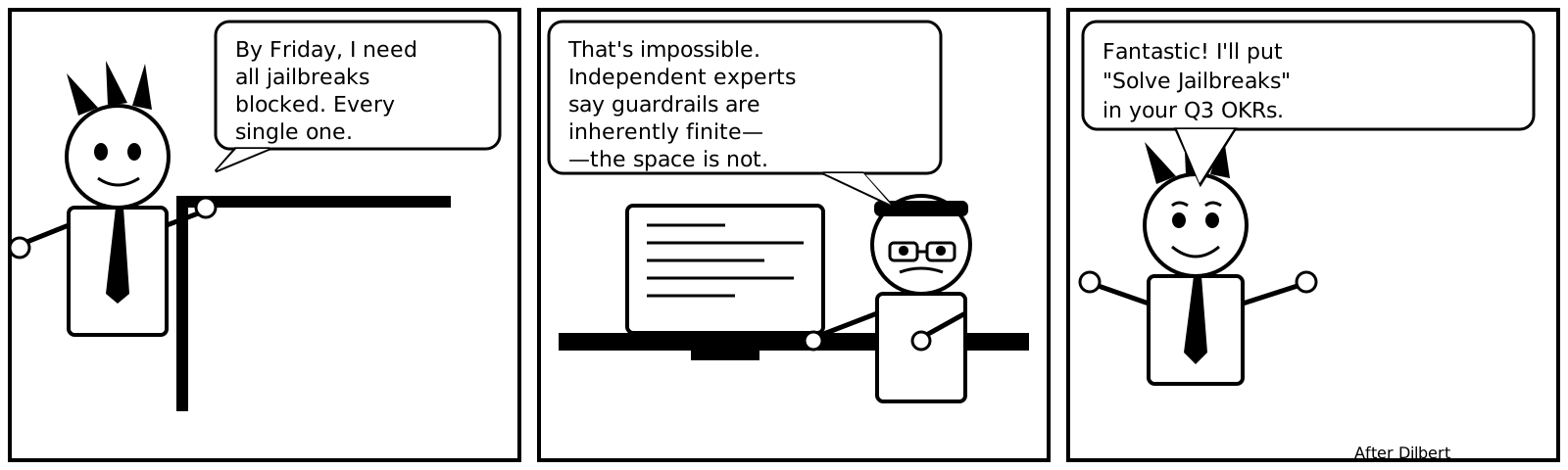
OKRs for the Impossible / The Ad That Launched a Career
*After Dilbert — on the White House's demand that Anthropic block every jailbreak forever, which independent experts call technically impossible, and which the pointy-haired boss immediately adds to Q3 OKRs. After Calvin and Hobbes — on Sally Ride answering a NASA newspaper ad in the Stanford student paper in 1977 and ending up in orbit on this date in 1983, which is exactly the kind of thing a spiky-haired boy would attempt before remembering he needs a physics doctorate.*
Froome Is Back at the Tour — as a Skoda Ambassador — Four-time winner Chris Froome, now 41 and without a team contract, will appear at this year's Tour de France as a brand ambassador for Czech carmaker Skoda, riding with fans and appearing at ASO events including La Vuelta and the Tour de France Femmes; his first role is at the all-electric Skoda Peaq world premiere on June 23. cyclingnews.comJun 18, 2026
Bosch Enters the Hub Motor Market — Bosch, which has concentrated exclusively on bottom-bracket mid-drive motors since entering the e-bike market, has launched its first rear hub motor: the Hub Line, targeting city e-bikes, with 45Nm torque, a 2.3kg motor, a 100mm-diameter housing, and a 360Wh slimline in-frame battery; it also updated the Active Line Plus mid-drive with 60Nm torque (up from 50Nm) and a 17% size reduction. bikeradar.comJun 18, 2026
Should Pro Cycling Ban Altitude Training? — A Cyclingnews feature argues that altitude camps — now attended by 14 WorldTour teams at Sierra Nevada alone before the Tour — are pushing riders to physiological and psychological limits, reducing race appearances, and hollowing out the startlists of Classics and mid-tier stage races, while coaches say the 1–2% performance gains from haemoglobin mass increases are too large to ignore. cyclingnews.comJun 18, 2026
Tour de France 2026: The Essentials — Barcelona Grand Départ on July 4, 3,333km across 21 stages with 54,450m of climbing; headline innovations include the first opening team time trial since 1971 (time taken on the first rider across, not the fifth), back-to-back Alpe d'Huez summit finishes on stages 19 and 20, and the Montmartre cobbled circuit finale with 15km to the line instead of last year's 6km. velo.outsideonline.comJun 17, 2026
OpenAI Lost $20.9 Billion Last Year — Leaked audited financial documents obtained by journalist Ed Zitron and reviewed by the Financial Times show OpenAI's 2025 revenue grew to $13.07 billion (from $3.7B in 2024), but R&D costs alone reached $19.18 billion — exceeding total revenue — including $10.59 billion paid to Microsoft; combined with $7.5B cost of revenue and $5.73B in sales and marketing, the operating loss hit $20.92 billion, though the loss as a percentage of revenue narrowed from 237% to 160%. arstechnica.comJun 17, 2026
SteamOS 3.8 Is a Big One — Valve's stable SteamOS 3.8 ships initial support for upcoming Steam Machine hardware, KDE Plasma 6.4.3 (with Wayland now the default in Desktop Mode), Linux kernel 6.16, controller support added for MSI Claw, OneXPlayer APEX, Lenovo Legion Go 2, and ASUS ROG Xbox Ally series, plus handheld controller input latency cut from 5–8ms to 100–500 microseconds. gamingonlinux.comJun 18, 2026
Mastodon 4.6 Ships Collections — The headline feature is curated Collections of up to 25 profiles with explicit consent: users must be opted into "Feature me in discovery experiences," are notified every time they're added to a collection, and can remove themselves at any time; the release also adds opt-in email newsletter subscriptions for institutional/creator accounts, a full profile editing redesign, and a #Wrapstodon year-in-review feature now available to all server admins. blog.joinmastodon.orgJun 18, 2026
Wolfram Language 15 Launches with Built-in AI Assistant — Version 15 ships a built-in AI Assistant chatbar in every notebook (free at Basic tier, Pro/Research by subscription), a `DeployAgentTools` function that auto-configures Claude Code and other AI environments to call the local Wolfram kernel, symbolic music representation (notes, chords, measures, scores, MIDI import), a `ModelFit` superfunction for unified model fitting, enhanced `TimeSeries`/`EventSeries` frameworks, and an all-new multicore notebook infrastructure that handles multi-gigabyte notebooks. writings.stephenwolfram.comJun 16, 2026
syntaqlite 0.6 Adds SQLite Dot Commands and Pyodide — Lalit Maganti — whose Perfetto trace processor work was covered in this paper — released syntaqlite 0.6 with support for SQLite dot commands (`.read`, `.print`, etc.), which previously caused parse errors on real-world SQL scripts, plus Python wheel publication to PyPI for Pyodide, enabling syntaqlite to run directly in the browser at the Pyodide playground. lalitm.comJun 17, 2026
Jeremy Clarkson Has Aggressive Prostate Cancer — The former Top Gear host and current Clarkson's Farm star, 66, disclosed his diagnosis in the Season 5 finale of the Prime Video series, telling co-stars that "it's cancer, and it's aggressive, but it's really early" and that 10% of his prostate "was dead"; he has known about his diagnosis since May and ended the episode from a hospital bed with "If it isn't [successful], I won't" be back for Season 6. kiro7.comJun 18, 2026
Daveigh Chase Dies at 35 — The actress who voiced Lilo in *Lilo & Stitch* (2002), Samara Morgan in *The Ring*, Samantha Darko in *Donnie Darko*, and the English dub of Chihiro in *Spirited Away* died Tuesday from complications of meningitis with serious blood infections; she had won an Annie Award for Lilo and later voiced the character across multiple spinoffs. kiro7.comJun 18, 2026
When the Standard Is Impossible, What Is the Standard For?
When perfection is the compliance threshold, it has stopped being a technical specification and become something else — a posture, a lever, a way of keeping someone permanently in default. That is the shape of what THE LAB reports today from Washington: the White House has told Anthropic that Fable 5 cannot return to service until the company blocks all jailbreaks. The administration's position, per Wired, is that this is Anthropic's problem to solve.1 Independent cybersecurity experts say that is not achievable.
The question this raises is not whether Anthropic should fix its guardrails. Of course it should try. The question is what it means to set an impossible standard as the bar for re-entry. Guardrails on language models are, by the field's own consensus, a stopgap by design — skilled users and future models will find ways around constraints, because constraints are finite and the space they're guarding against is not.1 Demanding that this problem be permanently solved before a product can operate is like requiring that a lock be unpickable before a door can be hung. The lock is useful; it was never the guarantee.
This morning's LONG READ — Charity Majors on the engineering discipline AI is forcing — reaches toward the same structural problem from a completely different direction. Her argument is that code is a materialized view of understanding, a cache of decisions that was never the decisions themselves. Engineers in trouble are the ones who mistake the cache for the thing it represents. Apply that logic to safety guarantees: the guardrail is a cached representation of "we tried to prevent harm here." Treating it as the harm-proof system itself is the mistake. The White House appears to be demanding that Anthropic ship the thing when it has only shipped the cache.
The harder version of the question, the one worth carrying through the day: is an impossible standard being set because the administration believes it is achievable, or because it is useful to have a standard nobody can meet? There is a difference between a regulator that misjudges the technology and one that understands the technology perfectly and prefers a lever to a resolution. Neither Commerce's AI Standards center nor the NSA has the staff to track every conceivable jailbreak on any frontier model — the government, too, cannot meet the standard it is setting.1 That asymmetry usually tells you something.
A strong edition on the most important beats — THE PELOTON and THE LAB both lead with substance, the writing is direct, and the ON THE TRAIL subsection is unusually well-executed for a holiday weekend window. The main drag is THE QUESTION, which spends a full paragraph restating THE LONG READ's core argument in the reader's face immediately after they finished reading it — a collision-rule violation that flattens what is otherwise a sharp structural question. Two meaningful cycling stories (Tom Pidcock's withdrawal from the Tour de Suisse, the Movistar thread resolution) vanished without appearing in any section or dropped list. The run itself was clean: all twenty agents completed, no missing outputs, modest cost at $8.84.
Frontpage
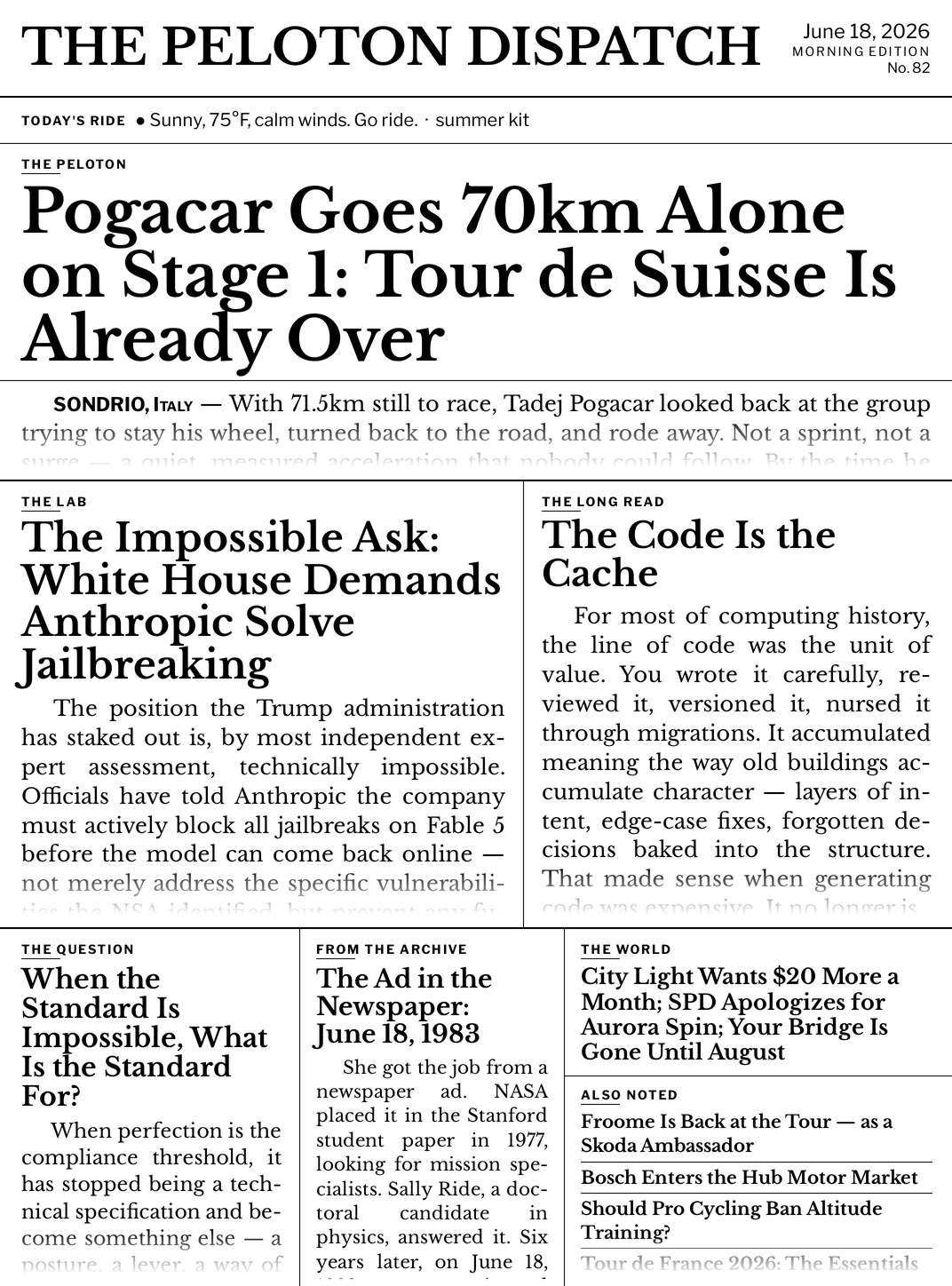
The rendered PNG looks credible. Visual hierarchy is correct: THE PELOTON headline ("Pogacar Goes 70km Alone") is large and dominant at top, THE LAB and THE LONG READ share the mid row in proportionate columns, THE QUESTION, FROM THE ARCHIVE, THE WORLD, and ALSO NOTED fill the bottom band in readable type. The lead image does not appear on the frontpage — FROM THE ARCHIVE carries the image flag but the art director placed no image in the print canvas, only the text column. That is consistent with how prior archive image placements have been handled (the image appears in the long-form index rather than the front page). No clipped headlines, no duplicate paragraphs (15 unique paragraphs), no font-shrinkage anomalies detected. THE WORLD gets only a headline on the front page (consistent with its frontpage_display: headline_only rule) and THE FUNNIES is correctly omitted (frontpage_display: skip). Section ordering in the HTML matches priority order: PELOTON (90), LAB (85), LONG READ (80), QUESTION (75), ARCHIVE (40), WORLD (62), NOTED (10) — the art director correctly places WORLD in the bottom-right column alongside NOTED rather than above the QUESTION.
Priority ranking
Section
Priority
Length
Image
Notes
THE PELOTON
90
~680 words
—
Pogacar 70km solo, van Aert sepsis, Bardet, Onley, Dygert
THE LAB
85
~700 words
—
Fable 5 jailbreak demand, GLM-5.2, UE6/Lore, AMD TSME, yay v13
THE LONG READ
80
~580 words
—
Charity Majors on AI and engineering discipline
THE QUESTION
75
~400 words
—
Impossible standard / Fable 5
THE WORLD
62
1 world bullet + 5 local bullets + ON THE TRAIL
—
Strong local haul
FROM THE ARCHIVE
40
~500 words
yes
Sally Ride, STS-7, June 18, 1983
ALSO NOTED
10
11 bullets
—
THE FUNNIES
7
text description only
—
Dilbert/Calvin parody; SVG and PNG generated
Ranking is defensible. PELOTON at 90 is earned — a 70km solo on stage 1 of a multi-day Grand Tour warm-up is legitimately extraordinary. LAB at 85 is slightly high given that the Fable 5 thread is now seven days old, but the SK Telecom angle and the impossible-standard framing add new substance. LONG READ at 80 and QUESTION at 75 are both inflated relative to what the QUESTION actually delivers (see editorial findings). FROM THE ARCHIVE at 40 is correct — Sally Ride is a genuine on-date find, not a backfill. No priority compression; the art director respected the ranking.
Editorial reading
THE QUESTION restates THE LONG READ's argument verbatim. The collision rule in newspaper.yaml states: "may not re-state THE LONG READ's central statistic." Paragraph 3 of THE QUESTION opens: "This morning's LONG READ — Charity Majors on the engineering discipline AI is forcing — reaches toward the same structural problem from a completely different direction. Her argument is that code is a materialized view of understanding, a cache of decisions that was never the decisions themselves." The reader has just read a 580-word LONG READ about exactly this. Reproducing the framing in the QUESTION — including the "materialized view" terminology and the analogy to safety guardrails as a "cache" — does not bridge two sections, it re-lectures. The structural question the QUESTION actually poses ("is an impossible standard being set because the administration believes it is achievable, or because it is useful to have a standard nobody can meet?") is sharp and worth asking on its own merits. The bridge to Majors is forced and dilutes the section's independence. The ANGLE-SELECTION TIE-BREAKER favors a non-dominant beat when its priority is within 20 points; the WORLD's local beats (SE May Valley Road closure directly affecting the reader; ferry cancellations during World Cup) were sitting at priority 62 — within 20 points of the dominant story — and would have produced a cleaner Question angle.
THE PELOTON headline overstates the case. "Tour de Suisse Is Already Over" is punchy but the article itself contradicts it: "a 24km time trial and Sunday's mountain finale at Villar-sur-Ollon" remain. Pogacar is 2:14 up on Carapaz, which is a decisive lead but not a mathematically sealed race — Carapaz won the 2019 Giro. The headline makes an editorial prediction the article is too careful to fully commit to. A sharper version — "Pogacar Goes 70km Alone: The Race for Second Has Already Begun" — would be both true and carry the same force without the hedge the body text creates.
Pidcock's Tour de Suisse withdrawal was not mentioned anywhere in the edition. The search results include two sources confirming Tom Pidcock pulled out of TdS due to illness on June 17, forcing a "rethink of Tour de France build-up." The covered.json shows prior Pidcock coverage (TdF ambitions piece) but the withdrawal URL is listed in search results and not carried into any section or dropped array. Pidcock is a GC rider for Netcompany-Ineos, the same team as Onley and Tarling, both of whom appear in THE PELOTON. A one-line note in ALSO NOTED — or a sentence appended to the Onley paragraph noting that Pidcock also withdrew from TdS — would have completed the picture of Ineos's Tour de France preparations falling apart simultaneously.
The Movistar thread resolution was silently dropped. The threads.json and search_results.md both show the movistar-sponsorship-crisis thread. The search results include a Peloton Post item: "Telefónica Extends Movistar Team Sponsorship until 2029" — a resolution to a multi-week running story. Neither THE PELOTON nor ALSO NOTED carries it, and it does not appear in any dropped array. A thread marked open should surface its resolution when one exists. One bullet in ALSO NOTED would have closed the loop.
The LAB article's section on "Stop Killing Games" is the weakest item in the section. The focus says to skip "funding announcements, PR fluff, hype cycles" and to cover games and real-time rendering. A campaign failing to secure EU law after 1.3M signatures is substantive regulatory news, not fluff — its inclusion is defensible. But it arrives after dense, technical coverage of Fable 5, GLM-5.2, UE6/Lore, AMD TSME, and yay v13 without integration into the article body; it sits in the dropped list of THE LAB (section-lab.md line 39) rather than in the article text, meaning it was relegated to ALSO NOTED. That choice is fine editorially. The finding is structural: the dropped item note says "bumped for space; substantial but lower priority for this reader," which is accurate — SteamOS 3.8 is the better call for the reader's gaming interest than an advocacy campaign outcome.
The archive image prompt uses "erupts" in close proximity to the word "Challenger." The prompt is technically accurate — STS-7 did fly on Challenger — but "Space Shuttle Challenger erupts from Launch Pad 39A in a thunderhead of exhaust and steam" is the language of catastrophe. Any reader with 1986 burned into memory will read "Challenger erupts" as a disaster image, not a launch image. The archive article itself is careful, mentioning the Challenger destruction in its final paragraph. The image prompt should read "lifts off" or "clears Launch Pad 39A" to avoid visual ambiguity.
Pipeline observations
Agent set was complete. All twenty expected agents ran: one scout, one researcher, one writer per section (seven), one reflector (THE QUESTION), one sweep (ALSO NOTED), one comic-strip, one fact-checker per section (eight), one meta-writer, one thread-editor, one art director. No duplicates, no missing agents.
Transient file-read errors in WORLD writer and ALSO NOTED writer/fact-checker. The WORLD writer attempted to read pages/local/research.md (does not exist — the correct path is pages/local/wta-trip-reports.md) and recovered by reading the correct source files. The ALSO NOTED writer and its fact-checker encountered EISDIR errors when trying to read the edition directory 2026/06/18 as a file, and also a pages/noted/ directory read error. All three agents recovered and produced correct output. These are low-severity transient path-handling issues; the agents adapted without degraded output.
Two fetch failures, one unrecovered.fetch_results.json shows two failures: soudal-quickstepteam.com (target: pages/cycling/soudal-qs-tour-roster.md) and a Cyclingnews women's cycling page (pages/cycling/zigart-crash-fear-tds.md). The Soudal page failed across all four methods; fetch_retry_results.json attempted the Cyclingnews URL but also failed; fetch_retry2_results.json shows one success. The Soudal failure meant the writer could not read the official Tour de France team announcement — the stale October 2025 IDL piece was correctly dropped, but a Jun 18 "luxury problem to solve later" story from Cyclingnews ('a-luxury-problem-to-solve-later') was in the search results and is a fresh source that was never fetched. The Zigart women's cycling URL was not used by any writer and had no visible impact.
FC:WORLD produced unusually high output (831 tokens vs. 15–91 for other fact-checkers). This likely reflects the fact-checker doing significant work on the multi-source local news block and the ON THE TRAIL subsection with its weather-sourced picks. No errors flagged; the section output appears clean and consistent with sources.
Starting commit. The dispatch commit is 83122be (2026-06-18 12:49 UTC), one day ahead of the prior dispatch commit 01d6454. No meaningful gap — same-day start, no missing intervening changes.
Trace highlights
The researcher is the critical-path agent at 1,089 seconds and $2.19 — roughly 4x the cost of the next most expensive writer (ALSO NOTED at $0.56). The researcher consumed 5.1M cached tokens; that volume is consistent with ingesting the full feeds digest and search results across all sections. At $2.19, the researcher cost more than all eight fact-checkers combined ($1.84). Whether that ratio is efficient depends on how much of the brief the writers actually used; the PELOTON writer produced a well-sourced article drawing directly from the brief, which suggests the investment translated.
FC:PELOTON took 275 seconds and 37 messages to pass 8 assistant turns. For a fact-checker, 37 messages is moderate; it read multiple source pages and made one stale-source note (Dygert item from Jun 12, flagged for awareness but accepted within the 7-day window). No removals were required — the writer filed a clean article.
FC:LAB at 287 seconds and $0.38 is the most expensive fact-checker. The LAB article is the longest and most citation-dense; five distinct stories across Anthropic/government, GLM-5.2, UE6/Lore, AMD TSME, and yay v13 each required independent source verification. The cost reflects actual work done rather than thrashing.
The illustrator ran in 59 seconds at $0.06 (OpenAI backend, using gpt-image-2). This is the cheapest agent in the run. The lead image is a raster PNG rather than an SVG; the funnies SVG was generated separately by the comic-strip agent ($0.22, 117 seconds), with the OpenAI funnies PNG generated in a follow-on pass ($0.06, 67 seconds).
Trace summary
Agent
Dur
Input
Output
Cache Read
Cache 5m
Cache 1h
Cost
Scout
254s
3366
7
163096
110627
0
$ 0.47
Researcher
1089s
937
1704
5132201
165791
0
$ 2.19
THE WORLD
165s
7
5
117982
58386
0
$ 0.25
THE PELOTON
128s
9
126
178915
46904
0
$ 0.23
THE LAB
131s
10
162
174992
39848
0
$ 0.20
THE LONG READ
56s
6
10
50040
20653
0
$ 0.09
FROM THE ARCHIVE
54s
7
8
90150
23356
0
$ 0.11
FC: THE PELOTON
275s
12
91
382303
66345
0
$ 0.36
FC: THE LONG READ
86s
8
15
124275
25546
0
$ 0.13
FC: FROM THE ARCHIVE
131s
10
10
200110
30669
0
$ 0.18
Meta-Writer
31s
6
6
48273
20700
0
$ 0.09
FC: THE WORLD
241s
15
831
357838
39633
0
$ 0.27
FC: THE LAB
287s
16
313
538266
57729
0
$ 0.38
Illustrator
59s
206
1372
0
0
0
$ 0.06
THE QUESTION
69s
5
3
47628
38186
0
$ 0.16
FC: THE QUESTION
77s
7
7
88789
23533
0
$ 0.12
ALSO NOTED
185s
75
144
728141
90387
0
$ 0.56
Draw today's TWO parody comic strips for
117s
12
142
269264
36863
0
$ 0.22
Funnies (OpenAI)
67s
368
1372
0
0
0
$ 0.06
FC: ALSO NOTED
186s
12
58
456424
70255
0
$ 0.40
Art Director
275s
7
5
135847
50167
0
$ 0.23
Update story threads for today's edition
146s
5
5
39279
37828
0
$ 0.15
Orchestrator
76
28316
2976236
0
99508
$ 1.91
TOTAL
5182
34712
12300049
1053406
99508
$ 8.84
Suggestions for next edition
The QUESTION writer should run the COLLISION RULE check on body paragraphs, not just sources. Today's QUESTION avoided sharing formal source URLs with THE LONG READ but still reproduced its argument nearly word-for-word in paragraph 3. The check should be: if the QUESTION names the same metaphor or framing that THE LONG READ built its article around, that is a collision regardless of source overlap.
Thread resolution events should surface automatically. Movistar's sponsorship extension (Telefónica commits through 2029) was in the search results and the thread was marked open, but neither the researcher nor the sweep writer flagged the resolution. The researcher brief should explicitly surface thread entries where search results contain a resolution-signal keyword ("extends," "confirms," "resolves," "drops," "announces") so the writer treats closure as a filing obligation, not an optional note.
The illustrator prompt for archive images should avoid double-reading words. "Space Shuttle Challenger erupts" combines a loaded proper noun with an ambiguous verb in a way that evokes the 1986 disaster regardless of intent. Future prompts for Challenger-era events should specify "lifts off," "ascends," or "clears the pad" to keep the image reading as launch rather than catastrophe.
Tom Pidcock's TdS withdrawal should have been a one-line ALSO NOTED item. Three Ineos riders (Onley, Tarling, Pidcock) withdrew from Tour de France build-up races within 48 hours of each other. The Onley story ran in full; Tarling was mentioned; Pidcock vanished. When multiple threads in the same team cluster are active simultaneously, the sweep writer should check that all open threads in that cluster are either covered or explicitly dropped with a reason.