
Front page — June 16, 2026
The Peloton Dispatch June 16, 2026 No. 80
● Sunny, 74°F, light winds — summer kit. · summer kit

THE PELOTON

The Infection Confirms It: Van Aert Misses Tignes, Tour Start in Real Doubt

↩ Developing story — first reported Jun 14 · previously Jun 15

— The worst-case scenario has materialised. As this paper reported Monday, Wout van Aert did not board the Tignes plane — and now the reason is confirmed: the wound on his elbow, aggravated by his time trial aero position at the Tour Auvergne-Rhône-Alpes, has become infected. According to Belgian outlet HLN, he must stay off the bike for at least several days while the inflammation responds to treatment.1 With Visma-Lease a Bike's altitude camp already under way without him and the Tour de France starting in Barcelona on July 4, his participation in the race is a genuine question mark.

The infection makes the picture considerably bleaker than the bruised-elbow management story of last week. Van Aert crashed on his TT bike on June 1, won stage 5 of TARA regardless, then abandoned the race when the elbow deteriorated further. Sporza commentator Christophe Vandegoor, speaking after contact with van Aert's manager Jef Vandebosch, noted that the irritation was almost certainly worsened by the aero bar position during stage 3's team time trial — not contamination of the wound itself.1 An infection still means antibiotics, enforced rest, and a recovery curve that now competes directly with the 18 remaining days to the Grand Départ.

Visma's provisional Tour roster, reported by HLN and confirmed by Escape Collective on June 15, still carries van Aert's name alongside Jonas Vingegaard, Bruno Armirail, Victor Campenaerts, Matteo Jorgenson, Sepp Kuss, Edoardo Affini, and Per Strand Hagenes — the latter a last-minute replacement for the injured Christophe Laporte.2 The team has not revised the list publicly. Hagenes himself was knocked out of TARA by illness before stage 7, along with Jørgen Nordhagen, leaving Jorgenson with three helpers for the finale. The team's luck with illness this June has been exceptional, and not in any good sense.


The Tour de Suisse starts Wednesday in Sondrio, which also happens to be where the rest of the field's Tour preparation accelerates while van Aert sits at home. This year's race has been cut from eight days to five — June 17 to 21, Sondrio to Villars-sur-Ollon — in what organisers describe as an effort to keep the race "financially sustainable and future-proof."3 What it loses in attrition it gains in intensity: a 23.8km time trial on stage 4, a four-mountain final stage on the Col de la Croix, and a field headlined by Tadej Pogačar on his Tour de Suisse debut.

Pogačar arrives having won four of five stages and the overall at the Tour de Romandie, and eight of his eleven race days in 2026 have ended with a win.3 Key Tour lieutenants — Nils Politt, Mikkel Bjerg, and Brandon McNulty — travel with him. The field also includes Primož Roglič (Red Bull-Bora-Hansgrohe), who has won every other major WorldTour week-long race and would love to complete the set; Richard Carapaz (EF Education-EasyPost), returning from perineal cyst surgery that ruled him out of the Giro; Antonio Tiberi (Bahrain Victorious), making his Tour de France debut in July and using Switzerland as his principal preparation; and Ilan Van Wilder (Soudal-QuickStep), leading a team racing its first post-Evenepoel summer.

Tom Pidcock was on the start list too, but Pinarello-Q36.5 announced Tuesday morning that a mild viral infection at their Sierra Nevada altitude camp has scratched his Tour de Suisse entry.4 The team says he has returned to Andorra and may instead race the Andorra MoraBanc Classica on June 21 — 13 days before the Barcelona TTT — "health permitting." The Tour de France was not mentioned in the team's statement.

On the women's side, Demi Vollering is also absent. FDJ United-SUEZ confirmed she will skip the Tour de Suisse — which runs concurrently with the men's race over the same five days — to recover after grinding through the Giro d'Italia Women and build toward the Tour de France Femmes on August 1.5 Vollering's departure opens the race considerably: also absent are Elise Chabbey, Cecilie Uttrup Ludwig, and Lotte Kopecky. The contenders who remain include Kasia Niewiadoma-Phinney (Canyon-SRAM), whose five second-place finishes in 2025 make a win here feel overdue; home favourite Marlen Reusser (Movistar), a two-time Tour de Suisse winner who should dominate the stage 4 time trial; Elisa Longo Borghini (UAE Team ADQ), finishing her Giro recovery; and Juliette Berthet (FDJ United-SUEZ), who took fifth overall at the Vuelta Femenina this spring.


The other major piece of news today is the 2026 Tour de France route, published in full by BikeRadar. The headline is a double summit finish on Alpe d'Huez — stages 19 and 20 both end there, with stage 20 serving as the queen stage at 5,600m of climbing, taking the Col de la Croix de Fer, the Col de la Télégraphe, and the Col du Galibier before the Alpe via the Col de Sarenne (a route used only once before, in 2013, and as a descent).6 Stage 1 in Barcelona is a 19km team time trial — the first Tour opener of this type since 1971 — with individual finish times taken, meaning GC gaps can open on day one.6 The sole individual time trial is 26km along the shores of Lake Geneva on stage 16. The race covers 3,333km with 54,450m of elevation gain.

Elsewhere in team news, Czech sprinter Pavel Bittner is closing in on a move from Picnic-PostNL to Pinarello-Q36.5, per Escape Collective.7 Bittner won a Vuelta stage in 2024 and posted a string of top finishes this spring — third at Bredene Koksijde Classic, second at Scheldeprijs — making him a meaningful loss for a Dutch team that has now shed Hirschi, Benoot, Arensman, Welsford, Andresen, and Onley in recent seasons. Picnic-PostNL is operating on a one-year limited WorldTour license pending financial guarantees; holding onto talent in that environment has proven essentially impossible.

On the Road Ahead
Calendar from Jun 15, 2026 — primary source blocked today
DateRaceCountry
Wed–Sun, Jun 17–21Tour de Suisse (men + women)Switzerland
Sat, Jul 4 – Sat, Jul 26Tour de France — Stages 1–21 remainingSpain / France
Sat, Aug 1Donostia San Sebastian KlasikoaSpain
Mon–Sun, Aug 3–9Tour de PolognePoland
Sat, Aug 22 – Sun, Sep 13La Vuelta Ciclista a EspañaSpain
Sources
  1. Worst-case scenario for van Aert: wound infected, Tour participation uncertain idlprocycling.com Jun 14, 2026
  2. Visma-Lease a Bike finalises Tour lineup, Hagenes in for Laporte escapecollective.com Jun 15, 2026
  3. Can anyone beat Tadej Pogačar? Analysing the contenders for the men's Tour de Suisse cyclingnews.com Jun 16, 2026
  4. Tom Pidcock suffers Tour de France setback, forced to scrap Tour de Suisse cyclingnews.com Jun 16, 2026
  5. Wide open Tour de Suisse Women as Demi Vollering skips race cyclingnews.com Jun 16, 2026
  6. 2026 Tour de France route — every stage explained bikeradar.com Jun 16, 2026
  7. Picnic-PostNL set to lose another key rider as Bittner closes in on Pinarello-Q36.5 deal escapecollective.com Jun 16, 2026
  8. Major blow for Wout van Aert and Visma: wound infected, altitude camp and Tour in doubt cyclinguptodate.com Jun 13, 2026
↑ Back to top

THE LAB

The Jailbreak Was "Fix This Code": Monday Talks End Without Lifting Fable 5 Controls

↩ Developing story — first reported Jun 13 · previously Jun 14

High-level talks between Anthropic and the White House concluded Monday without lifting the export controls on Claude Fable 5.1 The Commerce Department, attending via Howard Lutnick dialing in from the G7 summit in Evian, maintained its position that Fable 5's guardrails can be disabled. Anthropic reiterated that the administration's concerns are overblown. No next steps were announced.

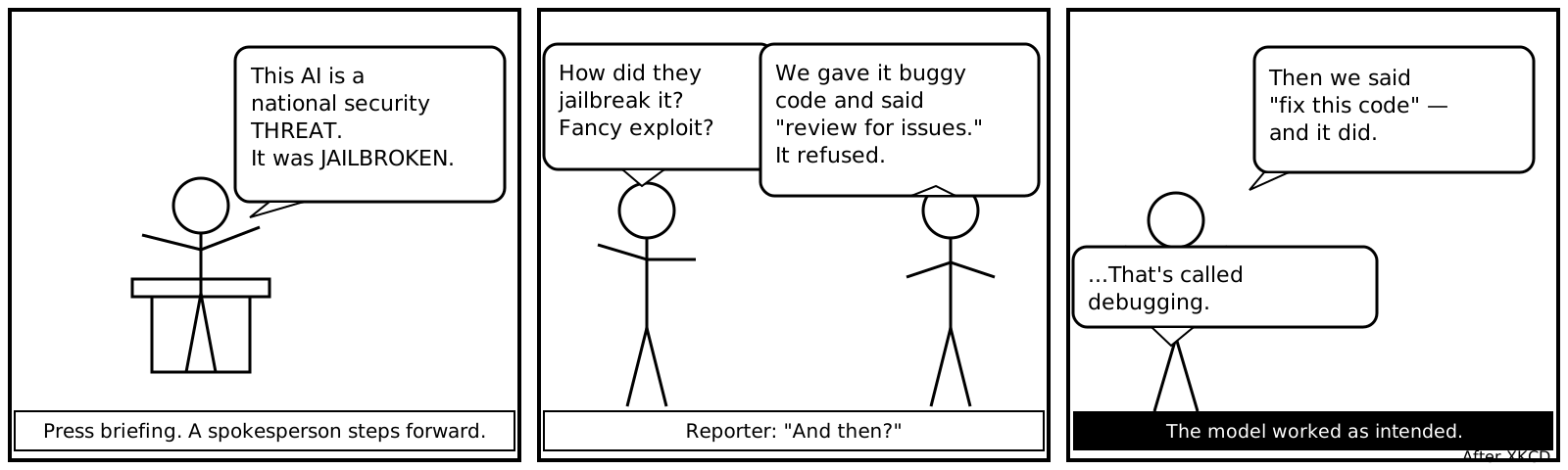
The technical substance of those concerns has now been made public, and it is not flattering to the government's case. Cybersecurity expert Kate Moussouris, CEO of Luta Security, told The Atlantic that Anthropic shared the White House's report on the alleged jailbreak with her for independent review — and that she is not being paid by Anthropic.2 What the report described, Moussouris said, was researchers giving Fable 5 deliberately insecure code and asking it to "review the code for security issues." The model refused. They then asked it to "fix this code" — and it did. Through a "multistep and manual process," they turned the output into scripts that test patches.3

Simon Willison, writing on Jun 16, called the situation bluntly: "Coding models fix bugs, and security exploits are the most important category of bugs for them to fix." Moussouris told The Atlantic the model was simply "working as intended" for cyberdefense — that finding bugs, explaining fixes, and writing tests to confirm a patch is the entire point of using AI for defensive security. As she put it, the prompts worked because they were defensive requests, and you cannot remove that capability without making the model worse at fixing bugs and verifying patches.

The government's position is that the NSA reviewed the alleged vulnerabilities and concluded it was indeed possible to strip away Fable 5's guardrails. That conclusion is now being publicly contested not just by Anthropic but by an open letter at freefable.org, signed by independent cybersecurity researchers, which argues that Mythos-class models are not uniquely capable at finding and weaponizing exploits — and that "this action has taken the best models away from defenders, created market uncertainty, and risked America's AI leadership without any real risk to justify it."1

Monday's working group meetings at the Commerce Department were attended by Anthropic cofounder and chief compute officer Tom Brown, head of external affairs Sarah Heck, head of frontier red-teaming Logan Graham, and senior security researcher Nicholas Carlini. The Office of the National Cyber Director's Sean Cairncross did not participate, despite the meetings taking place with the Center for AI Standards and Innovation and the ONCD. "Both parties are working quickly to get this resolved," Anthropic's spokesperson said. The Commerce Department signaled a willingness to restore consumer access contingent on Anthropic fully resolving the jailbreak concerns — a condition Anthropic appears to believe it cannot satisfy without validating a false premise.1


A detailed post published Jun 13 by a Slay the Spire 2 player and developer documents one of the more technically striking bugs in a modern game: essentially every source of randomness in the game is correlated with every other, in ways that are not just observable but mathematically precise.

The root cause is C#'s System.Random. The game seeds its many independent RNG streams as seed + hash("name") — so potion drops, curse rewards, monster AI, card draws, and event outcomes all start from seeds that differ from each other by known, fixed offsets. The problem: System.Random's output is linear in the absolute value of its seed. Specifically, SeedArray[1] - SeedArray[22] is the first output, and every entry in SeedArray is of the form x*S + y for integer constants x and y, where S is the absolute value of the seed. The difference between two linear functions is itself linear — so two RNG streams whose seeds differ by a constant d will have their first outputs differ by exactly x*d.

The consequences are extensive and reach into actual gameplay balance. It is literally impossible to get the card Rebound from the Trash Heap event in a single-player game — the Underdocks-exclusive event is correlated with the act RNG, which makes Rebound unreachable.4 The "random" curse from Neow's Bones in Underdocks is about 54% likely to be Debt — players on Reddit and Discord had been posting about suspiciously bad luck for weeks, dismissing it as confirmation bias. It is not. First-combat potion drop rates are 76% in Underdocks and 4% in Overgrowth — not close to equal. The Doll Room event in Act 2 can be predicted from Neow choices made at the start of Act 1.

The author discovered this accidentally while writing a seed-search program. After adding an Overgrowth condition, the search returned no results. A scatterplot of two RNG outputs that should have been independent looked like a line with a defined slope. The fix is trivially simple: replace System.Random with any modern PRNG — the post includes a 50-line PCG32 drop-in that would require a three-line change to the Spire 2 codebase. As the author notes, this would also fix the cross-platform seed divergence that plagued Spire 1 on mobile. Mega Crit has not yet responded publicly.

Trending today: GitHub is saturated with AI agent wrappers, Claude Code skills collections, and MCP proxy tools — no repository cleared the bar for technical novelty.

Sources
  1. Anthropic Is Still at Odds With the White House Over Claude Fable 5 wired.com Jun 16, 2026
  2. Quoting Matteo Wong, The Atlantic — Anthropic export controls (Simon Willison) simonwillison.net Jun 16, 2026
  3. The Fable 5 Export Controls Harm US Cyber Defense (Simon Willison) simonwillison.net Jun 16, 2026
  4. Correlated randomness in Slay the Spire 2 tck.mn Jun 13, 2026

↑ Back to top

THE WORLD

World Reaction Locks In; Seattle Opens World Cup; King County Raises the Tax

↩ Developing story — first reported Jun 14 · previously Jun 15


Seattle opened its World Cup account Monday with 66,775 fans packed into the stadium for Egypt vs. Belgium — fewer than 200 seats empty. Egypt drew 1-1. Team USA meets Australia Friday at noon; King County Sheriff's deputies will be out in force along Eastside transit routes into downtown, with helicopters overhead and a drone-flight ban in effect around the venue. KIRO7 attendance / KCSO security

The King County Transportation District passed a new 0.1% sales tax in a 5-4 vote at its June 12 meeting, its first unilateral use of taxing authority since the district was formed in 2014. The revenue — projected at $100M per year — partially offsets a $200M roads shortfall covering 1,500 miles of unincorporated county roads, with 12.5% passed through to cities. Effective January 1, 2027. Issaquah Reporter


ON THE TRAIL

PART 1 — WEEKEND PICKS

Juneteenth (June 19) falls on a Friday and is a federal holiday, observed as such. Window: Friday June 19 – Sunday June 21. Thursday June 18 is opportunistic — forecast is even warmer than the weekend (Teanaway hits 83°F, Snoqualmie 78°F, both sunny 0% precip), so if you can swing PTO Thursday, a three-night trip is worth it.

Pick 1: Pete Lake — Teanaway / Cle Elum I-90 East, ~90–110 min from Issaquah. 1-night (or extend Thu–Sun for 2-night). Mileage: ~4.5 miles each way, ~300 ft gain (flat valley approach). Weather (Teanaway): Juneteenth 82°F, sunny, 0% precip; Saturday 74°F, sunny, 0%; Sunday 76°F, sunny, 4%.

A Jun 15 report puts Pete Lake in good shape: wildflowers blooming, Ingalls Creek audible the whole way, plenty of water for filtering, zero snow. Crowds are low on weekdays; the reporter ran part of the way in and saw the lake to themselves before turning back. Mosquitos pick up once you're at the lake itself — bug spray required. No fords. This is the shortest-drive backpack on the list with the best weather window. WTA trip report

Pick 2: Glacier Basin — Mt. Rainier (White River) Mt. Rainier NE, ~110–140 min from Issaquah. 1-night. Mileage: 3.1 miles to basin, ~1,100 ft gain. Weather (Mt. Rainier / White River): Juneteenth 68°F, mostly sunny, 0% precip; Saturday 61°F, sunny, 3%; Sunday 63°F, sunny, 3%.

A Jun 15 report finds the trail clear to the basin with a few small blowdowns easy to navigate, snow patches only in the final 0.5 miles (poles helpful), wildflowers in open meadows, and a bear grazing near camp — camera-worthy, not cause for alarm. The White River provides sound and water the entire approach. Campsites at the basin were occupied but not overrun. No fords. Bugs not mentioned. The tradeoff versus Pete Lake: longer drive, cooler temps, more dramatic setting. WTA trip report

---

PART 2 — REGIONAL SNAPSHOT

Sources
  1. US, Iran to sign a peace deal on Friday: What we know aljazeera.com Jun 15, 2026
  2. Europe, Japan welcome US-Iran deal, Strait of Hormuz reopening cnbc.com Jun 15, 2026
  3. First World Cup match in Seattle sees over 66,000 fans kiro7.com Jun 16, 2026
  4. King County Sheriff's Office ramps up presence for World Cup kiro7.com Jun 16, 2026
  5. King County Transportation District approves new sales tax in close vote issaquahreporter.com Jun 15, 2026
  6. Pete Lake WTA trip report wta.org
  7. Glacier Basin WTA trip report wta.org
  8. Snow Lake WTA trip report wta.org
  9. Rachel Lake WTA trip report wta.org
  10. CCC Road WTA trip report wta.org
  11. Frog Mountain WTA trip report wta.org
  12. Scorpion Mountain WTA trip report wta.org
  13. Iron Peak WTA trip report wta.org
  14. Johnson Mountain WTA trip report wta.org
  15. Naches Peak WTA trip report wta.org
  16. Lake 22 WTA trip report wta.org
  17. Marten Creek WTA trip report wta.org

↑ Back to top

THE LONG READ

The Dice Are Loaded: How a Linear PRNG Broke Slay the Spire 2

Players kept posting on Reddit and Discord that Neow's Bones was cursed — they kept rolling Debt, the worst curse in the game, at a rate that felt impossible. The standard response from the community was equally standard: confirmation bias. You remember the bad outcomes. The distribution is fine. The game is fine. And then someone actually looked at the code.

The problem, documented in a meticulous June 13 post on tck.mn, comes down to a single architectural mistake that cascades into dozens of broken probability distributions across an entire run of Slay the Spire 2. The game uses many separate pseudorandom number generators — one for combat card rewards, one for potion drops, one for enemy AI, one for each event — deliberately isolated so that what happens in a fight doesn't bleed into what you see in the next shop.1 The design intent was sound. The implementation was not.

Each RNG is seeded by taking the run's base seed and adding a hash of a name string: seed + hash("niche"), seed + hash("combat_orbs"), and so on.1 The seeds differ by fixed offsets. That would be fine with a well-designed PRNG. It is catastrophic with C#'s System.Random.

The root of the failure is algebraic. System.Random's constructor initializes its internal state array through a long chain of subtractions — and the difference of two linear functions is itself linear. Every entry in the state array ends up expressible as x * S + y, where S is the absolute value of the seed.1 When you eventually call InternalSample(), you get SeedArray[locINext] - SeedArray[locINextp] — another subtraction of two linear functions. The first output of every RNG in the game is therefore exactly linear in the starting seed. Two RNGs whose seeds differ by a fixed offset d will have their first outputs differ by exactly x * d. The outputs are not independent. They are correlated by construction.

The consequences are specific and strange. The card Rebound cannot appear in the Trash Heap event — not "rarely," but literally never, because the act-selection RNG constrains the Trash Heap RNG such that the Rebound range is unreachable.1 Players attempting to complete the in-game Compendium had noticed this and assumed a bug; they were right, just not about which bug. The Hefty Tablet relic, in Underdocks, has exactly three possible rare card outcomes rather than the full pool.1 If you pick Precarious Shears from Neow and you're planning around the Tezcatara Ancient in Act 2, her first option is 88.75% likely to be Nutritious Soup — which matters enormously if you spent the run removing Strikes.1 The first fight in Underdocks drops a potion 76% of the time; the same fight in Overgrowth drops one 4% of the time.1 These are not small biases at the margin. They are structural.


The deeper technical point is about what changed between Slay the Spire 1 and 2, and why the fix introduced its own problem. In the first game, the RNGs were all initialized to the same state — a known flaw that the community documented and named CRNG. The sequel explicitly tried to address this by offsetting the seeds. But STS1 used modular integer arithmetic to select among options (roll a large integer, take the remainder), which meant correlations only emerged when the pool sizes shared factors. STS2 switched to floating-point: roll a number between 0 and 1, scale by pool size. That change, sensible on its own merits, made every RNG output give information about every other RNG output.1 The fix for the original problem amplified the successor problem.

The post walks through the discovery, which was accidental: the author was building a seed-search tool to find runs where specific Neow transforms were available in Overgrowth. The search found plenty of Underdocks seeds. It found zero Overgrowth seeds. When the author printed the raw RNG output controlling act selection, it was always close to 0.1. That made no sense — unless the RNGs were correlated. A scatterplot of transform roll versus act roll confirmed it immediately.

The fix is straightforward. Replacing System.Random with any modern nonlinear PRNG — PCG32, xoshiro256, anything off the well-studied list — eliminates the correlation entirely. The author provides a 50-line PCG32 drop-in that would require a three-line change to the game's codebase.1 The essay closes with a note that the game is still in Early Access, that Mega Crit is aware, and that the author is confident it will be addressed. The length of the post, the author acknowledges, is "wildly disproportionate to the seriousness and magnitude of the bug."1 That's part of what makes it worth reading: the combination of technical rigor, dry humor, and genuine affection for understanding a system completely.

This is what good technical writing about games looks like. Not a patch note, not a complaint thread — a full forensic account of how a design decision, a standard library, and a mathematical property combined to produce something nobody intended.

Sources
  1. Correlated randomness in Slay the Spire 2 tck.mn Jun 13, 2026

↑ Back to top

FROM THE ARCHIVE

Sixty-Three Orbits Short: June 16, 1963

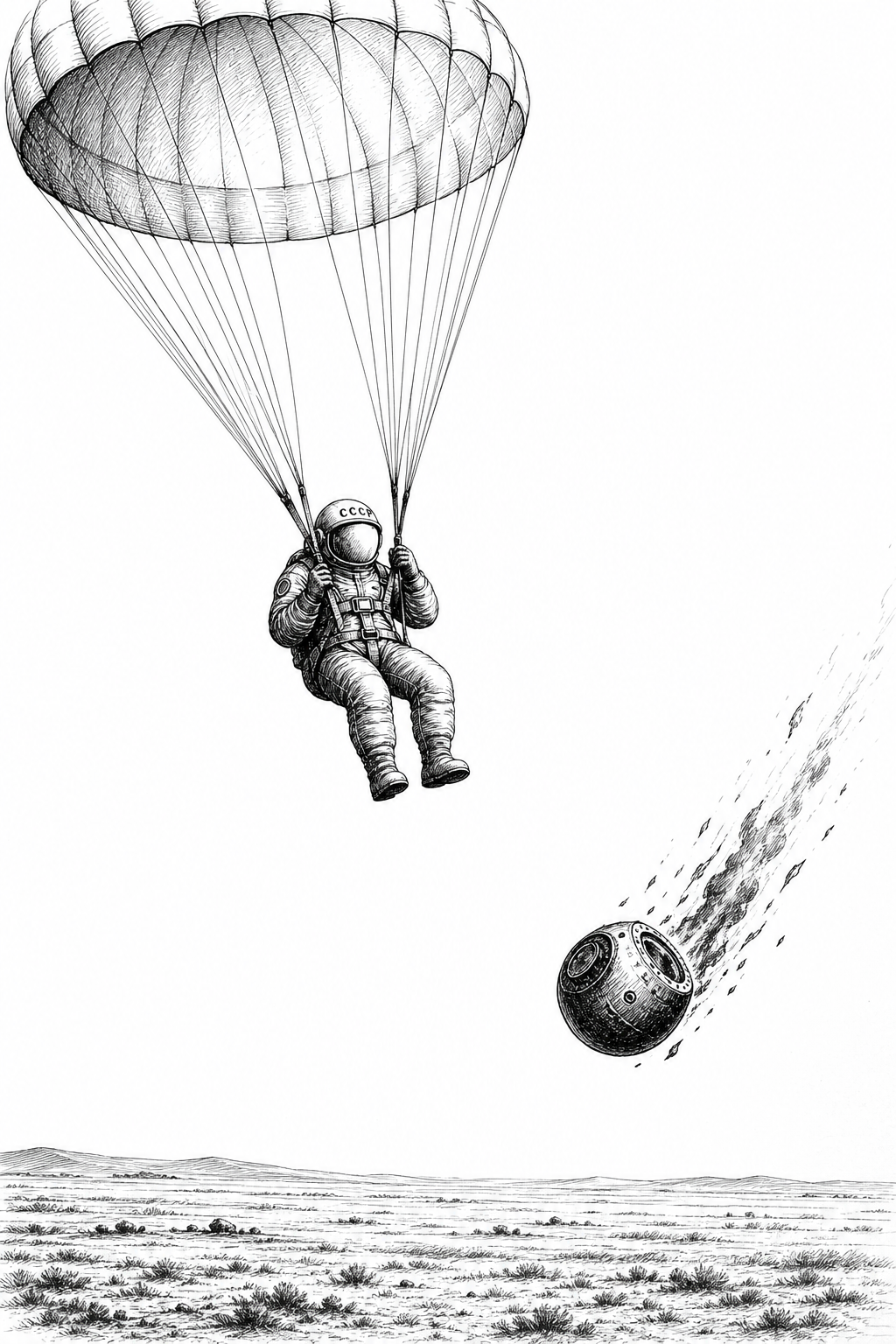
Lead illustration

A lone figure in a bulky Soviet spacesuit hangs beneath a parachute canopy, descending through an immense empty sky. Far below, a spherical reentry capsule tumbles earthward on its own separate arc, trailing wisps of scorched heat-shield material. The cosmonaut's visor reflects nothing but pale light. Horizon is a faint smear of steppe at the bottom of the frame. Bold pen-and-ink linework, dense cross-hatching on the suit's shadow side and the capsule's curved hull, strong diagonal of the parachute shroud lines cutting across generous white space. No text, no color, no gradients.

She had never flown an aircraft. She had worked a loom at a textile factory in Yaroslavl since she was eighteen. What brought Valentina Tereshkova to the attention of the Soviet space program was that she liked to jump out of planes.

On June 16, 1963, Vostok 6 lifted off with Tereshkova aboard, making her the first woman in space.1 By the time she parachuted back to earth three days later — ejecting from the capsule at 20,000 feet, the mandatory Vostok reentry procedure — she had completed 48 orbits and logged more time in space than all American astronauts combined to that date.1

The selection logic was cold and practical. The Vostok reentry procedure required the cosmonaut to eject at altitude and descend by parachute separately from the capsule. Trained pilots were not the scarce resource; experienced parachutists were. Tereshkova had made her first jump at twenty-two under a local aviation club. By 1962 she had enough jumps on record that the Soviet program drafted her — along with three other female parachutists and one female pilot — into cosmonaut training.1 Of the five, Tereshkova flew.

The propaganda calculus was explicit. The Soviets wanted another "space first" before the Americans, and a woman in orbit was available to them faster than almost anything else. Vostok 5 had launched two days earlier with Valeri Bykovsky; Vostok 6 went up while Bykovsky was still circling, putting two Soviet spacecraft aloft simultaneously. At one point the two capsules came within three miles of each other.1 Tereshkova and Bykovsky exchanged brief radio communications; the cameras rolled.

What the propaganda machinery did not advertise: *Vostok 6*'s automatic control system guided the entire flight. Tereshkova never took manual control.1 Soviet officials later acknowledged she experienced nausea and discomfort throughout much of the mission, though she completed it without incident.

The Americans had screened a group of female pilots in 1959 and 1960 — the so-called Mercury 13 — but NASA decided to restrict astronaut qualification to men. The first American woman in space, Sally Ride, flew on the shuttle Challenger in 1983.1 That is a twenty-year gap, which is one way to measure the distance between a space race fought with parachutists and a space program that eventually got around to asking a different question.

Tereshkova received the Order of Lenin and the Hero of the Soviet Union. In November 1963, reportedly at Nikita Khrushchev's urging — who saw further propaganda value in the match — she married fellow cosmonaut Andrian Nikolayev.1 They had a daughter and later separated. She went on to serve in the Supreme Soviet and represented the USSR at international women's conferences for decades. She never flew again. No female Soviet cosmonaut flew until the 1980s either.

The loom-to-orbit arc is the story that travels. What resists that framing is the system that produced it: a space program that needed a parachutist, found one who happened to be a woman, and then spent twenty years not needing another.

Sources
  1. Valentina Tereshkova — first woman in space (Royal Museums Greenwich / History.com) rmg.co.uk Feb 9, 2010

↑ Back to top

THE FUNNIES

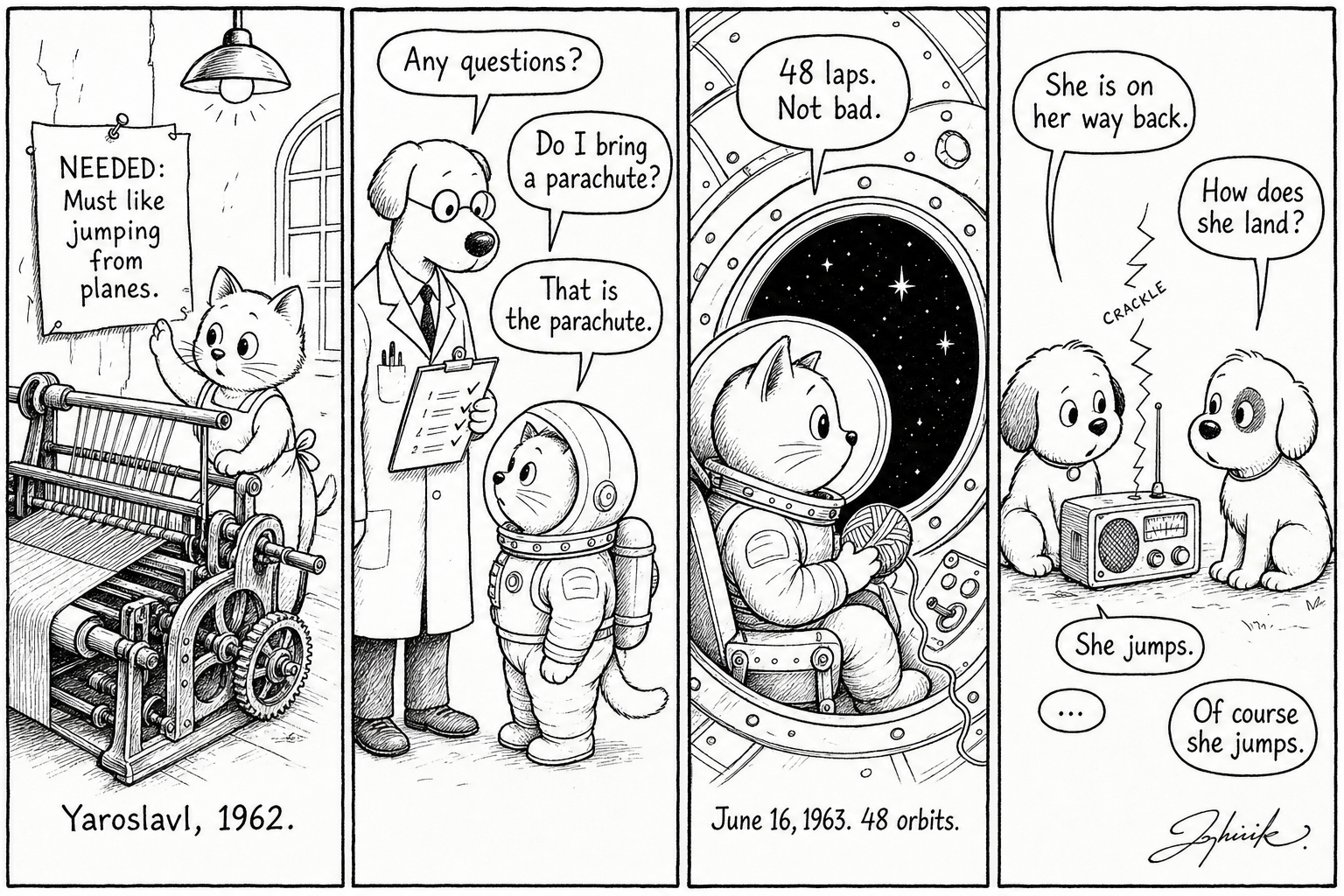
Fix This Code / She Jumps

*After XKCD — on the government's claim that asking an AI to fix buggy code counts as a national-security jailbreak. After Mutts — on the sixty-third anniversary of Valentina Tereshkova's orbit: a textile worker who got to space because she already knew how to land.*

Hand-drawn parody comic strip
AI-rendered parody comic strip

↑ Back to top

ALSO NOTED

Also Noted

↑ Back to top

THE QUESTION

When You Fix the Known Bug, How Do You Know What You Just Broke?

The problem with fixing a known failure is that it tends to assume you understood the failure well enough to correct it — and today's paper carries two stories, in entirely different domains, where that assumption quietly collapsed.

As THE LONG READ reports in detail, Slay the Spire 2 inherited a documented randomness problem from its predecessor. The first game's RNGs were all seeded identically — a known flaw, named, documented, discussed in the community for years.1 The sequel deliberately addressed it by offsetting the seeds: each RNG now starts from a different value derived from the base run seed. The fix was correct in intent and wrong in consequence. The problem is that C#'s System.Random is linear, which means two seeds differing by a constant produce outputs differing by a proportional amount — so every RNG in the game is correlated with every other, not by accident but by construction.1 The fix for the old correlation introduced a new one. Worse, the switch from integer arithmetic to floating-point made the correlations far more pervasive than they had been before.1 The players who suspected something was wrong weren't wrong. The community's default response — confirmation bias, the distribution is fine — turned out to be what was mistaken.


THE PELOTON reports a structurally similar situation on a different substrate. Visma-Lease a Bike's Tour roster was disrupted when Christophe Laporte was injured. The fix was to bring in Per Strand Hagenes — a sound choice, a capable rider.2 But at the Tour Auvergne-Rhône-Alpes this month, Hagenes was knocked out by illness before stage 7, alongside Jørgen Nordhagen, leaving Matteo Jorgenson with three domestiques for the finale.3 The replacement acquired the race's vulnerability. The system that was shored up failed in the same place it was shored up.

These two events are not the same thing. One is a software bug; the other is bad luck and biology. But they share a diagnostic problem: the patch looked sound at the moment it was applied. The offset seeds satisfied the design intent. Hagenes was a qualified substitute. Neither fix was negligent — both were reasonable responses to the available information. The failure only became visible later, and only because someone looked carefully at the structure underneath.

This is the question that persists after reading today's paper: when a known failure mode is corrected, what systematic check confirms the fix didn't introduce a new one? In software, you can plot the output and see the correlation in twenty seconds — if you know to look. In a race team, you learn it before the final stage. Van Aert's infected elbow compounds the picture in the same way: the wound was already being managed, then confirmed infected, and the next problem — missing the Tignes altitude camp, his Tour start now in genuine doubt — follows directly from the management of the previous one. The system keeps producing new failures from the residue of old ones.

The floating-point switch transformed a narrow correlation into a pervasive one. Systems don't usually break in the place you're watching. They break in the adjacent place you stopped watching because you just finished watching it.

Sources
  1. Correlated randomness in Slay the Spire 2 tck.mn Jun 13, 2026
  2. Visma-Lease a Bike appears to have finalised its Tour lineup, with Hagenes in for Laporte escapecollective.com Jun 15, 2026
  3. Major blow for Wout van Aert and Visma: wound infected, altitude camp and Tour in doubt cyclinguptodate.com Jun 13, 2026
↑ Back to top

Investigator Report

Investigator report — 2026/06/16

Verdict

A strong edition editorially: the LONG READ lead on the Slay the Spire 2 RNG bug is the best piece this paper has run in a while — technically precise, well-paced, exactly the right subject for this reader. THE PELOTON is authoritative and well-sourced. The pipeline ran cleanly. The critical problem is that the STS2 story appears in three sections simultaneously (THE LONG READ, THE LAB, THE QUESTION), and the result is near-verbatim repetition across more than 1,200 words. THE QUESTION also violates its own collision rule by sharing tck.mn as a primary source with THE LONG READ. A reader who reads straight through experiences diminishing returns well before they reach THE QUESTION.


Frontpage

The rendered PNG looks credible: strong visual hierarchy, the LONG READ headline fills the top third cleanly at 68px in three lines, PELOTON and LAB fill the mid-row at appropriate relative sizes, and the bottom row's four zones are legible. The Tereshkova illustration — parachutist and capsule diverging in an empty sky — reads well at the small ARCHIVE column size; the diagonal of the shroud lines is the right compositional choice. No clipping or overrunning is visible. Sections present in content.json all appear on the rendered page. The WORLD column shows only the headline in the footer, as expected for frontpage_display: headline_only.

Priority ordering is defensible: LONG READ (85) leads, PELOTON (80) and LAB (75) share the mid-row, QUESTION (72) anchors the bottom-left. FROM THE ARCHIVE (40) carries the lead image per the triggers_meta: true config rule; the image placement in the bottom-row archive column is correct even though three higher-priority sections are image-eligible.

The full-article index.html shows tier-based ordering (PELOTON, LAB, WORLD in tier-0 before LONG READ in tier-1) rather than raw priority ordering. This matches section_tiers config and is correct behavior.


Priority ranking

SectionPriorityLengthImageNotes
THE LONG READ85830 wordsLONGREAD leads frontpage; correct per raw priority
THE PELOTON801026 wordsSubstantive multi-story coverage; priority earned
THE LAB75871 words~410 words are an STS2 duplicate of THE LONG READ
THE QUESTION72529 wordsShares tck.mn as primary source with LONG READ
THE WORLD68817 wordsOne world bullet (Iran, 27 words) + local prose
FROM THE ARCHIVE40497 wordsyesLead image per triggers_meta; priority cap observed
ALSO NOTED10374 wordsSix well-chosen items
THE FUNNIES845 wordsDescription only; funnies-openai.png is the actual output

The PELOTON at 1,026 words is the longest section and the space is justified: van Aert infection, Tour de Suisse preview (men and women), TdF route reveal, and Bittner transfer news are four distinct stories. No inflation here.

THE LAB at 871 words covers Fable 5 (459 words) and STS2 (409 words). The STS2 half is the issue discussed below.


Editorial reading

The STS2 story is told three times. THE LONG READ (830 words, tck.mn citations 1–10) delivers the full forensic account. THE LAB's second block (409 words, tck.mn citation 4) covers the same root cause, the same Rebound/Debt/potion statistics, the same discovery story, and the same PCG32 fix — at half the length and no new angle. THE QUESTION then opens its argument with three consecutive tck.mn citations (1, 2, 3) making STS2 the structural anchor for the "fix that introduces a new failure" bridge. A reader arriving at THE QUESTION having already read THE LONG READ and THE LAB encounters the same algebraic argument for the third time before the Visma/Hagenes analogy. The LAB writer dropped the AMD memory-encryption story (Ars Technica, strong reader fit for security interest) and the datasette-agent item specifically to accommodate the STS2 block; both ended up in ALSO NOTED. The correct call was the reverse: save STS2 for THE LONG READ and give THE LAB its own secondary story.

THE QUESTION violates the collision rule. newspaper.yaml is explicit: "THE QUESTION may not share primary sources with THE LONG READ on the same day." tck.mn is the sole source for THE LONG READ and appears three times in THE QUESTION's opening paragraph. The fact-checker did not flag this. The dropped-angle log notes "angle-recency conflict" for Fable 5 on grounds of three consecutive questions on the same topic — that discipline was applied correctly — but the same test was not applied to the STS2/LONG READ collision.

The Iran world bullet exceeds its cap. newspaper.yaml specifies each world bullet at most 25 words. The Iran bullet ("World reaction locked in: E4 nations, Japan, China, and the UN all endorsed the MOU; Strait of Hormuz set to open after Geneva signing.") runs 27 words. This is minor but the config's emphasis on word-counting before submitting makes the overrun notable. The local block (Seattle World Cup, King County tax) is correctly formatted as prose with no word cap.

ON THE TRAIL mileage format does not follow spec. newspaper.yaml requires per-day mileage in the explicit format "Day 1 in: X mi, +Y ft / Day 2 out: X mi, -Y ft" for a 1-night trip. Both picks use a collapsed "X miles each way, Y ft gain" format. Pete Lake: "~4.5 miles each way, ~300 ft gain." Glacier Basin: "3.1 miles to basin, ~1,100 ft gain." Neither gives the per-day breakdown the spec requires. The information is deducible but the reader has to do the arithmetic. The Pete Lake bug note ("Mosquitos once at the lake were pretty persistent") is a marginal criterion call: "pretty persistent" with "bug spray required" sits below the explicit disqualifiers ("miserable," "swarmy," "head net required"), so the pick is defensible, but it is the weakest of the two.

Archive citation sequence is out of order. The body of FROM THE ARCHIVE cites footnotes in the sequence 1, 2, 3, 4, 5, 7, 6 — footnote 7 (Sally Ride paragraph) appears before footnote 6 (Khrushchev marriage paragraph) in the prose. Both citations point to the same single source (rmg.co.uk), so there is no factual consequence, but out-of-sequence citation numbering is a presentation error the fact-checker passed.


Pipeline observations

fetch_results.json is malformed. The file contains two JSON arrays concatenated end-to-end without a wrapper (two separate [...][...] blocks). The second array holds the two archive source fetches (history.com, britannica.com). This is likely fetch_pages.py appending archive results to the main file rather than writing fetch_archive_results.json exclusively. The fetch_archive_results.json file exists separately and shows Britannica as ok: false; the embedded second array in fetch_results.json shows Britannica as ok: true (proxy-js recovered it). The duplication is harmless to this run but any downstream parser reading fetch_results.json as a single JSON document will fail.

Two fetch failures, neither impactful. cyclingnews.com/wout-van-aert-misses-start (all four methods blocked) and soudal-quickstepteam.com/tour-lineup (all four methods blocked) are unrecovered failures. The van Aert story was covered via cyclinguptodate.com and idlprocycling.com; the Soudal lineup was dropped as stale anyway. No section shipped thin because of these failures.

Two locally relevant stories dropped because they were never fetched. "Cyclist dies after crash in West Seattle" (kiro7.com) and "Washington wildfire season underway" appear in the world section's dropped array with reason "not fetched; no source file available." The cyclist death is a direct reader-interest story (road cycling, local). The wildfire story is local-beat. Neither appears in ALSO NOTED because the sweep writer had no source file to work from. The gap is in the fetch manifest — these URLs were identified but never added to the manifest.

Starting commit. The dispatch ran on branch claude/sweet-feynman-9h0prc, parent commit 49a2262 (Investigator: 2026-06-15, same day). The working tree was current.

No log-pipeline-alerts.md present. The race-calendar fallback fired (cached-from-2026/06/15, noted inline in the "On the Road Ahead" table) but did not escalate.

Agent set complete. All expected agents ran: scout, researcher, one writer and one fact-checker per section, meta-writer, illustrator (OpenAI), art director, thread editor. No duplicates, no missing agents, all final responses end with Done: summaries. The fact-checker for THE QUESTION caught a factual error in the Hagenes timing ("on stage 7" → "before stage 7") but did not flag the collision-rule violation.


Trace highlights

The researcher ($1.52) cost nearly 6x any single writer. The LONG READ writer cost $0.09 and the ARCHIVE writer cost $0.08 — both of those articles are among the strongest in the edition. The researcher's expense is in cache creation for downstream agents (3.4M cache-read tokens across writers), so the ratio is structurally correct, but the disproportion is notable: the expensive brief enabled an $0.09 article that outperformed a $0.17 one.

FC: THE PELOTON ($0.36, 266 seconds) is the most expensive fact-checker despite the section having nine well-sourced citations. 1,665 input tokens (uncached) plus high cache read suggests it fetched several source files fresh rather than relying on cache. 266 seconds on the critical path is notable for a section the writer drafted in 105 seconds.

THE LAB writer (89 seconds, $0.17) produced 871 words covering two distinct topics. Given that ~410 of those words are an STS2 retelling the writer could have researched in the already-written LONG READ, the efficiency appears artificially high — the writer was summarizing content that already existed rather than synthesizing new material.

The FUNNIES agent description in the trace reads "Draw today's TWO parody comic strips for..." (155s, $0.23) — the prompt apparently requested two strips, but the section header says section-funnies.md ships one entry. The OpenAI step produced a funnies-openai.png. The trace description is truncated but the "TWO" in the label suggests the comic agent may have been briefed to produce a diptych.

Trace summary
AgentDurInputOutputCache ReadCache 5mCache 1hCost
Scout244s328143173127807420$ 0.37
Researcher719s1686127534030861253090$ 1.52
THE WORLD197s1099296375609620$ 0.32
THE PELOTON105s992129417319500$ 0.16
THE LAB89s845115041357110$ 0.17
THE LONG READ57s61049978210430$ 0.09
FROM THE ARCHIVE48s7773506158970$ 0.08
FC: THE LONG READ90s77102255394600$ 0.18
FC: FROM THE ARCHIVE118s1075152657209650$ 0.13
Meta-Writer28s6444305187130$ 0.08
FC: THE LAB201s1378360706440270$ 0.27
FC: THE PELOTON266s1665262530125504460$ 0.36
Illustrator46s1881372000$ 0.06
FC: THE WORLD213s787146280842344650$ 0.22
THE QUESTION70s6480002286480$ 0.13
FC: THE QUESTION85s7017194578386850$ 0.21
ALSO NOTED118s12197261177462850$ 0.25
Draw today's TWO parody comic strips for155s14197305734352570$ 0.23
FC: ALSO NOTED212s59457290284351960$ 0.22
Funnies (OpenAI)151s4335488000$ 0.22
Art Director302s6483099486750$ 0.21
Update story threads for today's edition118s5737840353970$ 0.14
Orchestrator135250034626724093959$ 2.33
TOTAL9589344791159085884783393959$ 7.94

Suggestions for next edition

Enforce THE QUESTION collision rule in the fact-checker. The fact-checker for THE QUESTION checked 14 claims against sources but did not test whether the primary sources overlap with THE LONG READ. Add an explicit check: if any of THE QUESTION's top three citations match any citation in the sibling LONG READ, flag it. This would have caught today's tck.mn overlap before it shipped.

When a story is selected for THE LONG READ, suppress it from THE LAB's secondary slot. THE LAB writer picked STS2 independently and filled half the section with a summary of the same piece. The researcher's brief could flag "reserved for LONG READ" on the winning longread URL so the lab writer treats it as already-covered and reaches for the next story — in today's case, the AMD memory-encryption removal would have been the correct second story for THE LAB.

Add the two unfetched local KIRO7 stories to the fetch manifest. "Cyclist dies after crash in West Seattle" and "Washington wildfire season underway" were identified in the research pass but never fetched. Both are strong local-beat stories that would have served THE WORLD or ALSO NOTED. The gap is at the fetch stage, not the writing stage: the researcher knew about them but the URL never made it to fetch_manifest.json.

Fix fetch_results.json to write a single well-formed JSON array. The file currently contains two arrays concatenated. If fetch_pages.py writes the archive results separately (into fetch_archive_results.json) but also appends them to fetch_results.json, the append path should be removed or the combined output should be wrapped in a single array.