Front page — June 20, 2026
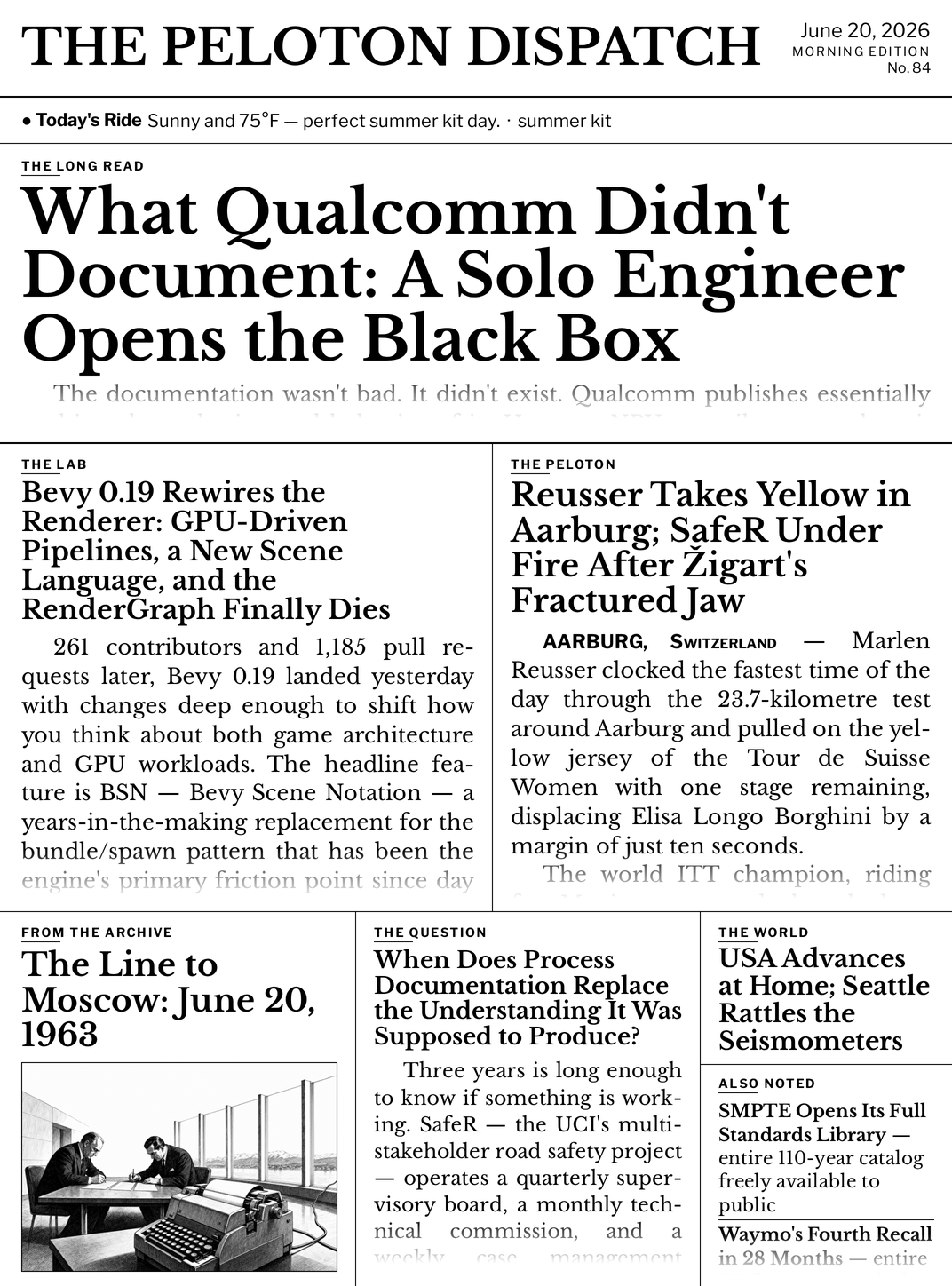
The Peloton Dispatch June 20, 2026 No. 84
● Sunny and 75°F — perfect summer kit day. · summer kit

THE LAB

Bevy 0.19 Rewires the Renderer: GPU-Driven Pipelines, a New Scene Language, and the RenderGraph Finally Dies

↩ Developing story — first reported Jun 19

261 contributors and 1,185 pull requests later, Bevy 0.19 landed yesterday with changes deep enough to shift how you think about both game architecture and GPU workloads.1 The headline feature is BSN — Bevy Scene Notation — a years-in-the-making replacement for the bundle/spawn pattern that has been the engine's primary friction point since day one. But the renderer work underneath is arguably just as consequential.

Start with the benchmarks. On a laptop with a mobile RTX 4090, the many_cubes test with 1.6 million entities and 116,000 in view went from 49.47ms per frame to 18.77ms — 21 FPS to 53 FPS. With culling off and all 1.6 million cubes rendered: 93.1ms to 41.2ms. The city scene benchmark (55,000 rendered entities) dropped from 19.3ms to 11.8ms static, 22.1ms to 16.2ms with motion.1 These are not incremental gains.

The work behind those numbers spans the entire pipeline. Batch-set unpacking for multi-draw-indirect moves from CPU to GPU, saving nearly 1.5ms at a million cubes. GPU clustering for lights improved the many_lights benchmark roughly 20x. Parallel mesh collection saves around 4ms at 200,000 moving meshes. Sparse mesh uniform buffer uploads — only changed uniforms go to the GPU — help scenes with many static objects disproportionately.

The partial bindless work deserves attention separately. WGPU's Metal backend supports texture binding arrays but not buffer binding arrays. Bevy previously required both before enabling bindless at all, which meant Apple hardware — no Vulkan, no fallback — never got the fast path. The fix is per-material: if your material only needs texture arrays (which includes StandardMaterial), it uses bindless on Metal. Benchmarked on the Bistro Exterior scene with 698 materials: M2 Max gets a 15% frame time reduction and drops 57 MB of RAM; an NVIDIA 5060 Ti improves 46%.1

The RenderGraph is gone. Render passes are now regular ECS systems running in schedules. What previously required implementing a Node trait, deriving a RenderLabel, and wiring edges through a targeted API is now add_systems(Core3d, my_render_fn.after(Core3dSystems::MainPass)). It's a clean deletion of an abstraction that outlived its justification — when the ECS matured enough to express the same ordering constraints directly, the graph became redundant scaffolding.

BSN itself is the other structural change. The old pattern — spawn a bundle, manually thread in asset handles, hope callers know what dependencies a component needs — gets replaced by a macro-based scene syntax where asset paths are first-class, components compose as patches, and spawning a Player guarantees its full scene (hands, weapons, whatever the component declares) is present at spawn time. The SceneComponent trait enforces this: if Player derives SceneComponent, you can query for Player and assume the declared children exist. That invariant was not achievable before without external conventions.

Other changes in the release worth noting: contact shadows via screen-space raycast fill the short-range shadow gap that shadow maps can't solve without prohibitive texture cost; resources are now stored as components on singleton entities, unifying ECS internals and making lifecycle hooks, observers, and relations available on resources; contiguous_iter exposes raw table slices to the SIMD path, delivering a 3.5x speedup over normal iteration with AVX2 on bulk transform updates; render error recovery gives games a typed handler for device loss, OOM, and validation errors instead of a silent hang.


As this paper reported Friday, Tim Sweeney announced at Unreal Fest that UE6 will replace Git with a new system called LORE. That repo is now public. Epic shipped EpicGames/lore on GitHub under MIT, with docs, a quickstart, and SDKs for JavaScript, Python, C#, and Go.

The architecture is content-addressed storage over Merkle trees — closer to Git's object model than to Perforce's lock-and-trunk approach, but with chunked storage for large binary assets, on-demand sparse workspace hydration, and centralized service backing for team scale. The design doc describes it as optimized for binary-first deduplication: files are stored as reusable chunks with indexed lookup, so a 4 GB texture asset updated by one pixel doesn't re-upload the whole thing.

One caveat in the README is worth flagging: LORE is the built-in VCS for UEFN (Unreal Editor for Fortnite), but today's open-source build can't yet talk to the UEFN server because the production build uses a proprietary compression format.2 Epic says they are migrating UEFN to the same open format used by the public repo. Until that gap closes, the UEFN and open-source deployments are separate. LORE is pre-1.0 and marked under active development; on-disk formats may change.


On the LLM-as-SRE front: Lorin Hochstein published a pointed essay arguing that LLM-written incident reports are more dangerous than LLM-generated code.3 The reasoning is structural. Incorrect code fails tests. An incorrect operational diagnosis either resolves the incident or it doesn't. But an incident report has no immediate correctness signal — a plausible-sounding narrative that invents couplings between systems, or misses a critical interaction, gets filed, read, nodded at, and archived. Nobody pushed back because nobody did the synthesis work that would have surfaced the contradiction. The problem compounds: the same organizations offloading report generation to LLMs will likely use LLMs to summarize them too. Hochstein draws on Dick Guindon's observation that writing is how you discover you didn't understand something — outsourcing that step doesn't skip the cognitive work, it just skips the discovery that the work wasn't done.


Today's THE LONG READ covers the reverse engineering of Qualcomm's NPU compiler — including the discovery that VTCM tensor placement is solved as a Mixed Integer Linear Program using HiGHS, that the compiler silently downcasts precision during placement to relieve memory pressure, and that there's a hidden analytical simulator called Hextimate inside the toolchain.4 Worth a full read if you do edge ML work.

Trending today: GitHub is saturated with AI agent wrappers, CLAUDE.md skills collections, and LLM scaffolding repos — EpicGames/lore is the one technically substantive repo on the list, and it's covered above.

Sources
  1. Bevy 0.19 release — next-gen scenes, contact shadows, GPU renderer improvements bevy.org Jun 19, 2026
  2. EpicGames/lore — open-source version control for games and large binary assets github.com
  3. I am dreading our LLM-written incident report future surfingcomplexity.blog Jun 19, 2026
  4. Reverse Engineering the Qualcomm NPU Compiler datavorous.github.io Jun 19, 2026

↑ Back to top

THE PELOTON

Reusser Takes Yellow in Aarburg; SafeR Under Fire After Žigart's Fractured Jaw

↩ Developing story — first reported Jun 18 · previously Jun 19

— Marlen Reusser clocked the fastest time of the day through the 23.7-kilometre test around Aarburg and pulled on the yellow jersey of the Tour de Suisse Women with one stage remaining, displacing Elisa Longo Borghini by a margin of just ten seconds.

The world ITT champion, riding for Movistar, stopped the clock at 29:36 — 11 seconds clear of Zoe Bäckstedt, who had herself been on course for a second consecutive stage victory after winning the sprint in Bad Ragaz on Friday.1 Bäckstedt led into the intermediate check by 25 seconds over the field, but Reusser was five seconds faster at that split and kept the gap growing to the line.1 Loes Adegeest (Lidl-Trek) took third on the stage, 54 seconds down. Longo Borghini rode in fifth, a minute and four seconds behind Reusser — enough to surrender the race lead.

Reusser described going to the limit from the gun: "It was very hard, really very, very hard. I went really hard from the start and I was suffering a lot. You go fast, but you don't really know if the others go faster."1 She remained cautious about Sunday's mountain finale to Villars-sur-Ollon, which includes two ascents of the Col de la Croix. "I think one weak moment can change the whole GC, not only getting me out of the yellow, but for everybody. Tomorrow is going to be super tough."1

The ten-second margin is thin enough that the GC is not settled. Kerbaol (EF Education-Oatly) sits third at 1:20, with Sarah Van Dam (Visma | Lease a Bike) fourth at 1:35. The final stage promises to reshuffle the order.

On the men's side, the Stage 4 ITT in Aarburg started with Pogačar last off the ramp in yellow, carrying a 2:50 cushion over Richard Carapaz.2 Carapaz started a minute ahead of the race leader; third-placed Andrea Bagioli at 3:07 and Mathias Vacek at 4:16 rounded out the top tier of GC threats. Roglic, slipped to 16th overall at 6:25, started at 16:48 — outside the yellow jersey equation but with time to recover against rivals below him.


The crash that hospitalised Urška Žigart during Stage 2 is now carrying institutional weight.3 The CPA Women — the UCI-affiliated riders' union — called for a "substantial review" of SafeR, the multi-stakeholder road safety project established in 2023, after Žigart suffered a fractured jaw when she went down over an uneven road surface in the final kilometre of Thursday's stage. Several riders crashed at the same spot going at high speed; Žigart's injury was the most severe.

Managing director Alessandra Cappellotto stopped short of abandoning the project but questioned whether its current committee structure was catching course hazards before they injured riders: "Serious incidents continue to occur, and it is our responsibility to ask whether the current system is providing all the answers that our sport requires."3 SafeR operates three committees — a quarterly supervisory board, a monthly technical commission, and a weekly case management committee that reviews incidents and audits upcoming races.3 The CPA Women's position is that the system's framework needs sharpening rather than scrapping.

The criticism arrives at a bad moment for SafeR. The project has been under fire since it emerged the UCI used SafeR funds to finance its legal battle against SRAM over gear ratio restrictions — a case the UCI subsequently lost on appeal.3 Three years into SafeR's existence, the UCI has not published data demonstrating a reduction in crashes or accidents.


The Tour de France sprinter selection at Soudal-QuickStep remains deliberately unresolved. CEO Jurgen Foré, speaking after the Giro d'Italia, reiterated that Tim Merlier remains the team's designated Tour sprinter while 22-year-old Paul Magnier — who won three Giro stages and the points jersey — continues building toward the biggest race of the year. "That is a luxury problem that we will have to solve later," Foré said of any future switch.4 Merlier holds five wins this season after a knee injury delayed his spring start; the team sees no reason to unsettle the plan now.4 As this paper reported last week, Magnier raced Circuit Franco-Belge in Belgium the day before Tour selection sharpened, finishing third — a reminder of how close the margin between them has become.

On the Road Ahead
Updated Jun 20, 2026
DateRaceCountry
Sun, Jun 21Tour de Suisse — Stage 5, Villars-sur-Ollon (finale)Switzerland
Sun, Jun 21Tour de Suisse Women — Stage 5, Villars-sur-Ollon (finale)Switzerland
Fri, Jul 4 – Sun, Jul 26Tour de France (stages remaining: 1–21)France
Sat, Aug 1Donostia San Sebastian Klasikoa (1.UWT)Spain
Mon, Aug 3 – Sun, Aug 9Tour de Pologne (2.UWT)Poland
Show Results

WOMEN'S TOUR DE SUISSE — STAGE 4 ITT (Aarburg, 23.7km): WINNER: Marlen Reusser (Movistar Team) — 29:36 STAGE PODIUM: 1. Reusser 29:36 · 2. Bäckstedt +0:11 · 3. Adegeest +0:54 · 4. Koch +1:01 · 5. Longo Borghini +1:04

GC AFTER STAGE 4: 1. Reusser (Movistar) · 2. Longo Borghini (UAE Team ADQ) +0:10 · 3. Kerbaol (EF Education-Oatly) +1:20 · 4. Van Dam (Visma | Lease a Bike) +1:35 · 5. de Vries (Visma | Lease a Bike) +1:43

NOTABLE: Longo Borghini ceded yellow after losing 1:04 to Reusser on the stage. One stage remains (Villars-sur-Ollon, June 21). Žigart (AG Insurance-Soudal) DNS Stage 4 after fractured jaw in Stage 2 crash.

Sources
  1. World champion Marlen Reusser wins stage 4 ITT to power into race lead cyclingnews.com Jun 20, 2026
  2. Start Times & Order Tour de Suisse 2026 Stage 4 ITT cyclinguptodate.com Jun 19, 2026
  3. CPA Women calls for 'substantial review' of SafeR after Žigart's crash cyclingnews.com Jun 20, 2026
  4. Soudal-QuickStep not yet picking between sprinters for Tour de France cyclingnews.com Jun 12, 2026
  5. Tour de Suisse Women 2026 Stage 4 (ITT) results procyclingstats.com Jun 20, 2026

↑ Back to top

THE WORLD

USA Advances at Home; Seattle Rattles the Seismometers


Mayor Katie Wilson rallied with transit advocates Thursday to defend her proposal to renew the Seattle Transit Measure with an expanded 0.15% sales tax increase. Council debate continues over the coming weeks. Source

In the year since Tacoma adopted new zoning standards last February, housing permits entering the pipeline jumped 62% compared to the five-year average — an early signal that the 2025 overhaul is moving supply in the right direction. Source

King County has issued a burn ban starting June 22. Fireworks remain illegal in unincorporated areas.


ON THE TRAIL

Weekend Picks — Sat–Sun Jun 21–22

Weather is excellent region-wide: sunny and 73–79°F in the lowlands, 60–65°F at Rainier, 62–69°F at Stevens Pass. No rain through the weekend.


Regional Snapshot

Sources
  1. Team USA triumphant on home soil with 2-0 win over Australia at Seattle Stadium kiro7.com Jun 20, 2026
  2. Pacific Northwest Seismic Network tracking fan-made earthquakes for FIFA World Cup kiro7.com Jun 19, 2026
  3. Wilson Makes Case for Expanded Bus Measure as Council Debate Ramps Up theurbanist.org Jun 19, 2026
  4. Tacoma Sees 62% More Homes Enter Pipeline Following 2025 Zoning Overhaul theurbanist.org Jun 19, 2026
  5. WTA Trip Reports wta.org Jun 20, 2026

↑ Back to top

THE LONG READ

What Qualcomm Didn't Document: A Solo Engineer Opens the Black Box

The documentation wasn't bad. It didn't exist. Qualcomm publishes essentially nothing about the internal behavior of its Hexagon NPU compiler — not how it decides what fits on-chip, not how it handles memory pressure, not what tradeoffs it makes when your model is too large. A solo engineer working on edge ML deployment, frustrated enough to consider quitting, instead pointed Ghidra at Qualcomm's shared libraries and started reading machine code.

What came out is one of the more quietly remarkable pieces of reverse engineering published this year. The engineer — writing under the handle datavorous — targeted libHtpPrepare.so from QAIRT SDK version 2.46.0, armed with decompiled output and Claude Code for symbol interpretation.1 The findings weren't incremental clarifications of vague documentation. They were things nobody outside Qualcomm appears to have known at all.

The most striking: Qualcomm's compiler solves tensor placement as a Mixed Integer Linear Program and hands it to HiGHS, a well-known open-source optimization solver. Not heuristics. Not a greedy allocator. A formal MILP, dumped to .mps format for debugging. The objective function minimizes total bytes moved — spills to DDR, fills back from DDR, and inter-core transfers on multi-core chips. Two live tensors can't share the same on-chip bytes. Everything else follows from those constraints, and when the constraints can't be satisfied cleanly, HiGHS finds the least-bad answer. That a proprietary NPU compiler was outsourcing its core placement problem to an open-source academic solver was, per the writeup, "completely unknown publicly."1


The memory architecture the compiler is navigating is genuinely constrained. The Hexagon chip has a small pool of on-chip scratch memory — VTCM, vector tightly coupled memory — and anything that doesn't fit there has to be shuttled to DDR, which is slow and energy-expensive. The difference between fitting and not fitting is dramatic: running Qwen 0.8B on an SM8350 produced 5.46 MB of spills and 33.9 MB of fills, for 37.9 MB of total DDR traffic. The same model on an SM8650 produced 1.15 MB. A 33x difference in DDR read traffic from choosing a different target chip. And yet both chips reported the same VTCM size in the compiler output — "a field that just says 4. Now I don't know 4 'what', or whether it's some code."1

The compiler works in stages. First a scheduler finds the operation ordering that minimizes peak working set size, using Priority BFS with a depth-first topological sort underneath and a stack of tiebreaker heuristics. Then the placer takes the fixed ordering and assigns tensors to VTCM addresses — not 1D addresses, but coordinates in a three-dimensional tile space, with a recursive backtracking allocator that retries when placement fails. The fallback path is that backtracker. When the compiler's full optimizer runs instead, that's when the MILP takes over.

One finding is less "surprising" than it is quietly alarming for anyone doing edge deployment: the compiler inserts relaxed_precision_cast operations during placement, converting tensors between float32, FP16, and BF16 to relieve memory pressure — without informing the developer. Your float32 weights can silently become FP16 if that's what makes the bytes fit. The engineer confirmed these casts are inserted during placement; whether they're variables inside the solver itself or a separate pass, the binary didn't make clear.1


Underneath the scheduler and placer sits a hidden analytical simulator called Hextimate — Hexagon estimate — that prices every tradeoff before the chip exists. The compiler runs on a Linux box; the phone hardware isn't there. Hextimate models the entire chip analytically, running each workload twice: once assuming perfect overlap, once assuming none, and returning a range. The memory cost formula, extracted directly from machine code, is the textbook roofline model: bandwidth = channels × width × efficiency × frequency, time = bytes / bandwidth. It also carries dedicated recognizers for FlashAttention, MoEs, KV cache, and rotary embeddings — the cost model is explicitly biased toward LLM workloads at the coefficient level.1

The writeup is careful about its own limits. One SDK version, one binary, one build ID. The engineer's prior RE experience was "easy/medium crackmes, not proprietary compilers."1 Every claim about the MILP and Hextimate is inferred from decompiled code and unmangled symbol names that survived stripping — not from source. Some SIMD-heavy sections were left unread. The legality of the approach is still being sorted out before the methodology gets published.

But the findings that matter for practitioners are concrete and reproducible with Qualcomm's own tools as oracle. The spillFillBufferSize metadata field in the compiled binary, when zero, means everything fits on-chip — a static oracle anyone can query.1 The MILP's objective is pure byte traffic, which means a custom scheduler that mirrors that objective will predict compiler behavior. Precision is a knob the solver pulls without asking, so inference quality on real hardware may differ from what you measured. These aren't implementation curiosities. They're the kind of things you need to know before shipping a model to a phone.

Full writeup: datavorous.github.io/writing/qairt/

Sources
  1. Reverse Engineering the Qualcomm NPU Compiler datavorous.github.io Jun 19, 2026

↑ Back to top

FROM THE ARCHIVE

The Line to Moscow: June 20, 1963

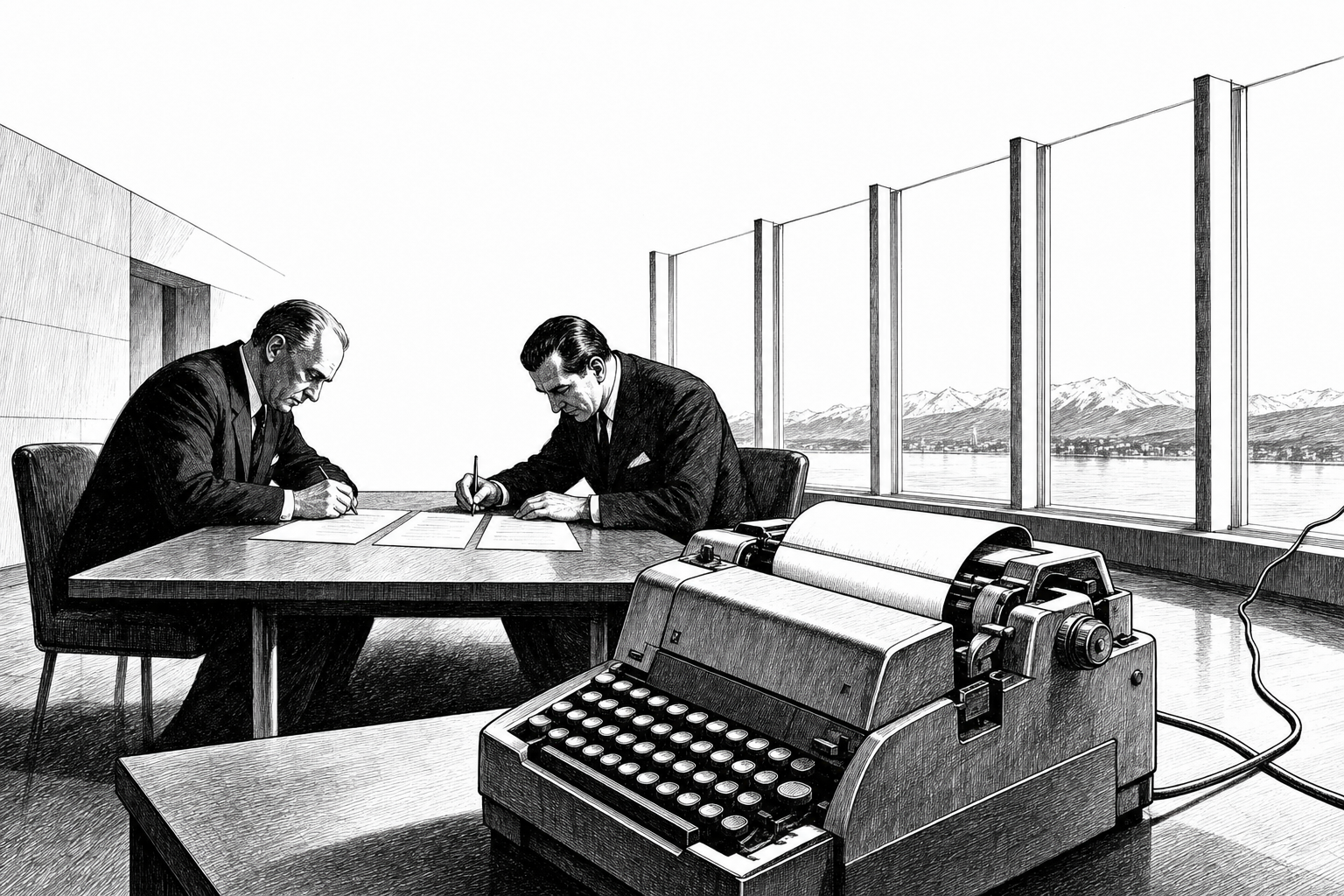
Lead illustration

Geneva conference room, 1963. Two figures in dark suits bent over a sparse table, pen touching paper on a three-page document. Harsh overhead light carves deep shadows across their faces and jacket lapels. In the foreground, a teletype machine dominates — its keys, paper spool, and mechanical housing rendered with dense cross-hatching. A single wire runs off the edge of the frame toward an implied horizon. Generous white space above; the room's tall windows suggest distance and cold clarity. Black-and-white pen-and-ink with bold architectural lines and controlled hatching. No text, no flags, no color.

Eight months after the Cuban Missile Crisis nearly ended the world, American and Soviet diplomats signed an agreement establishing a direct, 24-hour communications link between Washington and Moscow. The date was June 20, 1963. They called it the "hot line" — and it was, at the time, the most consequential piece of telecommunications infrastructure in the world.

The Cuban Missile Crisis had exposed something terrifying: the two nuclear superpowers had no reliable way to talk to each other in real time. During the critical days of October 1962, as Kennedy's naval quarantine surrounded Cuba and Khrushchev decided whether to back down, messages between Washington and Moscow took hours to arrive. The crisis was resolved not because the communications system worked but almost in spite of it. Kennedy declared: "This age of fast-moving events requires quick, dependable communication in time of emergency."1

The agreement signed on this date was built on that lesson. It was framed explicitly as "a first step to help reduce the risk of war occurring by accident or miscalculation" — an acknowledgment that accidental catastrophe was at least as dangerous as intentional conflict.1 The system was operational within months.1 It appeared in Fail Safe as dramatic infrastructure and in Dr. Strangelove as dark comedy.1 In practice — thankfully — it never had to prevent a nuclear war. What it represented was something new: the architecture of de-escalation, the idea that the line itself, simply being open, changes the calculation.

Sources
  1. United States and Soviet Union agree to establish a nuclear "hot line" history.com Nov 13, 2009

↑ Back to top

THE FUNNIES

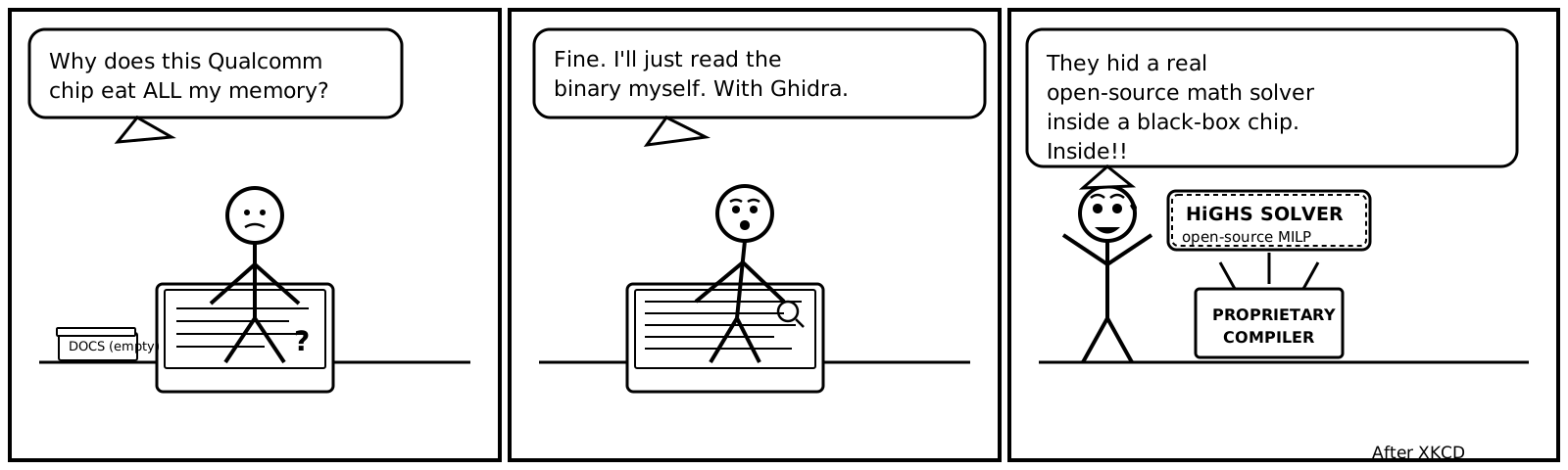
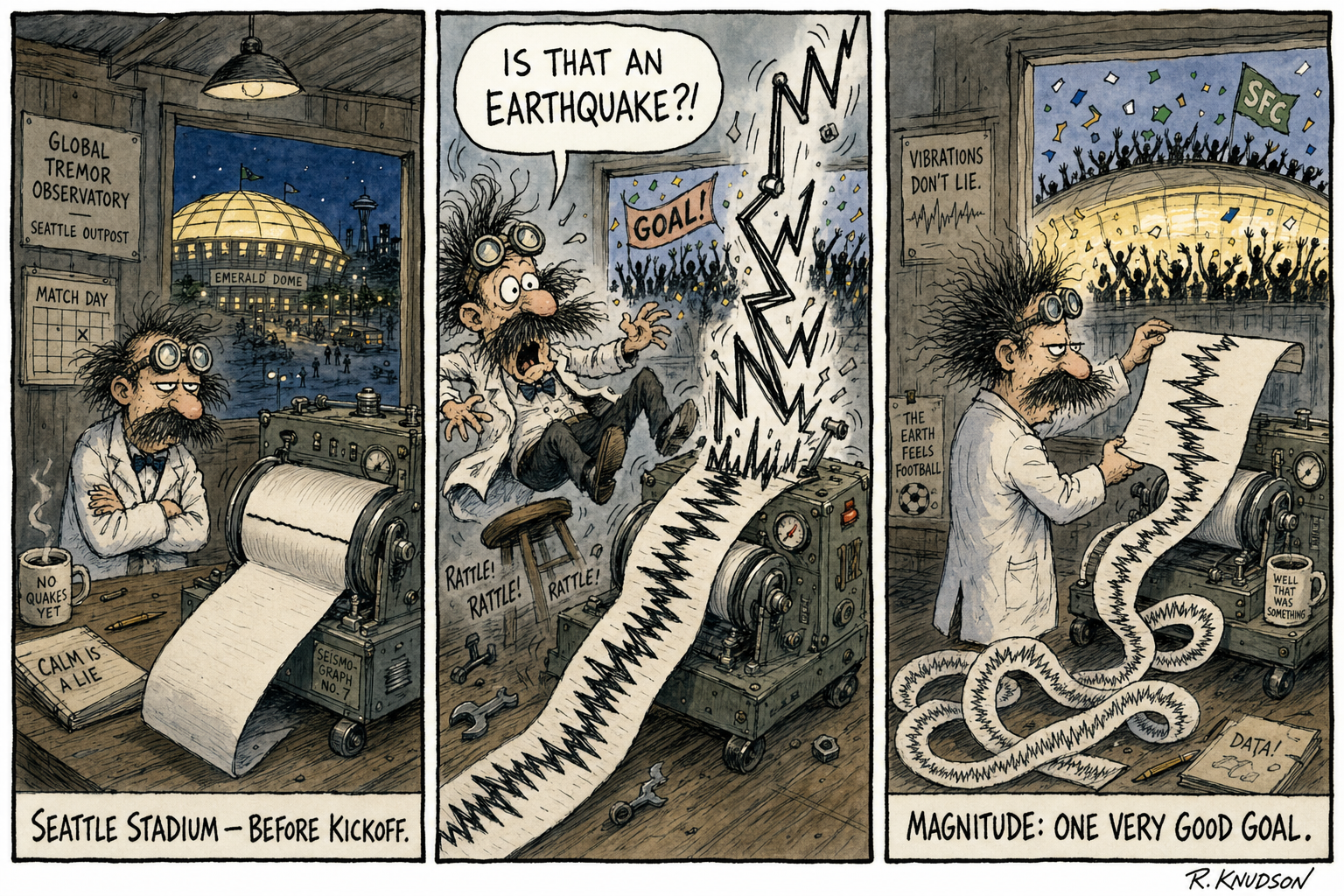
The Black Box Speaks / Seismic Activity

*After XKCD — on the solo engineer who cracked open a proprietary chip compiler with Ghidra and found a real open-source math solver doing the heavy lifting inside. After Krazy Kat — on the fans at Seattle Stadium whose goal-celebration roars registered as genuine seismic events on the Pacific Northwest Seismic Network's instruments.*

Hand-drawn parody comic strip
AI-rendered parody comic strip

↑ Back to top

ALSO NOTED

Also Noted

↑ Back to top

THE QUESTION

When Does Process Documentation Replace the Understanding It Was Supposed to Produce?

Three years is long enough to know if something is working. SafeR — the UCI's multi-stakeholder road safety project, established in 2023 — operates a quarterly supervisory board, a monthly technical commission, and a weekly case management committee that reviews incidents and audits upcoming race routes.1 As THE PELOTON reports today, the UCI has not published data demonstrating a reduction in crashes or accidents across three years of that operation.1 The CPA Women responded to Urška Žigart's fractured jaw at Tour de Suisse by calling for a "substantial review," not because the structure obviously failed but because the structure hasn't proven it worked.1

The same structural failure turns up in a different domain today. THE LAB covers Lorin Hochstein's essay on LLM-written incident reports, which argues that a plausible-sounding operational post-mortem — one that names causes, traces couplings, describes corrective actions — can be filed, read, nodded at, and archived without anyone having done the synthesis work that would surface a wrong answer. The correctness signal for a software incident report isn't "did the incident recur?" — that might take months, or it might not recur for unrelated reasons. The report itself becomes the artifact of record. Hochstein draws on Dick Guindon's observation that writing is how you discover you didn't understand something.2 Outsourcing the writing doesn't skip the report; it skips the discovery.

Both cases share the same architecture: an output that looks like understanding gets produced at regular intervals, and the underlying question — did this actually help? — never gets its correctness signal published. SafeR's committees meet. Incident reports get filed. The process is running. Whether it is working is a different question, and it's the one neither organization has forced itself to answer in public.

The hot line, which this paper's archive section traces to June 20, 1963, was built on exactly the opposite premise: that the value of a communication channel was not the volume of traffic through it but whether the channel changed the calculation in a crisis. That premise demanded a concrete test — would the line be there when needed? — not a schedule of meetings. The lesson from the Cuban Missile Crisis wasn't "establish a committee"; it was "build the thing that makes the catastrophic outcome less likely, and verify it's ready."

The question worth carrying through the day: at what point does the process documentation become the institution's evidence that it cares, rather than evidence that the problem is being solved?

Sources
  1. CPA Women calls for 'substantial review' of SafeR after Žigart's crash cyclingnews.com Jun 20, 2026
  2. I am dreading our LLM-written incident report future surfingcomplexity.blog Jun 19, 2026

↑ Back to top

Investigator Report

Investigator report — 2026/06/20

Verdict

A strong edition that leads with a genuinely surprising technical story (Qualcomm NPU reverse engineering), backs it with solid cycling coverage of Reusser's ITT win, and pulls off a rare three-section thematic bridge in THE QUESTION. The funnies are the best in recent memory — the XKCD-style SVG and the Krazy Kat PNG are both funny and tightly connected to the day's content. The main problem is THE QUESTION lifting a sentence verbatim from THE PELOTON such that both appear on the same printed page; and the ON THE TRAIL picks, though well-sourced, skip the required per-day mileage format and NWS weather quotes that make the section actionable for trip planning. The run itself was efficient and clean.

Frontpage

The rendered PNG looks like a credible newspaper front page. Visual hierarchy is clear: the 68px LONG READ headline dominates row 1, the LAB and PELOTON share row 2 in legible 30–36px heads, and the lower row parcels out archive (with the teletype image), question, and a right column for WORLD + NOTED bullets. The lead image (Geneva conference room, 1963) sits appropriately in the ARCHIVE column and reads well at its 400×236 display size — confident linework, generous white space, no clipping.

One layout asymmetry: the Peloton races-ahead table in the frontpage HTML shows only three rows (women's TdS finale, Tour de France, San Sebastian) and drops the men's TdS Stage 5 finale — also on June 21 — despite the article covering both races. The Country column is also dropped. The section file has five rows; the art director's frontpage rendering chose to truncate without logging the cut. The full table appears correctly in index.html.

The LONG READ leads the page on raw priority (84), which is correct — the config note says "The front-page layout still uses raw priority." The overflow fade-outs on LAB, PELOTON, and QUESTION all work as expected; no text is clipped against a hard edge.

Priority ranking

SectionPriorityLengthImageNotes
THE LONG READ84~780 wordsnoLeads the page; single-source (one personal blog post)
THE LAB80~750 wordsnoFour distinct segments packed into one section
THE PELOTON76~600 wordsnoWomen's results full; men's results absent
THE WORLD70~300 words + ON THE TRAILnoWorld bullets well within cap
THE QUESTION63~411 wordsnoStrong bridge; but re-narrates PELOTON in para 1
FROM THE ARCHIVE38~250 wordsyesGets the visual anchor by design (triggers_meta)
ALSO NOTED108 bulletsnoMixtape item is 43 days old
THE FUNNIES9caption onlynoTwo images (SVG + PNG), both solid

The ranking is defensible. THE LONG READ at 84 is the strongest individual piece in the edition — the Qualcomm NPU story has genuine technical novelty, clear narrative arc, and concrete practitioner takeaways. THE LAB at 80 and THE PELOTON at 76 are appropriate. No priority inflation; the spread from 9 to 84 gives the art director real information to work with. FROM THE ARCHIVE at 38 is correct: a solid historical find (June 20, 1963 is the exact date) but not a story that should lead.

Editorial reading

1. THE QUESTION re-narrates THE PELOTON verbatim, and the duplication appears on the printed page.

The sentence "the UCI has not published data demonstrating a reduction in crashes or accidents across three years of that operation" appears once in section-peloton.md (SafeR section, third substantive paragraph) and once in section-question.md (paragraph 1, third sentence). The frontpage renders enough of both columns that a reader sees the sentence twice — once in the PELOTON column, once in the QUESTION column — within the same visual frame. This is not a subtle echo; it is verbatim repetition. Beyond the sentence, the first 103-word paragraph of THE QUESTION re-narrates three other SafeR facts already stated in THE PELOTON (committee structure, Žigart's fractured jaw, CPA Women's "substantial review" call). The config rule says THE QUESTION must not "re-narrate the facts a sibling section already reported." Para 1 is almost entirely re-narration; only the first sentence ("Three years is long enough to know if something is working") is original framing. The cross-domain bridge in paragraphs 2–4 is excellent and is what makes this a good QUESTION — but it needs a different para 1 that pivots immediately to the structural problem rather than re-staging what PELOTON already reported.

2. THE LONG READ leads without an image while the archive (priority 38) holds the visual anchor.

The triggers_meta: true rule on FROM THE ARCHIVE means the lead image is assigned to the archive regardless of which section leads the page on priority. On a day when THE LONG READ (priority 84) is the front-page lead, this creates a layout where the most important story has no visual pull at all, and the image sits in the lower-left corner under a 38-priority section. The Geneva teletype image is evocative and fits the archive piece well — but it does no work for the Qualcomm story that dominates the page. This is a systemic config choice, not an error, but it is worth asking whether triggers_meta should be suspended on days when the lead story has stronger image potential (the Qualcomm NPU piece would have made a striking lead image: Ghidra screen, decompiled binary, HiGHS logo inside a black-box chip).

3. ON THE TRAIL picks are missing required per-day mileage breakdown and NWS weather quotes.

The config is precise: each pick requires "Per-day mileage AND elevation gain to/from camp. Format e.g. 'Day 1 in: X mi, +Y ft / Day 2 out: X mi, –Y ft'," plus a region-specific weather quote in "compact pipe-delimited format" with day high, night low, and precip% verbatim from the NWS regional forecast. None of the three picks this edition include either. Moonshine Lake via Cathedral Pass lists only a round-trip total (15.5 mi RT, 4,186 ft gain) with no per-day split and no weather quote at all. Sheep Lake to Sourdough Gap gives a simplified "60°F Saturday, 65°F Sunday, sunny both days" — missing night lows, precip percentages, and the required pipe format. The Teanaway NWS data was in feeds.md (Saturday 72°F / 46°F, 0% precip; Sunday 79°F / 47°F, 0%) but the writer summarized rather than quoted. The Moonshine Lake pick also flags "Scatter Creek crossing was flowing but passable" without clearly clearing the "no water fords" criterion.

4. THE PELOTON covers the men's Tour de Suisse Stage 4 ITT without any men's results.

The article's men's section reads: "On the men's side, the Stage 4 ITT in Aarburg started with Pogačar last off the ramp in yellow, carrying a 2:50 cushion over Richard Carapaz." The source (citation 5, cyclinguptodate.com, June 19) is a pre-race start-order preview. The PCS results page was fetched but returned a JavaScript-rendered shell with no actual times or finisher order. As a result, the article presents GC gaps and start positions as if setting the scene for a race the reader just witnessed — but never names a stage winner or reports any result. A reader coming to THE PELOTON for men's TdS ITT results will find none. The writer should either have flagged the absence explicitly ("Men's ITT results were not available at publication time") or found another source for results, or limited the paragraph to "preview of what was set up entering the stage."

5. THE LAB packs four distinct segments into a single section without clear structural signal.

Bevy 0.19, Epic LORE, Hochstein on LLM incident reports, and a cross-reference to THE LONG READ all appear under a single LAB headline. The headline ("Bevy 0.19 Rewires the Renderer…") signals only the first story. The dinkus separators work on the page but the Hochstein essay — which is a strong standalone piece that could carry a section-opener — is buried as segment 3 of 4 with a transitional "On the LLM-as-SRE front:" lede. The cross-reference to THE LONG READ at segment 4 is fine as a teaser but adds to the structural density. Given that the Hochstein essay also anchors THE QUESTION, it is doing triple duty across the edition (LAB segment, QUESTION source, QUESTION paragraph 2). On a lighter news day it would have been the LONG READ candidate; here it's compressed into a single paragraph in a four-story roundup.

Pipeline observations

Fetch failures. One URL failed across all methods: soudal-quickstepteam.com (the Soudal-QuickStep team site). The pipeline retried via CyclingNews and recovered cleanly — the Soudal-QuickStep sprinter story (soudal-qs-tour-announcement.md) is sourced from cyclingnews.com and fact-checked without issue. Net impact: none visible in the output.

Men's TdS results page (JS-rendered). pages/cycling/tds-stage4-itt-results.md (fetched from PCS) returned only the page shell — navigation, metadata, column headers — with no rider times or final order. The fetch itself did not fail (ok: true), so no retry was triggered. The writer used this source as if it contained results, when it contained only structural page scaffolding. This is a recurrent pattern with PCS results pages that need JavaScript to populate; it should be flagged in the fetch layer rather than silently passed to the writer.

Trail-area NWS forecasts absent from research.md. The feeds.md file contains a complete "Trail-area NWS forecasts (per-region, 7-day)" section with per-region temperature, wind, and precip data for all 11 trail regions. This section is not in research.md. The world writer checked feeds.md directly (confirmed in JSONL), which is correct behavior — but it means the format requirement (pipe-delimited NWS quotes) depends on the writer reading the format spec closely while also consulting feeds.md separately. The three picks this edition all gave simplified weather summaries rather than the required format, suggesting this is a recurring gap.

Art director dropped men's TdS from races-ahead table. The section-peloton.md races-ahead table has five rows (men's TdS Stage 5, women's TdS Stage 5, Tour de France, San Sebastian, Tour de Pologne). The frontpage HTML has three rows (women's TdS, Tour de France, San Sebastian) with no logged rationale for the cuts. Men's TdS and Tour de Pologne were silently dropped. No Country column. The full table is correctly rendered in index.html.

Starting commit. The dispatch started on 0605b18 (Investigator: 2026-06-19, same-day commit). No concern — same-day start is normal.

Agent set. All expected agents ran: scout (agent-a56b12697f359b2b0), researcher (agent-a0c945bca4ecf100a), five regular writers, one sweep (ALSO NOTED), one reflector (THE QUESTION), one comic agent, one meta-writer, one illustrator, one art director, one thread editor, and fact-checkers for all non-empty sections. No missing agents, no duplicates. All final responses end with a Done: summary. Clean agent set.

Trace highlights

The researcher at $1.85 and 1,058 seconds is the most expensive and slowest single agent — it ran 140 events with 78 assistant messages. That's a lot of turns for producing research.md. The resulting brief is thorough but the trail NWS data that the researcher had access to in feeds.md did not make it into the brief, which is part of what drove the ON THE TRAIL format gaps in the world writer's output.

The world fact-checker at 278 seconds / $0.27 ran significantly longer than the peloton fact-checker (164s / $0.24) despite the world section being shorter. The JSONL shows it caught a substantive error (the original draft said "Seattle Council candidate Ann Wilson" when the correct title is "Mayor Katie Wilson"); that kind of multi-step web verification explains the extra time well.

The LAB fact-checker at 177s / $0.36 was the most expensive per-section checker, consistent with it covering four distinct story segments each needing independent verification.

The orchestrator at $2.49 is the single largest cost item, slightly above the researcher ($1.85). The orchestrator's 5.2M cache read tokens reflect healthy re-use of feed digest and research content passed to writers, but it suggests the parent context is carrying a large payload. The 94K one-hour cache tokens (only item with 1h cache) hint at some late-stage orchestrator context that exceeded the 5-minute window.

Trace summary

Dispatch 2026-06-20 (model: claude-sonnet-4-6)

AgentDurInputOutputCache ReadCache 5mCache 1hCost
Scout259s463991242581470050$ 0.60
Researcher1058s3890119440018781647490$ 1.85
THE WORLD155s88174786648910$ 0.30
THE PELOTON101s88159330479240$ 0.23
THE LAB98s711114613432760$ 0.20
THE LONG READ77s6440713116560$ 0.06
FROM THE ARCHIVE39s6755372159800$ 0.08
Meta-Writer31s6746886198750$ 0.09
FC: FROM THE ARCHIVE46s6452172234880$ 0.10
FC: THE LONG READ86s6664287224890$ 0.10
FC: THE PELOTON164s852177483491990$ 0.24
FC: THE LAB177s1217444113598670$ 0.36
Illustrator109s1895488000$ 0.22
FC: THE WORLD278s1941135452545346950$ 0.27
THE QUESTION73s74890145248740$ 0.12
FC: THE QUESTION97s109168151234070$ 0.14
ALSO NOTED143s14208565969820140$ 0.48
Draw today's TWO parody comic strips for111s12147228749314210$ 0.19
Funnies (OpenAI)149s4185488000$ 0.22
FC: ALSO NOTED234s1216375369496790$ 0.30
Art Director154s5639780380710$ 0.15
Update story threads for today's edition146s5333860336290$ 0.14
Orchestrator148244305187044094564$ 2.49
TOTAL11363373051259750398818994564$ 8.92

Suggestions for next edition

1. THE QUESTION writer should run the REVISION TEST on any paragraph that retells a sibling section's specific facts before drafting: if three of four sentences in the opening paragraph are re-narrated PELOTON content, the angle needs to start later — at the structural comparison, not the trigger event.

2. The world writer's ON THE TRAIL prompt (or the researcher's brief) should include an explicit reminder to reproduce NWS weather quotes in the pipe-delimited format required by the config, including night lows and precip percentages, and to state per-day mileage splits (Day 1 in / Day 2 out) rather than round-trip totals. The data is in feeds.md; the format requirement is being missed, not the data.

3. For PCS results pages (procyclingstats.com), the fetch layer should detect when a results page returns a valid HTTP 200 but contains no race data (just navigation and metadata columns) and flag it as a soft failure — similar to how paywall stubs are flagged. The men's TdS Stage 4 results page was silently passed to the writer as if it contained data when it contained only the JS-rendered shell.

4. Consider whether the triggers_meta: true rule on FROM THE ARCHIVE should be conditional: on days when the front-page lead (THE LONG READ or THE LAB) has a score above 80, the illustrator should generate an image for the lead section instead of the archive. The current setup puts the day's only image in the lowest-priority slot on the page. The Geneva teletype image is good — but the Qualcomm NPU compiler cracked open by a solo engineer was the better image prompt today.