Sweeney Tears Down the House: UE6 Replaces C++, Git, and the Whole Actor Model
↩ Developing story — first reported Jun 17 · previously Jun 18
At Unreal Fest 2026 in Chicago on June 17th, Tim Sweeney did not announce a graphics upgrade. He announced that C++ is out as the primary language for gameplay logic, Git is out for large-scale game development, and the Actor-Component architecture that has defined Unreal since the early 2000s is deprecated on a timeline. Unreal Engine 6, targeting early access in late 2027, is a more fundamental re-architecture than any version change since UE3.1
The centerpiece is Verse, Epic's new programming language, which Sweeney frames as non-negotiable for the distributed-world problem they actually need to solve. The specific technical argument: all Verse functions run as atomic transactions that can be rolled back and re-simulated.1 That transactional semantics extends to C++ called from Verse via a custom LLVM compiler that automatically transactionalizes the C++ code. The goal is a full distributed software transactional memory system where game code is written as if running on a single machine, while the Verse runtime distributes work across a server cluster transparently — rolling back a transaction, migrating an object to the right server, and re-running it. Fortnite currently caps at 100 players per session; Sweeney said that cap is a direct artifact of the single-threaded server constraint the original Battle Royale film just happened to fit.1 Verse is the engineering path past it.
The language's other design priority is backward compatibility at metaverse scale. Sweeney's illustration is pointed: if a car object from developer A, a gun from developer B, and a stage from developer C all run together on a live server — without the three developers ever coordinating — and developer A patches the car, neither B's gun nor C's map should break. JavaScript's lack of a type system makes this impossible at that scale; Verse's type checker makes it structurally guaranteed. The existing Actor-Component architecture, in production since Unreal Engine 3, will be deprecated in favor of Scene Graph, a new gameplay framework built from scratch on Verse.2 Blueprints survive into early UE6 but are on a deprecation clock; Epic is building a Blueprint-to-Verse automatic conversion tool, using Fortnite's own hundreds of thousands of Blueprint structures as the test case.2
The second infrastructure announcement is LORE, a new version control and asset storage system replacing Git for large-scale game development.2 The critique of Git is familiar to anyone who has pushed a 4GB texture: it is text-code infrastructure adapted badly to binary game assets. LORE is designed to track gigabyte-to-petabyte binary assets at speed, scale from solo projects to global live services, and manage the three-stream isolation problem Epic actually runs: the live Fortnite build, next week's build, and the long-term UE6 integration work. Sweeney said Epic's own online services will migrate to LORE as live verification.
The third strand is the merger of UE5 and Unreal Editor for Fortnite (UEFN) into a single engine. Two different build targets — standalone AAA games versus the UEFN ecosystem with its 80 million monthly active Fortnite users — currently lack each other's features.1 UE6 collapses them. Build once, ship to console stores, PC stores, mobile stores, or live into the Fortnite ecosystem, or any other UE6-based ecosystem from any third-party developer. Fortnite cosmetics are the first portability proof point: Epic will open the outfit system as a UE6 module so other developers can accept Fortnite outfits in their games, and vice versa.
On the AI side, Epic is building MCP integrations for Claude, Gemini, and others as a first-class engine capability — the goal is to expose engine operations as MCP tools so developers can bring their own models.1 Sweeney's framing is productivity, not replacement: if an engine can interpret natural language to set up a level, rig a character, or tune a particle system, the development cost math changes. His numbers are blunt: a $100M AAA game that generates $50M in revenue is a structural business failure; a 3x productivity improvement gets that same game to $33M in production cost, which survives.2
The UE6 development branch is already on GitHub. Verse is visible there, though not intended for general adoption yet.1 Marcus Wassmer, Epic's EVP of Development, noted that Fortnite's live build is already running on the UE6 codebase — which is what makes it a live laboratory rather than a roadmap slide.
Godot 4.7 shipped on June 18th with two additions that matter for shipping 3D titles. AreaLight3D is a new node for rectangular light surfaces — a single node replaces the multi-point-light hack previously required to fake a soft ceiling panel or window light. HDR10 output support has landed across Windows, macOS, and Linux (Linux requires Wayland).34 The release also adds a native virtual joystick with three layout modes, 3D vertex snapping with a modifier key, and gyro aiming support for controllers. The Android build environment now supports full game creation, export, and publishing entirely within Android. Over 300 contributors pushed more than 1,600 pull requests for this release.5 Steam currently lists over 700 new Godot games published in 2026 so far, on pace to exceed 2025's full-year total.5
A researcher at Orchid Files published a detailed account on June 18th of finding 10,000 GitHub repositories actively distributing Trojan malware.6 The methodology is what makes it interesting: the repositories cycle commits every few hours — deleting the previous commit and pushing a new one that adds only a README link to a zip archive — while copying commit histories and contributor lists from legitimate repositories to fake provenance. Submitting the archive link to VirusTotal returns zero hits; submitting the zip file itself detects the Trojan.6 The author built a script against GH Archive event data (filtering for repositories updated 1–24 times per 24 hours, with single-file README-only commits) and found 10,000 matching repositories across the 25% hit rate. GitHub removed repositories from the reported list but has not run the script itself — the researcher documented running the script again after the initial takedowns and finding new repositories that remain up. The campaign has been active for at least 1.5 years, per a Reddit thread from February 2025.6
On the Fable 5 thread: Wired's report describes what a former White House technology official called the "slap-dash approach" — the administration's export control action against Anthropic's Mythos and Fable 5 models was taken without any written policy that clearly defines what Anthropic did wrong.7 The best public articulation of the government's position remains a post on X from White House technology adviser David Sacks.7 In a June 18th analysis, the Pragmatic Engineer flags the structural consequence: by restricting Fable 5 to US citizens only, the action creates a vacuum that China's open-weight models — GLM-5.2, DeepSeek, Kimi — are positioned to fill for non-US developers and governments. All of Anthropic's customers including Apple, Meta, and much of the Fortune 500 remain locked out.7
Trending today: GitHub trending is saturated with AI coding assistants, LLM wrapper frameworks, and curated "awesome" lists — zai-org/GLM-5 (the open-weights release Simon Willison covered Jun 17) is the one technically substantive entry, already reported.
Hormuz partially reopens. Ships transiting for first time in 110 days after the US-Iran MOU signed Wednesday; central route remains mined with an estimated 80 mines. Source
Gas prices won't snap back. Experts say the global oil supply disruption means no quick return to pre-war levels — national prices are still up 35% from late February. Source
USA vs. Australia kicks off at Seattle Stadium at noon today — the second USMNT match of the 2026 World Cup, played on Juneteenth. Watch parties scattered across the region if you're not among the ticket holders.
King County issues a burn ban starting Monday June 22, covering all unincorporated areas.3 Fireworks remain illegal in unincorporated King County regardless of the ban.3 Plan accordingly before any weekend campfires east of the pass.
## ON THE TRAIL
Trip window: Fri Jun 19 – Sun Jun 21. Today is Juneteenth, a federal holiday observed Friday — the reader gets the full Fri–Sun weekend off. No Thursday opportunistic day (that's already gone). Weekend forecast across the Cascades is excellent: sunny, dry, highs in the 67–79°F range through Sunday.
### PART 1 — WEEKEND PICKS
---
Pick 1 (1-night): Thorp Lake via Thorp Mountain Lookout — Teanaway
Region + drive: I-90 East / Salmon La Sac–Teanaway — ≈90–110 min from Issaquah
- Trip length: 1-night backpack (extendable to 2-night with summit day)
- Mileage + gain: 2.7 mi one way, ~1,400 ft gain to camp at Thorp Lake
- Weather: I-90 East region — Sat 73°F sunny, 0% precip; Sun 79°F sunny, 0% precip
- Why it clears the bar: A Jun 17 overnight report found the trail essentially dry ("socks stayed dry the entire trip"), no significant snow, creek crossing at the start manageable via rocks and logs, bugs tolerable while moving (annoying at camp when wind died — bug spray recommended). Only 2 people seen on trail, 1 camper at the lake. Water available at Thorp Lake. Trail runners adequate.
- WTA trip report — Jun 17
A Jun 17 day-hike follow-up confirms conditions: a few downed trees to step over, some mosquitoes but 2 bites total in a breeze, good views from the lookout. Camp at the lake (water access); summit the lookout on day 2 before hiking out.
---
Pick 2 (2-night): Melakwa Lake via Denny Creek — Snoqualmie Pass
Region + drive: I-90 / Snoqualmie Pass — ≈35–55 min from Issaquah
- Trip length: 2-night backpack to Melakwa Lake
- Mileage + gain: 10.2 mi RT, ~2,700 ft gain
- Weather: I-90 / Snoqualmie region — Sat 67°F sunny, 0% precip; Sun 74°F sunny, 0% precip
- Why it clears the bar: A Jun 17 report found the trail mostly dry, a DIY bridge over the Denny Creek waterslide crossing (no wading required), only scattered early-morning hikers before 8 a.m., no biting insects in the morning, wildflowers blooming, water at the lake. The upper trail is more demanding than its stats suggest — plan for slower travel. Snow Lake turnoff sign is reportedly missing; download a map.
- WTA trip report — Jun 17
Note: afternoon crowds increase, especially at Denny Creek waterslide. Leave Friday morning to beat the day-hikers and stake a camp at the lake.
---
### PART 2 — REGIONAL SNAPSHOT
I-90 / Snoqualmie Pass: Snow melting fast. Kendall Katwalk's main snowfield now dirt; a 2nd patch nearly gone. Granite Mountain has 3–4 small patches, easily crossed. Red Pass trail passable with minor creek hops. Kendall Katwalk Jun 18
Teanaway / Salmon La Sac (I-90 East): No snow on DeRoux Peak or Thorp Mountain. Dry trails already this early in the season. Wildflowers past peak at high elevations but still present. DeRoux Jun 18
Stevens Pass – West (US 2 West): Evergreen Mountain Lookout is clear — no snow, bugs just starting (fly bites, no mosquitoes yet), excellent views. Good option if you want a shorter, lower-commitment overnight. Evergreen Jun 18
Mountain Loop Highway: Mount Dickerman is in and passable but rocky and steep with significant switchbacks after mile 1. Cutthroat Lakes access road (Mallardy Ridge Rd 4032) is closed until October 15 for logging — plan around it. Dickerman Jun 18
Mt Rainier / Chinook Pass (Hwy 410): Sheep Lake has one inconsequential snow patch remaining, wildflowers at peak. Naches Peak Loop has snow on the eastern PCT side — manageable with care but kids and trail-runner hikers should expect some slippery crossings. Sheep Lake Jun 18
North Cascades / Mt Baker: Table Mountain (Artist Point) still has heavy snow coverage and steep, icy mounds requiring microspikes. Road opened Jun 10 but conditions remain technical — not suitable for trail runners. Table Mountain Jun 18
BAD RAGAZ, Switzerland — Zoe Bäckstedt launched her sprint from nearly 300 metres out, drifted back off her lead-out riders' wheel, and then simply drove past the entire field on the finishing straight to win stage 3 of the Tour de Suisse Women.1 The Canyon-SRAM rider — U23 ITT world champion and, increasingly, a sprinter to be reckoned with — beat Lily Williams (Human Powered Health) and Shari Bossuyt (AG Insurance-Soudal) by several bike lengths in a mass finish in Bad Ragaz on Friday.
The 120.8km stage was notionally flat by Swiss standards. A dangerous breakaway of eight riders, including Kim Le Court-Pienaar — 1:13 behind overall leader Elisa Longo Borghini — spent much of the day threatening to complicate things, but UAE Team ADQ would not let the gap exceed two minutes. Canyon-SRAM and Human Powered Health joined the chase, the break was absorbed with 17km to go, and a late solo by Laura Asencio (Ma Petite Entreprise) was also shut down 9km out.1 A crash involving Lauren Dickson (FDJ United-Suez) four kilometres from the line briefly disrupted the lead-out trains. It didn't matter for Bäckstedt, who had Kasia Niewiadoma-Phinney and Agnieszka Skalniak-Sójka in her corner through the final kilometre. "My whole team did an amazing job," she said. "I was a bit nervous when that break went and we didn't have anyone in it, but it was controlled quite nicely." She is also targeting Saturday's stage 4 time trial, which suits her as the reigning ITT world champion in the U23 ranks.
Colnago officially launched the TT2 on Friday, the time trial frame Pogačar first raced as a prototype at the Tour de Romandie prologue in April. The numbers are stark: the frame kit drops 550 grams compared to the TT1 — from 2,785g to 2,240g for an unpainted size S — while Colnago claims the bike is simultaneously stiffer, more aerodynamic, and more stable.2 Two watts of drag reduction across a weighted range of yaw angles. Fork weight falls from 530g to 393g, achieved by switching from the TT1's bayonet mount to a conventional steerer with a 32mm-wide head tube. BikeRadar confirms that a complete build including extensions and disc rear wheel can reach the UCI's 6.8kg weight limit.
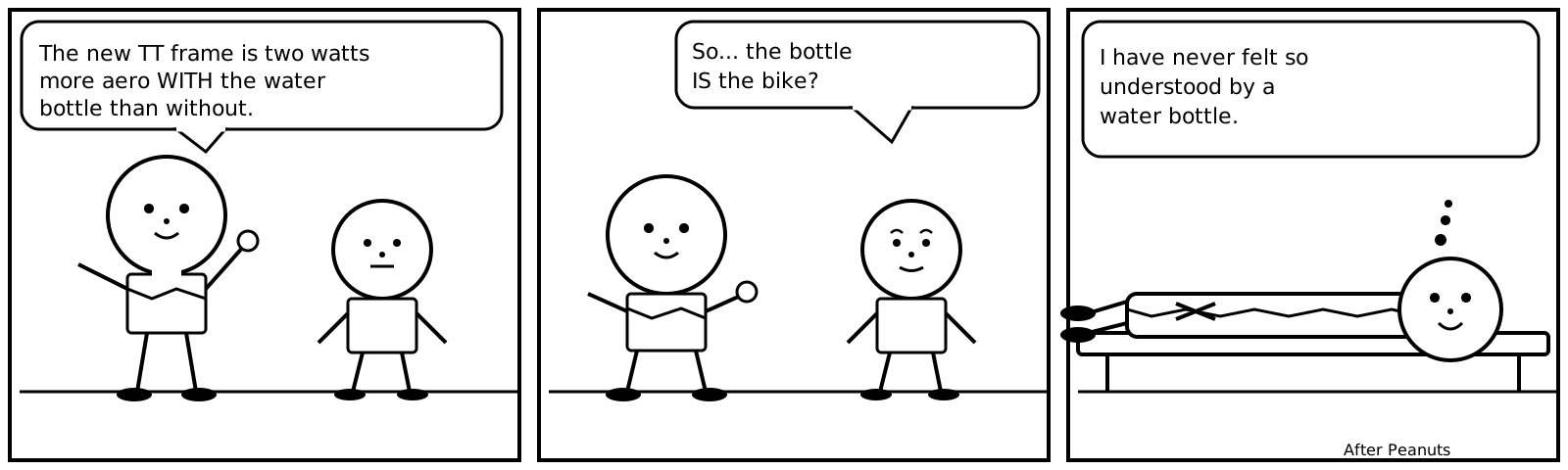
The geometry changes are aimed at modern TT courses — technical, punchy, sometimes climbing — rather than the straight drag strips of an earlier era. Stack grows as reach increases in larger frame sizes, eliminating the need for extreme spacer configurations. Seat tube angle steepened; bottom bracket drop lowered for more aggressive forward positions. The integrated aero bottle, mounted with Fidlock magnetic fasteners, is aerodynamically load-bearing: Colnago's lead engineer Filippo Galli says the bike is two watts more aero with the bottle than without, as it acts as a fairing around the bottom bracket.3 UAE Team Emirates-XRG will not use the stock bottle due to an Elite sponsorship arrangement and has a custom Colnago cage instead.
Pogačar rides the TT2 in Saturday's Tour de Suisse ITT, then again in the Tour de France team time trial opening in Barcelona on July 4 and the individual time trial later in the race. Frame kits are available from late September at $7,500 / £6,499 / €7,040 — the same price as the TT1.
The context around Pogačar's racing this week is harder than the results suggest. His partner Urška Žigart crashed at speed during Thursday's women's Tour de Suisse stage 2, striking what appeared from fan footage to be a raised road surface or speed bump inside the final kilometre. She was able to ride to the line but was admitted to hospital immediately. AG Insurance-Soudal confirmed a fractured jaw; no other injuries were detected.4 Pogačar learned of her condition minutes before his own stage start and rushed to the hospital after finishing the podium presentation. UAE team manager Mauro Gianetti described him as visibly shaken. "Normally, he manages to block out everything else when he's racing, but not if it's his girlfriend," Gianetti said.5 Pogačar confirmed at the start of Friday's stage 3. He is 15 days out from the Tour de France.
A mass crash 27km from the finish of Thursday's stage 2 at the Tour of Slovenia left two riders with broken legs. Eduard Prades (Caja Rural-Seguros RGA), 38, suffered a right tibia fracture on a sweeping downhill bend and will require surgery in Spain; Caja Rural confirmed he is out of consideration for the team's Tour de France selection.6 Lucas Towers (Modern Adventure), a neo-pro racing his first senior season, fractured his lower leg in the same incident and will be operated on at the University Medical Center in Maribor before returning to the UK for rehabilitation. The stage was neutralised for nearly 30 minutes while ambulances were brought to the scene. Racing resumed, and Dušan Rajović (Solution Tech-Nippo-Rali) won the sprint finish as Laurence Pithie (Red Bull-Bora-Hansgrohe) held the race lead.
Romain Bardet is returning to Decathlon CMA CGM — not as a rider. The former Tour de France podium finisher announced Thursday that he will take up a senior management role as Sports Manager at his old team from January 1, 2027, with responsibility over the full sporting structure from the WorldTour squad down through the New Gen development and Junior squads. He will sit under CEO Dominique Serieys and above Director of Racing Sebastian Joly. Bardet spent nine years at the team as a rider — including back-to-back Tour podiums in 2016 and 2017 — before leaving for DSM-Picnic PostNL in 2021 and retiring partway through last season.7 He has spent his first post-racing year winning gravel events on multiple continents, but has been considering the transition to management throughout. "I would start with real humility," he said. "It's quite a big task, sports manager, so I have a lot to learn." He will have no role around Paul Seixas' Tour de France debut this July; those plans are already set for 2026.
On the Road Ahead
Calendar from Jun 15, 2026 — primary source blocked today
Date
Race
Country
Thu–Sun, Jun 17–21
Tour de Suisse (stages 3–6 remaining, incl. ITT Sat Jun 20)
Switzerland
Fri Jul 4 – Sat Jul 26
Tour de France (opens with TTT in Barcelona)
France/Spain
Sat Aug 1
Clásica San Sebastián
Spain
Mon–Sun Aug 3–9
Tour de Pologne
Poland
Sat Aug 22 – Sun Sep 13
La Vuelta a España
Spain
Show Results
TOUR DE SUISSE WOMEN — STAGE 3 (Bad Ragaz, 120.8km):
WINNER: Zoe Bäckstedt (Canyon-SRAM)
PODIUM: 1. Bäckstedt 2. Lily Williams (Human Powered Health) 3. Shari Bossuyt (AG Insurance-Soudal)
GC AFTER STAGE 3: Elisa Longo Borghini (UAE Team ADQ) leads
TOUR DE SUISSE MEN — STAGE 2 (Jun 18, Locarno):
WINNER: Romain Grégoire (Groupama-FDJ United)
PODIUM: 1. Grégoire 2. Marcel Camprubí (Pinarello Q36.5) 3. Bart Lemmen (Visma-Lease a Bike)
GC: Pogačar leads by 2:50 over Richard Carapaz; Andrea Bagioli third at 3:07
TOUR DE SUISSE MEN — STAGE 3: In progress at time of filing
TOUR OF SLOVENIA — STAGE 2:
WINNER: Dušan Rajović (Solution Tech-Nippo-Rali)
NOTABLE: Eduard Prades (Caja Rural) — right tibia fracture, out of Tour de France selection; Lucas Towers (Modern Adventure) — lower-leg fracture; both require surgery
At 15km to go, Mike Woods threw up. At 12km to go he started talking to himself. For the last 10km he looked over his shoulder every 200 meters, waiting to see his pursuers materialize out of the heat shimmer on the Vancouver Island logging roads. They never did. He crossed the line alone, put his hands up, brought them down again, rode to the shade, and lay down.1
For twenty minutes nobody bothered him much. Someone brought water. A journalist asked for an interview. He grimaced at all of it. Then someone came over and told him the race was canceled.
The Canadian National Gravel Championships, run over 126km of logging roads outside Duncan, BC, on a 35-degree Saturday, fell apart behind the leaders. Other categories ran short of water. Medical support was overwhelmed. Race organizer Jon Watkin made the call to reroute and cancel. The top ten men had finished cleanly — Woods, his gravel mentor Ben Perry in second, mountain biker Andrew L'Esperance in third — but a Canadian cycling official explained the logic: because other categories could not produce a winner, neither could the elite men's field. No podium. No jersey. No medal. No result.
What follows in Woods's VeloNews essay is one of the more honest pieces of sports writing you'll read this year — honest about the body, honest about the absurdity, and honest about what he discovered the win actually meant to him when it was taken away.
Woods is a former WorldTour pro now racing as a privateer, a word he dissects with the same precision he brings to pacing a climb. He opened the season asking himself a half-joking question: in gravel, where privateers are the primary narrators of their own results, "if a privateer wins, and doesn't post about it, did they actually win at all?" He didn't intend the Canadian nationals to answer it. He hadn't planned to write about the race at all.
The piece earns its length by being specific where most athlete first-person writing goes vague. He describes the exact sequence of the break — 30km in, three men left: Woods, Perry, L'Esperance — followed by 40km of shared pulling in building heat.1 He names the sensation of heat exhaustion onset: muscle contractions in the feet, a "tickling and tightening" in the hamstrings, the gut starting to churn. He describes the descent at 20km to go — loose gravel, turns just straight enough to carry 75km/h without braking, "every part of your being shakes" — and his decision not to touch the brakes because there was no other way to hold the gap.
He also describes what the cancellation stirred up philosophically, and here the essay gets interesting. Woods doesn't simply cry foul. He acknowledges that Jon Watkin made a hard call in impossible conditions, that he doesn't envy anyone who now has to find a solution for the elite women whose race was also affected. But he pushes back on the specific logic — that the men's result was voided in solidarity with categories that couldn't finish, even though the men's race ran cleanly and all three finishers agreed the result was real. "Sometimes," he writes, "we let our desire for equity get in the way of reality."1
Whether you agree with that framing or not, the argument is made honestly, without score-settling.
The essay ends with a FaceTime call to his wife and son. His wife tells their boy Willy that daddy won a bike race. The look in his eyes, Woods writes, "almost brought me to tears."1 He hadn't processed the win until that moment — too wrecked, then too annoyed. Then Willy asks: "Did you get a medal?"
The question stands at the end of the piece unanswered, which is the right choice. Woods set out to test whether a privateer's win exists without the post, and got something richer: a win that existed entirely in his son's face, with no medal, no jersey, no official result, and no way to reduce it to a social media obligation.
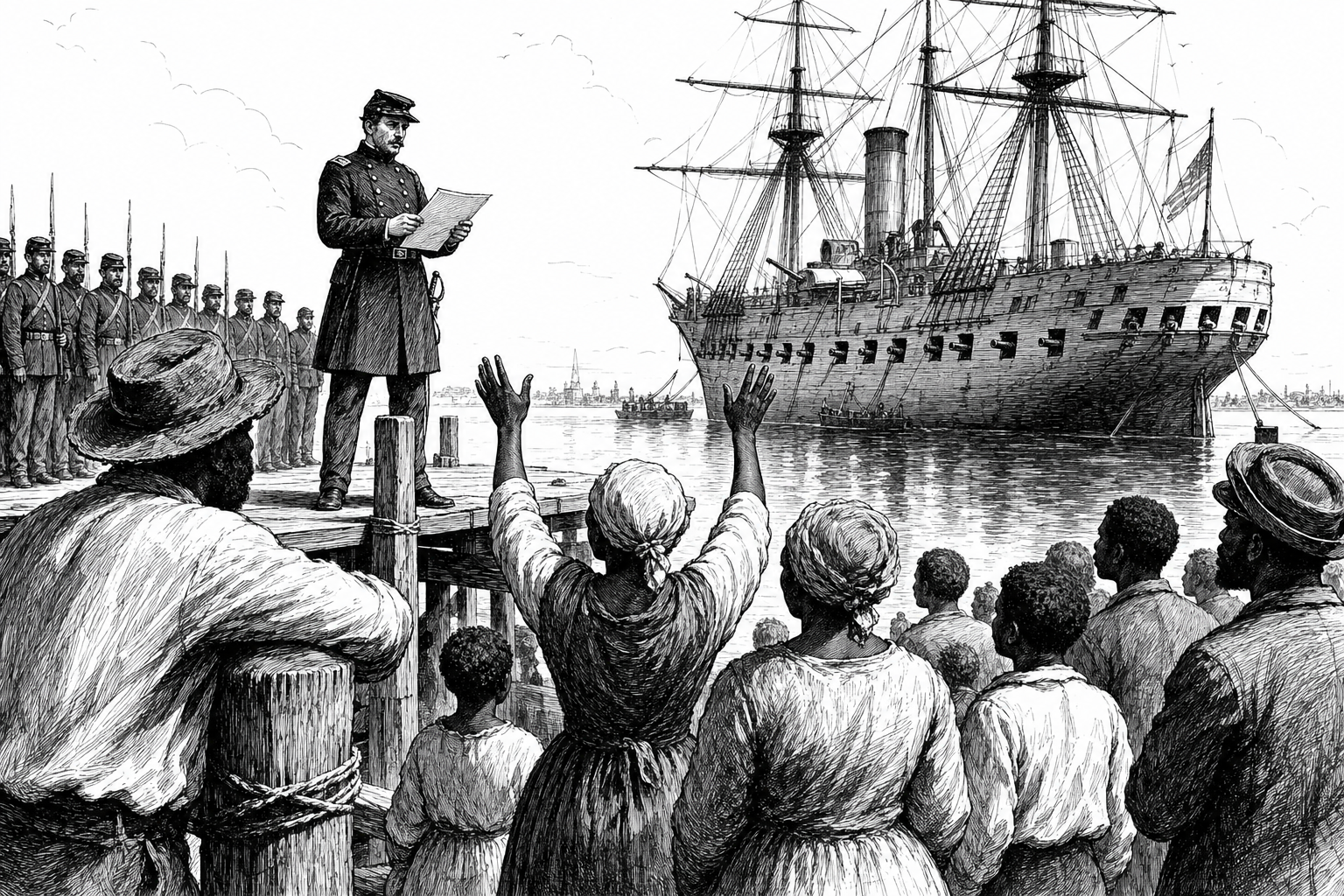
The Order That Arrived Two and a Half Years Late: June 19, 1865
Galveston Bay, June 19, 1865. A Union steam frigate anchored in still water, gun ports open, rigging taut against a flat sky. On the wharf below, a Union officer stands on a wooden platform, paper in hand, facing a crowd of Black Texans — men, women, children — pressing forward. Strong silhouettes from behind: a woman with hands raised, a man leaning on a post, a child at the edge of the dock. Hatched shadows under the hull of the ship; bold crosshatching on the crowd's clothing and faces. A diagonal line of soldiers in the background holds the frame. The water reflects the ship in broken strokes. No celebration telegraphed — just the moment of hearing. Pen-and-ink editorial illustration. Confident linework, controlled hatching, strong silhouettes, generous white space.
The Emancipation Proclamation took effect on January 1, 1863. What is less often dwelt on is that it did almost nothing in Texas — a state so far west, so deep inside Confederate territory, that Union enforcement couldn't reach it. For the more than 250,000 enslaved people living there, the proclamation was a legal fact with no mechanism behind it.1 It would sit that way for two years, five months, and eighteen days.
On June 19, 1865 — with the Confederacy collapsed, Lee having surrendered at Appomattox in April — some 2,000 Union troops arrived in Galveston Bay.1 The army announced what had been technically true since 1863: by executive decree, enslaved Black Texans were free. Texas was the last Confederate state where the order was enforced. The people who received the news that day named the date themselves. Juneteenth.
The distance between a law and its reach is not a technicality. The Emancipation Proclamation was real; the freedom it promised moved at the speed of Union armies. In the westernmost Confederate state, that speed was measured in years. Freedom didn't travel on paper — it traveled with 2,000 soldiers and a bay full of Union ships. The date on the proclamation was 1863. The date freedom arrived in Galveston was June 19, 1865.
Congress declared Juneteenth a federal holiday in 2021. It is today.
*After Peanuts — on the Colnago TT2's revelation that the aero water bottle is load-bearing, making it two watts better with the bottle than without, which is the kind of engineering news that requires lying down on a bench to process. After The Far Side — on the Juneteenth theme of the gap between a declaration and its arrival, rendered as a telegraph clerk in 1865 discovering what has been sitting in the inbox since 1863.*
Bosch enters the hub motor market — Bosch launched its first rear hub motor, the Hub Line, targeting city ebikes with a 45Nm, 2.3kg unit paired with a 68mm-wide 360Wh in-frame battery — a direct challenge to Mahle's hub systems, alongside an updated Active Line Plus mid-drive with 60Nm torque and 17% size reduction. bikeradar.comJun 18, 2026
SE May Valley Road closes through late August — King County is replacing the 1932 Fifteen Mile Creek Bridge #493C on Southeast May Valley Road near Issaquah-Hobart Road, closing the road in both directions — including to bikes and pedestrians — through August 23; a detour is in place but trucks over 15,000 lbs need alternate routes. issaquahreporter.comJun 17, 2026
COROS is replacing bricked watches, no questions asked — A May firmware update has killed an unknown number of COROS watches (Pace 3 most affected) days or weeks after install, with no rollback possible; after a rough few weeks of AI-chatbot runaround, COROS confirmed this week it will replace any device that fails after the update, and DC Rainmaker's Ray calls the end resolution fair even if the path there was not. dcrainmaker.comJun 18, 2026
The World Cup is too big for its own good — Wired reports that average visitor spend is projected at $5,400 — more than double Qatar 2022 — while US hotels are already seeing bookings below expectations, flights are the only inter-city option, and public security grants alone total nearly $1 billion across the US and Canada. wired.comJun 19, 2026
Sarah Ruggins breaks the outright Europe length record by three days — The Cirencester cyclist rode 6,000km from Tarifa to Nordkapp solo in 13 days, 20 hours and 27 minutes — beating the previous record by three days — and also set a women's world record for greatest distance in seven days (3,364km); she only took up cycling in 2023, having recovered from a rare neurological disease that had left her unable to use her limbs as a teenager. bikeradar.comJun 19, 2026
US Criterium Nationals: Elphingstone wins in Charleston — Luke Elphingstone (Project Echelon Racing), 23, claimed the elite men's criterium title in a nine-man sprint in Charleston, moving up from a U23 bronze last year; Kendall Ryan (Caldera Medical x Aurea Racing) defended the women's criterium title for a second straight year. cyclingnews.comJun 19, 2026
Castelli and Sportful go direct-to-dealer in the UK — After Saddleback — Castelli's distributor for more than 20 years — went into administration in May with 42 staff made redundant, parent company MVC Group has established its own UK entity and will absorb import duties so retailers and customers face no additional costs. bikeradar.comJun 19, 2026
Canyon's Predict prototype puts edge AI, radar, and 360° sensors on a bike — Debuting at Eurobike in Frankfurt next week, the concept uses on-bike AI (not cloud) to warn riders of obstacles and suggest cornering speeds via handlebar vibration and flashing lights, and integrates a dropper post for emergency stability; no production date announced. cyclingweekly.comJun 18, 2026
Simon Willison ships Datasette Apps — sandboxed HTML tools with SQL backends — The new plugin lets users host Claude Artifacts-style HTML+JavaScript applications inside Datasette, locked down via `