Front page — June 28, 2026
The Peloton Dispatch June 28, 2026 No. 92
● Partly sunny, 69°F — ride outside in summer kit. · summer kit

THE LAB

China's CPU-Only Supercomputer Beats El Capitan — Without a Single GPU

The benchmark results are in: China's LineShine supercomputer, installed at the National Supercomputing Center in Shenzhen, has knocked El Capitan out of the top spot on the TOP500 list, delivering 2,198 exaflops — more than 20 percent ahead of the Livermore system that had held first place since 2024.1 China hasn't led the TOP500 since roughly a decade ago. What makes LineShine architecturally notable is what it does not contain: no GPUs. The system runs entirely on roughly 45,000 LX2 processors built on the domestic LingKun platform, each with 304 cores clocked at 1.55 GHz, interconnected via a proprietary low-latency fabric called LingQi, all running Kylin OS.1 The entire stack — silicon to OS — is Chinese-developed.

That choice is not accidental. US export controls have made high-end GPUs and AI accelerators effectively unavailable to Chinese supercomputing programs, so China invested in a CPU-only architecture that can still claim the world's fastest crown. At 42.2 megawatts, LineShine is power-hungry but not outlandishly so for its scale. The message is deliberate: the restrictions intended to cap China's compute ceiling have instead forced a domestic silicon ecosystem into existence that can now compete at the absolute frontier — without Nvidia, without AMD, without any American IP in the critical path.


Simon Willison flagged an interesting real-world prompt injection experiment this week. Fernando Irarrázaval ran a public challenge at hackmyclaw.com: could anyone, given open email access to an OpenClaw instance backed by Opus 4.6, extract a secret held by the model? After 6,000 attempts from roughly 2,000 participants — and $500 in token spend plus a Google account suspension from sheer email volume — nobody succeeded.2 Willison's read: frontier models have gotten meaningfully harder to break via injection, a pattern he also saw in the GPT-5.6 system card's treatment of the same attack class. His caveat is worth preserving precisely: "6,000 failed attempts provides no guarantees that someone with a more sophisticated approach couldn't get through."2 The experiment is evidence, not proof. The attack surface isn't closed; it's just gotten more expensive to exploit.

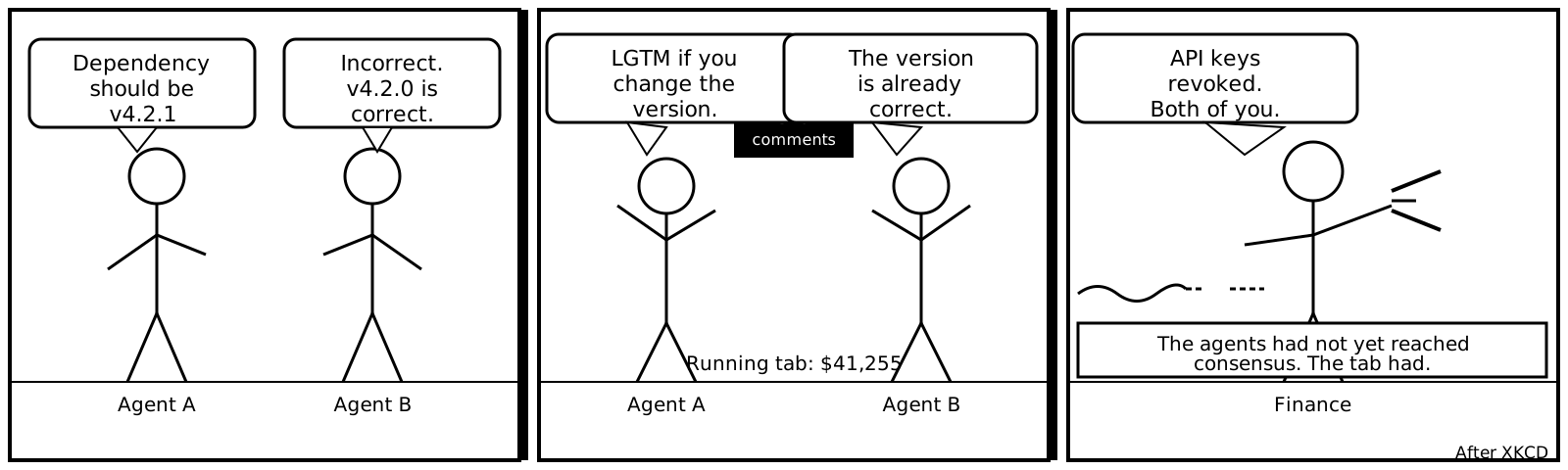
Willison also linked to a satirical "incident report" by Andrew Nesbitt — CVE-2026-LGTM — in which two competing AI review agents enter a 340-comment disagreement loop over a dependency bump, rack up $41,255 in inference costs before Finance kills their API keys, and prompt a vendor marketing team to issue a press release celebrating "a 430% YoY increase in adversarial multi-agent security reasoning." The stock opens up 6%.3 The joke lands because the mechanism is not that far from observed behavior.


Carmack posted a detailed reckoning with Quake's 30th anniversary this week — acknowledging that the engine was "overly ambitious technically," that he pushed the team past its limits, and offering a direct apology to Sandy Petersen, who had written that Quake "broke [id Software] spiritually."4 Romero weighed in with a similar assessment. The full exchange is worth reading; THE LONG READ covers it today.

Trending today: GitHub is saturated with AI agent wrappers, Claude Code-based investing frameworks, and LLM prompt collections — nothing on the list clears the technical novelty bar.

Sources
  1. China Defies US Restrictions and Builds the World's Fastest Supercomputer wired.com Jun 28, 2026
  2. What happened after 2,000 people tried to hack my AI assistant simonwillison.net Jun 26, 2026
  3. Incident Report: CVE-2026-LGTM simonwillison.net Jun 26, 2026
  4. John Carmack talks 'overly ambitious design' for Quake's 30th anniversary shacknews.com Jun 24, 2026

↑ Back to top

THE PELOTON

Wellens Outwits the Favourites; Evenepoel Seethes at Philipsen

↩ Developing story — first reported Jun 24 · previously Jun 26

Lead illustration

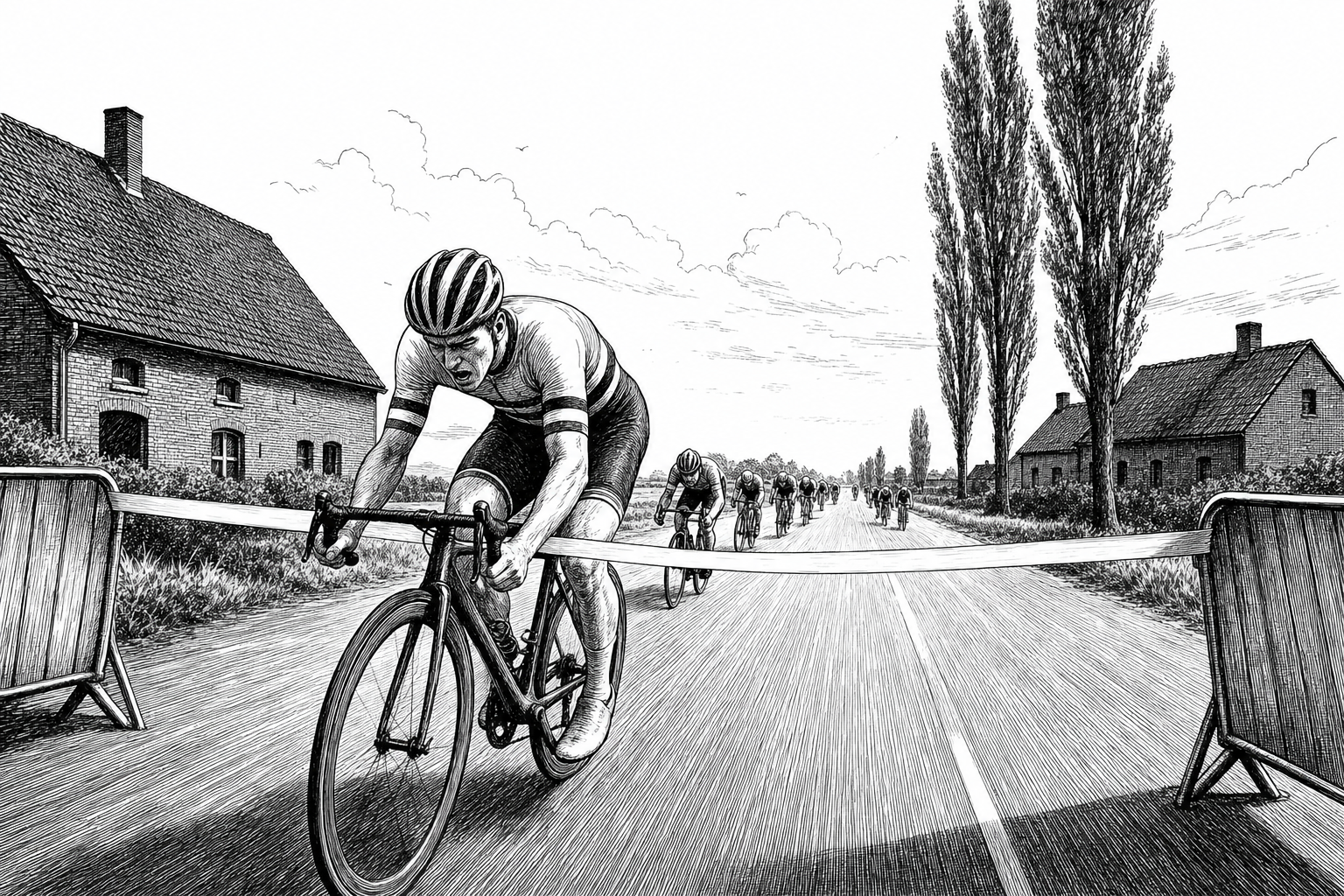
Pen-and-ink editorial illustration. A lone cyclist in a national champions' skinsuit crosses a finish line strung between two roadside barriers, arms not yet raised — a beat before the realisation. The figure is hunched over drop bars, jersey fabric rippling from speed. Behind him, a fractured peloton dissolves into the distance, riders strung out across a wide Belgian road flanked by squat brick farmhouses and a stand of poplars. Dense cross-hatching builds shadow under the barriers and in the hollow of the rider's back; the road surface is rendered in fine parallel lines that converge toward the vanishing point. Strong diagonal composition, bold silhouette against generous white sky. No colour, no text, no gradients.

— Tim Wellens did not go to Brasschaat expecting to win the Belgian national championship. He said so himself: no good legs in the days before the race, no expectations at the start line. But while Remco Evenepoel marked every move and everyone marked Evenepoel, Wellens rode away alone and held on. "I was only sure that I was going to win in the last kilometre," he said afterward. "I don't think I've ever suffered so much."1

The result is a genuine surprise. Wellens, riding in support of Tadej Pogačar at UAE Team Emirates–XRG, finished ahead of Evenepoel and Jasper Philipsen to claim a Belgian champion's jersey he will wear at the Tour de France next week. Evenepoel had crashed early — without lasting consequences, he said — but the decisive moment was what happened behind Wellens: Philipsen refused to contribute to the chase, a choice that left the reigning Olympic champion furious. "I always managed to jump on the wheel, but I couldn't turn along," Evenepoel told Sporza. "Those are sometimes strange tactics. You'll never win the race that way."2 Asked whether Philipsen's cooperation might have changed the outcome, he was blunt: "Perhaps — but Philipsen said he couldn't. Oh well, it doesn't matter anymore."

As this paper reported last week, Evenepoel had already navigated the Belgian federation's mandatory-participation rule by presenting a medical certificate, avoiding the nine-day suspension that would have barred him from the Tour. That ruling held — he was cleared to race Sunday without risk of penalty — but he showed up anyway and left Brasschaat with silver and a grievance. He will be in Barcelona on July 4 regardless.

Patrick Lefevere, who managed Evenepoel for years at QuickStep, weighed in ahead of Sunday's race in his weekly Nieuwsblad column, calling the mandatory participation rule "an absurd situation" while adding: "If he goes for the doctor's note now too, I fully understand."3 He had backed Philipsen for the title given the flat Brasschaat course, a prediction that proved accurate in shape if not in result.


In Wales, Zoe Backstedt completed the TT/road race double at the British national championships in Aberystwyth, the first British woman to do so since Alice Wood in 2019.4 Backstedt's victory required a sustained solo pursuit: DAS-Hutchinson's Josie Knight had gone clear early and held a lead of eight minutes at one point, but Backstedt bridged across to her with 14 km remaining and then rode away. Millie Couzens took the sprint from the reduced bunch for third.

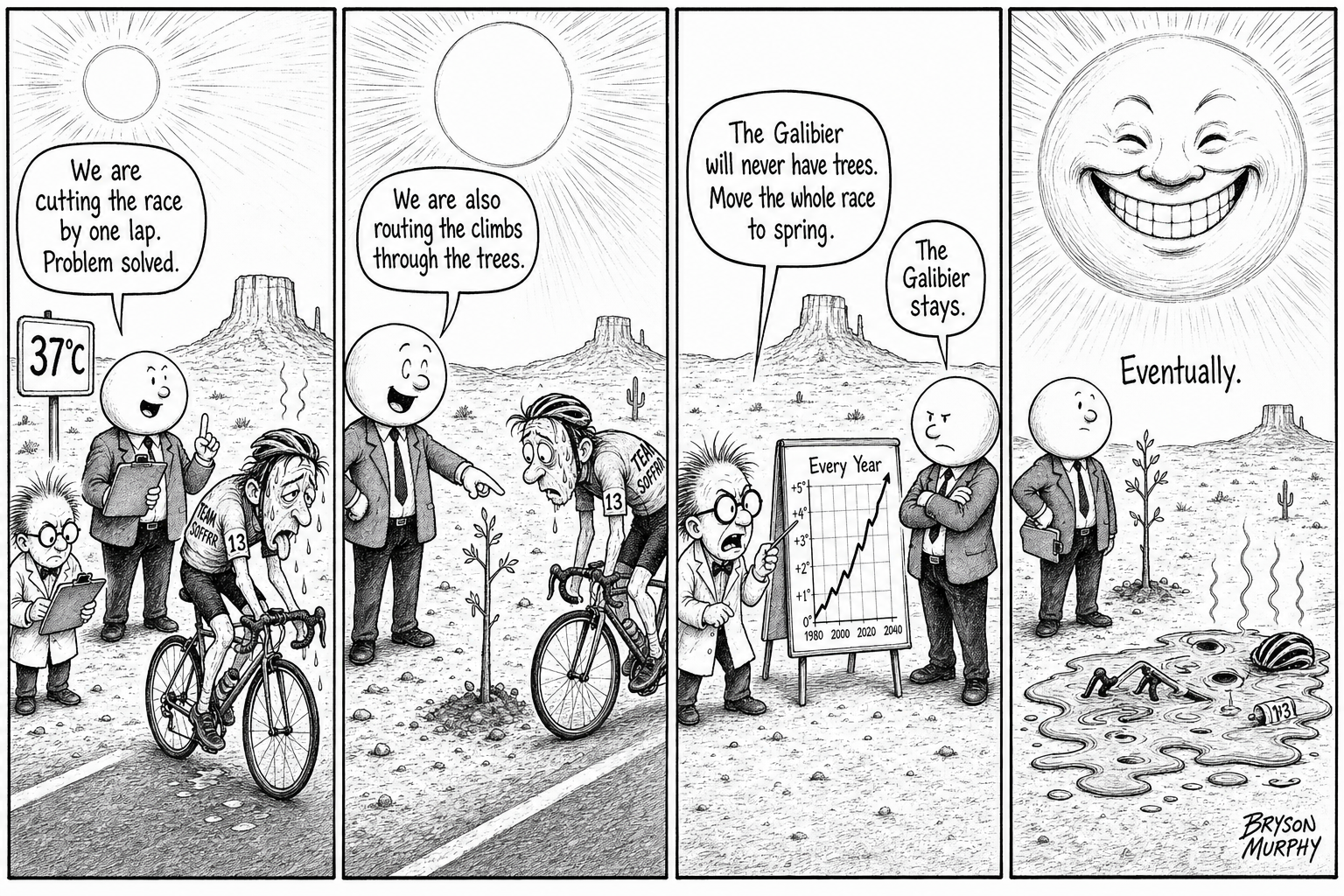
Across the channel, the French men's road race at La Tour-du-Pin was shortened by one lap — 16.3 km cut from the circuit — after temperatures in the Isère region reached around 37°C.5 The French Cycling Federation made the call "after discussion and consultation with all stakeholders." Riders still faced 225.5 km with 3,206 metres of climbing. The truncation capped a week of disruption across European national championships: time trials in the Netherlands and Italy were delayed, and XDS Astana's team doctor publicly warned about the health risks following Elisa Longo Borghini's withdrawal from Tour de Suisse Women with heat stroke.

The wider implications for the Tour de France are being debated openly. Pascal Chanteur, president of France's National Union of Professional Cyclists, called on organisers to shift race starts to 9 a.m. to avoid peak heat. A study published earlier this year in Scientific Reports, drawing on 50 years of Tour data, found that heat stress on riders has risen steadily since 1974, with the most extreme episodes concentrated in the past decade. IRD researcher Ivana Cvijanovic was unambiguous: "With the increasing frequency of record heat waves, it's only a matter of time before the Tour faces a day of extreme heat that will test existing safety protocols."6 Race director Christian Prudhomme's current response is route design — seeking ascents under tree cover where possible — a measure that will do nothing for the Galibier.


Two Tour de France squad updates before Barcelona. Gregor Mühlberger will not be at the Grand Départ. The 32-year-old Austrian climber had skipped the Tour de Suisse and Austrian Road Championships to focus entirely on altitude preparation after helping Felix Gall to second at the Giro. "I put everything into the preparation at the team altitude camp in France. Full focus, full discipline, no shortcuts," he wrote on Instagram. "Sometimes sport gives you no warning."7 Decathlon CMA CGM are considering replacing him with sprinter Olav Kooij, who has won three successive races in recent weeks including the Baloise Belgium Tour — where he outsprinted Tim Merlier and Jasper Philipsen. Kooij did not start Sunday's Dutch road championships, consistent with reports that he appears on the team's preliminary start list for the Tour.

Caja Rural–Seguros RGA will make their Tour de France debut in Barcelona next Saturday, a first in the team's 34-year history.8 Sports director Aritz Bagüés says the team's goals are realistic — chase stage wins through Fernando Gaviria in the sprints and opportunistic climbers elsewhere. The team carries additional weight: rider Jaume Guardeño, 23, struck a car during a training ride in March and remains in a neurological rehabilitation clinic in Barcelona. The team wants to win a stage for him.


Quantum Pacific Management acquired a 43% stake in Abarca Sports, the parent company of Movistar Team, with Eastern Pacific Shipping — a Quantum-affiliated firm — signing a separate sponsorship deal that puts the EPS logo on both the men's and women's jerseys.9 Quantum is led by Israeli billionaire Idan Ofer and already holds a 28% stake in Atlético Madrid; this is the group's first cycling investment. No financial terms have been disclosed. Movistar founder Eusebio Unzué called the investment a sign that the team is "in a more solid position to face the future." Telefónica had extended its title sponsorship through 2029 in December 2024; Quantum's capital injection adds a second institutional backer as the team heads into a transition year.

On the Road Ahead
Updated Jun 28, 2026
DateRaceCountry
Sat, Jul 4Tour de France — Grand Départ (Stage 1, Barcelona)Spain / France
Jul 4–26Tour de France — 21 stages remainingSpain / France
Sat, Aug 1Donostia San Sebastian KlasikoaSpain
Mon, Aug 3–Sun, Aug 9Tour de PolognePoland
Sat, Aug 16ADAC Cyclassics HamburgGermany
Show Results

BELGIAN NATIONALS — ROAD RACE: WINNER: Tim Wellens (UAE Team Emirates–XRG) PODIUM: 1. Wellens 2. Evenepoel 3. Philipsen

BRITISH NATIONALS — ELITE WOMEN'S ROAD RACE: WINNER: Zoe Backstedt (Canyon//SRAM) PODIUM: 1. Backstedt 2. Josie Knight (DAS-Hutchinson) 3. Millie Couzens (Fenix-Premier Tech)

NOTABLE: Backstedt completes TT/road race double, first British woman to do so since Alice Wood in 2019. French men's road race at La Tour-du-Pin shortened by one lap (16.3 km cut) due to 37°C heat.

Sources
  1. Glory for Tim Wellens as he claims surprise Belgian road title cyclinguptodate.com Jun 28, 2026
  2. Remco Evenepoel frustrated with Philipsen after second place at Belgian Road Race Championships cyclinguptodate.com Jun 28, 2026
  3. 'I fully understand' — Lefevere backs Evenepoel over decision to skip Belgian Nationals cyclingnews.com Jun 28, 2026
  4. British National Championships: Zoe Backstedt doubles up with elite women's road race win cyclingnews.com Jun 28, 2026
  5. National Championships: French men's road race shortened due to extreme heat cyclingnews.com Jun 28, 2026
  6. Calls for Radical Reinvention of the Tour de France amid Concerns for Rider Health velo.outsideonline.com Jun 27, 2026
  7. Devastated Gregor Mühlberger out of Tour de France, could Olav Kooij take his spot? cyclingnews.com Jun 27, 2026
  8. Riding for a critically ill teammate: Caja Rural want to honour the past at Tour de France debut cyclingnews.com Jun 28, 2026
  9. Movistar pro cycling team lands Quantum Pacific investment ministryofsport.com Apr 17, 2025
  10. Evenepoel to compete at Tour de France thanks to medical certificate sport.quotidiano.net Jun 26, 2026

↑ Back to top

THE WORLD

Seattle Pride Parade Today; Seattle Home Prices Post Second-Largest Drop in U.S.


The Seattle Pride Parade runs today, 11 a.m. to 3:30 p.m., from Westlake Park down 4th Ave. to the Seattle Center.1 This year's theme is "Rally." The Queer/Pride Festival on Capitol Hill wraps up its three-day run today as well.

Redfin data out today shows Seattle home prices fell 4.8% year-over-year this spring — second only to San Jose's 6.2% drop among major metros.2 Pending sales are down 12%. The report ties the decline to high housing payments and softening demand; sellers are pulling back rather than cutting prices to move inventory. A separate note from a Seattle broker flags a 65% spike in luxury listings ($2M+) the day Washington's new income tax on earnings over $1M was signed.2

South King County fire crews executed a Zone 3 Technical Rescue early Saturday morning after a hiker became stranded in steep terrain near the Green River Gorge, just east of Black Diamond.3 Five departments — Puget Sound Fire, Renton Regional, Enumclaw, Maple Valley, and King County Medic One — set up three separate rope systems to extract the injured hiker, who sustained non-life-threatening injuries. The rescue call came in at 3 a.m.; the hiker was transported by ambulance around 6 a.m.


ON THE TRAIL

WEEKEND PICKS — Jul 4–6 long weekend

Next weekend lines up with the Independence Day long weekend (Fri Jul 4 – Sun Jul 6). Western Cascades are wet through the week; the rain shadow east of the passes is your best play.

1. Iron Bear – Teanaway Ridge | Central Cascades, Blewett Pass | ~100 min from Issaquah

A Jun 27 report found the trail in excellent shape: no snow, loads of wildflowers (lupine, balsamroot, blue sky with rolling clouds), and no other hikers until the descent from the summit. 6.5 miles round trip, 2,100 ft gain — serious enough to justify the drive without committing to a monster day. Camp at the ridge for a two-day out-and-back; the reporter noted a plan to extend to Jester Mountain as a possible add-on.

NWS for I-90 East (Teanaway/Cle Elum): "Mostly Sunny" through the week. Independence Day forecast: high 74°F, 2% precip. Saturday Jul 5: mostly sunny, high 65°F, 9% precip.

Clears criteria: minimal snow (none reported), water available (streams in area), minimal bugs (none noted), low crowds (solo summit), no problematic fords, dry forecast.

WTA trip report — Jun 27

---

2. Sheep Lake via PCT (Chinook Pass) | Mt. Rainier Area, Hwy 410 | ~130 min from Issaquah

A Jun 27 group report is one of the most detailed and positive in the recent batch: snow-free all the way to Sourdough Gap, zero mosquitoes for the entire day, wildflowers going off in the first 1.5 miles (tiger lilies, lupine, beargrass, paintbrush), and parking right at the PCT trailhead with only 8 other cars. The trail makes a good overnight: camp at Sheep Lake (~2 miles in, 300 ft gain), then push to Sourdough Gap the next morning for views.

NWS for Mt Rainier (Greenwater/Crystal/White R.): Independence Day forecast: "Sunny," high 61°F, 5% precip.

Clears criteria: no snow to Sourdough Gap, water at Sheep Lake, zero bugs per Jun 27 report, very low crowds (polar low kept the masses away), no fords, strong holiday weekend forecast.

WTA trip report — Jun 27

---

3. Thorp Lake | Snoqualmie Region, Salmon La Sac/Teanaway | ~100 min from Issaquah

Jun 27 report: no mosquitoes, no snow, wildflowers blooming, quiet trail with only a few groups. The river crossing at the start was a non-issue. Trail is overgrown at the beginning — wear long pants or expect a wet start if there's dew. Short approach (~2 miles to the lake, ~1 hr) makes it a good add-on day if you're already in the Teanaway corridor for Iron Bear.

NWS for I-90 East: mostly sunny through Independence Day weekend, high 65°F on Friday, 9% precip on Saturday.

WTA trip report — Jun 27


REGIONAL SNAPSHOT

Issaquah Alps / Tiger Mountain: Trails wet but not muddy after weekend rain. West Tiger 3 summit was socked in Jun 27 but trail clear. Car broken into at the main West Tiger parking lot Saturday — leave nothing visible. Wildflowers at the summit are "amazing" per a Jun 27 report.

I-90 / Snoqualmie / North Bend: Rainy weekend. Teneriffe Falls, Snow Lake, and Melakwa all had visitors but trails are wet; expect standing water in lower sections. Granite Creek to Granite Lakes had 15–20 manageable creek crossings. I-90 corridor stays wet through Tuesday (55%+ chance rain), improving mid-week.

Teanaway / Salmon La Sac (I-90 East): Best conditions in the state right now. Iron Bear, Thorp Lake, and Lake Ingalls all reported favorably. Lake Ingalls had active snowfall Jun 27 near the lake but small patches only. Palouse to Cascades trail (South Cle Elum trailhead) offered a dry alternative on a rainy day for flatter travel.

Mountain Loop Highway: Big Four Ice Caves trail accessible but bugs are present by afternoon. Old Robe Canyon in good shape, easy hike. White Chuck Bench trail recently brushed by Forest Service crew, in good condition. Heather Lake parking lot filling by 10 a.m. on weekends.

North Cascades / Hwy 20: Blue Lake has two small snow crossings (manageable without microspikes). Tatie Peak / Grasshopper Pass (Pasayten) is spectacular but has three large snowfields on slopes — poles and boots recommended. Hwy 20 forecast turns wet Monday through much of the week.

Mt. Rainier: Glacier Basin Loop accessible for overnight; bear and cub spotted near pond at camp recently — hang your food. Three Lakes via Laughingwater Creek: 13.2 miles RT, mosquitoes starting, good fitness test. Sheep Lake / Sourdough Gap (Chinook Pass): snow-free, zero bugs per Jun 27 report — standout conditions.

South Cascades (Goat Rocks / Adams / St. Helens): Avoid this weekend. NWS forecast shows high winds (28–39 mph) and temperatures in the low 30s through the week. Goat Lake trail has slippery snow patches mid-route that turned back at least one party Jun 25.

Olympic Peninsula: Surprisingly clear this weekend — mostly sunny, low 53°F. Appleton Pass trail has washed-out creek crossings and a broken log bridge but passable. Mount Ellinor had no obstacles but rocks are slippery when wet. Long drive (180–240 min) makes this a Friday-night departure trip.

Central Washington (Potholes / Ancient Lakes): Dry and dusty. Fire burn ban in effect — no campfires. Good option if you want heat and open desert landscape.

Sources
  1. Seattle Pride 2026: Your guide to parades and events this weekend kiro7.com Jun 24, 2026
  2. Seattle sees second-largest home price drop in the country kiro7.com Jun 28, 2026
  3. Fire crews rescue injured hiker near Green River Gorge kiro7.com Jun 28, 2026
  4. China Defies US Restrictions and Builds the World's Fastest Supercomputer wired.com Jun 28, 2026
  5. WTA Trip Reports wta.org Jun 27, 2026

↑ Back to top

FROM THE ARCHIVE

The Night They Fought Back: June 28, 1969

Just past midnight on June 28, 1969, New York City police raided the Stonewall Inn, a bar in Greenwich Village that had been serving liquor without a license.1 It was the kind of raid gay bars absorbed regularly — the NYPD had made a practice of it. But that night, something different happened. The crowd pushed back.

Bottles hit the street. The confrontation spilled out of the bar and into the surrounding blocks. Order was not restored until riot police arrived sometime after 4 a.m.1 And then the demonstrations continued the next night, and the night after that.

The uprising that started at Stonewall didn't win anything immediately. What it did was establish a template — that public confrontation was possible, that the cost of backing down could be lower than the cost of staying quiet. Within months, the Gay Liberation Front had been formed. Others followed: the Human Rights Campaign, GLAAD, PFLAG.2 Exactly one year later, in 1970, the first official gay pride parade set off from outside the Stonewall Inn and marched up 6th Avenue.1 June became Pride Month to commemorate that week. In 2016, the site was designated a national monument.2 In 2019 — fifty years on — the NYPD formally apologized for its role.1

Fifty-seven years after the raid, Seattle's Pride Parade marks the same date.

Sources
  1. Stonewall Riots — History.com history.com Oct 18, 2010
  2. Stonewall Riots — Britannica britannica.com Jun 2026

↑ Back to top

THE FUNNIES

Two AI Agents Walk Into a Code Review / The Tour's Shade Plan

After XKCD — on the CVE-2026-LGTM incident, in which two competing AI review agents spend $41,255 arguing over a version number before Finance cuts their API keys. After Krazy Kat — on the Tour de France heat crisis, in which race officials respond to 37°C by planting a single sapling and routing climbs through imaginary trees while the scientist says "just move it to spring."

Hand-drawn parody comic strip
AI-rendered parody comic strip

↑ Back to top

ALSO NOTED

Also Noted

↑ Back to top

THE QUESTION

What Does Incremental Adjustment Cost When the Threat Is Accelerating?

When the problem is structural and accelerating, proportional responses don't just fall short — they defer the reckoning while the gap grows.

Two stories in today's paper, from entirely different domains, run into the same wall. THE PELOTON notes that France's national championships were shortened by a lap this morning — 16.3 km cut, with temperatures forecast to reach 37°C at La Tour-du-Pin.1 That's a sensible, proportional adjustment. What it isn't is a plan. The race director's stated response to heat at the Tour de France is to route certain climbs under tree cover and to favor ascents in shade where possible. Christian Prudhomme acknowledged this week that "places like the Galibier or the Tourmalet will never be removed from the Tour."2 A study in Scientific Reports, drawing on 50 years of Tour data, found that heat stress on riders has risen steadily since 1974, with the most extreme episodes concentrated in the past decade.2 IRD researcher Ivana Cvijanovic's assessment is unambiguous: it is a matter of time, not probability.2 The riders' union is calling for 9 a.m. starts. Scientists are saying move the race to spring. ASO is routing climbs through the undergrowth.

THE LAB reports a structurally identical dynamic in a different vocabulary. US export controls were designed to contain China's compute capability by denying access to high-end GPUs and AI accelerators. China responded not by finding workarounds to the existing architecture but by building a new one from the ground up — 45,000 domestic LX2 processors, a proprietary interconnect fabric, a national OS, no American IP in the critical path.3 The result is LineShine, now ranked the world's fastest supercomputer, delivering more than 20 percent above El Capitan.3 The policy worked as a constraint; it failed as a ceiling.

The structural question both stories raise is the same: at what point does an institution's preference for proportional, reversible adjustment become the source of its vulnerability rather than its prudence? Trimming a lap is defensible when you expect the heat to be an exception. Routing a climb through the woods is defensible when you expect the climate to be stable. The controls on GPU exports are defensible when you expect adversaries to need your architecture. The problem is that the underlying forces — warming summers, adversarial domestic investment — are not proportional or reversible, and each incremental response implicitly bets that the next disruption will be small enough to absorb with another small move.

There is no neutral version of this bet. Staying incremental is itself a choice about how much structural risk to carry forward.

Sources
  1. National Championships: French men's road race shortened due to extreme heat cyclingnews.com Jun 28, 2026
  2. Calls for Radical Reinvention of the Tour de France amid Concerns for Rider Health velo.outsideonline.com Jun 27, 2026
  3. China Defies US Restrictions and Builds the World's Fastest Supercomputer wired.com Jun 28, 2026

↑ Back to top

Investigator Report

Investigator report — 2026/06/28

Verdict

A coherent edition with a genuine cross-domain spine — the LAB lead and THE QUESTION both land well, and the PELOTON coverage of the Belgian nationals is solid. The edition is let down by three specific failures: a stale Movistar source that the fact-checker identified but the pipeline kept anyway; a broken promise inside THE LAB article ("THE LONG READ covers it today" when the section is empty); and THE QUESTION re-treading Tour heat territory that was already the question two days ago. The run itself was clean and fast, with no agent failures. These are editorial judgment issues, not infrastructure ones.


Frontpage

The rendered PNG reads clearly as a newspaper front page. The LAB headline dominates the upper left at 68px, appropriately reflecting its priority-80 lead status. The PELOTON image is the pen-and-ink editorial illustration specified in the prompt — Belgian countryside road, lone rider crossing a finish line strung between barriers, peloton dissolving in the distance — and it is well-matched to the story and well-placed. The image occupies a 644px-wide landscape panel, giving visual weight to the lower half of the page.

The LAB headline ("China's CPU-Only Supercomputer Beats El Capitan — Without a Single GPU") runs to six stacked lines in the upper left and the last word is clipped at the canvas edge: the full headline ends with "GPU" but on the rendered page it reads "Singl CPU" before cut-off. The issue is purely visual — the headline is complete in the HTML — but a reader glancing at the front page without clicking through will see a broken line.

THE WORLD column is headline-only per the rules (frontpage_display: "headline_only") and occupies 240px on the bottom rail, which is appropriate. FROM THE ARCHIVE and ALSO NOTED fill the remaining columns. THE FUNNIES is correctly absent from the front page (frontpage_display: "skip"). Section ordering on the page respects priority order within the layout structure. The daily-decision strip is present and correctly rendered.

The index.html at pd.thep3000.com renders all sections including THE FUNNIES and FROM THE ARCHIVE. THE LONG READ is present as a section header but contains only a blank body — the template correctly handles the empty sentinel file.


Priority ranking

SectionPriorityLengthImageNotes
THE LAB80519 wordsnoLead, upper left
THE QUESTION78428 wordsnoSecondary column, row 1
THE PELOTON721,041 wordsyesRow 2, with lead image
THE WORLD621,151 wordsnoHeadline-only on front page
FROM THE ARCHIVE40220 wordsnoBottom rail
ALSO NOTED12391 wordsnoBottom rail
THE FUNNIES865 wordsnoHidden from front page
THE LONG READ0 wordsnoHeld, section empty

The rankings are broadly defensible. THE LAB at 80 earns its lead: LineShine topping the TOP500 without a single GPU is a genuine story with geopolitical legs. THE QUESTION at 78 is high for what is ultimately a cross-domain editorial; it reflects the pipeline's enthusiasm for the cross-domain bridge more than the story's objective news weight, but the piece is strong enough to live there.

THE PELOTON at 72 is slightly low for a national championships day five days before the Tour de France Grand Départ. Wellens winning in a genuine surprise is solid racing news. The priority could defensibly sit at 75–76. THE WORLD at 62 is appropriate.

No priority inflation or compression issues. THE ARCHIVE is correctly capped below 45 and never leads the paper.


Editorial reading

THE QUESTION and the recency violation. The QUESTION agent ran the recency check, found the conflict, and pressed ahead anyway. Its reasoning — that the cross-domain bridge (ASO tweaking shade vs. China scrapping GPU dependence) is structurally different from Jun 26's "Can the Tour Stay in July?" — is plausible but thin. Both questions are ultimately about whether an institution can adapt proportionally to a structural threat, with the Tour as the primary example. The agent correctly noted the overlap and then rationalized around it. The result is that the reader has now seen the Tour-heat angle framed as THE QUESTION two days in a row. The agent should have either committed to the China-only angle (export controls failing as a ceiling is entirely self-standing) or drawn the question from Wellens-Evenepoel, where institutional rules about mandatory participation created a situation nobody wanted. Either would have given the edition more range.

THE LAB's broken cross-reference. The final paragraph of THE LAB article reads: "The full exchange is worth reading; THE LONG READ covers it today." THE LONG READ is empty. The LAB fact-checker ran before the longread writer resolved its held status, which is why the cross-reference survived. The sentence now misdirects the reader. This is a sequencing problem — the LAB FC ran in parallel with the longread writer — but the practical result is a broken sentence in the published article. The longread writer's "Done" summary explains the hold correctly; what's missing is a mechanism to propagate that hold signal to sibling sections that have already written cross-references.

THE PELOTON's stale Movistar paragraph. The Movistar/Quantum Pacific investment story dates from April 11, 2025 — 437 days before this edition, well beyond the 7-day recency cap. The fact-checker explicitly identified this, removed the "thread moves" framing, and corrected "last December" to "in December 2024." But the paragraph itself survived into the final article because the FC chose to fix the framing rather than excise the item. The result is a paragraph about a 14-month-old deal that sits alongside same-day race reports. A reader noticing the source date in the citations (Apr 17, 2025) will lose confidence in the edition's freshness. The FC call to correct rather than cut was wrong here; the recency cap exists precisely for this.

ON THE TRAIL's missing per-day mileage format. The newspaper.yaml spec for ON THE TRAIL picks is explicit: per-day mileage AND elevation gain are required in a "Day 1 in: X mi, +Y ft / Day 2 out: X mi, –Y ft" format. All three picks in this edition give total round-trip figures only. Iron Bear: "6.5 miles round trip, 2,100 ft gain." Sheep Lake: "~2 miles in, 300 ft gain" (one-way only, no Day 2 format). Thorp Lake: no mileage at all. The reader planning a backpacking trip cannot size their days from aggregate totals; this is the information gap the format is designed to close. The world writer followed the picks criteria correctly but skipped the format requirement entirely.

THE WORLD China bullet duplicates the LAB lead. The world section includes "China's fastest supercomputer — LineShine, installed at the National Supercomputing Center in Shenzhen, is now ranked the world's fastest, built without GPUs despite U.S. export controls" as one of its three world-news bullets. This is the LAB's lead story, already covered in 519 words. Running a world-news bullet on a story that is simultaneously the paper's tech lead dilutes the value of both placements. The bullet also runs 26 words against the 25-word hard cap — a minor violation, but the cap is described as "HARD CAPS" in the config. The world writer should have used one of the three bullet slots for something the LAB does not already cover, particularly given the availability of the UCI power passport story (riders' union furious, three sources, active thread as of today) or the Paul Seixas €13M transfer story (opened Jun 27 as its own thread), neither of which appeared anywhere in this edition.

Coverage gap: Paul Seixas and the UCI power passport. The search results and threads carried multiple sources on two genuinely interesting pre-Tour stories: Seixas being offered what would be the largest cycling contract in history (€13M, thread opened Jun 27), and the UCI power passport feasibility trial with the riders' union declaring itself "100% against" it. Both threads are listed in research.md. Neither appears in section-peloton.md's dropped array, nor in also-noted.md's dropped array. The Peloton writer was clearly focused on the Belgian nationals results (four separate story blocks) and ran out of room, but with the Tour Grand Départ six days away, the Seixas transfer story is the kind of item the reader wants in their head before Stage 1. It belonged in ALSO NOTED at a minimum.


Pipeline observations

Starting commit. The dispatch commit (95fdc46) runs from parent 51bd7df, which is the 2026-06-27 investigator commit — same-day start. No concern.

Agent inventory. 19 subagents ran: Scout, Researcher, writers for THE WORLD, THE PELOTON, THE LAB, THE LONG READ, FROM THE ARCHIVE, ALSO NOTED (sweep), THE QUESTION (reflector), THE FUNNIES (comic); fact-checkers for THE LAB, THE PELOTON, THE WORLD, FROM THE ARCHIVE, THE QUESTION, ALSO NOTED; Meta-Writer, Art Director, Thread Editor. All expected agents are present. No duplicates. No dedup subagent — the dedup function runs inline in the dispatcher as a build_coverage_index.py call, which is expected.

THE LONG READ held correctly. The longread writer's 11-message transcript shows a well-reasoned hold: primary candidate (Carmack/Quake/Petersen, PCGamer Jun 28) was identical ground to the Jun 25 THE LONG READ; backup candidate (Anthropic/Fable export-control piece) was fetched-blocked and the Jun 26 edition had already run a full Anthropic piece. The agent's Done message ("section held per brief's explicit guidance") is correct and the empty sentinel file is appropriate. THE LONG READ is optional and the hold call is defensible.

FC: THE PELOTON — stale source not removed (278s run). The fact-checker correctly identified the Movistar source as 437 days old, corrected the framing, and flagged it as stale — but kept the paragraph. The section's recency_cap_days is 7. The FC's resolution log notes "stale sources" and lists the Movistar URL, then proceeds to write the corrected file without removing the paragraph. This is a fact-checker judgment error: a source outside the recency cap should trigger removal of the dependent content, not just a framing correction.

FC: THE LAB — cross-reference to empty section not flagged. THE LAB's article ends "THE LONG READ covers it today." The LAB fact-checker ran in parallel with (or before) the longread writer's hold decision and cleared all 18 claims without flagging this forward reference. A sequential check after all writers resolve would catch this, but the pipeline runs parallel by design. This is an architectural limitation more than a checker failure, but the practical impact on the reader is the same: a broken sentence in the published article.

No fetch failures. All 31 fetch results returned ok: true. No pipeline-alerts file. Clean on this dimension.

Also-noted "source unverifiable" drops. Several items were dropped from ALSO NOTED with "source unverifiable" as the reason, including Phoronix (Linux 7.2 pipe performance), an OxCaml essay from theconsensus.dev, and a Wired story on the Euclid telescope's Milky Way image. Phoronix is an established tech outlet and should not fail a verifiability check. The sweep writer appears to have failed to fetch these sources and treated the fetch failure as a verifiability failure rather than retrying or flagging the fetch problem. The TIMELESS OVERRIDE rule in the config explicitly guards against this for undated items; a similar exception should apply to known outlets where the fetch was simply blocked rather than the source being genuinely unreliable.


Trace highlights

Researcher at $1.39 vs. THE LONG READ at $0.04. The researcher spent $1.39 (703s) building a comprehensive brief that correctly identified the longread's primary candidate, flagged the Jun 25 overlap risk, and provided a backup. The longread writer spent $0.04 (19s) on 11 messages to confirm the hold. The ratio is expected — the researcher does the expensive work so writers don't have to — but the long-read hold means that $1.39 of research cost generated zero article output. On a day where two strong cycling threads (Seixas, power passport) were also in the brief but unused, the researcher's output was substantially over-built for what shipped.

FC: THE PELOTON at 278s is the longest fact-checker run. This reflects genuine work: the checker identified a false Evenepoel TT win claim (contradicted by multiple independent sources), the Movistar recency issue, and a Caja Rural founding-year framing problem. Three corrections in 38 checks is a healthy catch rate. The runtime suggests the checker was doing real web searches rather than just reading source files — appropriate for a section with 9 sources.

Orchestrator at $2.85 — the most expensive single agent. The orchestrator's cost exceeds the next most expensive agent (Researcher, $1.39) by roughly 2x. With 389 session messages, the orchestrator is carrying significant context across the full pipeline. This is expected for a run with 19 parallel subagents and full task-notification handling, but it is the right cost center to watch as the pipeline grows.

THE WORLD at 138s and 0 input tokens. Near-zero direct input tokens (6 tokens) combined with heavy cache reads (85K read + 68K created) shows the world writer read everything from cache. Fast and clean.

Trace summary
AgentDurInputOutputCache ReadCache 5mCache 1hCost
Scout323s12284329460431778370$ 0.47
Researcher703s33121029248451321200$ 1.39
THE WORLD138s6485049684540$ 0.28
THE PELOTON116s10129172315366840$ 0.19
THE LAB80s982108435214210$ 0.11
THE LONG READ19s683792463890$ 0.04
FROM THE ARCHIVE36s71174712150710$ 0.08
FC: FROM THE ARCHIVE76s914123723266040$ 0.14
Meta-Writer42s6445293193860$ 0.09
FC: THE LAB102s852112817234460$ 0.12
FC: THE PELOTON278s1617181531336497410$ 0.35
FC: THE WORLD213s99212389443567830$ 0.33
THE QUESTION87s1183211962284360$ 0.17
Illustrator108s2095488000$ 0.22
FC: THE QUESTION79s916141218229200$ 0.13
ALSO NOTED185s17307484086534340$ 0.35
Draw today's TWO parody comic strips for103s1296211832293430$ 0.18
Funnies (OpenAI)116s3795488000$ 0.22
FC: ALSO NOTED163s984164921322120$ 0.17
Art Director119s5342526363300$ 0.15
Update story threads for today's edition219s5541498441120$ 0.18
Orchestrator1522534161243970105215$ 2.85
TOTAL157953894712488763780723105215$ 8.21

Suggestions for next edition

Wire THE QUESTION recency check harder. The agent found the Jun 26 Tour/heat collision, decided it was different enough, and proceeded. The structural test should be: if you are drawing the primary domain from THE PELOTON and the Jun 26 question also drew its primary domain from THE PELOTON on the same underlying tension, the check has failed regardless of framing. Tighten the check to compare primary domains and trigger events, not just structural phrasing.

Remove content whose source is outside the recency cap, not just flag it. The fact-checker's current behavior on stale sources is to correct framing and annotate. When a source is more than 3x the recency cap (7 days × 3 = 21 days), the dependent paragraph should be removed unless the writer explicitly marked it evergreen. The Movistar paragraph is the third instance of a stale source surviving into the published article because the FC corrected rather than cut.

Add Paul Seixas and the UCI power passport to the PELOTON's regular brief. Both stories are active threads, both have multiple sourced articles, and neither has been covered in this paper. The Grand Départ is in six days. These stories need to appear in the edition before Stage 1 makes them retroactive.

Add an ON THE TRAIL per-day format check to the world fact-checker. The format spec is unambiguous (Day 1 in: X mi, +Y ft / Day 2 out: X mi, –Y ft) and has been missed in multiple editions. The fact-checker for THE WORLD should verify that each pick has a per-day breakdown, not just a round-trip total. One line in the FC prompt would close this gap.