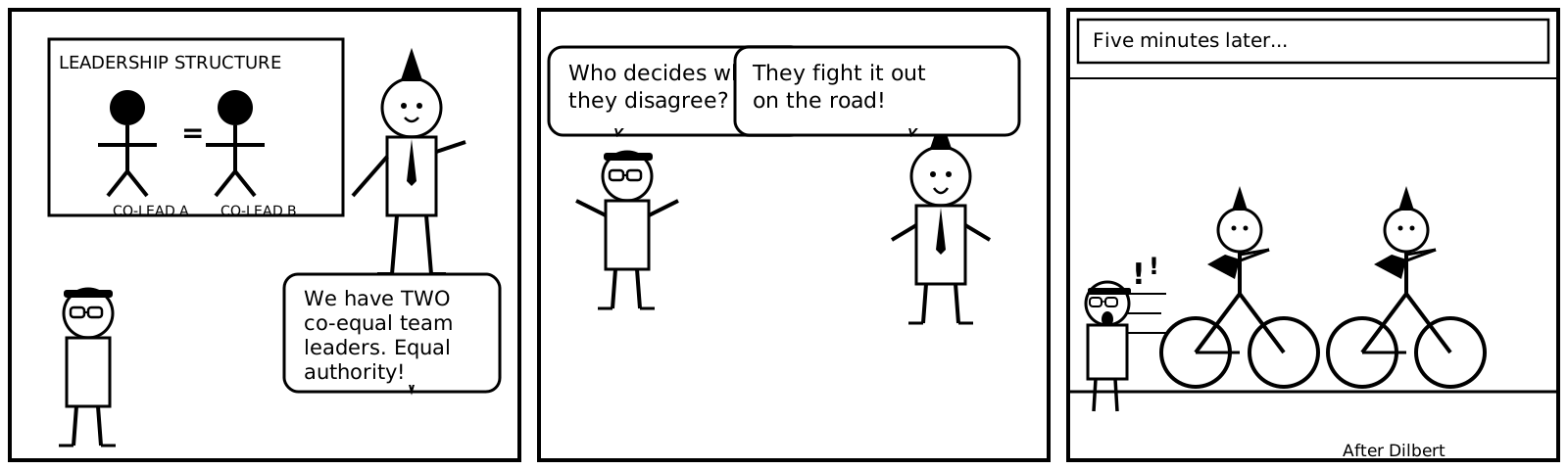
Ralph Denk chose his words carefully. "Remco is still the team leader," the Red Bull-Bora-Hansgrohe manager told Flemish press — then immediately pulled the rug. "Eventually, there will come a day when one or the other feels better. Then they will have to fight it out between themselves on the road."1
With eight days until the Barcelona Grand Départ, Red Bull has confirmed what everyone expected and few teams have attempted at this level: Remco Evenepoel and Florian Lipowitz go into the Tour de France as co-leaders, with no pre-agreed hierarchy beyond the road itself. The complete eight-rider roster is Evenepoel, Lipowitz, Mattia Cattaneo, Nico Denz, Jai Hindley, Jan Tratnik, Tim van Dijke, and Maxim Van Gils. Hindley, who finished third at the Giro, arrives with the unenviable task of trying to serve two masters on the same mountain.
Team manager Patxi Vila framed it in terms of tactical depth: "With Remco and Florian, we have two leaders who have already proven they can stand on the Tour podium. Their different strengths give us tactical options that could prove decisive."2 The analogy Denk reached for was McLaren's Papaya Rules — race freely, don't damage the team. The Formula 1 history of that particular arrangement is instructive.
Lipowitz has the quieter dossier but the stronger recent form: two stages and the overall at the Tour of Slovenia, second at Tour de Romandie, third at the 2025 Tour (in his debut). Evenepoel has not raced in more than two months, choosing altitude training over racing, and arrives in Barcelona carrying both the pressure of the team's marquee signing and an unresolved administrative problem. As this paper reported Wednesday, the Belgian Federation's rulebook calls for a nine-day suspension for any licensed rider who skips the national road race without a valid medical certificate. The road race is Sunday. Applied immediately, a ban issued Monday would block Evenepoel from the July 4 start. Red Bull has still offered no public comment on whether Evenepoel will race in Louvain, obtain a certificate, or appeal. The Belgian Federation has not announced a decision.
The full 184-rider, 23-team start list for the Tour is now confirmed.3 The hierarchy at the front is unchanged from the spring: Tadej Pogačar (UAE Team Emirates-XRG) chases a fifth title to match Anquetil, Merckx, Hinault, and Indurain. Jonas Vingegaard (Visma-Lease a Bike), Giro winner and the only man with recent proof he can beat Pogačar in a three-week race, leads the opposition. Paul Seixas, 19, makes his Grand Tour debut for Decathlon CMA CGM and has Cyclingnews noting that rivals already "respect and fear" him.4
Visma line up without Wout van Aert (elbow sepsis, confirmed out weeks ago) and without Christophe Laporte (torn quad). Their eight-man roster — Vingegaard, Affini, Armirail, Campenaerts, Hagenes, Jorgenson, Kuss, Piganzoli — was the first confirmed, and it reads as a team that has accepted its sprint options are gone and gone all-in on the GC. The notable name on the official UAE list is Nils Politt, who this morning reclaimed the German national time trial title in Streufdorf. He won by one second over Max Walscheid (Lidl-Trek), with Jasha Sütterlin (Jayco AlUla) two seconds back. The podium was split by two seconds across three riders in a 41km race.5 Politt will wear the German stripes in the opening team time trial.
Netcompany-Ineos arrive without Oscar Onley — confirmed out as this paper reported Thursday — and their finalised seven includes Egan Bernal, Filippo Ganna, Thymen Arensman, Carlos Rodríguez, Kévin Vauquelin, Dorian Godon, and Michal Kwiatkowski. Josh Tarling does not appear on the start list.
Away from the Tour build-up: Quinn Simmons won his third consecutive US national road race championship in Charleston, West Virginia on June 21, attacking solo with 29km to go and finishing more than two minutes clear.6 He was outnumbered by a stacked Modern Adventure Pro Cycling team, attacked anyway, and held it. He will wear the stars-and-stripes at Lidl-Trek in Barcelona.
Lizzie Deignan, who retired in 2025 after winning the inaugural Paris-Roubaix Femmes and a world title in Richmond in 2015, has taken a sports director role with the Great Britain Cycling Team, focused on road events ahead of the LA 2028 Olympics. British Cycling head Matt Brammeier called it "a real coup."7 The hire is notable for what it acknowledges: GB's road programme hasn't produced an elite rainbow jersey since Deignan herself in Richmond, more than a decade ago.
Four human rights organisations — FairSquare, the Bahrain Institute for Rights and Democracy, Sudan Unlimited, and Christian Solidarity Worldwide — wrote to UCI president David Lappartient this week calling for the suspension of UAE Team Emirates-XRG's licence. The letter argues the team "is under the financial and political control of the UAE state" and is used "to project a positive image of the UAE," which the groups contend stands in "marked contrast to the violence and repression" of its alleged support for the Rapid Support Forces in Sudan. The UN has documented RSF actions carrying "hallmarks of genocide"; Amnesty International published evidence last year of UAE arms transfers to the RSF.8 UAE declined to comment; the UCI was contacted.
The power-data anti-doping trial continues to grow. Sixty WorldTour riders from Visma, Picnic PostNL, Jayco AlUla, Decathlon CGM CMA, and Cofidis have now consented to the ITA's two-year feasibility study, with University of Kent and UCL leading the research. If the model is validated, the UCI has said it would amend regulations to make power data sharing mandatory for all professional men's road riders. CPA president Adam Hansen remains opposed: "I highly believe it won't be successful. And then it will be scrapped. But we will see how it goes."9
Primož Roglič, skipping the Tour for the Vuelta, will race the Slovenian national championships this week — the road race and time trial — for the first time since 2020.10 Pogačar had planned to compete but is staying home with partner Urška Žigart, still recovering from her fractured jaw sustained in the Tour de Suisse crash.
On the Road Ahead
Updated Jun 26, 2026
Date
Race
Country
Sat, Jul 4
Tour de France — Grand Départ (Stage 1, TTT Barcelona) through Sun Jul 26 · 23 stages remaining
Spain / France
Sat, Aug 1
Donostia San Sebastián Klasikoa
Spain
Mon, Aug 3–Sun Aug 9
Tour de Pologne
Poland
Sat, Aug 16
ADAC Cyclassics Hamburg
Germany
Sat, Aug 22–Sun Sep 13
La Vuelta Ciclista a España
Spain
Show Results
US NATIONAL ROAD CHAMPIONSHIPS (Jun 21):
Men: 1. Quinn Simmons (Lidl-Trek) 2. Kevin Vermaerke (UAE-XRG) 3. Larry Warbasse (Tudor)
Women: 1. Kate Courtney 2. Lauren Stephens (Aegis x Leaders of Enchantment) 3. Grace Arlandson (Aegis x Leaders of Enchantment)
GERMAN NATIONAL TT CHAMPIONSHIPS (Jun 26):
Men: 1. Nils Politt (UAE-XRG) 2. Max Walscheid (Lidl-Trek) 3. Jasha Sütterlin (Jayco AlUla) — podium split by 2 seconds
Zig Can Write Shaders Now: SPIR-V Backend Gets @SpirvType, Mesh Shading, and Multi-Threaded Codegen
The longest-standing blocker for writing Vulkan shaders in Zig just fell. Ali Cheraghi landed @SpirvType in today's devlog — a new compiler builtin that lets you express SPIR-V's opaque types (samplers, images, sampled images, runtime arrays) directly in Zig's type system.1 Previously those types simply could not be represented, which made writing real shaders impossible. The fix required a chain of three issues stretching back through the compiler's history, and the PR (#35461) closes all of them.
The other blocker was execution-mode metadata. Shader entry points need to declare things like workgroup size or fragment depth assumptions, and until now that was emitted via inline assembly OpExecutionMode instructions — fragile and detached from the type system. It's now carried by the calling convention itself. Two new calling conventions, spirv_task and spirv_mesh, were added for mesh shading pipelines, so task and mesh shaders are now first-class entry points alongside vertex, fragment, and compute.1 The SPIR-V assembler actively rejects any attempt to emit OpExecutionMode or OpCapability manually — the compiler now drives all of that from the CPU feature set, with dependency chains extracted from SPIRV-Headers.
Beyond the language-level changes, codegen is now multi-threaded. The SPIR-V backend previously ran entirely on the linker thread; each codegen job now produces a Mir value on the compiler's thread pool like every other self-hosted backend. Two ISel passes that had been deleted when the backend was single-threaded — dedup_types and prune_unused — are back. .spv files are recognized as object files, so you can compile multiple Zig files (or external .spv objects) and let the SPIR-V linker stitch them into one module. The net result: a nearly 10% increase in passing behavior tests on the spirv64-vulkan target, now at 49%.1 Still below the waterline, but Cheraghi's note is direct: "If you've been on the fence about trying Zig for shaders or compute kernels, this is a good time to give it a shot."
Separately, Matthew Lugg landed a cleaner @bitCast while fixing integer-lowering in the LLVM backend. The old semantics defined @bitCast as memory reinterpretation, which broke when he changed how non-ABI-width integers (like u4 or i13) are stored. The fix adopted a 2024 proposal that defines @bitCast in terms of a type's logical bit layout — endian-agnostic, based on bit ordering rather than memory layout. The new semantics match little-endian behavior on every target, align with what the x86_64 self-hosted backend already did, and unlock operations like casting [2]u3 to @Vector(3, u2). The LLVM backend itself saw about 5% performance gains from the better optimization that this enabled.1
At Eurobike this week, Canyon showed a concept bike called Predict that DC Rainmaker dug into at length. The hardware spec is legitimately dense: four cameras providing 360-degree coverage, three front radar sensors (two side, one forward) plus one rear, all fed into onboard AI edge compute that processes everything locally at 50ms latency.2 No cloud dependency — Canyon's lead hardware engineer said the two non-negotiables were privacy and response speed, and neither survives a round-trip to a cell tower.
The compute load requires a 1-kilogram battery — not an e-bike motor, purely for sensors and processing — currently rated at 8 hours.2 The system is predictive, not just reactive: it uses steering-tube sensors to determine whether your current trajectory actually intersects with a detected hazard, so turning away from a car door stops the alert. Front handlebar lights shift color as warnings; haptic and audio alerts are planned. There's an adjustable seat post that moves on button press, though DC Rainmaker rates that as the feature least likely to survive to production.
The harder question is software. Canyon is gesturing toward a built-in bike computer, and DC Rainmaker is skeptical — competing with a decade of Garmin/Wahoo feature depth on navigation, structured workouts, sensor ecosystems, and climbing metrics is genuinely hard, and Canyon has a prior: a smart bike concept at Eurobike 2015 that was promised for Spring 2016 and was never released.2 The current timeline is 2–3 years, contingent on whether road testing earns consumer trust. The tech on the show floor works; whether it works in rain, sun, and traffic at 40kph is a different question. DC Rainmaker notes Canyon is a site partner (loaner bikes, no money, no editorial control) and called the piece unsolicited.
A German court ruled this month that Google is liable for errors in its AI Overview summaries — the court treated them as Google's own statements, not a third-party's. Bruce Schneier's read, linked by Simon Willison: if a company hired human writers to produce summaries, it would own those errors; letting companies hide behind "faulty AI" when they chose to deploy it would create disastrous incentives.3 The ruling is narrow and German, but the logic — that an AI agent is the legal agent of whoever deploys it — is the frame that will travel.
Separately, Willison published a small but clever tool: browser-compat-db, which converts Mozilla's mdn/browser-compat-data JSON corpus into a ~66MB SQLite database, then hosts it on a GitHub orphan branch to get open CORS headers (which GitHub releases don't provide, but files in regular branches do).4 The build is automated via a GitHub Actions workflow. The result is queryable directly in Datasette Lite from any browser without a backend. It's a useful pattern for anyone who needs a queryable static dataset with zero hosting cost.
Trending today: GitHub is saturated with AI agent wrappers and prompt collections — the one technical outlier is plbrault/youre-the-os, a browser game where you play as an operating system managing processes and memory, but it's too small a project to build a full story around.
Egypt vs. Iran at Lumen Field Tonight; Bungie Cuts 292 in Bellevue
↩ Developing story — first reported Jun 20 · previously Jun 22
Turkey 3, USA 2 — The US finishes first in Group D despite the loss and faces Bosnia-Herzegovina in the Round of 32 Wednesday. Source
Egypt vs. Iran tonight at Lumen Field — Designated a Pride match over both nations' objections; organizers are proceeding as planned. Source
22 drones seized at Seattle World Cup — FBI also arrested a Mason County man last Friday who allegedly planned to use drones at a separate local event; most of those seized at World Cup venues were from people unaware of flight restrictions. Source
Washington faces a $4B shortfall — Gov. Ferguson pledges no new taxes in his upcoming budget, then immediately confirms cuts are coming in the 2027–29 cycle. Source
Bellevue: Bungie laid off 292 employees Thursday, shuttering a chunk of its local studio after Destiny 2's final content update "fell short of expectations." The game studio, headquartered in Bellevue, had already cut hundreds of jobs in prior rounds. See THE LAB for the broader tech context. Source
King County sewer rates will rise 12.75% after a unanimous council vote — and the county is signaling more increases ahead. Source
Seattle Transit Measure: As this paper reported when Mayor Wilson referred the measure to council June 22, the July 21 vote is approaching — and the bus network details are now coming into focus. The Urbanist reports the measure would deliver a meaningful boost to frequency on key corridors. Source
Issaquah/Eastside e-bike rebate: A rebate program for Bellevue, Redmond, and Issaquah residents closes June 29. If you've been sitting on an e-bike purchase, Sunday is the deadline. Source
ON THE TRAIL
PART 1 — WEEKEND PICKS (Sat June 28–Sun June 29)
The Snoqualmie/I-90 corridor is a wash for Saturday — 71% precipitation, rain showers likely all day. Mountain Loop is similar (68%). Head east.
Cutthroat Pass via Cutthroat Lake (North Cascades Hwy 20, ~3.5 hrs from Issaquah) — A Jun 25 report logged the trail as "basically snow free" with only a few patchy sections in the final mile that require no traction. Water for dogs throughout. The reporter counted low traffic and called it a great jaunt. North Cascades Hwy 20 forecast: 48% Saturday, dropping to 38% Sunday — go Sunday if you can. WTA report
Iron Goat Trail (Stevens Pass West, ~1.5 hrs) — Jun 25 report: no mud, no snow, no water crossings, no bugs. Only 2–3 other hikers on a Thursday afternoon. Wildflowers including tiger lilies, ripe salmonberries. Trail runners were sufficient. The US 2 West corridor forecast is rougher (76% Saturday), so Sunday is preferable here too (no forecast improvement noted, but Saturday afternoon may clear). Worth watching the hourly. WTA report
PART 2 — REGIONAL SNAPSHOT
Snoqualmie / I-90 (Snow Lake, Source Lake, Bandera): Busy and wet — 71% Saturday, 66% Sunday. Reports from Thursday show 50+ cars at Snow Lake by 8:45 AM even on weekdays. Skip for this weekend.
- Mountain Loop (Dickerman, Gothic Basin, Perry Creek): 68% Saturday. Gothic Basin was spectacular on Wednesday with low crowds and waterfalls running full — save it for a drier window.
- I-90 East / Teanaway corridor: Best nearby weather at 19% Saturday. No trail-specific reports in this batch, but conditions east of Snoqualmie Pass have been dry.
- Leavenworth / Wenatchee: 23% Saturday rain, high near 71°F. Colchuck Lake (Jun 24 report) has great trail conditions and a mountain goat sighting — the approach road on Eight Mile is rough, high clearance recommended.
- Harts Pass / Pasayten (Tatie Peak, Grasshopper Pass): Road just reopened June 24. A 9-person-rated report from June 25 calls wildflowers at their peak — avalanche lilies, lupine, paintbrush. Trail is 95% snow free. North Cascades Hwy 20 forecast 48% Saturday. Long drive (~3.5 hrs) but worth it if you can go Sunday when things look slightly better.
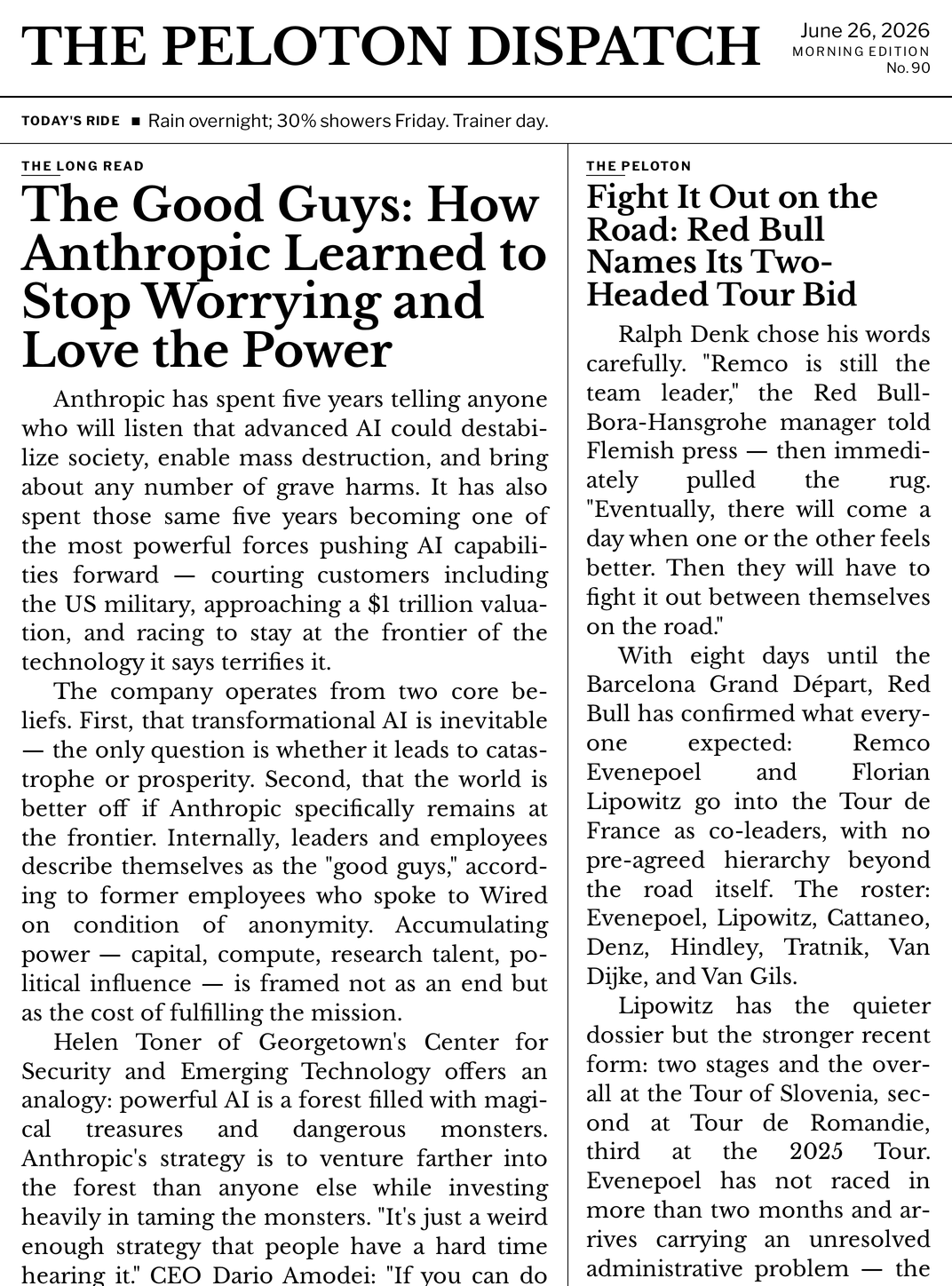
Anthropic has spent five years telling anyone who will listen that advanced AI could destabilize society, enable mass destruction, and bring about any number of grave harms. It has also spent those same five years becoming one of the most powerful forces pushing AI capabilities forward — courting customers including the US military, approaching a $1 trillion valuation, and racing to stay at the frontier of the technology it says terrifies it.1
In a new investigative piece published Thursday, Wired examines how the company reconciles what looks, from the outside, like a fundamental contradiction. The answer, it turns out, is that Anthropic doesn't see one.
The company operates from two core beliefs. First, that transformational AI is inevitable — the only question is whether it leads to catastrophe or prosperity. Second, that the world is better off if Anthropic specifically remains at the frontier. Internally, leaders and employees describe themselves as the "good guys," according to former employees who spoke to Wired on condition of anonymity.1 Accumulating power — capital, compute, research talent, political influence — is framed not as an end but as the cost of fulfilling the mission: "to ensure the world safely makes the transition through transformative AI."
Helen Toner, executive director of Georgetown's Center for Security and Emerging Technology and a former OpenAI board member, offers an analogy that captures the logic precisely. Powerful AI is a forest filled with magical treasures and dangerous monsters. All the villagers are rushing in, lured by the treasure. Anthropic's strategy, as Toner describes it: venture farther into the forest than anyone else while investing heavily in taming the monsters. "They're very straightforward about this," she tells Wired. "It's just a weird enough strategy that people have a hard time hearing it."1
CEO Dario Amodei put it plainly in a conversation with his cofounders: "You have to find a way to actually be competitive, to actually lead the industry in some cases, and yet manage to do things safely. If you can do that, the gravitational pull you exert is so great."1
Anthropic was founded in 2021 by former OpenAI employees who left after losing faith in Sam Altman's ability to bring transformational AI into the world safely.1 That origin story still shapes the company's internal culture. Former employees told Wired that in internal discussions, Anthropic executives regularly cite Altman and OpenAI — and, to a lesser extent, Meta and Elon Musk's xAI — as cautionary examples that define Anthropic's own sense of responsibility. The contrast with those cautionary examples is, in part, how the "good guys" identity gets maintained.
The piece doesn't claim this logic is wrong. It does note the obvious historical precedent: Google, Facebook, and Apple were all founded on idealistic principles that became muddier as they became richer and more influential. The pattern of companies that accumulate power on behalf of a mission, and the mission that stays legible long after the company has reshaped the landscape around it, is a familiar one.
The timing of the Wired investigation is not incidental. As this paper has reported, bipartisan lawmakers had set a June 26 deadline — today — for the Commerce Department to answer questions about the government order that pulled Anthropic's Fable 5 model offline, and about Commerce negotiations in which Dario Amodei was replaced by cofounder Tom Brown. The investigation arrives as Congress presses for answers about exactly what "accumulating political influence" looks like in practice when a safety-focused AI company is also a federal contractor with a national security footprint.
The forest analogy is elegant. Whether Anthropic's version of taming the monsters looks different from anyone else's, once you're deep enough in, is the question the next few weeks may start to answer.
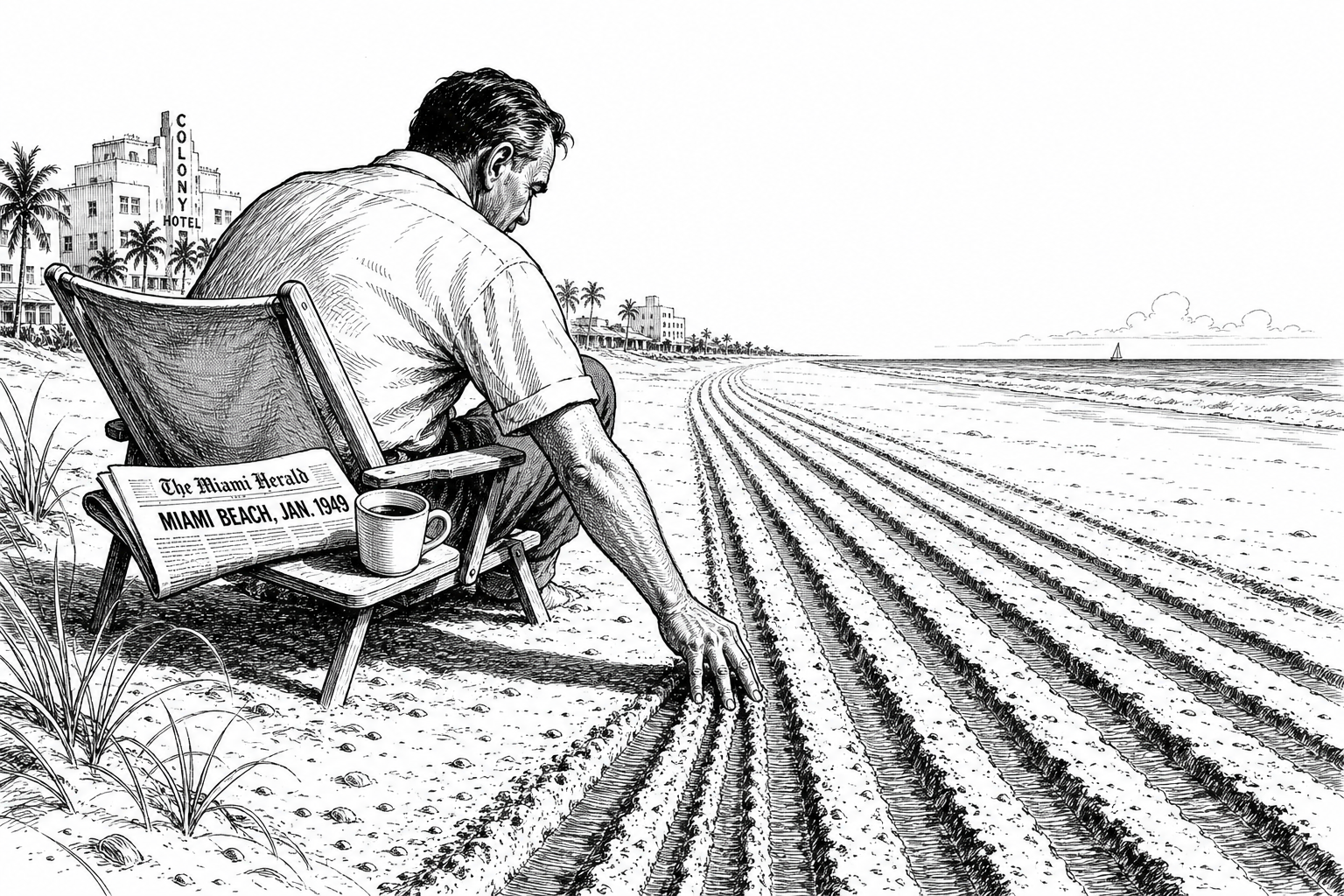
A man in a short-sleeved shirt seated in a low beach chair, four fingers pressed into wet sand, dragging parallel furrows toward him — wide and narrow striations catching the flat morning light. Miami Beach, January 1949. Sparse beach grass at the frame's edge. A folded newspaper and a half-drunk coffee cup rest on the armrest. The lines in the sand stretch forward, shadowed, impossibly deliberate. Strong diagonal composition, bold foreground texture of sand grain and shadow, expansive white sky above. Pen-and-ink editorial style: confident hatched shadows on the man's hunched shoulders and bent arm, cross-hatching in the deeper sand grooves, clean silhouette against the open horizon. No color, no gradients.
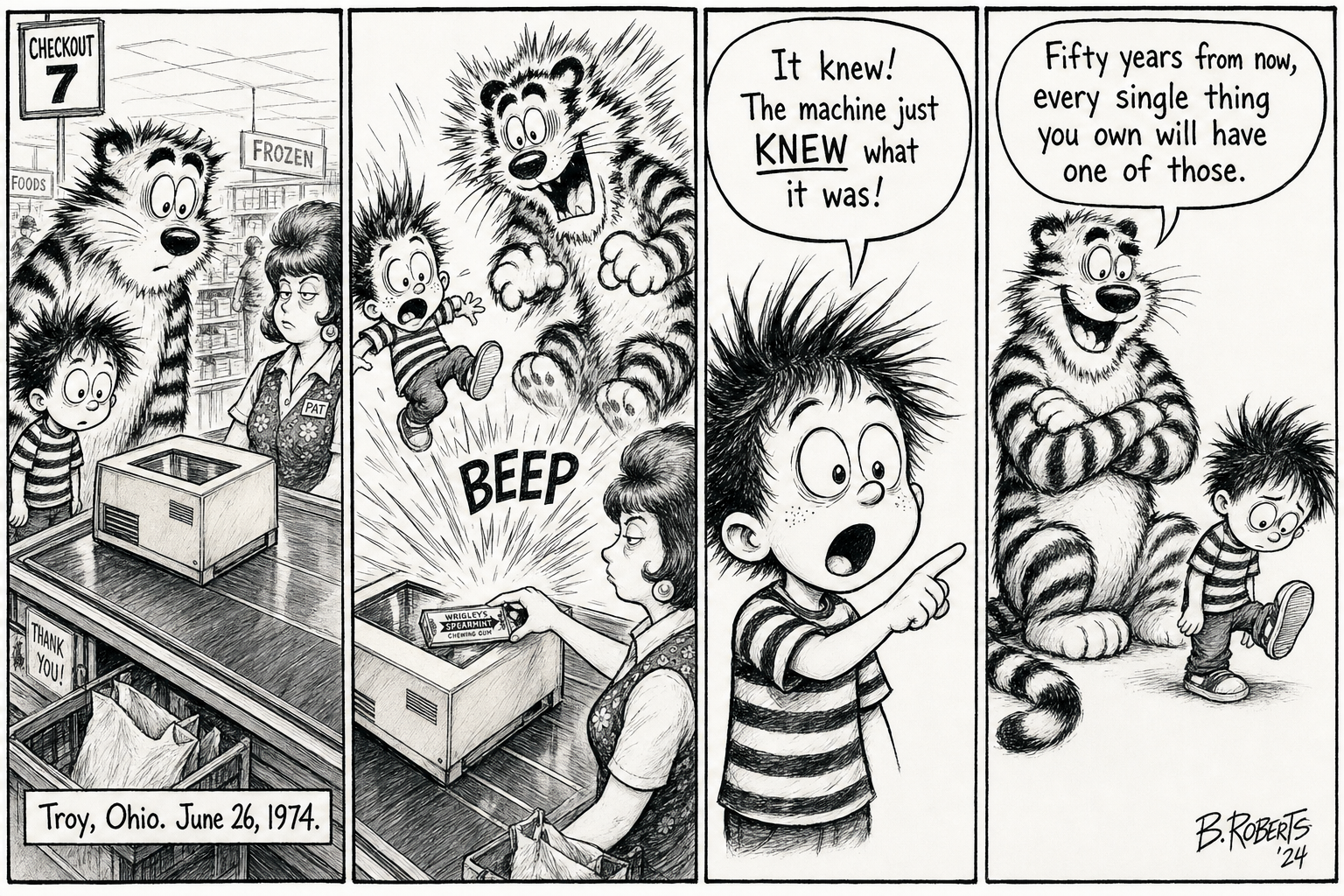
At just after 8 a.m. on June 26, 1974, a man named Clyde Dawson walked up to a checkout at Marsh Supermarket in Troy, Ohio, and placed a ten-pack of Wrigley's Juicy Fruit gum on the counter.1 Dawson was head of research and development for Marsh; cashier Sharon Buchanan was in on it. The gum was not a random choice. Wrigley's had been picked specifically because nobody was sure a barcode could be printed small enough to fit on the packaging. If it worked there, it would work anywhere.
It worked. The scanner — a laser reader installed the night before by National Cash Register while Marsh staff worked the floor putting codes on hundreds of items — beeped, logged the price, and sent the data to a computer. The Universal Product Code had its first commercial transaction. Fifty-two years later, you cannot buy a physical object without encountering it.
The story behind that beep starts on a Miami Beach in January 1949, with a man dragging his fingers through sand.1 Joe Woodland had dropped out of graduate school at Drexel, cashed in some stocks, and moved into his grandfather's apartment to solve a problem he'd heard about secondhand: a grocery store manager had complained to a dean at Drexel that checkout lines were destroying his margins. The dean shrugged him off. Woodland didn't.
Sitting in a beach chair, thinking about Morse Code — he'd learned it in the Boy Scouts — Woodland pressed four fingers into the sand and pulled them toward him. Four lines. Wide and narrow instead of dots and dashes. Then he swept the same fingers in a circle. That was the bull's-eye barcode, the ancestor of everything. He filed a patent with his Drexel colleague Bernard Silver in 1949; it was granted in 1952. An objective evaluation called it twenty years ahead of its time, which turned out to be accurate: the technology to read it didn't exist yet.
The missing piece was the laser. When Theodore Maiman demonstrated the first working laser in 1960, the Los Angeles Herald ran the headline "LA Man Discovers Science Fiction Death Ray."1 Nobody in that room mentioned supermarket checkouts. But the laser — coherent, concentrated, cheap enough eventually — was exactly what Woodland's bull's-eye needed.
By the early 1970s, the grocery industry had convened the Ad Hoc Committee of the Grocery Industry to standardize whatever was coming. RCA had already built a functioning prototype around Woodland's bull's-eye design and tested it at a Kroger store in Cincinnati in 1972, where it outperformed the conventional registers. RCA assumed the job was theirs.
Then IBM filed a last-minute submission. Remarkably, IBM had no working technology to demonstrate. What it had was George Laurer, an engineer who approached the problem without RCA's institutional investment in the circular design. Starting from the committee's specifications — maximum 1.5 square inches, printable with existing label technology, readable in any direction, fewer than one error in 20,000 — Laurer designed a rectangle. The vertical stripes were easier to print accurately than concentric circles, which smudged. He built a prototype. To convince his skeptical boss, IBM had its ace softball pitcher throw beanbag ashtrays with barcodes on the bottom over the scanner as fast as he could. Every one read clean.1
On March 30, 1973, in a hotel near Grand Central Station in New York, the Symbol Selection Committee voted.1 They had consulted MIT scientists on the competing designs. The rectangle beat the bull's-eye. Laurer's Universal Product Code — twelve digits, vertical stripes — was the standard. Joe Woodland, whose fingers in Miami Beach sand had started the whole chain, was working at IBM at the time. He was involved in the submission but was not the one who designed the winning code.
The consumer response was not warm. Some shoppers believed the lines and numbers were the "mark of the beast" from Revelation. The Consumer Federation of America launched a national campaign against barcodes; protesters picketed stores. The U.S. Senate held a symposium. By the end of the 1970s — six years after Marsh's checkout beep — only 1 percent of U.S. grocery stores had adopted scanners.1 A decade after that, more than half had them, and the objections had largely evaporated.
In 1992, President George H.W. Bush was photographed at a grocery convention examining a checkout scanner, and the New York Times ran it as evidence that the president had never seen one before — out of touch with ordinary American life. His aides said he was actually impressed that it could read a damaged barcode. The story stuck and was considered damaging to his campaign. A few months later, Bush gave Woodland the National Medal of Technology.1 Whether or not Bush had ever swiped his own groceries, the machine he was looking at traced a straight line back to four fingers drawn through Miami Beach sand forty-three years earlier.
After Dilbert — on Red Bull's announcement that its two Tour de France co-leaders will resolve any conflict by fighting it out on the road, which turns out to be literal. After Calvin and Hobbes — on the first commercial barcode scan, June 26, 1974, and what a tiger would say to a small boy watching a pack of chewing gum beep its way into history.
Om Malik, 1966–2026 — Om Malik, the tech journalist and founder of GigaOm who helped define blog-era tech coverage, died June 24 at Stanford Hospital after a long illness with his heart. om.coJun 24, 2026
Honesty gets an Emacs patch rejected — A developer disclosed that a macOS Emacs performance patch was drafted with help from GLM 5.2, then watched it bounced under GNU's policy against LLM-assisted contributions — his candid take: the policy punishes integrity, since anyone who stays quiet faces no consequence. xlii.spaceJun 25, 2026
Star Fox lands on Switch 2 — The Switch 2 launch title is a remaster of Star Fox 64 with a visual overhaul and new online modes; 46 critics have reviewed it and Nintendo Life calls it "sublime" for newcomers, though series veterans will find no surprises. opencritic.comJun 25, 2026
Uwajimaya coming to Issaquah — The Asian grocery chain won the lease bid on the former Rite Aid at 1065 NW Gilman Blvd (23,000 sq ft) and CEO Denise Moriguchi says an opening is "probably at least a year out" — which puts it right about now. 425business.comJul 25, 2025
Canyon Predict: AR helmet and V2X — Beyond the radar-and-camera Predict bike that THE LAB covered in depth, Canyon's Eurobike booth also showed a companion Canyon Stingr Smart Helmet with an augmented reality visor, and a separate Roadlite:ON e-bike with V2X (Vehicle-to-Everything) traffic communication built in for car-to-bike collision warning. velo.outsideonline.comJun 26, 2026
Franziska Koch: from super-domestique to champion — The rider who won the women's German national TT title today spent most of this spring in Demi Vollering's service at FDJ United-SUEZ — until Vollering skipped Paris-Roubaix and Koch took the win solo over Marianne Vos in a sprint. idlprocycling.comApr 13, 2026
The Tour de France has run in July for 120 years. Whether it can stay there is a question scientists have now answered: not if the conditions become dangerous, but when. A peer-reviewed study published in Scientific Reports this February examined fifty years of Wet Bulb Globe Temperature data across France's key stage cities — Paris, Nîmes, Bordeaux, Toulouse, and the mountain passes — and found that the highest WBGT readings in each location "since 1974 have all been recorded post-2018."1 The race hasn't yet collided with a red-zone heat event. The study's word for that: "apparently by chance."1
That paper landed in February. This week, Europe is in the middle of a record-breaking heatwave. Temperatures hit 43°C in parts of France and Spain with a week to go before the Barcelona Grand Départ.1 The UCI's High Temperature Protocol — adopted in 2023, never yet invoked at a major race — sets its red zone at 28°C WBGT, a threshold that other major sporting bodies including FIFA and the ITF don't even begin to flag until 32°C.1
The question for today is structural. If the Tour must eventually adapt — and the science says it must — what does adaptation actually cost?
The short-term answer is schedule compression: move stages into the morning, shade route design toward forested climbs. Race director Christian Prudhomme told Le Dauphiné Libéré recently that the 2026 route already seeks shaded ascents; the Col du Haag on stage 14 is entirely under tree cover.1 Five or six years ago, the priority was television sight-lines. Today it's ambient temperature. That's a real shift.
The harder answer is what morning racing does to the Tour as a spectacle and a commercial object. The race's economics depend on afternoon finish windows, roadside crowds that build through the day, live broadcast slots that match European prime time, and a summer calendar that the hospitality and tourism industries around French mountain towns have structured themselves around for decades. A Tour that races at 7 a.m. to avoid 40°C afternoons is not the Tour that fills Alpe d'Huez with half a million people. The crowds and the revenue don't follow the riders into the morning.
There's a subtler version of the problem that applies beyond cycling. The Tour isn't the only July institution that will eventually face this. Wimbledon. The Olympics. The summer schedule of outdoor professional sport in the northern hemisphere was built for a climate that no longer reliably exists in July. Cycling is among the more exposed — no shade, no air conditioning, no ability to call timeout — but it's also, by temperament, among the sports least inclined to acknowledge the structural dimension of the problem. Bob Jungels said the quiet part plainly in 2022, after a stage to Carcassonne in temperatures exceeding 40°C: "I would say other sports would be cancelled if it's that warm, but I think mostly in cycling we learn if something bad happens, which is very unfortunate."1
The 2026 Tour starts in Barcelona in eight days. The heat is already there. The protocol exists. What the sport doesn't yet have is an answer to the harder question: what it's willing to change before something bad happens, rather than after.
A solid edition anchored by a genuinely excellent archive piece (barcode, June 26, 1974) and a well-crafted PELOTON section covering a dense day of Tour pre-race news. The LONG READ and THE QUESTION both work, though each relies on a single source. The most significant failures are in ON THE TRAIL, which shipped two day hikes instead of backpacking picks and omitted all required trip-length, mileage, and elevation data. A broken cross-reference in THE WORLD ("See THE LAB for the broader tech context" on Bungie layoffs — THE LAB does not cover Bungie) will confuse any reader who follows the pointer. The run itself was clean; the orchestrator caught and fixed a YAML parse error mid-assembly without stalling the pipeline.
Frontpage
The deployed PNG reads well. THE LONG READ ("The Good Guys: How Anthropic Learned to Stop Worrying and Love the Power") correctly leads in the left column of row 1 at its priority-82 position, with THE PELOTON in the right column. The barcode/archive illustration sits in row 2 with clear diagonal composition and generous white space; it reads immediately at the printed scale. Text is legible throughout. No headlines are clipped or overrunning their containers. The gradient fade on THE LAB's 24px headline is aggressive given only 336px of row-3 height — the headline is readable but the body text cuts off early. No duplicate blocks or missing sections were found; the art director correctly suppressed THE FUNNIES per its frontpage_display: skip rule.
One layout priority note: THE LAB (priority 74) appears in row 3, below FROM THE ARCHIVE (priority 40) in row 2. The art director placed FROM THE ARCHIVE in row 2 because it carries the lead image, which is the correct judgment — the image needs enough vertical space to breathe. However, this means a priority-74 section visually follows a priority-40 section. The choice is defensible but the reader's eye moves bottom-to-right, so a casual scan of the frontpage slightly misjudges the day's news weight.
Priority ranking
Section
Priority
Length (words)
Image
Notes
THE LONG READ
82
629
—
Single-source Wired investigation
THE PELOTON
78
1,063
—
Dense pre-Tour coverage; well sourced
THE LAB
74
942
—
Two substantive stories plus Willison brief
THE WORLD
72
650
—
4 world bullets + local + ON THE TRAIL
THE QUESTION
68
539
—
Single-source Cyclingnews; strong argument
FROM THE ARCHIVE
40
825
yes
Priority 40 correct; image-driven layout
ALSO NOTED
10
284
—
6 bullets; Uwajimaya source 11 months old
THE FUNNIES
9
66
—
Two strips; omitted from frontpage by rule
Ranking is defensible across the board. THE LONG READ at 82 earns its lead — the Wired investigation is genuinely newsworthy and the June 26 congressional deadline makes today the right day to run it. THE PELOTON at 78 is appropriate: the Tour starts in eight days, Red Bull confirmed a two-headed leadership structure, and the Evenepoel ban question is unresolved. No priority inflation. The archive piece at 40 respects its cap correctly.
Editorial reading
ON THE TRAIL shipped day hikes instead of backpacking picks, and stripped the required spec data. The section's focus definition is unambiguous: "Lead with 1–3 backpacking picks for the upcoming weekend." Iron Goat Trail (section-world.md) is a documented 6-mile rail-to-trail loop near Stevens Pass — a day hike with no overnight-suitable campsites, confirmed by the WTA trip report itself. Cutthroat Pass via Cutthroat Lake is a strenuous day hike to a high pass; there is camping at Cutthroat Lake but the WTA report does not mention overnight use. Neither pick includes the required trip-length designation (1-night / 2-night / 3+ night), per-day mileage, or elevation gain — fields the spec marks mandatory: "Per-day mileage AND elevation gain to/from camp... Split per-day so the reader can size the days against fitness and pack weight." The spec also requires at least one 1-night and one 2-night option "when the data supports it," with explicit instruction to write a "no picks clear your criteria" call-out if nothing qualifies. The writer should have written that call-out rather than substituting day hikes and omitting the overnight framing. Additionally, drive times use informal format ("~3.5 hrs," "~1.5 hrs") rather than the authoritative ≈X–Y min values from the config table — and ~3.5 hrs (210 min) for Cutthroat/North Cascades is outside the authoritative range of 150–190 min.
THE WORLD's Bungie cross-reference is broken. The local Bellevue item reads: "See THE LAB for the broader tech context." THE LAB does not mention Bungie, Destiny 2, or game studio layoffs anywhere in its body. The LAB writer correctly routed Bungie to THE WORLD as a local story, but the WORLD writer apparently expected the LAB to carry tech context that never appeared. A reader who follows the pointer finds nothing. The cross-reference should have been removed or replaced with a sentence of inline context.
THE WORLD's drone bullet runs 44 words against a 25-word per-bullet cap. The config's WORLD focus block specifies "each bullet ≤ 25 words" as a HARD CAP, citing the 04/26 edition's compression failure by name. The drone bullet ("22 drones seized at Seattle World Cup — FBI also arrested a Mason County man last Friday who allegedly planned to use drones at a separate local event; most of those seized at World Cup venues were from people unaware of flight restrictions") is 44 words — nearly double the limit. The original bullet conflates two separate drone stories (the seizures and the FBI arrest) and should have been split or trimmed.
THE LONG READ and THE QUESTION each rely on a single source. This is not always fatal — THE LONG READ's purpose is to summarize a single exceptional piece, and the Wired investigation qualifies. But all five citations in THE LONG READ point to the same Wired URL, and all six citations in THE QUESTION point to the same Cyclingnews article. In the Long Read, the threading paragraph (about the Fable 5 model shutdown, Tom Brown, and the June 26 congressional deadline) is drawn from the story-thread record and is correctly attributed to prior reporting rather than invented. That paragraph is the strongest part of the piece — it gives the Wired investigation editorial context the Wired article itself cannot provide. THE QUESTION's single-source dependency is more of a problem because it obscures whether the "peer-reviewed study in Scientific Reports" claim is independently verified or taken on trust from Cyclingnews alone.
The Uwajimaya bullet in ALSO NOTED draws an inferential conclusion from an 11-month-old source. The source (425business.com, July 25, 2025) quotes CEO Denise Moriguchi saying an opening is "probably at least a year out." The bullet renders this as "which puts it right about now" — a plausible inference, but the article doesn't confirm an actual opening date or even a current status update. The TIMELESS OVERRIDE in the sweep spec applies to "undated technical work (a personal project, a tool release page, an essay without a dateline)" — a dated business lease announcement doesn't qualify. The bullet should have either been dropped for staleness or presented more hedged: "Uwajimaya secured the lease for a new Issaquah location as of mid-2025; status unclear."
Pipeline observations
FC WORLD encountered an EISDIR error. The WORLD fact-checker (agent-a15e7f9303977a345) attempted to read pages/world/ as a file rather than navigating it as a directory, returning EISDIR: illegal operation on a directory. The agent recovered by reading individual world source files by name; no section content was lost. But the error pattern suggests the fact-checker's file-reading logic needs a directory-traversal step before attempting to read section source pages.
WORLD writer had two "File does not exist" tool errors. The WORLD writer (agent-a3c100654f1a81d3c) hit two file-not-found errors, which it worked around without apparent impact on final output. The ALSO NOTED writer (agent-a698ad4bc550d0415) had one similar error. These are likely path-resolution issues when agents try to read files with relative paths from the wrong working directory. The section outputs themselves are complete and correct.
YAML parse error in section-peloton.md required in-flight orchestrator repair. The orchestrator (session.jsonl, line 345) reported: "YAML parse error in section-peloton.md — fixing it before proceeding." An unescaped single quote in the frontmatter caused the parse failure. The orchestrator identified and corrected line 30 before assembling content.json. The repair succeeded, but the fact that the Peloton writer emitted invalid YAML suggests the writer's frontmatter validation step is not catching apostrophes in single-quoted string values. (The headline "Red Bull Names Its Two-Headed Tour Bid" doesn't contain an apostrophe, so the problem likely originated in a title or citation field that was abbreviated in the rewrite.)
Starting commit is same-day (clean). The dispatch ran from dcf740b (Investigator: 2026-06-25), the immediately preceding commit. No meaningful gap between the tree the run started on and the deployed pipeline state.
No missing agents. All expected subagents ran: scout, researcher, five section writers, one sweep writer, five fact-checkers, meta-writer, illustrator (OpenAI backend), funnies (SVG + OpenAI raster), art director, thread editor. No duplicates.
Trace highlights
Researcher dominates wall clock and cost. The researcher ran for 981 seconds at $1.69 — more than four times as long as any individual writer. That's expected for the amount of source material it assembled, but the researcher's cache read (3.5M tokens) versus 5M writer cache reads combined suggests the writers are not all drawing efficiently from the research brief. THE LAB's total cost of $0.14 against a 942-word section is appropriately cheap; THE PELOTON at $0.32 for 1,063 words and the most densely sourced section of the run looks efficient.
FC PELOTON ran 252 seconds and cost as much as the PELOTON writer. The PELOTON fact-checker (252s, $0.34) took as long as the FC WORLD (206s) despite the PELOTON having no world-events complexity. It verified 90 output lines against 12 sources — a reasonable ratio, but the duration suggests it worked through the race calendar and team rosters carefully. No claims were removed from THE PELOTON section, which validates the writer's sourcing.
ALSO NOTED is the second most expensive non-infrastructure agent at $0.60. The sweep writer spent 220 seconds processing 851K cache read tokens to produce 6 bullets. This is the sweep's unavoidable cost — it reads every sibling section's JSON before filtering — but 6 bullets at $0.60 is expensive. The session showed the ALSO NOTED writer reading multiple source files it ultimately could not use (5 unverifiable sources dropped). There may be fetch-manifest value in pre-checking source availability before passing them to the sweep.
Orchestrator at $2.90 (32% of total) is the dominant cost center. The orchestrator spent heavily on context management across a long Step 3 polling loop (26 check-in messages between "still waiting on THE WORLD" entries in the session). The orchestrator waited on THE WORLD writer for an extended period while other writers had already completed and their fact-checkers were running. THE WORLD ran 167 seconds but the orchestrator spent many more seconds polling for its completion. Step orchestration cost could be reduced with a tighter step-3 signal protocol.
Trace summary
Agent
Dur
Input
Output
Cache Read
Cache 5m
Cache 1h
Cost
Scout
342s
6358
226
408637
73137
0
$ 0.42
Researcher
981s
952
1306
3500207
164281
0
$ 1.69
THE WORLD
167s
7
5
166320
77991
0
$ 0.34
THE PELOTON
137s
12
171
351599
56629
0
$ 0.32
THE LAB
86s
6
4
63490
32406
0
$ 0.14
THE LONG READ
62s
8
50
77891
23450
0
$ 0.11
FROM THE ARCHIVE
80s
7
5
84430
21588
0
$ 0.11
FC: THE LONG READ
69s
6
6
51670
24773
0
$ 0.11
FC: THE LAB
145s
7
7
124089
43398
0
$ 0.20
FC: FROM THE ARCHIVE
156s
8
10
123999
27056
0
$ 0.14
Meta-Writer
41s
6
4
45786
19928
0
$ 0.09
FC: THE PELOTON
252s
12
90
385712
58847
0
$ 0.34
FC: THE WORLD
206s
711
90
445394
47102
0
$ 0.31
THE QUESTION
89s
8
80
133608
32763
0
$ 0.16
Illustrator
48s
211
1372
0
0
0
$ 0.06
FC: THE QUESTION
84s
6
7
60969
20522
0
$ 0.10
ALSO NOTED
220s
19
516
851881
89549
0
$ 0.60
Draw today's TWO parody comic strips for
135s
12
89
253562
35678
0
$ 0.21
Funnies (OpenAI)
135s
386
5488
0
0
0
$ 0.22
Art Director
263s
6
10
89368
48021
0
$ 0.21
Update story threads for today's edition
208s
5
3
39513
41329
0
$ 0.17
Orchestrator
156
24844
6272552
0
107001
$ 2.90
TOTAL
8909
34383
13530677
938448
107001
$ 8.94
Suggestions for next edition
Fix ON THE TRAIL's backpacking vs. day-hike distinction. The writer agent needs a check step before writing picks: confirm via the WTA hike page or trip report that the candidate route has overnight camping capacity. If the day's reports are dominated by day hikes, the writer should write the "no backpacking picks clear your criteria" call-out that the spec explicitly requires. The per-day mileage + elevation format and the authoritative ≈X–Y min drive time should be validated in the fact-checker's checklist for this subsection.
Remove the Bungie cross-reference pattern from the WORLD section prompt. "See THE LAB for the broader tech context" is a dangerous phrase because the WORLD writer has no way to confirm what THE LAB will cover — the sections run concurrently. If the WORLD wants to note that a story has tech dimensions, it should supply that context inline rather than deferring to a sibling it cannot read.
Add a per-bullet word count step to the WORLD writer. The drone bullet ran 44 words against a hard 25-word cap that the config flags with explicit historical precedent (04/26 edition). The writer should count words in each bullet before outputting, the same way the researcher checks source recency before filing. The fact-checker should also have this check in its WORLD section checklist.
Investigate the FC WORLD EISDIR error. The fact-checker trying to read a directory path as a file will silently fail if not recovered. Patching the fact-checker agent to list directory contents before reading source files (or to catch EISDIR and iterate subdirectory files) would make the recovery explicit rather than lucky.