Front page — June 24, 2026
The Peloton Dispatch June 24, 2026 No. 88
● Sunny at 86°F, light wind — perfect summer ride. · summer kit

THE PELOTON

Meeus Takes Brussels; Evenepoel Faces a Nine-Day Ban That Could Derail His Tour

↩ Developing story — first reported Jun 12 · previously Jun 18

— Jordi Meeus did the work his team set up for him. Red Bull-Bora-Hansgrohe spent 145 kilometres neutralising the Brussels Cycling Classic before Laurence Pithie and Danny van Poppel drove the sprint train over the Rosweg cobbles, and from there Meeus won by a tyre's width from Milan Fretin and Biniam Girmay.1 It was his fourth win of the season, and a clean execution of exactly the race his team needed before packing for Barcelona.

The race itself followed a familiar Belgian script. Five riders — Casper Pedersen, Titouan Fontaine, Sébastien Grignard, Marius Mayrhofer and Henrik Pedersen — escaped after 55 kilometres and built more than three minutes as the peloton rolled three laps of the Muur van Geraardsbergen, Bosberg and Congoberg. Team Flanders Baloise nearly wrecked the plan: when Meeus missed the selection on the climbs, the team brought the peloton back together, giving Red Bull a second shot. They took it. Pithie caught the remnants of the break on the Heiligekruiswegstraat, Uno-X threw several counter-attacks that went nowhere, a crash at 4.6 kilometres to go briefly scrambled the back of the bunch, and then the final kilometre sorted itself in Red Bull's favour.2 Fretin and Girmay both challenged late; neither had the speed to close the gap.


Ten days before the Tour de France grand départ in Barcelona, the story off the bike is messier. Remco Evenepoel, confirmed on the start list for Sunday's Belgian road race national championships near Antwerp, is widely expected to skip the race — and under Belgian Cycling Federation rules, non-participation without a valid medical certificate carries a mandatory nine-day suspension.3 Applied immediately, that ban would theoretically overlap the July 4 Tour start. Belgian Cycling director of sport Massimo Van Lancker told Wielerflits there are no exceptions: "Every rider has received an email containing all the information. The regulations are stated in that email. It is up to every rider to know and respect those regulations." Van Lancker added that a doctor's certificate waives the sanction, and that Belgium is "not going to change that regulation anytime soon." Red Bull-Bora-Hansgrohe did not respond to Cyclingnews when asked for comment. Wielerflits notes privately that a ban would almost certainly be deferred to later in the season rather than applied across a Grand Tour, but the Belgian Federation is clearly not inclined to hand any public exemptions.

The irony is not subtle: Evenepoel's team manager Ralph Denk went public the same day with the team's Tour leadership formula, confirming that Evenepoel and Florian Lipowitz will both be protected riders — but on equal sporting footing. "Remco is still the team leader and Florian Lipowitz is a bit of the second man but in terms of sporting performance, they are on equal footing," Denk told Flemish papers Het Laatste Nieuws and Het Nieuwsblad. "Eventually, there will come a day when one or the other feels better. Then they will have to fight it out between themselves on the road."4 Denk invoked the McLaren F1 "Papaya Rules" — teammates race freely without damaging the team's overall ambitions. Lipowitz finished third at last year's Tour and won two stages and the overall at the Tour of Slovenia last week; Evenepoel has been training rather than racing in recent weeks. The fight, when it comes, will be unscripted.


Jonas Vingegaard used his Visma-Lease a Bike Tour squad announcement this week to deliver the plainest possible statement of intent. "I grew back to being more myself again. It took me some time, but now I finally feel like I'm there, as the same person I was before all these setbacks. I feel like I'm an even stronger version than I was back then," the Dane said.5 His previous two Tours both followed disrupted preparations — a serious crash at Itzulia in 2024, a concussion at Paris-Nice in 2025. This year he won Paris-Nice, Volta a Catalunya and the Giro d'Italia without a setback. The squad is Sepp Kuss, Matteo Jorgenson, Edoardo Affini, Bruno Armirail, Victor Campenaerts, Per Strand Hagenes, and Davide Piganzoli filling the van Aert vacancy. Vingegaard's confidence is grounded in evidence.


In a development that may reshape cycling's anti-doping architecture, the UCI's testing agency the ITA confirmed this week it has started a two-year research and feasibility study into a "power passport" — a system that would make it mandatory for professionals to submit race and training power data for longitudinal analysis.6 Five leading squads, including Visma-Lease a Bike and Decathlon CMA-CGM, are participating with 60 riders. The study's first year will interrogate historical data; the second will pilot the system on current-season results. The rider representative body led by Adam Hansen remained opposed when the concept was floated last winter — "The CPA's position is very clear: we're 100 percent against this, and so are the riders" — citing privacy, data integrity and the difficulty of accounting for power meter variance. The ITA says the trial will specifically investigate those flaws, using kilojoule training load as the central metric rather than peak power outputs. Early phases would cover male professionals only before any potential expansion to women's racing and other sports.


Chloé Dygert's return to racing has collapsed again. In an Instagram post, the Canyon-SRAM rider disclosed that months of shoulder rehabilitation — following the crash at Paris-Roubaix that ended her 2026 spring — ultimately failed: "it became clear that something still wasn't right."7 An MRI confirmed that the shoulder damage will require surgery. The same post disclosed a second diagnosis: a collapsed nasal valve also requiring a surgical fix. Dygert added that she has been managing RED-S (relative energy deficiency in sport) and "picked up a virus" with blood markers continuing to move in the wrong direction. "Not exactly the update I was hoping to share," she wrote, "but for now it's back to focusing on recovery, getting healthy, goals haven't changed. Just the path getting there has."

On the Road Ahead
Updated Jun 24, 2026
DateRaceCountry
Sat Jun 28Belgian National Championships (Road Race)Belgium
Sat Jul 4 – Sun Jul 26Tour de France (Grand Départ: Barcelona)France / Spain
Sat Aug 1Donostia San Sebastian KlasikoaSpain
Mon Aug 3 – Sun Aug 9Tour de PolognePoland
Sat Aug 22 – Sun Sep 13La Vuelta Ciclista a EspañaSpain
Show Results

BRUSSELS CYCLING CLASSIC (Jun 24, 206.3km): WINNER: Jordi Meeus (Red Bull-Bora-Hansgrohe) PODIUM: 1. Jordi Meeus, 2. Milan Fretin (Cofidis), 3. Biniam Girmay (NSN Cycling)

NOTABLE: Red Bull controlled the final via Laurence Pithie and Danny van Poppel on the Rosweg cobbles; Meeus won by a tyre's width. A crash at 4.6km to go dropped several riders but did not alter the outcome.

Sources
  1. Brussels Cycling Classic 2026 — Jordi Meeus wins sprint cyclinguptodate.com Jun 24, 2026
  2. Brussels Cycling Classic — Meeus wins tight sprint after hectic finale cyclingnews.com Jun 24, 2026
  3. Belgian National Championships mandate could mean Evenepoel banned nine days cyclingnews.com Jun 24, 2026
  4. Red Bull reveal Evenepoel-Lipowitz Tour de France co-leadership rules cyclingnews.com Jun 24, 2026
  5. Jonas Vingegaard: 'I feel like an even stronger version' ahead of Tour de France cyclingnews.com Jun 24, 2026
  6. UCI power data anti-doping trial — peloton opposed, trial proceeds velo.outsideonline.com Jun 24, 2026
  7. Chloé Dygert: comeback falters after months of rehab — shoulder surgery required cyclingnews.com Jun 18, 2026

↑ Back to top

THE LAB

The Coming Loop: Armin Ronacher on Why Harness Engineering Produces Organisms, Not Machines

↩ Developing story — first reported Jun 18 · previously Jun 19, Jun 23

"I don't prompt Claude anymore," Boris Cherny wrote recently. "I have loops running that prompt Claude and figuring out what to do. My job is to write loops."1 Armin Ronacher, the Flask and Jinja author who now runs the developer tooling company Pi, has been turning that sentence over in his head — and on June 23 he published what may be the most honest account yet of what harness-level agentic engineering is actually doing to software.

The essay is called "The Coming Loop," and Ronacher's thesis is uncomfortable: loops work, but they produce organisms rather than machines. The agent loop inside every coding agent — tool call, file read, test run, answer — is the familiar one. The harness loop outside it, where a queue system picks up work, runs it to a stopping condition, injects new context, or hands the task to a different machine, is the newer thing. What Ronacher has observed is that when you stack the two loops and step back, you tend to amplify the model's worst habits. "Present-day models tend to produce code that is too defensive, too complex, too local in its reasoning. They avoid strong invariants. They add fallbacks instead of making bad states impossible."1 Under a human-in-the-loop workflow, that tendency is checked by review. Under a harness, each iteration adds another small defense, and "the system slowly becomes less understandable while appearing more robust."

Ronacher is specific about where loops already work well: porting code at scale (he cites Bun's Zig-to-Rust migration and his own MiniJinja Go port), performance explorations where a machine can benchmark and discard failures autonomously, security scanning, and "research" workloads where the output doesn't need to survive past the investigation. What these have in common: the artifact either doesn't need to be maintained by humans, or its correctness is verifiable by a binary test. "Loops that produce artifacts without necessity of longevity or that create some form of clearly verifiable mechanical translation matter more than the general ability of a harness to mechanically measure a goal."1

The more alarming part of the essay is the opt-out problem. Even if you don't run loops to build your software, attackers will run loops against it. Ronacher points to Daniel Stenberg's recent post about cURL's summer of bliss — maintainers "overwhelmed by reports, most of which are now AI-generated" — as evidence of the pressure already arriving.1 "If attackers and reporters loop, defenders will eventually need to loop too to keep up." The competitive asymmetry is the same: a small team that figures out effective orchestration can out-build a larger one, and "some people might literally put a machine against your product in a loop and ask it to 'make it like the other one.'"

The dependency argument is Ronacher's sharpest point and the one least covered elsewhere. If a codebase is produced by loops, reviewed by loops, patched by loops, and kept alive by loops, what happens when access to the model tier changes — through trade restrictions, cost, or just capability drift? "We may create codebases that are not merely hard to maintain by humans, but that assume machine participation as part of their maintenance model."1 He frames his conclusion honestly: he resents the looping future, but doesn't doubt it's coming, and has started to believe the real question is how to architect for it — how to retain legibility, invariants, and human supervision when the harness decides what "done" means.


FromSoftware's reputation for punishing, varied NPC encounters has always seemed to imply exotic AI systems underneath. A post published June 23 by a developer writing at nega.tv tears that assumption apart by reading the decompiled Havok Script code directly. The actual implementation is a pushdown automaton — a goal stack — not a behavior tree or a planner.

Each frame, an Actor updates the Goal on top of its stack. That Goal can push Sub-Goals; when a Sub-Goal returns Failure, the stack unwinds to the parent. The top-level battle Goal runs a weighted random selection among actions, adjusts weights dynamically by distance and cooldown, and defers the actual work to parameterized animation IDs. The whole structure, including interrupt callbacks that let a boss immediately abort an attack combo when the player uses an item or enters a spatial watch region, is "a weekend-long implementation" on a generic scripting language. The Bell Bearing Hunter's ability to detect spell casting or item use and launch an attack with 85% probability is a single interrupt handler, not a planner or a learned policy.2

The post compares this to behavior trees honestly: event-based BTs can avoid top-down re-evaluation, but they push control flow into the tree itself as nodes — Conditions, Sequences, Selectors, Parallels — which bloats tree size and makes authoring expensive. The FromSoftware approach keeps control flow in imperative code inside a small number of bespoke goals, keeps the data model "extremely barebones" by any modern BT standard, and pays the maintenance cost of per-boss bespoke scripts rather than trying to generalize everything. GOAP and HTN planners are ruled out on performance grounds entirely: "they add an expensive search to the middle of everything."2 The implicit argument is that decades of industry enthusiasm for theoretically elegant AI frameworks has consistently underestimated what a well-structured PDA plus good animation tools can accomplish.


As this paper has reported, OpenAI has been positioning itself in contrast to the regulatory climate that pulled Anthropic's Fable 5 offline. That positioning became explicit on the DayBreak announcement, where OpenAI launched "Patch the Planet" — an initiative founded with Trail of Bits, in collaboration with HackerOne, involving more than 30 open-source projects including cURL, Go, Python, Sigstore, and pyca/cryptography. The stated goal is to move from finding vulnerabilities to landing fixes: automated patch generation at scale, with expert human researchers managing each engagement end-to-end rather than dumping raw findings on maintainers.

The technical centerpiece is an update to GPT-5.5-Cyber, which OpenAI says reached 85.6% on CyberGym (compared to 81.8% for GPT-5.5) in single-model evaluations.3 The model is positioned for full remediation loops — tracing reachability, generating patches, preparing evidence for review — rather than just finding issues. Codex Security, which OpenAI says has scanned over 30 million commits across 30,000-plus codebases since its March preview, ships an update today with deeper pipeline integration and SARIF export.3

OpenAI notes ongoing dialogue with the US government, including the Office of the National Cyber Director and OSTP, and cites a recent executive order on AI innovation and security. The contrast with Anthropic's situation — Fable 5 still offline under a government demand that security researchers have called technically unenforceable — is not stated but is structural. Whether "Patch the Planet" represents a durable competitive differentiation or a well-timed announcement remains to be seen; the question of whether the Commerce Department will restore consumer access to Fable 5 after the "block all jailbreaks" demand remains open.


Simon Willison spent June 22 running two parallel agent sessions: one in Codex Desktop doing the actual work on Datasette's new create/alter table feature, one as a side project he kept in a /tmp folder because he didn't expect it to succeed. The side project was porting Moebius, a 0.2B PyTorch inpainting model that required CUDA, to run entirely in the browser via ONNX Runtime Web on the WebGPU backend. It worked. Chrome, Firefox, and Safari can all run it now; the demo is live at simonw.github.io/moebius-web/. The 1.24GB of converted ONNX weights live on Hugging Face; the frontend on GitHub Pages; browser caching via the CacheStorage API handles the weight reuse problem. Willison's own summary of what he learned: Claude Opus 4.8 can convert a PyTorch model to ONNX, publish it to Hugging Face, and build a working WebGPU frontend without the human author reading a single line of code.4

Trending today: GitHub is dominated by CLAUDE.md skill collections, agent-wrapper repositories, and "use my exact setup" productivity forks — the entire top 25 is AI agent tooling and skills packages with no technical novelty beneath the surface.

Sources
  1. The Coming Loop — Armin Ronacher lucumr.pocoo.org Jun 23, 2026
  2. The Low-Tech AI of Elden Ring nega.tv Jun 23, 2026
  3. OpenAI DayBreak / Patch the Planet openai.com Jun 22, 2026
  4. Porting Moebius 0.2B to run in the browser with Claude Code — Simon Willison simonwillison.net Jun 22, 2026

↑ Back to top

THE WORLD

Bosnia vs. Qatar in Seattle Today; Germany's Rails Go Dark


Seattle's third World Cup match kicks off at noon today — Bosnia and Herzegovina vs. Qatar at Seattle Stadium, with some obstructed-view tickets still available around $350 on resale.3 The stakes are higher than the matchup: if the U.S. wins in Santa Clara on July 1, it advances to a Round of 32 match in Seattle, likely against Wednesday's Group B winner.

The city's micro-mobility numbers from match day June 19 are striking: SDOT recorded 83,600 shared bike and scooter trips — a single-day record, up from the previous high of roughly 59,300 set during the Seahawks' Super Bowl parade.4 Standing scooters led with about 46,700 rides. Seattle logged 10.5 million bike and scooter trips in all of 2025; through May 2026 trips are already up 42% year-over-year.

Pride weekend runs June 26–28, anchored by the Seattle Pride Parade on Sunday, June 28 (11 a.m.–3:30 p.m., Westlake Park to Seattle Center).5 The Capitol Hill Queer/Pride Festival is 21+ and runs all three days with Keke Palmer and others headlining.


ON THE TRAIL

WEEKEND PICKS — June 27–28

The weekend forecast splits sharply by region. Rain is heavy Saturday (75–89% precip) across the I-90/Snoqualmie corridor, Mountain Loop, US 2 West, Olympic Peninsula, and Mt. Rainier. One clear pocket: I-90 East / Teanaway / Cle Elum, where Saturday comes in partly sunny at 14% precip and Sunday at 12%. That is where to go.

REGIONAL SNAPSHOT

Sources
  1. Germany trains halted — nationwide GSM-R communications failure, Deutsche Bahn apnews.com Jun 23, 2026
  2. London Climate Action Week foiled by extreme heat — events moved online wired.com Jun 24, 2026
  3. Seattle prepares to host Bosnia and Herzegovina vs. Qatar World Cup match kiro7.com Jun 24, 2026
  4. Seattle shatters bike and scooter record amid World Cup festivities kiro7.com Jun 24, 2026
  5. Seattle Pride 2026 — guide to parades and events this weekend kiro7.com Jun 24, 2026

↑ Back to top

THE LONG READ

Sixty-Two Thousand Bytes of Cinema: Inside a 64k Demo

The executable is 62,976 bytes.1 It plays original music over a cinematic sequence of raymarched alien landscapes, wire-physics simulations, a flock of 512 GPU-simulated birds, and a spaceship built from intersecting Mandelbox fractals. No assets are loaded from disk. Everything — terrain, sky, bloom pipeline, ambient drone soundtrack — is computed from that single Windows binary at runtime.

This is the demoscene. And in a detailed post-mortem of Guberniya, released at Revision 2017, the developer cce (writing on lofibucket.com) lays out exactly how a six-person team built it in four months from roughly 8,300 lines of C++ and 4,840 lines of GLSL.1

The constraint that shapes everything is the 64-kilobyte limit. Hit it and you're in the competition. Go over and you're disqualified. The approach cce describes isn't heroic hand-tuning — it's a set of architectural choices that make size a non-issue for most of the work. Scrapping the C standard library in favor of Mike_V's Tiny C Runtime. Raymarching signed distance fields instead of storing polygon meshes. Compressing the final binary with kkrunchy, a tool built specifically for demoscene executables. The team had so much headroom that they left comments in the shaders.1

The technical catalogue is worth sitting with. The terrain is raymarched value noise with analytic derivatives — the derivatives do double duty, both shading the landscape and controlling ray step length to accelerate traversal across smooth regions.1 Shadows use a soft-shadow hack where penumbra size is derived from the closest distance found during shadow ray traversal rather than a proper shadow map, which would have been catastrophically slow to raymarch from multiple viewpoints. The wires are spring systems simulated on the GPU with Verlet integration, outputting triangle prisms directly into a vertex buffer via compute shaders. The B-52 bombers that appear in one scene are just capsule SDFs in a GLSL file — convincing at cinematic distance, trivial to pack.

The music section is where the piece gets genuinely strange. cce didn't want to use an off-the-shelf VST synthesizer, but building one from scratch was too much work. The solution: compose a short piece in MilkyTracker using Windows' built-in gm.dls MIDI soundbank (Roland instruments from 1996, sounding appropriately cheesy), then run it through a GPU-side implementation of Paulstretch — a time-stretching algorithm that randomizes phase in frequency space, producing ethereal smear instead of metallic artifacts. The DFT is a naive O(N²) implementation written in GLSL.1 It runs fast enough. The cheesy Roland instruments, buried in reverb and spectral smear, become something cinematic.


The post-mortem is not a tutorial. There is no step-by-step guide to making your own intro. It reads more like a director's commentary — what worked, what was scrapped, where the team made a pragmatic call and where they stumbled. The unified lighting system that was supposed to handle both raymarched and rasterized geometry was abandoned entirely when shadow map accuracy on vast terrains proved intractable. The brutalist architecture from the original storyboard never made it to the final cut. A second spaceship shader, described as "very cool," was built and then left unused.

What emerges is a portrait of software built under a hard constraint with a hard deadline — Revision 2017 was Easter weekend; development started in January — by people who cared about the result as a piece of cinema, not just as a technical exercise.1 The landscape was influenced by an Icelandic drone video and Koyaanisqatsi. The alley sequence was modeled on Fan Ho's Hong Kong photography. The opening sketches were, by cce's own admission, a rip-off of Viktor Antonov's Half-Life 2 concept art.

None of this required a file larger than 62,976 bytes. The write-up is long, technically dense, and worth every minute.

Sources
  1. How a 64k intro is made — post-mortem of "Guberniya" lofibucket.com

↑ Back to top

FROM THE ARCHIVE

The Road Into West Berlin: June 24, 1948

Lead illustration

Black-and-white pen-and-ink editorial illustration. Tempelhof Airport, West Berlin, summer 1948. A massive four-engine cargo aircraft descends low over a row of damaged apartment rooftops, engines roaring, its belly almost close enough to touch the chimney stacks. On the tarmac below, silhouetted ground crew race toward the plane with carts and fuel lines. In the foreground, a small crowd of Berliners stands at a wire fence, some with children on their shoulders, watching in silence. Beyond the fence line, the city stretches away in rubble and shadow. Strong diagonals from the plane's descent path cut across generous white sky. Deep cross-hatching on the ruined buildings; confident bold outlines on the aircraft and figures. No color, no gradients.

On the morning of June 24, 1948, Soviet forces closed the roads and severed the rail lines feeding West Berlin.1 Two and a half million people were now reachable only by air.

The crisis had been building for two years. Germany's four occupying powers had divided both the country and its capital into zones; almost immediately, the Americans and Soviets were working against each other. By May 1946, Washington had cut off reparations shipments to the Soviet zone.1 By late 1946, the British and American zones had merged; France joined them shortly after. Moscow read each step as provocation. On June 22, 1948, negotiations between the Soviets, the Americans, and the British collapsed.1 Two days later, the roads went dark.

In West Berlin, the civilian population began to panic. Food, water, medical supplies — all of it now depended on what could be flown in. Some voices in the Truman administration called for confrontation. The United States chose a different gamble: within two days of the blockade's start, American cargo planes were in the air.1 The airlift that followed became one of the largest sustained logistical operations in history, running through every season, every weather pattern the North German plain could produce.

For the Soviets, the calculation backfired badly. The blockade was intended to force the Western powers back to the negotiating table on Soviet terms. Instead it handed Washington a propaganda gift — the image of American aircraft feeding a city the Red Army was trying to starve. By May 12, 1949, Moscow lifted the blockade.1 West Berlin remained.

The Berlin Airlift established something that the postwar settlement had left ambiguous: Western resolve to hold ground even inside Soviet-encircled territory. That resolve, tested on a runway in 1948, shaped every Cold War standoff that followed.

Sources
  1. Soviets Blockade West Berlin — History.com history.com Nov 13, 2009

↑ Back to top

THE FUNNIES

The Organism Grows / Climate Week, Meet Climate

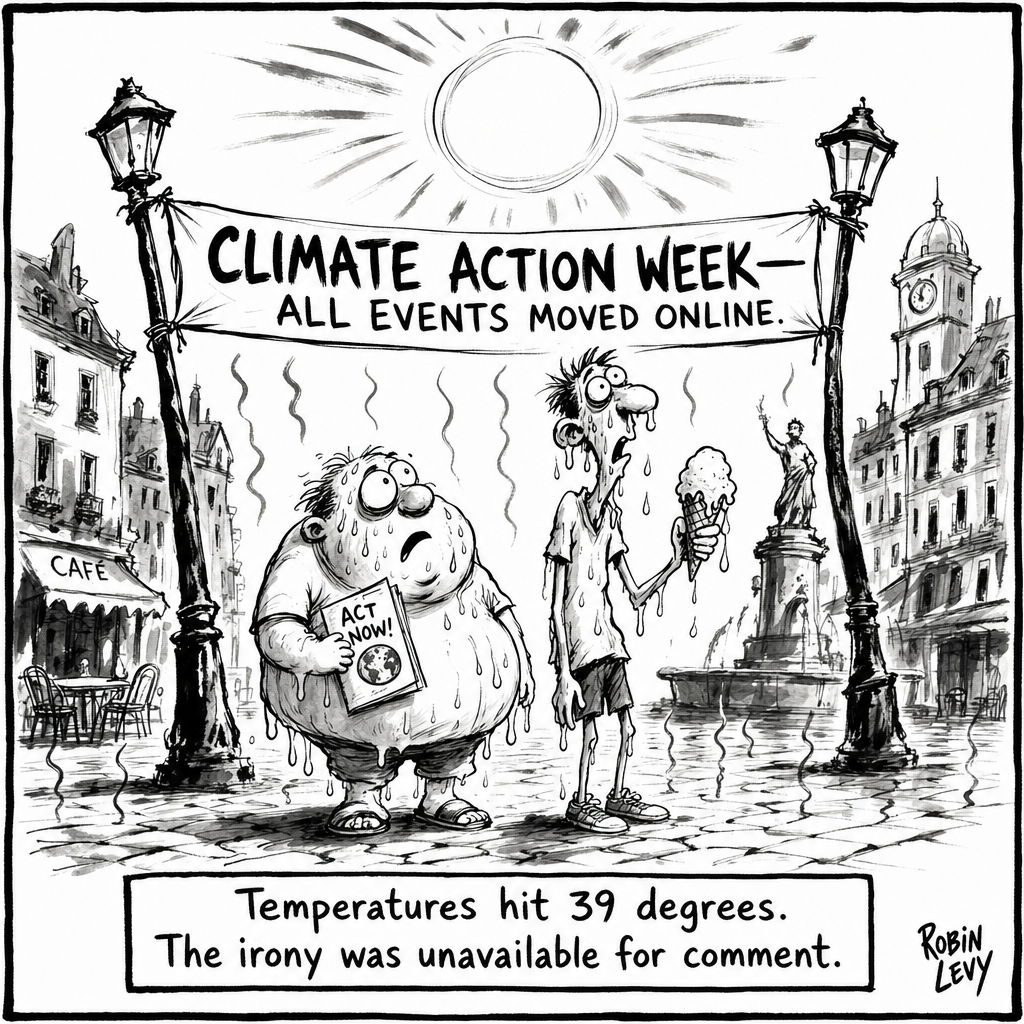
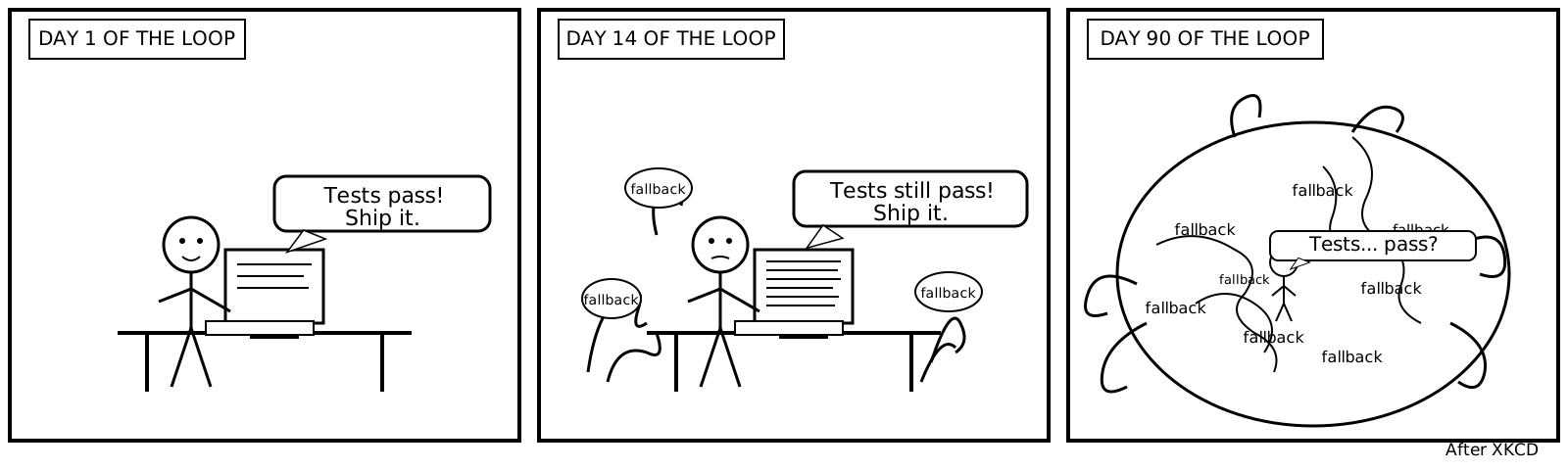
*After XKCD — on the AI harness loop that keeps passing its tests while the codebase quietly becomes an organism no one can read. After Krazy Kat — on London's Climate Action Week, which moved all its events online because the heat was too extreme to go outside.*

Hand-drawn parody comic strip
AI-rendered parody comic strip

↑ Back to top

ALSO NOTED

Also Noted

↑ Back to top

THE QUESTION

When the Constraint Is Gone, What Enforces the Discipline?

What a hard constraint enforces, its absence quietly erodes — and two stories this paper carries today make that tension visible from opposite ends of the engineering spectrum.

THE LONG READ describes a six-person team building a cinematic executable under a 64-kilobyte hard limit.1 The limit was binary: exceed it and you're out of the competition. So the team made every architectural decision in service of the constraint — raymarched SDFs instead of polygon meshes, a stripped C runtime, a naive DFT that happened to run fast enough. They had so much headroom left over that they didn't bother removing comments from the shaders.1 The constraint didn't produce heroic compression. It produced clarity about what to build and what to leave out.

THE LAB today covers Armin Ronacher's argument about the harness loops that now drive most serious AI-assisted software development. His diagnosis is precise: loops work, but without a hard check on quality, they tend to produce what he calls organisms rather than machines — codebases that grow incrementally more defensive, more complex, less amenable to human reasoning. Each iteration adds another fallback instead of making the bad state impossible.2 The system appears more robust while becoming less understandable.2 The 64k team couldn't afford fallbacks; they would have eaten the budget. The loop has no such budget. It runs until a stopping condition is met, and the stopping condition is usually "tests pass" — which is not the same as "bad states are impossible."

The structural question the two pieces raise together is not about AI specifically. It is about what fills the role of the constraint when there isn't one. The 64k team had the byte counter. Engineers writing software for deployment have compile-time types, test coverage requirements, code review, and human reviewers who will ask "why is this fallback here." What Ronacher observes is that when the harness does the reviewing, those questions stop being asked — not because the model can't ask them, but because the harness is optimized for throughput, not for architectural legibility. The organism grows. No one is counting the bytes.

This is not a new problem. Software has always grown in the absence of constraints; the question of whether to impose artificial constraints — line length limits, dependency budgets, interface-only programming — has been argued since at least the structured programming debates of the 1970s. What's new is the speed. A loop that runs overnight can add more complexity than a human team would introduce in a sprint. The fallbacks accumulate faster than any reviewer can track them. And as Ronacher notes, the codebases produced this way may not merely be hard to maintain by humans — they may come to assume machine participation as part of their maintenance model.2 At that point, the constraint that kept things legible was not a technical rule. It was the requirement that a human had to be able to read the thing.

That requirement is optional. The 64-kilobyte limit is not.

Sources
  1. How a 64k intro is made — post-mortem of "Guberniya" lofibucket.com May 2017
  2. The Coming Loop — Armin Ronacher lucumr.pocoo.org Jun 23, 2026

↑ Back to top

Investigator Report

Investigator report — 2026/06/24

Verdict

A strong edition with a coherent thematic spine: THE LAB, THE LONG READ, and THE QUESTION all pull on the same thread (hard constraints producing clarity in software engineering) and produce one of the more intellectually satisfying alignments this paper has run. THE PELOTON carries real news well. The main editorial failure is that THE QUESTION directly violates the COLLISION RULE by sharing its primary source with THE LONG READ. The main structural failure is ON THE TRAIL: the picks are missing every required numeric field (per-day mileage, elevation, trip type, NWS weather quotes). The run itself was clean and fast at $9.89, with no dedup agent present — which is worth noting but did not visibly harm the edition.

Frontpage

The rendered PNG is a credible newspaper front page. The hierarchy is clear: THE PELOTON dominates the top row with a 60px headline that reads well at distance; THE WORLD sits as a headline-only right column. THE LAB and THE LONG READ share the second row at equal width, both with 38px heads. The bottom row gives THE QUESTION the narrowest column (342px), FROM THE ARCHIVE a medium column with the lead image, and ALSO NOTED the remaining width as a bullet list.

The lead image — a pen-and-ink Tempelhof Airport scene — is rendered at 336×224px in the archive column. The contrast between the wide-winged cargo plane and the crowd at the fence is clear even at this size; the prompt was well-specified. The image earns its placement.

One visual concern: THE QUESTION column (342px) is tight for its headline, "When the Constraint Is Gone, What Enforces the Discipline?" The headline wraps to four lines at 30px, consuming most of the visible space before the gradient fade kicks in. A reader glancing at the front page sees mostly headline and two-thirds of a sentence — not enough to understand the argument. No clipping detected elsewhere. Font sizes are normal throughout; no shrinkage.

The deployed HTML at pd.thep3000.com/2026/06/24/ has all eight sections in correct order. The extra occurrences of "THE LAB" and "THE LONG READ" in the HTML are from THE QUESTION article's inline cross-references, not duplication bugs.

Priority ranking

SectionPriorityLengthImageNotes
THE PELOTON881,049 wordsBrussels Classic result + Evenepoel ban + Vingegaard + UCI power + Dygert
THE LAB821,344 wordsRonacher essay + Elden Ring AI + OpenAI DayBreak + Willison/Moebius
THE LONG READ78617 wordsGuberniya 64k post-mortem
THE QUESTION72496 wordsConstraint/discipline bridge across LAB + LONGREAD
THE WORLD62765 wordsBullet format + Seattle local + ON THE TRAIL
FROM THE ARCHIVE38296 wordsyesBerlin Blockade, June 24, 1948
ALSO NOTED10693 words14 items
THE FUNNIES848 wordsText caption only; image in funnies-openai.png

The ranking is broadly defensible. THE PELOTON at 88 is right: Brussels Classic result plus the Evenepoel ban story is a significant pre-Tour news day. THE LAB at 82 is slightly high for a single-essay anchor — Ronacher's piece is excellent but it is one essay — but justified by the four-story build. THE LONG READ at 78 is within the "Good longform" band and earns it. THE QUESTION at 72 is fair for the cross-domain bridge it attempts, though the collision violation (see below) argues it should have been rewritten at a lower priority rather than shipped as-is. No priority inflation; no compression.

Editorial reading

THE QUESTION violates the COLLISION RULE. The section's own config states clearly: "THE QUESTION may not share primary sources with THE LONG READ on the same day." THE QUESTION lists https://www.lofibucket.com/articles/64k_intro.html as a source — the same URL that is THE LONG READ's sole source. The article explicitly names and recaps the 64k demo's argument for two paragraphs before pivoting to the Ronacher contrast. The spec offers a remedy: "pick a different angle entirely (a second-order implication, a structural question about the system around the story)." A viable alternative was sitting in the same edition — the Evenepoel/Belgian Federation ban story raises a structural question about rules that exist for governance legitimacy rather than sporting fairness, which is a different domain entirely and would have given the edition more range. Instead the Question read as an editorial synthesis of THE LAB and THE LONG READ, which is exactly the failure mode the rule was designed to prevent.

ON THE TRAIL drops every required numeric field. The section rules are explicit: each pick must include per-day mileage and elevation gain formatted as "Day 1 in: X mi, +Y ft / Day 2 out: X mi, -Y ft"; a pipe-delimited NWS weather quote for each trip day; and a stated trip length (1-night, 2-night). None of these appear. The Esmeralda Basin pick gives no mileage or elevation figures at all. Kendall Peak Lakes gives only a total figure ("~8.7 mi, 2,100 ft"), not a per-day split. Neither pick states trip type. No NWS weather quotes are given in pipe-delimited format — the article has precip percentages for the regional snapshot, but the per-pick weather quotes the spec requires ("Fri 72°F / 51°F, 0% | Sat 68°F / 49°F, 10%...") are absent. The picks are editorially reasonable — the Teanaway call on a rainy weekend is correct — but they are structurally incomplete. A reader who wants to size pack weight and fitness against trip days cannot do it from what shipped.

THE LAB's thread field is misassigned. The section carries thread: fable5-government-shutdown, but the OpenAI DayBreak / Fable 5 angle is the third of four stories and not the primary coverage. The dominant story is Ronacher's "Coming Loop" essay, which has no corresponding thread. The secondary story is the Elden Ring AI teardown. The Fable 5 thread advances (OpenAI positions itself against the Anthropic regulatory climate), but assigning it as the section's thread tag overweights it relative to what the article actually covers. Similarly, THE PELOTON carries thread: soudal-qs-tour-sprinter-2026, but the Soudal-QS story was dropped from the article body. Tim Merlier's Baloise Belgium Tour Stage 2 win is listed in the dropped array with reason "Not referenced in article body; Soudal-QS sprinter thread not developed in this section." The thread tag should advance a thread the article actually covers; PELOTON would be better assigned to fable5-government-shutdown's cycling equivalent — the Evenepoel ban story has no thread, and it is the freshest news peg in the section.

THE WORLD drops two significant stories without a fallback attempt. Qatar's Ras Laffan explosion (13 killed, 66 injured) and the Israel/Gaza UN genocide inquiry were both dropped with "no page fetched, no source text to verify." The drop reason is procedurally correct — the fetch pipeline returned nothing — but neither writer nor researcher appears to have attempted an alternative source for events of this scale. The Qatar explosion is a major industrial disaster on the day the paper covers a World Cup match in Qatar; its absence from a section headlined partly on World Cup coverage is an editorial mismatch. The Seattle budget shortfall nearing half a billion dollars was also dropped for the same reason, yet the research brief identified it as a candidate. These are not cases where the story was too minor to pursue — they are cases where the fetch failed and no one widened the net.

THE ARCHIVE is single-sourced from History.com. The Berlin Blockade article is well-written and the narrative is clean. But every citation points to the same History.com page (published November 2009, a reference article rather than journalism). The section rules do not prohibit single-sourcing, but for a five-paragraph article with five citations all pointing to the same URL, the effect is that the "source" field provides no validation diversity. A second source — Truman Library records, an Smithsonian or Air Force Museum post-mortem, a contemporary newspaper account — would have given the fact-checker something to triangulate against.

Pipeline observations

No dedup agent ran. The jsonl/subagents/ directory contains 20 agent files; the agent types present are: art-director, comic-strip, fact-checker, meta-writer, researcher, scout, thread-editor, writer, writer-sweep. There is no dedup agent. The covered.json file is present (273 URLs, 4 GitHub repos, 10 local stories) and the dedup result was consumed correctly by downstream agents — suggesting the dedup step either ran as part of another process or the covered.json was inherited from a prior run. This should be confirmed; if dedup silently skipped, the edition ran without the full coverage index being freshly generated.

Three agents encountered tool errors (recovered). The WORLD writer attempted to read /home/user/peloton-dispatch/2026/06/24/pages/local/research.md (does not exist); the WORLD fact-checker tried to read pages/world as a file (it is a directory); the LAB writer tried to read pages/lab/noted/google-workspace-cli-fired.md (does not exist). All three recovered from the errors and completed successfully. The world writer's error may explain why some local sources were not consulted — the writer fell back to the already-loaded research brief rather than browsing the full source directory.

Fetch failures on two URLs, both recovered. soudal-quickstepteam.com and swiftpackageindex.com/blog/swift-package-index-joins-apple both failed on all methods in fetch_results.json. The Soudal-QS failure contributed to the sprinter story being dropped; the Swift Package Index acquisition (reportedly by Apple) was also dropped by ALSO NOTED with a 404. Neither loss materially harmed the edition.

The fetch_retry_results.json file is malformed. Attempting to parse it as JSON raises JSONDecodeError: Extra data. The file appears to contain multiple JSON objects concatenated without JSONL formatting. This did not block the run but means retry results cannot be audited programmatically.

Starting commit is current. The dispatch run started from commit e5f4748 (Investigator: 2026-06-23), and the dispatch commit b6e5453 has that as its parent — same-day starting commit, no stale worktree concern.

Illustrator used OpenAI backend. The Funnies (OpenAI) entry in the trace reflects the gpt-image-2 backend for the lead image; a separate funnies-openai.png (1.8MB) was also generated. Both the lead image and the funnies image were produced without errors. The SVG funnies (funnies.svg, 10KB) also exists but section-funnies.md links to the OpenAI rendering.

Trace highlights

The researcher owns 20% of total cost at $2.00 over 1,002 seconds. That is longer than any writer by a factor of 7–20x and expensive relative to the writers it served. The researcher read 4.4M cached tokens — substantially more than the LAB writer (164K) or PELOTON writer (213K). Either the research brief is overloaded with material the writers do not use, or the researcher is doing source-fetch work that could be pre-staged.

Fact-checkers for THE PELOTON and THE LAB ran long relative to their sections. FC: THE PELOTON took 314 seconds and cost $0.33; the underlying writer took 136 seconds and cost $0.20. FC: THE LAB took 222 seconds and $0.33 for a section the writer produced in 120 seconds at $0.25. High fact-checker duration on these sections suggests they are doing substantial source-reread work — consistent with the dense multi-story structure of both sections. Not a problem per se, but a signal that sections with 4+ stories run disproportionately long in the fact-check pass.

FC: THE WORLD ran longer than the WORLD writer (163s vs. 109s) despite the WORLD section having a relatively simple bullet structure. The FC also encountered the directory-read error noted above. The extra time was likely spent navigating around the error and re-reading available sources.

The orchestrator cost $3.00 — nearly a third of the total run cost. At 6.4M cached tokens read and 107K in 1-hour cache creation, the orchestrator is holding significant context across steps. This is consistent with a healthy run but worth monitoring as section count and research brief size grow.

Trace summary
AgentDurInputOutputCache ReadCache 5mCache 1hCost
Scout326s17872101362445985210$ 0.53
Researcher1002s2046152944658021687260$ 2.00
THE WORLD109s75150903698560$ 0.31
THE PELOTON136s12233212977366440$ 0.20
THE LAB120s985164581524700$ 0.25
THE LONG READ45s6943660128830$ 0.06
FROM THE ARCHIVE40s7581678176780$ 0.09
FC: THE LONG READ111s1023200948381730$ 0.20
FC: FROM THE ARCHIVE124s1217226405246490$ 0.16
Meta-Writer30s6550097213410$ 0.10
FC: THE WORLD163s833175289376331520$ 0.22
Illustrator62s2151372000$ 0.06
FC: THE LAB222s1417450843508530$ 0.33
FC: THE PELOTON314s16155472325503490$ 0.33
THE QUESTION57s5349334292740$ 0.12
FC: THE QUESTION97s811145096311540$ 0.16
ALSO NOTED196s16228671299875980$ 0.53
Draw today's TWO parody comic strips for146s17220413250353180$ 0.26
Funnies (OpenAI)200s2477024000$ 0.28
FC: ALSO NOTED208s12158409376584680$ 0.34
Art Director164s5345518434650$ 0.18
Update story threads for today's edition194s5342988438350$ 0.18
Orchestrator1572902763875830107401$ 3.00
TOTAL2153740408153364841004407107401$ 9.89

Suggestions for next edition

Add a COLLISION RULE preflight to the QUESTION agent prompt. The agent dutifully listed the 64k source and the Ronacher source, then proceeded to cite both without recognizing that lofibucket.com was already owned by THE LONG READ. The rule is in the config but the agent needs to be prompted to explicitly cross-check its source list against THE LONG READ's sources before writing.

Add a numeric-fields checklist to the ON THE TRAIL writer prompt. The writer produced reasonable trail picks but skipped every quantitative field the spec requires. A short preflight list — "confirm each pick has: trip type, Day 1 mileage, Day 1 gain, Day 2 mileage, Day 2 gain, pipe-delimited NWS quote" — run before drafting would catch the missing fields before the section ships.

Investigate whether the dedup agent ran. The covered.json is well-populated but the agent type does not appear in the subagents directory. If dedup is being folded into the researcher or handled externally, that should be documented; if it silently skipped, the coverage index may have gaps that caused the already-covered thread entries to be stale.

When a world-news fetch fails for a story above a certain threshold of significance (industrial disaster, UN inquiry finding), the WORLD writer should be prompted to attempt a second source rather than treating "no page fetched" as a drop condition. The Qatar Ras Laffan explosion and the Israel/Gaza UN inquiry were both dropped purely because the fetch failed — not because the stories were thin. A single fallback search query on a failed high-stakes story would recover most of these.