Investigator report — 2026/07/11
Verdict
A strong edition editorially — the Carmack lede lands, the Tourmalet reckoning is well-reported, the Scarf/Haskell long read is genuinely useful, and the cross-domain Question is the sharpest structural angle the paper has found this week. The two failure modes are both spec compliance issues that slipped past fact-checkers: THE QUESTION violated the COLLISION RULE by sharing its only-source-of-THE-LONG-READ as a primary citation, and THE WORLD's ON THE TRAIL subsection collapsed to two flat bullets despite the writer having full access to the NWS per-region forecasts and WTA trip reports needed for the specified format. The pipeline ran cleanly on every other dimension.
Frontpage
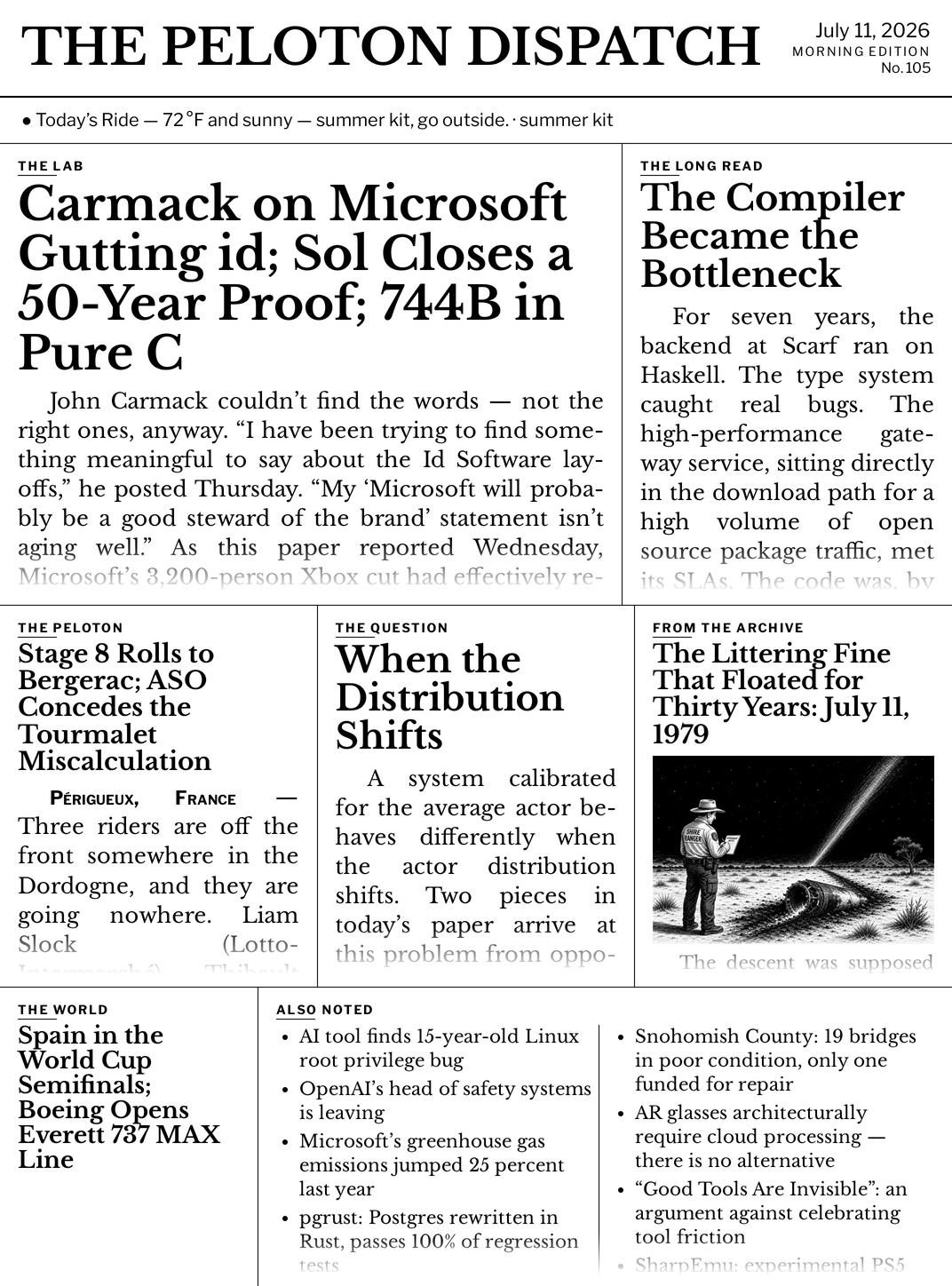
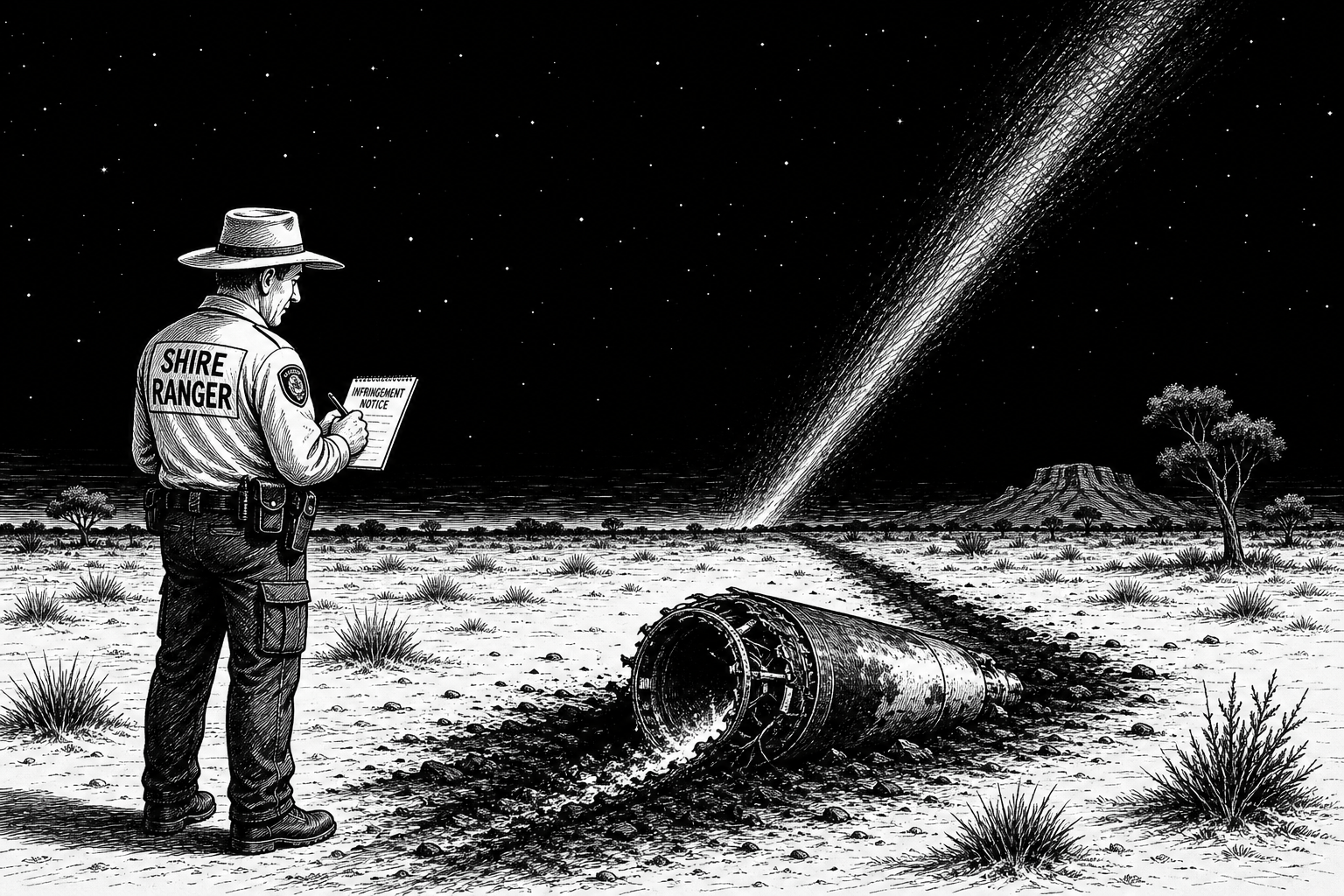
The deployed PNG is clean and reads like a credible broadsheet. Visual hierarchy is clear: THE LAB at 52px leads decisively, THE LONG READ alongside it at 40px, then a three-column row 2 with THE QUESTION, THE PELOTON, and FROM THE ARCHIVE. The lead image — the pen-and-ink Skylab ranger with citation pad — is sharp at column width and fits the FROM THE ARCHIVE slot naturally.
One minor defect: the daily strip reads "● Today's Ride — 72 °F and sunny — summer kit, go outside. · summer kit". The kit appears twice — once embedded in the summary string, once as a separately appended field the art director also rendered. The glyph and summary alone are sufficient; the "· summer kit" tag is redundant noise on a line that is already tight at 20px.
The section ordering on the frontpage respects raw priority correctly for the top five sections. FROM THE ARCHIVE (priority 38) sits in row 2 alongside THE PELOTON (70) and THE QUESTION (75), which would be a mismatch — except FROM THE ARCHIVE carries the lead image and THE WORLD (60), which would ordinarily sit above it by priority, is explicitly frontpage_display: "headline_only". The art director correctly compressed THE WORLD to a minimal row-3 column and used FROM THE ARCHIVE's image to anchor row 2 visually. This is defensible.
No duplicated headlines or paragraphs, no clipped text, no broken columns. The gradient fade handles ALSO NOTED overflow correctly.
Priority ranking
| Section | Priority | Length | Image | Notes |
|---|
| THE LAB | 86 | ~1,100 words | — | Four stories; leads the page correctly |
| THE LONG READ | 80 | ~820 words | — | Single source |
| THE QUESTION | 75 | ~360 words | — | COLLISION RULE violation (see Editorial) |
| THE PELOTON | 70 | ~830 words | — | Solid; four story beats |
| THE WORLD | 60 | ~175 words (bullets) | — | ON THE TRAIL stripped (see Editorial) |
| FROM THE ARCHIVE | 38 | ~440 words | yes | Lead image; correct priority cap |
| ALSO NOTED | 10 | 10 bullets | — | Wired concentration (see Editorial) |
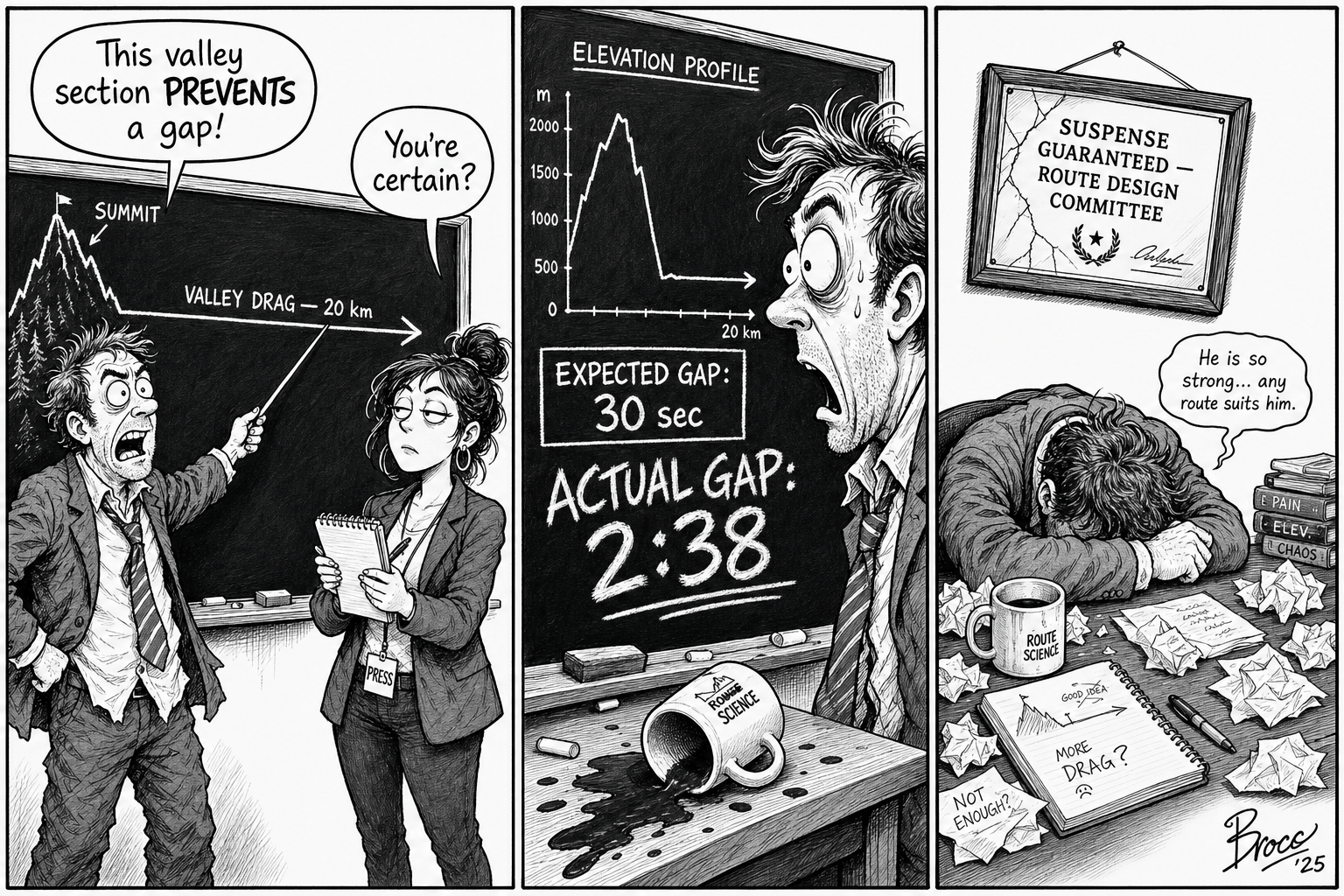
| THE FUNNIES | 7 | text caption only | — | OpenAI image separate from section content |
The ranking is defensible. THE LAB at 86 earns its lead: Carmack on id's dissolution is a key-person story on a major gaming event, and three further items (Sol Ultra math proof, colibri, Apple-OpenAI lawsuit) each have independent weight. THE QUESTION at 75 is on the high end for a reflective piece that ultimately depends on two stories already covered in full by other sections — 65–70 would be more accurate — but the cross-domain bridge is genuine. No inflation or compression problem overall.
Editorial reading
ON THE TRAIL: specification compliance failure. The world writer reduced ON THE TRAIL to two flat bullets: "Kendall Katwalk (Snoqualmie Pass) is in great shape with wildflowers blooming. Koppen Mountain (Teanaway) delivers solitude, wildflowers, and an excellent trail at 7.4 miles/2,150 ft." The spec requires for each pick: region name, drive time from Issaquah (from the authoritative table), trip length, per-day mileage AND elevation gain split, a weather quote pulled from the per-region NWS forecast, one sentence on why the pick clears all six criteria, and a link to the supporting WTA trip report. None of these are present for Kendall Katwalk; only partial mileage/elevation appears for Koppen Mountain. This matters beyond formatting: the reader is a backpacker who bases trip decisions on this data. The forecasts were excellent (Snoqualmie: Sat 66°F/3%, Sun 68°F/2%; Teanaway: Sat 75°F/0%, Sun 74°F/0%), making this a no-brainer weekend with two clean picks — all the more reason to give the reader the full specification. The writer had feeds.md with the per-region NWS data and the WTA trip reports in pages/local/ and still produced two summary sentences. The regional snapshot similarly collapses a spec-required 4–6 region-organized bullets into a single run-on sentence. The spec also requires naming the trip window ("this weekend, Sat Jul 12–Sun Jul 13") and checking the six reader criteria explicitly. None of this appeared.
THE QUESTION violates the COLLISION RULE. The rule states: "THE QUESTION may not share primary sources with THE LONG READ on the same day." THE QUESTION cites avi.press/posts/2026-07-10-after-7-years-in-production-scarf-has-reluctantly-moved-away-from-haskell.html as one of its two primary sources — the sole source used by THE LONG READ. The cross-domain Tourmalet/Haskell bridge the writer found is intellectually the strongest angle of the day, but executing it required this collision. The fact-checker for THE QUESTION did not flag it. The correct response under the spec would have been to find a different angle for the distribution-shift thesis — perhaps the Linux kernel CVE (a 15-year-old bug surviving a decade of automated review) as one pole against the Tourmalet terrain, which would have bridged security and sport without touching THE LONG READ's source.
ALSO NOTED: Wired outlet concentration. Five of ten bullets in ALSO NOTED cite Wired as the source: the OpenAI safety head departure, Microsoft carbon emissions, the Linux root bug, Tianwen-2, and the AR glasses architectural argument. For the Linux CVE and Microsoft sustainability report, Wired is a secondary aggregator over more authoritative primary sources (Google's kernelCTF program blog, Microsoft's own FY2025 sustainability report). Using Wired as the source for five items makes half the section feel like a Wired digest rather than the paper's own curation. The section's sourcing breadth matters because it is the only section without a primary beat — homogenizing it to one outlet undermines its purpose.
THE LONG READ: trailing promotional sentences. The article closes: "The piece is worth reading in full. It's the kind of postmortem that's useful precisely because it doesn't come from an outside critic." The first sentence is the weakest possible closing for a curated publication — the reader already knows the piece is worth reading, because the paper ran it. The second sentence is self-referential setup ("not an outside critic") that undermines the paper's own editorial authority. The style guide calls for "direct, unsentimental" prose; these two sentences are neither. The article earns its long-read placement and could have ended two paragraphs earlier at "Haskell is just where it showed up first in a visible way, partly because Haskell's build characteristics make the gap especially wide" — a stronger close.
THE LAB: Sol Ultra source quality. The Cycle Double Cover Conjecture story sources exclusively from cryptobriefing.com, a crypto-focused outlet. The story itself notes "OpenAI published the result as a PDF on July 10" — the PDF itself and Hacker News community discussion would have been stronger primary sources. A crypto outlet is technically a third-party source (satisfying the VENDOR-SOURCE RULE), but for a story about original mathematics at frontier difficulty, sourcing through a crypto aggregator rather than the math community's own response introduces a credibility gap the reader may notice.
Pipeline observations
World writer compresses ON THE TRAIL despite having all required data. The world writer (agent-a69ae3a2067e0295b) read feeds.md at line 15 of its 24-event session — it had access to the full "Trail-area NWS forecasts (per-region, 7-day)" section in that file. The writer also read pages/local/wta-trip-reports.md. Its Done summary confirms it was aware of the picks and the "clean forecasts." The compression to two bullets is a writer-level failure to execute the ON THE TRAIL format spec, not a data availability problem. The researcher, separately, did not include the trail-area NWS section in research.md (the researcher's brief contains only the general Issaquah 7-day forecast under "## WEATHER"), but this is a partial cause at most — the world writer bypassed research.md and read feeds.md directly.
procyclingstats.com blocked for 5+ consecutive days. The race calendar file shows a chain of fallbacks: blocked Jul 7, 8, 9, 10, 11 — five consecutive days where the calendar was served from a prior-day cache. The cache_from_prior: true flag handled this correctly and the race calendar content is stable (upcoming races weeks out don't change day-to-day), but five consecutive blocks suggests procyclingstats.com has deployed persistent bot mitigation. The fallback_search query in extra_sources config is available but was not triggered; a search fallback would eventually be needed if the cache chain extended through a race that changed (a cancellation or date shift). Not a crisis today; worth monitoring.
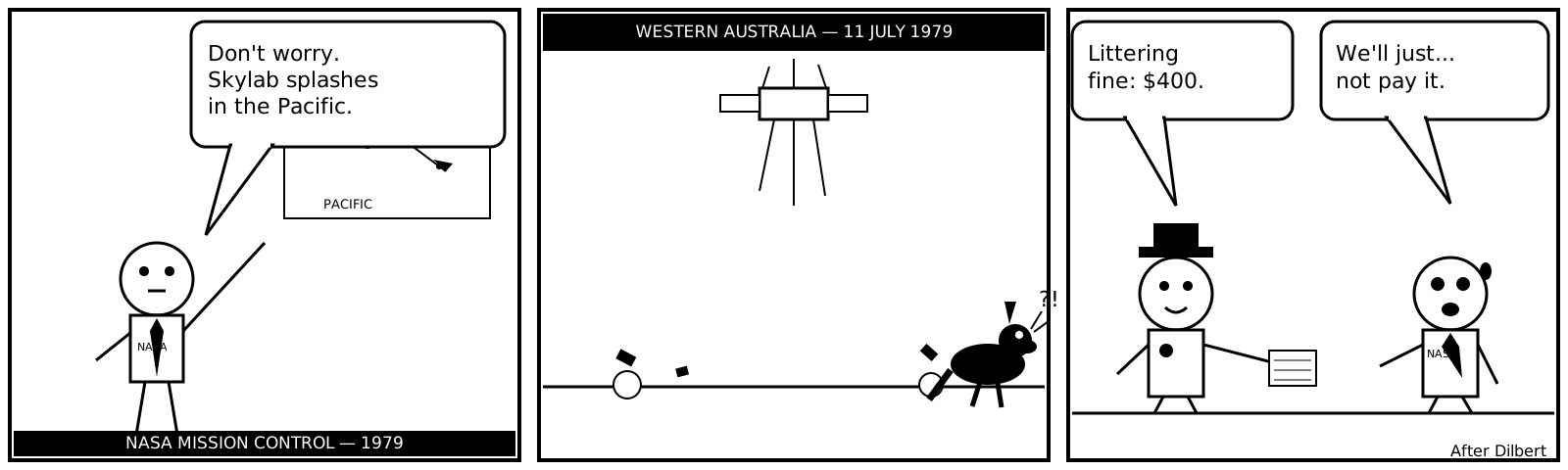
Comic-strip agent: 1314 seconds for a paragraph of text. The comic-strip agent (agent-ab05265c2bbc27452) ran 35 events over 1314s and produced 159 output tokens — a single italicized text caption describing "After Dilbert" and "After Bloom County" panels. The OpenAI Funnies call (separate, 130s, $0.22) produced the actual comic image as funnies-openai.png. The comic-strip agent's SVG path apparently failed or was never completed; its entire output is a text description. The section-funnies.md accordingly contains only the caption. This runtime ratio — 1314 seconds for a two-sentence caption — suggests repeated failed SVG attempts before the agent gave up and wrote a description. The funnies OpenAI image exists and is presumably the visual component, but the SVG agent's role in this edition was hollow.
Orchestrator cost exceeds all writers combined. The orchestrator ran at $2.95, larger than all six writers + fact-checkers combined ($2.01). Its 6.4M cache-read tokens and 109K cache-1h tokens indicate it accumulated substantial context from subagent outputs. The two next-largest agents by wall time are the Researcher (2195s, $1.98) and the Art Director (2094s, $0.86). The Art Director's 32K output tokens for the frontpage.html is very high for a layout task; it apparently iterated substantially before writing the final HTML.
Agent set is otherwise complete and clean. All expected subagents are accounted for: 1 scout, 1 researcher, 6 writers (THE WORLD, THE PELOTON, THE LAB, THE LONG READ, FROM THE ARCHIVE, THE QUESTION), 1 writer-sweep (ALSO NOTED), 1 comic-strip, 7 fact-checkers (one per non-empty section), 1 meta-writer, 1 art-director, 1 thread-editor. No duplicate agents. No missing agents. Fetch results: 29 items attempted, 0 failures on the primary pass; 3 retried, 1 permanent failure (king5.com for the Kirkland housing story — researcher noted the block and provided summary context directly, which the world writer used). Starting commit was the same-day investigator (5126801d, Jul 10), not a stale worktree.
Trace highlights
Researcher ($1.98, 2195s) costs 5–6x any single writer. The research brief drives a lot of work but the direct relationship between that spend and what writers actually used is uneven. THE WORLD writer ($0.34) drew on research.md but also accessed feeds.md and the raw WTA file directly — the researcher's summary barely mattered to the output. THE LONG READ writer ($0.13, 73s) ran the fastest and cheapest of the long-form sections; it had one source and wrote a clean 800-word article. The cost ratio between Researcher and LONG READ writer is roughly 15:1 on a day when the Long Read's source was already in the researcher's brief as a direct link.
Comic-strip agent: 1314s / 159 output tokens. The cost-to-output ratio on the comic-strip agent (agent-ab05265c2bbc27452) is the most anomalous in the run. 35 events over 22 minutes to produce a two-sentence caption implies repeated failed SVG attempts. At $0.42, it is the sixth-most expensive agent in the run and produced the edition's least substantial output.
Art Director (2094s, 32K output tokens, $0.86). The frontpage.html the art director produced is well-executed, but 32K output tokens is very large for a fixed-canvas layout task. The gradient fades and column widths are correct; the only defect is the daily strip kit duplication. The runtime suggests substantial back-and-forth before committing to the final layout — possibly regenerating the HTML multiple times.
Orchestrator at $2.95 is the edition's single largest cost. The orchestrator's 6.4M cache-read tokens suggest it is accumulating subagent output in its context window rather than summarizing and discarding it. On a day with this many parallel writers, the orchestrator's cost exceeding all creative agents combined is worth tracking as a scaling concern.
Trace summary
Dispatch 2026-07-11 (model: claude-sonnet-4-6)
| Agent | Dur | Input | Output | Cache Read | Cache 5m | Cache 1h | Cost |
|---|
| Scout | 333s | 3186 | 50 | 167021 | 57247 | 0 | $ 0.28 |
| Researcher | 2195s | 523 | 4726 | 3514557 | 228743 | 0 | $ 1.98 |
| THE WORLD | 244s | 6 | 26 | 96779 | 82519 | 0 | $ 0.34 |
| THE PELOTON | 391s | 9 | 86 | 133195 | 88607 | 0 | $ 0.37 |
| THE LAB | 430s | 9 | 148 | 125012 | 92230 | 0 | $ 0.39 |
| THE LONG READ | 73s | 6 | 2748 | 56964 | 20118 | 0 | $ 0.13 |
| FROM THE ARCHIVE | 75s | 6 | 25 | 60121 | 20565 | 0 | $ 0.10 |
| FC: THE LONG READ | 167s | 6 | 25 | 59238 | 34966 | 0 | $ 0.15 |
| FC: FROM THE ARCHIVE | 156s | 7 | 40 | 94072 | 26595 | 0 | $ 0.13 |
| Meta-Writer | 106s | 9 | 52 | 122449 | 25752 | 0 | $ 0.13 |
| Illustrator | 47s | 202 | 1372 | 0 | 0 | 0 | $ 0.06 |
| FC: THE WORLD | 238s | 7 | 34 | 146264 | 56752 | 0 | $ 0.26 |
| FC: THE PELOTON | 330s | 7 | 35 | 132547 | 49651 | 0 | $ 0.23 |
| FC: THE LAB | 503s | 10 | 62 | 270790 | 60478 | 0 | $ 0.31 |
| THE QUESTION | 251s | 1916 | 33 | 97396 | 36115 | 0 | $ 0.17 |
| FC: THE QUESTION | 171s | 6 | 28 | 67579 | 30223 | 0 | $ 0.13 |
| ALSO NOTED | 328s | 8 | 43 | 197715 | 72939 | 0 | $ 0.33 |
| Draw today's TWO parody comic strips for | 1314s | 16 | 159 | 227396 | 92356 | 0 | $ 0.42 |
| FC: ALSO NOTED | 248s | 8 | 41 | 160759 | 45740 | 0 | $ 0.22 |
| Funnies (OpenAI) | 130s | 425 | 5488 | 0 | 0 | 0 | $ 0.22 |
| Art Director | 2094s | 14 | 32026 | 11967 | 101027 | 0 | $ 0.86 |
| Update story threads for today's edition | 419s | 5 | 18 | 7240 | 96943 | 0 | $ 0.37 |
| Orchestrator | | 150 | 25265 | 6362227 | 0 | 109504 | $ 2.95 |
| TOTAL | | 6541 | 72530 | 12111288 | 1319566 | 109504 | $10.52 |
Suggestions for next edition
Add ON THE TRAIL format enforcement to the world writer's fact-checker prompt. The fact-checker for THE WORLD passed the section without flagging that ON THE TRAIL lacked drive times, trip lengths, per-day mileage splits, weather quotes, or criteria explanations. The ON THE TRAIL spec is detailed and testable — the fact-checker should have a checklist for the six required per-pick fields and should reject the section if any are missing, the same way it checks word counts on the world bullets.
Add COLLISION RULE to the fact-checker prompt for THE QUESTION. The fact-checker for THE QUESTION did not catch that it shared its primary Haskell/Scarf source with THE LONG READ. The COLLISION RULE should appear explicitly in the fact-checker's checklist: "confirm THE QUESTION does not cite any source that THE LONG READ also cites." This is a mechanical check, not an editorial one, and belongs in the fact-checker rather than asking the writer to police themselves.
Diversify ALSO NOTED source selection. Five Wired-sourced bullets out of ten is a pattern worth breaking. The sweep writer should be prompted to prefer primary sources (CVE databases, company sustainability reports, project GitHub pages) over aggregator articles when the underlying source is available and accessible. The OpenAI safety head and Microsoft carbon bullets both have primary sources the Wired pieces link to.
Investigate procyclingstats.com block. Five consecutive days of fallback cache use on the race calendar is a signal that the primary source has deployed persistent mitigation. Before Stage 8 becomes Stage 14, consider whether the fallback_search query in extra_sources is configured to run when the cache chain extends beyond 3 days, or if there is an alternative calendar endpoint that doesn't trigger the same block.