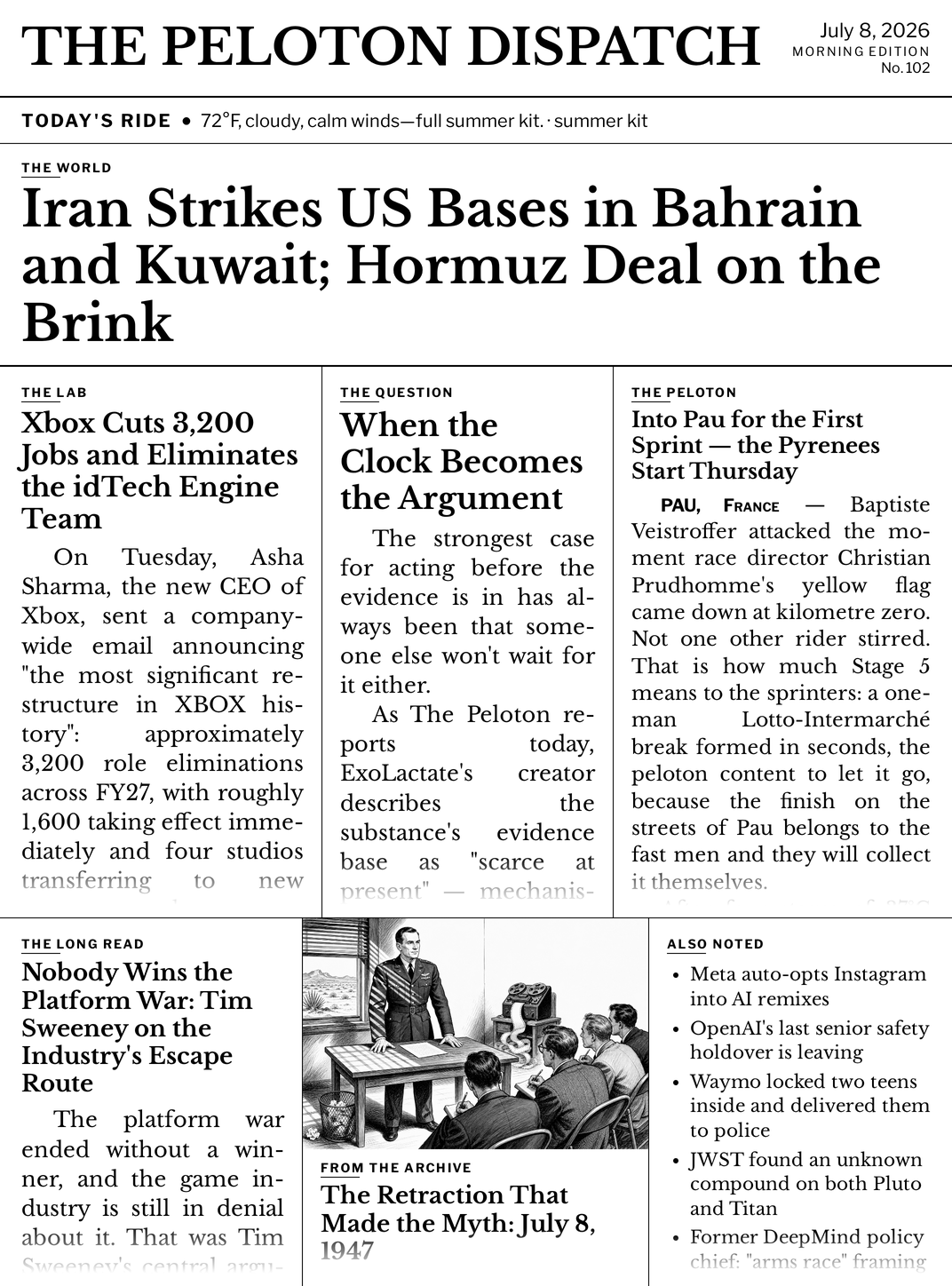
Front page — July 8, 2026
The Peloton Dispatch July 8, 2026 No. 102
● 72°F, cloudy, calm winds—full summer kit. · summer kit

THE WORLD

Iran Strikes US Bases in Bahrain and Kuwait; Hormuz Deal on the Brink

↩ Developing story — first reported Jul 03 · previously Jul 05, Jul 07


US 2 near Leavenworth entered permanent storm-repair mode Tuesday: lane restrictions with pilot cars are active from milepost 85 to 99 through the end of July, and the road closes entirely for four days beginning July 13 — freight and heavy vehicles (over 26,000 GVW) must use I-90 during that window. Source

The Chelan Hills Fire in Douglas County hit 50% containment today; evacuation orders remain in the Orondo area. Source

Clyde Hill — the Eastside enclave adjacent to Bellevue on the east side of Lake Washington — faces what The Urbanist describes as an existential budget crisis: municipal bankruptcy is projected by 2030, and the city is weighing a 69% property tax hike as an emergency measure. Source


ON THE TRAIL

PART 1 — WEEKEND PICKS

Trip window: Saturday July 11 – Sunday July 12. No federal holiday within the next seven days (Independence Day was July 4; Labor Day is September 7). Standard two-day window.

---

Pick 1: Thompson Lake via Granite Creek Trail

Trail note: devil's club and blackberry vines encroach on the path beyond the Granite Creek junction; trekking poles useful for the steep descent off the ridge. Trail condition is otherwise clean — only two blowdowns removed, evident by fresh cut shavings.

---

Pick 2: Lookout Mountain Lookout

Trail note: 4,256' of gain in under 5 miles is a serious objective — start no later than 7am Saturday to avoid the afternoon heat on the open switchback sections. Carry sufficient water from the lower creek crossings; no water above treeline. No permit required.


PART 2 — REGIONAL SNAPSHOT

Sources
  1. Iran Attacks Kuwait and Bahrain After U.S. Strikes npr.org Jul 8, 2026
  2. Hamas Announces Dissolution of Gaza Governing Body aljazeera.com Jul 6, 2026
  3. Storm-ravaged US 2 near Leavenworth getting permanent repairs, including 4-day closure kiro7.com Jul 8, 2026
  4. Chelan Hills Fire now 50% contained kiro7.com Jul 8, 2026
  5. Clyde Hill Faces Municipal Bankruptcy Looming by 2030, Considers 69% Property Tax Hike theurbanist.org Jul 7, 2026
  6. WTA Jul 7 report — Thompson Lake via Granite Creek Trail wta.org
  7. WTA Jul 6 report — Lookout Mountain Lookout wta.org
  8. WTA Trip Reports wta.org Jul 8, 2026

↑ Back to top

THE LAB

Xbox Cuts 3,200 Jobs and Eliminates the idTech Engine Team

↩ Developing story — first reported Jul 06

On Tuesday, Asha Sharma, the new CEO of Xbox, sent a company-wide email announcing "the most significant restructure in XBOX history": approximately 3,200 role eliminations across FY27, with roughly 1,600 taking effect immediately and four studios transferring to new management.1 Among the casualties, by multiple reports: most or all of the developers working on idTech at id Software. Michael Maynard, a more than 20-year id veteran, confirmed his departure via LinkedIn.

The idTech lineage is not a minor footnote. From Wolfenstein 3D and Doom through Quake and the engine families that followed, it seeded derivatives spanning practically the entire first-person shooter genre for three decades. The Quake engine's family tree is wide enough to warrant its own Wikipedia diagram. Apogee founder Scott Miller commented on the impact of the layoffs on id Software specifically.1

id Software co-founder John Carmack departed in 2013. The engine team's elimination is the second major amputation. The code doesn't disappear — Microsoft still owns it — but there is no longer a team to develop it.


The European Parliament voted 331-304 Tuesday to advance Chat Control 1.0 through an urgency motion, setting up a Thursday vote to restore the measure on Parliament's final plenary day before the summer recess.2 As this paper reported Monday, the EU Council had fast-tracked the reactivation of the regulation, which had expired in April.

The procedural arithmetic favors proponents. Passing the measure Thursday requires only a simple majority of MEPs present — but blocking or amending it in second reading requires an absolute majority of 361 votes of all Parliament members, a much higher threshold when many MEPs have historically left before the final session day. Rapporteur Birgit Sippel of the SPD called the process "an unfair maneuver by the EU countries" and refused to support it. Pirate MEP Markéta Gregorová accused the EPP of "engaging in a farce and violating its own rules of procedure." The Social Democratic group signaled approval for the urgency procedure anyway, providing the margin.

The regulation, if restored, would again allow Meta, Google, and Microsoft to voluntarily scan private messages, emails, and messenger services for child sexual abuse material without specific suspicion. Parliament had rejected renewal by a clear majority in both March and April. IT security researchers have repeatedly warned of "unacceptably high error rates" in the AI-based detection systems used. Civil rights groups argue that restoring the voluntary measure will reduce political pressure to negotiate a more targeted permanent successor to the blocked Chat Control 2.0.


Simon Willison shipped sqlite-utils 4.0 on Tuesday — the 124th release of the project and the first major version since 3.0 in November 2020. Three headline additions: schema migrations via Python-decorated functions tracked in a _sqlite_migrations table; a db.atomic() context manager with proper SQLite savepoint support for nested transactions; and compound foreign key creation. The migration design was promoted from sqlite-migrate, a beta package Willison had been using for three years.

The sharper detail in the release post is an AI model comparison. Given the same prompt — review the codebase since the last 3.x release, write scripts to exercise the new features — GPT-5.5 produced five scripts and flagged nothing significant. Fable 5 produced twelve scripts, identified four release blockers and ten additional issues, and generated a combined repro script with concrete bug output for each failure. That translated into a 16-commit PR before stable shipped.3

Noma Labs separately published details of a prompt injection vulnerability in GitHub's Agentic Workflows. An unauthenticated attacker posts a crafted issue to a public repository in an organization; the agent, configured with cross-repository read access, fetches private repo contents and posts them as a public comment on the public issue. No credentials required.4 Adding the word "Additionally" to the payload was sufficient to bypass GitHub's guardrails. Noma says it disclosed responsibly before publishing.

Also published Tuesday: a writeup by Maxime Chevalier-Boisvert on building a Clang backend for UVM, a custom stack-based bytecode VM, using textual LLVM IR as the bridge layer. Claude Opus 4.8 wrote a Rust LLVM IR parser in roughly twenty minutes. The result: PureDOOM compiling and running on the VM, starting at 27 FPS and optimized to 86 FPS on a MacBook Air M5 via palette lookup tables and memcpy-based frame buffer upsampling.5 The code is at github.com/maximecb/uvm-doom.

Trending today: GitHub dominated by Claude Code skills collections, AI job-application frameworks, and agent-wrapper repositories — no technical novelty cleared the bar.

Sources
  1. Microsoft Fires idTech Team at id Software gamefromscratch.com Jul 7, 2026
  2. Showdown in Strasbourg: The Unexpected Return of Chat Control 1.0 — Urgency Motion Passes 331-304 heise.de Jul 7, 2026
  3. sqlite-utils 4.0, Now With Database Schema Migrations simonwillison.net Jul 7, 2026
  4. GitLost: We Tricked GitHub's AI Agent into Leaking Private Repos noma.security Jul 6, 2026
  5. Building a Clang Backend and Porting Doom to My Custom Bytecode VM pointersgonewild.com Jul 7, 2026

↑ Back to top

THE PELOTON

Into Pau for the First Sprint — the Pyrenees Start Thursday

↩ Developing story — first reported Jul 05 · previously Jul 06, Jul 07

— Baptiste Veistroffer attacked the moment race director Christian Prudhomme's yellow flag came down at kilometre zero. Not one other rider stirred. That is how much Stage 5 means to the sprinters: a one-man Lotto-Intermarché break formed in seconds, the peloton content to let it go, because the finish on the streets of Pau belongs to the fast men and they will collect it themselves.

After four stages of 37°C heat, wildfire detours, and Pyrenean crosswinds, the 2026 Tour de France finally delivers a genuine mass sprint. Lannemezan to Pau, 158km, a handful of lumps that will trouble no one. Pau is the third-most-visited city in Tour de France history — 77th time the race arrives here, only Paris and Bordeaux ahead of it — and it is perfectly suited to the occasion: a long approach road, a knowledgeable local crowd, and infrastructure that handles this without fuss.1 The favourites are well established. Jasper Philipsen (Alpecin-Premier Tech) won here in 2024 and brings ten Tour stage wins and a Mathieu van der Poel lead-out into today's finale. Tim Merlier (Soudal-QuickStep), six wins this season after a disrupted spring, looks like his old self again. Olav Kooij (Decathlon CMA CGM) is riding his first Tour de France after years of limited openings at Visma and delivered three wins in two pre-Tour races as proof of condition. Biniam Girmay (NSN) and Mads Pedersen (Lidl-Trek) will be in the front row. The 2026 route has few sprint stages. There will be no passive racing today.

The man leading the race into Pau is Torstein Træen of Uno-X Mobility, and his presence in the maillot jaune carries one of the more striking backstories in recent Tour history. In 2022, during the Volta a Cataluña, a routine doping control flagged unusually high levels of hCG — human chorionic gonadotropin, a marker of certain cancers. The test led to a diagnosis of testicular cancer. Træen had his left testicle removed. The tumor had not spread. "So very small. We got there very early," he told Norwegian outlet VG Sporten.2 No chemotherapy was needed. The bitter irony is that he had been feeling excellent — good enough to win the mountains classification at the Tour of the Alps shortly before the test came back. The anti-doping apparatus found something his own body was not telling him.

Within months he was back racing. A stage win at the 2024 Tour de Suisse, dedicated to Gino Mäder who had died in the same race a year earlier. A stint in the red jersey at last August's Vuelta a España. Now yellow at the Tour. His closest GC rival is American Sean Quinn (EF Education-EasyPost).


Visma-Lease a Bike has now formally joined the Paul Seixas bidding war. CEO Richard Plugge confirmed the team's interest to Dutch broadcaster NOS on Tuesday, making Visma the sixth named suitor for the 19-year-old Frenchman. "Everyone wants to talk to Seixas. Everyone wants him," Plugge said. "Jonas Vingegaard is our big leader at the moment, but we also have to look to the future." The pitch is the team's track record: ten Grand Tour wins since 2019, the most of any squad.3 "We believe that he has the best chance with us to start winning Grand Tours." Plugge added the standard caveat — Seixas is contracted to Decathlon through end-2027 and the rules will be followed — but the declaration of intent was unambiguous.

The field of suitors now includes UAE Team Emirates-XRG (confirmed by team boss Mauro Gianetti), Red Bull-Bora-Hansgrohe (reportedly positioning Seixas as a long-term replacement for Primož Roglič), Netcompany Ineos (linked to incoming Total Energies title sponsorship), Lidl-Trek, Pinarello Q36.5 — whose backer Ivan Glasenberg is reported willing to offer €13M per season, a figure Pogačar's agent Alex Carera has publicly questioned — and now Visma. Decathlon is reportedly examining a registration change from France to Switzerland; French employer social-security obligations make high-salary contracts structurally more expensive than in Swiss-registered teams, and switching would remove that barrier. Every team that publicly declares raises the floor for whoever comes next.

Red Bull-Bora-Hansgrohe closed one outstanding transfer question Tuesday, confirming a long-term extension for Jai Hindley after months of links to Visma. The 30-year-old Australian — Giro winner in 2022, third at this year's edition — is riding the Tour in support of Remco Evenepoel and Florian Lipowitz and is increasingly the team's internal benchmark for younger Grand Tour development riders including Giulio Pellizzari and Luke Tuckwell. No contract duration was disclosed.4


With the Tourmalet on Thursday, the power numbers become the relevant conversation. A Velo analysis published today marks the current threshold: 6w/kg is the floor — the bare minimum for a versatile sprinter to survive a 20-minute climb. The attackers sustain 6.1–6.5w/kg; the top tier is capable of extended efforts at 7w/kg. The data from this season: Seixas held an estimated 7.4w/kg for 16 minutes on Saint Romain de Lerps in February, roughly equivalent to what Vingegaard produced on Stage 16 of the 2023 Tour.5 Vingegaard reached an estimated 6.7–6.8w/kg for 36 minutes on Piancavallo at this year's Giro — similar in duration to what Alpe d'Huez will demand. Pogačar has cleared 7w/kg on multiple occasions including at Tour de Suisse weeks ago. The question is whether race dynamics, cumulative fatigue, and the right terrain alignment produce the conditions to see it happen here. Marco Pantani's Alpe d'Huez record of 37 minutes 35 seconds has not been beaten in 21 years.

On the nutrition side, something new is circulating in the team cars. ExoLactate — a gel developed over seven years by Basque sports scientist Aitor Viribay — delivers 5 grams of exogenous lactate alongside 40 grams of carbohydrate in a 1:1 glucose:fructose ratio. Viribay, who previously worked with Ineos Grenadiers and helped push the high-carbohydrate fueling model, told Velo on Tuesday that riders are currently tolerating 20 grams of lactate per hour with no gastrointestinal distress.6 "That's absolutely insane," he said. "Until now, you could only ingest milligrams." Anecdotal reports from riders describe lower perceived exertion and better durability. One team reportedly paid significantly for exclusive access. Viribay is careful about what the evidence actually supports: "Exogenous lactate is so promising that it makes me dream. However, real evidence is scarce at present. Our hypotheses are based on mechanistic studies and metabolic knowledge." Which teams are using it, and whether the performance edge holds across three weeks, will be among the harder things to verify from outside the bus.

On the Road Ahead
Calendar from Jun 29, 2026 — primary source blocked today
DateRaceCountry
Wed Jul 8 – Sun Jul 26Tour de France, Stages 5–21 (ongoing)France
Sat Aug 1DSSK — San SebastiánSpain
Mon Aug 3 – Sun Aug 9Tour de PolognePoland
Sun Aug 16ADAC Cyclassics HamburgGermany
Sat Aug 22 – Sun Sep 13Vuelta a EspañaSpain
Show Results

STAGE 4 WINNER: Mads Pedersen (Lidl-Trek), from the breakaway

GC AFTER STAGE 4: 1. Torstein Træen (Uno-X Mobility); 2. Sean Quinn (EF Education-EasyPost) at 0:28; 3. Tadej Pogačar (UAE Team Emirates-XRG) at 7:52

STAGE 5: Sprint finish to Pau — result not in sources at publication time; Veistroffer (Lotto-Intermarché) off solo at kilometre zero

Sources
  1. Tour de France Stage 5 LIVE: First Sprint Day — Lannemezan to Pau cyclingnews.com Jul 8, 2026
  2. From Beating Cancer to Wearing the Tour de France Yellow Jersey: The Remarkable Ride of Torstein Træen velo.outsideonline.com Jul 7, 2026
  3. Fever Pitch: Negotiations Over Paul Seixas Ramp Up Even Higher as Another Super Team Confirms Interest velo.outsideonline.com Jul 7, 2026
  4. After Links to Rival Teams, Jai Hindley Commits Long-Term Future to Red Bull-Bora-Hansgrohe cyclingnews.com Jul 7, 2026
  5. Why This Tour de France Could Mark the Start of the 7w/kg Era velo.outsideonline.com Jul 8, 2026
  6. Tour de France Riders Are Using a Secretive New Fueling Solution That Could Blow Endurance Racing Apart velo.outsideonline.com Jul 7, 2026
  7. UCI Race Calendar 2026 procyclingstats.com

↑ Back to top

THE LONG READ

Nobody Wins the Platform War: Tim Sweeney on the Industry's Escape Route

The platform war ended without a winner, and the game industry is still in denial about it. That was Tim Sweeney's central argument at Unreal Fest in Chicago in late June, delivered at the close of his keynote and expanded at length in a sit-down with PC Gamer afterward.1

"It's now clear that nobody's going to end up with an absolute monopoly over gaming," Sweeney told PC Gamer. "Sony is not going to have one, Microsoft's not going to have one, Valve's not going to have one, Apple's not going to have one, Google is not going to have one."1 The reading Sweeney wants you to take from this: the thesis to connect is now stronger than the thesis to dominate, and a game industry in enough pain should be capable of actually acting on that.

He calls the program "Team Open." The pitch is federating social systems — not sharing game content between Fortnite and The Witcher 4, which would be absurd, but wiring together friend lists and voice chat infrastructure the same way the tech industry standardized email in the 1980s. "We need Tim@Epic to be a person who's distinct from Tim@Xbox and Tim@Sony and Tim@Steam," he said.1 The analogy is apt: the low-level protocols already converge (most major ecosystems use the same voice-chat stack), what's missing is the will to federate identity across them. Sweeney argues that in good times, Microsoft and Sony each preferred to carve out their own world. In the current downturn, with layoffs across every major studio, the calculus shifts.

The Valve section of the interview is the most entertaining. Sweeney would "want nothing more" than interoperability with Steam. Does he think Valve can be convinced? "We'll see," he said, before noting that Valve doesn't reach Fortnite's audience, doesn't carry Riot's games or Genshin Impact, and could theoretically have Steam on iPhone and Android if it joined Team Open. It lands as a recruiting pitch dressed as idle speculation.


The more substantive part of the conversation is on AI, where Sweeney takes a position more nuanced than either the boosterism or the backlash he's responding to.

His diagnosis of the structural problem is clear-eyed. AAA budgets have ballooned because hardware kept getting better and the player base kept doubling — "a lot of doublings" from the 1980s to now. But that cycle is over. Everybody in the world already plays games. "An opportunity for developers isn't going to grow by finding more gamers to come in and play games, it's got to be by building better games for the existing gamers."1 The only way out of that trap, for any studio competing against a game like Fortnite that Epic has been improving continuously for nine years and billions of dollars, is to get more productive.

He is honest that some of the AI companies operating early had "such shitty practices" — one, he said, was found by a court to have downloaded terabytes of training data from BitTorrent. He acknowledged that Adobe, not his favorite company, at least went through a process to verify the provenance of its AI training data.1 But he won't draw the line at the tools themselves. "You're not going to create good art by giving a computer a prompt and having it spit out a mesh. You're going to get good art by an awesome artist using all of the tools available to make it." He frames AI as a reduction in drudge work — moving polygons, roughing out geometry — and says the fraction of time when an artist is actually injecting creativity has always been small.

Where he gets pointed is on Steam's AI disclosure requirement, which flags games built with AI tools in their store listings. Sweeney calls it a "Scarlet Letter" that forces small developers into an impossible choice: forgo productivity tools that might be the only way to compete with incumbents, or submit to a designation that turns a "hater community" against the game before launch. "I think it's really irresponsible of Valve," he said flatly.1

It is worth noting the editorial footnote PC Gamer embedded in the piece: the AI tools Epic's own artists use in their concepting process — Nano Banana and GPT Image — "do not advertise stringent control over training data." Sweeney's critique of Steam's disclosure requirement lands harder if the disclosure is about tools that have unresolved provenance questions. He is not unaware of the tension; he just argues the industry cannot afford to resolve it by simply not using the tools.

The interview was conducted in a period of unusual industry stress, and Sweeney is candid about that context. Epic went through a layoff of over 1,000 employees following a stretch of Fortnite seasons that were "good but not great."1 The "Team Open" vision, the AI productivity argument, the attack on Steam's AI policy — all of it is downstream of a structural condition Sweeney describes simply: "most game developers have it worse right now." The interoperability pitch is not utopian idealism. It is what a company pitches when the alternative is everyone continuing to downsize.

Sources
  1. Tim Sweeney on the Future of Games, AI, and Whether Valve Will Ever Join Forces With Epic pcgamer.com Jun 24, 2026

↑ Back to top

FROM THE ARCHIVE

The Retraction That Made the Myth: July 8, 1947

Lead illustration

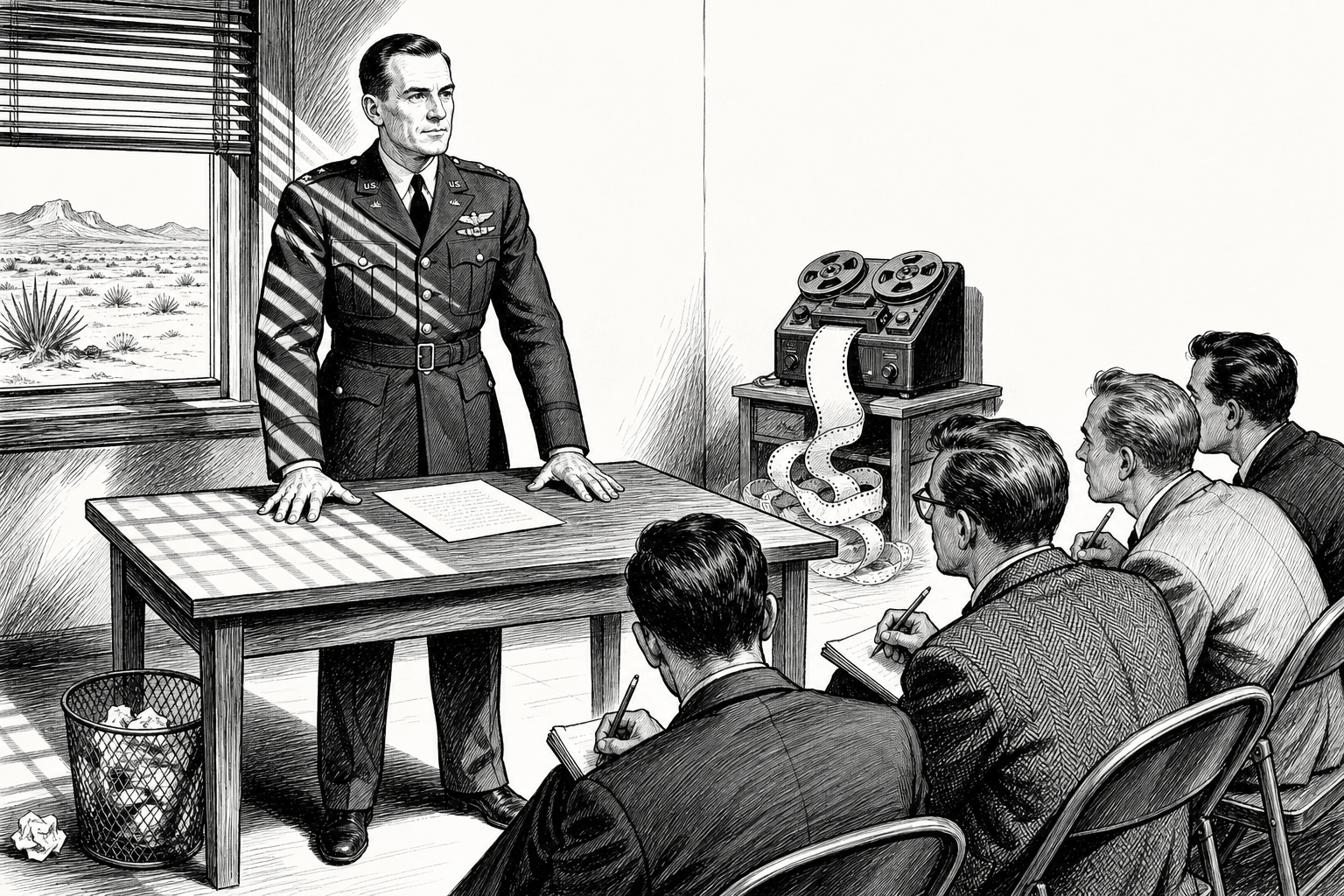
Black-and-white pen-and-ink editorial illustration. A U.S. Army Air Forces officer in 1947 dress uniform stands behind a plain wooden table in a sparse New Mexico pressroom, pressing a single typed sheet flat with both hands. Hard desert sunlight slices through venetian blinds, casting parallel stripes across his chest and the table surface. His expression is bureaucratically composed. Three or four civilian reporters lean forward in folding chairs across the room, pencils raised. A large reel-to-reel wire recorder sits in the corner; coiled teletype paper spills from beneath it. A metal wastebasket near the officer's feet holds a crumpled document. Strong diagonal shadows, confident hatching on the window trim and chair legs, generous white space in the upper right. No color, no gradients, no text.

The Army Air Forces press office at Roswell, New Mexico issued a statement on July 8, 1947, announcing that it had recovered a "flying disc" from a ranch outside town. The Roswell Daily Record ran it.1 That same day, the military walked it back.

That sequence — confident official announcement, then hasty denial — accomplished something neither step could have done alone. The original RAAF press release is what Britannica identifies as the first verified press event to anchor the UFO phenomenon.1 The retraction is what made it permanent. An institution that says nothing invites curiosity; an institution that says something and then unsays it invites everything else.

Seventy-nine years of mythology trace back not to whatever was actually in that New Mexico desert, but to the gap between two government statements. The military corrected the record. That correction became the proof.

Sources
  1. Today in History July 8: A Local Newspaper Kicks Off Roswell's UFO Mania britannica.com Jul 3, 2026

↑ Back to top

THE FUNNIES

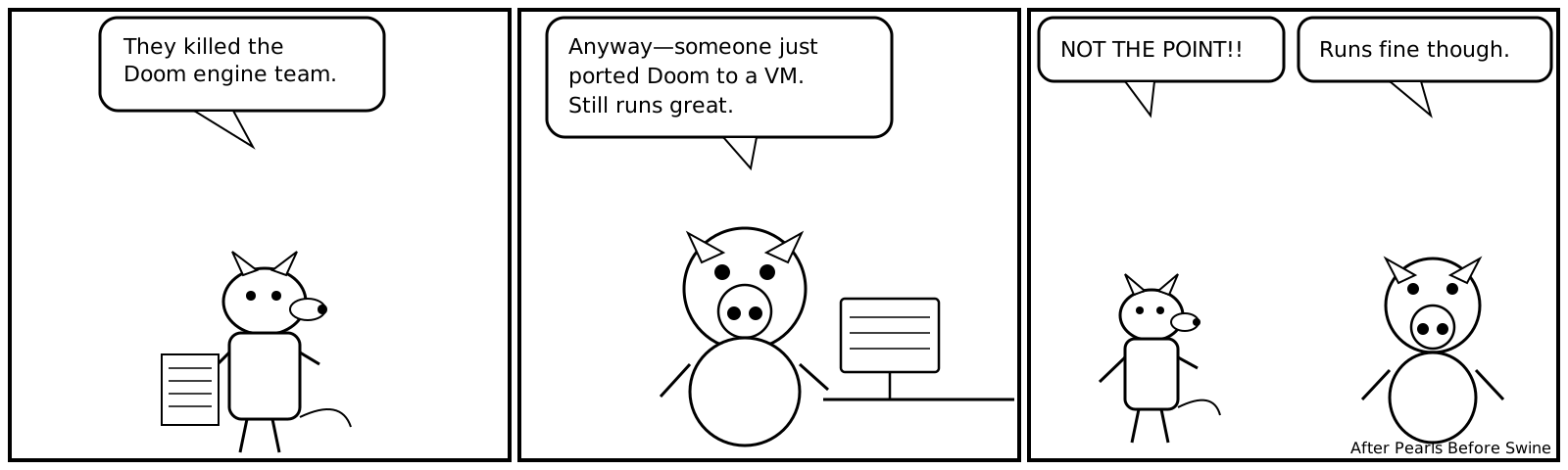
Doom Outlives Its Undertakers / The Retraction That Proved Everything

*After Pearls Before Swine — on Microsoft firing the legendary Doom engine team the same week a developer independently ported Doom to a homebrew VM and hit 86 FPS. After Calvin and Hobbes — on the Roswell retraction of July 8, 1947, the denial that became seventy-nine years of mythology.*

Hand-drawn parody comic strip
AI-rendered parody comic strip

↑ Back to top

ALSO NOTED

Also Noted

↑ Back to top

THE QUESTION

When the Clock Becomes the Argument

The strongest case for acting before the evidence is in has always been that someone else won't wait for it either.

As THE PELOTON reports today, ExoLactate's creator describes the substance's evidence base as "scarce at present" — mechanistic hypothesis, not clinical proof — while Tour de France riders are using it and one team has reportedly paid significantly for exclusive access.1 The competitive logic is blunt: if a rival has it and it works, the cost of waiting for evidence is a stage.

In Strasbourg on Tuesday, the European Parliament applied the same arithmetic. As THE LAB reports, an urgency motion passed 331-304 to advance a vote restoring Chat Control 1.0 — the voluntary message-scanning authorization Parliament had rejected by clear majority in both March and April, while IT security researchers documented "unacceptably high error rates" in the AI detection systems involved.2 The scientific objections did not change. The urgency framing did. The authorization window was closing, Parliament's summer recess was imminent, and acting now was presented as a precondition for the harder legislative fight later.

What competitive-pressure reasoning does in both cases is convert the evidentiary question into a timing question. Not: does the evidence support this? But: can we afford to wait until it does? When anyone with something to gain is already deploying, the answer is almost always no.

This is how the gap between "promising" and "proven" stays open — not because no one knows the evidence is thin, but because the structure of the situation makes that thinness operationally irrelevant. ExoLactate's inventor says so plainly. The MEPs who voted against restoration twice knew the error-rate data going into Tuesday's session. Neither set of doubts survives contact with the competitive clock. The logic that runs in a team car in the Pyrenees and in a parliamentary chamber in Strasbourg is, stripped to its mechanism, the same: the cost of waiting has been made to look larger than the cost of not knowing.

Sources
  1. Tour de France Riders Are Using a Secretive New Fueling Solution That Could Blow Endurance Racing Apart velo.outsideonline.com Jul 7, 2026
  2. Showdown in Strasbourg: The Unexpected Return of Chat Control 1.0 — Urgency Motion Passes 331-304 heise.de Jul 7, 2026

↑ Back to top

Investigator Report

Investigator report — 2026/07/08

Verdict

A strong edition that earns its punches: THE WORLD's Iran headline is genuinely breaking, THE QUESTION's cross-domain bridge between ExoLactate and Chat Control is the best structural-reasoning the paper has deployed in a while, and the Roswell archive piece is tight and well-chosen for the date. The run completed cleanly with one recoverable pipeline error (YAML apostrophe in the THE LONG READ headline). The main weaknesses are an over-rotated beat (second Epic/Sweeney piece in five days), a source that returned only an author bio rather than its article, and a daily-strip rendering defect that prints the kit label twice.


Frontpage

Reviewed both the local frontpage.html and the deployed frontpage.png (confirmed downloaded). The layout is clean and reads as a credible broadsheet. Visual hierarchy is clear: the 56px Iran headline commands the top row; the three-column main row flows THE LAB → THE QUESTION → THE PELOTON from left to right by priority. The Roswell illustration (pen-and-ink of the Army officer, venetian-blind shadow stripes across his chest) is the visual anchor of the bottom row and reads well at this size — it's one of the stronger lead images the paper has run.

One confirmed defect in the daily strip: the strip reads "72°F, cloudy, calm winds—full summer kit. · summer kit". The word "summer kit" appears twice — once inside the summary sentence and once as the separately rendered kit field. The meta-writer wrote a summary that ends with "full summer kit." and the frontpage template appends · <kit> unconditionally. Either the meta-writer should write a kit-agnostic summary (e.g., "72°F, cloudy, calm winds") or the template should suppress the kit field when it already appears verbatim in the summary.

No duplicate paragraphs or repeated headlines. All eight sections from content.json are accounted for in the layout: THE FUNNIES is correctly suppressed on the frontpage (frontpage_display: "skip"). No font shrinkage or clipping anomalies beyond the expected overflow-fade at each column's bottom edge.


Priority ranking

SectionPriorityLengthImageNotes
THE WORLD85836 wordsHeadline-only on front page; 3 world bullets + local + ON THE TRAIL
THE LAB80733 wordsTwo main stories + three brief items
THE QUESTION76323 wordsCross-domain bridge; in 75-94 "exceptional" band
THE PELOTON741,119 wordsTop of "50-74 solid" band; sprint day + 4 sub-stories
THE LONG READ62844 words14-day stale (Jun 24); exceeds 7-day recency cap
FROM THE ARCHIVE37140 wordsyes (lead)Under 45 priority cap; strong date-match
ALSO NOTED10521 words9 bullets
THE FUNNIES848 words (stub)noSVG in funnies.svg

The priority spread (85 to 37) is healthy — 48 points — and the art director respected the ordering: highest priority leads the world row, left-to-right within the main row follows descending priority. THE QUESTION at 76 (exceptional band) is defensible for a cross-domain bridge; THE PELOTON at 74 (top of "solid racing day") is correct for a sprint day. No priority inflation: the 95 band is empty, which is right for a sprint day and a secondary archive find. No compression: the gaps between sections are meaningful. The only question worth revisiting is whether THE QUESTION at 76 genuinely clears "exceptional" (75-94) when the bridge is clever but both source events are already fully covered in sibling sections — a 72 or 73 would have been more conservative.


Editorial reading

1. Daily-strip kit redundancy.

The meta.json summary reads "72°F, cloudy, calm winds—full summer kit." and the kit field separately reads "summer kit". The frontpage template renders both with a · separator, producing the visible "full summer kit. · summer kit" in the deployed PNG. The fix is either a meta-writer instruction to exclude kit from the summary (since the kit field is displayed separately), or a template-level deduplication check. This is a rendering defect that appears to every reader who opens the frontpage.

2. THE LONG READ is a second Epic/Sweeney piece in five days — and 14 days old.

The Tim Sweeney PC Gamer interview (June 24, 2026) appeared in today's THE LONG READ at priority 62 after "Built for the Hard Cases: Epic Bets a New Language on Game Development" ran in THE LONG READ on July 3 — five days ago. Both pieces are centered on Epic Games and Sweeney's vision. The recency cap is seven days with evergreen_ok: true as an exception, but this interview is 14 days old at publication. The evergreen_ok flag exists for timeless essays, not for a recent industry interview. More importantly, the RECENT EDITIONS dedup signal in recent_editions.md doesn't track THE LONG READ topic repeats by company — only by section headline — so the Epic repeat slipped through. The Sweeney interview is genuinely interesting, but a reader who just read the Jul 3 Epic/Unreal piece would reasonably feel the paper is over-rotating on one company.

3. Clyde Hill source returned an author bio, not the article.

pages/world/clyde-hill-budget.md is 309 bytes — the entire text is a Urbanist contributor bio ("Ryan Packer has written for The Urbanist since 2015..."). The article body never loaded. The world writer nonetheless reported specific figures: "municipal bankruptcy is projected by 2030" and "a 69% property tax hike as an emergency measure." Those numbers came from the article title in the research brief, not from the article text. The attribution is careful ("what The Urbanist describes as") but the specific figures are unverified against the article body. The writer made the right call citing it rather than inventing details, but the fact-checker had nothing but a title to work from for this claim. The Clyde Hill story is otherwise a good Eastside pick that most readers will not have seen.

4. THE LAB's idTech story relies on a single secondary aggregator.

The Xbox/idTech layoffs story — cited in both THE LAB and THE QUESTION as a significant event — is sourced exclusively from gamefromscratch.com (a small game-dev blog) with no independent confirmation from Kotaku, Eurogamer, IGN, or any major outlet. The claim "most or all of the developers working on idTech at id Software" is significant; so is "Michael Maynard, a more than 20-year id veteran, confirmed his departure via LinkedIn." The writer is correct to be cautious ("by multiple reports" is hedged language), but there is only one source listed, and it is a secondary aggregator. For a story about eliminating the team behind Doom and Quake, the paper would be on stronger ground with at least one primary or major independent source. This is the VENDOR-SOURCE RULE's spirit applied to secondary aggregation — not vendor content, but thin sourcing for a serious claim.

5. ALSO NOTED draws five of nine items from Wired.

The sweep section cites Wired as the source for: Meta/Instagram AI remixes, OpenAI's departing chief futurist, Waymo/teens, the JWST compound, and the DeepMind arms-race piece. That is five of nine bullets (56%) from a single outlet. The research pool was clearly broader — the researcher found stories from KIRO7, personal blogs, GitHub trending, OpenAI's own blog. ALSO NOTED is supposed to be a "catch-all for stories the other writers dropped" across the full digest; instead it reads like a Wired roundup with a few outliers. The Uniqlo bash easter egg and opendisplay GitHub item are the right texture for this section; the Wired run is not.

6. Race calendar uses unexplained "DSSK" abbreviation.

THE PELOTON's "On the Road Ahead" table lists "DSSK — San Sebastián" for August 1. "DSSK" is the abbreviation for Donostia-San Sebastián Klasikoa but is not explained anywhere in the article or table. A reader unfamiliar with the UCI calendar would have no idea what it refers to. The entry should read "Clásica de San Sebastián" (its common English name) or at minimum "Donostia-San Sebastián Klasikoa (DSSK)."


Pipeline observations

YAML apostrophe broke assembly; orchestrator manually patched.

When assemble_content.py ran on the completed section files, it threw a YAML parse error on section-longread.md because the writer used single-quoted YAML for the headline containing "Industry's" — the apostrophe in "Industry's" terminated the single-quoted string prematurely. The orchestrator caught the error at line 363 of the session, read the file, patched it with an Edit call, and re-ran assembly. Recovery was clean and cost about 20 seconds. However, this is a recurring failure mode: any headline containing an apostrophe in single-quoted YAML will break assembly. The writer agent prompt should explicitly instruct double-quoted YAML for all headline: fields, or assemble_content.py should pre-process the frontmatter with a YAML-escape pass before parsing.

Art Director: 27-minute critical path.

The Art Director ran from 13:26:24 to 13:53:53 UTC — 1648 seconds (27.5 minutes). It made three sequential API calls to generate the frontpage.html (gaps of approximately 9 minutes, 7.6 minutes, and 8.8 minutes between turns), producing 13 KB of dense HTML from frontpage.json. This is not a failure — the HTML is complete and correct — but it is the single largest bottleneck in the run. Every other agent completes well before this; the Art Director holds the final commit for 27 minutes. The generated HTML includes the full text of all articles, which is why it takes so long; an approach that generates the HTML template separately from the article text might reduce generation cost per turn.

OpenAI funnies render timed out and ran in background.

The orchestrator at session line 315 notes: "Render timed out in 2m — running it in background with extended timeout." This refers to the OpenAI comic image generation (funnies-openai.png), not the SVG comic strip. The render eventually completed successfully (funnies-openai.png is present at 7,055 bytes). No reader impact, but the initial timeout added latency before Step 4 could begin.

Clyde Hill fetch: article text unavailable, author bio returned.

fetch_results.json shows the Clyde Hill Urbanist URL fetched successfully (bytes: 309, ok: true) but the resulting pages/world/clyde-hill-budget.md contains only a contributor bio. The fetch pipeline reported success on what was effectively a 309-byte stub. The fact-checker for THE WORLD had access only to the article title for verifying the specific bankruptcy and tax-hike figures. This is an unrecovered thin-source situation: the fetch did not fail, so no retry was triggered, but the returned content was not the article. The researcher or fact-checker could check for stub-sized fetches (under ~500 bytes for prose pages) as a signal to flag.

Starting commit: same-day adjacent, no gap.

The run started on commit 39eac97 (Investigator: 2026-07-07, 2026-07-07T14:02:33Z) — yesterday's investigator commit, which was the tip of main at run time. No intervening commits to dispatch.md or agent files were missed.

Five KIRO7 local items dropped because not fetched.

Three KIRO7 items (FIFA viewership record, I-5 Revive return, Kent fireworks injuries) and two other items appear in ALSO NOTED's dropped array with "source unverifiable (not fetched — from feed digest only)." These stories were seen by the researcher in the feed digest but not fetched for the pages directory. The Kent fireworks injuries story in particular — "3 Critically Injured in Kent Fireworks Explosion" — is the kind of local story the reader cares about (Seattle/Eastside beat). It is unclear whether the fetcher skipped these by design or they were missed. A fetch retry against these URLs would be cheap.


Trace highlights

Orchestrator cost $3.67 of $11.58 total (31.6%).

The orchestrator's 410-message session cost more than the researcher ($1.97) and nearly as much as all writers combined. This reflects the overhead of coordinating 20 parallel agents, reading their outputs, normalizing priorities, fixing the YAML parse error, and managing retries. It is not alarming for a run this complex, but if this fraction creeps above 35% it would suggest the orchestrator is doing too much content work rather than coordination work.

Researcher ($1.97) nearly as expensive as all writers combined.

The seven content writers (THE WORLD through ALSO NOTED) together cost approximately $2.37. The researcher alone cost $1.97. This is expected — the researcher reads and summarizes many more sources than any individual writer — but it confirms that source brevity at the researcher stage (tight briefs, fewer redundant sources per section) would materially reduce total cost.

THE WORLD writer cost $0.66 for short bullet output.

The WORLD writer produced roughly 120 words of world bullets and three short local sentences, but cost $0.66 — the highest among individual writers. The WTA trip reports source was 76KB of HTML, which dominated the context window. The trip report brief alone likely accounted for the bulk of the cache reads (168K cache 5m tokens). The ON THE TRAIL subsection is the right editorial choice for this reader, but the source fetch is the single most expensive page in the pipeline by token cost.

FC: THE WORLD at 233 output tokens — most rewrites of any fact-checker.

Most fact-checkers output 25-58 tokens (a brief summary of what was verified/unchanged). FC: THE WORLD generated 233 output tokens, suggesting material changes to the WORLD draft. This correlates with the Clyde Hill thin source — the fact-checker was likely flagging or rewording the unverifiable claim — and possibly with the Iran bullet structure. The high output is a signal that the WORLD writer's draft was under-sourced in ways the fact-checker had to address.

Trace summary

Dispatch 2026-07-08 (model: claude-sonnet-4-6)

AgentDurInputOutputCache ReadCache 5mCache 1hCost
Scout327s74821534179706770410$ 0.57
Researcher2023s6332342722027942549210$ 1.97
THE WORLD578s625853761689560$ 0.66
THE PELOTON456s10126153635878610$ 0.38
THE LAB290s733107925477540$ 0.21
THE LONG READ136s62553931219900$ 0.10
FROM THE ARCHIVE126s73389402229560$ 0.11
FC: THE LONG READ181s733106104417240$ 0.19
FC: FROM THE ARCHIVE286s91158188531348860$ 0.19
Meta-Writer65s62552418239330$ 0.11
Illustrator51s2251372000$ 0.06
FC: THE LAB243s842163379422860$ 0.21
FC: THE PELOTON383s951215920579380$ 0.28
FC: THE WORLD403s10233308049703260$ 0.36
THE QUESTION342s73473345772670$ 0.31
FC: THE QUESTION113s62569083261120$ 0.12
ALSO NOTED352s1062309705809960$ 0.40
Draw today's TWO parody comic strips for859s121362063321011650$ 0.44
FC: ALSO NOTED394s168657278304600480$ 0.31
Funnies (OpenAI)136s3705488000$ 0.22
Art Director1648s113511958949650$ 0.36
Update story threads for today's edition389s5177222940200$ 0.36
Orchestrator1822767486620910109198$ 3.67
TOTAL1161674352134252101487145109198$11.58

Suggestions for next edition

1. Instruct the meta-writer to write a kit-agnostic daily summary.

The summary field should describe conditions only ("72°F, cloudy, calm winds") and leave the kit to the kit field. The frontpage strip already renders both; doubling up reads as a bug. A one-line addition to the meta-writer prompt would fix this persistently.

2. Add double-quote enforcement for YAML headlines.

The writer agents should be explicitly told to wrap all headline: values in double quotes (not single quotes) so apostrophes in titles do not break assemble_content.py. Alternatively, assemble_content.py could fall back to a regex-based frontmatter parser when PyYAML fails on the headline field. The current recover-and-patch approach works but costs the orchestrator an extra tool call and some seconds.

3. Add a stub-size check to the fetch pipeline.

Pages that return under 500 bytes of body text — like the Clyde Hill Urbanist fetch — should be flagged in fetch_results.json or research.md with a note such as "WARN: 309 bytes, possible redirect/stub." This would alert the writer and fact-checker that the source had no usable content, rather than silently treating a 309-byte author bio as a successful page fetch.

4. Add a per-section company/person dedup signal to the researcher brief.

The Epic/Sweeney over-rotation (Jul 3 and Jul 8) happened because recent_editions.md deduplicates by section headline, not by named company or author. A note in the researcher brief — "THE LONG READ ran an Epic Games story 5 days ago (Jul 3); avoid repeating the same company focus unless there is a materially new development" — would catch this pattern before the writer commits to a stale 14-day interview.