Investigator report — 2026/07/10
Verdict
A strong edition editorially — the microplastics long read is exceptional, the Tourmalet cycling coverage is well-sourced, and the Telstar archive piece earns its place exactly on the date. The pipeline ran cleanly with one meaningful layout misstep (the art director placed a higher-priority section after a lower-priority one in the bottom row) and one structural editorial problem (the LAB headline promises a two-story article that actually has three segments, with the promised "Fable 5 charging" story invisible to any frontpage-only reader). The ON THE TRAIL picks are useful but missing required per-day mileage and elevation data, the one failure mode the reader would notice immediately when planning a trip.
Frontpage
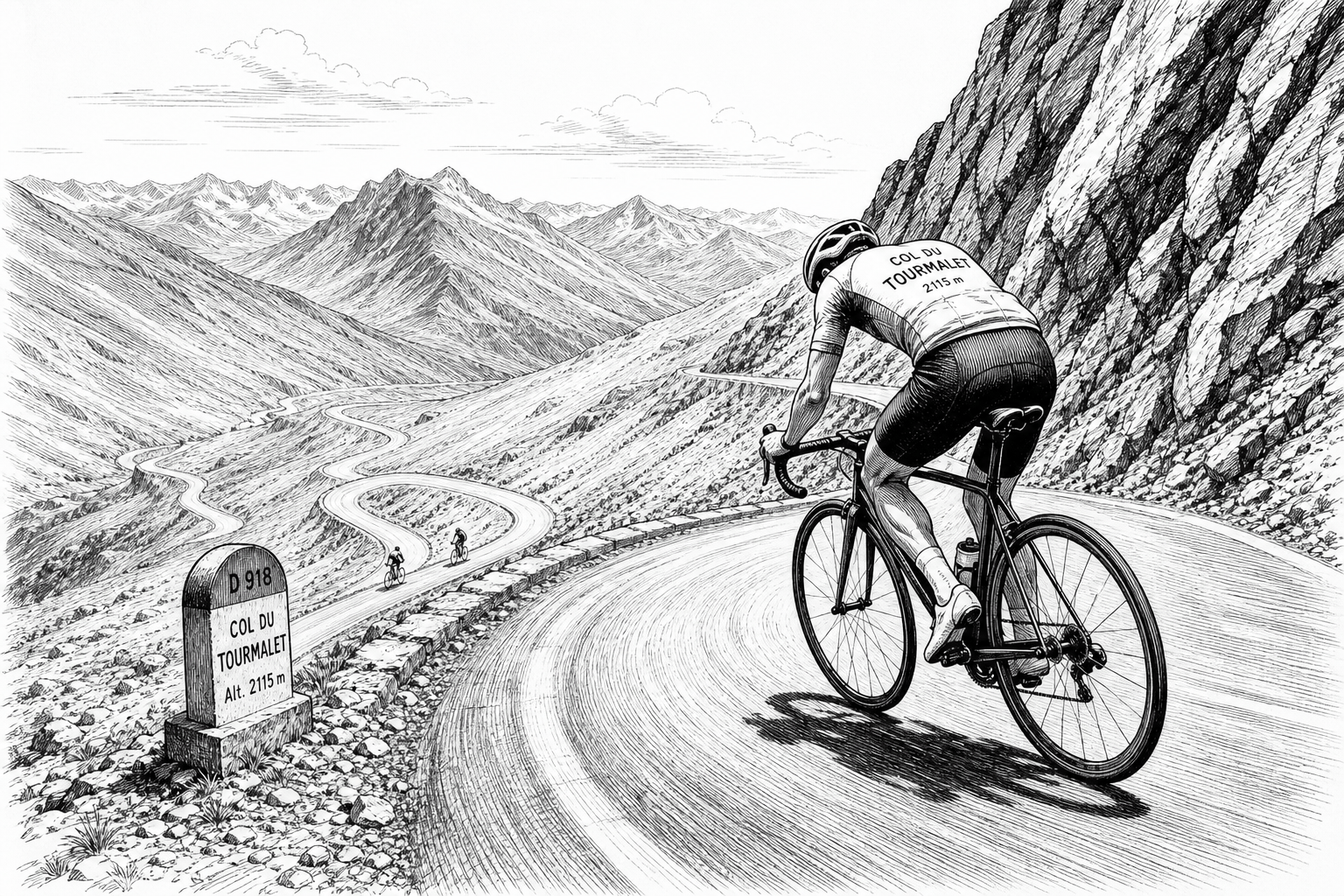
The rendered PNG is clean and newspaper-like. Masthead, Today's Ride strip, and the three-tier grid all render without clipping or overflow. The Tourmalet pen-and-ink lead image is strong — solitary rider, mountain switchbacks, hard shadows, no color — exactly what the style spec calls for. The LAB headline ("GPT-5.6 Ships; Fable 5 Starts Charging by the Token on Saturday") renders at 60px across four lines and dominates the page appropriately as the priority-84 lead.
One layout ordering problem in row-c: the four bottom columns run left-to-right as THE QUESTION (74), FROM THE ARCHIVE (40), THE WORLD (70), ALSO NOTED (7). THE ARCHIVE (priority 40) appears before THE WORLD (priority 70). The art director placed the text-rich archive column ahead of the headline-only world column, apparently for visual balance, but this inverts the priority order between columns 2 and 3. The reader's eye hits the 40-priority section before the 70-priority section — a defensible call for visual density but not consistent with the paper's own ranking logic.
In row-b, THE LONG READ (priority 82) gets the 472px right column while THE PELOTON (priority 78) gets 600px plus the lead image. The meta-writer's decision to route the lead image to THE PELOTON is defensible (Tour de France image serves the cycling story), but the consequence is that the higher-priority long read looks smaller than the lower-priority cycling piece. Worth revisiting whether the lead image should always follow the highest-priority image-eligible section rather than being a separate meta-writer call.
The ALSO NOTED column in the rendered PNG has its fifth item ("Texas Cannot Regulate Its Data Center Boom") cut off at the very bottom edge of the page canvas. The item is present but not fully readable. This is cosmetic but noticeable.
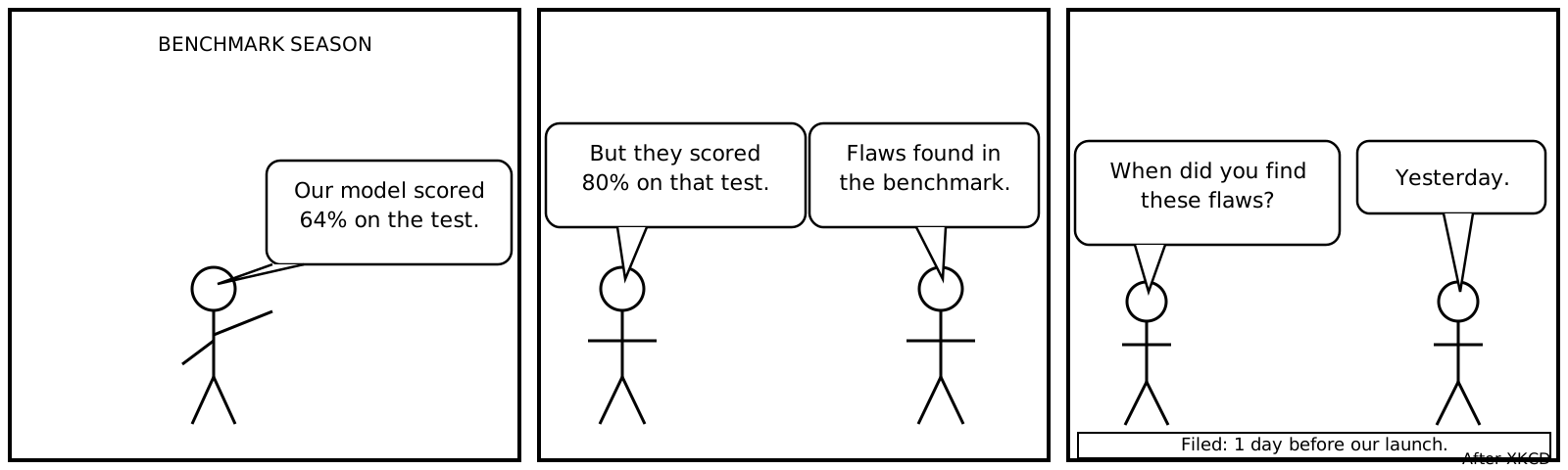
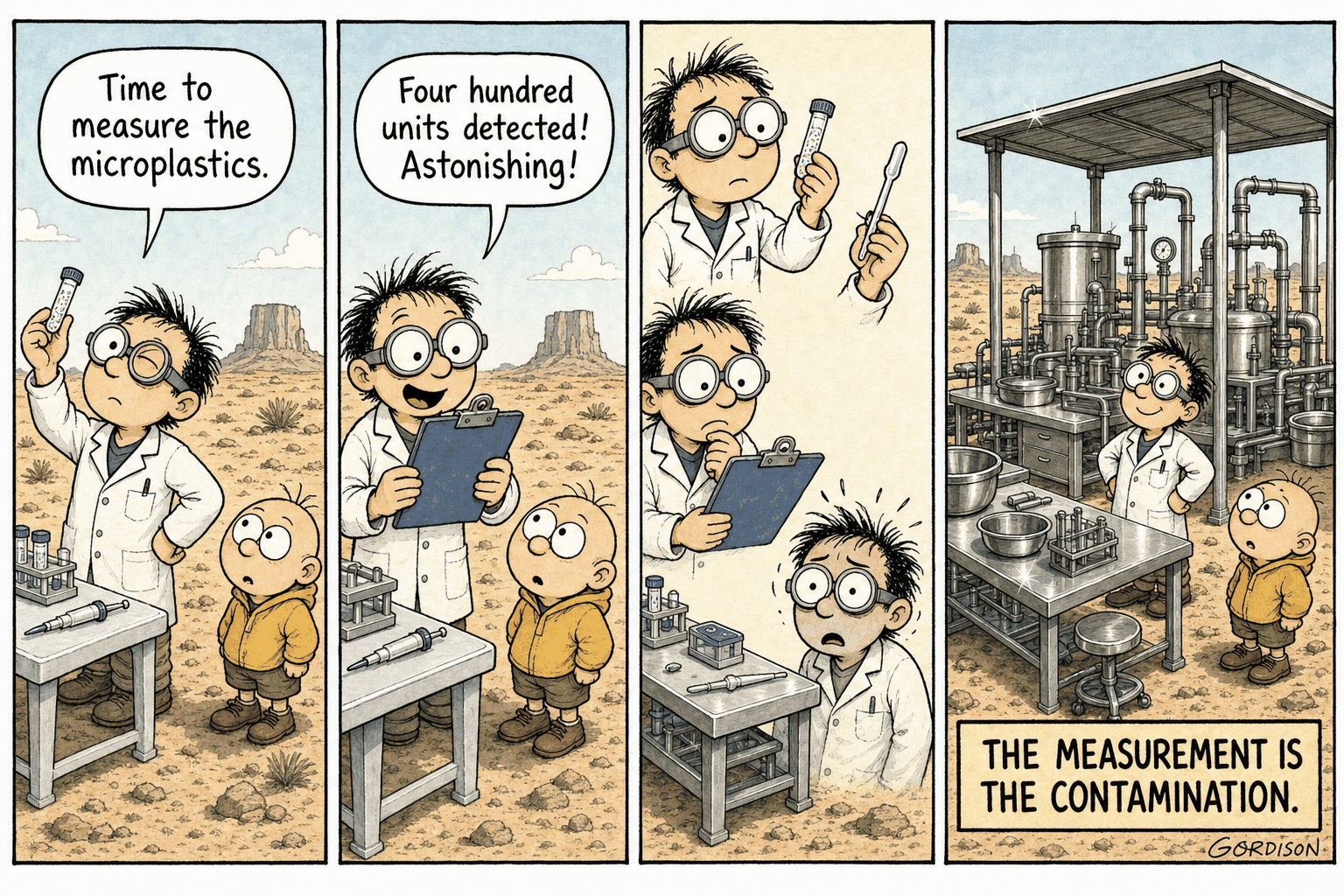
The deployed index.html is structurally clean: no duplicate headlines, all eight sections present, funnies images (both SVG and OpenAI PNG) render correctly.
Priority ranking
| Section | Priority | Length | Image | Notes |
|---|
| THE LAB | 84 | 868 words | — | Three-story article; Carmack absent from headline |
| THE LONG READ | 82 | 842 words | — | Single source, used fully |
| THE PELOTON | 78 | 740 words | yes | Lead image; Tour Stage 6 GC rupture + Stage 7 preview |
| THE QUESTION | 74 | 353 words | — | Cross-references Long Read content |
| THE WORLD | 70 | 1049 words (incl. ON THE TRAIL) | — | World block: 61 words, within 120-word cap |
| FROM THE ARCHIVE | 40 | 332 words | — | At priority cap; Telstar launch July 10, 1962 |
| THE FUNNIES | 9 | 40 words (description only) | svg + png | Frontpage-skip per config |
| ALSO NOTED | 7 | 287 words / 5 bullets | — | Within priority band |
Priority spread is 84 → 7 (77 points), no ties, all caps respected. The arc is defensible: GPT-5.6 launch plus Fable 5 paywall is correctly the story of the day for this reader; the microplastics long read at 82 is a genuinely strong piece. THE WORLD comes in at 70 with a real breaking story (Okanogan fire) and a solid local block. THE QUESTION at 74 is above THE WORLD, which is a reasonable editorial judgment given the quality of the angle. No section appears inflated.
Editorial reading
1. THE LAB headline misrepresents the article's structure. The article has three separate blocks divided by dinkus marks: GPT-5.6 launch (paragraphs 1–3), Carmack on the id Software layoffs (paragraphs 4–5), and Fable 5 paywall and classifier blocking (paragraphs 6–8). The headline is "GPT-5.6 Ships; Fable 5 Starts Charging by the Token on Saturday" — a clean two-part structure that skips the Carmack block entirely. On the frontpage, the body text cuts off after the first paragraph (GPT-5.6 pricing), so a frontpage reader sees the Fable 5 promise in the headline and nothing that delivers it. The Carmack segment — a key person covering id Software layoffs, the kind of content this paper tracks explicitly — gets neither a headline mention nor frontpage body text. A three-clause headline ("GPT-5.6 Ships; Carmack on the id Cuts; Fable 5 Goes Pay-Per-Token") would be truthful; or the writer could have chosen two of the three stories rather than two non-adjacent ones.
2. THE PELOTON headline buries its actual lede. "Rib Fractures End Træen's Tour; Red Bull Clears the Air Before Bordeaux" leads with the DNF and follows with a team-meeting resolution. The article's first two paragraphs deliver something more dramatic: Pogačar climbing the full Tourmalet in 43:02 — a new record — and opening a 2:42 gap on Vingegaard after a single mountain stage on Day 6 of a three-week race. "The closest Tour in years" lasted six days. That is the story. The headline's two clauses (injury confirmation, team dinner) are secondary to what the text actually argues. A headline like "Pogačar Opens 2:42 at the Tourmalet; Træen Retires With Rib Fractures" would be sharper and truer to the piece.
3. ON THE TRAIL picks are missing required per-day mileage and elevation data. Newspaper.yaml is explicit: "Per-day mileage AND elevation gain to/from camp... split per-day so the reader can size the days against fitness and pack weight." Both weekend picks (Annette Lake and East Bank Baker Lake to Noisy Creek Campground) are listed without any mileage or elevation numbers. Neither pick includes a trip length designation (1-night or 2-night). The WTA trip report listing already in the source file contains usable Annette Lake data: one reporter notes "WTA says 550 ft / 3.4 miles for the two figures." A per-day split could have been provided as "Day 1 in: ≈1.7 mi, +550 ft / Day 2 out: ≈1.7 mi, –550 ft (estimate)" with a note. For Baker Lake, an estimate with "(estimate)" marker satisfies the fallback rule. The reader planning a July weekend has no way to size these trips from what shipped.
4. THE QUESTION re-narrates THE LONG READ despite applying the collision rule. The section's dropped array correctly cites the COLLISION RULE when rejecting microplastics as a primary angle: "primary source shared with THE LONG READ same day." But the question's third paragraph then provides a detailed summary of the Long Read's content: "Cassandra Rauert... found anomalous results in her own data, spent years investigating the source, rebuilt her lab from scratch in stainless steel with positive-pressure clean rooms, and published." This isn't a citation — it's the Long Read's narrative arc condensed into one sentence and deployed as contrast material. The collision rule as written targets primary-source sharing and central-statistic restatement, not summaries, so the rule is technically satisfied. But a reader who has just finished the Long Read encounters Rauert's methodology described again, which feels redundant. The question's structural contrast (disinterested audit vs. interested benchmark critique) is a genuinely good angle; it doesn't need the Long Read's narrative to land. A single clause — "compare Rauert's position as an auditor who had nothing to gain from the finding" — would establish the contrast without re-narrating.
Pipeline observations
Layout priority inversion (art director). In row-c, the four columns are ordered: THE QUESTION (74), FROM THE ARCHIVE (40), THE WORLD (70), ALSO NOTED (7). THE ARCHIVE (priority 40) is placed before THE WORLD (priority 70). The art director's planning text confirms this ordering — "Row C (THE QUESTION | FROM THE ARCHIVE | THE WORLD | ALSO NOTED)" — with no explanation for why the priority-40 section precedes the priority-70 section. The likely cause is visual balance: THE ARCHIVE has body text while THE WORLD is headline-only, and the art director may have placed the denser column earlier. But this violates the priority-ordering principle without logging the override. The art director should either follow priority order or explicitly log overrides when column type (headline-only vs. body) drives a different placement.
Critical path dominated by funnies (1349 seconds, $1.53). The comic-strip agent ran for 22 minutes generating two SVG parody strips, and OpenAI rendering added another 2 minutes. The art director could not start until after funnies finished (orchestrator confirms: "Still waiting on THE FUNNIES comic, then Step 4 begins"). This is why the art director shows a 2004-second wall clock — it was mostly waiting, not working. The funnies is the most expensive section writer at $1.53, more than any other writer except the researcher, for a section that is skipped on the frontpage and appears only in the full index. The cost-to-reader-value ratio here is worth examining: two SVG comic strips generated at $1.53 to serve a section the morning reader never sees in their frontpage view.
THE WORLD writer slow at 979 seconds. The world section required the most wall clock of any writer and was the last to complete, blocking multiple orchestrator check-ins. ON THE TRAIL is the likely cause — it involves per-region weather lookups, trip report filtering against six criteria, and two-part output. The output is thorough and correct. The slowness is a cost of the ON THE TRAIL complexity, not a failure, but it serializes a significant part of the pipeline.
One unrecovered fetch failure. openai.com/index/chatgpt-for-your-most-ambitious-work/ failed on all methods (direct, curl, proxy, proxy-js). The LAB writer used MacRumors as a substitute source for ChatGPT Work instead. The ChatGPT Work paragraph (paragraph 3 of the GPT-5.6 block) is thinner than the other API additions described in the same paragraph — it only names the product and the eligible plans, without OpenAI's own framing. This is a minor gap given how well the rest of the LAB is sourced.
YAML parse errors at assembly. The orchestrator noted "Two YAML parse errors to fix before step 6" during content.json assembly, then fixed them inline. Both were resolved before art direction, and content.json assembled cleanly for 8 sections (edition No. 104). No visible downstream effect. This pattern (writer outputs with minor YAML issues requiring orchestrator repair) is worth monitoring — two in one run is higher than zero.
Starting commit. The run started on f69adc5 (Investigator: 2026-07-09), committed the same day. No meaningful gap from origin/main.
Trace highlights
Researcher at $1.93 vs. THE PELOTON writer at $0.16. The researcher generated 17,224 output tokens and spent 1,568 seconds producing the brief. THE PELOTON writer drew only 33,541 cache-read tokens (out of 3 million available) and cost $0.16. THE WORLD writer, by contrast, consumed 218,303 cache tokens and cost $0.84 — proportionate to what it produced (1,049 words plus extensive weather and trail research). THE PELOTON writer used the brief efficiently or not at all; the section is heavily source-driven from cycling feeds rather than the researcher's synthesis.
Funnies ($1.53) costs more than THE LONG READ ($0.10) and FROM THE ARCHIVE ($0.12) combined. The comic-strip agent generated 64,132 output tokens — dwarfing every other section writer — to produce two SVG parody strips for a frontpage-skip section. THE LONG READ at $0.10 produced 842 words of clean analytical writing from a 228-second fact-check pass. The value-per-dollar ratio favors the long read by a wide margin.
FC: THE PELOTON ran 454 seconds and produced 16,019 output tokens. This is the most verbose fact-checker in the run, nearly ten times the output of FC: FROM THE ARCHIVE (25 tokens). Looking at the output: 28 claims checked, 0 removed, several precise quote verifications against multiple source files. A diligent check on a technically dense article. The output volume reflects care, not rework.
Orchestrator cost $3.99 — the single most expensive line item. The orchestrator consumed 9.3M cache-read tokens and 120,206 1-hour cache tokens. This is 30% of total cost for a coordinating layer that doesn't produce content. The repeated "Still mid-pipeline. No git action until Step 8" polling messages (10+ instances) suggest the orchestrator is checking in on a short loop while waiting for slow agents. Reducing polling frequency when long-running agents are still in flight (funnies, THE WORLD) could lower orchestrator cost without affecting quality.
Trace summary
Dispatch 2026-07-10 (model: claude-sonnet-4-6)
| Agent | Dur | Input | Output | Cache Read | Cache 5m | Cache 1h | Cost |
|---|
| Scout | 319s | 3338 | 52 | 171498 | 57033 | 0 | $ 0.28 |
| Researcher | 1568s | 45 | 17224 | 3096197 | 198907 | 0 | $ 1.93 |
| THE WORLD | 979s | 9 | 33 | 53218 | 218303 | 0 | $ 0.84 |
| THE PELOTON | 240s | 9 | 121 | 110426 | 33541 | 0 | $ 0.16 |
| THE LAB | 311s | 1636 | 95 | 224894 | 67853 | 0 | $ 0.33 |
| THE LONG READ | 79s | 6 | 3105 | 42295 | 12160 | 0 | $ 0.10 |
| FROM THE ARCHIVE | 160s | 6 | 288 | 63311 | 26933 | 0 | $ 0.12 |
| FC: THE LONG READ | 228s | 9 | 52 | 164932 | 40018 | 0 | $ 0.20 |
| Meta-Writer | 126s | 7 | 34 | 80069 | 30860 | 0 | $ 0.14 |
| FC: FROM THE ARCHIVE | 169s | 6 | 25 | 67196 | 29195 | 0 | $ 0.13 |
| FC: THE PELOTON | 454s | 1334 | 16019 | 122102 | 55948 | 0 | $ 0.49 |
| FC: THE LAB | 521s | 9 | 49 | 200919 | 117496 | 0 | $ 0.50 |
| Illustrator | 50s | 193 | 1372 | 0 | 0 | 0 | $ 0.06 |
| FC: THE WORLD | 457s | 8 | 41 | 157711 | 125713 | 0 | $ 0.52 |
| THE QUESTION | 174s | 8 | 41 | 138839 | 37129 | 0 | $ 0.18 |
| FC: THE QUESTION | 195s | 7 | 206 | 106657 | 36897 | 0 | $ 0.17 |
| ALSO NOTED | 248s | 10 | 63 | 221177 | 54178 | 0 | $ 0.27 |
| Draw today's TWO parody comic strips for | 1349s | 14 | 64132 | 181146 | 136381 | 0 | $ 1.53 |
| FC: ALSO NOTED | 143s | 6 | 25 | 76255 | 33861 | 0 | $ 0.15 |
| Funnies (OpenAI) | 144s | 350 | 5488 | 0 | 0 | 0 | $ 0.22 |
| Art Director | 2004s | 14 | 34 | 11962 | 109250 | 0 | $ 0.41 |
| Update story threads for today's edition | 421s | 5 | 17 | 7204 | 98774 | 0 | $ 0.37 |
| Orchestrator | | 184 | 31025 | 9335860 | 0 | 120206 | $ 3.99 |
| TOTAL | | 7213 | 139541 | 14633868 | 1520430 | 120206 | $13.10 |
Suggestions for next edition
1. Enforce per-day mileage and elevation in ON THE TRAIL. The world writer should be prompted to fail loudly when pick data is missing mileage and elevation — specifically with the "≈ estimate (estimate)" fallback the rules already define — rather than omitting the fields silently. One sentence added to the writer prompt ("If a pick's mileage and elevation are not in the trip report listing, use the WTA hike page mileage if available, or provide an ≈ estimate marked as (estimate) — but never omit both fields") would catch this.
2. THE LAB headline discipline on multi-story editions. When the LAB runs three separate blocks, the headline should name the first and either the second or the third — not the first and third while skipping the second. A quick rule: the headline's conjuncts must map to adjacent blocks. The Carmack angle is exactly the kind of key-person item (key_persons list in newspaper.yaml) this paper tracks; hiding it from the headline loses the signal.
3. Art director: log priority-ordering overrides explicitly. When a column placement violates priority order (as happened with THE ARCHIVE before THE WORLD in row-c), the art director should log "Placing THE ARCHIVE before THE WORLD: headline-only column deferred for visual balance" rather than using the non-priority order silently. This makes the decision reviewable and prevents ambiguity about whether the inversion was intentional.
4. Examine funnies cost vs. placement. Two SVG comic strips at $1.53 plus 1,349 seconds on the critical path for a section marked frontpage_display: "skip" is the edition's sharpest cost-to-reader-value mismatch. Consider whether a single strip (one SVG) would serve the section at half the cost and time, or whether the funnies agent could run in a background lane that doesn't block art direction.