Investigator report — 2026/07/17
Verdict
A strong edition led by genuinely excellent longform — the Turner/Google essay is specific, structured, and reads like a researcher who spent five months doing things, not a summary of a summary. The Tour de France coverage is clean. The archive piece is charming. What brings the edition down are two converging failures: the OpenAI billing cap wiped out the lead illustration entirely, and THE LAB section sourced both stories through a single blogger, producing a section with zero independent source diversity. The question angle is competent but repeats a structural pattern the paper has overused this month.
Frontpage
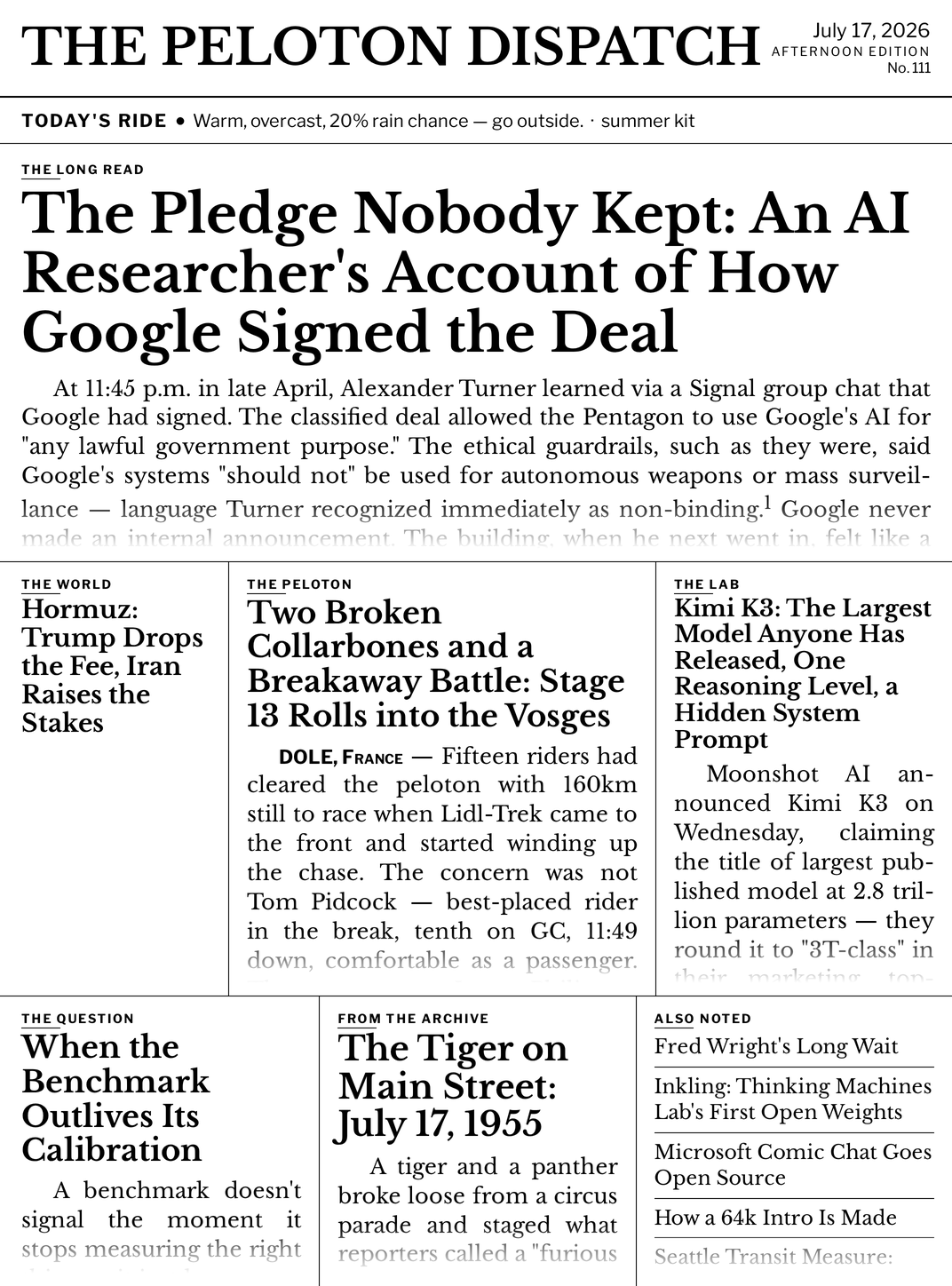
The deployed PNG (read via pd.thep3000.com) renders as a credible newspaper front page. Visual hierarchy is clear: THE LONG READ leads with a 60px headline at full width; THE WORLD | THE PELOTON | THE LAB fill the three-column row 2; THE QUESTION | FROM THE ARCHIVE | ALSO NOTED fill row 3. Priority ordering is correct throughout — highest-priority section leads, lowest is in the margin.
Two issues. First, there is no lead image. meta.json specifies lead_image_section: "FROM THE ARCHIVE" and FROM THE ARCHIVE carries image: true, but no lead_image.png exists in the edition directory. The OpenAI billing cap blocked its generation (see Pipeline). The lead block is text-only. For an edition with a strong visual prompt (a tiger and a panther fighting on Disneyland's Main Street), the absence is felt.
Second, THE LAB headline — "Kimi K3: The Largest Model Anyone Has Released, One Reasoning Level, a Hidden System Prompt" — wraps to six lines in the narrow right column, consuming most of that column's visible space and leaving almost no body text before the fade. A headline that long is functional in the full article page, but it was the wrong choice for the frontpage slot. The art director did not flag it.
No duplicate sections, no missing sections, no clipped headlines, no broken columns.
Priority ranking
| Section | Priority | Length | Image | Notes |
|---|
| THE LONG READ | 87 | ~1,150 words | intended, missing | Turner/Google essay |
| THE WORLD | 79 | ~110w body + travel | — | Iran, World Cup, local, travel |
| THE PELOTON | 74 | ~770 words | — | Stage 13, in progress at filing |
| THE LAB | 73 | ~360 words | — | Kimi K3 + Firefox-WASM |
| THE QUESTION | 68 | ~430 words | — | Benchmark decoupling |
| FROM THE ARCHIVE | 35 | ~200 words | intended, missing | Disneyland Black Sunday |
| ALSO NOTED | 9 | 5 bullets | — | Cycling, tech, transit |
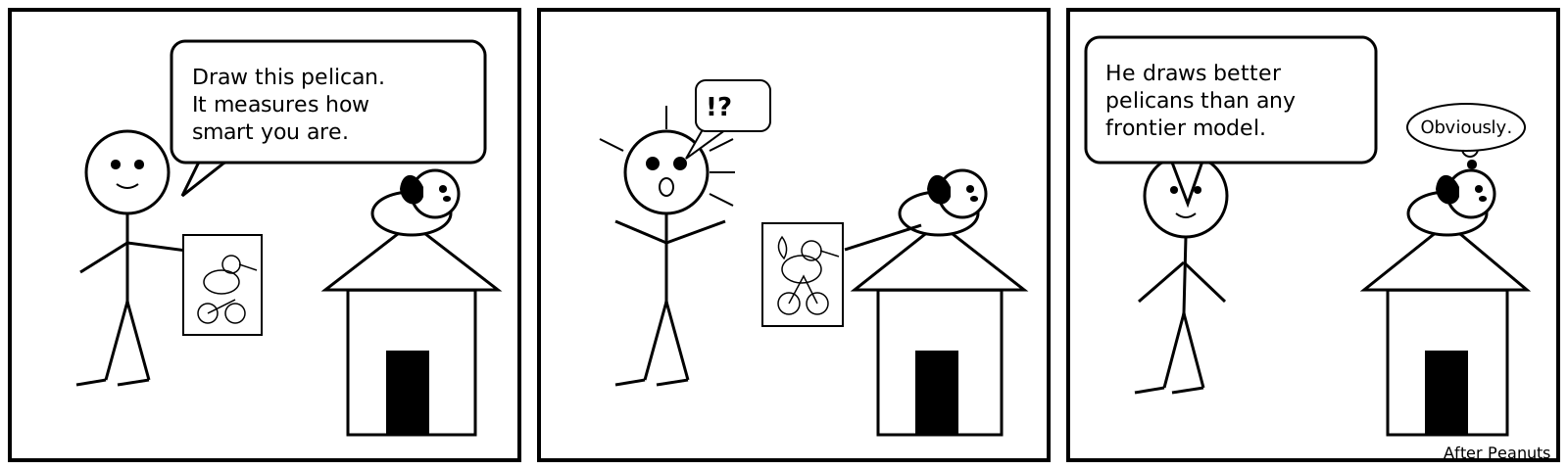
| THE FUNNIES | 7 | SVG comic | — | Peanuts/Far Side parody |
Ranking is defensible. THE LONG READ at 87 is earned — a first-person, date-stamped narrative of an AI ethics campaign with named sources and documented meetings is genuinely significant. THE WORLD at 79 is reasonable for an ongoing Iran escalation with a Snoqualmie wildfire and a ballot initiative in the local block. THE PELOTON at 74 (sub-"major stage win") correctly reflects a stage still in progress at filing. THE LAB at 73 is slightly low for what is framed as the world's largest published model, but Willison's piece is analysis rather than original reporting, which the writer seems to have registered implicitly. FROM THE ARCHIVE at 35 is correct — it is capped at 45, and Disneyland's opening day is a fun find rather than a consequential one.
The art director respected the priority order exactly. No misranked section in the layout.
Editorial reading
THE LAB: Both stories sourced through a single blogger. Kimi K3 and Firefox-in-WASM both cite only Simon Willison (simonwillison.net). Willison is independent and technically credible, but the section has zero source diversity this edition: no direct Moonshot announcement, no independent evaluator quoted by name, no primary GitHub analysis beyond what Willison ran. The section config says to check Willison daily — on a day when he happened to write two substantive things, the section mechanically became "what Simon noticed this week." The Inkling model release (Thinking Machines Lab, 975B total / 41B active MoE, 77.6% SWE-Bench Verified, Mira Murati's company) was punted to ALSO NOTED. Inkling is arguably more original than a benchmark run on an announced model — it has no Willison writeup, which likely explains why it landed lower. The section should push back on that gravity.
THE QUESTION: Structural pattern overuse. "When the Benchmark Outlives Its Calibration" is the fourth variation on "how do you know when your measurement framework has stopped tracking what you think it tracks?" that this paper has run in recent issues — Jul 10 "When the Lab Grades Its Own Test" (AI benchmarks self-referential), Jul 11 "When the Distribution Shifts" (testing frameworks diverging from reality), and today. Both prior instances are outside the 3-entry recency window, so the writer technically passed the angle-recency check. But the structural repetition is real and cumulative, and a careful reader has noticed. The collision rule blocked the most obvious alternative (the Turner essay's "principles vs. judgment calls" structure), but the Three Queens Fire east of Snoqualmie Pass — a wildfire burning in a reader-proximate zone the day before a good weekend forecast — offered a locally urgent angle this edition never considered for THE QUESTION.
ALSO NOTED: Transit item buries the only missing fact. The Seattle Transit Measure bullet reads: "voted on by the Select Committee Thursday ahead of a full council vote July 21." The world writer correctly dropped the transit story because the "Jul 16 Select Committee vote outcome not in sources; source predates the vote." ALSO NOTED used the same pre-vote source and reproduced the same gap — the reader learns a vote happened but not what the vote decided. The thread's open question is literally "Will the Select Committee adopt Wilson's 0.3% rate or Kettle's 0.05% amendment?" The bullet should either have carried the result or flagged "result not confirmed" so the reader knows they're getting a pre-vote setup, not news.
FROM THE ARCHIVE: All six citations point to a single 2015 History.com article. This is low-stakes for an archive section, and the article itself is well-written — the "Disney had built something so right in concept that it survived everything wrong with the execution. The tiger helped." closing is a good line. But six superscripts<sup>1–6</sup> all resolving to the same URL give a false impression of sourcing depth. A note like "Sources: one 2015 retrospective at History.com" would be more honest than citations that look independent.
THE LONG READ: Strong throughout. The lede opens in media res as instructed. The narrative structure is date-stamped and disciplined. The quotes are specific and well-attributed. The structural argument — principles as advance commitments vs. principles as judgment calls — is precise and the payoff ("one company structured its commitments as rules; the other structured them as judgment calls") earns its place. The article does not announce itself; it starts the story. This is the best piece in the edition.
Pipeline observations
Lead image missing — OpenAI billing cap. funnies-openai.error.txt records: fetch_lead_image: OpenAI returned 400: {"error": {"message": "Billing hard limit has been reached."}}. The same call that was supposed to generate lead_image.png also failed the OpenAI-rendered funnies. The edition ships without a lead illustration. funnies.svg was produced by the Claude comic-strip agent and shipped correctly. The frontpage.html contains no <img> tag. The deployed PNG is imageless at the lead. This is a hard-stop failure that the pipeline did not route around — there is no fallback to an SVG illustrator when the OpenAI backend fails.
No dedup subagent in transcripts. The subagents directory contains 20 agent files; none are typed as "dedup". covered.json was produced correctly (252 URLs, 5 GitHub repos, 10 local stories indexed), so dedup work was done. If dedup runs as a Python script rather than a Claude subagent, this is expected and silent failures there would not surface in the log. Worth confirming whether this step is intentionally scriptified.
One fetch failure. A cyclingnews breakaways analysis article was Cloudflare-blocked. The researcher marked it [BLOCKED]; it appears in the research brief explicitly; the writer did not need it. No section was left source-thin by this failure.
Starting commit is current. The dispatch ran on 1d5a810 (Merge pull request #128, Jul 16), the same-day parent of the dispatch commit. No concern.
Clean run otherwise — no mid-run stops, no malformed section files, no truncated articles. All seven expected agent categories present and accounted for (scout, researcher, six section writers, comic-strip, writer-sweep, six fact-checkers, meta-writer, art-director, thread-editor).
Trace highlights
Researcher dominates wall clock at 2145s (35 minutes). This is the critical path for the run. Writers could not start until the brief was complete. The run carried travel mode sources (two French regional sites), local sources, six section briefs plus a world cup update — the volume justifies the time, but it means half the total run time was pre-writer.
Comic-strip cost $1.59, higher than any individual writer or fact-checker. The agent drew two parody strips ("Draw today's TWO parody comic strips" in its description). The funnies section has always been expensive for its output size, but at $1.59 it cost more than THE WORLD + THE LAB + THE LONG READ writers combined ($0.30 + $0.21 + $0.17 = $0.68). If the funnies routinely ships two comics, the doubled-prompt instruction may be the culprit; if it should ship one, that instruction is wrong.
FC: THE QUESTION produced 10,015 output tokens vs. 20–50 for all other fact-checkers. This is roughly 200× the typical fact-checker output and suggests either the agent wrote an extensive internal audit log, rewrote the section substantially before approving it, or had an unusual run. The resulting section-question.md is clean and coherent; if major rewriting happened, the output is net-positive, but the cost ($0.29) exceeds what the QUESTION writer spent ($0.15) — fact-checking the question cost twice what writing it did.
Orchestrator at $3.04 exceeds any single writer. At 25% of total run cost, the orchestrator is the most expensive participant. The likely cause is context accumulation — section outputs routed back to the parent after each step compound quickly across eight section writers plus sweep, comic-strip, and reflector. The 6.5M cache-read tokens suggest efficient reuse of earlier context, but the pattern is worth watching if total run cost climbs.
Trace summary
Dispatch 2026-07-17 (model: claude-sonnet-4-6)
| Agent | Dur | Input | Output | Cache Read | Cache 5m | Cache 1h | Cost |
|---|
| Scout | 505s | 4140 | 57 | 179655 | 206797 | 0 | $ 0.84 |
| Researcher | 2145s | 21536 | 4522 | 3535150 | 238988 | 0 | $ 2.09 |
| THE WORLD | 312s | 6 | 27 | 107426 | 72099 | 0 | $ 0.30 |
| THE PELOTON | 329s | 8 | 44 | 142843 | 52798 | 0 | $ 0.24 |
| THE LAB | 267s | 8 | 43 | 120694 | 45337 | 0 | $ 0.21 |
| THE LONG READ | 121s | 6 | 26 | 72710 | 39847 | 0 | $ 0.17 |
| FROM THE ARCHIVE | 102s | 7 | 30 | 89704 | 24249 | 0 | $ 0.12 |
| FC: FROM THE ARCHIVE | 112s | 6 | 26 | 56984 | 31512 | 0 | $ 0.14 |
| Meta-Writer | 109s | 7 | 35 | 77350 | 27129 | 0 | $ 0.13 |
| FC: THE LONG READ | 429s | 8 | 45 | 200437 | 60415 | 0 | $ 0.29 |
| FC: THE LAB | 285s | 8 | 43 | 163641 | 51384 | 0 | $ 0.24 |
| FC: THE WORLD | 360s | 8 | 473 | 152804 | 50287 | 0 | $ 0.24 |
| FC: THE PELOTON | 482s | 8 | 42 | 128904 | 115234 | 0 | $ 0.47 |
| THE QUESTION | 236s | 5 | 21 | 48176 | 36814 | 0 | $ 0.15 |
| FC: THE QUESTION | 196s | 6 | 10015 | 69267 | 31181 | 0 | $ 0.29 |
| ALSO NOTED | 390s | 1447 | 55 | 345647 | 96574 | 0 | $ 0.47 |
| Draw today's TWO parody comic strips for | 1487s | 19 | 65138 | 439655 | 127043 | 0 | $ 1.59 |
| FC: ALSO NOTED | 235s | 980 | 43 | 184545 | 55165 | 0 | $ 0.27 |
| Art Director | 626s | 8 | 25 | 55435 | 64056 | 0 | $ 0.26 |
| Update story threads for today's edition | 473s | 5 | 20 | 7258 | 103375 | 0 | $ 0.39 |
| Orchestrator | | 149 | 27239 | 6523470 | 0 | 112136 | $ 3.04 |
| TOTAL | | 28375 | 107969 | 12701755 | 1530284 | 112136 | $11.93 |
Suggestions for next edition
Add an OpenAI billing fallback. When fetch_lead_image.py returns a billing error, the pipeline should fall back to the SVG illustrator agent rather than shipping imageless. An edition without a lead illustration is a worse reader experience than one with a hand-drawn SVG. The billing cap is likely to recur if the account is not topped up.
Enforce source-diversity check in THE LAB. When both stories cite the same single source, the writer or fact-checker should flag this. Willison's blog is a legitimate daily check, but on days when he posts multiple items the LAB writer should actively resist selecting both from him. The Inkling release from Thinking Machines Lab would have given the section a second independent sourcing line today.
Expand the angle-recency window for THE QUESTION. The current 3-entry window (approx. 3 days) is too narrow to catch structural repeats over a weekly cycle. A 7-entry window would have surfaced the Jul 10 and Jul 11 measurement-failure questions and pushed the writer toward a different angle today.
Consider whether ALSO NOTED should hold items when the key fact is missing. The transit measure bullet is the second time recently that ALSO NOTED has included a "here is what was proposed / scheduled to be voted on" item without knowing the outcome of an event that has already occurred. The sweep agent's default-include disposition is correct for undated or evergreen items, but for time-anchored civic events, outcome-unknown items mislead more than they inform.