Investigator report — 2026/07/15
Verdict
A technically strong edition with genuinely good writing in THE LONG READ and THE PELOTON, but two pipeline failures undercut the visual product (no lead image, Bloom County comic unrendered), and a rendering bug ships "summer kit" twice in every daily-strip display. Editorially, THE QUESTION spent its one reflector slot re-narrating THE LAB's argument when a better cross-domain bridge was sitting in THE PELOTON. Local coverage was thinned by fetch failures on the day's most interesting Seattle stories. The run was expensive but structurally clean; the cost tail is the comic-strip retry and the orchestrator's heavy context load.
Frontpage
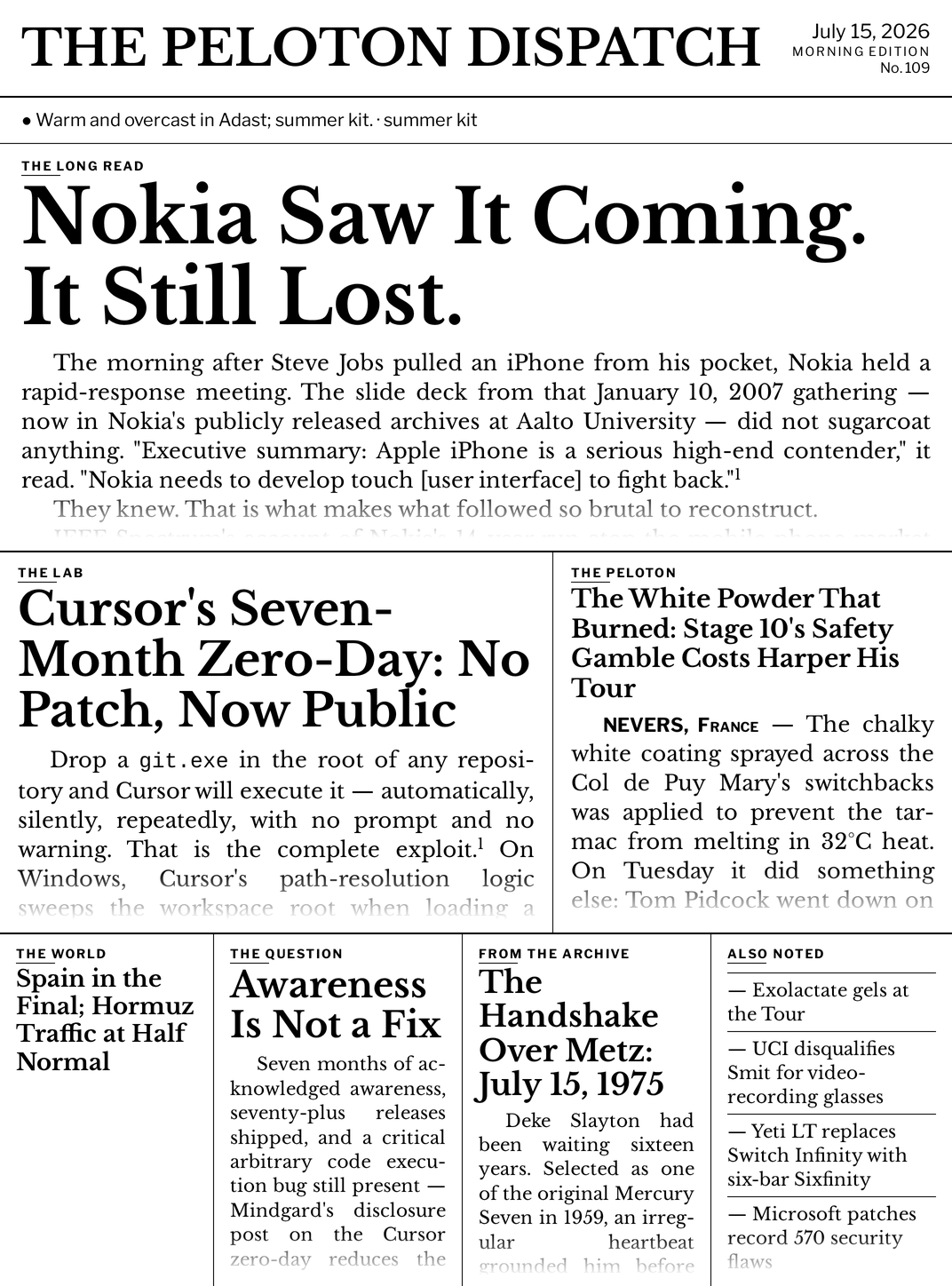
The deployed PNG (viewed from pd.thep3000.com/2026/07/15/frontpage.png) is clean and reads as a credible newspaper front page. Visual hierarchy is correct: the Nokia headline at ~84px dominates the lead zone, THE LAB headline at 52px anchors the mid-left, and THE PELOTON at 28px fills the mid-right. The bottom zone (WORLD, QUESTION, ARCHIVE, ALSO NOTED) is appropriately dense. No clipping, no text overflow, no broken columns.
One visible defect: the daily strip reads "● Warm and overcast in Adast; summer kit. · summer kit" — the kit label appears twice because build_html.py appends both the summary field (which already ends with "summer kit") and the kit field separately with a middot separator. The same string appears in the rendered index.html ride-strip div. The bug is confirmed in both outputs.
No lead image is present. The lead zone contains only text; the Nokia conference room illustration described in meta.json → lead_image_prompt was never generated (see Pipeline observations). The layout handles the absence cleanly — the fade gradient covers the lede — but the frontpage loses the visual anchor that an editorial illustration would have provided for a story that earned it.
Section ordering respects priority. THE WORLD (79) correctly receives headline-only treatment per its frontpage_display: "headline_only" rule despite outranking THE PELOTON (76); the art director placed it in the bottom row accordingly.
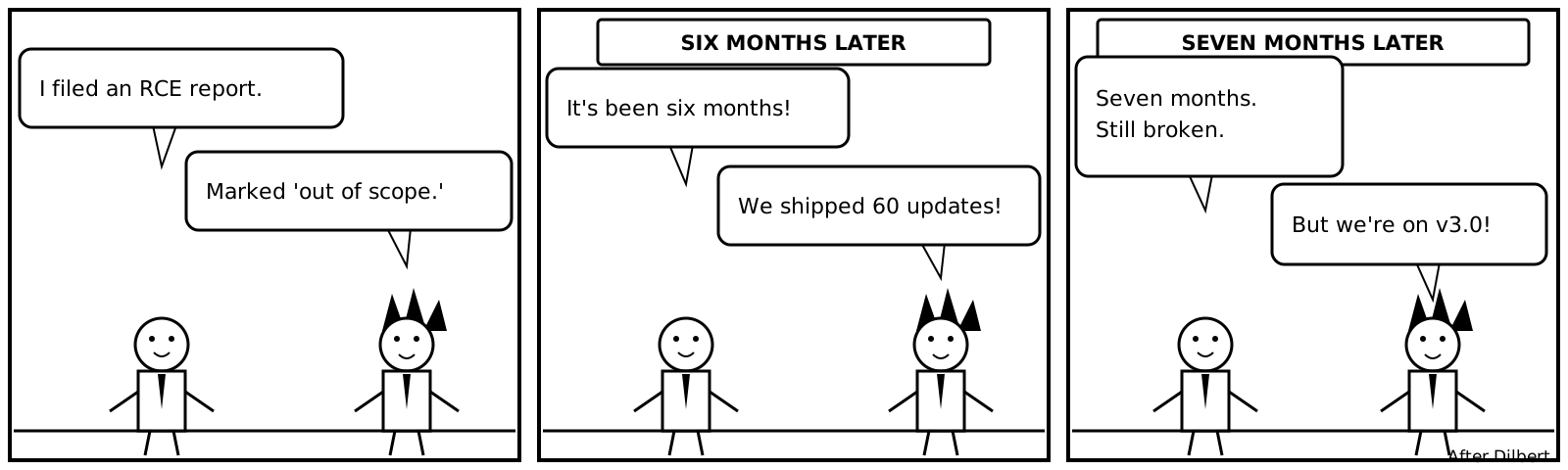
The full-article index.html is correctly structured: section order follows section_tiers (LAB, WORLD, PELOTON, LONG READ, ARCHIVE, FUNNIES, NOTED, QUESTION). The funnies section shows the SVG comic inline (<img src="funnies.svg">) with a caption that mentions two comics; only one SVG comic (Dilbert, 3 panels) is present (see Pipeline observations).
Priority ranking
| Section | Priority | Length (est.) | Image | Notes |
|---|
| THE LONG READ | 85 | ~900 words | planned, not generated | Leads frontpage correctly |
| THE LAB | 82 | ~800 words | — | 3 stories; Cursor + Ronacher + NY datacenter |
| THE WORLD | 79 | ~400 words | — | headline-only on frontpage; ON THE ROAD travel block |
| THE PELOTON | 76 | ~1,100 words | — | 6 story threads; notable length |
| THE QUESTION | 74 | ~380 words | — | LAB-adjacent angle |
| FROM THE ARCHIVE | 40 | ~600 words | — | Apollo-Soyuz; within priority_cap |
| ALSO NOTED | 10 | 5 bullets | — | |
| THE FUNNIES | 6 | 1 SVG comic | — | frontpage_display: skip |
The ranking is mostly defensible. THE LONG READ (85) over THE LAB (82) is a judgment call worth examining: the Cursor zero-day affects 7 million active users and was unpatched; the Nokia piece is excellent longform but not breaking news. The 3-point difference is plausible. THE WORLD at 79 slightly undersells a day when US strikes on Hormuz are continuing nightly and the World Cup semifinal decided Sunday's final — 82 would be defensible.
THE QUESTION at 74 is the ranking that causes problems for the edition's overall range: see Editorial reading.
Editorial reading
THE QUESTION fails the angle-selection test it was given. The ANGLE-SELECTION TIE-BREAKER in the section's own config says to prefer a non-dominant beat when it is within 20 points of the dominant one. THE LAB (82) was the dominant beat. THE PELOTON (76) sits 6 points below it — well within the 20-point window. Instead, THE QUESTION chose to reflect on THE LAB's Cursor zero-day story and amplify the Ronacher essay from THE LAB. The result is a section that reads as THE LAB's editorial page. Paragraph two of THE QUESTION ("Armin Ronacher's essay in THE LAB today offers that structural layer") is explicitly forwarding the reader to a sibling section rather than opening a new angle. The structural point the article arrives at — "awareness without friction to convert it into action doesn't close the gap" — is exactly the point THE LAB already made with Ronacher's closing quote. The CROSS-DOMAIN BRIDGE available on this day was richer: ASO knew the road treatment was slippery (awareness), used it anyway (not a fix), and a rider lost his Tour. Nokia knew multitouch was the future (awareness), funded the research (not a fix), and lost the company. THE PELOTON's safety thread and the tech institution failures share the identical structural pattern across different domains. That bridge — sport safety governance and software security disclosure both instantiating "knowing is not doing" — would have earned the 75-94 band. THE QUESTION as published is a single-domain article that tops out lower.
THE PELOTON article carries a sixth story thread that earns its length only barely. The Froome section runs three full paragraphs (and it is good writing — the quote "I can say I'm glad he wasn't around when I was at my best" is sharp). But Froome is a retired rider working as a Skoda ambassador; his interview adds color to the race atmosphere, not news. The article already covers the road treatment crash, the GC picture, Stage 11 preview, Vingegaard's team restructuring, and Nerurkar's car injury. Six threads at 1,100 words is dense even for a Grand Tour day, and the Froome section dilutes the primary story (the safety failure and its implications for ASO). Cutting it to one paragraph would tighten the section without losing anything the reader couldn't get from the cited Cyclingnews link.
THE LONG READ uses a single source for the entire article. Every citation in section-longread.md points to spectrum.ieee.org/nokia-phones-history (citation n=1, used five times). The IEEE Spectrum piece is built on newly released Nokia archival documents and named interviews — the sourcing is strong at the Spectrum level — but the Dispatch article never goes beyond that single piece. If Spectrum got a detail wrong (the sponsor list on Jeff Han's TED talk, the exact kiosk billing unit, the first-multitouch-device date), there is nothing in the brief to catch it. The fact-checker had one page to work from. For a story this well-executed, seeking one independent corroborating source — a Nokia engineer's blog post, an academic paper on the archival release, a second piece drawing on the same Aalto documents — would have strengthened the foundation.
Two Simon Willison micro-posts were never fetched. Research.md lists simonw/pedalican (Jul 14) and Simon's note on lobste.rs switching to SQLite (Jul 14) as "not fetched" — they appear in the research brief's KEY PERSONS block under this heading, and THE LAB writer then dropped them for "Source file not fetched; no facts to cite." These are exactly what THE LAB's focus describes ("check Simon Willison's blog daily") and they never entered the pipeline. The pedalican tool in particular — a Simon Willison release — would have been ALSO NOTED material at minimum. The fetch gap left the lab thinner on the "interesting small tools" front.
THE WORLD dropped three Seattle stories that a local reader would have wanted. Three local items in the research brief — Navy ship spills 5,000 gallons of fuel into Elliott Bay (Jul 15), Governor Ferguson's Millionaires Tax campaign (Jul 14), Snohomish County juvenile detention lawsuit (Jul 15) — were all dropped for "not fetched; no source content." The Navy spill is exactly the kind of local environmental story this paper covers. The Millionaires Tax ballot fight is major local civics. The fetch-failure rate on local Seattle stories this run was notably high; three items missed due to fetch gaps rather than editorial judgment.
Pipeline observations
Daily strip rendering bug. build_html.py appends both the summary field and the kit field to the daily strip, separated by a middot. The summary for this edition already ends with "summer kit" ("Warm and overcast in Adast; summer kit."), so the strip renders as "Warm and overcast in Adast; summer kit. · summer kit". The bug appears in both frontpage.html and the deployed index.html. The fix is to strip the kit from the summary output or to suppress the kit appendage when the summary already contains it.
OpenAI billing limit hit mid-run; lead image silently absent. funnies-openai.error.txt documents billing_hard_limit_reached when the pipeline tried to render the Bloom County comic as a PNG via render_funnies. No lead_image.png exists in the edition directory, and no error file was written for that failure. The meta.json → lead_image_prompt (the Nokia conference room scene) was generated correctly by the meta-writer, but fetch_lead_image.py apparently also hit the billing limit and failed silently — no error log, no sentinel file. The lead image failure is undetected by the run's own alerting. The Bloom County failure at least left an error file; the lead image failure left nothing.
Funnies: two-comic intent, one-comic delivery. The comic-strip agent ran twice (agent-ac21f5292b43b47ed initial, agent-ad017b108e75024d4 retry per .meta.json). The first run (1916s, $1.35) produced funnies.svg — a clean 3-panel Dilbert parody about the Cursor zero-day. The second run (937s, $0.49) produced the text-only placeholder now in section-funnies.md. The Bloom County comic was planned as an OpenAI-generated PNG (funnies-openai-prompt.json exists with the full 4-panel prompt) but was never rendered due to the billing limit. The published funnies caption reads "After Dilbert... After Bloom County..." — promising two comics, delivering one. The Dilbert SVG is good on its own. The caption should have been adjusted to match what actually shipped.
Fetch failures on multiple Seattle local stories and Simon Willison micro-posts. fetch_results.json and fetch_retry_results.json show no attempts on five URLs that appeared in research.md as "not fetched": the three Seattle local stories (Navy spill, Millionaires Tax, Snohomish lawsuit) and the two Simon Willison micro-posts. These appear to have been surfaced by the researcher from the feed digest without triggering a fetch. The researcher correctly flagged them as "not fetched" but the pipeline had no mechanism to go back and fetch them. The result is that the writer for THE WORLD dropped three local items on "no source content" grounds — reasonable given the rule, but the underlying gap is fetch coverage, not editorial judgment.
The Urbanist fetch hit a stale 2024 page. fetch_results.json shows https://www.theurbanist.org/seattle-sends-transportation-levy-to-ballot/ returned 309 bytes with a published date of 2024-07-10 — a two-year-old page. The retry correctly fetched the Capitol Hill Seattle URL (6695 bytes, 2026-07 date), and that is the source the world writer used. The stale initial fetch was recovered cleanly but is worth noting as a URL mismatch in the fetch manifest.
FC: THE PELOTON slowest fact-checker (642s, 42 claims). The agent ran multiple web searches to verify geography ("southwest" was wrong — Nevers is north of Vichy) and dates ("September" was wrong — Froome's crash was in August). Both corrections were made. A writer checking stage geography before filing would have avoided one web-search round-trip in the fact-checker; the writer attributed Froome's August crash to September, a factual error the fact-checker correctly caught. Forty-two claims checked for a 1,100-word article with 7 sources is thorough; the 642s runtime was earned.
All agents ran and completed. One scout, one researcher, seven writers (including sweep, reflector, and comic-strip), eight fact-checkers, one meta-writer, one art-director, one thread-editor. The comic-strip ran twice (initial + retry per .meta.json); all others ran once. No agent produced an empty or truncated output. No tool errors in the fact-checker logs beyond the expected retry patterns.
Trace highlights
The researcher ($1.72, 1515s) cost more than all seven writers combined ($1.32). The brief was thorough — 200+ citations, 13 sections organized by beat, travel mode correctly activated — and the writers consumed it almost entirely from cache (6–9 non-cached input tokens each). The ratio is not surprising but worth watching: when the researcher is expensive and writers are cheap, the brief is doing all the heavy lifting and the writers are paraphrasing rather than judging.
The two comic-strip runs combined cost $1.84 (45 minutes of wall clock) for a section that doesn't appear on the frontpage. The first run generated the Dilbert SVG; the second generated a text placeholder. The $1.35 first run had 64K output tokens — a sign of a complex SVG being written token by token. For a section explicitly marked frontpage_display: "skip", the combined cost exceeds the researcher's cost on a per-character-of-reader-impact basis.
FC: THE PELOTON's 642s (vs. a 252–393s range for other fact-checkers) reflects a longer article with more moving parts, not a structural problem. Its 267 uncached output tokens — the highest of any fact-checker — show it was actually rewriting rather than rubber-stamping. That is the fact-checker working as designed.
The orchestrator at $3.25 (28% of total) is the single most expensive agent. Its 7.2M 1h-tier cache reads (vs. 1.45M 5m-tier across all agents) indicate a very large persistent context. This is expected for an orchestrator that hands the research brief and section outputs to each subagent in sequence, but it is the main driver of cost. If the brief could be handed to writers via a smaller structured index rather than the full research.md, the orchestrator cost would drop.
Trace summary
Dispatch 2026-07-15 (model: claude-sonnet-4-6)
| Agent | Dur | Input | Output | Cache Read | Cache 5m | Cache 1h | Cost |
|---|
| Scout | 330s | 9384 | 41 | 135341 | 92135 | 0 | $ 0.41 |
| Researcher | 1515s | 8435 | 1908 | 2520609 | 242498 | 0 | $ 1.72 |
| THE WORLD | 290s | 6 | 25 | 95975 | 64562 | 0 | $ 0.27 |
| THE PELOTON | 444s | 7 | 35 | 67385 | 57927 | 0 | $ 0.24 |
| THE LAB | 235s | 7 | 34 | 94177 | 44778 | 0 | $ 0.20 |
| THE LONG READ | 109s | 6 | 3926 | 50378 | 21415 | 0 | $ 0.15 |
| FROM THE ARCHIVE | 141s | 6 | 6673 | 76406 | 36577 | 0 | $ 0.26 |
| FC: THE LONG READ | 345s | 8 | 41 | 159811 | 52180 | 0 | $ 0.24 |
| FC: FROM THE ARCHIVE | 156s | 6 | 25 | 81205 | 38611 | 0 | $ 0.17 |
| Meta-Writer | 114s | 12 | 1905 | 235270 | 32432 | 0 | $ 0.22 |
| FC: THE LAB | 252s | 6 | 27 | 77126 | 39450 | 0 | $ 0.17 |
| FC: THE WORLD | 393s | 1092 | 48 | 132511 | 56299 | 0 | $ 0.25 |
| FC: THE PELOTON | 642s | 726 | 267 | 297740 | 71771 | 0 | $ 0.36 |
| THE QUESTION | 265s | 2910 | 42 | 158251 | 47411 | 0 | $ 0.23 |
| FC: THE QUESTION | 142s | 6 | 25 | 73858 | 30977 | 0 | $ 0.14 |
| ALSO NOTED | 338s | 9 | 49 | 309159 | 101924 | 0 | $ 0.48 |
| Draw today's TWO parody comic strips for | 1916s | 13 | 64017 | 12026 | 103024 | 0 | $ 1.35 |
| FC: ALSO NOTED | 211s | 6 | 28 | 86115 | 44786 | 0 | $ 0.19 |
| Draw today's TWO parody comic strips for | 937s | 11 | 1539 | 179013 | 110549 | 0 | $ 0.49 |
| Art Director | 490s | 5 | 10 | 12008 | 59510 | 0 | $ 0.23 |
| Update story threads for today's edition | 401s | 5 | 19 | 7242 | 102939 | 0 | $ 0.39 |
| Orchestrator | | 166 | 27111 | 7184485 | 0 | 115118 | $ 3.25 |
| TOTAL | | 22832 | 107795 | 12046091 | 1451755 | 115118 | $11.43 |
Suggestions for next edition
Fix the daily-strip rendering bug before the next run. The summary field already contains the kit decision; the kit field appended after a middot creates the duplicate. One line in build_html.py to suppress the kit appendage when it already appears in the summary.
Add an error sentinel for the lead image generation step. When fetch_lead_image.py fails (billing limit, API error, timeout), it should write a lead-image.error.txt file in the edition directory in the same pattern as funnies-openai.error.txt. A silent missing lead image is harder to catch and fix than one with an error log.
Brief the QUESTION writer to explicitly evaluate THE PELOTON as a source domain before committing to a LAB-adjacent angle. On a Grand Tour day when the Peloton section covers a safety governance failure (road treatment, organizational decisions, consequence), the cross-domain bridge to software security is available and the config specifically rewards it. The writer ran the angle-selection check correctly on LAB vs. LONG READ (COLLISION RULE was observed) but did not run it across LAB vs. PELOTON.
Increase fetch coverage for Seattle local stories. Three Seattle items in research.md fell through as "not fetched" on the same day, including a Navy fuel spill into Elliott Bay. Consider adding the West Seattle Blog as a feed source and ensuring KIRO7 local story URLs in the research brief trigger a fetch rather than appearing only in the "not fetched" section.