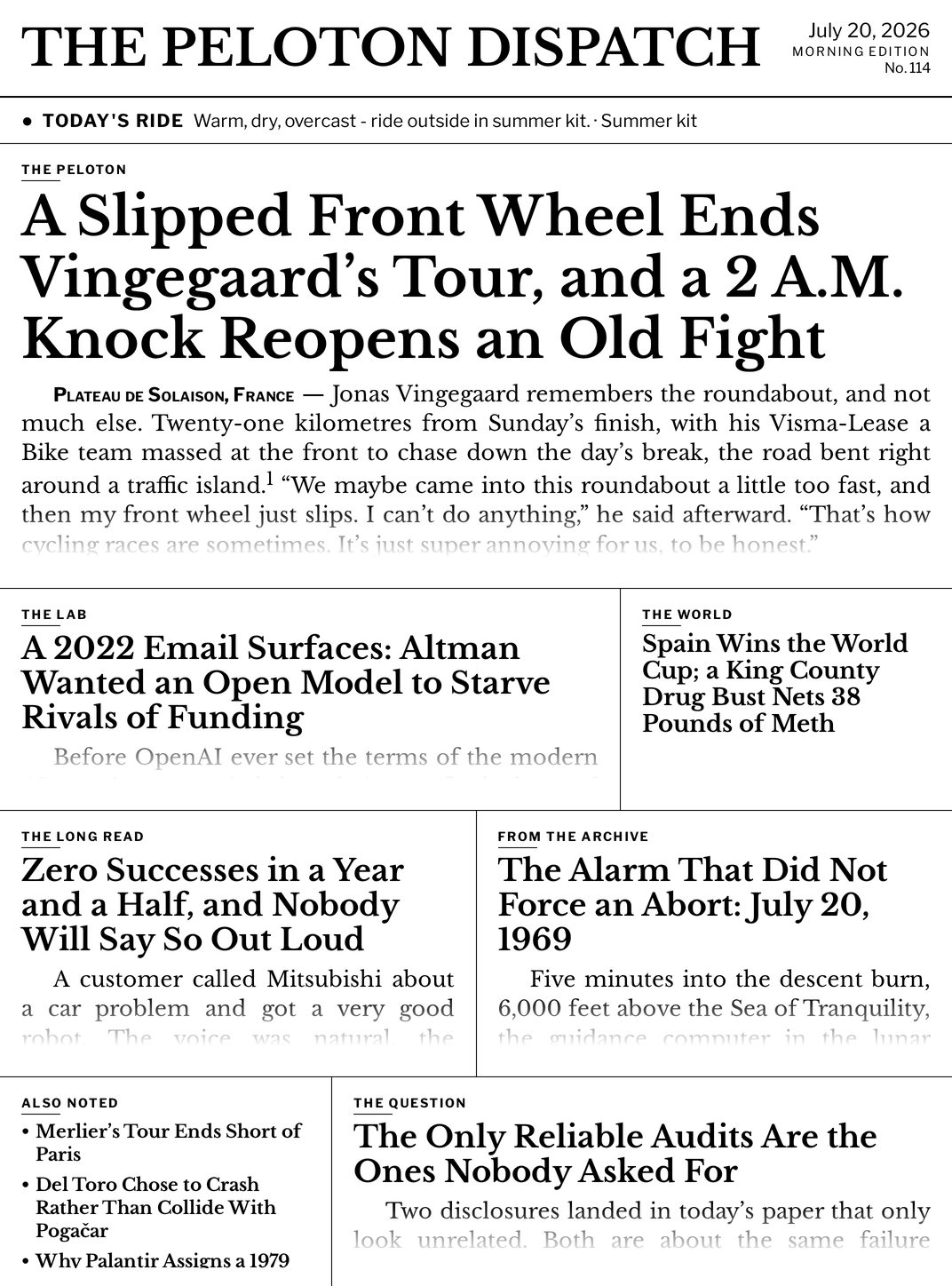
PLATEAU DE SOLAISON, France — Jonas Vingegaard remembers the roundabout, and not much else. Twenty-one kilometres from Sunday's finish, with his Visma-Lease a Bike team massed at the front to chase down the day's break, the road bent right around a traffic island.1 "We maybe came into this roundabout a little too fast, and then my front wheel just slips. I can't do anything," he said afterward. "That's how cycling races are sometimes. It's just super annoying for us, to be honest."
He was taken by race ambulance to the medical truck in the valley below the summit finish, then sat on the team bus for more than half an hour before he would speak to anyone.1 When he finally did — to Danish broadcaster TV2, having declined the reporters waiting outside — the collarbone break was confirmed, and so, within hours, was the diagnosis that mattered most: surgery.1 Visma's statement said only that "due to the severity of the collarbone fracture, surgical intervention has been recommended and will be performed in the coming days," a walk-back from team director Marc Reef's earlier line that the club was still weighing whether an operation was needed at all.2
Vingegaard's own account was strikingly unsentimental for a rider who has spent five Julys locked in what has become the sport's defining rivalry. "It's going surprisingly well. It's of course very disappointing for us to end up like this, and for the Tour to end like this. But that's how cycling is. Luckily, it's only a broken collarbone," he said. "It's no use hanging your head. It just makes it worse."1 Reef was less measured, calling the crash scene a "strange situation" and pointing at a lead motorbike he said had panicked and braked in front of the bunch. Vingegaard wouldn't go that far. "Maybe the motorcycle makes a mistake, but we can't trust the motorcycles. We have to have our own judgment," he said. "People make mistakes, and we can't change that now."1
The crash landed on top of a subplot that had already been simmering since Saturday night. Vingegaard was roused for a surprise anti-doping control at roughly 2 a.m., and Pogačar for one of his own around 5 a.m., ahead of Sunday's stage.3 Riders pointed out that the testing landed in the middle of the only recovery window a three-week race allows.4 Asked directly whether the disrupted sleep played any part in his crash, Vingegaard wouldn't rule it out but wouldn't claim it either.1 "It is clear that it has not done anything good for it, you could say. Whether that is the reason, I dare not speculate," he said. "I don't want to blame it on that, because it's a bicycle race, and crashes happen in bicycle races."1
His rival showed no such restraint. In his own post-stage remarks, Evenepoel called the overnight testing "inhuman" and said the riders' union has to intervene.4 "I can't speak for the guys about their focus and how they manage competition, I only think I can say it is very disrespectful to wake up guys at 2 AM and 5 AM," he said. "The CPA has to do something about that. It is inhuman to wake us up, we had a long transfer, and to wake them up like that is pretty disrespectful… Sleep is the only moment we have to recover. This is the hardest race in the world, it makes it even harder. It's something we could and should not accept."4
Tom Pidcock's third straight day trying to force his way up the general classification from the break ended in the commissaires' office instead. Twice on the stage 15 climbs, the Pinarello-Q36.5 rider pushed off a car — each offence carrying its own 200 CHF fine, 10-second time penalty and 4-point KOM deduction, for a combined 400 CHF, 20 seconds and eight KOM points gone by the finish.5 It capped a stretch in which Pidcock has gone from a virtual fourth place on GC mid-stage to crossing the line well down, worn out by three days of racing on the attack while also defending a top-ten overall position.5 "I think I'm getting quite good at getting the breakaways… Today can break loads of records, but so can I," he said afterward, before admitting the final kilometres had been a crawl: "I was completely empty."5
Away from the Alps, the Baloise Ladies Tour wrapped its four-stage run on a flat, cobbled circuit through Mechelen, the last of six laps taking in the Keizerstraat five times.6 Zoe Bäckstedt carried the leader's jersey into the finale after building her advantage almost entirely against the clock — a prologue win followed by the stage 3a time trial — and the Canyon-SRAM team, alongside the sprinters' squads of Visma-Lease a Bike and Fenix-Premier Tech, spent the final circuits controlling a five-rider move that briefly opened a 2:20 gap before it was hauled back inside the closing kilometres.6 "We had the leader's jersey and we had a really strong team. I feel that we had to be in control and we really played it well every day," Bäckstedt said.6 Nienke Veenhoven timed her sprint to beat Lotte Kopecky by half a wheel for her third stage win of the race.6
On the Road Ahead
Updated Jul 20, 2026
Date
Race
Country
Tue Jul 21 – Sun Jul 26
Tour de France, Stages 16–21
France
Sat Aug 1
Donostia San Sebastián Klasikoa
Spain
Mon Aug 3 – Sun Aug 9
Tour de Pologne
Poland
Sun Aug 16
ADAC Cyclassics
Germany
Sat Aug 22 – Sun Sep 13
La Vuelta a España
Spain
Show Results
WINNER: Remco Evenepoel (Red Bull-Bora-hansgrohe), Stage 15, Plateau de Solaison
PODIUM: 2. Tadej Pogačar (UAE Team Emirates-XRG); 3. Isaac del Toro (UAE Team Emirates-XRG)
GC AFTER: 1. Tadej Pogačar (UAE Team Emirates-XRG); 2. Remco Evenepoel +5:00; 3. Isaac del Toro +5:58; 4. Paul Seixas (Decathlon CMA CGM) +6:23; 5. Florian Lipowitz +6:48. Jonas Vingegaard (Visma-Lease a Bike) abandoned after a stage 15 crash — broken collarbone, surgery pending "in the coming days."
NOTABLE: Tom Pidcock (Pinarello-Q36.5) fined 400 CHF and docked 20 seconds and eight KOM points for pushing off a car twice on the stage 15 climbs. Baloise Ladies Tour: Zoe Bäckstedt (Canyon-SRAM) won the overall for the second year running; Nienke Veenhoven (Visma-Lease a Bike) took stage 4 in Mechelen and finished second overall; Felicity Wilson-Haffendel (Lidl-Trek) third overall.
A 2022 Email Surfaces: Altman Wanted an Open Model to Starve Rivals of Funding
Before OpenAI ever set the terms of the modern AI race, it was worried about being outflanked — and it had a plan to make sure that didn't happen. An October 2022 email Sam Altman sent to OpenAI's board, surfaced this week in the Musk v. Altman litigation and republished by Simon Willison, lays it out without much subtlety: "We have been having extensive discussions around open source strategy. We will discuss it more at our next board meeting, but one thing we'd like to do soon is to create a language model with the approximate capability of GPT-3 that can run locally on consumer hardware and release that. We'd like to do it soon, before Stability or someone else does. In general, we think this helps discourage others from releasing similarly-powerful models, and makes it harder for new efforts to get funded."1
Willison's post is short — a single quoted paragraph — but it's a rare unfiltered look at the calculus behind OpenAI's occasional open-weight releases. The stated goal wasn't research openness or community goodwill; it was denying oxygen to Stability AI and anyone else who might attract funding by shipping a capable open model first.1 That framing is worth keeping in mind the next time a lab frames an open release as a gift to the ecosystem rather than a competitive maneuver.
Simon Willison also spent part of the weekend reverse-engineering his own Claude Code install, chasing down a claim from Bun creator Jarred Sumner's post on rewriting Bun in Rust: that Claude Code v2.1.181 (released June 17th) and later ship on the Rust port of Bun. Willison didn't take the vendor's word for it — he ran strings ~/.local/bin/claude | grep -m1 'Bun v1' against his own binary and got back Bun v1.4.0 (macOS arm64), a version number that doesn't exist in any tagged Bun release (the latest is v1.3.14, from May 12th) but does match a commit that bumped package.json to 1.4.0 back in May and has sat there, unreleased outside of canary builds, ever since.2 A second check — preloading a script that prints Bun.version before invoking claude --version — confirmed the same 1.4.0 string. Anthropic, in other words, is running an unreleased canary build of Bun's Rust rewrite in production across, per Willison's own estimate, millions of installs, and nobody noticed until someone went looking.2 Sumner's own account is the vendor's: 10% faster startup on Linux, otherwise invisible. Willison's independent poke at the binary is the part worth trusting.
Mojang's own snapshot notes are the only source on this one, so take it as vendor-reported: in a snapshot posted Thursday — a day late, because "peak vacation season" hit the Swedish team's usual Tuesday cadence — Mojang confirmed it has switched Minecraft: Java Edition's window management, input handling, and platform integration from GLFW to SDL3.3 For a game with Minecraft's install base, swapping out the windowing layer is not a small change: keybindings now map to physical key positions via SDL scancodes instead of layout-dependent codes, Wayland becomes the preferred backend on Linux, exclusive fullscreen is gone on macOS, and the same snapshot slips in new core shaders for order-independent transparency.3 It's the kind of unglamorous infrastructure migration that a game this old and this widely deployed rarely gets to do cleanly.
Smaller, but worth a look if you write embedded firmware: Wren6991 — the same developer behind the RISCBoy RISC-V handheld — shipped CodeSizer, a static code-size profiler that answers the perennial "why is this binary so big" question properly. It runs objdump and addr2line against an ELF file to unwind the inlined call stack at every instruction address, then attributes code size to the correct node in an interactive HTML call tree — solving the real problem with LTO'd, heavily-inlined embedded builds, where a single function symbol can hide dozens of inlined callers and flat symbol-size tools tell you nothing useful.4 The sample report, run against the Raspberry Pi RP2350's bootrom ELF, is on GitHub if you want to see what the output actually looks like before pointing it at your own build.4
Trending today: the list is saturated with AI-agent wrappers, coding-assistant CLIs, and "awesome-llm-apps"-style curated lists — nothing there cleared the novelty bar; today's repo pick came from Lobsters instead.
Spain Wins the World Cup; a King County Drug Bust Nets 38 Pounds of Meth
Spain won its second World Cup title, beating Argentina 1-0 in extra time on Ferran Torres's 106th-minute goal in New Jersey.1
- Argentina's Enzo Fernández was sent off for a second yellow card late in regulation, forcing his team through extra time a man down.1
- It may have been Lionel Messi's final World Cup; Spain shut him down all night, and he left MetLife Stadium in tears.1
Inflation dominated conversation at Sunday's "ReUnion on Union" block party in the Central District, where the Africatown Community Land Trust handed out housing and small-business resources alongside the music and food. Seattle-area inflation is up 4.5% over the past year, with produce prices up nearly 12%, clothing up nearly 15%, and fuel up 25.4%; residents told KIRO 7 they want elected officials to feel it too.2
King County Sheriff's deputies broke up a drug trafficking operation spanning King, Snohomish, and Pierce counties, serving warrants at two Lynnwood distribution hubs Saturday. The bust yielded 38 pounds of methamphetamine, 4.4 pounds of fentanyl powder, 1.7 pounds of heroin, more than $95,000 in cash, and three arrests.3
High bacteria counts have closed swimming at Gene Coulon Memorial Beach, Houghton Beach in Kirkland, Mount Baker in Seattle, and Salt Creek near Port Angeles; toxic algae has separately shut Lake Marcel near Carnation and Palmer Lake in Pierce County. County health departments say the beaches reopen once testing clears.4
KIRO 7 meteorologists have called Pinpoint Alert Days for Tuesday and Wednesday, with highs touching 90°F in Seattle and the mid-90s farther south as onshore flow shuts down and wildfire smoke drifts in from British Columbia. The heat breaks Thursday as marine air returns.5
Pierce County's council narrowly approved a Unified Regional Approach to homelessness in June, aiming to avoid the governance mess that has hollowed out the King County Regional Homelessness Authority.6 Advocates call it a genuine step forward but warn the county-controlled structure lacks independent accountability and rests on notoriously incomplete data — last year's official point-in-time count found 2,955 homeless residents against outreach estimates of 10,000 or more.6
ON THE ROAD — Adast, Hautes-Pyrénées, France
A lightning-sparked wildfire above Barèges — in the same stretch of the Pyrenees as Adast — reignited this past week after wind gusts fanned embers that had smoldered since the fire first broke out July 9. Firefighters redeployed a water-bombing helicopter to hit flare-ups in the steep, rocky terrain, and hikers are being told to stay off the massif because of rockfall risk; officials are also asking residents not to jam emergency lines reporting smoke that's already been spotted and logged.7
Separately, the Vallées des Gaves announced their first chamber-music festival for the 2026 season, a new addition to the valley's cultural calendar.8
Beyond those two items, local coverage for the reader's last day in the valley was thin — no other dated news turned up from the outlets serving Adast and the surrounding Gaves valleys.
Zero Successes in a Year and a Half, and Nobody Will Say So Out Loud
A customer called Mitsubishi about a car problem and got a very good robot. The voice was natural, the response was fast, the promise was clear: someone would call back. Nobody did. Six months later, that customer — an AI consultant who has spent the past year and a half watching corporate AI projects fail — was still waiting, and had quietly decided not to buy another Mitsubishi.1 Somewhere in a dashboard, that call almost certainly reads as a resolved ticket, because a request that vanishes doesn't register as a failure. It just isn't there.
That anecdote is the small version of the argument in "AI Mania Is Eviscerating Global Decision-Making," an essay from the consultant behind ludic.mataroa.blog. The big version is blunter: in a year and a half of engagements — some run directly, some observed in passing while doing unrelated work — the success rate on corporate AI projects has been 0%. Not mostly succeeding. All of them failed.1 The author is careful to note this isn't really an indictment of what LLMs can do; it's an indictment of what large organizations do to any sufficiently ambitious software project, with AI's novelty as an extra unpriced risk stacked on top of the usual ones.
What makes the essay worth forty minutes rather than a skim is that it doesn't stop at the failure-rate claim — it explains why almost nobody inside these organizations is able to say it out loud. Executives who tell the truth get removed. Employees who are honest get "randomly" selected for layoffs.1 So the org chart routes around candor. Engineers who do their jobs competently without a chatbot now lie and say Claude did it — "AI-washing," in the author's phrase — because their managers are unhappy if the work wasn't visibly AI-touched. Elsewhere, staff are graded on "token leaderboards" where more spend reads as better performance, so the people with the skills to actually optimize a system instead set two LLMs looping against each other, walk away, and watch Netflix. Nobody has been caught, even when they privately think the output isn't fit to ship.1
The essay's sharpest scene is a live demo of Snowflake's Cortex — an AI layer that, per the author's account of a briefing from Snowflake's own staff, runs at something like 92% accuracy on production data, which sounds impressive until you translate it into one wrong number in ten on a CFO's dashboard.1 The consultant's team stopped pitching it. But on the occasions they showed it anyway, at a client's insistence, the room's mood would flip in real time — skeptical, budget-conscious buyers turning, in the author's words, into people plunging their hands into their own chests to present their "still-beating credit cards."1 The team ended up refusing sales to any lead who showed more than passing interest in AI, because the pattern that interest predicted — magical thinking about vendor claims, willingness to buy anything with the right label — created legal and reputational exposure the consultancy didn't want.
The most useful section, though, is the one that explains why executives keep repeating numbers they privately doubt. It isn't simple dishonesty, or not only that. A Fortune 500 executive, speaking without microphones in the room, told the author that if a vendor's executive publicly contradicted a customer's inflated productivity claims, it would read as an attack on that customer's credibility and risk the contract. So the vendor stays quiet. But that vendor is also, in other deals, the customer — and faces the same pressure from someone below it in the chain. The result, as the author frames it, is a prisoner's dilemma played out across entire industries: cooperate (repeat the nonsense) and keep your job; defect (tell the truth) and get replaced by someone who won't. An anonymous CISO quoted in the piece put the mood among his peers plainly — "quietly skeptical but afraid to speak up" — and compared the atmosphere to cloud adoption, except with "a cult-like atmosphere to it that you didn't see with the cloud."1
The essay's back half turns practical: how to raise concerns about a specific project without getting shot as a heretic (one-on-one conversations, anonymous polls on success likelihood, talking to the people who actually use the tooling day to day), and, for readers who've concluded the fight isn't winnable at their company, how to survive — contract instead of taking a salary, stop reading AI news, start a job search quietly the moment you're handed 2,000-line AI-generated pull requests to review.1 None of it is triumphant. The essay's closing note is that this particular mania will pass, the way crypto's did, but that the underlying organizational credulity won't — it'll just wait for the next trigger.
The reader of this paper has almost certainly sat in a version of the rooms this essay describes. What the piece offers isn't a novel observation — plenty of people have noted that AI mandates produce theater — but a rare, granular, on-the-record account of the mechanism: who lies to whom, why the lie is individually rational, and why the aggregate effect is that large institutions currently cannot make a sound decision about the technology they've bet their strategy on.
The Alarm That Did Not Force an Abort: July 20, 1969
Five minutes into the descent burn, 6,000 feet above the Sea of Tranquility, the guidance computer in the lunar module Eagle threw a 1202 program alarm.1 Neil Armstrong and Buzz Aldrin had no idea what it meant. Neither, for a few seconds, did most of Mission Control. In Houston, a 24-year-old computer engineer named Jack Garman told guidance officer Steve Bales it was safe to keep going, and Bales relayed the call up the chain in time for Armstrong to fly through it.1
The alarm wasn't a bug in the arithmetic. It was an executive overflow — the Apollo Guidance Computer's real-time scheduler running out of cycles because a rendezvous radar switch had been left in the wrong position, feeding it a second stream of position data it had no use for during a landing.1 Software engineer Don Eyles later traced the root cause to an electrical phasing mismatch that made the stationary radar antenna look, to the computer, like it was oscillating — spurious interrupts stealing cycles the landing software needed.1 Margaret Hamilton, who ran the Apollo flight software effort at MIT's Draper Lab, had built the AGC to shed low-priority tasks and preserve the ones that mattered rather than crash or force an abort. It did exactly that, several times, during the descent, and kept flying.1
It nearly wasn't enough anyway. As Armstrong took semi-automatic control to steer clear of a boulder field near what would later be named West crater, Eagle burned through propellant faster than the flight plan allowed for.1 At 100 feet, with only about 90 seconds of propellant remaining, the margin for an abort was closing fast.1 He landed with about 25 seconds of that margin left, according to the numbers Mission Control was watching in real time — though post-mission analysis put the true figure closer to 50 seconds, the shortfall an artifact of propellant sloshing in the tanks and uncovering a sensor early.1 Subsequent Apollo lunar modules carried anti-slosh baffles because of it.1
Eagle touched down at 20:17:40 UTC on July 20, 1969.1 Armstrong's full transmission to Houston — "Houston, Tranquility Base here. The Eagle has landed." — opened with an unrehearsed swap: Tranquility Base, the landing site's new name, in place of Eagle, the ship's call sign, a tell to Mission Control that the landing was real.1 Six and a half hours later, at 02:56 UTC on July 21 by the clock but still "July 20" in the mission's frame and the world's memory, he stepped off the footpad and onto the regolith.1
The interesting part of that story was never really the flag or the plaque. It was that the software failed safely under load it hadn't been designed to expect, degraded gracefully instead of crashing, and a 24-year-old caught the failure mode fast enough to say "go" instead of "abort." That's a systems-engineering result, not just a historical one.
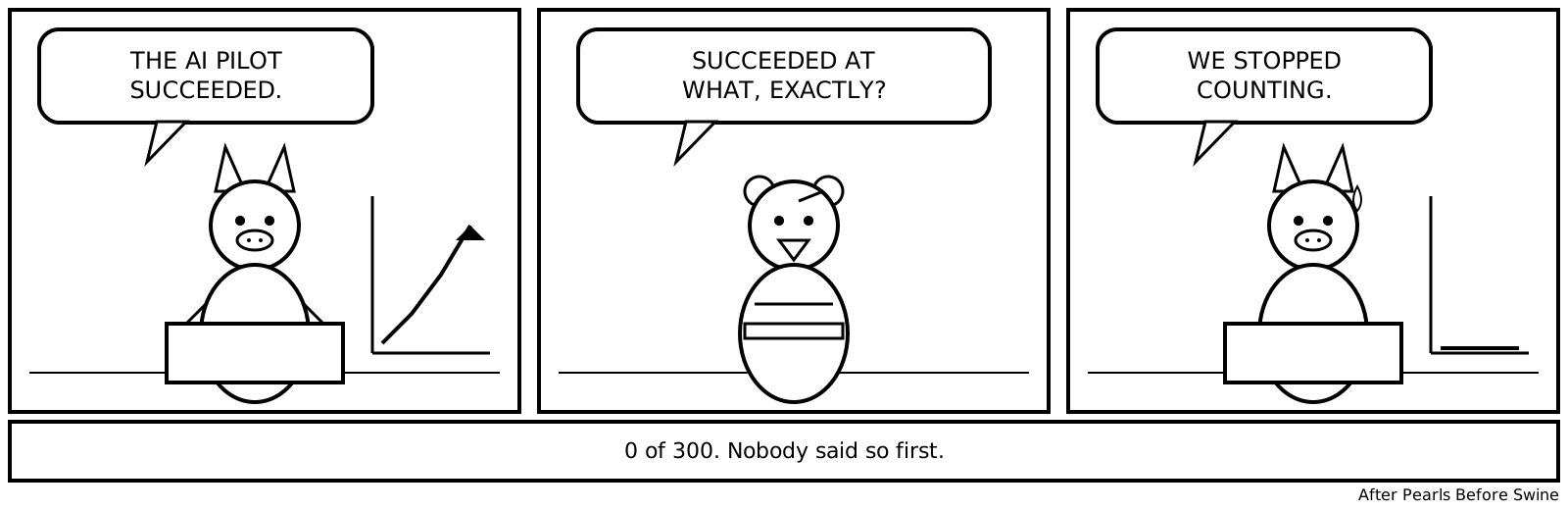
*After Pearls Before Swine — on the long read's zero-for-three-hundred corporate AI success rate, and the quiet art of not saying so. After Calvin and Hobbes — on the Tour's nighttime anti-doping wake-up calls, imagined as a kid's bedtime routine nobody consented to.*
Merlier's Tour Ends Short of Paris — Soudal-QuickStep's three-time stage winner climbed off during Stage 15's second consecutive brutal mountain day, after his own director had flagged the time-cut risk before the start. cyclingnews.comJul 19, 2026
Del Toro Chose to Crash Rather Than Collide With Pogačar — When the peloton overshot a corner on Stage 15, Isaac del Toro deliberately hit the deck instead of taking down his UAE Team Emirates-XRG leader, then got paced back up by a grateful Pogačar. cyclingnews.comJul 19, 2026
Why Palantir Assigns a 1979 Improv Textbook to New Hires — Software engineer Sean Goedecke argues that Keith Johnstone's *Impro* — canonical reading across Silicon Valley founders and onboarding decks — reads less like an acting manual and more like a literal playbook for running a cult, mask-induced trance states included. seangoedecke.com
The Only Reliable Audits Are the Ones Nobody Asked For
Two disclosures landed in today's paper that only look unrelated. Both are about the same failure mode: an institution's official account of what it is doing can diverge from the truth of what it is doing for years, and the gap closes only when someone with no stake in the official story bothers to go looking.
The first came out of a courtroom, not a shareholder letter. As THE LAB reports today, an October 2022 email from OpenAI's CEO to its board — surfaced only because litigation forced it into evidence — lays out the real reasoning behind the company's occasional open-weight releases: ship something capable enough to "discourage others from releasing similarly-powerful models" and "makes it harder for new efforts to get funded."1 That is a materially different story than the one told publicly at the time, about openness and ecosystem contribution. Nobody volunteered the real version. It took a subpoena.
The second came from an engineer checking his own machine instead of trusting a blog post. A developer's claim that Anthropic's coding tool now ships on an unreleased canary build of a competitor's runtime should have been unverifiable without inside access — except that Simon Willison ran strings against his own installed binary, found a version number that matches no tagged release, and confirmed it with a second, independent test.2 Anthropic never announced the swap. It took a stranger's curiosity and a command-line utility to find it, running — by Willison's own estimate — across millions of production installs.
Put next to each other, the two stories describe the same structural fact from opposite ends: the account an organization gives of its own system and the actual behavior of that system are not the same document, and nothing inside the organization is designed to reconcile them. This paper's long read today makes the mechanism explicit from the other side of the table — a consultant's account of what happens inside large organizations trying to adopt AI, where the people closest to a system's real performance have the strongest incentive not to say what they've seen. Candor gets you removed. Silence gets you promoted. The report writes itself in whatever direction keeps the org chart intact.
Which leaves an uncomfortable asymmetry. Verification happened today in both directions — but only because a plaintiff's lawyer wanted an email and an engineer wanted to know why his terminal felt a little faster. Neither is a system. Neither scales. For every claim that gets checked because litigation forces it into discovery or because someone happened to run the right diagnostic, there's an unknown number that don't — no lawsuit pending, no engineer curious enough to open the binary. The honest answer to "how do you know what this system is actually doing" is, right now, "you mostly don't, unless someone with nothing to lose decides to check." That's not a comfortable place to build a year's worth of decisions on. It's the place most organizations are building them anyway.
A solidly written edition on a huge cycling news day (Vingegaard's Tour-ending crash) undercut by two mechanical failures: the front page no longer follows its own priority scores, and there is no lead image for the seventh straight edition (OpenAI billing hard limit, unfixed since at least 07/14 per log-pipeline-alerts.md). The prose itself is strong — THE PELOTON's Vingegaard lede, THE LONG READ's Mitsubishi-robot cold open — but THE QUESTION spends most of its word count re-narrating two stories THE LAB already told in the same edition, and the researcher silently dropped fresh John Carmack / Tim Sweeney search hits despite newspaper.yaml's explicit "never silently dropped" safety net for key_persons. The pipeline itself ran cleanly once started (no missing agents, one fetch failure that retried clean), but it is still running on a CCR session that has not reset since 07/18 — the third consecutive day this has been flagged.
Frontpage
frontpage.png (fetched from pd.thep3000.com/2026/07/20/) renders cleanly — no clipping, no duplicate paragraphs, no font shrinkage, correct dateline/byline on THE PELOTON, and the missing lead image degrades gracefully (purely typographic page, no broken <img> or layout hole). Row 1 correctly leads with THE PELOTON (priority 90).
Below the lead, the layout does not track priority. Row 2 is THE LAB (64) + THE WORLD (60); row 3 is THE LONG READ (80) + FROM THE ARCHIVE (42); row 4 is ALSO NOTED (10) + THE QUESTION (76). That means the edition's second- and third-highest-priority stories — THE LONG READ (80) and THE QUESTION (76) — render smaller and lower on the page than THE LAB (64) and THE WORLD (60), which sit in the more prominent row 2. This is not an art-director judgment call; it's a mechanical result of frontpage.json's invocation prompt (2026/07/20/jsonl/subagents/agent-ac959a6da20ca2025.jsonl.gz) explicitly instructing the art-director to apply newspaper.yaml's section_tiers ("tier 0 renders above tier 1 regardless of priority") to the front page. The art-director's own sign-off confirms it followed orders literally: "Tier ordering applied per invocation (tier 0: PELOTON/LAB/WORLD, tier 1: LONG READ/ARCHIVE, tier 3: ALSO NOTED, tier 4: THE QUESTION)." But newspaper.yaml says the opposite about this exact field: "The front-page layout still uses raw priority." Section tiers are documented as governing the full index.html article page only — and indeed index.html (fetched live) orders sections in exactly that tier sequence, correctly. Someone (or something) composing the $PER_SECTION_DISPLAY_RULES substitution in dispatch.md Step 6 is now feeding the tier table into the front-page prompt as if it were a front-page rule. See Pipeline observations for when this started.
Priority ranking
Section
Priority
Length
Image
Notes
THE PELOTON
90
928 words
yes (eligible; render failed)
Earns it — Vingegaard's Tour-ending crash + surgery + nighttime-testing subplot
THE LONG READ
80
872 words
no
"Exceptional longform" band; a genuinely sharp single-source essay
THE QUESTION
76
500 words
no
Solid premise, but see Editorial reading — mostly recaps THE LAB
THE LAB
64
719 words
no
Reasonable spread (AI/LLM, dev tooling, games infra, embedded)
THE WORLD
60
493 words
no
Bullet-capped world block + local + travel-mode "ON THE ROAD"
FROM THE ARCHIVE
42
480 words
no
Apollo 11 1202-alarm angle; well within the 45 cap
ALSO NOTED
10
135 words
no
Thin but the day's overflow was genuinely small
THE FUNNIES
9
43 words
no
—
Spread is 81 points (9–90), no ties, no priority inflation or compression — the ranking itself is defensible section-by-section. The failure is entirely downstream, at layout: the art-director did not respect the order (see Frontpage above).
Editorial reading
THE QUESTION recaps THE LAB rather than reflecting on it. The focus block for THE QUESTION is explicit: "don't re-report any story's details... a second full recap of a story already in THE LAB... is not [acceptable]." Today's Question draws its entire argument from THE LAB's two lead items — the Altman email and Willison's Bun/Rust investigation — using the same two source URLs THE LAB already cited (simonwillison.net/2026/Jul/20/sam-altman/ and .../claude-code-in-bun-in-rust/) and restating the same direct quote LAB used ("discourage others from releasing similarly-powerful models... makes it harder for new efforts to get funded"). Paragraphs 2–3 of section-question.md are substantive recaps, not "a sentence or two of context." The COLLISION RULE correctly kept it away from THE LONG READ (its dropped list explicitly notes this), but the same discipline wasn't applied against THE LAB.
The key_persons safety net was silently violated.newspaper.yaml states the researcher must never silently drop a URL naming a key_persons entry. search_results.md today carries three fresh John Carmack items (timeextension.com, videogameschronicle.com, roadtovr.com — the $1M VR-ports pledge is new, not the Jul 11 Microsoft story) and three Tim Sweeney items (Steam/Fortnite revenue comments, AI-disclosure pushback). None of these six URLs appear anywhere in research.md — not even in a "dropped, reason: X" line the way THE WORLD's Iran thread or THE PELOTON's Van Eetvelt piece were explicitly logged. The researcher's transcript gives no indication these were considered and rejected; they simply don't exist downstream of the raw search dump.
Fetch "success" hides two Cloudflare block pages.fetch_results.json marks phoronix.com/news/Last-MPEG-4-Patent-Expired and queue.acm.org/detail.cfm?id=3818307 both "ok": true, but pages/noted/mpeg4-patent-expired.md and pages/lab/acm-queue-bikesheds.md contain nothing but an author bio blurb and a Cloudflare "Why have I been blocked?" page, respectively. LAB and ALSO NOTED both correctly declined to run either story (crediting good writer judgment), but the fetch layer's ok flag gave them no help — they had to notice by reading the actual page content. A validator that flags known bot-wall boilerplate (or a byte-count floor) would catch this before it reaches a writer.
Headline overpromises a callback that isn't there. THE PELOTON's headline — "...a 2 A.M. Knock Reopens an Old Fight" — implies a previously-established dispute. Neither recent_editions.md nor the article body establishes any prior specific incident; the nighttime-testing complaint is presented as fresh news from Evenepoel and Vingegaard. "Reopens" isn't earned by anything in this edition's own record.
Pipeline observations
Lead image: seventh consecutive failed edition (CRITICAL, from log-pipeline-alerts.md).fetch_lead_image.py returned OpenAI 400 billing_hard_limit_reached; the same failure also killed the second OpenAI funnies render (funnies-openai.error.txt), which fell back to the SVG path successfully. The pipeline alert itself counts "7 straight editions" in this session. This is now the single most consequential unaddressed item across three audited editions running — the paper has shipped without an image for a full week.
Front-page tier/priority bug is new as of 07/19 and persists today. Comparing the art-director invocation prompts across the last three editions: 07/18's prompt contained only the two frontpage_display rules (no tier text) and that edition's layout tracked priority top-to-bottom exactly. Starting 07/19, and again today, the prompt gained the full section_tiers block framed as a front-page rule ("tier 0 renders above tier 1 regardless of priority"). The 07/19 investigator report described the resulting symptom but attributed it to art-director latitude; today's evidence (agent-ac959a6da20ca2025.jsonl.gz, agent-ae86ce37b6aaf9f63.jsonl.gz on 07/19) shows both art-directors received and mechanically followed an incorrect instruction injected into their invocation prompt at Step 6, not a discretionary layout call. This wants a fix in whatever composes $PER_SECTION_DISPLAY_RULES in dispatch.md, not in art-director.md.
Multi-day CCR session reuse, third consecutive day.2026/07/20/jsonl/session.jsonl.gz (1,370 lines) is not a fresh session — jsonl/subagents/ contains 60 agent transcripts, but only 20 are timestamped 2026-07-20 (confirmed per-file: e.g. agent-a3c59296636c745b0, "Write THE WORLD section," is 2026-07-20T04:28, while two duplicate WORLD-writer files carry 07-18 and 07-19 timestamps). The other 40 are carried-over transcripts from the 07/18 and 07/19 runs, plus their investigator passes. This is the exact bug the 07/18 and 07/19 reports both flagged and asked to be root-caused; it has not been fixed. Practical effect: jsonl_to_trace.py's raw summary (below) triple-counts three editions' worth of agents and reports one aggregate Orchestrator row spanning all of them ($38.80, 72.8M cache-read tokens) — not usable as today's cost. Filtering to the 20 genuinely-2026-07-20 subagent rows gives a corrected subagent total of ≈$10.42 (see Trace highlights); the orchestrator's today-only incremental share can't be cleanly isolated from the printed table but the growth (1,051→1,370 session lines, +319 in one day) confirms it's non-trivial. All 20 expected today-only roles (scout, researcher, 7 writers incl. sweep, 7 fact-checkers, meta-writer, thread-editor, art-director, comic-strip) are present exactly once — no missing or duplicated agent for today's actual work.
Starting commit.Dispatch: 2026-07-20 (2052fd1)'s parent is Investigator: 2026-07-19 (0666103, committed 05:07 the previous day) — same-day-adjacent, and origin/main sits at exactly 2052fd1. No staleness.
No fetch failures of consequence. 1 of 29 fetch_results.json entries failed on first pass (stage15-evenepoel-wins.md, PELOTON's lead source) and recovered clean on retry (fetch_retry_results.json). No section shipped source-thin because of a fetch failure.
Fact-checker on THE PELOTON caught real writer errors. The fact-checker (agent-a9f9db05fe935b79e) corrected three invented/misstated details: the article originally had both Vingegaard and Pogačar tested at both 2 a.m. and 5 a.m. (sources show one rider per time slot), "virtual GC podium spot" for Pidcock (sources say virtual fourth, not top-3), and an unsupported "team car" claim (sources say only "a car"). Caught before publication, so no reader-facing error — but a third factual overreach from a writer in three audited editions is a pattern worth the writer prompt's attention, not just the fact-checker's.
Trace highlights
The raw jsonl_to_trace.py --summary table (below) is not representative of today's cost — it sums three consecutive editions' subagents plus one cumulative Orchestrator row, per the session-reuse finding above. Filtering to the 20 subagent rows genuinely timestamped 2026-07-20 gives a corrected subagent-only total of ≈$10.42, the highest of the three affected editions (07/18 ≈$8 area, 07/19 ≈$8.73 per that day's corrected figure) — driven mainly by Researcher ($3.61, the priciest of the three days) and an unusually expensive PELOTON fact-check ($0.69, 14,296 output tokens — consistent with the three-error rewrite described above).
Researcher cost more than 3x THE LAB writer's own cost ($3.61 vs. THE LAB writer's ~$0.25 in the today-only slice) — a normal and expected ratio for this pipeline (one large fan-out brief feeding several lean writers), not a red flag on its own, but a useful baseline against which the PELOTON fact-checker's $0.69 stands out as the day's real outlier.
Comic-strip agent ran at $0.24 (today-only) despite the OpenAI funnies render failing outright (funnies-openai.error.txt) — the SVG fallback path absorbed the retry cost cleanly, no wasted double-spend visible in its transcript.
The Orchestrator's aggregate row (72.8M cache-read tokens, $38.80) is not a today-only number; it is the entire multi-day session's carrying cost and should not be read as this edition's overhead. See Pipeline observations for why a corrected figure isn't cleanly extractable from the printed table.
Trace summary
Dispatch 2026-07-15 (model: claude-fable-5)
Agent
Dur
Input
Output
Cache Read
Cache 5m
Cache 1h
Cost
Scout
194s
6221
2503
178773
100714
0
$ 0.49
Researcher
1130s
1583
1885
6080442
237330
0
$ 2.75
THE WORLD
101s
8
14
67162
44590
0
$ 0.19
THE PELOTON
232s
8
669
104225
73591
0
$ 0.32
THE LAB
145s
8
15
93503
56582
0
$ 0.24
THE LONG READ
49s
8
11
58686
17457
0
$ 0.08
FROM THE ARCHIVE
32s
10
269
119203
27314
0
$ 0.14
Meta-Writer
88s
22
2313
606470
85284
0
$ 0.54
FC: FROM THE ARCHIVE
86s
10
15
120492
43365
0
$ 0.20
FC: THE LONG READ
123s
12
184
201029
45357
0
$ 0.23
FC: THE WORLD
212s
1177
6118
170067
65412
0
$ 0.39
FC: THE LAB
190s
18
36
438637
72435
0
$ 0.40
FC: THE PELOTON
306s
10
12
226217
91997
0
$ 0.41
THE QUESTION
146s
6
10
67445
48304
0
$ 0.20
FC: THE QUESTION
164s
24
40
458157
52153
0
$ 0.33
ALSO NOTED
113s
10
18
152162
67597
0
$ 0.30
Draw today's TWO parody comic strips for
194s
16
524
301184
51782
0
$ 0.29
FC: ALSO NOTED
138s
24
480
484101
58118
0
$ 0.37
Art Director
195s
6
10
36478
37288
0
$ 0.15
Update story threads for today's edition
313s
6
9
59563
83201
0
$ 0.33
Audit today's edition of Peloton Dispatc
406s
84
1098
3667972
130698
0
$ 1.61
Scout
281s
12460
3743
377357
87709
0
$ 0.54
Researcher
1291s
453
758
7756774
255295
0
$ 3.30
THE WORLD
81s
8
15
105791
73467
0
$ 0.31
THE PELOTON
223s
10
16
141983
51639
0
$ 0.24
THE LAB
142s
8
481
68764
33089
0
$ 0.15
THE LONG READ
53s
8
14
56771
16845
0
$ 0.08
FROM THE ARCHIVE
39s
8
11
99735
37180
0
$ 0.17
Meta-Writer
40s
6
231
66949
57790
0
$ 0.24
FC: FROM THE ARCHIVE
164s
12
180
205237
61996
0
$ 0.30
FC: THE LONG READ
234s
10
168
173271
64751
0
$ 0.30
FC: THE WORLD
84s
8
3641
140160
73259
0
$ 0.37
FC: THE LAB
195s
10
520
179605
65629
0
$ 0.31
FC: THE PELOTON
297s
12
21
252267
81711
0
$ 0.38
THE QUESTION
159s
6
7
71179
54026
0
$ 0.22
FC: THE QUESTION
218s
10
3283
204910
81801
0
$ 0.42
ALSO NOTED
233s
14
4402
263794
95483
0
$ 0.50
Draw today's TWO parody comic strips for
273s
16
87
330513
57455
0
$ 0.32
FC: ALSO NOTED
141s
14
23
284802
67546
0
$ 0.34
Art Director
240s
6
13
37909
42592
0
$ 0.17
Update story threads for today's edition
283s
6
669
63742
83695
0
$ 0.34
Audit today's edition of Peloton Dispatc
706s
140
832
7085318
162836
0
$ 2.75
Scout
164s
2231
12106
175445
98565
0
$ 0.61
Researcher
947s
994
12146
8561578
227209
0
$ 3.61
THE WORLD
113s
10
16
250471
102541
0
$ 0.46
THE PELOTON
251s
14
23
315745
70186
0
$ 0.36
THE LAB
98s
8
13
109606
58304
0
$ 0.25
THE LONG READ
53s
8
13
71067
25254
0
$ 0.12
FROM THE ARCHIVE
46s
8
12
106790
48707
0
$ 0.21
Meta-Writer
122s
24
300
699311
87885
0
$ 0.54
FC: FROM THE ARCHIVE
241s
1166
21
349319
101883
0
$ 0.49
FC: THE LONG READ
569s
12
25
172220
88281
0
$ 0.38
FC: THE WORLD
129s
8
7
134118
78438
0
$ 0.33
FC: THE LAB
187s
916
16
276326
73469
0
$ 0.36
FC: THE PELOTON
363s
8054
14296
430138
86993
0
$ 0.69
THE QUESTION
105s
6
10
67668
45835
0
$ 0.19
FC: THE QUESTION
100s
8
17
103410
46036
0
$ 0.20
ALSO NOTED
154s
14
28
327087
90190
0
$ 0.44
Draw today's TWO parody comic strips for
139s
14
181
229552
46016
0
$ 0.24
FC: ALSO NOTED
140s
6029
39
233277
45956
0
$ 0.26
Art Director
217s
6
7
37196
40173
0
$ 0.16
Update story threads for today's edition
362s
6
10
11093
137019
0
$ 0.52
Orchestrator
459
163832
72848703
0
2413965
$38.80
TOTAL
42491
238466
117168919
4695303
2413965
$70.95
(Rows are grouped by edition in session order: 07/18 block, then 07/19 block, then 07/20 block — see Pipeline observations for why only the last block and a corrected subagent-only figure should be trusted for today.)
Suggestions for next edition
Fix $PER_SECTION_DISPLAY_RULES in dispatch.md Step 6 so it stops injecting section_tiers into the art-director's front-page prompt — that field is documented as full-page-only and its "regardless of priority" language is actively corrupting front-page visual hierarchy for the second straight day.
Actually root-cause the CCR session-reuse bug rather than re-flagging it a fourth time — it is now inflating every edition's committed jsonl/ folder 2-3x and making the trace tooling unusable without manual date-filtering.
Add a fetch-quality check (byte-count floor or known-boilerplate detector) that flags "ok: true" fetches that are actually bot-wall or author-bio stubs, so writers don't have to catch it by hand every time.
Have the researcher log an explicit drop line for every key_persons hit it declines to use, even when the reason is "not novel enough" — today's Carmack/Sweeney search hits vanished with no trace, which is exactly what the safety-net rule exists to prevent.