
Front page — July 19, 2026
The Peloton Dispatch July 19, 2026 No. 113
● 85°F, overcast, 13% rain — ride outside in summer kit. · summer kit

THE PELOTON

The Col du Haag Crowned a New French Star and Left the Contenders Guessing

↩ Developing story — first reported Jul 08 · previously Jul 09, Jul 13

— The rain came first, sheeting down on Mulhouse as the peloton rolled out, then broke into sunshine before the road even started climbing. By the time the race reached the Vosges high country, a 38-rider breakaway was already up the road1 — and Tom Pidcock, fresh off Friday's seven-minute raid that had rewritten the top of the general classification overnight, had slipped into it again.2

It didn't work the same way twice. UAE Team Emirates-XRG spent the day chipping at the move's advantage, and by the base of the Col du Haag — a brutal new addition to the route, 11.2km at an average of 7.2 percent that ramps into double digits before flattening into a deceptive false-flat run to the line — the race behind had regrouped into something resembling order.1 Decathlon-CMA CGM set a persistent pace among the favourites, dropping Isaac del Toro's teammate cushion one rider at a time, before Florian Lipowitz went on the attack with 11km to go and drew Jonas Vingegaard out to answer.1 Sepp Kuss had already done the donkey work for his leader; what followed was a group whittled down, again and again, until only a handful remained for the final reckoning through a corridor of fans so thick it left barely a bike's width of open road.3

Pidcock wasn't among them by then. "I jumped across to the break — probably a mistake, with that last climb," he said afterward, matter-of-fact about a gambit that had put him into the virtual overall podium on the road before the final ascent stripped it back away.2 Behind him, Anthon Charmig's race ended in a different, quieter way — dropped alone on the opening climb, his legs still carrying the toll of a crash two days earlier, the Uno-X rider rode alone to the line nearly an hour down and outside the time cut.4 "It was quite disappointing. I have to admit I was quite sad when I crossed the finish line," Charmig said, recalling the stage 11 combativity award and a Tour that also saw his teammates wear yellow and win a stage.4 His own race was over; the numbers on the results sheet said so, even if the ovation from the fans still trackside said something else.


Nobody needed the top of the podium to make Saturday's real story. Paul Seixas had ridden a deliberately quiet three weeks — his director Luke Rowe had spent Saturday morning explaining why Decathlon-CMA CGM was reining in the 19-year-old's more aggressive instincts for his first three-week race — and then he spent the finale chasing down Vingegaard's wheel through a wall of noise on the Col du Haag and out-kicking him in the run to the line.3 It was enough to pull the white jersey off Juan Ayuso's shoulders and put the Frenchman on a Tour de France podium for the first time in his career, looking out at a crowd that had, by every account from the roadside, lost its mind.3

"Today I must say thanks to all the fans that came to the side of the road because it was really something unforgettable," the race leader said afterward.1 Former yellow-jersey wearer Thomas Voeckler, working the France Télévisions studio built into the mountainside, put it more bluntly: "To hell with Pogačar today."3 Laurent Jalabert predicted Seixas would be "carried by the whole of France" from here.3 Whatever exactly happens in the standings over the final week, that leverage lands at an interesting moment — Decathlon's retention talks with a rider six rival squads have already circled aren't scheduled to start in earnest until mid-August, and a French sensation who just delivered the Tour's most electric afternoon on home roads is not a cheaper rider to keep than he was Friday.

Seixas, for his part, wasn't getting carried away. "The Tour is still long, the hardest part is yet to come, so I remain pragmatic," he said. "There was an unknown over the second and third weeks of racing. We're not yet in the third week so let's be careful."3


The other conversation Saturday belonged to the two men actually racing for yellow, and it had nothing to do with Saturday. Pogačar, pressed on Vingegaard's long injection of pace up the lower slopes of the Col du Haag rather than a single explosive dig, all but talked up his rival's chances for the mountain still to come. "If my power meter is correct, he did an amazing performance," he said. "I think honestly, he's missing a little bit compared to the last few Tours, but maybe the bigger, longer mountains like Alpe d'Huez he will get this extra boost. Maybe he will drop me there, you never know."5

Vingegaard, for his part, sounded unusually upbeat for a man who'd just been distanced. "I got the feedback that my legs are extremely good," he said, explaining the tactic as deliberate: "After the Giro, we know that I might not be the most explosive version of myself. So if I'm going to try to get away from someone, it's probably more on the long, hard stretch."5 His director, Marc Reef, was blunter about what comes next: "Tomorrow we have a long and steep climb at the end... we hope that we can win it and that we also manage to put pressure on the other general classification riders."5

That "tomorrow" is Stage 15, the last mountain test before the Tour's second rest day — a 183.9km run from Champagnole finishing atop the HC climb to Plateau de Solaison, 11.3km at 9.1 percent.6 It's the same summit where Del Toro soloed to a stage win and the overall title at the Tour Auvergne-Rhône-Alpes last month, and both he and Pogačar reconned it this spring.6 Whether Vingegaard's "different battle" theory holds on a climb UAE has already studied is the last open question before the peloton gets a day off to find out what's left in the legs for the Alps.

On the Road Ahead
Updated Jul 19, 2026
DateRaceCountry
Mon Jul 20 – Sun Jul 26Tour de France (Stages 16–21, remaining)France
Sat Aug 1DSSK (Donostia San Sebastián Klasikoa)Spain
Mon Aug 3 – Sun Aug 9Tour de PolognePoland
Sun Aug 16ADAC CyclassicsGermany
Sat Aug 22 – Sun Sep 13La Vuelta a EspañaSpain
Show Results

WINNER: Tadej Pogačar (UAE Team Emirates-XRG), Stage 14, Mulhouse–Le Markstein — his fourth stage win of this Tour PODIUM: 2. Isaac del Toro (UAE Team Emirates-XRG); 3. Paul Seixas (Decathlon-CMA CGM)

GC AFTER STAGE 14: 1. Tadej Pogačar; 2. Jonas Vingegaard (+4:30); 3. Remco Evenepoel (+5:04); 4. Paul Seixas (+15 sec to podium); 9. Tom Pidcock

NOTABLE: Anthon Charmig (Uno-X Mobility) eliminated outside the time limit after crashing twice earlier in the race; Seixas took over the white jersey from Juan Ayuso; Pidcock dropped from a virtual podium spot on the day's final climb after a second straight day infiltrating the break.

Sources
  1. Tour de France: Tadej Pogačar's late attack on Col du Haag nabs solo stage 14 win as Isaac del Toro outsprints Paul Seixas and Jonas Vingegaard to take second cyclingnews.com Jul 18, 2026
  2. 'Probably a mistake' – Tom Pidcock tumbles back down the Tour de France top 10 after more breakaway antics cyclingnews.com Jul 18, 2026
  3. 'To hell with Pogačar, Paul Seixas mania has begun' – amid incredible atmosphere, the great home hope ignites the Tour cyclingnews.com Jul 18, 2026
  4. 'Dropped alone on the first climb' – Anthon Charmig fights through stage 14 but time cut ends his Tour de France cyclingnews.com Jul 19, 2026
  5. Pogačar: Vingegaard Did an Amazing Performance, Maybe He Will Drop Me on Alpe d'Huez velo.outsideonline.com Jul 18, 2026
  6. Tour de France Stage 15 Preview: Will the True GC Contenders Please Stand Up velo.outsideonline.com Jul 18, 2026
↑ Back to top

THE WORLD

Eighth Night of U.S. Strikes on Iran Follows Fatal Jordan Base Attack

↩ Developing story — first reported Jul 15 · previously Jul 16, Jul 17, Jul 18

WORLD


LOCAL (Seattle / Eastside)


ON THE ROAD — Adast, Hautes-Pyrénées, France

No fresh dated local news out of Adast or the Gave de Pau valley (Argelès-Gazost, Pierrefitte-Nestalas, Cauterets, Lourdes) today — nothing to report before home service resumes Tuesday.

Sources
  1. Iran War Updates: U.S. concludes 8th straight night of strikes on Iran after Iranian attack kills 2 U.S. soldiers cbsnews.com Jul 17, 2026
  2. World Cup final: Spain vs Argentina – Which team has best chance to win? aljazeera.com Jul 18, 2026
  3. Seattle mayor turns off Stadium District surveillance cameras day after World Cup ends komonews.com Jul 7, 2026
  4. Seattle Council and Mayor Butt Heads Over Universal Free School Meals theurbanist.org Jul 18, 2026
  5. Dozens gather on Capitol Hill to protest the recent ICE shooting kiro7.com Jul 19, 2026

↑ Back to top

THE LAB

Anthropic Retreats on Fable 5, Folding It Back Into Subscriptions at Half Strength

↩ Developing story — first reported Jul 07 · previously Jul 10, Jul 13

Beginning July 20, Claude Fable 5 goes back into every Max and Team Premium subscription — at half the usage limits Anthropic was giving away before it tried to wall the model off behind pay-per-token API pricing.1 Pro and Team Standard subscribers keep the usage-credit arrangement Anthropic rolled out on July 12, plus a one-time $100 credit as a peace offering.1 The $20/month plan still gets nothing.1

This paper has followed the flip-flopping since June: a shutdown order, a reroute to Opus 4.8, a walk-back to usage fees on July 12, a deadline bump to July 19 on July 13. Today's move, announced via Anthropic's own account and parsed by Simon Willison, is the fourth reversal in six weeks, and it reads less like a plan than a company reacting in real time to GPT-5.6 Sol and Kimi 3 eating its lunch. As Willison puts it: why pay $100 or $200 a month for a plan that doesn't include Anthropic's best model?1 Whether the U.S. government's supply-chain risk designation on Fable 5 — the thing that started this whole mess — actually gets lifted remains unaddressed; nothing moved on that front today.


Elsewhere, Willison spent part of today doing forensics on his own Claude Code install. Bun's creator, Jarred Sumner, claimed in a blog post that Claude Code v2.1.181 and later quietly ship a Rust rewrite of Bun — "boring is good," he wrote, 10% faster startup on Linux, nobody noticed.2 Willison didn't take the claim on faith. He ran strings ~/.local/bin/claude | grep -m1 'Bun v1' and got back Bun v1.4.0 (macOS arm64) — a version number ahead of the latest public Bun release (v1.3.14, shipped in May), meaning Anthropic is running a preview build in production.2 A second strings pass pulled 563 distinct .rs source filenames out of the binary, confirming the Rust runtime is genuinely load-bearing rather than a marketing claim.2 It's a good reminder that "trust but verify" applies to vendor blog posts too, and that a five-minute binary inspection beats reading a press release.


Separately, an independent security researcher going by BadChemical spent six months getting TP-Link to fix the Kasa Spot EC71 indoor camera, and the write-up is a small masterclass in how not to run a bug bounty program. The headline bug: a single unauthenticated UDP packet — {"system":{"get_sysinfo":{}}} sent to port 9999 — returns precise GPS coordinates, hardware IDs, and firmware version in cleartext behind nothing but a trivial XOR cipher, no auth token required.3 The coordinates are captured once at account setup and baked permanently into firmware; they don't rotate.3 The exposure isn't new — the same unauthenticated protocol was documented in 2016, and the identical GPS leak was published against a different Kasa camera in 2020 — but TP-Link never extended the fix across its camera line, patching it only now, in firmware 2.4.1, as CVE-2026-13230.3

The disclosure timeline is the real story: TP-Link took six months, bricked the researcher's test device with a bad beta OTA (recovered only via a $3 SPI flash programmer), and at one point sent a triage response referencing an MD5 field that doesn't exist anywhere in the device's actual JSON output — evidence the report was never read.3 Chained with a second finding (unsalted MD5-hashed cloud credentials, stored in plaintext-recoverable form even after a factory reset), the bug lets anyone who buys a used EC71 off the secondary market recover the previous owner's TP-Link ID, home coordinates, and — because TP-Link IDs are shared across Kasa, Tapo, and Deco — potentially their smart locks and home network too.3


The Apple-OpenAI hardware IP suit picked up a new thread today: Apple has sent legal preservation letters to roughly 40 former Apple employees now at OpenAI, on top of the ~400 ex-Apple staff the original complaint says now work there.4 OpenAI told Bloomberg it's "not aware of any evidence that this complaint has merit."4 No ruling, no new filing beyond the letters — just Apple casting a wider net before discovery.

Trending today: GitHub's list was dominated by generic AI-coding-agent wrappers and "awesome" curated lists — no technical novelty cleared the bar; the one repeat, Robbyant/lingbot-map, was already featured earlier this week and isn't being re-covered as a primary subject.

Sources
  1. Claude make Fable 5 permanent simonwillison.net Jul 18, 2026
  2. Claude Code uses Bun written in Rust now simonwillison.net Jul 19, 2026
  3. Security Advisory: Kasa Spot EC71 GPS and credential exposure github.com Jul 16, 2026
  4. Apple sends legal letters to dozens of former Apple employees now at OpenAI macrumors.com Jul 17, 2026

↑ Back to top

THE LONG READ

The Computer Scotland Threw in a Canal Was Right About Everything

A Linn Products engineer named David Harland stood on the bank of the Forth and Clyde Canal, furious about a dented Porsche, and threw a box of his own hardware and backup tapes into the water. It is the best possible ending for the strangest computer Scotland ever built, and the fact that it's mostly true is beside the point — the ideas inside that box didn't drown.

The computer was called the Rekursiv, and the company that built it made record turntables. Linn Products — the Glasgow firm behind the Sondek LP12, the deck still worshipped by vinyl partisans — ran its Eaglesham factory on VAX minicomputers in the early 1980s, and its founder Ivor Tiefenbrun hated the software running on them. He wanted every object on the factory floor, down to the individual turntable moving through assembly and test, to carry a shadow record of its own history. When the software proved too slow for that ambition, Tiefenbrun didn't blame the programmers. He blamed the hardware, and decided a hi-fi company would simply build better hardware.

So around 1981 Linn hired a University of Glasgow lecturer, David Harland, built an object-oriented language called LINGO, and — when LINGO ran too slowly on a VAX to automate anything — set out to build a processor shaped entirely around it. By 1984 Tiefenbrun had formed Linn Smart Computing, funded with Linn's own money plus roughly £10 million from the UK's Department of Trade and Industry, and LSI Logic was fabricating four custom gate arrays named NUMERIK, LOGIK, OBJEKT and KLOK.1

What came out of that project, chronicled in a Byte magazine feature in November 1988 and reconstructed since mostly from the recollections of the engineers who built it, was a machine that looked nothing like a conventional CPU.1 A programmer on the Rekursiv could never see a raw address. Every object carried a 40-bit identifier assigned at creation, and a dedicated chip called OBJEKT translated those identifiers to physical memory through a hashed table — checking the type and bounds of every access in hardware as it went. Run off the end of an array, and the machine refused. Forge a reference, and the machine refused. Because only OBJEKT ever knew where anything actually lived, the garbage collector could relocate live objects freely without touching a single reference anywhere in the running program — so garbage collection went into silicon too, a two-space compacting collector sliding objects across DRAM mid-execution. Memory and disk were treated as one persistent object store; if a needed object wasn't resident, the processor simply stalled mid-instruction while a disk processor fetched it, then resumed as if nothing had happened. There wasn't even a fixed instruction set — it was a loadable artifact, and different groups microcoded their own: Linn wrote C, one engineer built a Prolog instruction set, Manchester ported Scheme, Aberdeen ported the persistent language PS-algol.

It didn't work, commercially. The Rekursiv arrived into a market that had just been pulled out from under it. David Patterson and David Ditzel had made the public case for RISC in 1980, four years before the first Rekursiv board powered on, arguing that compilers use only a fraction of a complex instruction set and that simple instructions plus caches plus good compilers would simply go faster.1 By 1984, Berkeley's SOAR project had already run Smalltalk fast on a chip a fraction the size of Rekursiv's.1 Then the commodity curve did the rest: general-purpose microprocessors improved at roughly 52% a year through the era Lawrence Livermore's Eugene Brooks called "the attack of the killer micros," and the Rekursiv — four years in design, conceived when a VAX still counted as respectable — landed into a world of SPARCstations and 386s. Around twenty or thirty boards were ever built, mostly shipped to universities; there's no record one ever ran Linn's actual production line, which was the entire point. Black Monday squeezed the company's finances, a rescue deal fell through, and then came the Porsche.


Here's why a failed 1988 hi-fi-company CPU is worth forty minutes of your morning: every one of the Rekursiv's four defining bets has since been vindicated, separately, by an industry that spent decades insisting they were wrong.

Hardware-enforced type and bounds checking on unforgeable references is a working description of CHERI, the capability architecture Cambridge and SRI researchers have built since 2010 and that Arm shipped in its Morello prototype boards in 2022 under the UK's Digital Security by Design program — a government-funded push for better silicon, just as the Department of Trade and Industry once bankrolled Linn's. Microsoft's own security team concluded in 2020 that CHERI would have deterministically stopped roughly two-thirds of the memory-safety bugs it patched in 2019.1 Hardware garbage collection had its own commercial run at Azul Systems, whose Vega appliances built pause-free collection into silicon in the 2000s before the underlying algorithm migrated back into pure software. Single-level persistent storage — memory and disk as one object space — shipped commercially in IBM's System/38 in 1978 and survives today as IBM i; Intel spent billions trying to revive the same idea as Optane before killing it in 2022, and the ambition is migrating again into CXL memory fabrics.1 And the biggest bet of all — silicon shaped to a single computational language rather than to everything — is now simply how the industry works, from Google's TPU to Groq's deterministic streaming processor to Cerebras's wafer-scale engine, all machines built to run one kind of math well. Hennessy and Patterson themselves, the two people most responsible for burying machines like the Rekursiv, used their Turing Lecture to argue that domain-specific architectures are the only way forward now that Moore's Law has stalled.

Four correct architectural convictions in a row is not luck. It suggests that the forty years between the Rekursiv and now were not computing's natural state but an accommodation to a scarcity — the 52%-a-year commodity curve — that has since ended.

The more interesting lesson, though, is about where you put the idea, not whether the idea is right. IBM's System/38 shared the Rekursiv's deepest commitments — single-level store, capabilities, everything an object — and thrived for decades because IBM put those semantics in a virtual instruction set and translated it to whatever silicon sat underneath; when the platform moved to PowerPC in 1995, customer applications didn't even need recompiling. Linn welded the same semantics directly into four gate arrays. The abstraction is still running today. The gate arrays lasted five years. Britain ran a version of this experiment twice more: Acorn designed the ARM1 in 1985, and the business that conquered the world wasn't Acorn's computers but the licensing company selling the instruction set to anyone on any process node — while Inmos welded David May's genuinely brilliant Transputer architecture straight into silicon and got run down by the same curve that took the Rekursiv, surviving today mostly as lineage.1 Put the ideas above the silicon and they outlive the chip. Weld them into the chip and they live exactly as long as the process node does.

One complete Rekursiv board is known to survive, in the Jim Austin Computer Collection near York. Harland left computing around 1995 and became a prolific historian of spaceflight. And the machine that beat him — the general-purpose commodity processor — was itself a compromise, forced by a growth curve that made any bespoke architecture obsolete before it reached silicon. That curve is dead now too, which is the actual argument for reading a forty-year-old failure this closely: the accommodation is ending, and the workload-shaped machine Harland was building in a Glasgow factory in 1984 is what comes back next.

Sources
  1. The Computer at the Bottom of a Canal negroniventurestudios.com Jul 18, 2026

↑ Back to top

FROM THE ARCHIVE

The Fool Who Won by Three Hours: July 19, 1903

Maurice Garin crossed the line at Ville-d'Avray at 2:09 in the afternoon, ten seconds ahead of Fernand Augereau, and nobody was surprised.1 He'd been in the lead group or at the front of it for six stages and 2,428 kilometers, and by the time the last one started in Nantes he was already more than two and a half hours clear of second place.1 All he had to do was stay upright. On July 19, 1903, Maurice Garin won the first Tour de France by a margin — roughly 2h49m45s over Lucien Pothier — that no winner has come close to matching since, in over a century of racing.1

The nickname was "Le Fou." The Fool. Garin earned it in Belgium a decade earlier, riding reckless and fast on a body built for chimney-sweeping, not cycling2 — he'd worked the trade since he was a teenager after his family crossed from the Italian side of the Alps into France, penniless, when he was fourteen.1 He didn't turn professional cleanly, either: his first real breakthrough came at a race in Avesnes-sur-Helpe he wasn't technically allowed to enter, which he rode anyway, catching and passing every professional in the field before organizers refused to pay him.1 The crowd passed the hat instead. He went home with double the posted prize.

By 1903 he was in his mid-thirties and, by his own account, barely holding together.2 "I had trouble on the road," he said afterward. "I was hungry, I was thirsty, I was sleepy, I suffered."1 Six stages of unpaved night racing will do that. He still won three of them, took a 25-franc town prime in Chartres along the way, and pocketed 6,125 francs from the organizers for the overall.1

The twist is that this Tour would be Garin's last recognized one.1 He rode the 1904 edition to what looked like a second straight win, only for the field to erupt in accusations once the also-rans arrived — tacks scattered on the road, riders towed by cars in the dark, and Garin himself later claiming he'd been beaten by partisan fans.2 Twelve of twenty-seven finishers were eventually disqualified, Garin among them, and Henri Desgrange — the man who'd invented the race to sell newspapers — stripped him of the title he'd defended.2 He wouldn't race again until 1911, when he finished tenth at Paris-Brest-Paris — his last competitive outing.1 He spent the next five decades running a garage in Lens, selling bicycles under his own name, telling the story to anyone who'd listen.1 He died in 1957, at 85, still the answer to a trivia question nobody has topped: biggest winning margin in Tour de France history, set in year one.

Sources
  1. How Maurice Garin won the first Tour de France cyclist.co.uk Nov 23, 2020
  2. Maurice Garin Wins the First Tour de France historydaily.org Jul 19, 2023

↑ Back to top

THE FUNNIES

Two Strips, Two Reversals

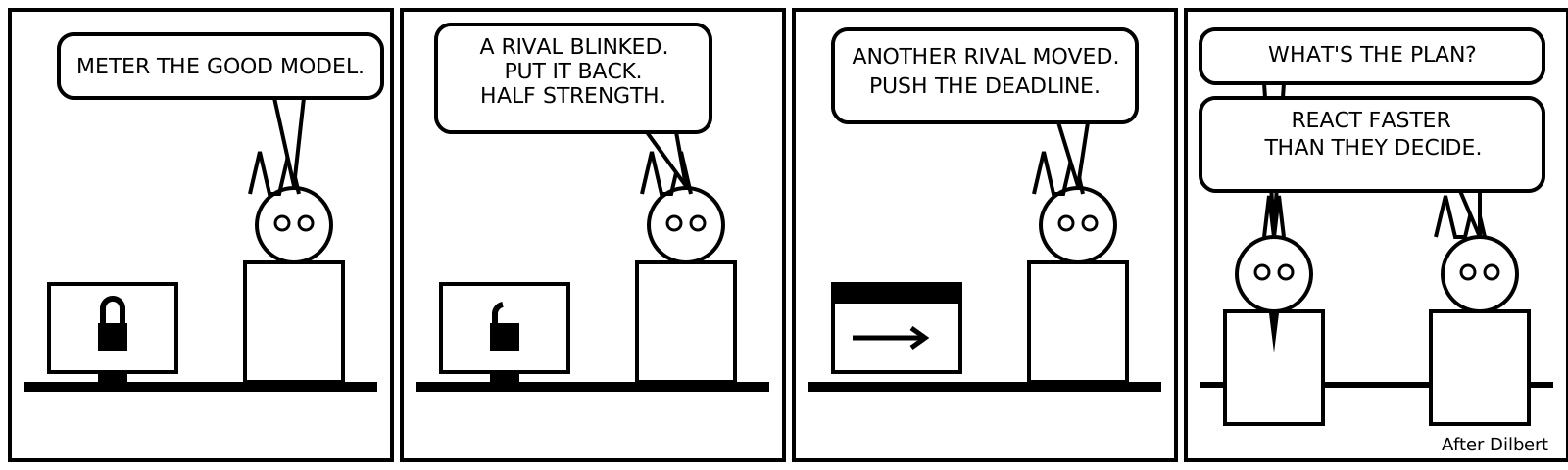
*After Dilbert — a corner-office pantomime of Anthropic's fourth Fable-5 pricing flip-flop in six weeks, drawn as a boss who only ever reacts to whatever the last competitor did. After Bloom County — on Tom Pidcock jumping into the break twice running at the Tour, and what "probably a mistake" looks like from a stone wall.*

Hand-drawn parody comic strip

↑ Back to top

ALSO NOTED

Also Noted

↑ Back to top

THE QUESTION

When Reacting to the Last Move Stops Counting as a Strategy

A sequence of reactions can pass for a strategy for a surprisingly long stretch — right up until somebody asks what the plan actually was, and the honest answer turns out to be an itemized list of things done in response to whatever the other side just did. That test landed twice this weekend, in two venues that could not be less alike: a war logging its eighth consecutive night of retaliatory strikes, and an AI company reversing its own pricing decision for the fourth time in six weeks.

The U.S. hit Iran for an eighth straight night after a Friday strike on a Jordanian air base killed two American soldiers, as this paper reported today — an escalation ladder with no stated rung at the top.1 Iran's supreme leader promised "unforgettable lessons."1 Nobody involved has said what ends this, only what happens next if it doesn't.

A very different kind of standoff produced the same shape. Anthropic folded Claude Fable 5 back into ordinary subscriptions at half its old usage limits today — the fourth reversal on how the model gets priced since a government shutdown order in June.2 As this paper's tech coverage notes, the moves have tracked competitors' releases almost step for step, including a deadline extension announced the same day a rival lifted its limits entirely. Simon Willison, watching from outside, put the tell plainly: why would anyone pay for a plan that excludes the best model.2 That's not really a question about Anthropic's math. It's a description of a company negotiating with itself in public, one competitor's move at a time.

The distinction that matters here isn't speed, and it isn't flexibility — adapting fast to new information is what a strategy is supposed to do. The distinction is whether there's a theory of the endpoint underneath the adaptation, something the actor could have stated in advance that predicts what it does next. Iran's leadership has offered threats, not an off-ramp. Anthropic's four pivots have each been justified after the fact, framed as a response to whatever just landed from a competitor, with no visible thesis about where Fable 5's pricing should actually land. Both look, from the outside, like the same failure mode: an actor whose next move is fully determined by what the other side did last, and nothing else.


Contrast that with the account Jonas Vingegaard gave, in today's Tour de France coverage, for his own tactical shift in the mountains this weekend: no longer the most explosive rider in the field, so the attack moves from the short ramps to the long, grinding pitches — a theory he stated before Sunday's summit finish at Plateau de Solaison, testable against what actually happens on the road.3 It might be wrong. Pogačar might simply out-climb him there too. But it's falsifiable in a way "we responded because they moved first" never is. A stated theory can fail and still have been a strategy. A string of reactions can succeed and still not have been one.

The question worth carrying past the coffee: for anything you're watching unfold this week — a war, a pricing war, a mountain stage — can the people running it tell you in advance what they'll do next, or only what they did last time?

Sources
  1. Iran War Updates: U.S. concludes 8th straight night of strikes on Iran after Iranian attack kills 2 U.S. soldiers cbsnews.com Jul 17, 2026
  2. Claude make Fable 5 permanent simonwillison.net Jul 18, 2026
  3. Pogačar: Vingegaard Did an Amazing Performance, Maybe He Will Drop Me on Alpe d'Huez velo.outsideonline.com Jul 18, 2026

↑ Back to top

Investigator Report

Investigator report — 2026/07/19

Verdict

A well-written, well-sourced edition — THE PELOTON's Seixas breakthrough, THE LONG READ's Rekursiv piece, and THE QUESTION's Iran/Anthropic/cycling bridge are all genuinely good — shipped with no lead image for the sixth straight day and, more consequentially, on a CCR session that quietly picked up exactly where 07/18 left off instead of starting fresh, the same failure mode the 07/18 investigator flagged and recommended fixing. Travel mode (Adast, France) was handled correctly end to end — weather, ride decision, and the ON THE ROAD subsection all honored the destination window and none of it was silently faked. The front page's visual hierarchy doesn't track its own priority scores: THE LONG READ (83) and THE QUESTION (78), the second- and third-highest-priority stories in the paper, get less space and smaller type than sections ranked well below them. A substantive, on-interest Tesla story (Q2 deliveries beat) was silently dropped by the researcher in favor of a novelty item on the same brand.

Frontpage

Clean, no clipping, no duplicate blocks, correct slugs/datelines throughout (verified against both frontpage.html and the rendered frontpage.png fetched from pd.thep3000.com/2026/07/19/). THE PELOTON correctly leads at priority 88 with a full-width 60px headline, matching the MAJOR archetype in art-director.md. There is no lead image anywhere on the page — meta.json names FROM THE ARCHIVE as lead_image_section and the archive section carries image: true in its frontmatter, but fetch_lead_image.py failed (see Pipeline observations), so the whole page is typographic today; the art director adapted gracefully (no broken <img>, no layout hole).

The layout does not track priority once you leave the lead slot. Row 2 gives THE LONG READ (priority 83, the edition's second-highest score) and FROM THE ARCHIVE (40, priority_cap: 45, "never leads the paper") identical column width and FROM THE ARCHIVE's headline renders at a visually larger size (.archive-col h2 { font-size: 40px } vs .longread-col h2 { font-size: 36px } in frontpage.html). Row 3 — the shortest row on the page at 306px, versus 580px for row 1 and 400px for row 2 — is where THE QUESTION (78, third-highest priority in the edition) ends up, sharing it with ALSO NOTED (10). Visually, on the rendered PNG, ARCHIVE and QUESTION look at least as prominent as LAB (66) and WORLD (74), which sit in the tall top row. art-director.md gives the AD real latitude here ("Think asymmetrically... vary the layout day to day"), so this isn't a broken rule, but the net effect is that a reader scanning the page by size would rank FROM THE ARCHIVE above THE LONG READ, which is backwards from the editors' own scores.

The long-form index.html (fetched from the live site) orders sections exactly per section_tiers in newspaper.yaml and shows no duplicate content or missing sections; frontpage.png and funnies.svg are both correctly embedded.

Priority ranking

SectionPriorityLengthImageNotes
THE PELOTON881,050 wordsno (failed)Correctly leads; earns the score — a French breakthrough podium on home roads
THE LONG READ831,283 wordsnoSecond-highest priority; visually subordinated to ARCHIVE (see Frontpage)
THE QUESTION78549 wordsnoThird-highest priority; placed in the page's smallest row
THE WORLD74290 wordsn/a (image_eligible: false)Correctly headline-only per rule
THE LAB66713 wordsnoSolid, but see Editorial reading below
FROM THE ARCHIVE40449 wordsyes (planned, not rendered)priority_cap: 45 respected; carried the meta-writer's image pick for at least the 6th time recently (see Pipeline observations)
ALSO NOTED10292 wordsn/aWithin priority_cap: 15
THE FUNNIES856 wordsn/aWithin priority_cap: 12

The spread (88 → 8) is not compressed or inflated — it maps sensibly onto the day's actual news weight, and no section reads as dressed-up-routine. The one real tension is layout-vs-score in the middle of the table (see Frontpage): priority order and visual order diverge for LONG READ and QUESTION specifically, while PELOTON/ARCHIVE/FUNNIES/NOTED all land where their scores would predict.

Editorial reading

Priority-to-layout mismatch for THE LONG READ and THE QUESTION. Covered in detail above; repeating the citation here because it's a layout judgment call, not a bug: frontpage.html lines 128–138 (row2 CSS) size ARCHIVE's headline larger than LONG READ's, and lines 140–151 (row3) give QUESTION the smallest row on the page. A reader who trusts font size and placement as a signal of what the paper thinks matters most would misread this edition's actual editorial ranking.

A substantive, on-interest Tesla story was silently dropped before it reached any writer. search_results.md (the scout's raw output) surfaces "Tesla Q2 2026 Deliveries Jump 25%, Beating Wall Street Estimates" (electriccarsreport.com, Jul 2026) plus "Tesla starts US production of best-selling 6-seater Model Y L" (Jul 8) and "Tesla makes the cut on California's newest EV Rebate program" under ## OTHER. None of the three appear anywhere in research.md — the researcher passed only the trivial "Tesla's New 'Balance Bike for Kids'" through to the writers (research.md line 45), which is what ran in ALSO NOTED. "Tesla/EV news" is an explicit, ranked reader interest in newspaper.yaml; a 25%-beat quarterly-deliveries story is a more substantive item than a $225 kids' balance bike, and there's no dropped: entry anywhere explaining why the earnings story didn't make the cut — it never reached the point where a writer could make that call.

THE LAB's beat is entirely AI-subscription-pricing, security, and corporate-legal today — zero graphics/gamedev/low-level-systems/demoscene, which together are 5 of the reader's top 8 ranked interests. This is the first day in the last nine editions (per recent_editions.md) without any representation of that cluster (Jul 11 Carmack, Jul 13 loop-throughput piece, Jul 18 "Doom Inside SQLite's Bytecode VM" all touched it). I checked whether this was researcher laziness: covered.json's all_urls confirms the candidate graphics pieces mentioned in research.md (Alan Wolfe's demofox.org post dated Jul 1, two fabiensanglard.net pieces, chipsandcheese.com's x86 piece, seangoedecke.com's two essays) were genuinely already fetched/featured in prior editions or are outside the 7-day recency cap — so this is a real quiet week for that beat rather than a filtering failure. Worth watching over the next few days rather than acting on now.

Voice, lede, and sourcing are otherwise clean. No hedge phrases surfaced in any section (grep'd for the standard tells — none found). THE QUESTION's lede preflight is genuinely honored: its opening sentence ("A sequence of reactions can pass for a strategy...") names no proper noun from either sibling section it draws from, satisfying its own PROPER-NOUN TEST. THE LAB's Bun/Rust item models exactly the vendor-source rule in action — Willison independently verified Sumner's blog claim via strings before the paper reported it, and the article says so.

Pipeline observations

CRITICAL (from log-pipeline-alerts.md): fetch_lead_image.py failed — OpenAI 400 billing_hard_limit_reached, described as "second consecutive edition." That undercounts the outage: funnies-openai.error.txt (a second OpenAI image call, for the comic) shows the identical billing_hard_limit_reached error on every edition since 07/14 — 07/14, 07/15, 07/16, 07/17, 07/18, and today — six straight editions with no lead image, not two. Every one of those meta.json files still planned a lead_image_prompt and lead_image_section, so the pipeline has been trying and silently failing since 07/14; the CRITICAL alert mechanism itself only started firing on 07/18, four editions into the outage. The reader has had zero editorial illustration for nearly a week and the alerting system took most of that week to notice.

The multi-day session-reuse bug the 07/18 investigator flagged and asked to be root-caused has recurred, one day later. 2026/07/19/jsonl/session.jsonl.gz (1,051 lines) is byte-identical for its first 733 lines to 2026/07/18/jsonl/session.jsonl.gz (733 lines) — today's run did not start a fresh CCR session; it continued directly from yesterday's. Consequently 2026/07/19/jsonl/subagents/ contains 41 agent transcripts, but only 20 of them (Scout, Researcher, 7 writers, 7 fact-checkers, meta-writer, thread-editor, art-director, comic-strip) actually ran today — confirmed by per-file timestamps, e.g. agent-a007c1a81e9e3c3da ("Write THE WORLD section") is dated 2026-07-19T04:36, while agent-a635c81418a0f849e (same role) is dated 2026-07-18T04:33. The other 21 files (20 duplicated-from-07/18 agents plus 07/18's own investigator transcript, which never made it into 2026/07/18/jsonl/subagents/ at all and leaked into today's folder instead) are carried-over artifacts, not today's work. No git commit between f4369f8 (Dispatch: 2026-07-18) and today's run addresses this — the 07/18 report's suggestion to "start each firing from a fresh session context" was not acted on, and the exact problem it described (session continuity inflating cost and context) repeated verbatim. This also means jsonl_to_trace.py's naive summary (below) is not a reliable view of today's actual pipeline: it sums the entire session file, double-counting every 07/18 agent invocation alongside today's.

No fetch failures, no malformed section outputs. fetch_results.json shows 0 of 30 items failed; both fetch_retry_results.json entries resolved ok: true. All 8 content.json sections have non-empty headline, priority, and article fields — no zero-byte skip sentinels, no truncated bodies. All 21 expected today-only subagent roles (Scout, Researcher, 7×writer, 7×fact-checker, meta-writer, thread-editor, art-director, comic-strip) are present exactly once; no missing or duplicated role for today specifically once the carried-over 07/18 files are set aside.

Starting commit. The Dispatch commit for today (12820e2) has parent 8b56635 ("Investigator: 2026-07-18", committed 04:57:55 the previous day) — a same-day-adjacent, non-stale starting point. No dispatch.md / .claude/agents/ / root-script changes landed in the one-commit gap, so code staleness is not a factor here; the session-reuse issue above is a separate, infrastructure-level problem.

Trace highlights

The raw jsonl_to_trace.py --summary table below is not representative of today's actual cost — see the session-reuse finding above. It sums two full pipeline passes (07/18's and 07/19's) plus one investigator run, because the underlying session file spans both days. Filtering to just the 20 subagent transcripts genuinely timestamped 2026-07-19, plus only the new (post-line-733) portion of the orchestrator's session, gives a corrected picture: subagents ≈ $8.73, orchestrator's today-only share ≈ $8.67, total ≈ $17.40 for this edition — versus the $48.48 the raw table reports.

Even in the corrected view, the orchestrator's incremental slice (~$8.67) is roughly even with all 20 subagents combined (~$8.73), and its 20.4M cache-read tokens for just today's ~318 new session lines is the same symptom the 07/18 report called out: an orchestrator re-reading a transcript that never resets carries cost forward day over day. Researcher was the single most expensive subagent today (54,633 output tokens in its own file, driven by an 84-source combined-research pass) but every writer downstream used only a few hundred tokens of that brief per section — consistent with a thorough researcher and appropriately lean writers, not waste.

Trace summary

Dispatch 2026-07-15 (model: claude-fable-5)

AgentDurInputOutputCache ReadCache 5mCache 1hCost
Scout194s622125031787731007140$ 0.49
Researcher1130s1583188560804422373300$ 2.75
THE WORLD101s81467162445900$ 0.19
THE PELOTON232s8669104225735910$ 0.32
THE LAB145s81593503565820$ 0.24
THE LONG READ49s81158686174570$ 0.08
FROM THE ARCHIVE32s10269119203273140$ 0.14
Meta-Writer88s222313606470852840$ 0.54
FC: FROM THE ARCHIVE86s1015120492433650$ 0.20
FC: THE LONG READ123s12184201029453570$ 0.23
FC: THE WORLD212s11776118170067654120$ 0.39
FC: THE LAB190s1836438637724350$ 0.40
FC: THE PELOTON306s1012226217919970$ 0.41
THE QUESTION146s61067445483040$ 0.20
FC: THE QUESTION164s2440458157521530$ 0.33
ALSO NOTED113s1018152162675970$ 0.30
Draw today's TWO parody comic strips for194s16524301184517820$ 0.29
FC: ALSO NOTED138s24480484101581180$ 0.37
Art Director195s61036478372880$ 0.15
Update story threads for today's edition313s6959563832010$ 0.33
Audit today's edition of Peloton Dispatc406s84109836679721306980$ 1.61
Scout281s1246012314377357877090$ 0.66
Researcher1291s4535463377567742552950$ 4.11
THE WORLD81s815105791734670$ 0.31
THE PELOTON223s1016141983516390$ 0.24
THE LAB142s82068764330890$ 0.15
THE LONG READ53s81456771168450$ 0.08
FROM THE ARCHIVE39s820999735371800$ 0.17
Meta-Writer40s6866949577900$ 0.24
FC: FROM THE ARCHIVE164s1228205237619960$ 0.29
FC: THE LONG READ234s10119173271647510$ 0.30
FC: THE WORLD84s817140160732590$ 0.32
FC: THE LAB195s1014179605656290$ 0.30
FC: THE PELOTON297s1221252267817110$ 0.38
THE QUESTION159s61310671179540260$ 0.42
FC: THE QUESTION218s1015204910818010$ 0.37
ALSO NOTED233s14681263794954830$ 0.45
Draw today's TWO parody comic strips for273s1687330513574550$ 0.32
FC: ALSO NOTED141s1423284802675460$ 0.34
Art Director240s61337909425920$ 0.17
Update story threads for today's edition283s63099963742836950$ 0.80
Orchestrator3531389174702601201986191$28.11
TOTAL227092675027159949329335271986191$48.48

Suggestions for next edition