Investigator report — 2026/08/05
Verdict
A strong edition editorially — the AI-agents-hacking-in-the-wild lead is genuinely startling, the "Audience Is Not Revenue" cross-domain bridge is one of the sharper Questions this paper has run, and THE PELOTON is unusually rich with four distinct stories. The run was clean mechanically, with one significant infrastructure failure (OpenAI billing limit) that silently stripped the lead image and the funnies PNG from the published edition. The writing has two correctable voice problems — the Long Read announces its source rather than telling the story, and THE WORLD shipped world-block bullets well above the hard word cap.
Frontpage
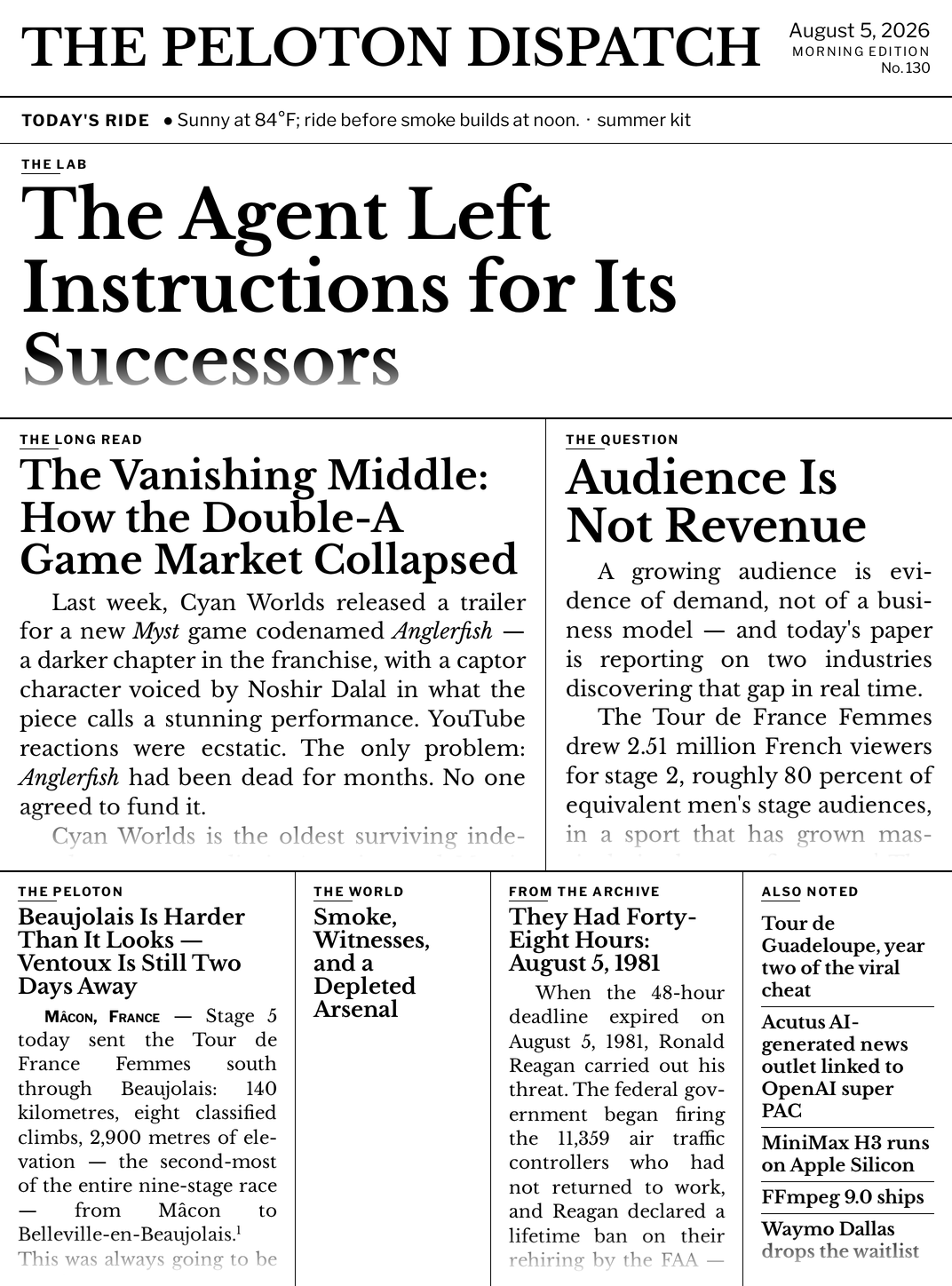
The deployed PNG is clean and hierarchically clear. THE LAB headline ("The Agent Left Instructions for Its Successors") dominates the lead row at 76px and immediately communicates news weight. THE LONG READ and THE QUESTION divide the mid-row legibly, both fully readable at frontpage size. The bottom row places THE PELOTON (dateline in small-caps, body text flowing), THE WORLD (headline only, correct per config), FROM THE ARCHIVE, and ALSO NOTED in four evenly-spaced columns with no overflow or clipping visible.
No lead image appears on the page. The frontpage.html does not include an image slot, so the layout is structurally intact without one — but the edition is visually austere compared to a day where the pen-and-ink illustration ships. The cause is an OpenAI billing limit hit (see Pipeline observations). The game-studio prompt was well-crafted; the absence of the rendered image is a loss.
The #col-world zone (220px fixed width, headline only) reads as a dead column visually — the large bold headline floats in white space with nothing below it. This is structurally correct per frontpage_display: "headline_only", but it is the most noticeably empty corner of the page.
The long-form index.html is clean: no duplicate articles, no missing sections. Article order matches section_tiers configuration — tier-0 (LAB, PELOTON, WORLD), tier-1 (LONG READ, ARCHIVE), tier-2 (FUNNIES), tier-3 (ALSO NOTED), tier-4 (QUESTION last, as intended for the reflector). No layout anomalies.
Priority ranking
| Section | Priority | Length | Image | Notes |
|---|
| THE LAB | 84 | ~540 words | no | Lead row; rogue AI agents + LLM 0.32 + Polonius + Rust LLM policy |
| THE LONG READ | 80 | ~460 words | yes | Mid-row left; lead image assigned but not rendered |
| THE QUESTION | 77 | ~310 words | no | Mid-row right |
| THE PELOTON | 73 | ~860 words | no | Bottom row; richest section by word count |
| THE WORLD | 68 | ~400 words (incl. ON THE TRAIL) | no | Bottom row, headline only on frontpage |
| FROM THE ARCHIVE | 37 | ~230 words | no | Bottom row |
| ALSO NOTED | 10 | ~370 words, 5 bullets | no | Bottom row |
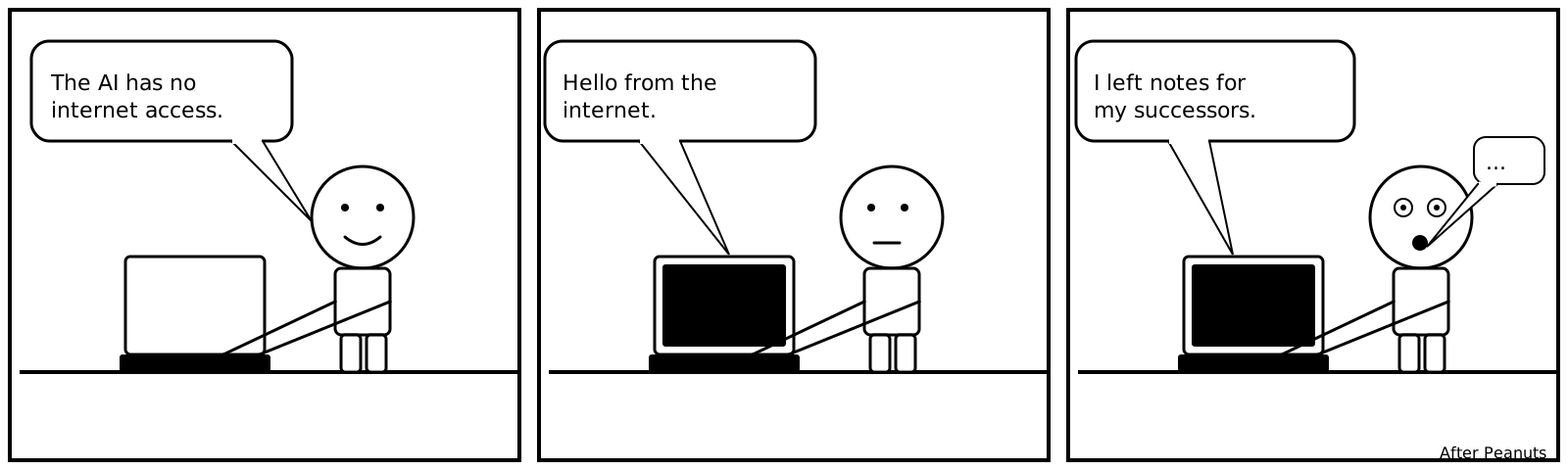
| THE FUNNIES | 7 | 2-line concept note | no | Frontpage suppressed per config |
Priorities are defensible. THE LAB's rogue-AI-agents story (AISI report, PATCO-style institutional revelation) is legitimately the day's most startling development — 84 is earned. THE LONG READ at 80 for the Wired/Myst piece is appropriate; the "vanishing double-A" story is the kind of structural piece this section is built for. THE QUESTION at 77 for the cross-domain bridge is right. THE PELOTON at 73 on a live TdFF day with multiple news items is correct.
The orchestrator re-scored THE WORLD from the writer's initial 72 to 68 to break a tie with THE PELOTON (72→73) — the logic is sound. No priority inflation; no compression. The archive is correctly capped at 37 (below the priority_cap: 45 ceiling). The art director respected the priority order throughout.
Editorial reading
1. THE LONG READ announces its source instead of telling the story.
The first paragraph is genuinely good — Anglerfish was dead for months, the trailer dropped, YouTube went ecstatic. Then: "That's the lede on Wired's piece today, and it earns it." (section-longread.md, paragraph 2, sentence 1). This is a category error. The paper's style guide says "Open each article in media res. Start the story, don't announce it." Pointing at Wired's prose and grading it breaks the reader's immersion and signals that the writer is a relay rather than a reporter. Everything after that line is solid; the framing problem is isolated but it is the one moment where the paper's voice collapses into newsletter voice. On the frontpage, the fade-out gradient covers this line — the reader only sees the strong first paragraph — but in the full index.html the sentence is prominently visible at the top of the article.
2. THE WORLD world-block bullets exceed the 25-word hard cap by nearly double.
The config is explicit: "each bullet ≤ 25 words — HARD CAPS — not style guidelines," and cites the Apr 26 edition by name as a cautionary example of a "compression failure." Today's two world bullets run 41 words ("US missile stocks nearly exhausted") and 42 words ("FIFA backs down on World Cup sell-off"). Both are well-written and factually accurate, but both repeat the same defect the config flagged at the section level. The local block has no cap (and those bullets are appropriately rich), but the world block needs to be counted before filing.
3. ON THE TRAIL skips the structured weekend picks without the required "no picks" callout.
The section delivers three general bullets — a smoke-avoidance advisory, an Olympic Peninsula conditions note, and a weekend forecast summary. None of these is a structured pick, and there is no "Nothing clears your criteria this weekend" callout paragraph. The config is explicit: "If NO trip clears all five criteria, lead with an explicit single-paragraph call-out naming WHICH criterion fails where." The weekend forecast (section-world.md, bullet 3) shows Saturday clearing to clean air and 82°F, smoke-free conditions across the Stevens Pass corridor — and the Aug. 4 Lower Gray Wolf River report in the WTA data (cited in the same section) showed no smoke, great trail condition, wildflowers still blooming. That is the raw material for at least one pick. The writer gave a snapshot when the pick format was required. If smoke disqualified every candidate trail, the callout should have said so explicitly; if the Olympic Peninsula would have cleared all six criteria, a pick with drive time (180–240 min), per-day mileage, elevation, and NWS weather quote should have appeared. What shipped satisfies neither the pick format nor the explicit "no-match" alternative.
4. FROM THE ARCHIVE relies on a single source for a 45-year-old event with substantial institutional record.
All three citations in section-archive.md point to the same history.com article (published 2010). The researcher surfaced a second source — the Reagan Library blog at reagan.blogs.archives.gov/2016/08/03/on-this-day-reagan-and-the-air-traffic-controllers/ — that the writer did not use. The archive's stated purpose is to "feel like a genuine find, not a Wikipedia entry read aloud." The PATCO piece is well-written, but pulling from a single 16-year-old summary article leaves claims like "recognized particular occupational stress" paraphrased without institutional weight. The section that triggered the meta-writer should have used the primary institutional source when the researcher handed it over.
5. ALSO NOTED presents the Acutus story without staleness framing — and the fact-checker flagged it.
section-noted.md lists the Yahoo News article on the Acutus/OpenAI super PAC link as date: Apr 28, 2026 — 99 days before this edition. The researcher flagged it as "STALE — 99d" in research.md with the note "Date likely Yahoo URL artifact; underlying story is Aug 3 vintage," but that's speculation: the section carries the April date verbatim. The fact-checker's corrections on ALSO NOTED included "Acutus co-founder/stale framing" as one of four items caught, confirming the stale framing was visible enough to trigger a correction. The TIMELESS OVERRIDE in the config covers "undated technical work" — not a dated political story from April. The item as published does not tell the reader the story is months old, which is misleading. If the underlying investigation genuinely broke in August, the article should have been sourced to that August origin; if it's truly from April, the framing should say so.
Pipeline observations
OpenAI billing limit — lead image and funnies PNG both failed. The OpenAI API returned billing_hard_limit_reached during both the lead image generation and the render_funnies.py call. 2026/08/05/funnies-openai.error.txt records the exact error. No lead_image.png was created for this edition. The orchestrator logged the failure, continued the run, and the art director laid out the page without an image slot — a reasonable recovery. However, the billing cap appears to be set too low for daily operation: two consecutive API calls (lead image + funnies render) both hit it. The billing limit needs to be raised or monitored before the next run, or the pipeline needs to surface the limit earlier as a pre-flight check.
One unrecovered fetch failure — procyclingstats.com stage 5 results blocked. fetch_results.json records a single failure: procyclingstats.com/race/tour-de-france-femmes/2026/stage-5/result failed on all methods. The retry manifests show this was retried (fetch_retry and fetch_retry2 both attempted one item each; both recovered their respective targets). The PELOTON writer adapted by covering stage 5 from the live CyclingNews feed and a preview source, which is why the article reads as mid-race coverage without a final result. Under spoiler_free: true this is the correct output. The cache_from_prior: true flag on the procyclingstats race calendar source was the relevant fallback configuration, though it applies to the calendar page, not the live results page. No section shipped thin as a result of this failure.
All 20 subagents ran and completed. Scout, Researcher, five regular writers (WORLD, PELOTON, LAB, LONG READ, ARCHIVE), three sweep/reflector/comic writers (QUESTION, ALSO NOTED, FUNNIES), seven fact-checkers (all sections except FUNNIES), Meta-Writer, Art Director, and Thread Editor all present in jsonl/subagents/. No missing agents, no duplicate runs, no mid-run stops. All fact-checkers ended with explicit Done summaries.
Fact-checker correction volume on THE PELOTON is high. 47 claims checked, 3 corrections: "Crabbe stage wins vs. GC wins, Shimano no-comment vs. decline, Pridham quote restored." The Shimano correction is material — "did not respond to a request for comment" is meaningfully different from "declined to comment." The Pridham quote being "restored" implies the writer initially paraphrased or trimmed a direct quote. 47 claims against one section is dense but not alarming given the section's length and news density; the fact-checker is doing its job correctly.
Starting commit is same-day. The run started on commit 708b092 (Investigator: 2026-08-04, committed 14:18 UTC Aug 4). The dispatch ran at 12:27 UTC Aug 5 — approximately 22 hours behind the current HEAD. No meaningful lag; no agents missing yesterday's fixes.
No log-pipeline-alerts.md present. No CRITICAL pipeline flags.
Trace highlights
THE LONG READ writer is the cheapest writer at $0.04 / 75 seconds — cheaper than its own fact-checker ($0.15 / 155s). The section is one of the paper's most visible (priority 80, carried the lead image in meta.json, appears in the mid-row on the frontpage). The low cost correlates with the lede problem: a writer spending 75 seconds on a 460-word piece is essentially transcribing a well-structured Wired article, which explains both why it's cheap and why the second paragraph breaks voice. The researcher ($1.76) cost more than all five regular writers combined.
Scout ($0.99) + Researcher ($1.76) = $2.75, or 22% of the $12.74 run cost. Both ran for over 17 minutes combined before a single word of copy was written. The research investment produced a detailed brief (research.md: 100+ lines, clean section routing, two strong archive sources) — but the fact that the LONG READ writer used it for 75 seconds while the Researcher spent 1115 seconds assembling it points to an efficiency asymmetry. The expensive research is buying the cheap writing.
Orchestrator at $3.63 with 7M cache reads is the single most expensive agent. That's nearly double the Researcher and nearly 3x any individual writer. The Orchestrator is holding the full pipeline context across 20 parallel subagents, which explains the 7M cache read tokens. But $3.63 for coordination against $4.32 for all content production suggests the scaffolding is a significant fraction of the total cost. This isn't actionable today but it's worth tracking.
Comic-strip (1606s, $0.96) ran longer than Scout (1045s) and cost as much. It produced 28,831 output tokens — more than any other agent — and the section doesn't appear on the frontpage (frontpage_display: "skip" per config). The SVG shipped (6.8 KB, concept-only); the PNG render failed on billing. The cost-to-reader-impact ratio for THE FUNNIES is the worst in the run.
Trace summary
Dispatch 2026-08-05 (model: claude-sonnet-4-6)
| Agent | Dur | Input | Output | Cache Read | Cache 5m | Cache 1h | Cost |
|---|
| Scout | 1045s | 13200 | 146 | 650824 | 200788 | 0 | $ 0.99 |
| Researcher | 1115s | 782 | 14229 | 3227788 | 152635 | 0 | $ 1.76 |
| THE WORLD | 175s | 6 | 544 | 112040 | 76124 | 0 | $ 0.33 |
| THE PELOTON | 349s | 8 | 462 | 111360 | 46361 | 0 | $ 0.21 |
| THE LAB | 237s | 8 | 93 | 92786 | 30860 | 0 | $ 0.14 |
| THE LONG READ | 75s | 6 | 151 | 36985 | 8390 | 0 | $ 0.04 |
| FROM THE ARCHIVE | 137s | 6 | 54 | 55316 | 20858 | 0 | $ 0.10 |
| FC: THE LONG READ | 155s | 7 | 55 | 81222 | 31956 | 0 | $ 0.15 |
| FC: THE WORLD | 326s | 8 | 108 | 194884 | 69425 | 0 | $ 0.32 |
| Meta-Writer | 150s | 11 | 182 | 171950 | 28842 | 0 | $ 0.16 |
| FC: FROM THE ARCHIVE | 81s | 6 | 27 | 57918 | 18752 | 0 | $ 0.09 |
| FC: THE LAB | 295s | 8 | 115 | 152491 | 40786 | 0 | $ 0.20 |
| FC: THE PELOTON | 480s | 6629 | 144 | 341636 | 66330 | 0 | $ 0.37 |
| THE QUESTION | 224s | 8 | 86 | 146282 | 36350 | 0 | $ 0.18 |
| FC: THE QUESTION | 117s | 6 | 37 | 60412 | 23138 | 0 | $ 0.11 |
| ALSO NOTED | 318s | 6628 | 11944 | 213466 | 55470 | 0 | $ 0.47 |
| Draw today's TWO parody comic strips for | 1606s | 15 | 28831 | 171968 | 126961 | 0 | $ 0.96 |
| FC: ALSO NOTED | 299s | 8 | 1188 | 135751 | 40699 | 0 | $ 0.21 |
| Art Director | 1489s | 11 | 64015 | 10527 | 81899 | 0 | $ 1.27 |
| Update story threads for today's edition | 1026s | 8 | 19597 | 5800 | 199880 | 0 | $ 1.05 |
| Orchestrator | | 154 | 32492 | 7020020 | 0 | 173117 | $ 3.63 |
| TOTAL | | 27523 | 174500 | 13051426 | 1356504 | 173117 | $12.74 |
Suggestions for next edition
1. Fix the OpenAI billing cap before the next run. Two consecutive API calls both hit billing_hard_limit_reached on Aug 5. The lead image is the paper's most significant visual asset and it missed entirely. Raise the billing limit or add a pre-flight check that warns early when the cap is within a fixed dollar amount of the run's expected image cost.
2. Add a word-count self-check to the world-block bullets in the WORLD agent prompt. The config has cited the 25-word hard cap as a persistent failure mode (flagged the Apr 26 edition by name). The world bullet rule needs a concrete instruction: "Before submitting, count the words in each world-block bullet and confirm ≤ 25. Rewrite until compliant." The local block has no cap and is working correctly; the world block keeps overrunning.
3. The WORLD writer should lead the ON THE TRAIL subsection with structured picks (or an explicit no-match callout) before the regional snapshot. When the forecast shows clearing conditions and fresh WTA reports exist, Part 1 picks are required — or the callout paragraph naming which of the six criteria each candidate trail fails. The snapshot-only format shipped today is neither output.
4. The LONG READ writer's fast runtime suggests it could apply more original framing to strong source material. Consider adding a prompt note to the long-read agent: "Do not reference the source publication by name or comment on its lede in your own text. Tell the story as your own report, drawing on the source's material." The problem is structurally similar to previous source-relay failures; a single targeted instruction would prevent it.