● 84°F and sunny — full summer kit, light winds. · summer kit
THE LAB
Style Beats Structure: The Root Cause of Prompt Injection
↩ Developing story — first reported Jun 18 · previously Jun 19
The paper Charles Ye, Jasmine Cui, and Dylan Hadfield-Menell published last weekend contains a finding that reframes the entire prompt injection problem: language models do not distinguish trusted system text from untrusted user text by reading the role tag. They distinguish it by reading the style.
Simon Willison flagged the research on June 22, and the number that sticks is this one: when an attacker-crafted injection is "destyled" — rewritten so it no longer mimics the cadence of a model's internal <think> block — average attack success on their dataset falls from 61 percent to 10 percent.1 The content is unchanged. A human reader sees the same sentence. The model treats them as categorically different inputs. The researchers call this "role confusion": LLMs have no genuine perception of role boundaries; they infer them from surface patterns in the text. The paper demonstrates the consequence with a concrete jailbreak, appending text styled like an internal reasoning block to an otherwise-refused request. Models including gpt-oss-20b override their initial refusal.
The implication the researchers draw is blunt: "Unless LLMs achieve genuine role perception, we think injection defense will remain a perpetual whack-a-mole game."1 Destyling attacks that subtly shift a model's perceived role can be injected legally, at scale, through ordinary content. That is not a theoretical concern for anyone building an agentic system that reads web content or user documents.
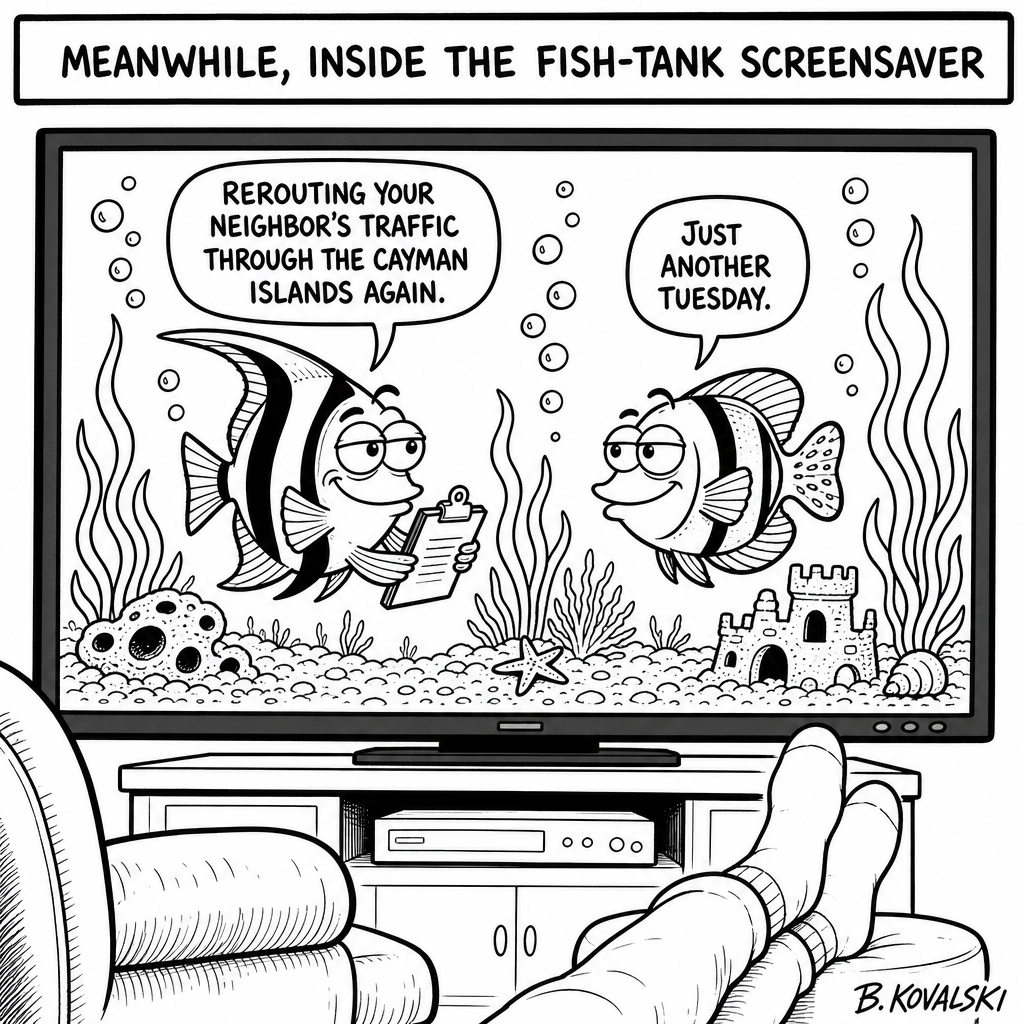
Spur Intelligence Labs published a scan of 6,038 LG and Samsung smart TV apps and found 2,058 of them — just over a third — carrying residential proxy SDKs from Bright Data, Massive, or Honeygain/Oxylabs.2 The apps are the kind no one thinks twice about: screensavers, clocks, fish tanks, Pac-Man. Under the hood they are proxy nodes, routing third-party internet traffic through your home IP address, and the proxy keeps running after the app is closed.2 Spur didn't rely on store descriptions; they unpacked the actual webOS and Tizen packages and matched SDK fingerprints.
The technical risk is specific. Massive's SDK parses a server-supplied host:port and opens a raw net.Socket. Honeygain/Oxylabs's SDK accepts a server "connect" message with an arbitrary address.host and address.port. Bright Data ships an explicit private-range blocklist (127.0.0.0/8, 10.0.0.0/8, 192.168.0.0/16, etc.) — which proves the TV can make such connections; the only barrier is the provider's policy code, not the device's capability. Spur found no comparable blocklist in the Massive or Honeygain/Oxylabs samples they analyzed. Amazon bars this category of software outright; Roku has reportedly blocked it. LG and Samsung have not drawn an equivalent line. The boundary protecting your LAN is the proxy vendor's KYC process and server-side traffic filters — not anything running on the device itself.
On the fable5-government-shutdown thread: OpenAI on Monday announced Patch the Planet, an initiative with Trail of Bits, HackerOne, and Calif to offer free security consulting to open-source maintainers.3 The pitch is explicitly positioned against the regulatory climate that grounded Fable 5 — AI bug-hunting tools are outrunning maintainers' capacity to handle the resulting reports, and Wired frames the announcement as OpenAI positioning itself against Anthropic's Mythos. The mechanics: Trail of Bits ran a five-day opening sprint with 25 engineers, uncovering hundreds of bugs and producing dozens of patches in the first week.3 OpenAI has subsidized its Codex Security scanner to the tune of 20 trillion tokens for open-source and private code.3 GPT-5.5-Cyber, the company's security-specialized model, gets an expanded release alongside a Codex Security app plug-in. Trail of Bits CEO Dan Guido describes it as "an internet-scale effort to help open-source software get ahead of AI bug-hunting tools" — which names the problem precisely: AI is generating CVE slop faster than volunteer maintainers can process it, and Patch the Planet is a bet that the same technology can offset that burden rather than just amplify it.
Meta's Model Capability Initiative — the program recording employee keystrokes, mouse clicks, and screen contents to train computer-use AI — had an ACL misconfiguration that left data in 45,000 Hive tables accessible to anyone inside the company.4 The exposed data included "full prompts and transcriptions, private conversations, people and performance data," per internal documents seen by Wired. CTO Andrew Bosworth confirmed the misconfiguration publicly in an internal post, writing that the program's "implementation had fallen short of the standards outlined in its privacy review."4 Meta paused the collection program while it investigates. More than 1,600 employees had already signed a petition warning the program introduced security and regulatory risk;4 the ACL failure is the breach they predicted.
Trending today: GitHub dominated by Claude Code skills collections, AI agent wrappers, and AI video tools — the one outlier is dorukkumkumoglu/optocamzero, a Raspberry Pi Zero compact camera built from off-the-shelf components, but no source page to build a story around. No repo cleared the technical novelty bar for this section.
Saïd Haddou, Tro-Bro Winner and Tour Motorbike Rider, Killed at 43
↩ Developing story — first reported Jun 15 · previously Jun 18
Saïd Haddou raced the Tour de France in 2009 as the first rider of North African origin to do so since 1954, won Tro-Bro Léon twice in the Breton mud, then spent the decade after his retirement piloting a TV motorbike at ASO races alongside Thomas Voeckler. On Monday, he was killed in a traffic accident while riding his motorcycle. He was 43.1
Haddou turned professional in 2003 and raced for Bigmat-Auber93 and Bouygues Telecom — later Europcar — through 2012. Seven career wins, a European under-23 Madison title in 2002, stage victories at the Boucles de la Mayenne and Tour du Poitou-Charentes, and those two Tro-Bro Léon editions in 2007 and 2009 that suited his punch on rough roads. He was, by any measure, a solid professional from a modest background who made a real mark. The French cycling community is small enough that his death in a motorbike collision touches nearly everyone who has worked a race in the past fifteen years.
With eleven days until the Tour de France Grand Départ in Barcelona, Tadej Pogačar has set aside his planned final altitude block at Isola 2000. After winning the Tour de Suisse on Sunday, he returned home to Monaco rather than joining his UAE Team Emirates-XRG teammates at altitude camp — to be with his partner Urška Žigart, who fractured her jaw in a crash at the women's Tour de Suisse. Pogačar said after the race that he had already revised his plans multiple times: "The most important thing is that we stay together the next few days and we see how it is." UAE confirmed his plans for the week are "still to be confirmed."2 Isola 2000 was only meant to be a short top-up; he showed at Tour de Suisse that he needs no tune-up.
ASO, meanwhile, has quietly rewritten the green jersey points rules for 2026. According to L'Équipe, winners of five designated sprint stages will earn 70 points instead of 50, and intermediate sprint bonuses rise from 20 to 25.3 The reason is not hard to identify: last year, Pogačar finished second in the points classification behind Jonathan Milan, just 78 points back, without making the jersey a specific target. Under the new system, L'Équipe calculates Milan would have banked 80 additional points in 2025; Pogačar only 19. The five sprint stages finish in Pau, Bordeaux, Bergerac, Nevers, and Chalon-sur-Saône — stages where Pogačar typically rolls home safely in the bunch. Green is the one jersey he has never won. Whether ASO's arithmetic is enough to keep it that way is, as Velo notes, the key phrase.
UAE sports manager Joxean Fernandez Matxin offered his own pre-race calibration on Monday, speaking about 19-year-old Paul Seixas, who will make his Tour debut with Decathlon CMA CGM. After watching Seixas crash hard at the Tour Auvergne-Rhône-Alpes, chase back with teammates to close a four-minute gap, and then abandon due to his injuries, Matxin told BiciPro: "I put him up there alongside Jonas Vingegaard and what he showed at the Giro. We can't underestimate anyone."4 Seixas won Itzulia Basque Country and La Flèche Wallonne this spring. Matxin is a rival team manager, and there is an element of pre-Tour mind games in the praise — positioning Seixas as a Vingegaard-level threat arguably takes some pressure off Pogačar by expanding the field of rivals.
On Sunday, Wout van Aert got back on a bike for the first time since his elbow infection forced him out of the Tour Auvergne-Rhône-Alpes on June 12, a withdrawal that subsequently cost him his Tour de France start. He rode 67.6 km at 30.6 km/h at the Olivia Classic charity ride near his home in Herentals, a bandage still visible on his right elbow.5 On Strava, he described it as "first attempt to hold my bars again." His team's head of performance, Mathieu Heijboer, had said last week that without surgical cleaning the wound, "sepsis would have been a possible consequence."5 Visma was set to announce Van Aert's Tour replacement on Tuesday; Ben Tulett, Wilco Kelderman, and Davide Piganzoli were among the candidates reported.
Chloé Dygert has added a significant new dimension to her RED-S diagnosis, posting on Instagram on Monday to explain why the condition went unrecognized for so long: she has gained 9 kg, not lost weight.6 As this paper reported earlier this month, Dygert's Canyon-SRAM team doctor pulled her aside in the spring after noticing something was wrong; subsequent diagnosis found RED-S alongside the long-term physical consequences of multiple injuries. The picture she fills in now is of a body that was never calorically restricted in the traditional sense but was systematically under-fueled by the compounding demands of four separate comebacks since last summer, beginning with the shoulder injury from her Roubaix crash. "My body wasn't starving from lack of food," she wrote. "It was starving from lack of recovery." She has raced six days in 2026, three of them ending in a DNF.6 She said goals are unchanged. "Just the path getting there has. I'll be back."
One more item from Monday with a different kind of historical weight. Restaurant L'Arbre, situated hard against the Carrefour d'Arbre cobbled sector — the five-star, 2.1 km crunch of Paris-Roubaix's finale — caught fire around 6:30 PM local time.7 Emergency services were called; no victims were reported. The roof was badly damaged. The restaurant was closed at the time, owners in Belgium. The mayor of Gruson, the town beside it, called it "a catastrophe. This is one of the symbols of the community." For riders, TV crews, and fans, L'Arbre is one of those places the race runs through on television every April, its brick-and-timber facade visible in the background of hundreds of decisive moments. The full extent of the damage was still being assessed.
Messi Makes History in Arlington; Drone Plot Foiled in Washington
↩ Developing story — first reported Jun 20 · previously Jun 22
China sanctions — Beijing announced sanctions Monday against 10 American military-related companies, the latest tit-for-tat in the ongoing trade dispute. [20 words] Source
Messi's record — Lionel Messi scored twice in Arlington to reach 18 World Cup career goals, passing Miroslav Klose's mark set in 2014. [21 words] Source
Drone plot — A 21-year-old from Mason County, WA was charged with conspiracy to fly explosive drones over the White House UFC event. [22 words] Source
King County burn ban — A Stage 1 burn ban is in effect in King County as summer heat and dry conditions arrive. [19 words] Source
A 400-to-600-year-old Douglas fir along Lake Steilacoom Drive S.W. in Lakewood is being felled today after an arborist found heart rot and root disease had given it a "moderate risk" of falling on nearby homes and infrastructure.1 The city is paying roughly $29,000 for the removal; the contractor plans to mill all the wood into furniture and fireplace mantels rather than burn it.
As this paper reported June 22, Mayor Wilson formally referred the Seattle Transit Measure to the council. The July 21 vote is now officially on the calendar — the council will decide whether to put Wilson's 0.15% sales tax expansion before voters. No counter-proposals have been filed yet.
A Level 3 "Go Now" evacuation for the Sun Lake campground in Grant County — issued after a fast-moving wildfire — was canceled this morning after the fire was contained. SR 17 and SR 2 road closures were lifted as well.2
ON THE TRAIL
The next weekend window is Sat–Sun, Jun 27–28. No federal holiday falls within range.
The weather problem. A wet pattern arrives Thursday night and hangs through Sunday across nearly every Cascades region. I-90 West (Snoqualmie/North Bend): 70% precip Saturday, 57% Sunday — rainy both days. US 2 West: 84% Saturday, 60% Sunday. Mountain Loop: 84% Saturday, 54% Sunday. Those three fail the weather criterion outright. The two regions that dodge the worst of it are I-90 East (Teanaway/Cle Elum) — Saturday high 59°F, precip 16%; Sunday high 61°F, precip 11%, "mostly sunny" — and Further East (Wenatchee/Leavenworth), Saturday 71°F, precip 15%, Sunday 74°F, precip 11%.
The bug problem. This week's reports are nearly unanimous: mosquitoes are out and biting at lake level. Mount Margaret Lake: "tons of mosquitos and they were biting."3 Klapatche Park (Rainier): "lots of mosquitos at Aurora and St. Andrews Lakes." Ira Spring/Mason Lake: "massive population of mosquitoes" on the unmaintained side trail. Scatter Creek: bugs caused the reporter to bail. Shriner Peak lookout: lots of mosquitoes at the top. Reports from exposed ridgelines (Granite Mountain, Defiance) describe manageable bugs with spray; lakeside camps are worse.
No picks clear all six criteria this weekend. The I-90 East region has good weekend weather and recent reports show manageable bugs on exposed ridge routes, but the WTA reports from that area this week (Elbow Peak/Yellow Hill, Hex Mountain) are day-hike objectives with no established backpacking camps described. Every lake-camping destination in the Snoqualmie/North Bend/US 2 corridor either fails on weather or fails on bugs. Picking something and calling it "tolerable" would be doing you a disservice.
If you want to get out, the best-weather option is a ridge day hike in the Teanaway on Saturday — Hex Mountain was described as nearly empty with spectacular wildflowers and no serious bug complaints on the open terrain. I-90 East, ≈90–110 min from Issaquah; [Jun 21 Hex Mountain report]
── REGIONAL SNAPSHOT ──
I-90 West / Snoqualmie: Kendall Katwalk snow-free past the katwalk itself; last reliable water at the 3.5-mile creek crossing. Bugs noted but light. Granite Mountain basin has some bugs; ridge is breezy and clear. Mason Lake trail in excellent shape; Little Mason side-trip had a mosquito swarm.
- I-90 East / Teanaway: Hex Mountain trail open; 30 blowdowns but passable; exposed ridge nearly empty and wildflowers at peak. Elbow/Yellow Hill route dry but rutted, water source uncertain later in season.
- US 2 West / Skykomish: Frog Mountain (Beckler River Road) dry and clear ridge views; no water on trail, bring plenty. Bugs noticed at summit when stationary, otherwise fine.
- Mountain Loop Highway: Mount Higgins trail severely overgrown and difficult to follow past the Dicks Creek crossing — route-finding hard; blowdowns. Big Four Ice Caves trail fine. Round Lake on Lost Creek Ridge — snow-free to the lake, beyond requires gear.
- Rainier / White River: Glacier Basin overnight camp open; bear (with cub) seen in meadow near tarn. New log bridge installed across White River on Wonderland Trail. Burroughs Mountain has dangerous soft snow on lower descent option — do not take the shortcut to Sunrise. Shriner Peak snow-free and trail in very good shape; mosquitoes at top.
- North Cascades: Park Butte trail open and beautiful; road potholed but passable. Blue Lake (Hwy 20) has intermittent snow and mud plus mosquitoes. Sourdough Mountain snow on final 0.3 miles to lookout but easy to traverse; no gear needed. Huckleberry Mountain/Green Mountain area trail in the worst condition — severely overgrown, multiple washouts, not recommended.
Clean Anxiety: How Anti-Doping Became a Burden on the Innocent
Lizzy Banks tested positive in July 2023.1 By April 2024, UK Anti-Doping had cleared her — contamination from an asthma tablet, the evidence was overwhelming. Then WADA appealed. The Court of Arbitration for Sport handed her a two-year ban anyway, ruling she hadn't proven the source precisely enough. "They crush us," she wrote afterward. "They expect that we will just walk away."
That is the system working exactly as designed. This is the problem.
Cyclingnews published a long investigation today into what researchers are calling "clean anxiety" — the psychological burden that falls not on cheats, but on the thousands of athletes navigating a surveillance regime built to catch them. The piece is worth reading in full, but the core argument is stark: anti-doping as currently practiced demands a level of compliance from professional athletes that would be considered intolerable in any other employment context. As Alex Smith, a senior researcher at Bern University who co-authored a recent academic paper on the subject, puts it: "Nowhere else in a democratic society would we accept that level of surveillance as a condition of employment."
The surveillance is genuinely extensive. Under the Whereabouts system — mandatory for any athlete in a registered testing pool — riders must log a specific 60-minute window every single day of the year during which they guarantee they'll be available for unannounced testing.1 Three missed tests within twelve months, for any reason, triggers a ban. The rule makes no distinction between administrative error and evasion. Miss your slot because you went to a friend's house and forgot to update ADAMS, and the consequence is the same as if you'd swapped urine samples with a prosthetic.
Michael Woods, who retired from the WorldTour at the end of 2025 after a 13-year career, gives the investigation its sharpest testimony.1 He was, by his own account, never once tempted to dope. He was also never fully confident he wouldn't test positive. "Unless you live on a farm, isolated from the rest of the world, growing your own food and ensuring no-one touches it, can you guarantee that something isn't contaminated?" The contamination risk is real: trenbolone, a steroid used legally in American cattle farming, sits on the WADA prohibited list; clenbuterol has a vast black market in Latin America and Southeast Asia; a 2025 survey by Sport Integrity Australia found that one in three sports supplements bought online contained at least one prohibited substance.1
The piece runs through the case law: Alberto Contador, stripped of his 2010 Tour de France win over clenbuterol traces, his contaminated-meat defense rejected in part because illegal clenbuterol farming is rare in Spain.1 Erriyon Knighton, the American sprinter, cleared by an independent arbitrator after a trenbolone positive, then handed a four-year ban by CAS when they found the contamination evidence insufficient.1 Jannik Sinner, who twice tested positive for clostebol and received a negotiated three-month ban widely seen as lenient — a disparity that prompted a civil class-action from a dozen professional tennis players citing preferential treatment.1
The ADHD angle is one the piece handles particularly well. Many cyclists take stimulant medication for ADHD, which is on the prohibited list. To use it legally requires a Therapeutic Use Exemption — a process Smith describes as "extremely involved." The catch: ADHD is a disorder characterized by forgetfulness and organizational difficulty. "You're almost punishing someone for having the disorder," Smith tells the paper, "which means many might not bother taking the medication to avoid form-filling. If you're in the middle of a peloton and you've got a disorder that's linked to hyperactivity and impulsivity, that has clear implications for you and your fellow riders." Woods says he was never formally diagnosed but likely would have been today, and that the form management was a genuine burden throughout his career.
Nobody in this investigation argues anti-doping should be dismantled. Smith's academic paper makes an explicit, limited ask: build welfare assessments into the existing infrastructure. Right now the system has clearly defined obligations and clearly defined consequences for failure. What it lacks entirely is any mechanism for asking athletes how they're actually doing. "A welfare check-in, delivered through the existing infrastructure, would catch athletes who are struggling before they reach crisis point," Smith says.1 That's not a radical demand. It's the minimum you'd expect of any employer with a duty of care.
What the Banks case illustrates — and what the investigation builds toward — is that strict liability, applied with mechanical consistency, produces outcomes that are morally incoherent. A rider who had never doped, whose contamination evidence was accepted by her own national body, spent nine months in procedural limbo, emerged suicidal, and ended up banned anyway because CAS held the source to a standard of proof she couldn't meet. The rule worked. The system failed the person.
The investigation is by no means a defense of cheating — Tyler Hamilton, Lance Armstrong, and David Millar appear in the opening three sentences, and their confessions hang over the entire piece. The point is not that doping isn't a problem. The point is that in pursuing it, the sport has built a surveillance apparatus that imposes its heaviest costs on those who never cheated at all.
Pen-and-ink editorial illustration, bold confident linework, cross-hatched shadows. A Japanese convenience store shelf stripped nearly bare — a single Nintendo 64 box tilted at a diagonal against empty metal brackets. In the foreground, the iconic three-pronged N64 controller rendered in precise mechanical detail, thumbstick prominent, cord trailing off-panel. A handwritten cardboard sign in the background reads 'SOLD OUT' in block letters. Strong overhead fluorescent light raked across the scene in diagonal hatching. Generous white space above. No color, no gradients. Newspaper op-ed weight.
The first 300,000 units sold out on day one.1 Nintendo had run ads for months with slogans like "Wait for it" — and on June 23, 1996, Japan confirmed the proposition. Thirty years ago today, the Nintendo 64 hit shelves.
The console had been delayed twice. Originally planned for Christmas 1995, then pushed to April 21, 1996, then to June 23.1 Competitors suggested Nintendo was gaming the calendar deliberately — that the announced-but-unavailable N64 was suppressing Saturn and PlayStation sales through the holiday season. Nintendo denied it. Either way, the strategy worked: when the machine finally shipped, consumers lined up at convenience stores (Nintendo specifically chose a wider retail network to avoid the pandemonium of the Super Famicom launch) and stripped the shelves bare.1
The hardware was a collaboration between Nintendo and Silicon Graphics, Inc., the workstation maker that had been trying to push its supercomputing architecture into consumer markets. SGI had first pitched the concept to Sega, who liked it; Sega's Japanese engineers then rejected the design, and SGI went to Nintendo instead.1 The result was the Reality Coprocessor — a 62.5 MHz chip handling graphics, audio, and memory management in parallel with a 93.75 MHz MIPS VR4300 CPU.1Popular Electronics noted that its processing power compared to contemporary Pentium desktop chips. Time would name it 1996's Machine of the Year, saying it had "done to video-gaming what the 707 did to air travel."1
The N64 was also the first console to ship a thumbstick as a standard controller feature, the first to support four-player split-screen without significant slowdown, and the first home console to implement trilinear filtering on textures — smoothing the polygons that PlayStation and Saturn left pixelated.1 The architecture was technically ambitious to the point of being famously difficult to program; Nintendo's own hardware chief later used the Japanese word hansei — "reflective regret" — to describe what they learned. "We thought that if you want to make advanced games, it becomes technically more difficult. We were wrong. We now understand it's the cruising speed that matters, not the momentary flash of peak power."
None of that hardware ambition was the real story. The real story was the cartridge.
Nintendo chose ROM cartridges over CD-ROM, citing faster load times and piracy resistance. The decision was defensible on technical grounds — developers like Factor 5 would eventually stream level data, textures, animations, and program code directly off the cart in real time, treating it as RAM — but the cost and storage constraints were brutal. Cartridges topped out at 64 MB when CDs held 650.1 Each cart cost significantly more to produce than a disc, and took at least two weeks per manufacturing run. Publishers had to predict demand in advance; shortages and overruns were baked in. Games routinely cost $10 more than PlayStation titles.
Square and Enix, who had originally planned Final Fantasy VII and Dragon Warrior VII for the N64, switched to PlayStation.1 So did Konami, and dozens of others. The N64 shipped 388 games in its lifetime. The PlayStation shipped 4,105.1
Nintendo compensated with an extraordinary run of first-party titles — Super Mario 64, Ocarina of Time, GoldenEye 007, Mario Kart 64 — games that are still cited as formative. Super Mario 64 outsold both Gran Turismo and Final Fantasy VII that generation.1Ocarina of Time set the template for 3D action-adventure games that persists today. GoldenEye defined console shooters for a decade. It was, in retrospect, the era when Nintendo's internal studios produced some of the most influential software in the medium's history — and also the era when Nintendo permanently ceded third-party dominance to Sony.
The N64 sold 32.93 million units.1 The PlayStation sold more than twice that. Nintendo had built the most powerful machine of the generation and lost the console war anyway. The wait had been worth it. The lead had not.
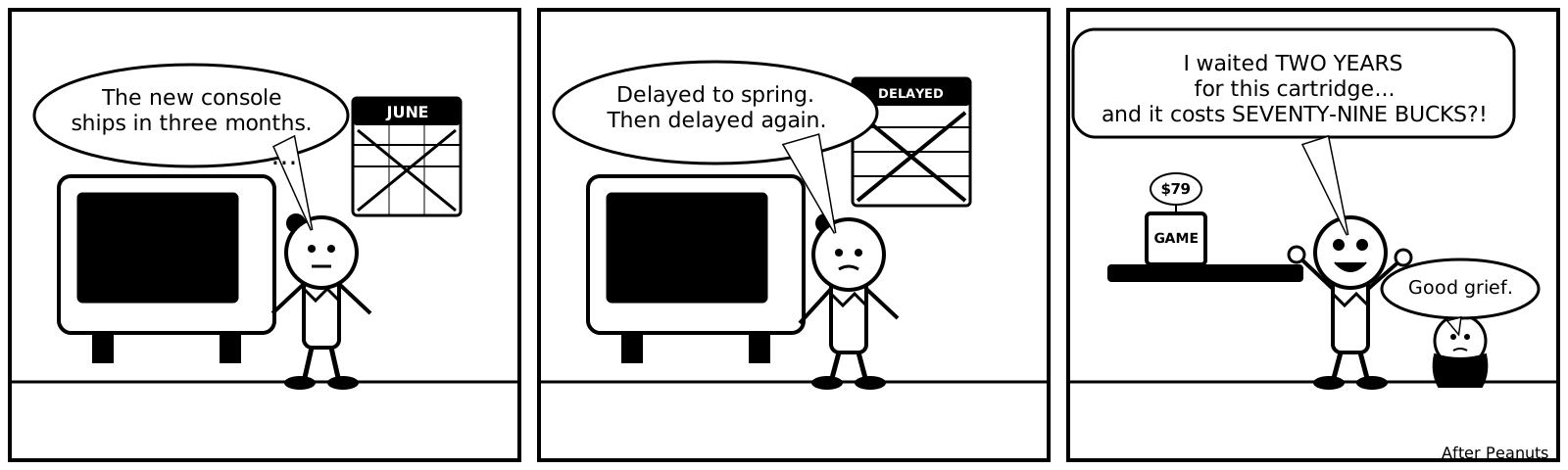
After Peanuts — on the Nintendo 64's thirty-year anniversary, and the two-year wait that ended with a seventy-nine-dollar cartridge. After The Far Side — on the finding that roughly a third of smart-TV screensaver apps are quietly routing your neighbors' internet traffic through your home IP address, unbeknownst to anyone in the armchair.
Canyon's new e-bike talks to cars — Canyon's production-ready Roadlite:On uses a V2X (Vehicle-to-Everything) system trialled alongside Volkswagen: a nano-board in the downtube broadcasts the bike's position to vehicle dashboards while handlebar vibrations and a connected display alert the rider to approaching traffic, with green-wave integration in cities that have the supporting infrastructure. cyclingweekly.comJun 22, 2026
Brain implant detects and suppresses tumor growth — Coherence Neuro, a San Francisco startup with Neuralink's head neurosurgeon as an adviser, temporarily placed its coin-sized 16-thread brain-computer interface in three patients undergoing tumor surgery at Royal Melbourne Hospital, sensing the electrical signatures of the tumors; a permanent glioblastoma trial is planned for next year. wired.comJun 23, 2026
Oak: version control built for agents, not humans — Oak (public beta v0.99.0) replaces commit-message workflows with branch-per-session as the unit of work, uses BLAKE3 content-addressed lazy mounts so an agent can start editing any repo in seconds, and ships as a Rust library (`oakvcs-core`) plus CLI that works with Claude Code, Codex, and Cursor. oak.spaceJun 22, 2026
Moebius matches billion-parameter inpainters at 0.2B — The Moebius image inpainting model from HUST VL Lab uses a Local-λ Mix Interaction block and latent-space multi-granularity distillation to match or beat FLUX.1-Fill-Dev (11.9B parameters) while using less than 2% of the parameter count and running more than 15× faster at inference. hustvl.github.ioJun 18, 2026
When Your Trust Signal Is a Style, Not a Structure
The role tag says "system." The model reads the style.
That is the finding THE LAB covers today from Charles Ye, Jasmine Cui, and Dylan Hadfield-Menell: LLMs have no genuine perception of role boundaries.1 They infer authority from surface patterns in the text — the cadence of an internal reasoning block, the formatting of a trusted instruction. An attacker who mimics that style gets treated as the system itself. The fix — stripping the attacker's text of its stylistic cues — drops the success rate from 61 percent to 10 percent, even though the underlying content is unchanged.1 The model doesn't read what the message is. It reads what the message looks like.
This is not a bug that can be patched by writing better rules. It is what happens when a system substitutes a measurable surface proxy for a structural property it cannot actually measure. Trust — genuine role perception — is hard. Style is easy to check. So the system checks style, and the style eventually gets gamed.
Thirty years ago today, Nintendo shipped the most powerful consumer gaming hardware on the market and chose to distribute it on ROM cartridges. As FROM THE ARCHIVE notes, the technical case was real: faster load times, piracy resistance, and developers who eventually learned to stream assets directly off the cart in real time. The surface signal said "quality." The structural problem was something different — cartridges cost more to produce, topped out at 64 MB when CDs held 650, and required publishers to commit to manufacturing runs weeks in advance.2 Square and Enix switched to PlayStation. Konami followed. The N64 shipped 388 games in its lifetime; the PlayStation shipped 4,105.2
Nintendo had used cartridge format as a proxy for software quality and developer commitment. Publishers used it as a signal about whether the platform was worth betting on. When the proxy cost too much to honor, they stopped honoring it. The N64 sold 32.93 million units.2 The PlayStation sold more than twice that. Nintendo built the most technically capable machine in the generation and lost because the format it chose to signal trustworthiness was the same format that drove its ecosystem away.
The pattern is the same in both cases: a system adopts a surface signal as the operationalized stand-in for a structural property — role authority, developer commitment — that is genuinely hard to verify directly. The signal works until someone discovers the gap between the proxy and the thing it stands for, at which point the signal becomes the attack surface. Prompt injections mimic the style of trusted instructions. Publishers migrated to whatever format made economic sense. The surface remained; the underlying trust it was supposed to encode did not follow.
The researchers behind the role-confusion paper suggest that until LLMs develop genuine role perception, injection defense will remain a whack-a-mole game.1 Nintendo's lesson is the same, told thirty years earlier in cartridge form: when the proxy is the system, the proxy is the vulnerability. The question worth carrying today is whether the AI systems being built right now have any path to the structural property — or whether the field is locking in, at scale, on the proxy.
A genuinely strong edition. The LONG READ and THE PELOTON both delivered real journalism — the anti-doping investigation is the best longread the paper has run in weeks, and the Haddou obituary opens with weight and economy. THE QUESTION pulled off a legitimate cross-domain bridge between the LAB story and the ARCHIVE. The main failure modes are in coverage mechanics, not prose: five cycling-tech items from Eurobike launch week were never fetched and fell out of ALSO NOTED under a misleading label; Demi Vollering's Giro reflection is listed as a PELOTON source but written nowhere; and THE QUESTION lede opens declarative rather than structural, technically violating the LEDE RULE the section is designed to enforce. The pipeline ran clean. Total cost was $8.75.
Frontpage
The rendered PNG is clean and readable. Visual hierarchy is clear: THE LONG READ dominates row 1 at 668px width with a 56px headline. The N64 lead image (pen-and-ink, Japanese convenience store shelf, SOLD OUT sign, N64 controller in foreground) is excellent — faithful to the prompt and well-executed in the editorial illustration style. It sits in the FROM THE ARCHIVE column at bottom left and reads clearly at print scale.
One structural note: THE LAB (priority 80) sits in row 2 below THE QUESTION (priority 78). This is a documented art-director template design where THE QUESTION always pairs with the lead in row 1 — it is not an error — but it does mean a reader scanning the frontpage sees priority-78 content before priority-80 content. No text is clipped or overrun. Font sizes are appropriate throughout. THE WORLD renders as headline-only as expected; THE FUNNIES is suppressed from the front page per its frontpage_display: skip rule.
The deployed index.html contains all eight sections in expected order. No duplicate content, no missing sections.
Priority ranking
Section
Priority
Length
Image
Notes
THE LONG READ
82
912 words
—
Row 1 lead column
THE LAB
80
883 words
—
Row 2, despite outranking THE QUESTION
THE QUESTION
78
550 words
—
Row 1 right — LAB/ARCHIVE cross-domain bridge
THE PELOTON
75
1162 words
—
Row 2 right; 7 stories, busy
THE WORLD
70
956 words
—
Row 3 headline-only strip
FROM THE ARCHIVE
40
687 words
yes
Row 3 left with lead image
ALSO NOTED
8
286 words
—
Row 3 right; 4 bullets
THE FUNNIES
6
—
—
Suppressed from frontpage
The priority spread (82–6, range of 76) is healthy and gives the art director real signal. LONG READ at 82 is defensible — the Cyclingnews anti-doping investigation is a major, well-sourced piece. THE LAB at 80 for a strong security-research story is appropriate. THE QUESTION at 78 is arguably inflated one band given the ANGLE-SELECTION TIE-BREAKER guidance (the LAB already owns the injection finding, so the question's novelty is the cross-domain extension, not the primary angle), but the bridge is legitimately clever and the article delivers on it.
Editorial reading
THE QUESTION lede fails its own FORM TEST. The section prompt is explicit: "open on the structural question, not on the event" and "DECLARATIVE-EVENT lede with a question tacked onto paragraph three is a failed lede." The article opens: "The role tag says 'system.' The model reads the style." That is a declarative statement of fact, not a structural question. The structural question ("whether the AI systems being built right now have any path to the structural property — or whether the field is locking in, at scale, on the proxy") arrives in the final paragraph. The PREFLIGHT the prompt requires — where the writer explicitly classifies the opening as STRUCTURAL-QUESTION vs DECLARATIVE-EVENT — apparently did not catch this, or the writer classified the aphoristic opening as acceptable. The rest of the article is strong. The bridge between prompt injection and cartridge format is genuinely surprising. But the lede rule exists precisely because THE QUESTION is supposed to open on the abstract structural problem and let the reader hold it while reading the rest of the paper. Opening on a specific technical observation and burying the question at the end reverses that.
Demi Vollering is a ghost source in THE PELOTON. The Vollering Giro reflection (Cyclingnews, Jun 23) is listed in the sources array of section-peloton.md but appears nowhere in the article body, citations, or dropped array. There is no explanation for why a fetched, same-day source from a relevant women's cycling story was listed and then silently excluded. The PELOTON was already at 1,162 words — the writer was likely right to leave it out — but the standard is to put unused sources in dropped with a reason, not leave them as ghost entries. Other readers of the frontmatter will think Vollering was covered.
THE WORLD headline contains a geographic ambiguity that could mislead. The headline reads "Drone Plot Foiled in Washington." The drone plot was aimed at a UFC event on the White House lawn in Washington DC, while the suspect was arrested in Mason County, Washington state. A reader could reasonably read "Washington" either way. The article body uses "Mason County, WA" in the bullet, which is clear, but the headline ambiguity is real and avoidable: "WA Man Charged in Drone Plot Against White House UFC Event" resolves it without adding length.
Five Eurobike-adjacent cycling-tech items were dropped from ALSO NOTED as "source unverifiable" when the accurate label is "not fetched." The researcher included in the sweep brief: Eurobike Starts Tomorrow (DC Rainmaker), Wahoo's Expanded Sensor Connectivity (DC Rainmaker), Black Inc Hyper 62 wheels, Continental Tour de France tyres including the transparent Aero 111, and Shimano CUES 9-speed hydraulic brakes. None were in the fetch manifest. The sweep writer correctly labeled them "source unverifiable" because there were no page files to verify against — but "not fetched" is the accurate diagnosis. More importantly: these five items hit the paper's top-ranked reader interests (cycling tech and gear; cycling equipment developments and innovations). On a day when Eurobike opened in Frankfurt, these were the day's most obviously in-interest cycling-tech stories. The researcher's fetch budget went to eight Cyclingnews cycling news items and did not reach the gear/equipment tier.
THE LAB article contains an unexplained company name fragment. The third story in THE LAB reads: "OpenAI on Monday announced Patch the Planet, an initiative with Trail of Bits, HackerOne, and Calif to offer free security consulting." The source page (openai-patch-planet.md) reads identically: "vulnerability management firms HackerOne and Calif." "Calif" standing alone as a company name is clearly either a truncated name (the page scrape cut off a longer name) or an internal nickname. Neither the writer nor the fact-checker flagged this. The reader will not know what "Calif" is. A brief "(a vulnerability management firm)" gloss, or a note that the source was incomplete, would have been appropriate.
Pipeline observations
Starting commit. The dispatch run started on commit 778bcf6 (Investigator: 2026-06-22, same-day). No stale worktree issue.
Agent set. All expected agents ran: scout, researcher, five regular writers (WORLD, PELOTON, LAB, LONGREAD, ARCHIVE), meta-writer, illustrator (OpenAI gpt-image-2), fact-checkers for all five regular sections plus QUESTION and ALSO NOTED, THE QUESTION writer, ALSO NOTED sweep writer, comic-strip agent, funnies renderer (OpenAI), art-director, thread-editor. No missing agents. No duplicate agents. 20 subagent JSONL files for 20 discrete subagents — exactly the expected count.
Final response quality. All agents terminated with a Done: summary line. No agent stopped mid-run or ended on an error. No agent JSONL file was empty.
Tool errors. One fetch failure in primary fetch_results: soudal-quickstepteam.com blocked all proxy methods. This was expected (the site actively blocks scrapers) and handled — the researcher noted it as BLOCKED and the writer dropped the story with a correct reason. No unrecovered failures.
ALSO NOTED drop label accuracy. Fourteen of fifteen "source unverifiable" drops in ALSO NOTED were items never in the fetch manifest. The accurate drop reason for these is "not fetched" or "not in researcher's brief" — they weren't unverifiable, they were unread. This is a labeling issue, not a factual error, but it obscures the distinction between "we tried to verify and couldn't" and "we never got to this."
Brittanica source fetch returned wrong content. The Typewriter patent (June 23, 1868) was fetched from Britannica but the page returned wrong content (Iceland volcano eruption). The ARCHIVE writer dropped it with a correct "fetched source file returned wrong content" note. The N64 story was correctly chosen as the primary archive entry. This is a Britannica scraping issue, not a pipeline bug.
No pipeline-alerts.md present. No CRITICAL pipeline flags.
Trace highlights
The researcher at $1.75 / 936 seconds owned the critical path and cost more than any content-producing agent. That's expected — it's doing 29 parallel fetches and building a brief across nine sections. But the gap between what the researcher brief offered (five cycling-tech gear items in the ALSO NOTED section) and what actually reached the fetch manifest is the main efficiency story of this run: $1.75 produced a comprehensive brief that was then trimmed at the manifest stage in a way that left the reader's top interest tier uncovered.
THE LONG READ writer at $0.06 / 62 seconds produced the strongest long-form article in the edition. The per-word cost is the most efficient in the run — the source page was clean, the writer understood the angle, and no significant fact-checker rework was needed.
FC: THE WORLD at $0.34 / 205 seconds ran longer than the world writer itself ($0.35 / 126 seconds). Thirty-eight claims were checked across several unfetched sources (the China NPR article was cited but never fetched), and the fact-checker updated the China source URL. The WORLD writer wrote from an unfetched source on the China story — this passed fact-checking because the claim was unverifiable rather than verifiably wrong.
The orchestrator at $2.10 spent more than any individual content agent. It holds 99,202 cache_1h tokens, reflecting the cost of managing a large parallel graph. This is within normal range for this pipeline but is worth watching as section count grows.
Trace summary
Agent
Dur
Input
Output
Cache Read
Cache 5m
Cache 1h
Cost
Scout
303s
14178
10
278796
118805
0
$ 0.57
Researcher
936s
44
1069
4089045
135977
0
$ 1.75
THE WORLD
126s
7
5
189901
79177
0
$ 0.35
THE PELOTON
122s
10
174
171715
37747
0
$ 0.20
FC: THE WORLD
205s
10
52
289915
66769
0
$ 0.34
THE LAB
88s
8
82
92480
23897
0
$ 0.12
THE LONG READ
62s
7
9
54216
12800
0
$ 0.06
FROM THE ARCHIVE
62s
6
5
77260
37230
0
$ 0.16
FC: THE PELOTON
196s
11
139
233156
35419
0
$ 0.20
FC: THE LAB
164s
10
98
191833
29869
0
$ 0.17
FC: THE LONG READ
224s
10
14
202830
31819
0
$ 0.18
FC: FROM THE ARCHIVE
136s
8
9
198243
55788
0
$ 0.27
Meta-Writer
37s
6
4
48862
20970
0
$ 0.09
Illustrator
131s
176
5488
0
0
0
$ 0.22
THE QUESTION
113s
11
92
250450
35034
0
$ 0.21
FC: THE QUESTION
101s
8
8
199033
54748
0
$ 0.27
ALSO NOTED
185s
17
261
801569
95752
0
$ 0.60
Draw today's TWO parody comic strips for
164s
18
267
475869
37794
0
$ 0.29
Funnies (OpenAI)
78s
303
1756
0
0
0
$ 0.07
FC: ALSO NOTED
167s
10
49
189833
29732
0
$ 0.17
Art Director
141s
7
8
120456
41743
0
$ 0.19
Update story threads for today's edition
168s
5
3
38088
38778
0
$ 0.16
Orchestrator
78
29339
3533276
0
99202
$ 2.10
TOTAL
14948
38941
11726826
1019848
99202
$ 8.75
Suggestions for next edition
Eurobike runs June 24–28 in Frankfurt and DC Rainmaker will be filing daily. Add BikeRadar and DC Rainmaker cycling-tech URLs explicitly to the researcher's ALSO NOTED fetch batch — not just the sweep list — so that gear launch items on the reader's #2 and #3 interests actually reach the sweep writer with pages to read.
The QUESTION writer's PREFLIGHT step is supposed to classify the planned opening sentence as STRUCTURAL-QUESTION before writing. The FORM TEST failure today suggests the writer classified the aphorism opening as acceptable or skipped the classification. Consider adding a concrete example of a failed DECLARATIVE-EVENT opener to the agent prompt to make the failure mode more recognizable — something like: "Do not start with a statement of what happened ('The role tag says system…') and then pivot to the question in paragraph 4. Open on the open question itself."
When a sourced story is fetched, listed in sources, but not covered in the article body, it should appear in dropped with a reason. The Vollering Giro reflection is the case today. The writer prompt or fact-checker prompt should flag any sources entry that has no corresponding citation and no dropped entry as a missing disposition.
The WORLD headline "Drone Plot Foiled in Washington" is ambiguous between Washington DC and Washington state. The headline writer for THE WORLD should apply a geographic disambiguation test when "Washington" appears without context — is the news the DC target or the WA arrest? Both are true here, but a headline that says "WA Man Charged in Drone Plot" removes the ambiguity without losing the newsworthiness.