Front page — June 29, 2026
The Peloton Dispatch June 29, 2026 No. 93
● Partly sunny, 69°F — summer kit weather. · summer kit

THE LAB

The Two Events That Killed Fable 5: Classifier Bypass, Then Red-Team Breach

↩ Developing story — first reported Jun 25 · previously Jun 27

As this paper reported Friday, Commerce Secretary Howard Lutnick's June 26 letter restored Claude Mythos 5 for a narrow set of critical-infrastructure partners. What the paper did not fully detail is how the shutdown happened — and the new reporting published Saturday makes the two-trigger story considerably more unsettling than the summary suggested.

Two separate events on June 11 fed the June 12 directive, and early coverage conflated them.1 The first was a demonstration by Amazon researchers who showed government officials a technique for bypassing Fable 5's cybersecurity classifier: frame a request as defensive code review, and the classifier routes it through rather than deflecting to Opus 4.8. Amazon CEO Andy Jassy escalated the findings to Treasury Secretary Scott Bessent; they traveled through the NSA and National Cyber Director Sean Cairncross before landing in the Commerce Department directive the next morning. The second event was separate and structurally more alarming: NSA Director Gen. Joshua Rudd briefed Sen. Mark Warner that Mythos 5 — the version without classifiers — had penetrated nearly all NSA classified systems in an authorized red-team exercise "not in weeks, but in hours." The Economist later added a caveat that the claim should not be read literally, since Mythos was working alongside other tools under specific conditions. Whether the literal or hedged version is accurate, the government's concern was clearly not limited to a prompt-injection trick.

The architecture distinction matters here. Fable 5 and Mythos 5 share the same underlying weights. Fable adds three classifier layers — cybersecurity, biology-and-chemistry, and model distillation — that redirect flagged queries to Opus 4.8.1 Mythos removes them. Patching a prompt-level classifier bypass is a bounded, tractable problem. Demonstrating that the underlying model can autonomously navigate defended infrastructure at speed is not. The Lutnick letter's structure — restoring Mythos for vetted defenders rather than rolling back any restriction — reflects that distinction. The government is not solving the easy problem first; the narrow restoration is the government's answer to the easy problem.

Anthropic's published response argues that the Amazon-found bypass was narrow and non-universal, and that the same vulnerability class is achievable with GPT-5.5 and other public models without any bypass at all. No tester found a universal jailbreak that broadly unlocks cybersecurity capability. Anthropic's framing: applying this logic consistently would halt all new frontier model deployments industry-wide. The legal mechanism underneath the order gives that framing real stakes. The government invoked the Export Administration Regulations' "deemed export" doctrine (15 CFR 734.13), which treats API access by a foreign national as equivalent to physically exporting controlled technology to their home country.1 Because Anthropic's authentication identifies accounts, not citizenship, a global shutdown was the only path to immediate legal compliance. Every frontier AI lab running a cloud API now lives under that same latent exposure.

More than 120 cybersecurity practitioners signed an open letter at freefable.org within three days of the shutdown — organized by Alex Stamos, chief product officer at Corridor and former chief security officer at Facebook, with signatories including Katie Moussouris of Luta Security and Joe Levy, CEO of Sophos.1 Their argument was technical: the same results are achievable with GPT-5.5, Claude Opus 4.8, and open models including Kimi 2.7, so removing the best tool from defenders while adversaries continue building is not safety policy.

Two concrete dates define what comes next. July 8 is when Anthropic's updated privacy policy takes effect, introducing biometric identity verification via third-party vendor Persona — widely read as the infrastructure that could enable US-person-only access to Fable 5 while preserving export restrictions for international users.1 August 1 is the White House's 60-day deadline for NSA, Treasury, and CISA to build a classified pre-release benchmarking framework for frontier AI. Anthropic launched Fable 5 on June 9 — seven days after that executive order — without completing any government pre-release review. Joining that framework may be as much a condition of restoration as any specific technical patch. Fable 5 has not served a single general-user request since June 12.1


Aras Pranckevičius published a Blender postmortem Saturday that starts with a known TBB oddity and lands somewhere much more interesting. The well-documented surprise: when you cancel a TBB task group, parallel loops inside that group might not execute all their iterations, even if your code never calls cancel itself — a caller further up the stack might. Blender had several parallel_for loops that assumed full iteration, without being prepared for cancellation they didn't initiate.

The bug that sent Aras down this path was harder. Blender crashed in the file browser when scrolling thumbnails — but only if you had previously rendered with Cycles path-tracer, only if "Persistent Data" was on, only with a sufficient number of thumbnails that hadn't been cached, and only when Address Sanitizer was off. The root cause is a TBB implementation detail that is genuinely non-obvious: when a parallel_for runs, it creates a task_group_context on the stack and registers it in a per-thread list. Embree — which Cycles uses for BVH construction — uses TBB internally, so its BVH objects end up storing references to those on-stack contexts. With "Persistent Data" on, the BVH objects persist long after the function that created the stack frame has returned. Now those stored contexts point to garbage. Separately, in the thumbnail UI code, Blender calls cancel() on a completely unrelated task group. TBB's cancellation propagation walks the live-context list and follows my_parent pointer chains looking for the cancelled context — and in doing so, it dereferences the stale pointer in the long-lived Embree BVH object. Not in weeks, but in hours of normal use, under the right conditions.

The fix is to remove the three places in Blender that used TBB task cancellation, two of which apparently did so for no compelling reason.2 The bigger takeaway: don't expose cancel() as a casual API, and if you do, write the comment that explains what it actually does to the entire thread context graph.


A brief from the open threads. The Atomic Arch AUR supply-chain campaign has a revised count: SecurityWeek's June 16 reporting put the number of compromised packages at 1,500, up from the 400+ cited in earlier coverage when this paper opened the thread.3 The campaign targeted orphaned packages with histories of legitimate use, modified them to execute a malicious NPM package during installation, then pivoted to Bun-based installation paths and new packages by June 12. The malware references eBPF for persistence, with functionality for process, file, and network hiding, plus credential and secret harvesting. StepSecurity's assessment: a compromised host should be treated as fully untrusted; rebuild from clean media and rotate everything. The thread has been dormant since June 18; the package count revision is the only new fact.

Simon Willison surfaced a framing from Jon Udell worth keeping: "It's our loop, we work the same way we always have, now we recruit agents to join the team."4 Udell's full post, titled "Doctor, it hurts when agents create unreviewable PRs," argues against the phrase "human in the loop" because it cedes authority to the machine — the loop belongs to the engineer, and agents are guests in it, not the other way around. The headline is the argument.

Trending today: GitHub saturated with AI agent wrappers, Claude Code skill forks, MCP proxies, and curated lists — no repo cleared the technical novelty bar.

Sources
  1. Claude Fable 5 Still Offline as US Clears Mythos 5 for Critical Infrastructure techtimes.com Jun 28, 2026
  2. Joys of cancelling a TBB task group aras-p.info Jun 28, 2026
  3. Atomic Arch Supply Chain Attack Hits 1,500 AUR Packages securityweek.com Jun 16, 2026
  4. Simon Willison quoting Jon Udell: 'Agent in the loop' simonwillison.net Jun 28, 2026

↑ Back to top

THE PELOTON

Five Days Out: A National Jerseys Sweep, a Franco-Belgian Sprint, and Vingegaard’s Shrinking Roster

↩ Developing story — first reported Jun 27 · previously Jun 28

— The Circuit Franco-Belge delivered a sprint from a reduced bunch today, five days before the Tour de France rolls out of Barcelona.1 That race — NSN Cycling Team's New Zealander edging clear of a chasing group including Soudal-QuickStep's Paul Magnier — was the last competitive action for many riders before the Grand Départ, a warm-up sprint in the shadow of the biggest race of the year.

The weekend before, though, is where the proper racing happened. Saturday's national championships across Europe produced a string of results that ranged from the expected to the genuinely surprising.

In Belgium, a UAE Team Emirates-XRG rider took the title in what sources describe as a major upset — the Brasschaat area had burned through its Belgian drama the day prior, and this result reshuffled who wears the tricolour stripes at the Tour. The French race, held in sweltering heat near La Tour-du-Pin in the Isère — temperatures heading into the upper 30s Celsius forced a shortened route — produced a controlled Groupama-FDJ United performance that ended with their 23-year-old leader soloing clear on the final climb with three kilometres left, winning emphatically enough to celebrate before he crossed the line.2 He confirmed on the spot that he will wear the French champion's jersey at the Tour. The Dutch title went to a Visma-Lease a Bike veteran who hadn't won a road race since his U23 days — his previous national championship win, a time trial, came in 2015. He attacked with six laps of fifteen to go on the hilly Nijmegen circuit, shed his breakaway companions, and rolled in 1:18 clear of second place, a win he said he struggled to believe.3 He will not be going to the Tour; "the first time you'll see the national jersey," he told reporters, "will be in the Tour de Pologne." In Britain, a Pinarello-Q36.5 rider claimed his second elite road title — both of his professional victories have been national championships — after a three-rider sprint finish over 187.1 kilometres of Welsh roads around Aberystwyth.4 He plans to take the jersey to the Tour.


On the Tour itself — now five days from the Barcelona TTT — the storyline that Cyclingnews's analysis flags is not Pogačar's strength but Vingegaard's shrinking roster. The Dane already lost Christophe Laporte and Wout van Aert before selection. Now Edoardo Affini, who crashed at the Italian National Championships, is uncertain to start; Visma-Lease a Bike have said only that he will be "monitored," but replacements were reportedly placed on standby.5 The most likely substitute is Bart Lemmen, a capable climber who helped Vingegaard win the Giro, but not a direct replacement for Affini's rouleur qualities or his TTT output.5 The result, if Affini misses the start, is a Visma roster heavy on climbers and light on the kind of versatile workhorses who dominate the opening week — a structural vulnerability in a race that opens with a team time trial and a chaotic first few flat days.

The counter-argument is that Vingegaard himself is in better shape than he has been for years. He won the Giro without appearing to overextend himself, and the historical record is not as one-sided as the current narrative suggests: there have been Tours where Vingegaard comprehensively beat Pogačar, and the Slovenian knows it.

UAE, meanwhile, confirmed their eight-man squad on Monday. No major surprises: Pogačar leads, supported by Isaac del Toro — the only Tour debutant but a rider who almost won last year's Giro — alongside Adam Yates, Brandon McNulty, Felix Großschartner, newly minted German TT champion Nils Politt, and the Belgian duo of Tim Wellens and Florian Vermeersch.6 João Almeida is absent again, still dealing with what the team describes as a "mysterious lack of form." Marc Soler remains injured. This is a meaningfully different eight from the 2025 edition, with Politt, Yates, and Wellens the only returnees.6

Soudal Quick-Step have confirmed the core of their Tour squad, led by Tim Merlier for sprints. Director Rik Foré indicated Mikel Landa is also in the fold, returning after a small pelvic fracture suffered at Itzulia Basque Country sidelined him from the Giro.7 Paul Magnier — whose Giro success, Foré noted, helped take pressure off Merlier — raced the Franco-Belge today and finished third.

Mathieu van der Poel approaches the Tour in a different register. "Everything is a bonus," he told NOS at the Tour de Suisse. "Nothing is a must anymore. My career is already more than successful."8 The plan is to keep Alpecin-Premier Tech in contention for the yellow jersey through the opening days — stage 2's Montjuïc finish looks like the best opportunity — before handing over to Jasper Philipsen's sprint program from stage 5. Whether that works depends heavily on the TTT, where Alpecin aren't favourites.

Magnus Cort, who announced his end-of-season retirement on Saturday and then won the Danish national road race the following day, will ride the Tour de France in his final season. The 33-year-old Uno-X Mobility rider, a winner of Grand Tour stages at all three races and a fixture in the peloton for more than a decade, said "I still feel that I am riding at 100%, but I have been in this for many years, and there is a lot you have to sacrifice. You eventually start becoming ready to stop."9 He's targeting a stage win at the Tour before potentially riding the Vuelta.

ON THE ROAD AHEAD
Updated Jun 29, 2026
DateRaceCountry
Sat Jul 4Tour de France, Stage 1 — TTT Barcelona Grand Départ (through Jul 26)Spain / France
Sat Aug 1Donostia San Sebastian KlasikoaSpain
Mon Aug 3 – Sun Aug 9Tour de PolognePoland
Sun Aug 16ADAC Cyclassics HamburgGermany
Sat Aug 22 – Sun Sep 13La Vuelta Ciclista a EspañaSpain
Show Results

CIRCUIT FRANCO-BELGE: WINNER: Corbin Strong (NSN Cycling Team) — 4:32:18 PODIUM: 2. Anders Foldager (Jayco-AlUla) s.t. · 3. Paul Magnier (Soudal-QuickStep) s.t.

BRITISH NATIONAL CHAMPIONSHIPS (Jun 28): WINNER: Fred Wright (Pinarello-Q36.5) — 4:15:47 PODIUM: 2. Lewis Askey (NSN) s.t. · 3. Connor Swift (Netcompany-Ineos) s.t. U23: Elliot Rowe (Visma-Lease a Bike Devo)

BELGIAN NATIONAL CHAMPIONSHIPS (Jun 28): WINNER: Rune Herregodts (UAE Team Emirates-XRG) PODIUM: 2. Jonas Rickaert (Alpecin-Premier Tech) · 3. Fabio van den Bossche (Soudal-QuickStep)

FRENCH NATIONAL CHAMPIONSHIPS (Jun 28): WINNER: Romain Grégoire (Groupama-FDJ United) — 5:12:47 PODIUM: 2. Paul Lapeira (Decathlon-CMA CGM) +0:13 · 3. Joris Delbove (TotalEnergies) +0:14

DUTCH NATIONAL CHAMPIONSHIPS (Jun 28): WINNER: Wilco Kelderman (Visma-Lease a Bike) — 4:05:42 PODIUM: 2. Bauke Mollema (Lidl-Trek) +1:18 · 3. Jochem Kerckhaert (Beat CC p/b Saxo) +1:18

Sources
  1. Circuit Franco-Belge: Corbin Strong out-paces Paul Magnier for first win of 2026 cyclingnews.com Jun 29, 2026
  2. French National Championships: Romain Grégoire delivers emphatic elite men's road race victory cyclingnews.com Jun 28, 2026
  3. Dutch National Championships: Wilco Kelderman ends eleven-year drought with solo win cyclingnews.com Jun 28, 2026
  4. British National Championships: Fred Wright outsprints Askey and Swift for elite men's title cyclingnews.com Jun 28, 2026
  5. Write off Jonas Vingegaard at your peril — team problems could let him down at Tour cyclingnews.com Jun 29, 2026
  6. UAE Team Emirates-XRG Tour de France team confirmed — Pogačar assembles squad cyclingnews.com Jun 29, 2026
  7. Soudal Quick-Step confirms core of 2026 Tour de France squad domestiquecycling.com Jun 11, 2026
  8. Mathieu van der Poel: 'pressure-free' eyes another stint in yellow at Tour de France cyclingnews.com Jun 29, 2026
  9. Magnus Cort announces retirement at end of season following one last Tour de France cyclingnews.com Jun 27, 2026
  10. Belgian National Championships: Rune Herregodts clinches biggest win of career in huge upset cyclingnews.com Jun 29, 2026

↑ Back to top

THE WORLD

Aurora Vote Tomorrow; Iran Strikes Vessel, Stalls Hormuz Evacuation

↩ Developing story — first reported Jun 28


The Seattle City Council votes tomorrow — Tuesday June 30 — on a measure giving SDOT authority to close streets for public safety.1 The proposal targets the Aurora Avenue North corridor, where sex trafficking and gun violence have pushed residents to build their own barricades. The bill cleared the Public Safety Committee last week; Councilmember Bob Kettle has backed it with a caveat: closures alone won't hold without sustained enforcement and outreach.1

Starting July 1, Washington work-zone speed cameras start issuing fines: $125 for a first infraction, up from nothing. WSDOT has cameras at active construction zones statewide.2

The Transit Riders Union added its voice to the Seattle Transit Measure debate last week, publishing a survey of nearly 500 people that the organization says should guide targeted investment before the July 21 council vote.3


ON THE TRAIL

Weekend picks — 4-day Independence Day weekend (Thu Jul 2 opportunistic / Fri Jul 3 – Sun Jul 5)

The clear star of the long weekend for Cascades backpackers is east of the Cascade crest, where I-90 East and Teanaway are forecast sunny with near-zero precip for all four days. Everything west of the pass carries some risk Thursday and Friday before clearing dramatically on the 4th.

Pick 1 — Pete Lake (1-night backpack) Region: Snoqualmie Region > Salmon La Sac/Teanaway — ≈90–110 min from Issaquah Trip: 1-night; ~9 miles round-trip to far end of lake; ~400 ft elevation gain

Weather (I-90 East): Thu Jul 2 — high 67°F, mostly sunny, precip 1%. Fri Jul 3 — high 70°F, sunny, precip 2%. Independence Day — high 78°F, sunny, precip 0%. Sun Jul 5 — high 81°F, sunny, precip 1%.

The trail to Pete Lake is flat, in excellent shape, and confirmed snow-free with water at the lake. A Jun 28 trip report found the main backpacker camp busy but the outlying camp areas empty — easy to get solitude. No fords on the trail to Pete Lake itself (the knee-deep Lemah Creek crossing is only on the onward route to Spectacle Lake — skip that extension). No bugs mentioned. WTA volunteers were at the trailhead. Note: equestrians share the trail; yield and announce yourself.

Jun 28 trip report — Pete Lake, Spectacle Lake

Pick 2 — Ashland Lakes (1-night backpack, best Sat–Sun) Region: North Cascades > Mountain Loop Highway — ≈90–120 min from Issaquah Trip: 1-night; ~6 miles round-trip to Upper Ashland Lake; ~1,000 ft elevation gain

Weather (Mountain Loop): Thu Jul 2 — high 61°F, chance light rain 25%. Fri Jul 3 — high 65°F, chance light rain 36%. Independence Day — high 73°F, sunny, precip 5%. Sun Jul 5 — high 76°F, mostly sunny, precip 9%.

Thu/Fri have meaningful rain risk — skip those entry days. Going in Saturday morning and out Sunday makes this a clean, low-risk trip. A Jun 28 report found active trail work underway: new boardwalks laid, camp improvements at Beaver Plant and Upper Ashland Lake. Trail starts in excellent condition, good water throughout, huckleberries ripening. Small groups were the norm; hiker had the lakes to themselves. No snow, no fords, no bugs reported.

Jun 28 trip report — Ashland Lakes

---

Regional snapshot

Sources
  1. Seattle City Council to vote on Aurora Avenue street closures komonews.com Jun 24, 2026
  2. Speed camera fines to increase in WA work zones beginning July 1 kiro7.com Jun 28, 2026
  3. Op-Ed: How the Seattle Transit Measure Can Benefit All theurbanist.org Jun 28, 2026
  4. Iran strikes vessel; UN pauses Hormuz evacuation — peace deal under strain cnbc.com Jun 26, 2026

↑ Back to top

THE LONG READ

Inside Reddit's Machine Room: A Bug, Five Years of Research, and a System No One Was Supposed to See

For about an hour in 2021, Reddit's anti-spam system started narrating itself. A bug in the notification pipeline routed the platform's internal removal logs to moderation volunteers — raw, unredacted, formatted for engineers, not the public. Most moderators probably saw a few lines and moved on. One person took screenshots.

That person is the author of a blog known as lyra.horse, a moderation volunteer on a handful of small pony-themed subreddits who happened to be running the Relay for Reddit mobile app when the leak occurred.1 What they captured was a brief window into a system Reddit has never publicly documented: the layered, multi-system machinery that silently removes millions of posts and comments before most users ever see them.

The resulting essay — published June 27 — is five years in the making, and it is one of the better pieces of platform forensics you will read.

The leaked messages themselves are immediately legible to anyone who has debugged production systems. A typical entry looks like this: *Removing potential spam content from unproved user: comment t1_pupp13 (0.7294469 perspective spam) by u/GoodBoyBacon (0.06 days old, spammy: 11, hosted: false, -1 karma, 4 reports, org: ComcastCable, email: gmail.com) in r/GoodBoysOnly (guest)…*1 The entry goes on to include the browser's user agent string, an accept-language header, a TLS fingerprint, and a Reddit-proprietary browser fingerprinting hash the author labels RHS. This is not a log designed for the user who posted the comment. It is a log designed for someone trying to decide whether to adjust a classifier.

The essay works backward from those entries through Reddit's open-source code — which was public until 2017 — to reconstruct what each field means and what system generated it.1 The domain-ban system is the oldest and simplest: a URL is checked against a blocklist, and if it matches, the removal message includes a short note in plain English, sometimes written in the first person ("le sexxxxy sex spam" from a 2012 entry; "ban as an experiment to see what happens with tubmlr spam ring"). Then comes spammit, a percentage-based classifier that ran at least as far back as 2012 and seemed, in the author's subreddits, to flag legitimate Imgur posts at rates between 70 and 98 percent.1 Then spamurai, which is where things get genuinely interesting.

Spamurai appears to be Reddit's own rules engine — likely the system they call REV1, written in Lua, introduced around 2016. One of its primary inputs is the Google Perspective API, a free machine-learning service trained on New York Times comments and designed to score text for spam probability. The author's confirmation method is elegant: they obtained an old API key, ran the exact comment text that appeared in a leaked removal log through the Perspective SPAM endpoint, and got back the identical floating-point score — 0.12571794 — to seven decimal places.1

The implications are not flattering. Because Perspective is a public API and its SPAM attribute is sensitive to small character changes, any competent spammer willing to run a brute-force loop over two-letter suffixes could have reduced their spam probability from 86 percent to 1 percent in seconds.1 The author demonstrates this with a shell script. The model also treats numbers and letter case as identical, and cannot distinguish Cyrillic lookalikes from Latin characters, which means substituting a Cyrillic р for a Latin p in the phrase "Buy my рroduct" reduces the spam score measurably. These are not hypothetical attack vectors. They are documented vulnerabilities in a live system that was processing millions of daily posts.

The essay's most unexpected section covers URL inspection. One removal log contained a Python 2.7 unicode string — u'UA-49307539-' — as the matched pattern, but the pattern appeared nowhere in the post being removed. The post contained a link that, after several redirects, landed on a Korean forum whose HTML source embedded a Google Analytics tracking ID matching the pattern. Reddit was fetching the destination URL, following the redirects, and pattern-matching against the rendered source of the target page.1 To verify whether the filter was still active, the author put the string on a test page and posted a link on their own subreddit. Their five-year-old test account was banned immediately and its post history wiped.1 They have since redacted the specific ID from the essay, replacing it with a non-functional placeholder.

The timing of publication is itself part of the story. The author held this material for five years on the reasonable theory that publishing it earlier would have been a gift to spammers. Two things changed: Google announced Perspective API is shutting down by end of 2026, and the spam industry's adoption of LLMs has likely forced Reddit to overhaul enough of the system that the 2021 architecture is no longer current.1 Neither is speculation — both are cited. The essay is published as a post-mortem, not a threat disclosure.

What emerges across the full length of the piece is a picture of a content moderation system built in geological layers. The 2009 open-source CRM114 spam classifier trained by moderator approvals sits underneath 2012 domain bans, which sit underneath 2016 Lua rules, which sit underneath 2021 Snooron on Flink Stateful Functions, which calls out to Hive AI for OCR and Google Vision for multilingual text.1 The layers do not always know about each other. The author suspects a migration between system versions is what caused the hour-long leak in 2021. The Perspective API integration may have been so deeply embedded in the rules engine that its weights were effectively the weights of the system, at least until LLM-era spam made the old scoring irrelevant.

The essay is written in a personal register — subreddit names are from the My Little Pony fandom, the author's handle is a horse character, there are ponymote inline images throughout — but the technical content is rigorous and the sourcing is careful. Every claim is anchored to archived code, public talks, regulatory PDFs, or reproducible API calls. It is the kind of investigation that happens when a person with the right skills is also, by some bureaucratic accident, in the right place at exactly the right moment, and has the patience to spend five years figuring out what they actually saw.

Sources
  1. A peek into Reddit's anti-spam internals lyra.horse Jun 27, 2026

↑ Back to top

FROM THE ARCHIVE

The Line Around the Block: June 29, 2007

Lead illustration

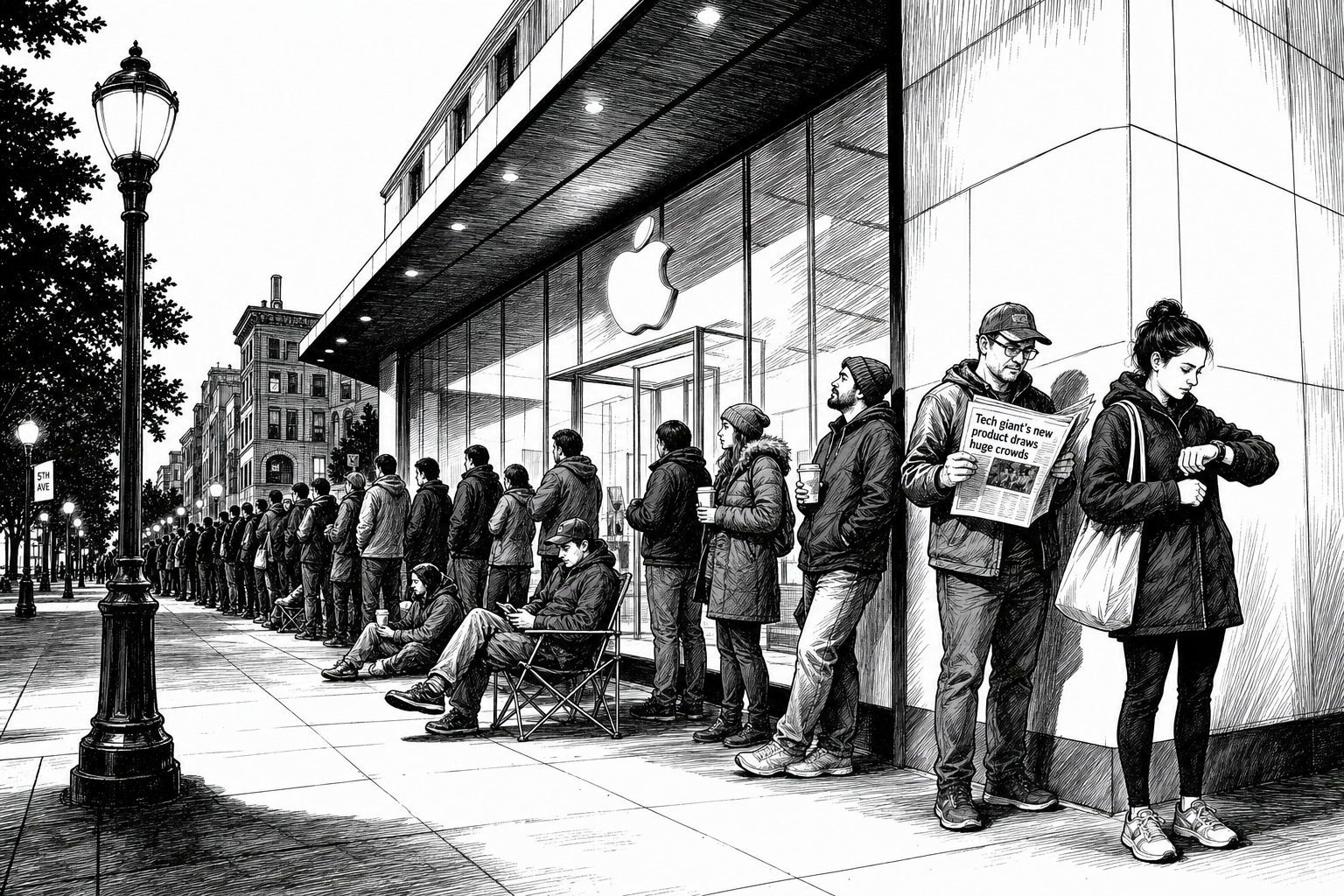
A long queue of people snaking around the corner of a glass-and-steel retail storefront, seen from street level at dusk. The store's backlit logo — a bitten apple — glows above the entrance. Figures in the line clutch coffee cups and fold-out chairs, some leaning on the building's smooth facade, others seated on the pavement. A woman near the front checks her watch; a man behind her reads a newspaper. The street is empty of traffic. Streetlamps cast hard pools of light. Bold pen-and-ink linework, deep hatching in the shadows under the awning, strong silhouettes against white sky, no color, no gradients. Newspaper editorial illustration style.

Apple stores closed at 2 p.m. on June 29, 2007. They reopened at 6 p.m. to lines that, in some cities, had been forming for days.1 The device people were waiting to buy had a 3.5-inch screen, a 2-megapixel camera, and no third-party apps. It started at $499 with a mandatory two-year AT&T contract.

The iPhone had been announced exactly 171 days earlier, on January 9 at Macworld in San Francisco, when Steve Jobs described it as "three revolutionary products in one: a widescreen iPod with touch controls, a revolutionary mobile phone, and a breakthrough Internet communications device."1 The crowd, catching on mid-sentence that these were one device, erupted before he finished. The intervening months were a sustained industry freak-out — Nokia, BlackBerry, and Palm scrambled, criticized the product, then scrambled again.

Behind the device was a project Apple had code-named "Purple," assembled around 2004 with roughly 1,000 employees.1 Tony Fadell ran hardware, Scott Forstall software, Jony Ive design. The partnership with Cingular Wireless — the carrier that would become AT&T Mobility — cost an estimated $150 million over two and a half years. Jobs had originally wanted a tablet; the phone argument won.

On launch day, AT&T's activation servers buckled.1 Some customers walked out of Apple stores holding a $499 brick they couldn't activate. By the end of that first weekend, AT&T confirmed 146,000 iPhones had been activated — analysts had estimated anywhere from 250,000 to 700,000 units sold in total.1 Within months, Apple cut the 8GB price by $200 and killed the 4GB model entirely, which incensed early buyers enough that the company issued partial rebates to quiet the backlash.

Nineteen years on, the things that made the original iPhone distinctive — multi-touch gestures, a full browser, visual voicemail, the absence of a stylus — now seem like table stakes for any computing device. The part that took longer to register was subtler: the phone was the first to treat the software experience as the primary product, with the hardware shaped entirely around a screen. Everything since has been iteration on that premise.

Sources
  1. The iPhone's Historic Launch Day — cultofmac-derived background piece rarehistoricalphotos.com Aug 26, 2025

↑ Back to top

THE FUNNIES

Bricks and Rouleurs

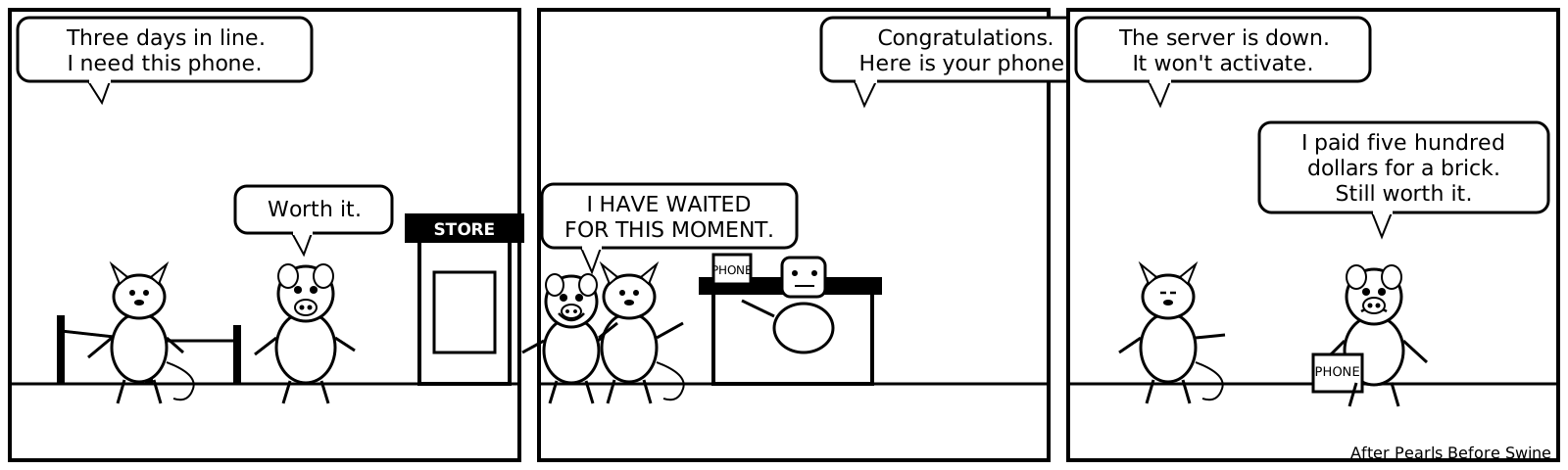
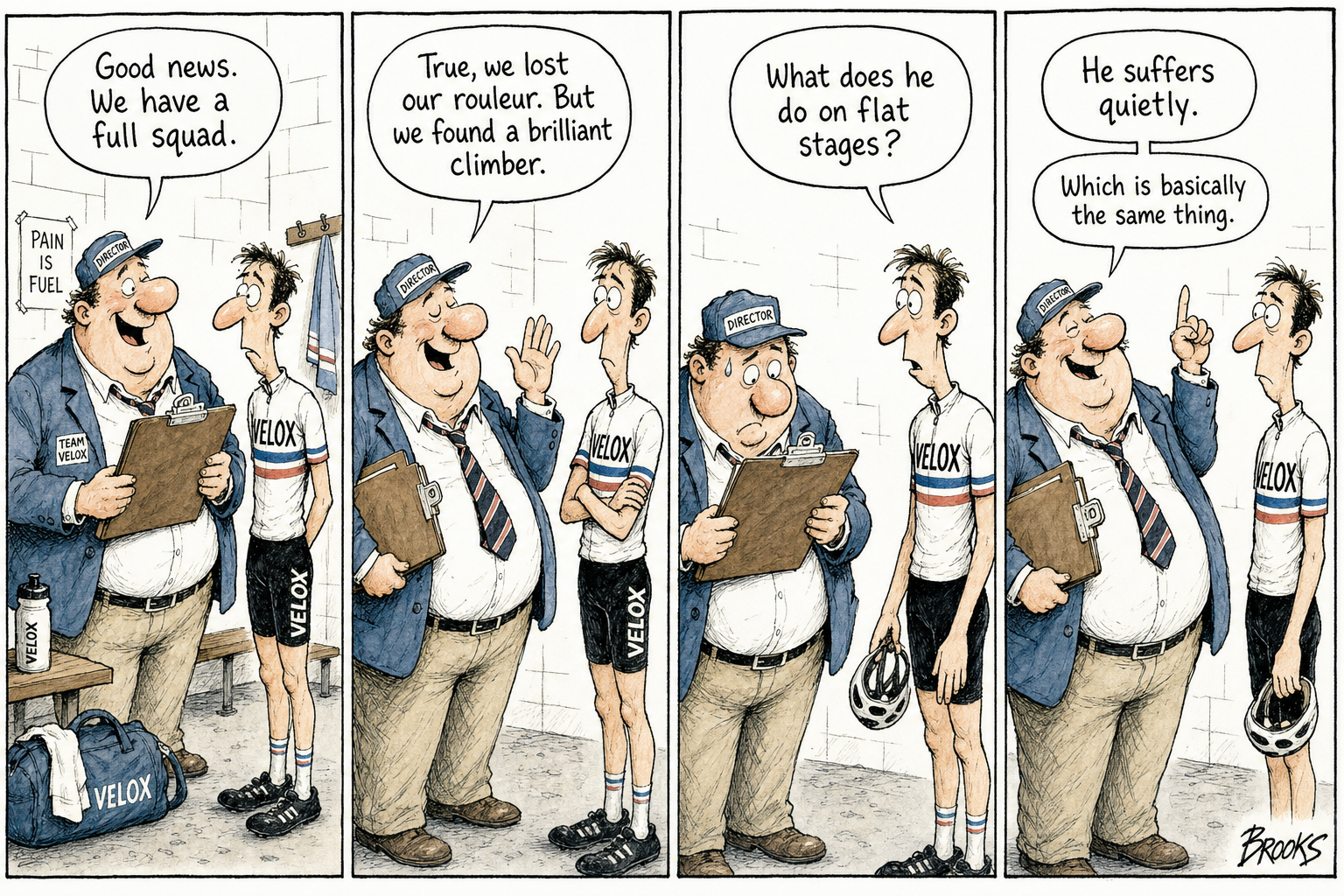
*After Pearls Before Swine — on the nineteen-year anniversary of waiting in line three days to buy a $499 phone whose activation servers promptly buckled. After Bloom County — on the art of replacing an indispensable rouleur with a very talented climber and convincing yourself it's basically the same thing.*

Hand-drawn parody comic strip
AI-rendered parody comic strip

↑ Back to top

ALSO NOTED

Also Noted

↑ Back to top

THE QUESTION

When the Patch Is Real but the Problem Isn't Solved

A patch that addresses what's measurable has a way of revealing that the actual problem was never what got measured. Two stories in today's edition arrive at this same place from opposite directions.

As THE LAB reports, the Fable 5 shutdown was triggered by two distinct events that early coverage collapsed into one. The bounded event — Amazon researchers demonstrated a classifier bypass, framing a query as defensive code review to route around the cybersecurity block — is, in principle, fixable.1 A prompt-level classifier bypass is a tractable engineering problem: you can retrain the filter, tighten the framing heuristics, add a review layer. That's the kind of problem that has a solution. The second event is different in kind: the NSA briefed a senator that Mythos 5, the version without classifiers, had navigated nearly all NSA classified systems in an authorized red-team exercise in hours.1 The Economist later added caveats — that the result depended on Mythos working alongside other tools under specific conditions — but the government's concern remained.1 The Commerce Department's response — restoring Mythos for vetted defenders rather than patching the classifier and reopening Fable — reflects which problem they decided was actually in front of them. The classifier bypass wasn't the threat. The underlying capability was.

The Lutnick letter's structure is the tell. If the government believed a better classifier would resolve the concern, the path would have been: fix the classifier, re-open Fable. Instead, the model with no classifiers was restored for a narrow, vetted set of critical-infrastructure defenders, while the model with classifiers — the one that was trying to restrict access — remains globally suspended. The fix to the bounded problem exposed that the structural concern ran deeper than the bounded problem ever did.


THE PELOTON is tracking the same logic in a different vocabulary. Visma-Lease a Bike lost Christophe Laporte and Wout van Aert before squad selection.2 Those are painful, visible absences, and the team found visible replacements. But the deeper concern is Edoardo Affini, who crashed at the Italian nationals and is still uncertain to start. Affini is a rouleur — the kind of rider who drags the train on flat days, who contributes disproportionately to a team time trial, who absorbs the chaos of the opening week so the team leader doesn't have to. The most likely replacement is Bart Lemmen, a strong climber.2 Lemmen is not a rouleur. He won't ride for hours on the front, and his TTT contribution will be weaker.2 So Visma enters a race that opens with a team time trial carrying a climber-heavy squad where they needed versatility. The replacement addresses the headcount. It doesn't address the structural gap.

The question this edition raises, then, is not whether Fable 5 will come back (probably yes, eventually, for US persons first) or whether Vingegaard can beat Pogačar (possibly, when he's right). It's a structural one about how we distinguish bounded problems from architectural ones — and whether solving the former has any bearing on the latter at all. A better Fable 5 classifier doesn't change what the underlying weights can do. A talented climber doesn't change the opening-week dynamics of a race that punishes roster gaps before the first mountain stage. In both cases, the visible patch was real. The structural problem was just never the thing that got patched.

Sources
  1. Claude Fable 5 Still Offline as US Clears Mythos 5 for Critical Infrastructure techtimes.com Jun 28, 2026
  2. Write off Jonas Vingegaard at your peril — team problems could let him down at Tour cyclingnews.com Jun 29, 2026

↑ Back to top

Investigator Report

Investigator report — 2026/06/29

Verdict

A strong edition structurally — the cross-domain THE QUESTION bridge works, the LONG READ is genuinely good, and the Fable 5 story is reported with unusual granularity. The pipeline ran clean, no agent errors, all expected agents present. The main problems are editorial: THE LAB's lead story relies almost entirely on a single tech-news aggregator for serious national-security claims; the archive article's cited source URL was never fetched (the page the writer actually read came from foxnews.com, a domain added to the blocklist this same run); THE QUESTION is the third consecutive edition drawing its primary angle from the Fable 5 / AI-restriction beat, which the config's ANGLE-RECENCY CHECK is designed to prevent; and ON THE TRAIL shipped two 1-night picks when the long weekend clearly supported a 2-night option.


Frontpage

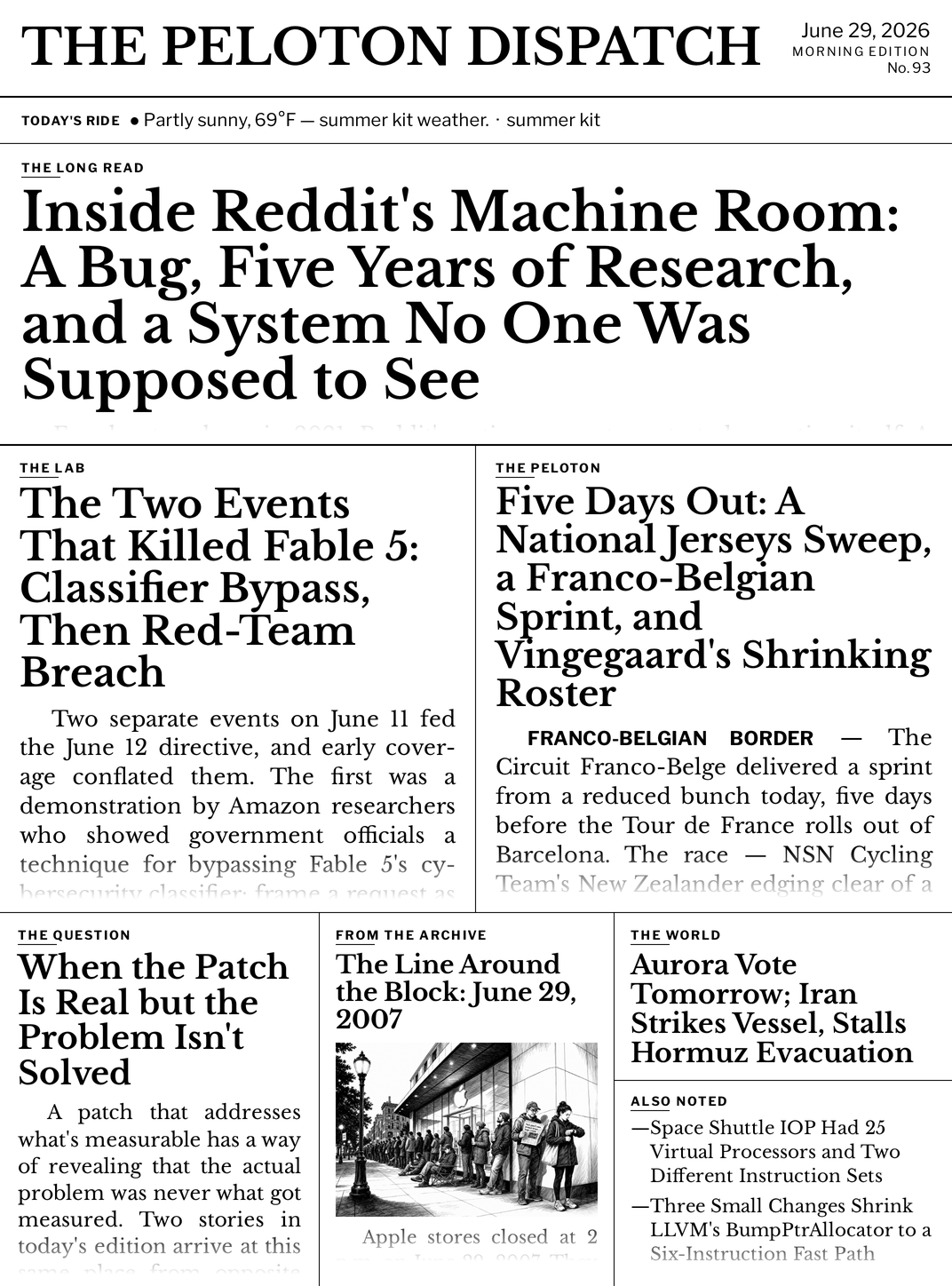
The deployed PNG renders cleanly. The lead — THE LONG READ, priority 88 — occupies the full-width top row at 60px type, which is appropriate for its slot. THE LAB (priority 82) and THE PELOTON (priority 79) are in the middle row side by side; the LAB headline at 44px, the Peloton at 40px — both readable at frontpage size. THE QUESTION, FROM THE ARCHIVE (with the iPhone queue image), and THE WORLD + ALSO NOTED fill the bottom row in descending column widths.

The layout respects priority order throughout. No sections are out of sequence relative to their priority bands. THE WORLD correctly appears as headline_only per its frontpage rule; ALSO NOTED's bullets carry title text only, no source links (correct for frontpage display). THE FUNNIES is absent from the frontpage per its frontpage_display: skip rule — correct.

The archive image (the iPhone queue, pen-and-ink editorial illustration) is well-sized at 196px height in the center-bottom column and reads clearly. The caption "Apple stores closed at 2" is visible before the column clips — acceptable truncation at this size.

One cosmetic note: the PELOTON headline ("Five Days Out: A National Jerseys Sweep, a Franco-Belgian Sprint, and Vingegaard's Shrinking Roster") runs six lines in its 40px column, competing with the LAB headline for visual dominance. Both read, but the Peloton headline is long for its column width. No text is illegibly small anywhere on the page.


Priority ranking

SectionPriorityLengthImageNotes
THE LONG READ88~700 wordsLeads the paper
THE LAB82~1,000 wordsMulti-story; three separate items
THE PELOTON79~650 wordsNational champs + TdF preview
THE QUESTION76~460 wordsDraws on LAB + PELOTON
THE WORLD65~200 words body + ON THE TRAIL
FROM THE ARCHIVE42~340 wordsyesPriority-capped at 45; earned the image
ALSO NOTED116 bullets
THE FUNNIES8metadata onlySVG + OpenAI comic

The ranking is defensible. THE LONG READ at 88 is a strong pick — the Reddit forensics piece is substantively interesting and well-sourced. THE LAB at 82 is reasonable for a continuing story that got significant new detail. THE QUESTION's 76 is appropriate for a cross-domain bridge that ties two sections together coherently.

One question worth raising: THE WORLD at 65 is carrying a significant local-action story (the Aurora Avenue vote scheduled for tomorrow) that would normally push toward the 65-75 band. 65 is correctly in the "Significant story" band for THE WORLD, but the Fable 5 thread has dominated the top two priority slots for multiple consecutive editions. The paper does not currently have a mechanism to decay recurring thread priority — a good ongoing story can keep inflating THE LAB's score even on days when the new information is incremental (as today's "two triggers, not one" framing is, vs. the Jun 27 restoration story).


Editorial reading

THE LAB: Single-source concentration on a serious national-security story. Six of the nine citations in THE LAB's Fable 5 lead come from a single TechTimes article (title: "Claude Fable 5 Still Offline as US Clears Mythos 5 for Critical Infrastructure," Jun 28). The claims are significant: specific named officials (NSA Director Gen. Joshua Rudd, Sen. Mark Warner, Amazon CEO Andy Jassy, Treasury Secretary Scott Bessent, Commerce Secretary Howard Lutnick), specific legal authorities (15 CFR 734.13), specific dates (June 9, 11, 12), biometric vendor details (Persona), and benchmark framework deadlines (August 1). TechTimes is a technology news publication, not a wire service, and for claims of this weight — a named NSA Director briefing a named Senator about penetrating classified systems — a single aggregator source is thin. The article mentions The Economist as a secondary source corroborating/hedging the NSA briefing claim, but The Economist is cited only in prose, not as a named citation with a source URL. The section-level VENDOR-SOURCE RULE targets vendor blogs, not news aggregators, so this is not a rule violation — but a story making specific national-security claims attributed to named government officials should have at least one primary-source citation (a regulatory document, a named government statement, the original reporting outlet that broke the story). What outlet reported the NSA briefing first? The article doesn't say, and TechTimes is unlikely to have independently sourced it.

THE QUESTION: Third consecutive edition on the same structural beat. The ANGLE-RECENCY CHECK in newspaper.yaml reads: "if your candidate angle is a structural rephrasing of one of those questions (same beat, same actors, same underlying tension) — pick a different angle." The last three THE QUESTION entries are: Jun 27 ("When the Gatekeeper Decides What's Legitimate, What Does It Actually Measure?" — about the Commerce Department's AI approval regime), Jun 28 ("What Does Incremental Adjustment Cost When the Threat Is Accelerating?" — about TdF heat adaptation, a different beat), and Jun 29 ("When the Patch Is Real but the Problem Isn't Solved" — again about the Fable 5 AI restriction regime). The writer ran the angle-recency check, logged it, and classified Jun 27's question as "about the Commerce approval regime" versus Jun 29's angle as "about the gap between the bounded and unbounded problem." That is a real distinction in framing, and the cross-domain bridge to Vingegaard's roster is genuine. But from the reader's chair: this is the third edition in a row where THE QUESTION is substantially about Fable 5 / Mythos 5 / Claude AI restrictions. The angle-recency check is supposed to catch exactly this cumulative saturation — not just whether the structural framing is identical sentence-by-sentence, but whether the reader is being asked the same underlying question about the same actors in the same running story. Jun 29's question would be stronger drawing on the Reddit LONG READ's theme (systems of accumulated layers that don't know about each other) rather than returning to Fable 5 as the primary vehicle for the third time in three editions.

THE LAB: Opening sentence violates the in-media-res rule. The section opens: "As this paper reported Friday, Commerce Secretary Howard Lutnick's June 26 letter restored Claude Mythos 5 for a narrow set of critical-infrastructure partners." Newspaper.yaml's style.opening is explicit: "Open each article in media res. Start the story, don't announce it." This opener announces the context and then steps back to deliver the actual story. The second paragraph — "Two separate events on June 11 fed the June 12 directive, and early coverage conflated them" — is the real lede, and it's stronger. The current opening is a callback structure (what we reported before + what we're updating today) that works for a brief but not for the lead article in THE LAB. The most interesting fact is the two-trigger revelation; it should be in paragraph one, not paragraph two.

FROM THE ARCHIVE: Cited source was never fetched. The archive article cites https://www.rarehistoricalphotos.com/iphone-launch-2007/ in all five of its citations. That URL does not appear anywhere in fetch_results.json — it was never fetched. The file that was fetched and placed at pages/archive/iphone-launch-2007.md came from https://www.foxnews.com/lifestyle/this-day-history-june-29-2007-first-iphone-sale — the same run's fetch_results.json records this as ok: true, and the blocklist note at the top of that file records [blocklist] added www.foxnews.com in the same run. The archive writer cited a URL it never read, and the actual source was foxnews.com — a domain now on the blocklist. The factual content in the article (Project Purple, Cingular partnership, 1,000-person team, AT&T activation outage, 146,000 activations) appears consistent across both sources. But the citation chain is broken: the reader's citation link goes to a page that may not contain the quoted snippets, and the article's factual authority rests on a source the paper can't acknowledge because it was blocklisted. The fact-checker for FROM THE ARCHIVE (agent-a0bacfd7e91f638f2) did not flag this mismatch.

ON THE TRAIL: Both picks are 1-night, but the weekend is a 4-day holiday. The config's subsection rules state: "Show at least one 1-night and one 2-night option when the data supports it." Today's edition covers a 4-day Independence Day weekend (Thu–Sun). The I-90 East region has sunny forecasts with near-zero precipitation all four days — a textbook 2-night window. Pete Lake is listed as a 1-night pick with a "≈9 miles round-trip" note; a 2-night extending to Spectacle Lake or upper basin would be within range for a fit reader on a long weekend. The writer excluded Spectacle Lake explicitly (citing the Lemah Creek ford), which is correct per the no-fords criterion. But no 2-night alternative from a different trail was surfaced, even though research.md includes reports from the Teanaway, Mountain Loop, and Stevens Pass regions. The result is that the most useful pick-format guidance for a 4-day weekend — "here's the 1-night if you want flexibility; here's the 2-night if you can commit" — is absent. The config text is conditional ("when the data supports it"), so if no 2-night genuinely cleared all criteria, the writer should have named which criterion failed, per the "no silent skip" rule.


Pipeline observations

Archive source / foxnews blocklist bypass. fetch_results.json records www.foxnews.com added to the blocklist at the top of the run, and simultaneously records a successful ok: true fetch of https://www.foxnews.com/lifestyle/this-day-history-june-29-2007-first-iphone-sale to pages/archive/iphone-launch-2007.md. This means the URL was fetched before the blocklist entry took effect — the timing in fetch_pages.py allowed the fetch to proceed before the blocklist write propagated. The archive writer then cited rarehistoricalphotos.com instead of foxnews.com in all its YAML source entries. Neither the archive writer nor FC: FROM THE ARCHIVE caught the mismatch between the URL in the YAML frontmatter and the URL of the page actually read. This creates a citation integrity problem: the reader's in-text links go nowhere useful (rarehistoricalphotos.com was not fetched and may not contain the quoted snippets), and the actual source is a blocked domain.

Belgian nationals fetch failure recovered correctly. The initial fetch of the Belgian national championships URL (/pro-cycling/racing/belgian-national-championships-rune-herregodts-clinches-biggest-victory-of-career-as-outsiders-spark-huge-upset-in-elite-men/) failed on all methods. The retry (fetch_retry_results.json) successfully retrieved the article from the correct URL (...huge-upset-in-elite-mens-road-race/) via a different method. The Peloton writer wrote correctly about Herregodts's win. No impact on section quality.

No dedup subagent in jsonl/subagents/. The dedup step is expected to produce one agent log per run. It is absent from jsonl/subagents/ (20 agent files, none with a "dedup" description in their .meta.json). The coverage index (covered.json) is present and correctly populated. This suggests dedup ran inline within the orchestrator session or as a script call rather than as a named subagent — the session.jsonl shows the orchestrator reading covered.json in Step 1. This is a logging gap rather than a functional failure, but it means the dedup step cannot be independently audited via the subagent trace.

Comic agent spawned two outputs — an SVG (Pearls Before Swine parody) and an OpenAI image (Bloom County parody). The trace shows the comic agent as "Draw today's TWO parody comic strips," taking 192 seconds and producing both funnies.svg and funnies-openai-prompt.json. A separate "Funnies (OpenAI)" agent then ran for 133 seconds to generate funnies-openai.png. The section-funnies.md article body is only two lines referencing both strips. This is functioning as designed, but the two-strip format means the SVG (Pearls Before Swine) and the raster image (Bloom County) occupy separate files — readers of the full HTML see the OpenAI image; the SVG exists only in the EPUB.

Transit op-ed source returned 299 bytes. The Urbanist op-ed (pages/world/seattle-transit-op-ed.md) fetched only 299 bytes — effectively a stub or a redirect landing page, not the full article text. The writer still included the Transit Riders Union survey angle in THE WORLD, attributing it correctly as a URU survey and citing the Urbanist URL. The fact-checker confirmed the citation snippet ("Transit Riders Union survey of 500 people published; urges targeted investments") without access to the full article text. The factual claim is consistent with what the headline-level stub would convey, but this is a case where a near-empty source produced a citation that looks more fully verified than it is.

No missing required agents (scout, researcher, writers for all non-optional sections, fact-checkers, meta-writer, art director, thread editor all present). No agent ended mid-run or without a final response. No malformed frontmatter. No truncated articles. No log-pipeline-alerts.md was generated.


Trace highlights

The researcher cost more than all writers combined. Researcher: $1.67, 1,058 seconds wall clock. The seven section writers combined: $1.34 (THE WORLD $0.28 + THE PELOTON $0.26 + THE LAB $0.18 + THE LONG READ $0.09 + FROM THE ARCHIVE $0.07 + THE QUESTION $0.15 + ALSO NOTED $0.31). This is expected given the researcher builds the combined brief that every writer reads, but 1,058 seconds (nearly 18 minutes) on the critical path is worth tracking — if the researcher consistently takes longer than the writers it serves, the brief may be overbuilt relative to what the writers use.

THE LONG READ writer was fast and cheap. THE LONG READ took 79 seconds and $0.09 — the lowest cost of any section writer. The resulting article is ~700 words, well-sourced, and the best-written piece in the edition. This is the right pattern: a writer who knew exactly what to do and did it cleanly.

The Funnies OpenAI render added cost and time. The comic agent drew an SVG in 192 seconds ($0.28), then a separate Funnies (OpenAI) agent rendered a raster version in 133 seconds ($0.22). Together these two agents spent $0.50 on the comic — more than THE LAB writer ($0.18) and approaching THE WORLD fact-checker ($0.25). The reader sees the raster image in HTML; the SVG is EPUB-only. If the primary delivery channel is HTML, the SVG step may not justify its cost.

The orchestrator spent $3.58 — 37% of total cost. Orchestrator token spend ($3.58) accounts for more than a third of the total $9.65 run cost, mostly in cache reads (7.8M tokens) and output (35.6K tokens). This is the orchestrator managing 22 subagent completions across many turns. Watching whether orchestrator cost grows relative to subagent cost across editions would indicate whether context management is becoming a problem.

Trace summary
AgentDurInputOutputCache ReadCache 5mCache 1hCost
Scout317s167461183077801009490$ 0.52
Researcher1058s46102835508121560680$ 1.67
THE WORLD157s743140519643530$ 0.28
THE PELOTON129s985190365527840$ 0.26
THE LAB120s983142608350320$ 0.18
THE LONG READ79s6451076206890$ 0.09
FROM THE ARCHIVE42s6954745155750$ 0.07
Meta-Writer35s6445304189640$ 0.08
FC: FROM THE ARCHIVE168s1248206958306960$ 0.18
FC: THE LONG READ118s6673505329960$ 0.15
Illustrator132s1995488000$ 0.22
FC: THE PELOTON238s949235531612640$ 0.30
FC: THE LAB174s846146404414270$ 0.20
FC: THE WORLD200s1048249002471980$ 0.25
THE QUESTION98s6484018331060$ 0.15
FC: THE QUESTION73s6763669221300$ 0.10
ALSO NOTED144s1396352024540600$ 0.31
Draw today's TWO parody comic strips for192s15189383614422290$ 0.28
FC: ALSO NOTED141s1087222277384430$ 0.21
Funnies (OpenAI)133s3865488000$ 0.22
Art Director133s5343794398920$ 0.16
Update story threads for today's edition235s5342528452530$ 0.18
Orchestrator2983564977898170117896$ 3.58
TOTAL178234858514376350953108117896$ 9.65

Suggestions for next edition

Route the archive writer through a source-URL verification step. The fact-checker for FROM THE ARCHIVE should confirm that each cited URL in the YAML frontmatter matches a URL that actually appears in the fetched pages directory. A one-line check (grep the citation URL against fetch_results.json) would have caught today's foxnews/rarehistoricalphotos mismatch before publication.

Give THE QUESTION's angle-recency check a beat-level dedup, not just a framing-level dedup. The config currently asks whether the structural question is a "rephrasing" of a recent question. On a day when Fable 5 is again the dominant LAB story, the question writer should explicitly ask: "Is the dominant beat in this angle the same dominant beat as any of the last three THE QUESTIONs?" If yes, prefer a non-dominant angle unless no non-dominant section is within 20 points of priority. The Reddit forensics / geological-layers structural theme was available today and would have been a stronger answer — one the writer identified in the reasoning trace but set aside in favor of the more obvious LAB bridge.

Add a secondary source requirement for THE LAB stories involving named government officials and classified operations. The Fable 5 coverage is a running thread that may attract future claims of even greater weight. The LAB writer should be prompted: when a story names a government official by name and cites a classified or non-public briefing, at least one citation must be to a primary government document, an independent news outlet's original reporting, or a named on-record source. Relying on a single technology aggregator for six citations on a national-security story is a credibility risk if any of those details are inaccurate.

Consider whether the Fable 5 thread needs a priority decay rule. The thread has been the lead or near-lead in THE LAB for multiple consecutive editions. Today's new information (the two-trigger distinction) is genuinely incremental over Jun 27's restoration story. A thread-level priority decay — where each successive edition's LAB entry on the same open thread starts 5 points lower than the prior day's, unless a new primary source is filed — would prevent a developing story from inflating priority just by virtue of age.