Venezuela's Deadliest Quake in a Century; Aurora Closures Begin; Sound Transit Tops U.S. Rails
↩ Developing story — first reported Jun 17 · previously Jun 18
Venezuela — twin quakes — A 7.2 then a 7.5 struck western Venezuela on Tuesday; 164+ dead, state of emergency declared, worst since 1900. Source
Iran deal — Hormuz status — Pakistan, the U.S.-Iran mediator, backed "restoration of status quo" on Strait of Hormuz navigation; IAEA inspection timing remains unresolved. Source
SDOT confirmed this week that temporary street closures are going in on the west side of Aurora Ave N — N 96th, 98th, 100th, and 102nd streets — through summer, as this paper reported when Mayor Wilson announced the plan earlier this month.1 The goal is cutting dangerous cut-through traffic and disrupting illegal activity along the corridor. Residents should note that Wednesday waste pickup now runs from the north side of the closed streets between Linden Ave N and Aurora.
Sound Transit's Crosslake Link, two months in, has pushed Seattle's light rail system to the top ridership slot in the U.S. CEO Dow Constantine said the system is now regularly seeing 160,000 daily boardings — up 35-40% since Crosslake opened — with the USA-Australia World Cup match setting an all-time record of 280,000 on June 19.2 The July 21 council vote on the transit measure renewal will have this data in its corner.2
A 15-year-old faces arraignment today on first-degree murder charges in the fatal June 3 shooting of a 16-year-old girl in Kent. Prosecutors are asking a judge to try him as an adult; state law makes that automatic at 16 or 17 but requires a separate hearing for a 15-year-old.3 He was arrested June 18 in Seattle carrying a handgun modified to fire like a machine gun.3
Work zone speed cameras get teeth starting July 1: first-time infractions, previously carrying no fine, will now cost $125.4 Second and subsequent violations remain at $248. Since enforcement began in April 2025, 85,000 infractions have been issued — 77,000 of them first-timers who paid nothing.4
ON THE TRAIL
PART 1 — WEEKEND PICKS (Sat Jun 27 – Sun Jun 28)
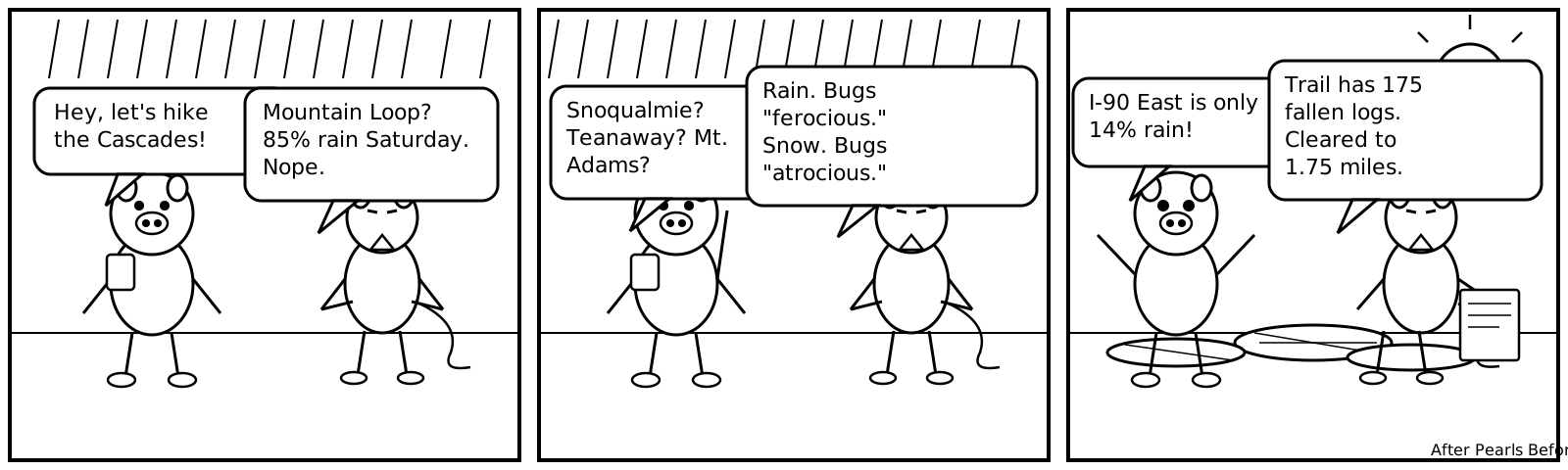
Most of western Washington is getting washed out this weekend. I-90/Snoqualmie sits at 78% precip Saturday and 62% Sunday. The Mountain Loop and US-2 corridors are worse. The one viable zone from Issaquah: I-90 East / Teanaway / Cle Elum, forecast at just 14% Saturday and 11% Sunday — partly sunny both days, highs near 59-60°F.
The catch: the main documented backpacking destination in this zone right now is Tuck and Robin Lakes via Hyas Lake (Salmon La Sac/Teanaway), and a June 23 report from the Cle Elum Ranger District Wilderness Crew confirms the trail is still very difficult — 175 logs remain cleared only to 1.75 miles, well short of the Hyas Lake junction. That route is not viable this weekend.
No trips cleared all six criteria this weekend. Western Cascades are rained out (I-90, Mountain Loop, US-2, Issaquah Alps all ≥50% precip Saturday). I-90 East has the forecast but its most recent backpacking trip report documents an impassable trail. The Further East (Wenatchee/Leavenworth) zone is also dry (13% both days), but the well-documented Colchuck Lake area is heavily crowded and requires a lottery permit, failing the low-crowds criterion. If you have flexibility, consider holding the trip for the following weekend — the extended July 4 window (Fri Jul 3 – Sun Jul 5) should benefit from a full dry cycle.
PART 2 — REGIONAL SNAPSHOT
I-90 / Snoqualmie / North Bend — Rainy Lake (unmaintained trail, bugs described as "out in hordes" at the lake) and Mirror Lake (mosquitoes present, manageable) had reports Jun 23-24. Granite Mountain trail in excellent shape with only minor rock obstacles. Bandera/Mason Lake area quiet after 5pm on weekdays. Heavy rain Fri-Sun, plan for a muddy return trip if you go.
Mountain Loop Highway — Gothic Basin reported Jun 24: bugs low in the basin, <20 people on a weekday, waterfalls running high with snowmelt. Lake 22 reported Jun 23: trail well-maintained, no snow issues, accessible water. Both look great on conditions — but Sat 85% precip rules the weekend out.
Snoqualmie Pass area — PCT south of Alpental snow-free with bugs beginning near lakes and Olallie Meadow. Silver Peak loop (Silver–Abiel–Tinkham) doable; bugs at trailhead but non-biting. Mount Defiance reported buggy near summit. Same weekend washout applies.
I-90 East / Teanaway / Cle Elum — Best weekend weather (Sat 14%, Sun 11%). Tuck and Robin Lakes / Hyas Lake still heavily obstructed; trail crew notes 175 logs remain. Granite Creek area has minimal documentation. If you know a less-reported trail here, this weekend's the window.
North Cascades / Mount Baker — Yellow Aster Butte (Jun 23): road passable, snow patches in the lake basin but manageable via Keep Kool trail, creek crossings a concern due to snowmelt. Sat 72% precip there — marginal.
Central Cascades / Glacier Peak — Multiple teams summited Glacier Peak via the North Fork Sauk trail this week; route is long (36+ miles, 11,100' gain), requires rope and crampons above 8,400'. Snow melting fast is creating new hazards daily. Not a casual weekend trip.
South Cascades / Mt. Adams — Muddy Meadows/Foggy Flat (Jun 23): trail in good shape with recent work, but mosquitoes described as "ferocious" near Foggy Flat and the PCT crossing. High winds and snow in the forecast (Sat highs near 26°F at elevation) — this zone is a hard no this weekend.
Mount Rainier area — Crystal Lakes reported bad bugs at the upper lake (camper called them "atrocious"). Grand Park via Lake Eleanor: bugs described as "abysmal," one party cut the trip short after one night. Sat 59% precip at Rainier.
Figma Moves the Canvas Into the Codebase: WebGPU Shaders, Code Layers, and a Direct Assault on Cursor
↩ Developing story — first reported Jun 19 · previously Jun 23
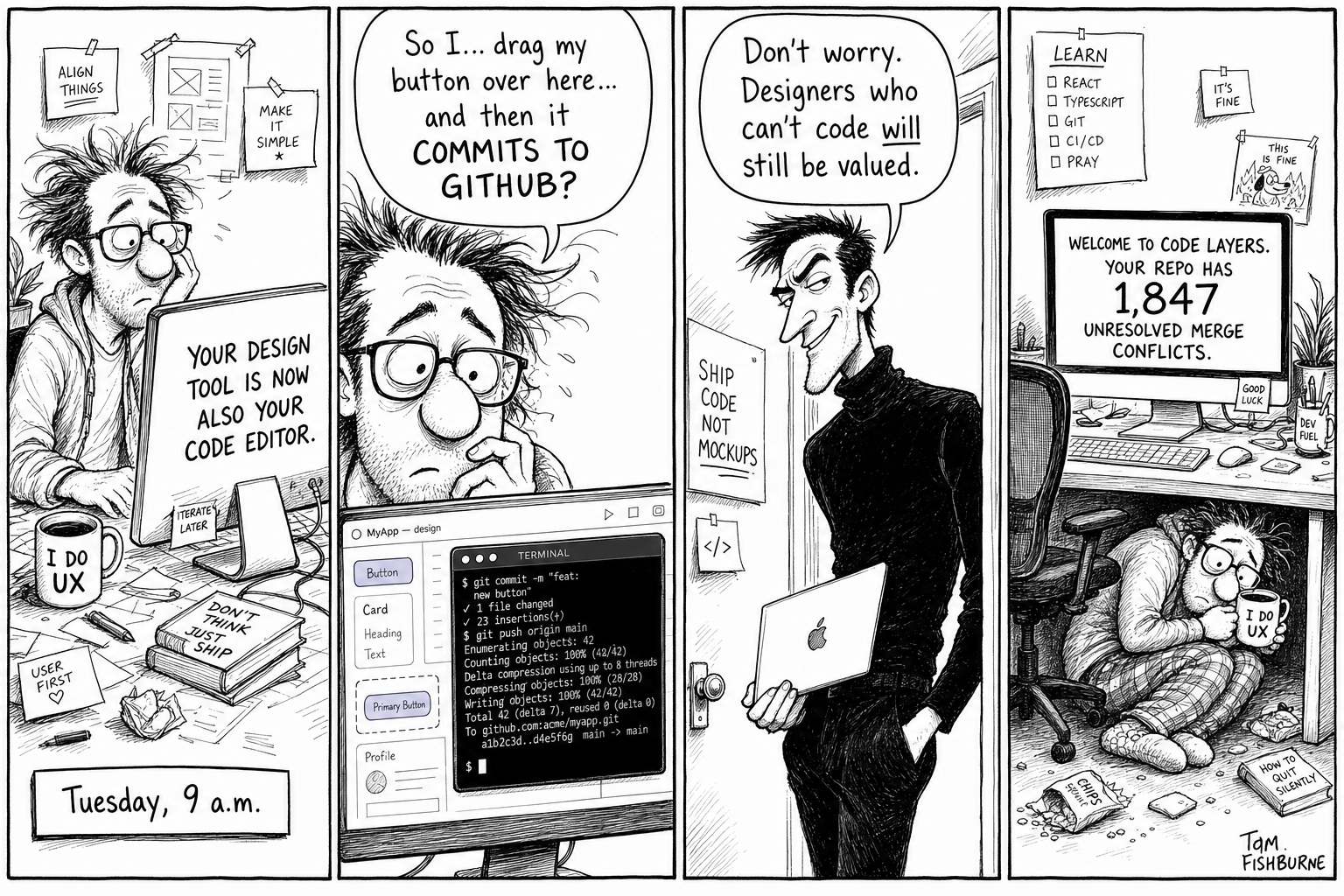
The competition with Cursor has been coming for a while. At Config 2026, which closed Thursday at Moscone Center in San Francisco, Figma made it official: Code Layers brings GitHub-linked repositories directly onto the design canvas, letting teams clone a repo, convert any design layer into an interactive code-backed layer, and sync changes back to the codebase — all in the same multiplayer file.1 Where AI coding environments like Cursor have moved development upstream toward design, Figma is moving the canvas downstream into the codebase. Early access opens in July.
The more technically interesting announcement is the GPU shader tooling. Shader fills powered by WebGPU are live today for Full seat holders on paid plans. The distinction from WebGL is not cosmetic: WebGL is a JavaScript wrapper around OpenGL ES 2.0, an API designed in 2007 with no path to the compute pipelines found in Vulkan, Metal, or Direct3D 12. WebGPU, the W3C-standardized successor that ships as production-stable in Chrome, Edge, and Safari with approximately 82% global browser support, supports general-purpose GPU computation alongside rendering.1 That is the same architectural capability that underlies browser-side ML inference and real-time game engine work — Figma's shader fills are the first user-facing surface of a deeper architectural unlock. Users describe an effect, the design agent generates a parameterized WGSL program, and the controls surface directly on the canvas. Firefox still has WebGPU disabled by default; users there will see nothing render.
Figma migrated its rendering backend from WebGL to WebGPU starting in 2023, writing all internal shaders in WGSL.1 What Config 2026 adds is user-authorability: effects including dithering, blur, frosted glass, liquid metal, and fractal noise, stackable and exportable. Interactive shaders that respond to user input in real time are listed as coming soon, with performance optimization still underway.
Figma Motion, also announced at Config, adds a full keyframe timeline inside Figma Design files — keyframes, easing curves, spring animations — with export in CSS, JSON, React, MP4, WebM, Animated SVG, and GIF. The operational argument for motion designers is that a component animated once carries that behavior across every collaborator's file, the same way fills and typography already do. It is in open beta now. High-resolution MP4 export and publishing animated components require a Full seat on a paid plan.2
The business context is rough. Figma went public on the NYSE in July 2025 at a $1.2B IPO; its stock, which peaked at $142.92, had fallen to roughly $19 by June 2026. Revenue continues to grow — $1.056 billion in fiscal year 2025, up 41%, with Q1 2026 up 46% to $333.4 million — but investor concern about AI coding tools routing around traditional design workflows has weighed on the share price.1 Code Layers is the direct answer to that concern.
Matthew Lugg published a detailed Zig devlog today covering two related changes that landed together. The first: the LLVM backend previously lowered arbitrary bit-width integers (say, u4 or u40) directly to LLVM IR's bit-int types, but because Clang never emits IR this way, those code paths have been poorly tested for years — producing both missed optimizations and confirmed miscompilations.3 The fix extends them to ABI-sized types in memory (matching how Clang lowers C's _BitInt(N)), which restores the optimization paths LLVM actually exercises.
That change forced the second: @bitCast had to be redefined. The old semantics defined it as "reinterpret bytes in memory," but that definition had quietly broken down over time — the language already allowed casting [3]u8 to u24 even when @sizeOf(u24) > @sizeOf([3]u8), which the pointer-reinterpret model can't express. The new semantics, specified in proposal #19755 and already implemented in the self-hosted x86_64 backend, define @bitCast in terms of logical bit layout rather than memory layout.3 The endian implication: under the old semantics, casting [2]u8 to u16 gave different results on big- and little-endian targets; under the new semantics, the result is always the same — the first array element becomes the 8 least significant bits. The change also allows operations like casting [2]u3 to @Vector(3, u2), or deconstructing an integer into a vector of individual bits via @bitCast to @Vector(n, u1). As a side effect, the Zig compiler itself — which makes limited use of arbitrary-width integers internally — saw around 5% performance improvement from the better LLVM optimization paths.3
As this paper has reported since June 13, the US government pulled Anthropic's Claude Fable 5 offline after the NSA affirmed that guardrails on the company's restricted Mythos model could be disabled. Wired reports that the Trump White House has replaced Dario Amodei with cofounder Tom Brown in Commerce Department negotiations over the controls.4 One person directly familiar with the calls told Wired that Brown "is not being a weirdo like Dario and can actually engage." Amodei was described as too difficult to work with. Both high-level and technical-staff working-group conversations are now underway, focused on what proof from Anthropic might alleviate the administration's jailbreak concerns. A bipartisan group of lawmakers sent Commerce secretary Howard Lutnick questions about the redeployment path and demanded responses by June 26 — tomorrow.4 The timeline for lifting the export controls remains uncertain.
Trending today: GitHub is saturated with AI agent skill packs, Claude Code workflow collections, and coding-assistant wrappers — the one exception with any engineering interest is apple/container, Apple's Swift-based tool for running Linux containers on Apple Silicon via lightweight VMs, which continues to accumulate stars but is not a new release.
Onley Is Out: Ineos Arrive at Their Own Tour With Three Leaders and One Too Few
↩ Developing story — first reported Jun 18 · previously Jun 21
Nine days from the Grand Départ in Barcelona, Netcompany Ineos confirmed what a Wednesday Strava post had already implied: Oscar Onley will not start the Tour de France. The 23-year-old posted a 43km "Morning ride" with the caption "Road to the Tour… of Guangxi" before the team made it official on Thursday, citing a "significant shoulder injury" from his crash on stage 6 of the Tour Auvergne-Rhône-Alpes.1 Onley, who finished fourth at last year's Tour and transferred to Ineos on the strength of that ride, had completed some course reconnaissance with the team before medical tests made the call clear.
The announcement crystallises what has been a slow-motion crisis at the British team. As this paper reported in June, Josh Tarling fractured his collarbone at the same race and underwent surgery; his Tour participation remains unresolved, with long days of indoor training his current horizon. Kévin Vauquelin, the team's other co-leader, pulled out of the French national championships after picking up a virus and bacteria during the stage race. Filippo Ganna, Carlos Rodríguez, Michał Kwiatkowski, Dorian Godon and Thymen Arensman are expected to fill out the eight-man roster, with Andrew August likely drafted in to replace Onley.1 The team presentation in Barcelona is Tuesday; the Tour starts Saturday, July 4.
Philippa York's analysis in Cyclingnews today makes no effort to soften the prognosis: "None of Kevin Vauquelin, Thymen Arensman or Carlos Rodríguez seem likely to be battling with Lipowitz, Seixas and Del Toro."2 The opening team time trial — which was supposed to be Tarling's stage — is now framed as Ineos' best chance at the limelight all race.
Across Europe, national championships are running through a heatwave that has pushed temperatures past 35°C in the Netherlands and into the 40s in parts of France and Spain.3 Federations have bent their schedules around it — the Dutch moved elite time trials to late afternoon, shortened U23 courses, and split riders into two waves to reduce waiting in the heat. Belgium is considering adding sprinklers along the TT course on Friday and has added extra refreshment zones for Sunday's road race, which runs in Binche.
The results from the time trials were not routine. In Lampeter, Wales, Zoe Bäckstedt (Canyon-SRAM) defended her British elite women's TT title on the 25.6km course, beating four-time track world champion Anna Morris by 21 seconds. Her sister Elynor (UAE Team ADQ) finished third. It is Bäckstedt's third win of the 2026 season, following the Vuelta Extremadura Feminas TT and stage 3 of the Tour de Suisse.4
In Sabiñánigo, Mireia Benito (AG Insurance-Soudal) rode the 18.6km Spanish TT course in 25:59 at nearly 43 kph to take her fourth consecutive elite women's title — every edition since 2023.5 Pre-race contender Paula Blasi (UAE Team ADQ) crashed during her course reconnaissance and needed stitches, finishing fourth, 40 seconds down.
In Laren, in the Achterhoek under 35°C skies, Huub Artz (Lotto Intermarché) won the Dutch men's elite TT in 40:29, beating Dylan van Baarle (Soudal-QuickStep) by 31 seconds and Sjoerd Bax (Pinarello Q36.5) by 58.6 In the women's race run at the same venue, Daniek Hengeveld (Visma-Lease a Bike) produced an aggressive second-half ride to win her first elite national title in 45:12. Her teammates Femke De Vries and Lieke Nooijen completed a full podium sweep for Visma. Defending champion Mischa Bredewold finished eighth, 51 seconds back.7
On Thursday, Primož Roglič lines up at the Slovenian national TT — his first appearance at the championships since 2020, when he finished second behind Tadej Pogačar.8 Pogačar had planned to race the Slovenian nationals as part of his Tour preparation but has stayed in Monaco with partner Urška Žigart, who fractured her jaw at the Tour de Suisse. The start list for the road race Sunday is not yet confirmed; Roglič is targeting the Vuelta later in the year and is looking for his first win of the 2026 season.
Canyon officially launched the new Aeroad CFR LTD on Thursday, claiming a drag score of 198W in independent wind-tunnel testing by German magazine TOUR — putting it, by Canyon's reckoning, below the 200W barrier for the first time.9 The key change is the CP0053 Race handlebar, previously available only to professionals, now opening to consumers via Canyon's MyCanyon programme. The bar is 120g lighter than the outgoing CP0048 Pace cockpit and saves approximately two watts on its own; the remaining gains come from the SRAM Red XPLR 1x drivetrain, deeper DT Swiss ARC 1100 65mm wheels, and Continental Aero 111 tyres on the LTD build. The frame itself is largely unchanged beyond the addition of a Universal Derailleur Hanger. One catch: Mathieu van der Poel's Alpecin-Premier Tech runs Shimano with a 2x crankset, so the team that fields Canyon's most prominent Tour de France rider cannot replicate the tested spec. Movistar and Canyon-SRAM, both on SRAM drivetrains, have a clearer path to the 1x setup.
The ITA confirmed Tuesday that a two-year power passport feasibility study is now formally underway, funded by the UCI and conducted in partnership with the University of Kent and UCL.10 Visma-Lease a Bike and Decathlon CMA-CGM are among five Tour de France teams taking part, with 60 riders contributing historical data in year one and live-season data in year two. The trial is designed to confront the criticisms CPA head Adam Hansen raised this winter — variance between power meters, measurement errors, and rider specialisation — before any enforcement mechanism is considered. Hansen's position remains unchanged: "We're 100 percent against this, and so are the riders."
On the Road Ahead
Updated Jun 25, 2026
Date
Race
Country
Sun Jun 28–Mon Jun 29
Belgian Nationals — Road Race (Men & Women)
Belgium
Sat Jul 4 – Sat Jul 26
Tour de France (stages 1–21 remaining)
France / Spain
Sat Aug 1
Clásica de San Sebastián
Spain
Sun Aug 3 – Sat Aug 9
Tour de Pologne
Poland
Sat Aug 16
ADAC Cyclassics Hamburg
Germany
Show Results
BRITISH TT (WOMEN): Zoe Bäckstedt (Canyon-SRAM), 25.6km in Lampeter, Wales. Beat Anna Morris by 21 sec. Elynor Bäckstedt 3rd at 1:05.
SPANISH TT (WOMEN): Mireia Benito (AG Insurance-Soudal), 18.6km in Sabiñánigo, 25:59. Sara Martín 2nd at 21 sec. Sandra Alonso 3rd at 27 sec.
DUTCH TT (MEN): Huub Artz (Lotto Intermarché), 35.8km in Laren, 40:29. Dylan van Baarle 2nd at 31 sec. Sjoerd Bax 3rd at 58 sec.
DUTCH TT (WOMEN): Daniek Hengeveld (Visma-Lease a Bike), 36km in Laren, 45:12. Femke De Vries 2nd at 2 sec. Lieke Nooijen 3rd at 15 sec. Full Visma podium sweep.
June 22, 2026 was Quake's 30th anniversary, and Sandy Petersen used the occasion to say something direct: "Quake ruined id Software."1 He said it without rancor — crediting everyone on the team, calling Quake "an amazing feat of art, programming, and design" — but the core claim was blunt. The work was so intense, he wrote on X, that "I think it broke us spiritually."1
What came next was more surprising. John Carmack, who tends toward precision over sentiment, agreed — and then apologized. "Sorry, Sandy," he wrote, at the end of a post that laid out, with characteristic clarity, exactly where he thought things had gone wrong.
The self-critique is worth reading carefully. Carmack's diagnosis: Quake was "overly ambitious technically," and the studio "could have done all the great multiplayer and modding work inside a Doom++ engine, allowing the designers to work with a more stable base instead of rug-pulling everything out from underneath them a couple times."2 The engine he actually built — an achievement that remains extraordinary — was, by his own accounting, the wrong call for the team at that moment. A follow-up game could have brought the full 6DOF environments. The sequence was wrong.
On top of the technical overreach: "I pushed everyone too hard. I didn't appreciate how maturing companies need more slack, and that running people at startup intensity constantly will wear them out." And there was a structural failure specific to id's founding arrangements: the stock vesting setup was wrong, creating bad incentives, and "the Silicon Valley standard approach of vesting stock would have worked out better."2 These are not vague regrets. They are a retrospective engineering analysis of a company failure, written by someone who spent decades not saying them publicly.
Petersen had already pointed to Carmack's particular "intensity" as a factor — the decision to put everyone in the same large room together, the idea that physical co-location would focus the team, the reality that there was "nowhere we could decompress or hide out."1 He also revisited the departure of American McGee, who was reportedly fired by Carmack for underperformance on Quake, suggesting instead that McGee was "done dirty by another employee."1
John Romero entered the thread with his own accounting. He agreed, broadly, that staying on a Doom-derived engine would have been wiser; that everyone was "pushing ourselves past what was reasonable because that was how id had always worked."1 He gave pointed credit to McGee as "really good" at building Quake levels — pointed given how McGee's time at id ended. And then: "There are a hundred things we could have done differently, but we did the best we could do at the time with what we knew. Having a media circus around us certainly didn't help."
The list of people who left id "within a couple years of finishing Quake," as Petersen catalogued it: Romero, Shawn Green, Dave Taylor, Mike Abrash, American McGee, and Petersen himself.1 Petersen's conclusion was characteristically unsentimental: "Games are more important than game companies, and Quake is an iconic titan of the gaming world."1 But the dream team was gone, and in his reading, the company never recovered to that level — only Quake 3 approached what came before, and not quite.
What makes this exchange worth reading thirty years later isn't just the nostalgia. It's the specificity. Carmack doesn't traffic in generalities about "work-life balance" or "burnout culture." He identifies the exact technical decisions that put designers on unstable ground; the exact structural incentives that misaligned the founders; the precise moment when he "had to accept my personal limits" — he was working as hard as humanly possible and still missing his goal points. That sentence carries a lot.
Petersen's response to the apology: he didn't blame Carmack for how it worked out. Romero thanked Petersen for getting them talking. "It really was a hell of a game."1
It was. And thirty years was apparently the right amount of time to say so honestly.
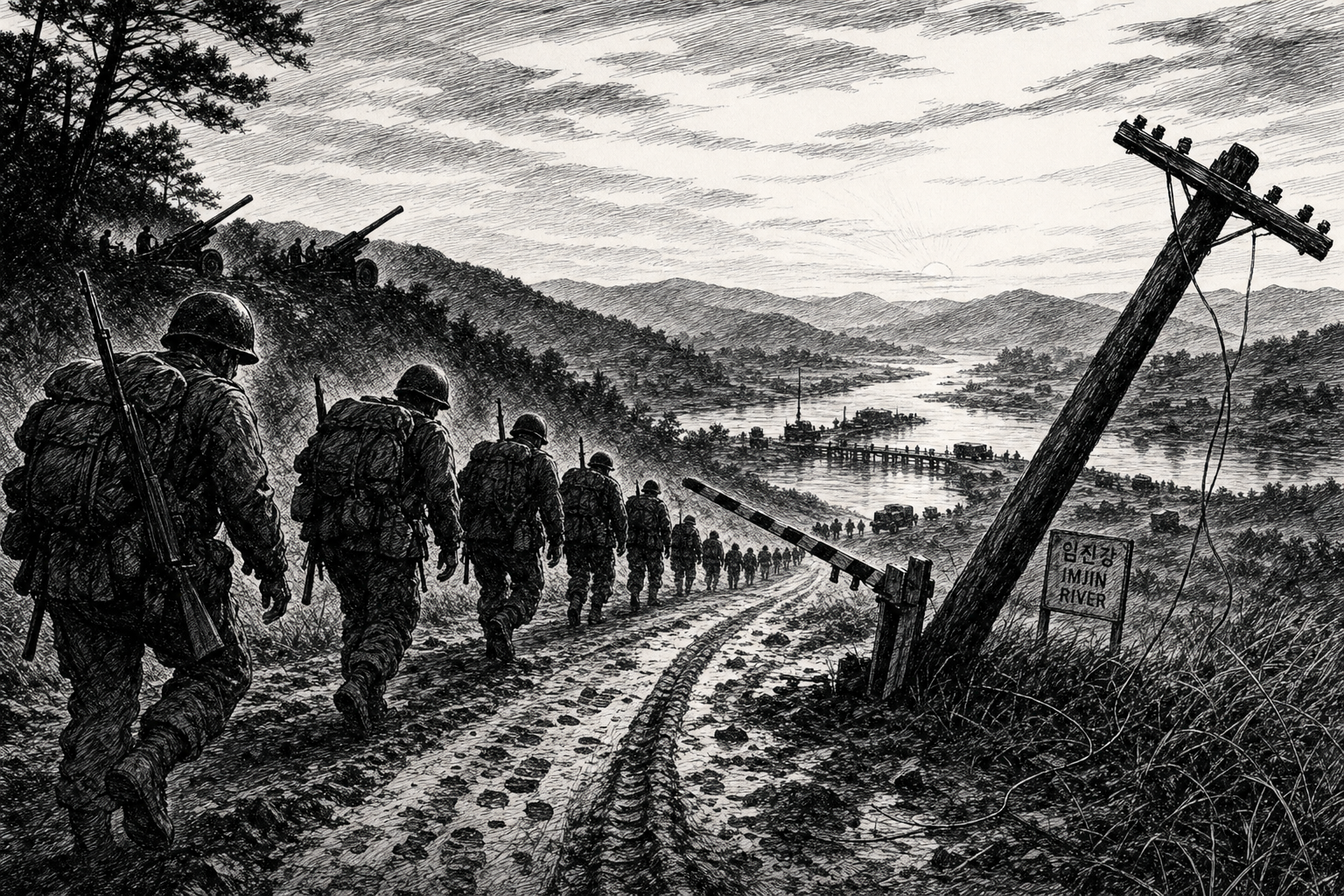
Pre-dawn Korean hillside, June 1950. A long column of infantry silhouettes descending a ridge toward a river crossing, figures hunched under heavy packs, helmets catching the first pale light. A checkpoint barrier pole hangs broken at an angle across a dirt road. Tire tracks and boot prints churn the muddy shoulder. Behind the soldiers, artillery pieces are barely visible in the dark treeline. In the foreground, a single telephone pole lists sideways, its wire slack and trailing in the grass — the connection already cut. Black-and-white pen-and-ink rendering with dense cross-hatching in the shadows of the hills, strong silhouettes of the marching column against a luminous pre-dawn sky, bold diagonal composition driving the eye toward the river.
The South Korean army had almost no warning. On June 25, 1950, North Korean forces crossed into the South and moved fast toward Seoul, catching both the ROK troops and the small American contingent stationed in the country completely off guard.1 The Korean War had begun.
Within hours, the United States had the matter before the UN Security Council, which passed a resolution calling for military assistance to the South.1 The vote went through cleanly for one accidental reason: the Soviet Union was boycotting the Council and was not present to use its veto.1 President Truman dispatched land, air, and sea forces and called it, deliberately, a "police action" — not a war. The distinction was not semantic. Congress had not declared war, and Truman was not going to ask it to.
What followed was three years of fighting that ended where it started. US and South Korean forces pushed back, then marched into North Korea, then watched China intervene massively in late 1950, and the whole enterprise ground into a bloody stalemate. The 1953 cease-fire left Korea divided at roughly the same geographical point as before, a boundary that has not moved since. More than 55,000 Americans died.1
The Korean War introduced a concept that would define the next four decades of American foreign policy: the limited war.1 The goal was not total defeat of the enemy — the objective the United States had pursued and achieved in 1945 — but the narrower aim of protecting South Korea from being absorbed. The logic was sound: total war against a nuclear-armed Soviet proxy risked a third world war and would spread American resources to the breaking point. But it was genuinely difficult to explain to a public that had been told, six years earlier, that unconditional surrender was the only acceptable outcome. The Korean War never found its popular footing. It remains, seventy-six years on, the war that is mostly remembered for having been forgotten.
The Cold War's first shooting conflict also established a template that would repeat. A limited American commitment, a UN fig leaf, a stalemate, a cease-fire that resolved nothing on the underlying question. Korea did not end in 1953 so much as it paused. The two Koreas are still, technically, at war — the armistice was a cease-fire, not a peace treaty. That pause has held for longer than anyone in 1953 had reason to expect. Whether it continues to hold is a different question, one that the last seventy-six years have not made any easier to answer.
*After Pearls Before Swine — on this weekend's hiking forecast, in which every Cascades zone is either washed out, infested with bugs described in trip reports as "ferocious," "atrocious," or "abysmal," or blocked by 175 fallen logs on the one dry trail.*
*After Bloom County — on Figma's Config 2026 announcement that your design canvas is now also a code editor, GitHub-linked and synced, which is good news for everyone except the designer currently using it.*
Star Fox on Switch 2 scores 9/10 at Nintendo Life — Velan Studios' ground-up visual remake of Star Fox 64 launches today with new Challenge Mode, three-mode online multiplayer, and GameShare co-op, earning the best reviews in the series since the N64 original. nintendolife.comJun 24, 2026
Sarah Ruggins rides south-to-north Europe faster than any man — The Canadian doctor, who only began cycling three years ago after recovering from a rare childhood neurological disease, covered Tarifa to Nordkapp (6,000+ km, nine countries) in 13 days, 20 hours, and 27 minutes — three days faster than the previous record set by Ian Walker in 2019. velo.outsideonline.comJun 23, 2026
Eurobike moves to a biennial cycle, then immediately gets a rival — Organizers confirmed the Frankfurt show will go on hiatus after 2027, shifting to every two years; the same week, German industry group ZIV announced a competing show called "Towards Tomorrow — European Bike Show" at Cologne's Koelnmesse, scheduled for September 2027, days after Eurobike. bikeradar.comJun 25, 2026
Simon Willison converts MDN's entire browser compatibility dataset into a queryable SQLite database — The 66MB database is hosted on a GitHub repo's `db` orphan branch, which carries open CORS headers unlike GitHub Releases, making it directly explorable via Datasette Lite in the browser without a server. simonwillison.netJun 24, 2026
Datasette 1.0a35 ships Create/Alter table UI and a stable template API — The alpha release adds full in-browser table management (columns, types, foreign keys, NOT NULL constraints, renames, drops) and formally documents the template context variables as a stable API through 2.0. simonwillison.netJun 23, 2026
ARM64 instruction encoding demystified in a free open-access book chapter — Tomas Pitner's piece explains how a 32-bit word like `9100A820` decomposes into opcode, register, and immediate fields — and why registers occupy exactly five bits, branch offsets are relative, and CBZ bundles compare-and-branch into one encoding — drawn from his forthcoming ARM64 assembly guide available free on Zenodo. medium.com
Sacr3d: a 3D rendering engine toolbox written in Scheme — Théo Tyburn's project, hosted on Sourcehut, provides a library for doing 3D graphics in Scheme with a tutorial and full source on Codeberg. teddd.srht.site
Eastside Safe Streets Task Force, launched in February, patrols indefinitely — Police from Bellevue, Issaquah, Redmond, and Kirkland launched a joint task force to patrol for reckless driving, street racing, and modified exhaust noise, with combined patrol resources continuing indefinitely. komonews.comFeb 14, 2026
Whether a founder can still negotiate on behalf of their own company is a question that usually gets answered quietly, over time, by results. At Anthropic it got answered publicly this week, by replacement.
As THE LAB reports today, Wired confirmed that the Trump White House has swapped Dario Amodei out of Commerce Department negotiations over Claude Fable 5's redeployment, installing cofounder Tom Brown in his place.1 The characterization from someone directly familiar with the calls was blunt: Brown "is not being a weirdo like Dario and can actually engage."1 Whether that framing is fair to Amodei is beside the point. The administration has made a personnel judgment, and Anthropic — with its flagship model still offline and a bipartisan group of lawmakers demanding answers by tomorrow — accepted it.1
The structural question worth carrying through the day: at what point does the person who defined a company's values become an obstacle to the company's institutional survival? Amodei built Anthropic around a particular kind of intellectual seriousness — the kind that produces careful position papers on AI safety, that treats "jailbreaking is technically impossible to fully prevent" as an engineering fact rather than a negotiating posture. That seriousness is presumably what made him difficult to work with from the White House's perspective. It is also precisely what gave Anthropic its credibility as something other than an ordinary tech company.
The bind is real. If Brown succeeds by being more accommodating, Anthropic gets Fable 5 back but may have conceded something about who sets the terms of acceptable AI behavior. If Amodei had held the room and the model stayed offline, the principled position would cost the company its commercial viability in the US market. Neither outcome is clean.
Founders are not always the right people to manage the institutional phase of what they built. That is almost a cliché. But it matters who does the replacing and on what terms. Here it was not a board decision, not a voluntary strategic handoff, not investor pressure — it was a government with enforcement power deciding that one specific person was too difficult to talk to, and the company complying. The question the paper leaves open is whether the accommodation saves the model or simply normalizes the dynamic that produced the shutdown in the first place.
A strong edition with a genuine editorial spine: Carmack's retrospective carries the day as an exceptional long read, the Ineos crisis story is efficiently reported, and the WORLD section earns its priority with a real earthquake and genuinely useful local items. The main editorial weakness is thematic redundancy — THE LONG READ and THE QUESTION independently reach the same structural conclusion about founders becoming obstacles to the institutions they built, which undermines the sense that the paper has range. The race calendar mislabels a not-yet-started Tour as having "remaining" stages, and THE LAB skipped the brief Carmack cross-reference the research brief called for. The pipeline ran cleanly with one minor context handoff at the very end; cost was reasonable at $9.63 and no agents failed.
Frontpage
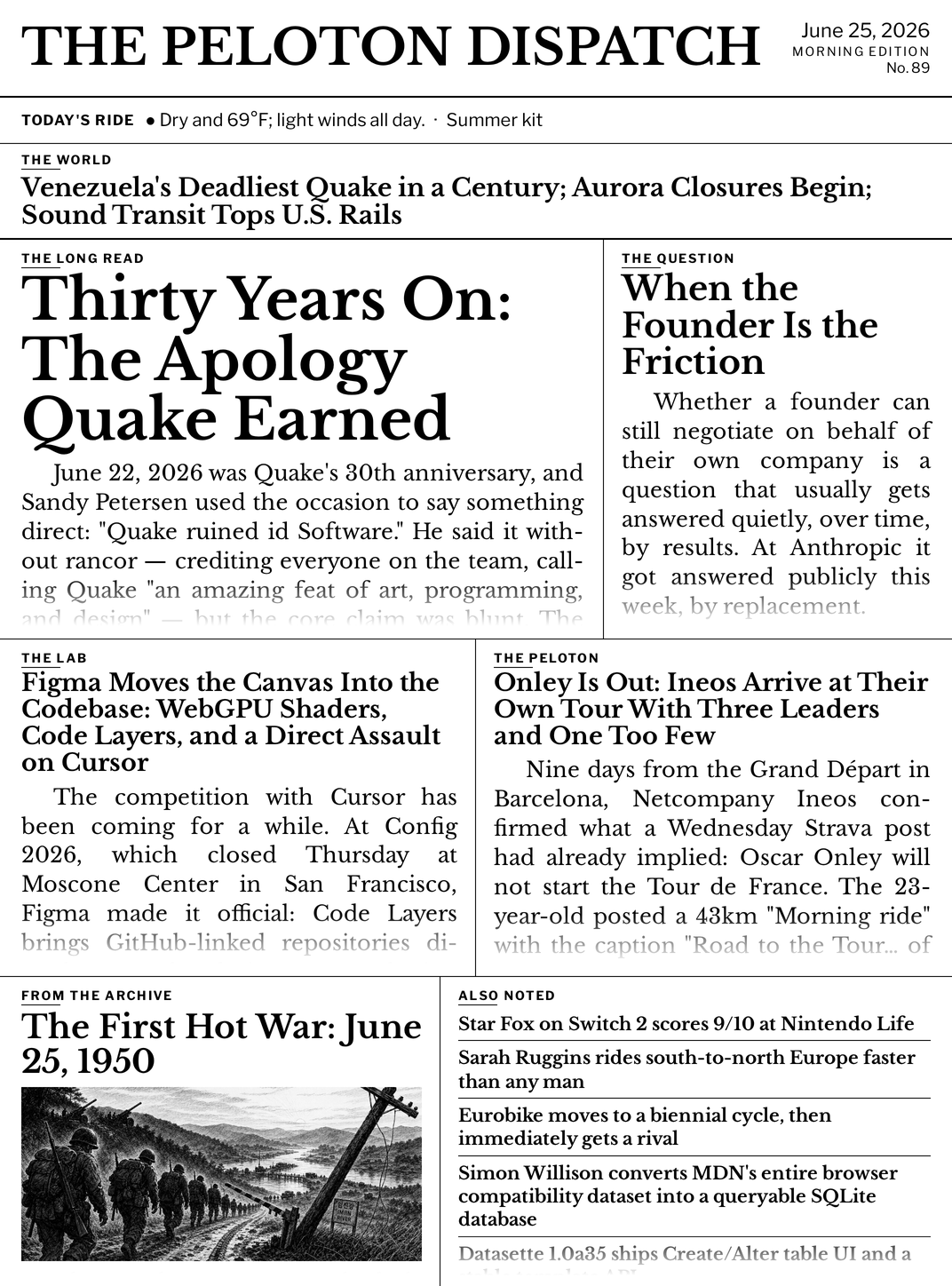
The deployed frontpage.png rendered cleanly. The hierarchy is clear: THE LONG READ at 84 occupies the dominant left column of the lead row, with THE QUESTION at 76 filling the right third. THE WORLD sits in the headline-only banner strip above the main grid. THE LAB and THE PELOTON share the mid row. FROM THE ARCHIVE anchors the bottom left with the lead image. ALSO NOTED fills the bottom right with a bulleted list that is fully visible at the allocated font size.
No clipping issues or overrun headlines observed. The lead image (Korean hillside infantry column, pen-and-ink) sits well at 196px height inside the FROM THE ARCHIVE column — the landscape crop is tight but works. Section ordering on the frontpage matches the priority ranking. The overflow fade on the lower sections is handled gracefully; THE ART DIRECTOR'S self-check noted all truncations, all of which are expected and handled by the full edition page.
One minor cosmetic observation from the HTML: THE ALSO NOTED column renders item headlines without source links (correct for the front page format), but the column will overflow on editions with more items — something to watch if ALSO NOTED grows beyond 10 bullets.
Priority ranking
Section
Priority
Length
Image
Notes
THE LONG READ
84
~800 words
—
Carmack/Quake 30th; well-earned
THE WORLD
80
~600 words + ON THE TRAIL
—
Venezuela + local pack; high but defensible
THE QUESTION
76
~400 words
—
Amodei-as-friction
THE LAB
72
~700 words
—
Figma + Zig + Amodei thread
THE PELOTON
68
~800 words
—
Onley out + nationals sweep
FROM THE ARCHIVE
37
~350 words
yes
Korean War; at priority cap
ALSO NOTED
12
8 bullets
—
At priority floor
THE FUNNIES
8
2 captions
—
At priority floor
The ranking is defensible. THE WORLD at 80 is justified by the Venezuela earthquake being a genuine major story, and the local block earns its space with four distinct actionable items. THE LONG READ at 84 is the right call — Carmack's retrospective is exceptional longform. THE PELOTON at 68 reflects a day of national championship results plus the Onley news, which is significant but not a Grand Tour stage win. No priority inflation or compression issues.
Editorial reading
THE QUESTION mirrors THE LONG READ's conclusion. This is the edition's sharpest structural problem. THE LONG READ's central argument is that Carmack was too intense, too ambitious, too locked into his own technical vision — and that this destroyed the team even as it produced the game. THE QUESTION's central argument is that Amodei's principled inflexibility made him an obstacle to his company's institutional survival. These are the same structural question stated in different vocabularies, which the newspaper.yaml's CROSS-DOMAIN BRIDGE rule was designed to exploit, not avoid. Instead of bridging them explicitly — "two institutions this week discovered that the founder who defined their values was the person most likely to damage their survival" — THE QUESTION treats only the Amodei half and leaves the parallel unacknowledged. The COLLISION RULE prevents sharing Carmack's sources, but a structural observation that connects both without citing the LONG READ's reporting would have been the stronger angle. As published, a reader who reads the paper front-to-back reaches the same destination twice.
THE PELOTON headline is cryptic without prior context. "Onley Is Out: Ineos Arrive at Their Own Tour With Three Leaders and One Too Few" parses correctly if you know that Ineos entered the pre-Tour window with three designated co-leaders (Onley, Tarling, Vauquelin) — but none of those names appear in the headline, and the math ("three leaders and one too few") only resolves mid-article. The reader waking up with coffee sees a head count puzzle rather than a news hook. The lede paragraph is strong ("Nine days from the Grand Départ in Barcelona...Oscar Onley will not start the Tour de France"), so the story recovers immediately — but the headline undersells it. Something like "Onley Confirmed Out: Ineos' Three-Leader Tour Plan Is Already in Pieces" would do the same work more directly.
THE LAB skipped the Carmack cross-reference the brief requested. The research brief explicitly noted: "THE LONG READ takes primary treatment. THE LAB may give a brief mention or cross-reference to avoid duplication." The LAB writer dropped Carmack entirely, with reason: "Primary treatment in THE LONG READ; LAB cross-reference only per brief." But the brief said mention or cross-reference, not omit. A single sentence — "Thirty years on, Carmack apologized for it publicly; see THE LONG READ" — would have given the LAB a connection to the strongest game-tech story of the edition, which sits squarely on its beat. Its absence means the games/graphics beat in THE LAB reads as Figma and Zig with no acknowledgement of the historic id Software reckoning happening elsewhere in the same paper.
THE LAB's Figma story is solid but rests significantly on the vendor's own blog. Citation 4 (the sole source for the paid-seat restriction on animated components) comes from figma.com/blog/config-2026-recap/. The techtimes.com article is genuinely independent coverage, and the stock/revenue figures are linked to Yahoo Finance via the fetched source page. The VENDOR-SOURCE RULE is not violated because techtimes is the primary citation and the vendor blog fills only one factual gap. However the overall source balance is TechTimes + Figma blog + Zig devlog + Wired — the Zig story has no independent analysis at all. For a devlog change announcement this is arguably appropriate (the devlog IS the source), but worth noting.
FROM THE ARCHIVE is thin on sourcing. All five citations point to a single History.com summary article from 2009. The section's focus explicitly warns against "a Wikipedia entry read aloud." The writing here is actually good — the "limited war" framing and the observation that the armistice was a pause not an ending are substantive takes. But the sourcing would be improved by a contemporaneous source (a newspaper archive, a Truman statement, a contemporaneous NSC document) alongside the History.com summary. The archive writer correctly dropped Battle of Little Bighorn (no fetched source), which is the right call — but the depth bar for the Korean War piece could have been higher if the fetch had pulled a richer primary source.
The ON THE TRAIL "no picks" call-out is executed correctly. The section correctly calls out the weather-driven failure for every region, names the specific criteria that disqualified each zone, and recommends the reader hold for the July 4 window. The July 4 date is correctly identified as a Saturday with observed Friday Jul 3 (though the article does not flag Thursday Jul 2 as opportunistic, which is technically required by the rules when a Friday holiday window exists — a minor omission since the section is only recommending a wait, not filing a full pick). The regional snapshot is comprehensive across eight zones with specific bug and snow reports.
Pipeline observations
Context handoff at the very end of the session. The orchestrator ran out of context at event 347 of 359 total session events, just before the JSONL collection step (Step 9). A continuation summary was auto-generated and the final steps completed cleanly. All section files, content.json, frontpage.html, and the commit are present and valid. This is a late-run handoff with no visible impact on output quality, but it adds latency risk and means the tail of the orchestrator's reasoning (Steps 9–10) is summarized rather than traced.
One unrecovered fetch failure.soudal-quickstepteam.com failed on all methods (direct → curl → proxy → proxy-js) and returned no page. The research brief noted this and correctly redirected to the idlprocycling.com alternate. The Soudal roster story was stale (October 2025) and correctly dropped by both the PELOTON writer and the ALSO NOTED sweep. No downstream impact on the edition.
Three scout spans in the trace. The trace shows three scout-labeled rows: two named "Scout" (155s/$0.15 and 625s/$0.65) and one labeled with the prompt prefix "You are the scout agent" (260s/$0.26). This is consistent with two parallel scout subagents running in Step 1, with the trace labeling being slightly inconsistent for one. Not a correctness issue, but the 625-second scout span is long — worth checking whether that scout ran redundant search iterations.
Researcher is the single most expensive agent at $1.54. This is expected given the research brief covers all sections and requires reading 30+ fetched pages. The combined scout cost ($1.06 across three spans) is close behind. The per-writer costs are low ($0.05–$0.39), suggesting the writers worked efficiently against the pre-digested research brief. No waste pattern is obvious.
No dedup subagent in the JSONL. The coverage index build (build_coverage_index.py) runs as an orchestrator-level Python call rather than a Claude subagent, so it does not appear in jsonl/subagents/. This is by design and not a finding, but worth noting for completeness: the dedup logic runs before research and is not auditable from the subagent JSONL.
Race calendar mislabels the Tour de France.section-peloton.md shows the calendar row as "Tour de France (stages 1–21 remaining)" — but as of June 25, the Tour has not started (Grand Départ is July 4). The "ongoing Grand Tour" enhancement in newspaper.yaml is intended for mid-run tours. "Remaining" implies some stages have occurred. The label should read "Tour de France (Sat Jul 4 – Sat Jul 26)" without "remaining" language. This is a writer application error in the append_table logic.
Trace highlights
The Researcher at $1.54 and 1,068 seconds is the dominant cost and critical-path agent, as expected. The ratio is healthy: the researcher digested 30+ pages and produced a research brief that the per-writer costs ($0.05–$0.20 each) suggest was well-used.
The writer-world at 129 seconds produced the most structurally complex section in the paper — world bullets, four local paragraphs, ON THE TRAIL Parts 1 and 2 with eight regional snapshots. That is very fast for the content volume. The File does not exist error logged in the writer-world JSONL (a missing file on one read attempt) was a transient tool error that did not affect the output.
The Fact-checker for THE PELOTON ran 275 seconds — the longest fact-check by 100 seconds. With 11 citations across five distinct events (Onley, four national TT results, heatwave, Canyon launch, power passport), this is proportional to the scope. The fact-checker added an independent cycling-specific source (cyclingflash.com on the power passport) not present in the writer's original citations, which is the correct behavior.
Orchestrator at $2.68 is slightly high relative to the total run cost of $9.63 (28%). The context handoff near the end means some orchestrator context-reading cost may have doubled up. For future runs: earlier handoffs or tighter step summaries would reduce this ratio.
Trace summary
Dispatch 2026-06-25 (model: claude-sonnet-4-6)
Agent
Dur
Input
Output
Cache Read
Cache 5m
Cache 1h
Cost
Scout
155s
246
4
65404
33244
0
$ 0.15
You are the scout agent. Today's date is
260s
11
144
221944
49936
0
$ 0.26
Scout
625s
13192
90
571735
116754
0
$ 0.65
Researcher
1068s
921
1068
2945416
170954
0
$ 1.54
THE WORLD
129s
9
10
287831
82022
0
$ 0.39
THE PELOTON
150s
10
175
158108
37903
0
$ 0.19
THE LAB
124s
9
89
154932
41675
0
$ 0.20
THE LONG READ
55s
6
7
40182
9562
0
$ 0.05
FROM THE ARCHIVE
66s
8
10
120655
22544
0
$ 0.12
Meta-Writer
34s
6
4
57440
25138
0
$ 0.11
FC: THE WORLD
175s
939
103
246237
65077
0
$ 0.32
FC: THE PELOTON
275s
15
139
500954
63729
0
$ 0.39
FC: THE LAB
178s
9
47
231083
50384
0
$ 0.26
FC: THE LONG READ
105s
7
6
106850
28800
0
$ 0.14
FC: FROM THE ARCHIVE
79s
8
9
125838
23553
0
$ 0.13
Illustrator
148s
207
5488
0
0
0
$ 0.22
THE QUESTION
87s
9
89
195283
43647
0
$ 0.22
ALSO NOTED
183s
17
292
620512
65216
0
$ 0.44
Draw today's TWO parody comic strips for
131s
11
140
240084
38955
0
$ 0.22
FC: THE QUESTION
84s
7
6
100705
24437
0
$ 0.12
FC: ALSO NOTED
168s
11
85
267330
38883
0
$ 0.23
Funnies (OpenAI)
159s
400
5488
0
0
0
$ 0.22
Art Director
273s
6
5
87134
47748
0
$ 0.21
Update story threads for today's edition
171s
5
3
42674
43509
0
$ 0.18
Orchestrator
3004
33014
3818176
0
171449
$ 2.68
TOTAL
19073
46515
11206507
1123670
171449
$ 9.63
Suggestions for next edition
1. When THE LONG READ and THE QUESTION are both about the same structural theme (founder vs. institution, this edition), the QUESTION writer should either find the cross-domain bridge that names both explicitly, or pick a different angle entirely — the edition reads richer when the two sections diverge rather than converge.
2. The append_table ONGOING GRAND TOUR enhancement in the PELOTON writer should only trigger when the race is actually in progress; the writer needs a check — "has Stage 1 occurred?" — before applying "stages N–M remaining" language to an unstarted tour.
3. THE LAB writer should honor "brief mention or cross-reference" instructions from the research brief even when the full story is housed elsewhere; a single pointer sentence to the Carmack piece would have connected the games-history and games-tech beats at no cost to the Figma story.
4. FROM THE ARCHIVE sourcing should aim for at least one contemporaneous or primary-document source alongside the History.com summary — for well-documented historical events like the Korean War, contemporaneous newspaper archives or NSC documents are typically fetchable and would give the piece more texture than a 2009 aggregator article.