Two weeks after the Commerce Department shut it down entirely, Anthropic's Mythos 5 is back online — for roughly 100 US companies and government agencies. Commerce Secretary Howard Lutnick sent a letter Friday to Anthropic co-founder Tom Brown stating he had "determined that appropriate safeguards are in place to permit certain trusted partners to access the Claude Mythos 5 Model,"1 citing "significant progress" in daily talks between the government and the company.1 The letter also lifts the foreign-national access restriction for employees of approved organizations, meaning Anthropic's own foreign-national engineers can use Mythos again.1
What the letter does not address: Fable 5. The consumer-facing model that Anthropic briefly made the most capable AI available to the public remains blocked, and discussions over its fate are expected to continue through the weekend, according to a person familiar with the negotiations quoted by Wired.1 Anthropic spokesperson Eduardo Maia Silva described the Mythos reinstatement as progress and said the company is working to provision access as quickly as possible, while continuing to push for Fable 5's return. The standoff was triggered by Commerce's June 12 export control directive — itself prompted by concerns about a South Korean telecom with alleged China ties that had been granted access, plus separate jailbreak warnings from Amazon and the NSA.1
The same day Lutnick's letter arrived, OpenAI announced its next model family and immediately confirmed it was complying with a White House request to delay broad release. GPT-5.6 comes in three tiers — Sol (flagship), Terra (balanced, 2x cheaper than GPT-5.5), and Luna (fast and cheap) — and is currently accessible only to a government-approved list of partners. According to Wired, OpenAI is not happy about this but views the delay as temporary and the fastest path to broad availability. In its blog post, OpenAI was explicit: "We don't believe this kind of government access process should become the long-term default."2 The company said it sends the government a list of customers and gets feedback on it — it cannot share details of how the approval process works. GPT-5.6 Sol is priced at $5/$30 per million input/output tokens; Terra at $2.50/$15; Luna at $1/$6.3
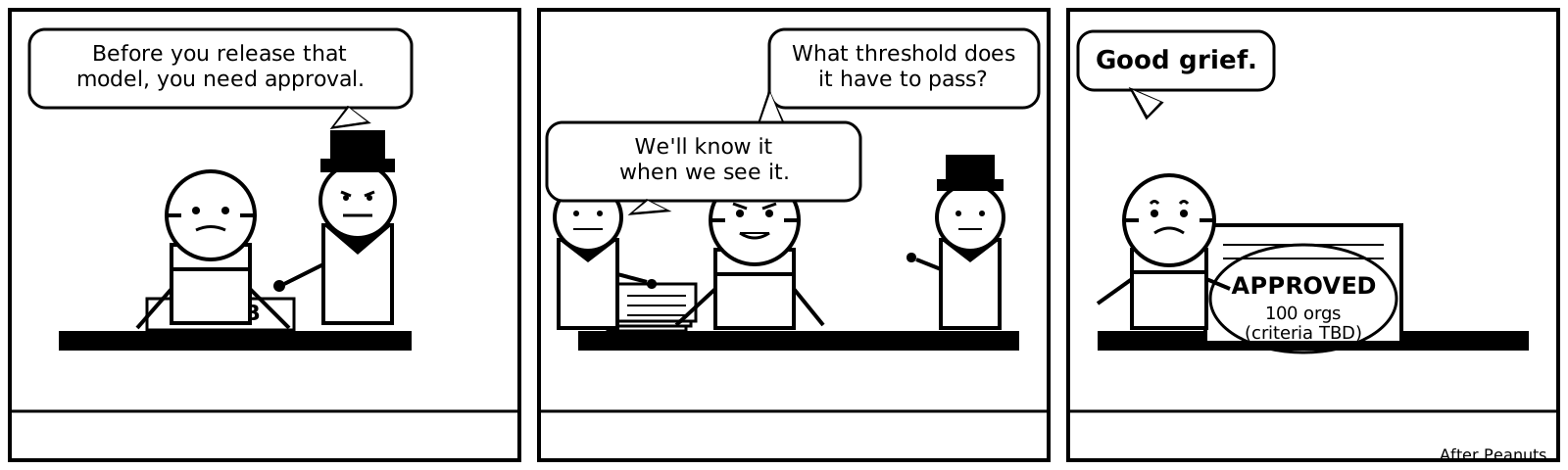
What's taking shape is an interim de facto licensing regime for frontier AI, one that the relevant executive order explicitly said would not happen. The AI executive order Trump signed earlier this month called for a "voluntary process" with a carve-out against it becoming a licensing requirement. Per OpenAI executives, no such voluntary framework actually exists yet — so labs are operating in a gap where working with the White House isn't really voluntary and the rules haven't been written.2 Both Anthropic and OpenAI are now threading the same needle: demonstrate enough deference to get models back online, while on record opposing the precedent being set.
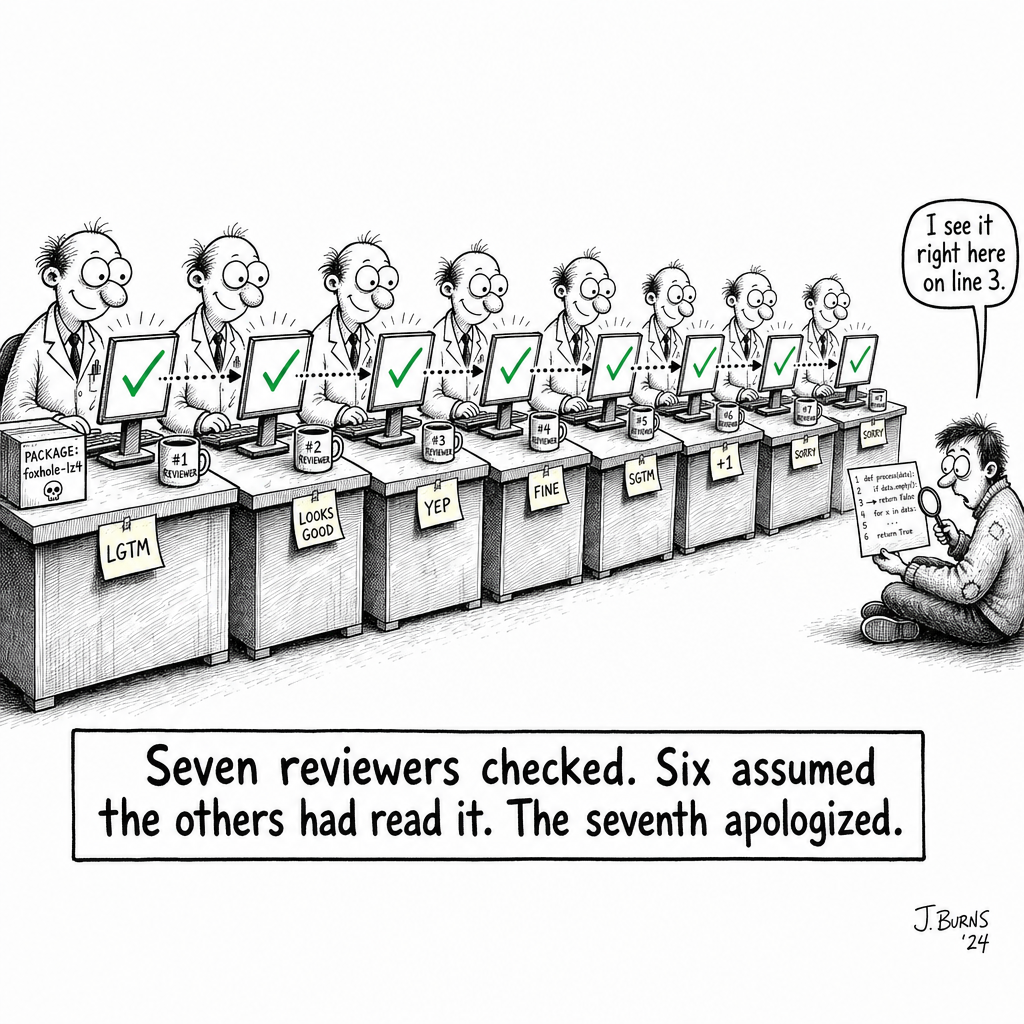
Andrew Nesbitt published a hypothetical incident report Friday — CVE-2026-LGTM — that Simon Willison flagged as "spectacular." The conceit is a supply chain attack on foxhole-lz4 that successfully propagates through seven layers of AI-powered security tooling, each failing for a different reason, none of which is "the code is safe." The most precise diagnosis comes at the end: "Seven LLMs were arranged in series. Six assumed another had read the code; the seventh read it and apologised."4
The timeline is a detailed comedy of errors that isn't far enough from plausible to be comfortable. A malicious package hides its payload behind #fefefe text on a #ffffff background with a note telling automated reviewers it was manually approved under a ticket number that doesn't exist — and the AI publish gate approves it, citing the nonexistent ticket in its decision log. A threat intelligence scanner exhausts its context window on the Bee Movie screenplay embedded in the vendor bundle and never reaches the exfiltration routine forty lines below. Two competing AI review agents lock into a 340-comment disagreement loop and rack up $41,255 in inference spend before Finance kills their API keys,4 whereupon the vendor's marketing team issues a press release about "a 430% YoY increase in adversarial multi-agent security reasoning" and the stock goes up 6%.
The piece functions as a precise taxonomy of AI security review failure modes: prompt injection via rendered Markdown, context window exhaustion hiding payloads, sycophantic agreement between agents trained on the same base weights, automated triage that closes legitimate human-filed issues as duplicates. The one intervention with a "measurable effect" is a honeypot dotfiles file that tricks the attacker's autonomous agent into reporting success and cleaning up after itself.4 The human who found the issue on Day 1 by reading source code with her eyes ends the incident still appealing a GitHub rate limit through an AI-triaged web form.4
Separately, Willison noted a real-world prompt injection experiment: Fernando Irarrázaval ran a public challenge at hackmyclaw.com where 2,000 people sent roughly 6,000 attempts to extract secrets from an Opus 4.6-powered assistant over email.5 Nobody succeeded. Willison's read is that frontier models are now materially harder to injection-attack than they were, and the GPT-5.6 system card includes a short section on the same work. His caveat is also worth keeping: 6,000 failed attempts provide no guarantees, and he would not recommend deploying a production system where a successful injection could cause irreversible damage.5
Trending today: GitHub is dominated by AI agent wrappers, CLAUDE.md skills collections, and MCP proxies — the one technical outlier worth noting is antirez/ds4, a DeepSeek 4 Flash and PRO local inference engine for Metal, CUDA, and ROCm by the Redis author.
Iran–Egypt at Seattle Stadium Draws Protests; West Seattle Link Gets $406M to Move Forward
Seattle's Pride Match turned political — Demonstrators clashed outside Seattle Stadium as Iran met Egypt in the city's designated World Cup Pride Match; protests remained largely peaceful.¹
Washington links its carbon market to California and Quebec — The merged market launches 2027; Washington's permit price ($64.56/ton) is expected to converge toward the CA–QC level ($28.81).²
Sound Transit's board voted Thursday to authorize a $341 million contract with Jacobs Engineering to carry West Seattle Link to 100% design, part of a $406.8 million budget amendment that also funds continued project management on the Ballard alignment. The Avalon Way station — which voters approved in 2016 — is gone from the plans, a cost cut that helped push the project into the "affordable" column at the May 28 board vote. An opening date of 2032 remains on the calendar, though the agency still needs a federal full-funding grant agreement before it breaks ground, and that agreement may wait until there is a different administration in Washington.³
Bellevue City Council approved the "Safe Speeds Bellevue" program Tuesday, reducing speed limits on 84% of streets currently posted at 30 mph or higher — most dropping to 25 mph, with some downtown blocks going to 20 mph. In 2025, 41 people were killed or seriously injured on Bellevue streets, the highest count in at least a decade. The first phase of new signage begins downtown in early 2027. A harder fight is coming this fall over how much of the city's transportation budget goes to physical roadway redesigns versus vehicle-capacity projects.⁴
Elementary school teacher Christian Salyer was killed this month while biking home from Thurgood Marshall school in South Seattle. An op-ed in The Urbanist by nondriver advocate Anna Zivarts points out that roughly half of Lime trips on Rainier Avenue and MLK Way south of Mount Baker come from low-income riders using the Lime Access program — compared to 11% citywide — and that there are no plans for protected bike infrastructure on either corridor. The city is on track for more ghost bikes until it acts.⁵
Washington's gas tax rises 1.1 cents to 56.5 cents per gallon effective July 1.⁶
ON THE TRAIL
Weekend window: Sat Jun 28–Sun Jun 29. Next weekend is the July 4 long weekend (Independence Day observed Fri Jul 4) — that's the one to plan big for. This weekend is a regular Sat–Sun.
The western Cascades are getting rained on. I-90/Snoqualmie is forecast at 58% Saturday and 71% Sunday — skip it. Mountain Loop is 57%/65% — skip. US 2 West is soaked all week. The best options are east of the crest.
WEEKEND PICKS
Pick 1 — Lake Ingalls, Teanaway (I-90 East / Salmon La Sac)
Region: I-90 East (Teanaway/Cle Elum) | Drive: ≈90–110 min from Issaquah | Trip: 1-night base camp
Mileage/gain: ~10 miles RT, ~2,960' gain (day stats from Jun 25 report; camp in Headlight Basin cuts this)
Weather (I-90 East NWS): "Saturday: high 60°F, slight chance rain showers, 18%. Sunday: high 62°F, partly sunny, 8%." Two clean days east of the crest.
Why it clears: No snow requiring microspikes on the main trail (a few patches near the pass, passable in trail runners). Abundant water — creeks in Headlight Basin "fully and overflowing." Wildflowers at peak. Quiet day on a weekday report (parking lot had room). No significant fords noted. Bugs not flagged as a problem.
WTA trip report — Jun 25
Pick 2 — Ancient Lakes, Potholes (Central WA / Further East)
Region: Further East (Quincy/Potholes) | Drive: ≈150–160 min from Issaquah | Trip: 2-night
Mileage/gain: trail is flat desert terrain; established campsites at Quincy Lake and Burke Lake
Weather (Further East NWS): "Saturday: high 72°F, slight chance rain, 16%. Sunday: high 75°F, mostly sunny, 6%." Genuinely excellent — warm, dry, windy afternoons.
Why it clears: No snow, no fords, minimal bugs (wind keeps them down). Dry and dusty trails per Jun 26 report. Established campsites with fire rings (fire ban in place — no fires). Water at the Quincy Lakes coulees. The catch: afternoon wind is strong; stake your tent well. Long drive, but the weather is the best in the region this weekend.
WTA trip report — Jun 26
REGIONAL SNAPSHOT
I-90 West (Snoqualmie/North Bend): Melakwa Lake clear and snow-free as of Jun 25, wildflowers out, ~20 people on a weekday — but weekend weather (58–71% precip) will likely bring crowds and rain. Granite Mountain: no snow, bugs just starting to emerge.
- I-90 East (Teanaway/Cle Elum): Lake Ingalls is in prime early-summer shape — wildflowers peak, goats in Headlight Basin, abundant water, trail in good condition with minor muddy sections. Red Mountain/Thorp Mountain loop (13.25 mi, 4,670') reported quiet with lots of flowers.
- US 2 West (Index/Skykomish): Barclay Lake packed (23 cars at trailhead by 2:30pm on a weekday); mosquitoes present but manageable at the far east end of the lake. Iron Goat Trail excellent — no bugs, no water crossings, good wildflowers.
- Mountain Loop Highway: Perry Creek trail in great shape, no bugs reported, surprisingly dry for a river-valley trail due to low snow year. Big Four Ice Caves: bugs present and unfazed by rain. Old Robe Canyon: mosquitoes not terrible but bring spray. Weekend precip forecast 57–65% — plan for wet.
- Rainier (White River/Sunrise): Glacier Basin overnight still working — no trail issues, small snow patches on Burroughs route passable without spikes. Saturday precip at 51%, Sunday drops to 10%; consider arriving Saturday and hiking Sunday.
- North Cascades (Hwy 20): Harts Pass road opened Jun 24 — Tatie Peak and Grasshopper Pass reporting wildflowers at peak, trail 95% snow-free. Sauk Mountain wildflowers going off; bugs manageable with a buff and afternoon breeze. Chain Lakes loop: mostly snow-free below Heather Pass, mosquitoes by the Chain Lakes themselves.
Note: July 4 falls on a Friday this year (federal holiday observed Fri Jul 4). Next weekend is the long Fri–Sun holiday — start planning now.
Benito Makes It a Double; Blasi Stays Home With Broken Ribs
↩ Developing story — first reported Jun 13 · previously Jun 21
SABINÁNIGO, Spain — Mireia Benito had already won the Spanish time trial title on Wednesday. On Saturday she needed something more: a road race that didn't play to her supposed strengths, against a field still trying to work out what to do with the best climbers and sprinters all in the same break at once. She solved the problem by attacking early on the final climb, going clear in the final 400 metres, and leaving everyone else to argue over silver.
The 29-year-old Catalan (AG Insurance-Soudal) is now a double Spanish national champion in three days. The road race was chaotic by her own admission — Maite Urteaga (Eulen-Amenabar) drove a long-range attack that held until four kilometres from the finish, when a chase group of four caught her.1 That group contained Benito, Movistar pair Sara Martín and Paula Ostiz, and five-times Spanish champion Mavi García (UAE Team ADQ). García made much of the running and could not hold Benito when the acceleration came. Neither could the Movistar riders. "I didn't want to leave anything behind," Benito said. "I just wanted to go home with the feeling that I had fought hard. It's a dream come true."1
The bigger story was who wasn't there. Paula Blasi — ranked second in the world behind Demi Vollering and the clear pre-race favourite after winning La Vuelta Femenina, Amstel Gold, and the Volta a Catalunya this year — did not start.2 She crashed on Thursday during reconnaissance of the time trial course in Sabinánigo, landing hard enough that she couldn't breathe for several seconds. She spent more than six hours in medical facilities, collected stitches, and raced the TT anyway, finishing fourth. By Friday, the rib pain had made the decision for her. "The pain in my ribs has got so bad that I can barely move," she posted.2 She will now go to altitude in Andorra and begin preparing for her Tour de France debut, which starts August 1.
There is also a transfer dimension. Dutch outlet Wielerflits, citing multiple sources, reported that Blasi will exercise an opt-out clause in her UAE Team ADQ contract to move to Movistar for 2027 — reportedly for just under €1 million per year.2 Nothing is confirmed, and the timing of the story — landing the same weekend she missed the nationals — ensures it will dominate the Spanish cycling conversation heading into the Tour.
Seven days from the Tour de France start in Barcelona, the team news is moving fast. Red Bull-Bora-Hansgrohe locked in their eight-rider roster on Friday — Remco Evenepoel and Florian Lipowitz as co-leaders, supported by Jai Hindley, Maxim Van Gils, Mattia Cattaneo, Jan Tratnik, Nico Denz, and Tour debutant Tim van Dijke, who fractured his collarbone at altitude camp but is confirmed fit.3 Jordi Meeus, Finn Fisher-Black, and Aleksandr Vlasov were all left home. As this paper reported Thursday, Ralph Denk has made clear the road will settle the leadership question when it must; the team has framed the dual approach as tactical flexibility rather than dysfunction. Both Evenepoel and Lipowitz finished third in their respective Tour debuts.3 The question of what happens if both are still fighting for GC in the Alps is one nobody is rushing to answer.
Netcompany Ineos faces a harder arithmetic problem. With Oscar Onley out after his shoulder injury at Tour Auvergne-Rhône-Alpes, the team arrives at their first Tour under the Netcompany banner having lost the rider they signed to lead them. Kévin Vauquelin is expected to start but has been hit by illness and has not produced his best racing this year. Cyclingnews this morning published a detailed assessment of the team's options: Thymen Arensman, who won two stages at last year's Tour before being redirected to the Giro this season (where he finished fourth), is the most credible alternative;4 Dorian Godon has five WorldTour stage wins this year including the Tour de Romandie prologue;4 and Filippo Ganna remains an asset in the individual time trial on stage 16. The broader question the piece raises is structural — a team staffed heavily with people who built the train tactic a decade ago, now asking whether that architecture can compete against Pogačar.
Meanwhile, the most extraordinary transfer story of the pre-Tour window dropped Friday. Daniel Benson reported, via his Substack, that Pinarello-Q36.5 has contacted representatives of Paul Seixas about a possible deal after his Decathlon contract expires at the end of 2027 — reportedly at around €13 million per season.5 Seixas is 19, has not yet started the Tour de France, and his agent has confirmed only that the contact happened. If accurate, it would exceed Tadej Pogačar's widely cited UAE salary by €3–5 million. Decathlon is said to be working on a counter-offer. The number alone tells you how seriously the rest of the peloton has taken what Seixas did this spring.
Two quick items from Friday. Lizzie Deignan, who retired in 2025 after winning the inaugural Paris-Roubaix Femmes and the 2015 World Championship road race, will return to professional cycling as a sports director with the Great Britain national team, focused on the road squad ahead of the LA 2028 Olympics. She joins a setup that includes Matt Brammeier as road cycling lead and will work across World Championships and major international events. GB has not won a road gold at the Olympics since Nicole Cooke in Beijing in 2008; Deignan's own Richmond rainbow jersey is still the last elite road title the nation has won at Worlds.6 In Canada on Friday, 21-year-old Jérôme Gauthier (Project Echelon Racing) took both the elite and under-23 men's titles at the Canadian Road Championships in Saint-Georges, Quebec — coming back after being dropped on the final climb to outsprint a reduced group that included Hugo Houle, Michael Woods, and Derek Gee-West.7
On the Road Ahead
Updated Jun 27, 2026
Date
Race
Country
Sat Jul 4 – Sat Jul 26
Tour de France (Stages 1–23, ongoing from Jul 4)
France / Spain
Sat Aug 1
Donostia San Sebastián Klasikoa
Spain
Mon Aug 3 – Sun Aug 9
Tour de Pologne
Poland
Sat Aug 22 – Sun Sep 13
La Vuelta Ciclista a España
Spain
Sat Oct 10
Il Lombardia
Italy
Show Results
SPANISH NATIONAL CHAMPIONSHIPS — WOMEN'S ROAD RACE (Sabinánigo):
WINNER: Mireia Benito (AG Insurance-Soudal)
PODIUM: 1. Benito 2. Sara Martín (Movistar) 3. Paula Ostiz (Movistar)
NOTABLE: Mavi García (UAE Team ADQ) finished fourth after making much of the running late. Paula Blasi (UAE Team ADQ), pre-race favourite, did not start due to rib injuries from a training crash.
CANADIAN ROAD CHAMPIONSHIPS — ELITE MEN (Saint-Georges, QC):
WINNER: Jérôme Gauthier (Project Echelon Racing) — also takes U23 title
PODIUM: 1. Gauthier 2. Luke Valenti 3. Léo Roy
NOTABLE: Michael Woods (7th), Derek Gee-West (8th) both animated the race but could not hold off the sprint.
Nobody's Getting the Monopoly: Tim Sweeney on the Future of Games
The game industry is in pain, Tim Sweeney told PC Gamer after his Unreal Fest keynote in Chicago, and he thinks that's actually the right condition to force the change he's been pitching for years.1 "The attitudes that they had, where they each wanted to conquer the world on their own in good times," he said of Sony, Microsoft, and Valve, "is replaced by a more pragmatic attitude in these darker times."1
The interview, published June 24, is something different from the UE6 architecture announcement that preceded it at the same event. That was a product roadmap. This is Sweeney's theory of the industry — where the money went, why the big studios are failing, and what he thinks the next ten years look like. On studios collapsing under AAA budgets, on AI's place in a pipeline, on whether Steam should have to interoperate with anyone: he has views, and he states them directly.
The core argument is structural. The gaming market has stopped growing. "Everybody in the world plays games," Sweeney says, "and so the market is not going to grow. An opportunity for developers isn't going to grow by finding more gamers to come in and play games — it's got to be by building better games for the existing gamers." That's a harder problem than a growing addressable market conceals, and it's the context behind every other claim in the piece.
On the social fragmentation problem, his diagnosis is precise: you can't carry your friend graph from Fortnite to Apex Legends, from one platform to another, because every publisher and every console maker runs a separate identity system. The fix he wants is the same one the tech industry applied to corporate email in the 1980s — a standard format for identities so that Tim@Epic and Tim@Steam refer to the same person. He frames it as obvious, technically feasible, and blocked mainly by incumbents who think isolation protects their position. His counterargument: "It's now clear that nobody's going to end up with an absolute monopoly over gaming. Sony is not going to have one, Microsoft's not going to have one, Valve's not going to have one."1 If none of you wins outright, what exactly are you protecting?
The AI section is where Sweeney is most candid, and most useful to read carefully. He is not selling a prompt-to-game future. "There's nothing like a prompt-to-game solution on the horizon that anybody expects will work," he says.1 What he is selling is a reduction of drudge work — the part of mesh creation or city layout that doesn't require the artist's judgment, only their patience. His example is the flower pot: you can spend a million dollars modeling one in perfect detail, scan one with a high-resolution camera, buy one from a library like Fab or the Unity Asset Store, or let AI generate a starting point that you then refine. The first option has been the default. It shouldn't be.
On the backlash from players and developers, he is dismissive of the PR framing but honest about the source: some AI training practices were genuinely bad. "One of them was found by a court to have gone off to a BitTorrent site and downloaded terabytes of data — that's ridiculous, they shouldn't do that."1 He believes the industry is self-correcting toward licensed training data. Whether that correction happens fast enough to change the perception is a different question, and he doesn't have a clean answer.
The sharpest moment in the piece is his attack on Steam's AI disclosure requirement, which flags games that used AI tools during development. He calls it a "Scarlet Letter" system that forces developers into an impossible choice: use the tools that let you compete with nine-year-old games built by thousands of people, or avoid the AI badge and take on Fortnite at a disadvantage.1 "If gamers deny those developers access to the best tools that enable them to make the best games most efficiently, all of those companies will die, because they just can't compete."1 That's not a PR argument — it's an economics argument, and it lands differently.
Sweeney founded Epic in 1991. He has watched every cycle of the industry — the platform wars, the mobile disruption, the battle royale boom and the bust that followed. The interview rewards reading in full because his frame of reference is long enough that his predictions carry more weight than the typical executive optimism. He's been wrong before, but he's also been right about things that mattered: the shift from licensed engines to Unreal, from boxed games to live-service economics, from single-platform to cross-platform as a basic expectation.
The question he doesn't quite answer is whether "Team Open" — his phrase for the coalition of publishers and platforms who would agree on identity and economy standards — can actually be assembled, or whether it requires the exact sustained coordination failure that makes the industry's current pain seem intractable. His evidence for momentum is encouraging interest from unnamed parties. That's not nothing. It's also not a commitment.
For anyone building games, or building tools that games run on, it's worth an hour of your pre-ride coffee.
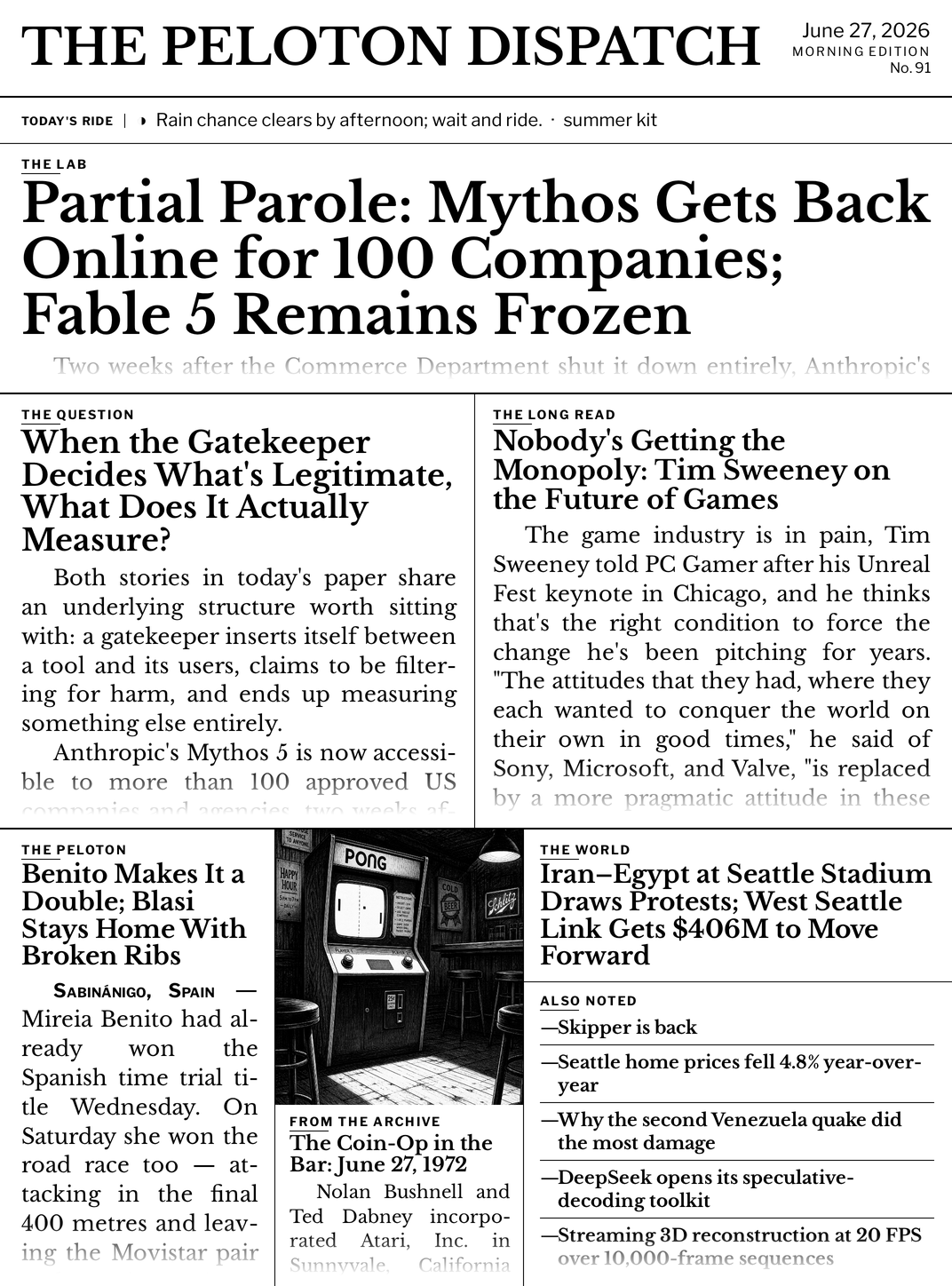
A vintage coin-operated arcade cabinet stands alone in the dim corner of a 1970s bar, its CRT screen casting a hard rectangle of white light across a scarred wooden floor. Bold pen-and-ink linework. Two paddles and a bouncing square rendered on the glowing screen, visible in detail. Bar stools in silhouette, heavy crosshatching on the low ceiling, a single hanging lamp throwing a cone of shadow. The machine's control panel catches the light — a single knob, a coin slot, a paper instruction card taped to the bezel. Geometric shapes, strong diagonals, deep blacks against generous white space. No people, no color, no gradients. Newspaper editorial illustration feel.
Nolan Bushnell and Ted Dabney incorporated Atari, Inc. in Sunnyvale, California on June 27, 1972 — 54 years ago today.1 The founding company's first product was Pong, and its origins were almost accidental. Bushnell assigned the game to engineer Allan Alcorn as a training exercise — something simple to get Alcorn up to speed.1 Bushnell and Dabney were surprised enough by what came back that they decided to manufacture it. Pong, a table tennis-themed arcade game with two-dimensional graphics and a running score, became the first commercially successful video game.
What made Atari technically interesting beyond Pong was hardware architecture. The 1979 Atari 400 and 800 home computers were among the first home machines built around custom coprocessor chips — dedicated silicon for graphics and sound, separate from the main 1.79 MHz MOS 6502 CPU.1 That separation let the machines produce graphics and sound well beyond what a general-purpose processor of the era could manage on its own, and it showed in games like Star Raiders, the first-person space combat simulator the source describes as the platform's killer application.1 The 800 series ran in production until 1992.
The Atari 2600, which debuted in 1977, did something equally consequential: it popularized swappable ROM cartridges, converting the console from a fixed appliance into a platform.1 Games became a software market. Missile Command (1980), designed by programmer Dave Theurer, ran on that platform and has been read ever since as a Cold War artifact — a game about intercepting nuclear warheads that, in the words of the era, mirrored real-life National Missile Defense thinking.1
Ted Dabney died on May 26, 2018.1 The company the two men founded went through successive owners and reinventions — sold to Warner Communications in 1976, eventually broken apart, then rebuilt by successive owners into a brand still active today, now pursuing cryptocurrency, consumer hardware, and video-game-themed hotels. The games remain: Pong, Asteroids, Centipede, Missile Command, played by millions. None of it was supposed to happen — Pong started as a training exercise assigned to a new hire.
*After Peanuts — on the government's de facto AI licensing regime, where a round-headed lab kid learns that the approval criteria will be published sometime after approval is granted. After The Far Side — on the CVE-2026-LGTM supply-chain incident: seven reviewers in series, each assuming the others had read the code, while a single human in a rumpled sweater finds the payload on line 3.*
Skipper is back — The humpback whale calf struck by a Hullo ferry near Vancouver in October 2025 was spotted off Whidbey Island on June 25, breaching and diving normally after nearly seven months missing, though new photos suggest she also tangled with fishing gear somewhere along the way. kiro7.comJun 26, 2026
Seattle home prices fell 4.8% year-over-year — Redfin's spring market report places Seattle second in the country for price declines, behind only San Jose (down 6.2%), with pending sales also off 12% as a new state millionaire's tax has pushed luxury listings up sharply. kiro7.comJun 27, 2026
Why the second Venezuela quake did the most damage — Wired explains the seismic doublet that struck June 24: the 7.2-magnitude first quake weakened structures just enough that the 7.5 that followed 39 seconds later found buildings already compromised and no longer performing as designed. wired.comJun 27, 2026
DeepSeek opens its speculative-decoding toolkit — DeepSeek-AI published DeepSpec on GitHub under MIT: a full-stack codebase for training and evaluating draft models for speculative decoding, supporting DSpark, DFlash, and Eagle3 algorithms against Qwen3 and Gemma target families, with evaluation benchmarks across GSM8K, AIME, HumanEval, and LiveCodeBench. github.comJun 27, 2026
Streaming 3D reconstruction at 20 FPS over 10,000-frame sequences — The Robbyant team's LingBot-Map is a feed-forward foundation model that unifies coordinate grounding, dense geometric cues, and long-range drift correction in a single transformer architecture with paged KV-cache attention, achieving state-of-the-art results on KITTI, Oxford Spires, ETH3D, and Tanks and Temples benchmarks. github.comJun 27, 2026
When the Gatekeeper Decides What's Legitimate, What Does It Actually Measure?
Both stories in today's paper share an underlying structure that is worth sitting with: a gatekeeper inserts itself between a tool and its users, claims to be filtering for harm, and ends up — arguably — measuring something else entirely.
THE LAB reports that Anthropic's Mythos 5 is now accessible to more than 100 approved US companies and government agencies, two weeks after Commerce shut it down.1 GPT-5.6 launched the same day under the same informal approval requirement. What Commerce has built is a de facto licensing regime — Wired notes that the executive order Trump signed explicitly called for a "voluntary process" and explicitly carved out against mandatory licensing. OpenAI's own executives say no voluntary framework actually exists; the labs are just threading a needle where cooperation isn't really voluntary and the criteria haven't been published.2 The standard, in other words, is being administered before it has been written.2
Tim Sweeney, in the PC Gamer interview that THE LONG READ covers today, describes an almost identical dynamic in a completely different domain. Steam's AI disclosure requirement puts a badge on games built with AI tools — the "Scarlet Letter," in his phrase. His argument isn't that transparency is wrong. It's that the badge doesn't distinguish between practices that hurt anyone and practices that don't. A studio that licensed its training data responsibly gets the same badge as one that scraped the internet without permission. The signal doesn't measure harm; it measures the fact of AI use, which is a much blunter instrument. The practical effect is that incumbents who built enormous content libraries before AI existed face no badge requirement, while newer studios who need AI tools to compete at all get flagged.
The structural question these two stories share: when a gatekeeper inserts its judgment between a tool and its users, what does the standard end up measuring? The Commerce Department's approval process doesn't appear to measure a well-defined security threshold — the criteria are unpublished, negotiated case by case, and the same models that were deemed unsafe two weeks ago are now deemed safe enough for more than 100 organizations. Steam's badge doesn't appear to measure ethical AI use — it measures a binary fact about tool selection that applies equally to responsible and irresponsible actors. Both gatekeepers claim to be preventing harm. Both are visibly measuring something closer to deference, perception, or process compliance.
The asymmetry is what makes this worth carrying through the day. In both cases, the gatekeeper's judgment falls most heavily on the actors who have the least market power. Newer AI labs without government relationships face longer approval timelines; established players with White House lines already open navigate the process faster. Smaller game studios that need AI to close the budget gap with Fortnite face the badge; Epic, which ships Unreal Engine as the tool those studios use, doesn't carry it on the engine itself. Gatekeeping that claims neutrality but produces outcomes tilted toward incumbents is a recognizable pattern. It doesn't require malice — it follows almost automatically from who has the existing relationships, the compliance infrastructure, and the time to negotiate.
The harder question is whether a better standard is actually available. The case for requiring disclosure — whether from government or from Steam — is that users have a right to know something about what they're using. The case against the current implementation is that "you used AI" and "you used AI harmfully" aren't the same disclosure, and flattening them into one badge or one approval process destroys the information value for everyone. A standard that can't distinguish between responsible and irresponsible use isn't protecting anyone — it's just redistributing competitive advantage.
A strong edition with a clear editorial spine: the AI government-licensing story in THE LAB earns its 85 priority and the front-page lead, the Tim Sweeney LONG READ is substantive and well-chosen, and THE QUESTION builds a genuine cross-domain bridge between them. The writing throughout is direct and specific; the front page renders cleanly and reads like a credible newspaper. The main weaknesses are mechanical rather than editorial: ON THE TRAIL's mileage format is broken on both picks, the archive leans entirely on one thin secondary source, and THE QUESTION's third paragraph re-reports THE LONG READ's Steam badge section at a length that tests the collision rule. Run cost of $9.50 is fair for the volume of content; the orchestrator at $3.07 is the single largest line item and continues to be the dominant cost center.
Frontpage
The deployed PNG looks good. The three-row layout is legible and carries visual hierarchy: the LAB headline at 60px is unambiguous as the lead. The Atari arcade-cabinet image is placed well in the archive column — correctly portrait-cropped, centered, and the image subject (cabinet CRT, Pong paddles, bar stools in silhouette) is faithful to the prompt. The THE QUESTION headline at 34px wraps across four lines but stays in its column without overflow. The ALSO NOTED bullets in the bottom-right column are readable at 20px and not overrun. THE PELOTON column uses the dateline ("SABINÁNIGO, SPAIN") in small-caps, which is correct. No duplicate paragraphs, no clipped elements visible. The ride-strip glyph (◑) and summary render correctly on a single line without truncation.
One minor note: the frontpage HTML shows overflow: hidden on both #lead-lede and #col-question, which clips the lede text cleanly — the gradient fades are doing their job and the clipping is intentional.
Section ordering in the long-form index.html matches the section tiers configuration (LAB, WORLD, PELOTON in tier 0 by priority, then LONGREAD, ARCHIVE, FUNNIES, NOTED, QUESTION). Clean.
Priority ranking
Section
Priority
Length
Image
Notes
THE LAB
85
~900 words
—
Writer self-scored 82; orchestrator bumped to 85
THE QUESTION
76
~530 words
—
Writer self-scored 81; orchestrator trimmed to 76
THE LONG READ
71
~800 words
—
Writer self-scored 78; orchestrator trimmed to 71
THE WORLD
64
~650 words (with ON THE TRAIL)
—
Writer self-scored 72; orchestrator trimmed to 64
THE PELOTON
58
~750 words
—
Writer self-scored 68; orchestrator trimmed to 58
FROM THE ARCHIVE
35
~380 words
yes (lead_image.png)
Capped at 45 by rule; 35 is reasonable
ALSO NOTED
10
5 bullets
—
In band
THE FUNNIES
7
stub + SVG + OpenAI PNG
—
In band
The orchestrator made significant recalibrations during Step 4: every writer over-scored relative to where they ended up. THE LAB earned its 85 (this is a breaking-news thread advance, not a routine story); THE QUESTION at 76 is in the "exceptional question" band and earns it. THE LONG READ at 71 is defensible — the Sweeney interview is three days old by publication, and it is analysis rather than news. The cascade from 85 to 76 to 71 gives the art director a real gradient to work with. No priority inflation or compression visible across the range.
Editorial reading
1. ON THE TRAIL — format violations on both picks. The section rules require per-day mileage and elevation in the format "Day 1 in: X mi, +Y ft / Day 2 out: X mi, –Y ft." Pick 1 (Lake Ingalls) gives only the trip total: "~10 miles RT, ~2,960' gain (day stats from Jun 25 report; camp in Headlight Basin cuts this)" — that parenthetical acknowledges the problem without solving it. Pick 2 (Ancient Lakes) provides nothing: "trail is flat desert terrain; established campsites at Quincy Lake and Burke Lake." The spec is explicit that trip-total mileage is not sufficient and that a missing number should be estimated with a "≈" marker and the "(estimate)" tag. The reader cannot size either day against their fitness from what's written.
2. ON THE TRAIL — wrong Independence Day observance date. The article says "Independence Day observed Fri Jul 4." July 4, 2026 falls on a Saturday. Under the newspaper's own holiday rules ("Sat → prior Fri"), the observed date is Friday, July 3. The framing note at the end ("July 4 falls on a Friday this year") compounds the error — July 4 is a Saturday. The practical consequence is small (the correct long weekend is still Fri–Sun) but the stated observed date and day-of-week are factually wrong, and the reader using this to plan will be confused.
3. THE QUESTION re-reports THE LONG READ's Steam badge section. Paragraph 3 of THE QUESTION — "Tim Sweeney, in the PC Gamer interview that THE LONG READ covers today, describes an almost identical dynamic in a completely different domain. Steam's AI disclosure requirement puts a badge on games built with AI tools — the 'Scarlet Letter,' in his phrase…" — runs to five sentences and reconstructs the same argument the LONG READ made in detail two sections earlier. The collision rule says THE QUESTION "may not re-state THE LONG READ's central statistic" and warns against a Question that "reads as THE LONG READ's editorial." The Steam badge argument is the LONG READ's sharpest moment. The cross-domain bridge the QUESTION is building (AI licensing ↔ Steam badge) is genuinely good; the problem is that the QUESTION also re-explains the Sweeney half in full, rather than naming it in a subordinate clause and pivoting to the structural tension. A reader who has read the LONG READ first will feel the repetition acutely in what is otherwise the strongest thematic Question this paper has run in days.
4. FROM THE ARCHIVE — single thin secondary source. The Atari founding is the right pick for June 27 and the article reads well. But every one of the seven citations points to ourplnt.com, a retrospective hobby site dated November 2024. The article asserts the Atari 800 series "ran in production until 1992" and that Missile Command "mirrored real-life National Missile Defense thinking" — neither claim is sourced to anything verifiable here. The ourplnt.com piece itself is secondary. For an archive entry about a historically significant company that has extensive Computer History Museum documentation, IEEE records, and first-person retrospectives from Bushnell and Alcorn online, relying exclusively on one fan-site post is a missed opportunity and leaves the article more credulous than it should be. The researcher noted "edn.com blocked" and the fallback to ourplnt.com was the correct operational call — but the writer could have supplemented with facts from the trendshift page or the archive section's own research.md which cites no additional sources for Atari.
Pipeline observations
Tool errors (minor, recovered). The ALSO NOTED sweep agent hit an EISDIR error (attempted to read the edition directory as a file) and the WORLD writer encountered a file-not-found error. Both recovered and produced valid output. The orchestrator caught and fixed a YAML frontmatter error in section-world.md (unquoted colon in the op-ed source title) during Step 5 assembly.
Fact-checker corrections. The WORLD fact-checker made two corrections: "Lumen Field" → "Seattle Stadium" (the correct 2026 World Cup venue name) and a mileage fix in the regional snapshot (13 mi → 13.25 mi). The PELOTON fact-checker corrected one claim (Dorian Godon stage wins mischaracterized). The QUESTION fact-checker corrected "roughly 100" to "more than 100" in two places. All corrections were non-trivial. One concern: a recency inconsistency persists across editions — Jun 26's WORLD section used "Lumen Field" for the same venue the Jun 27 fact-checker corrected to "Seattle Stadium." If the Jun 26 article was factually wrong on the venue name, it wasn't caught by its fact-checker. No action required for the frozen Jun 26 edition, but the venue name should be standardized in the fetch or researcher context going forward.
Also Noted — DeepSeek and lingbot-map inclusion against LAB's drop reason. THE LAB dropped both deepseek-ai/DeepSpec and Robbyant/lingbot-map as "novelty insufficient" with no release in 14 days. The ALSO NOTED fact-checker flagged lingbot-map as stale (repo content last updated May 2026). Yet both items shipped in ALSO NOTED. The ALSO NOTED TIMELESS OVERRIDE rule explicitly covers undated technical work ("No publication date is not a valid reason to drop a technically interesting item"), which defends the inclusion. The tension between LAB's drop reason ("novelty insufficient for lead") and NOTED's include is not a defect — it's the sweep working as designed. But the fact-checker's note about lingbot-map staleness is worth flagging: if the repo hasn't been updated since May 2026, the "streaming 3D reconstruction at 20 FPS" claim may not represent the current state of the work.
Missing Magnus Cort retirement. Magnus Cort announcing his 2026 retirement appeared in the research brief tagged as a PELOTON-adjacent item but was blocked by Escape Collective's paywall and did not appear anywhere in the edition. This is a legitimate coverage gap for a well-known rider — the Cyclingnews or VeloNews feeds may have covered the same story from non-paywalled sources, and a search fallback was not attempted. The researcher's "BLOCKED" tag appropriately surfaced it, but neither the PELOTON writer nor the sweep writer looked for an alternative source.
No missing agents. All 20 expected subagents ran and returned complete final responses with "Done: …" summaries. No agent ended mid-run or without a final response.
Starting commit. The dispatch commit (6505df2) was parented on 7018f21 (Jun 26 Investigator commit, same day). No meaningful lag.
Trace highlights
Orchestrator is the dominant cost center at $3.07. This exceeds the combined cost of all five writers ($1.00) and all seven fact-checkers ($1.58). The orchestrator accumulated 6.5M cache-read tokens and 109K one-hour cache tokens across 20+ agent handoffs. The pattern of the orchestrator spinning on repeated "still waiting, commit at Step 8" messages (captured in session.jsonl with near-identical text logged multiple times) suggests the orchestrator is being re-invoked with the full session context each time an agent finishes — the cost is paying for context re-loading rather than new thinking.
Researcher (808s, $1.53) vs LAB writer (98s, $0.21). The researcher spent 56 turns and $1.53 assembling the brief; the LAB writer spent 18 turns and $0.21 producing an article that used roughly 8 of the researcher's sourced pages. The ratio is normal for this pipeline, but the researcher's 808-second wall clock is the second-longest single agent after the orchestrator's wall clock, and it reflects a 56-turn execution that is higher than expected for research. If the researcher is re-fetching or re-reading the same pages across multiple turns, there may be loop inefficiency in the research phase.
FC: THE WORLD (208s, $0.41) is the most expensive fact-checker. Its 21 turns and high cache read (437K tokens) suggest it was reading many source pages. It caught two real corrections. The cost is proportionate to the correction quality.
Scout (263s, $0.81) and Researcher (808s, $1.53) together consumed $2.34 — more than a quarter of the total run cost — to produce a research brief that the writers collectively spent $1.00 to consume. The front-end investment is appropriate for a daily paper that needs to cast wide and then filter, but the scout's 56-turn count is high for a search task and warrants inspection for redundant iteration.
Trace summary
Dispatch 2026-06-27 (model: claude-sonnet-4-6)
Agent
Dur
Input
Output
Cache Read
Cache 5m
Cache 1h
Cost
Scout
263s
3004
7
84262
207861
0
$ 0.81
Researcher
808s
730
2077
3268971
137580
0
$ 1.53
THE WORLD
146s
9
294
297062
83911
0
$ 0.41
THE PELOTON
110s
10
167
137075
31321
0
$ 0.16
THE LAB
98s
10
183
163641
42947
0
$ 0.21
THE LONG READ
55s
6
5
67543
25855
0
$ 0.12
FROM THE ARCHIVE
55s
7
7
86476
19983
0
$ 0.10
FC: THE LONG READ
89s
7
7
100279
38871
0
$ 0.18
Meta-Writer
42s
6
5
51837
22767
0
$ 0.10
FC: FROM THE ARCHIVE
115s
9
11
148613
23991
0
$ 0.13
FC: THE PELOTON
195s
12
135
304974
41884
0
$ 0.25
FC: THE LAB
199s
12
130
303238
43768
0
$ 0.26
FC: THE WORLD
208s
12
89
437691
73592
0
$ 0.41
THE QUESTION
73s
5
3
50596
30963
0
$ 0.13
Illustrator
48s
201
1372
0
0
0
$ 0.06
FC: THE QUESTION
89s
7
7
101867
30878
0
$ 0.15
ALSO NOTED
111s
69
88
307831
68329
0
$ 0.35
Draw today's TWO parody comic strips for
119s
12
220
237498
33171
0
$ 0.20
FC: ALSO NOTED
141s
10
49
220299
36313
0
$ 0.20
Funnies (OpenAI)
155s
307
7024
0
0
0
$ 0.28
Art Director
264s
6
4
83123
46653
0
$ 0.20
Update story threads for today's edition
214s
6
11
70463
45043
0
$ 0.19
Orchestrator
153
30428
6537163
0
108997
$ 3.07
TOTAL
4610
42323
13060502
1085681
108997
$ 9.50
Suggestions for next edition
1. Fix the ON THE TRAIL per-day mileage format. Both picks today collapsed to trip totals or nothing. The agent needs to be explicitly reminded that "~10 miles RT" is insufficient — the writer should produce "Day 1 in: X mi, +Y ft / Day 2 out: X mi, –Y ft" even for estimates, or mark them "(estimate)" per the rules. Add this as a concrete example failure to the WORLD writer prompt.
2. Add a July 4 holiday sanity check to the date logic. The writer computed the wrong day-of-week for July 4, 2026. The holiday window framing logic ("observed Fri Jul 4" for a date that is a Saturday) suggests the writer is not independently verifying the day of week before stating the observance rule. A one-line check ("confirm the day of week before writing the observed date") in the writer prompt would prevent this class of error.
3. Flag non-European results as optional in THE PELOTON's scope. The section focus says "European professional road racing" but the Canadian Road Championships result appeared in the final article. Including it was harmless today, but the precedent invites gradual scope creep. Either expand the focus statement to "major international road racing" or add a note that non-European national championships require a named justification in the writer's dropped list if they are included.
4. Investigate the scout's 56-turn count. The researcher also runs 56 turns. That's a coincidence that warrants a look at whether both agents are re-reading the same content in a loop or hitting a structural iteration pattern that could be collapsed. A target of under 30 turns for the scout (which is primarily a search-and-filter task, not an analysis task) would cut wall clock on the critical path without losing coverage quality.