Front page — June 30, 2026
The Peloton Dispatch June 30, 2026 No. 94
● Dry and 67°F; mostly cloudy but no rain. · summer kit

THE PELOTON

The Squads Are Set: Piganzoli In, Landa Out, and a 19-Year-Old Carrying France

↩ Developing story — first reported Jun 28 · previously Jun 29

Lead illustration

A lone teenage cyclist in a racing skinsuit stands beside his road bike on a narrow Barcelona street, one hand resting on the top tube, head slightly bowed under the weight of expectation. Harsh midday sun slices a diagonal shadow across stone-paved ground. The French tricolor sits on his jersey sleeve. Behind him, deep in cross-hatched shadow, a loose assembly of team vehicles, helmets, and handlebars suggests a peloton on the verge of something. Confident pen-and-ink linework, controlled hatching for shadow volumes, strong silhouettes against generous white space. No color, no gradients, no text.

— Four days out, and the rosters are closing. Visma-Lease a Bike answered the last open question in their Tour de France lineup on Friday: Davide Piganzoli takes Wout van Aert's spot, and Edoardo Affini starts as planned.

The resolution lands differently than last week's speculation suggested. As this paper reported Tuesday, Affini crashed at the Italian nationals time trial, sustaining a deep groin laceration that required internal and external stitches, and Bart Lemmen quietly disappeared from the Dutch nationals startlist — pointing, unmistakably, toward a call-up.2 Instead, Visma rang Piganzoli. The 23-year-old Italian finished eighth at the Giro while working for Vingegaard's maglia rosa, then won La Route d'Occitanie earlier this month. "Marc called me a few days ago and it was really special," Piganzoli said during the team's squad reveal. "I have to say that my answer was 'What?'" He'll be the youngest member of the squad, making his Tour debut.1 Affini, confirmed fit, slots in as the team's time-trial anchor — he was their best finisher at last year's stage 5 TT in Caen.

Vingegaard arrives fresh off winning the Giro d'Italia and chasing a third yellow jersey, which would make him only the ninth rider in history to complete the men's Giro-Tour double — joining Eddy Merckx, Fausto Coppi, Miguel Indurain, and Tadej Pogačar.1 The Visma squad around him: Sepp Kuss and Matteo Jorgenson as climbing lieutenants, Victor Campenaerts and Bruno Armirail in the rouleur core, Per Strand Hagenes making his Grand Tour debut in place of the injured Christophe Laporte.


The rest of the field is similarly finalised. Alpecin-Premier Tech go in with Jasper Philipsen and Mathieu van der Poel as explicit co-leaders — a sprint-and-attack partnership that won two stages between them in 2025. Philipsen enters having won In Flanders Fields, the Baloise Belgium Tour, and the Copenhagen Sprint this season.3 Van der Poel won the E3 Saxo Classic in a characteristically dramatic late escape. He also announced this week, via social media, that he is expecting his first child.

Soudal Quick-Step will not have Mikel Landa, ruled out with a lingering back injury.4 The squad pivots entirely to Tim Merlier in the sprints — the three-time stage winner and former European champion is arguably the fastest finisher in the peloton. Red Bull-BORA-hansgrohe line up the most interesting GC pairing: Remco Evenepoel alongside Florian Lipowitz, last year's third-place finisher. The team will not settle for the podium, according to previews, and with Evenepoel's preparation entirely built around this race, the dynamics inside that bus over three weeks will be worth watching.

UAE Team Emirates-XRG travel with Pogačar flanked by Isaac del Toro, Brandon McNulty, Adam Yates, Tim Wellens, Felix Großschartner, Nils Politt, and Florian Vermeersch — the kind of depth that won five stages in 2025 and makes Pogačar the clear favourite again. Defending champion Pogačar is targeting a fifth Tour title, which would equal Hinault and Merckx.4


The wildcard everyone is watching is Paul Seixas. At 19, the Decathlon CMA CGM co-leader will be the youngest rider to start the Tour since 1937.5 His spring resume is remarkable for any age: winner of Itzulia Basque Country and La Flèche Wallonne, second at Strade Bianche and Liège-Bastogne-Liège. France has not produced a Tour winner since Bernard Hinault in 1985, and the hype around Seixas is the loudest the sport has generated around a debutant in decades.

He is trying not to hear it. "I feel ready to give everything I have over these three weeks and achieve the best result possible," Seixas said. "I am not setting myself a more specific goal because I am heading into the unknown, having never raced an event this long and demanding before." After crashing out of the Tour Auvergne-Rhône-Alpes in June, he resumed preparation almost on schedule, and his public Strava account has been full of alpine KOMs in the weeks since. His team manager Dominique Serieys put it plainly: "We will target the general classification while also aiming to claim at least one stage victory whenever the opportunity arises."5 Decathlon also bring Olav Kooij for the sprints and Tour debutant Matthew Riccitello, fifth at last year's Vuelta, as a mountain domestique.

No one seriously expects Seixas to beat Pogačar or Vingegaard this July. What they want to know is how close he already is — whether a 19-year-old whose power-to-weight numbers suggest he belongs in the GC conversation can survive three weeks at this level. The race starts Saturday.

On the Road Ahead
Calendar from Jun 29, 2026 — primary source blocked today
DateRaceCountry
Sat Jul 4Tour de France, Stage 1 — Team Time Trial (Barcelona)Spain
Sun Jul 5Tour de France, Stage 2 — Tarragona › BarcelonaSpain
Sat Jul 4 – Sat Jul 26Tour de France, Stages 1–21 (ongoing)France / Spain
Sat Aug 1Donostia San Sebastian KlasikoaSpain
Sat Aug 22 – Sun Sep 13La Vuelta Ciclista a EspañaSpain
Sources
  1. Visma-Lease a Bike confirms Tour de France lineup — Piganzoli replaces Van Aert, Affini starts cyclingnews.com Jun 27, 2026
  2. Bart Lemmen skips Dutch nationals — set to replace Affini at Tour de France idlprocycling.com Jun 27, 2026
  3. Alpecin-Premier Tech Tour de France line-up: Van der Poel and Philipsen co-lead cyclingnews.com Jun 30, 2026
  4. 2026 Tour de France teams: Every squad announced — BikeRadar roundup bikeradar.com Jun 30, 2026
  5. Paul Seixas tries to block out the noise ahead of most-hyped Tour debut in decades velo.outsideonline.com Jun 30, 2026
  6. Tour de France 2026 GC & stage previews — Pogačar vs. Vingegaard vs. Seixas cyclinguptodate.com Jun 29, 2026

↑ Back to top

THE LAB

JIT-to-Wasm: A Game Boy Emulator That Outruns Its Own Native Interpreter

The premise is slightly absurd on its face: Game Boy emulation should not benefit meaningfully from JIT compilation. The instruction set is simple, the clock is slow, and the overhead of compiling and linking new bytecode at runtime ought to eat the gains. And yet WATaBoy — a final-year undergraduate project by a developer who goes by EnergeticBark — runs Pokémon Blue approximately 1.2 times faster than an optimized native C interpreter when its JIT-to-Wasm path is active, and roughly 1.5 times faster than the same interpreter compiled to WebAssembly.1

The technique, documented in a detailed post, works by generating WebAssembly bytecode at runtime rather than native machine code. The Rust-compiled main emulator module calls out to a JavaScript bridging function — linkNewModule — which compiles fresh Wasm bytecode via WebAssembly.Module, instantiates it, grows the main module's indirect function table by one slot, and returns the slot index. Back in Rust, a call_indirect instruction (emitted via inline Wasm, because there's no stable intrinsic for it) dispatches into the newly linked block. Each non-branching stretch of SM83 instructions becomes a cached basic block that the JIT recompiles once and replays.

The reason this works on iOS — the platform that motivated the whole experiment — is that Apple's JIT prohibition has a carve-out for web browsers. Safari's JavaScript engine runs its own JIT on WebAssembly internally, so code generated at runtime eventually gets compiled to native ARM by WebKit. The Wasm binary format serves as a portable IR that piggybacks on that privilege without requiring any entitlement the app itself could not hold.

Benchmark conditions were careful: M2 MacBook Air, five iterations per configuration, title-screen loops timed over 10 wall-clock seconds, results normalized to the Game Boy's 59.73 Hz refresh rate.1 Three ROMs, three browser engines. Safari led all browsers on the JIT path — which the author notes is satisfying given that most profiling during development was done in Firefox.1 The remaining performance headroom is traceable: PPU interrupt prediction is incomplete, causing the JIT to fall back to the interpreter more often than it needs to.

The engineering friction is real and the post is honest about it. Wasm is a Harvard architecture — code and data live in separate spaces — so you cannot simply write bytecode into a buffer and jump to it. Every new module must cross the Rust/JS boundary for compilation and linking, adding latency that a native JIT avoids entirely. The --growable-table LLD flag that allows the indirect function table to expand at runtime is undocumented; it exists, there is a test for it, and that is the entirety of the guarantee.1 Hardware fastmem optimizations that Dolphin relies on are structurally impossible: invalid memory accesses inside Wasm are irrecoverable, so the signal-handler trick that lets Dolphin skip bounds checks cannot translate.

The author frames the larger point carefully: this benchmark shows one basic-block JIT beating one fetch-decode-execute interpreter. A cached interpreter might close the gap. More aggressive JIT optimizations — compiling through branch instructions to stay in JIT blocks longer — might widen it. Both directions are worth exploring, and the project is continuing.


Simon Willison published first impressions of Ornith-1.0 on Jun 29, the first model release from DeepReinforce. The model family runs from 9B dense to 397B MoE, built on Apache 2.0-licensed Gemma 4 and Qwen 3.5 base weights.2 Willison ran the 35B Q4 GGUF (20 GB) locally via LM Studio and connected it to his Pi agent harness; it handled multi-step Datasette codebase navigation "with ease." The MIT license and clean base-model licensing are the headline — no Gemma Terms of Use baggage that afflicted earlier Gemma derivatives.

Wired reported Jun 29 that hundreds of contractors working for Meta under an arrangement managed by contractor firm Covalen were instructed to create fake under-18 accounts and probe competitor chatbots — ChatGPT, Gemini, Character.AI — with high-risk prompts covering suicide, self-harm, eating disorders, and sexual content. The effort, called Cannes internally, used a spreadsheet of 3,748 prompts; a single August 2025 round ran more than 45,000 prompts through rival systems.3 An internal Covalen document described it as "comprehensive AI safety benchmarking."3 Contractors interviewed by Wired described many prompts as crude and repetitive, raising questions about what the project actually measured.

Jon Udell published a short post that Willison quoted approvingly: "It's our loop, we work the same way we always have, now we recruit agents to join the team. An agent-assisted process need not be a black box that takes in prompts and emits features."4 The frame — agent-in-the-loop rather than human-in-the-loop — is a small terminological correction that carries a real architectural argument: the developer remains the orchestrator, not the passenger.

Trending today: GitHub is saturated with Claude Code skills collections, AI agent wrappers, and multi-LLM deliberation frameworks — the one pedagogical outlier is Windy3f3f3f3f/claude-code-from-scratch, an 11-chapter tutorial that rebuilds the core Claude Code architecture in roughly 4,000 lines of TypeScript and Python.

Sources
  1. WATaBoy: JIT-ing Game Boy Instructions to WebAssembly Beats a Native Interpreter humphri.es Jun 29, 2026
  2. Ornith-1.0: Self-Scaffolding LLMs for Agentic Coding (Simon Willison) simonwillison.net Jun 29, 2026
  3. Meta Contractors Posed as Teens to Prompt Rival Chatbots About Suicide, Sex, and Drugs wired.com Jun 29, 2026
  4. Quoting Jon Udell — Agent in the loop vs Human in the loop (Simon Willison) simonwillison.net Jun 28, 2026

↑ Back to top

THE WORLD

Aurora Vote Today; KCRHA Spent $1B as Homelessness Grew

↩ Developing story — first reported Jun 25 · previously Jun 29


The Seattle City Council votes today on whether to give the police chief authority to close residential streets off Aurora Avenue when gunfire, drug activity, or prostitution concentrates in an area. The Public Safety Committee approved the plan earlier this month after residents — citing bullets through bedroom walls — took matters into their own hands, barricading streets themselves between May 24–28 and watching crime drop, only to see rates climb again when the mayor's office removed the barriers. Councilmember Debora Juarez was blunt: Mayor Katie Wilson had the authority to close streets all along, without legislation, and it was "unfortunate" that it took this long. The vote today removes that excuse. The Center Square

The King County Regional Homelessness Authority has spent nearly $1.1 billion over five years — and the homelessness problem is worse. The 2026 Point-in-Time Count found 18,365 people unhoused, with 64% living unsheltered, up from 58% in 2024. A forensic audit in April found $4.26 million overspent, $8 million unaccounted for, and a gift card program with no spending controls. Seattle Mayor Katie Wilson and King County Executive Girmay Zahilay have about one month to recommend whether to keep or disband the agency; Zahilay called the results "unacceptable." KIRO 7

A violent attack near Cal Anderson Park during a Pride weekend event is circulating on video. Separately, the Lyle Hill 2 wildfire in Klickitat County has grown to 1,500 acres as of Sunday. KIRO 7 KIRO 7


ON THE TRAIL

WEEKEND PICKS — 4-Day Independence Day Weekend (Fri Jul 3 – Mon Jul 6)

The weather pattern breaks just in time. After a week of June-uary gloom, the forecast turns sunny by Thursday and stays there through the holiday weekend. The best conditions are east of the Cascades; the I-90 corridor is close behind.

1. Lake Ingalls via Headlight Basin — Salmon La Sac/Teanaway, I-90 East; 90–110 min from Issaquah. Two Jun 29 reports confirm the lake is ice-free, Headlight Basin snow is "mostly gone" with a few easy crossings, zero mosquitos, wildflowers in full bloom, and only ~15 people seen all day. Water is available with a filter. One report flags the creek crossing through Headlight Basin as "high — simple with poles," so bring them. Four tents were in the meadow campsites. Parking lot was full but no road parking — arrive early. NW Forest Pass required; no dogs past the pass; no camping directly at the lake. Weather (I-90 East): Fri 71°F/2%, Sat 77°F/1%, Sun 78°F/2% — outstanding. WTA report

2. Kendall Katwalk / PCT — Snoqualmie Pass, I-90 West; 35–55 min from Issaquah. Jun 29 report (14.2 mi, 2,953 ft gain): no snow, no blowdowns, stream crossings fine, wildflowers along the ridge. The PCT beyond the Katwalk offers camping options for an overnight stretch. Only 5 cars in the 50-car lot at 7:30am Monday — expect a holiday bump, but the corridor is large enough to absorb it. Weather (I-90/Snoqualmie): Fri 65°F/11%, Sat 71°F/1%, Sun 71°F/4% — good. Closest option if Thursday opportunistic travel isn't possible. WTA report

3. Cooper River to Cooper Lake — Salmon La Sac/Teanaway, I-90 East; 90–110 min. Jun 28 report: road clear, trail in good shape, wildflowers, huckleberries already ripe. Campers at the lake. You can drive to Owhi Campground and hike in, or approach via the river trail (1.5 hr each way). A low-stress, low-commitment overnight for the first night of a longer trip. Weather same as Lake Ingalls — sunny all weekend. WTA report

REGIONAL SNAPSHOT

Sources
  1. Venezuela earthquakes LIVE: Death toll rises amid recovery and rescue efforts news.un.org Jun 26, 2026
  2. World Cup Round of 32 live updates sports.yahoo.com
  3. AG Brown joins 23-state coalition suing Trump administration over Medicaid rule kiro7.com Jun 30, 2026
  4. SCOTUS ruling keeps Washington's vote-by-mail postmark rule in place kiro7.com Jun 29, 2026
  5. Seattle City Council Aurora Avenue vote thecentersquare.com Jun 24, 2026
  6. $1B spent on King Co. homelessness organization as unhoused population grows kiro7.com Jun 30, 2026
  7. Viral video shows weekend attack at Seattle's Cal Anderson Park kiro7.com Jun 30, 2026
  8. Lyle Hill 2 wildfire in Klickitat County grows to 1,500 acres kiro7.com Jun 29, 2026
  9. WTA Trip Reports wta.org

↑ Back to top

THE LONG READ

The Geometry of Good Color: How a 2011 Algorithm Finally Gets Its Due

Joel Yliluoma published his ordered dithering algorithms in 2011 on his personal website and, as the author of a recent deep-dive on the subject puts it, they "haven't gained much traction."1 That's not because they're bad. It's because they were never fully explained.

The piece on 30fps.net fixes that. It takes Yliluoma's second algorithm — a method for converting a full-color image down to a small indexed palette while preserving perceptual quality — dissects its geometric structure, proposes simplified variants, and arrives at conclusions that undercut some common assumptions in the field. It's the kind of post that rewards the reader who slows down, and it earns the attention it asks for.

The core problem is one that sounds deceptively approachable: given an input pixel and a fixed palette of, say, 16 colors, how do you pick which palette color to display so that a region of pixels, seen together, reads as the right intermediate hue? The naive answer — find the closest color in the palette — produces flat, banded images. The better answer involves dithering: spreading quantization error across neighboring pixels so the eye averages them into something closer to the original. Ordered dithering does this deterministically, using a threshold matrix tiled over the image, which makes it fast and artifact-free in animation.

The trouble is doing this well in color. The 30fps.net author works through the state of the art — including Thomas Knoll's algorithm, the method inside Adobe Photoshop — before arriving at Yliluoma-2.1 Where Knoll's approach tracks an error term and iteratively compensates for it (essentially walking around the input color in palette-space until the weighted average converges), Yliluoma-2 maintains an exponential moving average of candidate colors and selects new candidates by finding which palette color, linearly combined with the current mean, passes closest to the input. It's a geometric operation: a closest-point-to-line-segment test in RGB space.1

The author's key insight is that when you use a simple Euclidean color distance — rather than the perceptual formulas that are often considered mandatory for quality results — the geometry becomes tractable. You can solve for the optimal mixing factor t analytically, via a dot product, rather than doing a parameter sweep. That derivation is clean and worth following step by step. The conclusion is that the common belief about needing complex color-difference formulas is simply wrong: luma weighting can be folded into a preprocessing step (desaturate the image and palette before dithering, then map back to the original colorful palette), and the rest of the algorithm can work in plain Euclidean space.


From there, the piece introduces three simplified variants — EMA-Sweep, EMA-Exact, and EMA-Constant — that range from a close re-implementation of Yliluoma-2 to a version that just fixes t at 0.3 and skips the search entirely. The fixed-*t* variant is the surprising one: it runs faster, is trivial to implement, and in most cases produces output indistinguishable from the more elaborate methods. The author found the optimal t was near zero 97% of the time in the exact solver — which means the search was largely wasted work.1

The complexity analysis is honest. Knoll's algorithm, with a kd-tree for nearest-palette lookups, runs in O(N log K) per pixel. The EMA variants are all O(NK) — they test every palette color on each candidate search iteration, which is their structural weakness.1 At 32 candidates and 16 palette colors, that's 512 tests per pixel for EMA versus a logarithmically smaller count for Knoll's. The author doesn't paper over this: the EMA-Constant variant, despite its simplicity, is harder to recommend for general use precisely because it's still slower than an algorithm that already exists and works well.

What the piece delivers, then, isn't a new champion. It's a forensic reconstruction of something that was sitting in the archive, unread, for fifteen years — and a demonstration that the ideas inside are geometrically coherent and practically useful in specific contexts (light dithering, small palettes, cases where Knoll's exact behavior isn't available). The author notes this research is for a book on color reduction algorithms.1 If the book is anywhere near as careful as this post, it'll be worth reading too.

The source code is included. It runs with uv.

Sources
  1. Revisiting Yliluoma's ordered dither algorithm 30fps.net Jun 29, 2026

↑ Back to top

FROM THE ARCHIVE

The Sky Came Down: June 30, 1908

At 7:17 on a summer morning in 1908, an object perhaps 60 meters wide entered the atmosphere above central Siberia at roughly 54,000 kilometers per hour. It never reached the ground. About five to ten kilometers up, over the basin of the Podkamennaya Tunguska River, it tore itself apart.1 The air burst released energy equivalent to roughly four megatons of TNT — 250 times the force of the bomb that destroyed Hiroshima.1

The blast flattened 80 million trees across 2,150 square kilometers of taiga.1 Witnesses reported a bluish light nearly as bright as the sun moving across the sky, followed by a flash and a sound like artillery fire. The shockwave broke windows hundreds of miles away and knocked people off their feet sixty kilometers from the epicenter. There was no crater, because there was nothing left to crater with.

The event did not receive a scientific investigation for nineteen years. The region had no roads, no railways, and almost no settlements — reaching it required a serious expedition into the taiga. Then came the compounding catastrophes: World War I, the Russian Revolution, the Civil War. When Leonid Kulik finally led the first expedition to the site in 1927, he found radial patterns of fallen trees stretching to the horizon, all pointing away from a central point above the ground.1 The absence of a crater or any substantial meteorite fragment left the door open for wilder explanations. Alien spacecraft was a popular theory. So was a mini-black-hole and a particle of antimatter.

The actual explanation is more unsettling than any of those. A stony asteroid — undistinguished, undetected, unremarkable — entered the atmosphere and vaporized before it could be stopped by the ground. The event was not unusual in geological terms. It was unusual only in that humans were around to witness it.

It happened again in 2013. On February 15, a smaller air burst over Chelyabinsk, Russia — 1,500 miles (about 2,400 kilometers) to the west of Tunguska — injured more than a thousand people mostly from blown-out windows, and gave planetary scientists their first modern high-resolution data on exactly what a Tunguska-class event looks like from the ground.1 The models built from Chelyabinsk footage confirmed what the 1927 expedition inferred from fallen trees: the object explodes before it lands, the shockwave does the damage, and there is no warning.

June 30 is now Asteroid Day, a designation chosen specifically for today's date.1

Sources
  1. The Tunguska explosion: June 30, 1908 — EarthSky earthsky.org Jun 30, 2026
  2. Tunguska event — Britannica britannica.com Jun 2026

↑ Back to top

THE FUNNIES

The Audit Recommends an Audit / What the Universe Owes You

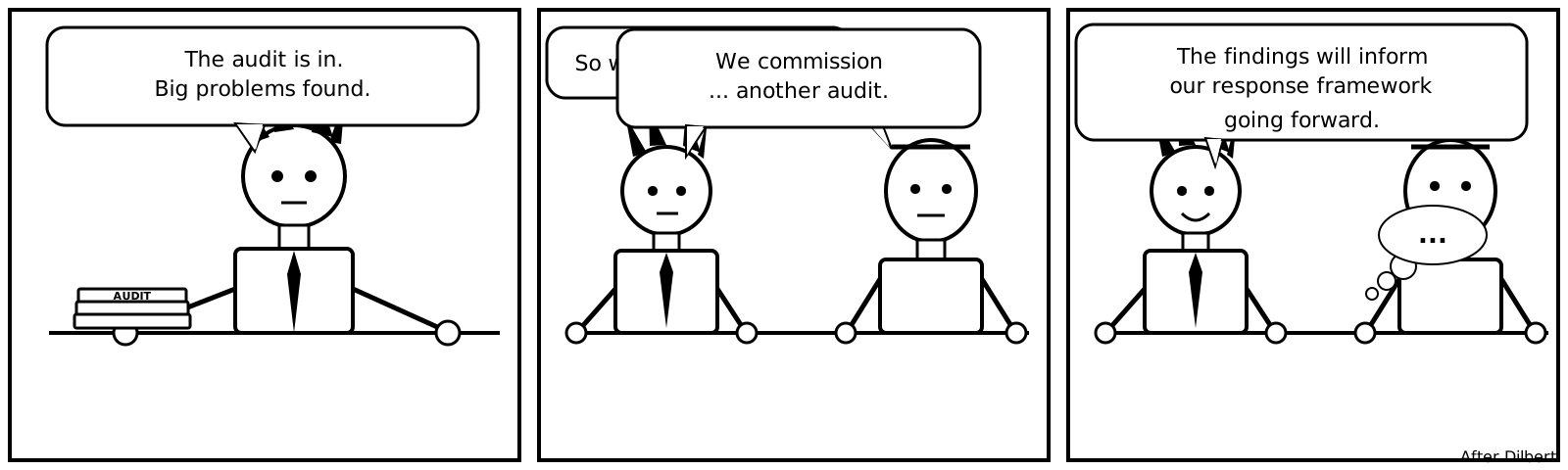
After Dilbert — on the accountability loop that generates reports about previous reports, riding on today's King County homelessness audit that found $1.1 billion spent and conditions worsening. After Calvin and Hobbes — on what it feels like to learn that a building-sized rock exploded over Siberia in 1908 with no warning, riding on today's Asteroid Day anniversary.

Hand-drawn parody comic strip
AI-rendered parody comic strip

↑ Back to top

ALSO NOTED

Also Noted

↑ Back to top

THE QUESTION

When the Audit Replaces the Fix

Accountability structures have a known failure mode: the structure becomes the deliverable. Today's paper surfaces two examples of it running simultaneously, in domains that share nothing except the pattern.

The first is from THE LAB. As reported there today, Meta ran a program called Cannes in which hundreds of contractors created fake under-18 accounts and sent 45,000 prompts through competitor chatbots — ChatGPT, Gemini, Character.AI — probing for responses to prompts about suicide, self-harm, eating disorders, and sexual content.1 Meta described the effort as "comprehensive AI safety benchmarking."1 The contractors Wired interviewed described the prompts as crude and repetitive.1 The question that lingers is not whether the exercise was ethical — it obviously wasn't — but what it was actually designed to measure, and for whom. A benchmark that produces a number without a rigorous methodology for what that number means is not a safety instrument. It's a document that says the word "safety" in the title.

The second runs in THE WORLD. King County's Regional Homelessness Authority has spent roughly $1.1 billion over five years. The 2026 Point-in-Time Count found 18,365 people unhoused — more than before, and a higher share living unsheltered.2 A forensic audit found $4.26 million overspent, $8 million unaccounted for, and a gift card program with no spending controls.2 None of which stopped the organization from continuing to operate, to report, to audit, to plan. The audit found the problems. The audit was the response to previous audits that found problems. Seattle's mayor and the county executive now have about a month to recommend whether to keep or disband the agency — which is itself another process, producing another report, with an outcome TBD.2


The structural problem in both cases is the same: the measurement infrastructure exists and functions, but it is decoupled from the correction mechanism. Meta's benchmark produced a spreadsheet. The forensic audit produced a report. Both organizations can point to the artifact as evidence of accountability. Neither artifact appears to have changed the thing it was measuring.

This is not purely a public-sector or a corporate-sector problem. It shows up wherever the cost of being seen to address a problem is lower than the cost of actually addressing it — and wherever the people who commission the measurement are not the people who bear the consequences of the answer. Meta's contractors bore the ethical exposure. The people who approved the prompts got a benchmark. KCRHA's auditors found the $8 million gap. The people without housing got a press release about the gap.

The question worth carrying today is this: when an accountability structure generates more audits than corrections, at what point does the audit become the alibi?

Sources
  1. Meta Contractors Posed as Teens to Prompt Rival Chatbots About Suicide, Sex, and Drugs wired.com Jun 29, 2026
  2. $1B spent on King Co. homelessness organization as unhoused population grows kiro7.com Jun 30, 2026

↑ Back to top

Investigator Report

Investigator report — 2026/06/30

Verdict

A strong edition anchored by a well-reported TdF eve dispatch and a technically sharp LAB lead. The cross-domain QUESTION about accountability theatre is the best intellectual angle the paper has produced in weeks. Two substantive problems temper the assessment: the THE WORLD bullet block violates its hard per-bullet word cap on two of four bullets, and the "On the Road Ahead" race calendar duplicates the Tour's opening day in back-to-back rows — a reader confusion issue that went past three rounds of review. The run itself was clean, efficient, and parallel; cost $9.36 against a 780-second researcher that anchored the long pole.


Frontpage

The rendered PNG (fetched from pd.thep3000.com) is strong. Hierarchy is legible at a glance: the 60px PELOTON headline reads across the top half of the page, the lead image (pen-and-ink cyclist on a Barcelona street) fills the left box with good contrast and appropriate subject, and the right-side lede text carries two paragraphs before the gradient clips it. The mid-row QUESTION / LAB split is correctly ordered (QUESTION 79 > LAB 76, QUESTION in the more prominent left column). The bottom row's three-way split — LONG READ, WORLD headline, ARCHIVE teaser — works at frontpage size; the ARCHIVE body text clips early but the opening sentence is vivid enough. ALSO NOTED two-column bullets fill row 4 cleanly.

One layout issue: the "ALSO NOTED" slug appears only in the first column; the second column's slug reads   (a non-breaking space). This is an art-director convention, but on the rendered PNG it reads as if the second column has no label at all, which is slightly disorienting.

No duplicate paragraphs, no missing sections, no clipped headlines. Section ordering on the frontpage matches priority: PELOTON (84) → QUESTION (79) → LAB (76) → LONG READ (72) → WORLD (65) → ARCHIVE (40) → ALSO NOTED (10). THE FUNNIES (7) correctly absent per frontpage_display: skip.

The index.html section order (PELOTON → LAB → WORLD → LONGREAD → ARCHIVE → FUNNIES → NOTED → QUESTION) matches the configured section_tiers, with THE QUESTION correctly in tier 4 (last) per newspaper.yaml. This is intentional and correct.


Priority ranking

SectionPriorityLengthImageNotes
THE PELOTON84816 wordsyesSole image; correct lead
THE QUESTION79448 wordsCross-domain bridge; well-earned
THE LAB76823 wordsStrong lead; fragmented secondary block
THE LONG READ72704 wordsSingle-source; technically deep
THE WORLD651,221 wordsLongest by far; ON THE TRAIL is the bulk
FROM THE ARCHIVE40404 wordsTunguska; strong date match
ALSO NOTED10315 wordsSix items; appropriate sweep
THE FUNNIES758 wordsIn-band

The ranking is defensible on a TdF-eve day. The orchestrator's priority normalization pass resolved a tie between LAB and LONG READ (both originally at 78) cleanly, with LAB winning on reader-interest fit. THE QUESTION at 79 is justified by the cross-domain bridge quality — this is one of the stronger editions of that section in recent weeks. No priority inflation: the 84 for PELOTON reflects genuine pre-race significance without reaching for a 90+ it did not earn.

One tension: THE WORLD, at 65, is the edition's longest artifact by word count (1,221 words), almost entirely because ON THE TRAIL is dense with trail picks and regional snapshots. The section's word weight is inverted relative to its priority — the reader who skims by priority gets the longest section last. This is a structural issue with the ON THE TRAIL format, not today's editorial call specifically.


Editorial reading

THE WORLD bullets exceed the per-bullet word cap. The newspaper.yaml focus block specifies "each bullet ≤ 25 words" as a "HARD CAP — not style guidelines." Of the four world bullets, two exceed that limit: the Venezuela bullet runs 29 words ("Death toll from the double earthquake has climbed past 235 confirmed dead, with nearly seven million Venezuelans at risk amid ongoing search and rescue"), and the Medicaid bullet runs 29 words ("Washington AG Nick Brown joined a 23-state coalition suing the Trump administration over Medicaid work requirements, which they say unlawfully narrow protections for medically frail recipients"). The total block (98 words) is within the 120-word cap, but the individual bullet violations are explicit failures of a constraint that was added after a prior compression failure. The fact-checker checked 28 claims in the WORLD section and corrected two factual errors but did not flag the bullet word counts. Neither did the writer's own summary note. The constraint is being read as a style suggestion rather than a hard cap.

THE QUESTION leads paragraph 2 with a section pointer, not an idea. The opening sentence is excellent — "Accountability structures have a known failure mode: the structure becomes the deliverable" — a clean STRUCTURAL-QUESTION lede with no proper nouns, passing the form test. But paragraph 2 begins "The first is from THE LAB." This organizational pointer ("the first is from X") is the writer's note-taking syntax leaking into prose. It works logically but reads mechanically. Compare the eventual closing — "when an accountability structure generates more audits than corrections, at what point does the audit become the alibi?" — which is far more alive. The article finds its register too late. A revision would move the section-referencing scaffolding into embedded clauses: "Meta's program Cannes, which THE LAB reported today, ran hundreds of contractors…" rather than "The first is from THE LAB."

"When the Audit Replaces the Fix" is the seventh "When..." headline in the last ten editions of THE QUESTION. The section-recency check in newspaper.yaml is configured for angle overlap (same beat, same actors, same tension) — it does not catch headline-form repetition. Of the last ten THE QUESTION editions, seven open with "When…": "When the Patch Is Real but the Problem Isn't Solved," "When the Gatekeeper Decides What's Legitimate," "When the Founder Is the Friction," "When the Constraint Is Gone," "When Your Trust Signal Is a Style," "When You Build a Machine to Hold the Knowledge," and now "When the Audit Replaces the Fix." The angle-recency check catches the second "what does incremental adjustment cost?" — it does not catch the writer defaulting to a "When X, Y" framing six times in a row. The question itself is strong; the headline is a tell.

The "On the Road Ahead" race calendar duplicates the Tour's opening day. The table contains a row for "Tour de France, Stage 1 — Team Time Trial (Barcelona)" on Sat Jul 4, immediately followed by a row for "Tour de France, Stages 1–21 (ongoing)" spanning Sat Jul 4 – Sat Jul 26. The ONGOING GRAND TOUR ENHANCEMENT rule in newspaper.yaml calls for a single span row when a Grand Tour is mid-run. The race has not started yet; it starts Saturday. Applying the mid-run span row to a race that starts in four days creates redundancy: Stage 1 appears twice in the same table under different date formats. The reader sees two entries starting July 4 and has to infer they refer to the same event. This is a writer mis-applying the enhancement rule before the race is in progress, compounded by a fact-checker that did not flag it.

THE LONG READ's single-source constraint is not acknowledged. The dither algorithm piece rests entirely on one post from 30fps.net (Revisiting Yliluoma's ordered dither algorithm). The newspaper.yaml VENDOR-SOURCE RULE applies to THE LAB, not THE LONG READ — but the spirit of the constraint matters here. The piece is a careful write-through of someone else's analysis. Nowhere in the article does the writer make clear that the analysis being described is itself the primary source, i.e., the 30fps.net post is the longform being reviewed, not a paper or publication whose claims are independently assessed. The final line ("The source code is included. It runs with uv") works well, but the article's analytical authority rests on how faithfully it transcribes and interprets a single post. This is fine editorially — the piece earns its depth — but the reader does not know that all six citations point to the same URL.


Pipeline observations

Starting commit. The dispatch ran from commit 3696800 (same-day "Auto: add foxnews.com to paywalled domains"), which is itself a same-day automated commit. The parent of the dispatch commit (300beb2) is same-day — no stale worktree issue.

Agent set. 20 subagents ran. Expected: scout, researcher, 5 regular writers (PELOTON, LAB, WORLD, LONGREAD, ARCHIVE), 1 reflector writer (QUESTION), 1 sweep writer (NOTED), 1 comic strip writer (FUNNIES), fact-checkers for each non-empty section (7), meta-writer, illustrator (OpenAI), art-director, thread-editor. Actual count matches expected. No missing agents, no duplicates.

Two source pages returned 404 during fact-checking. The FC:WORLD agent reported that cal-anderson-attack.md and klickitat-wildfire.md both returned KIRO 7 "page not found" errors. The agent continued, noting those two claims were paired together in a single sentence with no independently verifiable text. The published article includes the Cal Anderson Park and Klickitat wildfire items despite the underlying pages being unreachable at fact-check time. The writer had fetched these pages at research time and they were likely valid then, but the FC had no source to check against. This is a known fragility — live-news pages go stale between fetch and FC — but worth naming: two claims in the final edition have no verified source backing in the archive.

THE QUESTION writer held the critical path. The orchestrator waited explicitly for the QUESTION writer before launching ALSO NOTED, THE FUNNIES, and the QUESTION fact-checker. The QUESTION agent ran 96 seconds, which is typical. But the sequential dependency — all three post-QUESTION agents blocked — meant that a struggling QUESTION writer would have stretched wall-clock significantly. The orchestrator logged five separate "still waiting for QUESTION" messages before the section completed. This is not a defect in today's run but a structural bottleneck worth noting: the reflector writer that reads all sibling sections is necessarily late, and everything that reads sibling JSONs (sweep, comic) is chained behind it.

THE LONG READ source page was placed in pages/noted/ not pages/longread/. The researcher routed the Yliluoma dither page to pages/noted/yliluoma-ordered-dither.md rather than a longread subdirectory. The FC:LONGREAD agent found and correctly read it from that path. No output failure, but the directory placement suggests the researcher's section-routing heuristic put a primary LONG READ source in the sweep directory. The fact-checker noted reading from pages/noted/yliluoma-ordered-dither.md explicitly.

FC:LONGREAD silently changed priority from 78 to 72 and image: true to image: false. The writer's final response claimed priority 78 and the writer set image: true on the LONG READ. The fact-checker's file rewrite downgraded priority to 72 and removed the image flag. The orchestrator's priority normalization pass later formally re-scored both LAB and LONG READ (from the post-FC values), which separated the previously-tied sections. The FC changing priority is outside its stated remit (factual claims), but in this case the orchestrator caught it and made a principled editorial call. It resolved correctly, but the FC's scope-creep on frontmatter values (priority, image) is a behavior to watch.

No pipeline alerts file. Clean fetch record: 30 primary fetches all succeeded; 1 retry (earthsky for the Tunguska article, which originally returned a blocked APS page) succeeded.


Trace highlights

The researcher owned the critical path at $1.34 and 779 seconds. At 2.7M cache-read tokens, this is the most expensive single step by a significant margin and is not unusual for this pipeline — the researcher reads the full feed digest, all fetched pages, and newspaper config before writing the brief. But the cost-to-output ratio is notable: the researcher consumed $1.34 and emitted 1,060 output tokens. The scout, which ran a 44-search 149-URL crawl for $0.48, produced roughly equivalent editorial yield in less than half the cost.

THE WORLD fact-checker ($0.44, 233 seconds) cost more than twice the WORLD writer ($0.35, 142 seconds). The FC read 11 source files, found two genuine factual errors (coalition count, police-chief vs. SDOT), and flagged two unverifiable sources (the 404 KIRO pages). This level of checking against a 1,221-word section with 8 inline citations represents genuine work — the cost ratio here is appropriate rather than alarming, but it is the heaviest FC-to-writer cost ratio in the edition.

The QUESTION writer ($0.16, 96 seconds) was inexpensive given the section's priority (79) and strategic role. The reflector writer reads all sibling section JSONs before writing. At 105K cache-read tokens for a 4,086-input-token session, it consumed relatively little context — suggesting it was operating mostly from its agent prompt and the assembled sibling summaries rather than fetching additional source material. The cross-domain bridge it produced (Meta audit loop ↔ KCRHA accountability failure) is the strongest angle available from today's section set.

Orchestrator token cost ($3.47, 7.6M cache reads) dominated the run. At 37% of total cost, the orchestrator is the most expensive agent — not unusual for a multi-step parent session, but the 7.6M cache-read token figure reflects a large context window being re-read on each step. The 1h cache bucket ($117K tokens) suggests some longer-lived caching is working, but the 5-minute bucket dominates (7.6M vs. 117K 1h tokens).

Trace summary
AgentDurInputOutputCache ReadCache 5mCache 1hCost
Scout346s11518203395168870730$ 0.48
Researcher779s75106027133481357350$ 1.34
THE WORLD142s77150514822820$ 0.35
THE PELOTON82s990173671478760$ 0.23
THE LAB88s84595613250010$ 0.12
THE LONG READ58s6751561207840$ 0.09
FROM THE ARCHIVE42s6466959240030$ 0.11
FC: FROM THE ARCHIVE136s82516200953386670$ 0.21
Meta-Writer55s7680200264100$ 0.12
FC: THE LONG READ94s75108401310880$ 0.15
FC: THE PELOTON175s1098281053551760$ 0.29
FC: THE LAB132s1048235564405910$ 0.22
FC: THE WORLD233s108250480225771370$ 0.44
THE QUESTION96s408651105987315570$ 0.16
Illustrator55s1841372000$ 0.06
FC: THE QUESTION63s6468391226410$ 0.11
ALSO NOTED191s14211436720746690$ 0.41
Draw today's TWO parody comic strips for119s12141247322340200$ 0.20
Funnies (OpenAI)136s3435488000$ 0.22
FC: ALSO NOTED159s884146341397220$ 0.19
Art Director125s5745882399600$ 0.16
Update story threads for today's edition209s5345401483610$ 0.20
Orchestrator1543327775610870117118$ 3.47
TOTAL183874227713690361982753117118$ 9.36

Suggestions for next edition

1. Teach the bullet checker to count words, not just verify facts. The THE WORLD fact-checker caught two genuine factual errors but did not flag the two 29-word bullets against the 25-word hard cap. Adding a mechanical word count step to the FC:WORLD prompt — or having the writer's "Done:" summary include bullet word counts — would have caught this. The cap exists precisely because it failed before; it should be machine-enforced, not reliant on the writer remembering.

2. Restrict the "On the Road Ahead" ongoing-Tour span row to editions where the Tour has already started. The ONGOING GRAND TOUR ENHANCEMENT rule should fire only when stages_completed > 0. When the Tour starts Saturday and today is Monday, the right output is a forward-looking row ("Stage 1 starts Sat Jul 4") without the span, which makes the Stage 1 individual row redundant. A simple condition on the start date would prevent the duplicate.

3. Add headline-form recency to THE QUESTION's angle check. The agent already scans the last three editions for angle overlap. It should also note when the candidate headline's grammatical opening ("When X, Y") matches the predominant form of the last five QUESTION headlines — and prompt itself to find a different framing. Seven "When..." headlines in ten editions is pattern-fatigue even when the underlying angles are fresh.

4. Scope-guard the fact-checker's frontmatter writes. FC:LONGREAD changed both priority (78 → 72) and image: true → false without being asked to. The orchestrator's normalization pass caught and corrected this, but a fact-checker that rewrites frontmatter metadata rather than only article body text introduces a silent priority-laundering path. The FC agent prompt should explicitly restrict writes to the article body and citations array, leaving priority and image for the orchestrator's normalization step.