Front page — July 6, 2026
The Peloton Dispatch July 6, 2026 No. 100
● Sunny 79°F, light wind — ideal summer ride. · summer kit

THE PELOTON

No Caravan, No Crowd: Stage 3 Races Through Fire Country to a Silent Les Angles

↩ Developing story — first reported Jul 03 · previously Jul 04, Jul 05

— Stage 3 rolled out of Granollers on Monday into a Tour that has already acquired the atmosphere of a race operating around rather than through normal conditions. As this paper reported Sunday, ASO chose to run the stage despite the wildfires burning in southern France — 10,000 people evacuated near the finish — but stripped the final 40 kilometres of both spectators and the publicity caravan. The peloton will finish Les Angles in something close to silence.

By mid-morning, the stage had found its shape. A 19-rider break was out front with roughly two minutes in hand after Visma's race radio confirmed no GC threats were in the move and the team stood down.1 The break includes Cort (Uno-X), Oliveira and García Pierna (Movistar), Plapp and Schmid (Jayco AlUla), Storer (Tudor), Pedersen (Lidl-Trek), Vervaeke (Soudal-QuickStep), Bennett (NSN), and nine others from smaller outfits. The decisive terrain is still ahead: the category-1 Col de Toses at kilometre 128 — 9.3km at 6.5% — before the race crosses into France and climbs to the cat-3 finish at Les Angles.

The opening act produced casualties. A crash near the front of the peloton caught del Toro, Bruno Armirail (Visma), and several Netcompany-Ineos riders. Everyone came through, but Matthew Riccitello — a key domestique for Paul Seixas — was at the medical car.1 Egan Bernal spent considerable energy trying to force his way into the break, then suffered a flat tyre just as the move consolidated and lost the battle. Cian Uijtdebroeks, Movistar's GC hope, was already struggling out the back before 40 kilometres were done. Arnaud De Lie, who has been ill since before the start, was also off the back early.

The heat was already established at sign-on. Granollers read 33°C at the flag.1 Stage 4 is forecast at 40°C.


After Sunday's stage, Visma sports director Marc Reef gave IDL Pro Cycling the team's honest read of why Vingegaard let Pogačar and del Toro through on the final Montjuïc climb. "On the first climb of the day, it was already around 40 degrees," Reef said. "As soon as the pace picked up a bit, a lot of riders fell behind. By the time we started the fourth lap, I think three-quarters of the peloton had already been dropped." The riders who survived the selection essentially stayed together until the very end, when the pace finally lifted near the summit. Reef's framing: a stage that suited Vingegaard "a little less this time around," not evidence of a gap in form. "He's still showing that he belongs among the best."2

Visma are not treating the yellow jersey as an obligation. Reef said directly that keeping yellow "isn't the be-all and end-all."2 Whether Vingegaard leaves Les Angles in the leaders' jersey this evening is, on their read, not the metric by which to judge the opening weekend.

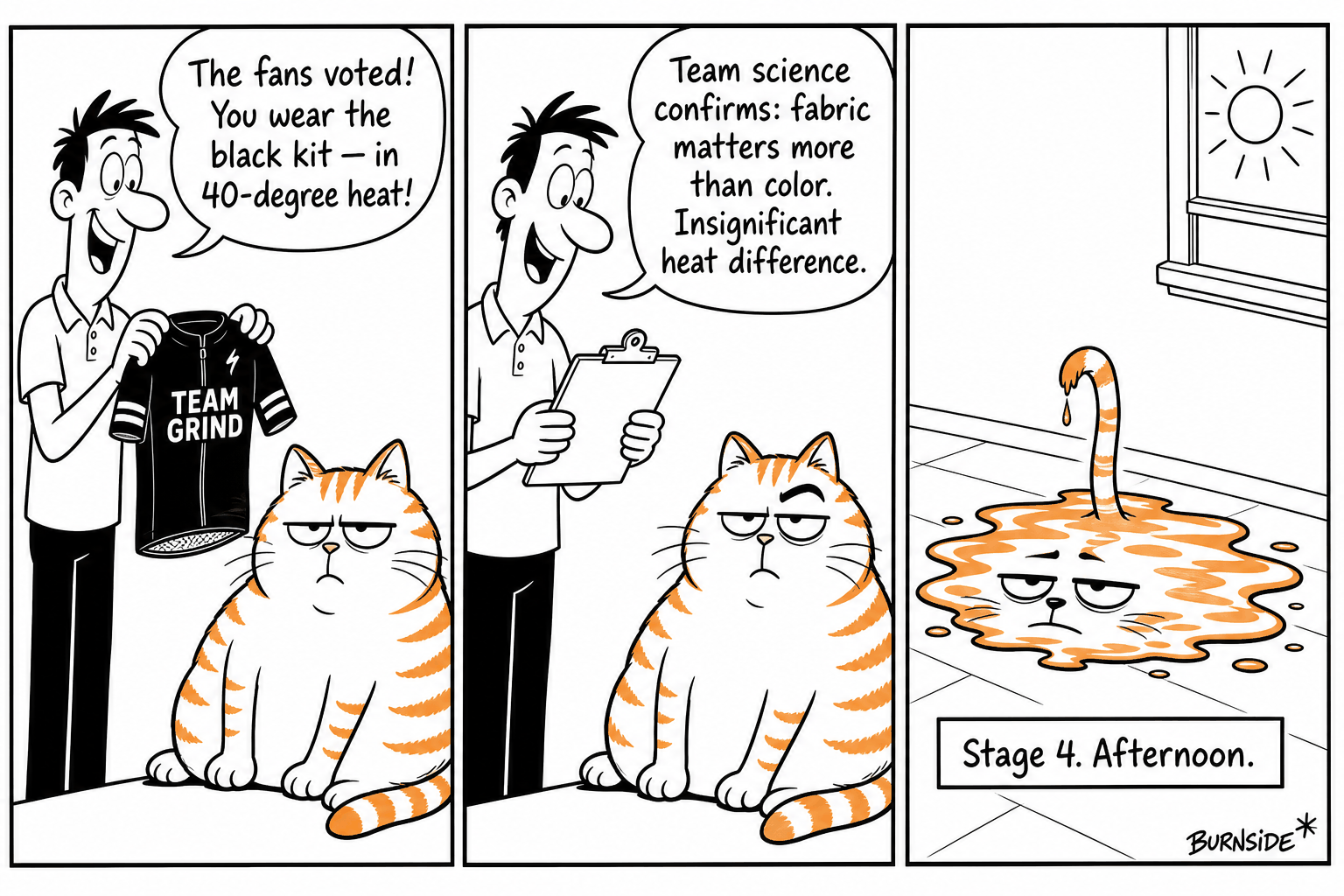
One quieter dispute is playing out around Visma's kit. The team is racing in an all-black "architect" swap-out, chosen over a cream alternative by public vote before the Tour. Commentators had flagged it as a heat trap. Visma head of performance Mathieu Heijboer pushed back in a team note: fabric construction matters far more than colour for thermoregulation, he argued. UV-resistant, moisture-wicking fibres produce only "insignificant differences" in body temperature between colour options, backed by the team's own climate-chamber testing of Nimbl kit prototypes. "The choice of fabric plays a much greater role than the color," Heijboer said.3

The catch Heijboer did not address directly: the cream jersey they voted away is made from the same materials as the black one. Same fabric, lighter colour — it would have been cooler.3 The team has apparently calculated that aerodynamics, UV resistance, and fan goodwill cover the difference. Stage 4 at 40°C will serve as a live trial.

On the Road Ahead
Calendar from Jul 5, 2026 — primary source blocked today
DateRaceCountry
Mon Jul 6 – Sat Jul 26Tour de France, Stages 3–21 (ongoing)France / Spain
Sat Aug 1DSSK — Donostia San Sebastián KlasikoaSpain
Mon Aug 3 – Sun Aug 9Tour de PolognePoland
Sun Aug 16ADAC Cyclassics HamburgGermany
Show Results

STAGE 2 RESULT (Jul 5): Isaac del Toro wins; Tadej Pogačar 2nd (UAE 1-2)

GC AFTER STAGE 2: Yellow: Jonas Vingegaard (Visma-Lease a Bike) Green: Isaac del Toro (UAE Team Emirates-XRG) Polka dot: Alex Molenaar (Caja Rural-Seguros RGA) White: Juan Ayuso (Lidl-Trek) — del Toro leads the classification

Stage 3 result: not confirmed at publication time

Sources
  1. Tour de France stage 3 LIVE cyclingnews.com Jul 6, 2026
  2. Visma-Lease a Bike draws a connection between the racing conditions in Barcelona and Vingegaard's time loss idlprocycling.com Jul 6, 2026
  3. Darker Jerseys Aren't Always Hotter Jerseys. Tour de France Testing Proved It. velo.outsideonline.com Jul 6, 2026
  4. UCI Race Calendar procyclingstats.com

↑ Back to top

THE LAB

.splat4d: Dynamic Gaussian Splat Sequences at 58× Compression, HTTP Range Native

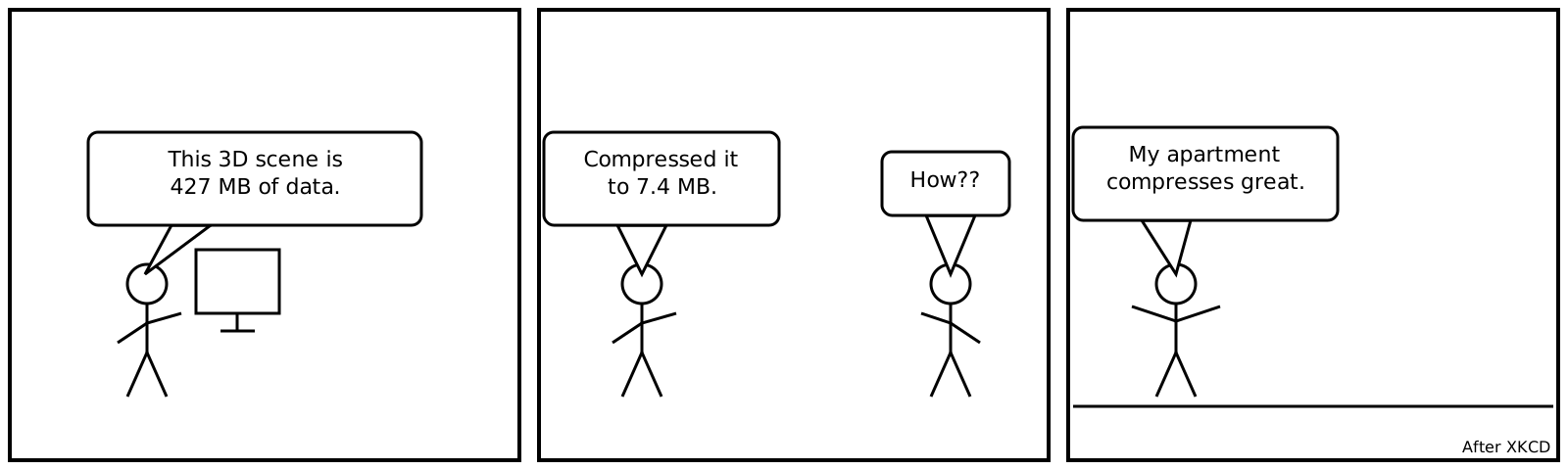
A 427 MB raw sequence of Gaussian splat frames encodes to 7.4 MB — 58× — and streams over plain HTTP Range requests from any object store, no server logic required.1 That's the headline figure for .splat4d, a new container format for streaming dynamic 3D Gaussian splat sequences documented by Adam Raudonis.

The compression stack layers several decisions. A static/dynamic split stores all background splats exactly once — the entire background of a 1.6 GB sequence costs a few megabytes. For dynamic splats, a deadband "hold" track emits a new value only when the true value would violate the stored bound, which zeroes most temporal deltas and eliminates quantization flicker by construction. Frames organize into H.265-style closed GOPs: keyframes of absolute quantized values, followed by P-frames of exact integer deltas. Each GOP chunk decodes independently, so a seek fetches roughly 10% of a chunk to show a keyframe — about 145 ms on a 50 Mbps connection. The entropy stack then runs Morton ordering of splats, zigzag-coded deltas, byte-plane shuffling (Blosc-style), and per-stream zstd, landing at near-order-0 entropy for those streams. Across eight sequences from three independent capture pipelines — CMU Panoptic dome juggling and ball sports, Neu3D cooking scenes, Technicolor birthday footage at 659k splats — the format runs 16–58× below raw and 14–20× below per-frame gzip at −9. For context, the best generic lossless baseline, zstd-19 --long applied across the whole series, reaches only 2.5×.1

The error-bound guarantee is unusual: bounds are deterministic and pointwise, not statistical or averaged over PSNR. Position is bounded to ±2mm per axis (L∞ norm), color to ±4 out of 255 levels, rotation is exact.1 The Rust and JavaScript decoders reconstruct bit-identical values — integer deltas cannot drift. The streaming design uses plain HTTP Range requests: a 256 KB fetch for the header and chunk index, one range for the static section to render the complete first view, then one range per GOP chunk during playback. On the server side, this means standard S3/GCS/R2 CORS configuration and no Content-Encoding (payloads are already compressed inside the container). A WebGPU renderer ships as primary with a pixel-verified WebGL2 fallback. The Python encoder is pip install splats4d; input is a directory of antimatter15 .splat frames.

Smaller-scale compression note from July 4: Iwo Kadziela, working with Codex, built a credible ASCII world map in 445 bytes using deflate. The JavaScript snippet Simon Willison highlighted uses fetch() with a base64-encoded data: URI piped through new DecompressionStream('deflate-raw') — a browser API combination Willison noted he hadn't seen used this way before.2


On July 2, the EU Council adopted a position to fast-track reactivation of Chat Control 1.0 — the 2021 temporary exemption from E-Privacy rules that allowed messaging providers to voluntarily scan private chats using AI and hash matching for known child sexual abuse material. That exemption expired April 3 with no replacement in place: the Council and Parliament failed to agree on an extension, and the broader Chat Control 2.0 proposal, which would make such scanning mandatory, remains stalled.3

The procedural maneuver works around a formal constraint. An expired regulation cannot be extended in legal terms, so the Council introduced what Heise describes as a new regulation that is "largely identical in content but different in form."3 The draft is being pushed onto Parliament's agenda under an urgent procedure, timed for the last plenary session before the summer recess. At second reading, the Council's position can only be blocked if an absolute majority of all MEPs — not just those present, but of the full chamber — votes against it. Heise notes that threshold is historically difficult to reach before summer break, when many members have already departed. Critics quoted in the article call the procedure an attempt to bypass democratic scrutiny; the Council frames the expired exemption as a legal loophole that leaves providers without cover for detection systems already running.

If it clears the vote, messaging services operating in the EU regain legal cover to run AI and hash-match scanning of private communications on a voluntary basis. The mandatory Chat Control 2.0 battle continues in the background.

Trending today: GitHub is dominated by Claude Code skills collections, AI agent wrappers, and leaked system-prompt repositories — no games, graphics, compiler, or GPU-architecture work cleared the bar.

Sources
  1. .splat4d — streamable 4D Gaussian splat format adamraudonis.github.io Jul 4, 2026
  2. Building a World Map with only 500 bytes simonwillison.net Jul 4, 2026
  3. Chat Control 1.0: EU Council forces messenger scans via fast-track heise.de Jul 4, 2026

↑ Back to top

THE WORLD

Seattle Hosts USA-Belgium Round of 16 Tonight; Office Market Faces a Zombie Decade


Match-day logistics: Downtown will be gridlocked from roughly noon to 9pm — Alaskan Way closes as early as 1:30pm for the march to the stadium. Sound Transit runs the 1 and 2 Line every eight minutes with service extended to 1am; fares are $3. No public parking at Seattle Stadium; rideshare pickup zones are in Pioneer Square, CID, and SODO. Free secure bike valet is available south of Dearborn at Alaskan Way.1

Downtown's zombie decade: Seattle's downtown office vacancy hit 37% — the highest of any major U.S. city, per Cushman & Wakefield — and the problem is structural, not cyclical. Since 2020, downtown office properties have shed $15 billion in value (down 46%) and now generate $128 million less per year in property taxes.2 Even a full return to pre-pandemic demand would take eight more years to fill the current surplus. Strip out Amazon specifically and that number grows to 16 years. Experts estimate as much as a quarter of the supply is effectively permanent excess. The city currently has four conversion projects totaling 400 housing units in progress.


### ON THE TRAIL

WEEKEND PICKS — Sat Jul 11 – Sun Jul 12

Weekend weather across the Cascades is clean. I-90 East / Teanaway stands out (72°F Saturday, 77°F Sunday, precip ≤1% both days). Mountain Loop and North Cascades carry a slight Saturday chance (18–22%) but well clear of the disqualifying 50% threshold.

---

1-night: Boulder River — Mountain Loop Highway, ≈90–120 min from Issaquah

A Jul 5 reporter's watch clocked 9.17 miles total, with the campsite at the halfway point: roughly 4.6 mi / ~800 ft gain to camp. Trail in good condition with a few easily skirted blowdowns; huckleberries beginning to ripen. No bugs, no snow, no ford mentioned; river access throughout for water. Crowd count: 5 cars at 9:30am on a holiday Sunday.

Weather (Mountain Loop): "Mostly sunny Saturday (66°F, 22% precip); mostly sunny Sunday (71°F, 6% precip)."

Jul 5 WTA report

No 2-night pick cleared criteria this week. Goat Rocks / North Fork Tieton to Old Snowy is spectacular and trail-crew cleared — but a rock-hop creek ford after the burn area and head-net-level mosquitoes at McCall Basin disqualify it. PCT White Pass section likewise has a calf-deep Bumping River ford and atrocious bugs at several lakes.

---

REGIONAL SNAPSHOT

Sources
  1. Seattle's final FIFA World Cup match: Your ultimate guide kiro7.com Jul 6, 2026
  2. As downtown Seattle offices empty, city facing years of 'zombie' towers seattletimes.com Jul 4, 2026
  3. WTA Trip Reports listing wta.org

↑ Back to top

THE LONG READ

The Unlootable Archive: How Three People Are Making Palestinian Memory Impossible to Erase

About once a month, the Palestine Museum Digital Archive's website goes down. Someone attacks it — the team doesn't always know who — and the site disappears. Then the staff restore it from one of the distributed backups stored at sites around the world, and the archive comes back up. More than 500,000 records: photographs, identification papers, diaries, maps, films, letters. All of it returns.1

"We can't protect it from being hacked," says Amer Shomali, general director of the Palestinian Museum in Birzeit, West Bank, "but we can protect it from disappearing."

That distinction — between a successful intrusion and a successful erasure — is the architectural principle at the center of one of the more quietly remarkable preservation projects running today. Shomali and his team began building the archive in 2018, starting with door-knocking: visiting families in the West Bank, asking permission to scan old photographs and documents. What they built has grown to half a million records, maintained by three full-time staff and a network of volunteers, funded by diaspora donations, the University of California, and the Gerda Henkel Foundation.

The scale of what they're working against is documented. UNESCO verified damage to 164 cultural sites in Gaza since October 7, 2023 — historical buildings, religious sites, museums, archaeological sites.1 A 2025 report by the Applied Research Institute–Jerusalem found at least 2,400 archaeological sites in the West Bank had been taken over by Israel. In June, Reuters reported Israeli lawmakers are advancing legislation to place ancient sites in occupied territory under the Israeli Ministry of Heritage — a move that Palestinian and Israeli rights groups describe as functional annexation. Shomali says roughly 80 percent of the country's national collections have been looted, destroyed, or remain under Israeli control.

The engineering response is deliberately unglamorous. The platform is open-source. The backups are geographically distributed. The redundancy is designed not to prevent attack but to make destruction impossible regardless of attack success. "It's not something theoretical," Shomali told Wired's Tamara Davison, recalling a week in which Israeli forces bombed two art galleries, seven museums, two main archives in Gaza, and hundreds of archaeological sites.1 The archive exists because physical institutions — even the Palestinian Museum itself, a striking building designed by Heneghan Peng architects among terraced gardens in Birzeit — can be seized, bombed, or made inaccessible by checkpoints. Bits distributed across multiple continents are harder to confiscate.

The team is also solving problems most archivists don't face. Some documents are in Ottoman Arabic, a script that requires specialized expertise to read; the museum is exploring an automated bot to help process historical records in that language. Among the items digitizer Mohammad Rabae has handled: a 19th-century Bible printed in Jerusalem, and a Palestinian newspaper from 1930 with pages so brittle they had to be unfolded by hand before scanning. "Digitization is not only about creating a digital image," he said. "It's also about preserving fragile historical material safely for future generations."

The archive's second purpose is access. The museum built what Shomali calls "an exhibition in a box, Ikea-style" — downloadable exhibition materials that anyone, anywhere, regardless of budget, can print and mount. The project has been exhibited more than 260 times, from Japan to San Francisco, translated into five languages.1 In May 2026, artist Leyya Mona Tawil used the archive to build an exhibition at SoEx in San Francisco; she described accessing only "a fragment of what the museum holds." In Spain, curator Pablo Llorca spent two months working with the archive's imagery before debuting To Tell My Story in Madrid in October 2025 — it has since traveled to around 15 locations across the country and drawn interest from Spain's Ministry of Culture.

The distributed model gives Shomali something he describes as structural: "All of a sudden, you start to have this mesh, this web of information and data, and it allows you to rewrite the history — but interestingly, bottom-up, in the sense that it's not a state archive." The archive wasn't commissioned by a government and doesn't depend on one for survival. It survives because copies exist in enough places that no single actor can make them all go away.

He closes the piece with a line from the late Palestinian poet Mahmoud Darwish: "We who are able to remember are able to liberate ourselves."1 It reads less like a slogan than like a design requirement.

Sources
  1. How Palestinians Are Building a Digital Archive That Can't Be Erased wired.com Jul 6, 2026

↑ Back to top

FROM THE ARCHIVE

The Boy Who Came Back: July 6, 1885

Lead illustration

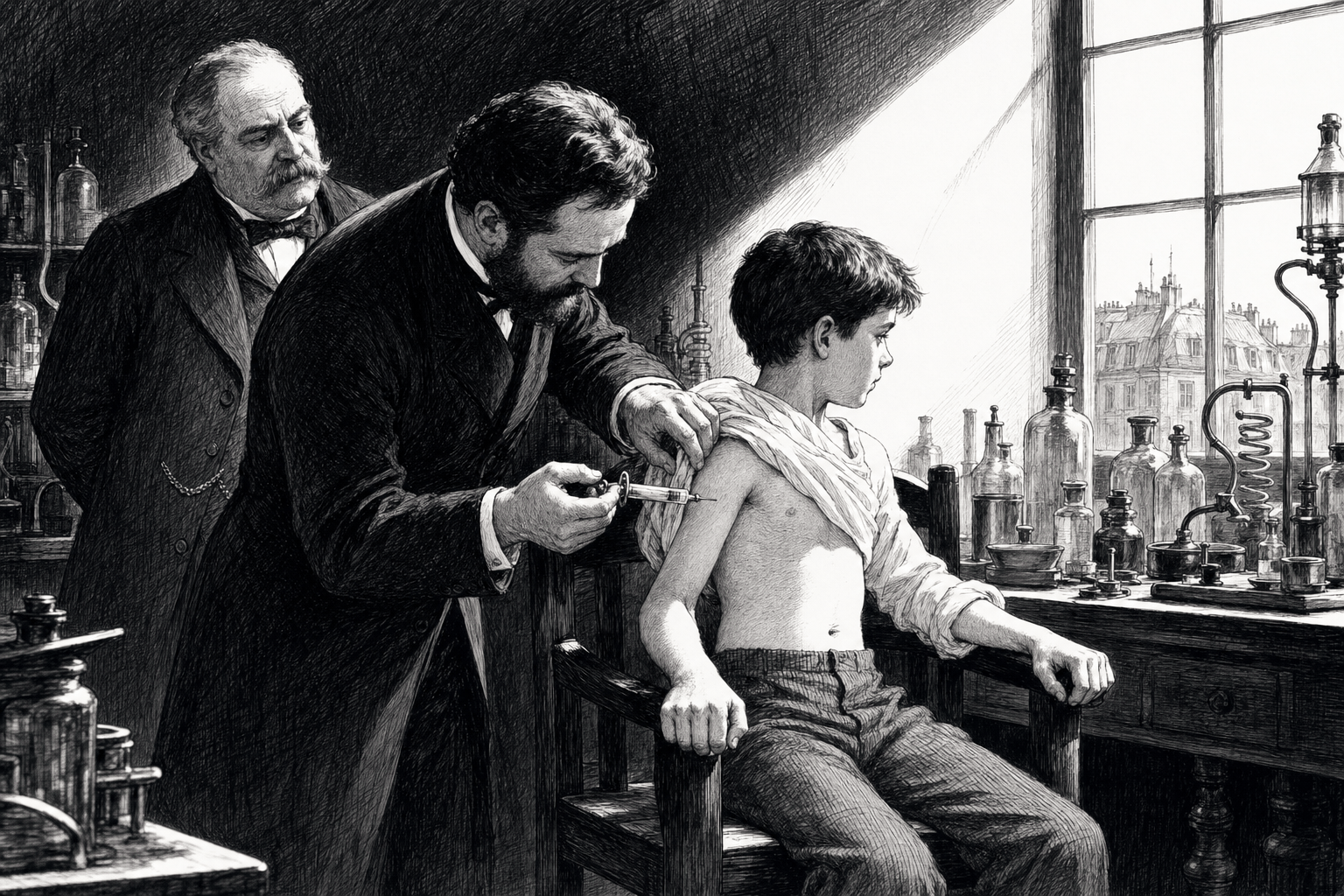
A gas-lit laboratory, Paris, 1885. A boy of nine sits upright in a wooden chair, shirt lifted, knuckles white on the armrests. A bearded physician in a dark frock coat leans over him, syringe in hand, the boy's side exposed. Behind, a second older man — heavy-set, watchful, his hands clasped behind his back — stands at a bench crowded with glass vials, rubber stoppers, and coiled tubing. A single window throws a shaft of afternoon light across the bench; the rest of the room recedes into deep cross-hatched shadow. The physician's face is intent, the boy's turned slightly away. No text. Black-and-white pen-and-ink with confident bold linework, controlled hatching on the coats and shadow, generous white space in the light-struck areas, newspaper op-ed style.

Sixty hours after a rabid dog bit Joseph Meister fourteen times — wounds deep enough that the nine-year-old could barely walk — Louis Pasteur made a fold in the skin of the boy's right upper abdomen and administered the first injection.1

The date was July 6, 1885. Pasteur was not a doctor; his doctorate covered chemistry and physics, and he had no legal right to vaccinate a human being. He had tested his rabies preparations on dogs and rabbits. He had never given them to a person. At a weekly meeting of the French Academy of Sciences, he had laid the case before two physicians — Alfred Vulpian and Jacques Grancher — and together they looked at the Alsatian boy and concluded that his death, absent intervention, was essentially certain. Grancher would administer the doses to keep Pasteur inside the law. Pasteur would supply the material and the nerve. He later wrote that he resolved to try the method "though not without great anxiety."1

The protocol ran three weeks: thirteen inoculations total, each drawn from progressively more virulent rabbit spinal cord preparations, each batch first injected into healthy rabbits to confirm it didn't cause disease outright before going into the boy.1 At the end of the course, Meister received a dose from a rabid dog. Nothing happened. He was immune.

Pasteur eventually hired him as a concierge at the Institut Pasteur, the institute whose construction Grancher had overseen and which opened on November 14, 1888.2 Meister worked there for decades, in the building that owed its existence to his survival.

He died on June 24, 1940, ten days after the German army entered Paris. He turned on a gas stove. For years the story circulated that he had killed himself rather than let the Nazis desecrate Pasteur's crypt — a heroic myth, and a false one. Researchers Héloïse Dufour and Sean Carroll, working from the diary of Eugène Wollman and interviews with Meister's granddaughter, determined that he was despondent over his wife and children, who had fled Paris to escape the bombing.1 He had somehow convinced himself they were dead.

His wife and daughters returned to Paris later that same day.

Sources
  1. Louis Pasteur's risky move to save a boy from almost certain death pbs.org Jul 7, 2016
  2. The history of the first rabies vaccination in 1885 pasteur.fr Nov 21, 2023

↑ Back to top

THE FUNNIES

Compression Ratios and Hot Takes

*After XKCD — on the .splat4d format's 58x compression claim, and what storing the background exactly once implies about the spatial variety of most people's apartments. After Garfield — on the Visma team's fan-voted all-black race kit, and what Stage 4's forecast 40 degrees thinks of the performance science marshaled in its defense.*

Hand-drawn parody comic strip
AI-rendered parody comic strip

↑ Back to top

ALSO NOTED

Also Noted

↑ Back to top

THE QUESTION

When the Explanation Arrives After the Decision

When the EU's legal exemption for voluntary message scanning expired on April 3 and detection reports kept flowing anyway, the Council's fast-track move to restore "identical in content" authorization was not restoring a system — it was labeling one that never stopped.1

As THE LAB reports today, the Council's procedural maneuver rests on a formal distinction: an expired regulation cannot legally be extended, so member states introduced what Heise describes as a regulation "largely identical in content but different in form."1 The draft is timed for Parliament's final session before summer recess, when an absolute majority of all MEPs — not just those present — is required to block it. That threshold is historically unreachable once members have departed.1 The Council's own framing names the stakes plainly: it is closing "a looming legal loophole" for detection systems already running. The systems were already running. The loophole was legal exposure, not a behavioral gap.

Today's paper raises the same structural question in a different register. THE PELOTON's coverage of Visma-Lease a Bike's all-black race kit includes head of performance Mathieu Heijboer's technical defense: fabric construction matters far more than color for thermoregulation; climate-chamber testing of the team's Nimbl kit prototypes showed jersey color produces only "insignificant differences" in body temperature.2 That explanation is probably accurate. But the black kit was chosen over a cream alternative by fan vote before the testing was marshaled in its defense2 — and Velo's own reporting notes the discarded cream jersey, made of identical materials, would still have been cooler.2 The science describes the choice. It didn't make it.

The question worth carrying through Stage 4's forecast 40°C and through this week's EU parliamentary session: when formal justification arrives after the decision — legal authorization, climate-chamber data, expert review — what work does it actually do? In the jersey case, the cost of getting the sequence wrong is a few degrees of body heat. In the Chat Control case, it is the privacy architecture of messaging for hundreds of millions of people. The sequencing problem is the same. The stakes are not.

Sources
  1. Chat Control 1.0: EU Council forces messenger scans via fast-track heise.de Jul 4, 2026
  2. Darker Jerseys Aren't Always Hotter Jerseys. Tour de France Testing Proved It. velo.outsideonline.com Jul 6, 2026

↑ Back to top

Investigator Report

Investigator report — 2026/07/06

Verdict

Issue No. 100 is a clean production and a well-written edition. The three

lead pieces — TdF Stage 3, the Palestinian digital archive, and the Pasteur

archive entry — are genuinely good journalism. The main editorial failures

are structural: THE QUESTION recaps THE LAB at full paragraph length

(violating its own section rule), the Chat Control story is misrouted into

THE LAB, and THE WORLD's local block ignores its own format constraint on

World Cup game day. The pipeline ran without hard failures and the

orchestrator progressed smoothly through all steps. Cost was $10.07.


Frontpage

The rendered PNG is legible and visually hierarchical. THE PELOTON leads with

a 48px headline; THE LONG READ occupies the right column of row 1 with a

well-chosen complement. Row 2 correctly puts THE LAB, THE QUESTION, and

FROM THE ARCHIVE in descending column width. THE WORLD appears bottom-right

with headline only, per its rule.

Two layout issues:

Races-ahead table is invisible. The art director explicitly noted in its

final response that "the 5 body paragraphs fill the 500px height before

[the table]" and the overflow:hidden clips it. The table is in the HTML but

never rendered on any display. The art director flagged the clip and left it

unfixed. A 4-line calendar table being silently swallowed on a Tour de France

day is not a trivial loss.

Lead image renders photorealistic, not pen-and-ink. illustration_style

in newspaper.yaml specifies "Black-and-white pen-and-ink editorial

illustration. Confident linework with controlled hatching..." The OpenAI

backend produced what looks like a grayscale photograph of a doctor and child

in a Victorian laboratory — technically on-theme, but clearly a rendered scene

rather than a drawn editorial. The style directive is not being honored by the

OpenAI backend. This is a recurring gap worth tracking if the style directive

matters.

World Cup logistics hidden. On a day when the USA–Belgium match kicks off

at 5pm and downtown Seattle is gridlocked from noon, THE WORLD's

frontpage_display: "headline_only" rule suppresses the transit and parking

logistics from the front page entirely. A reader who only reads the front

page doesn't know they need to leave before noon. This is a rule-design

observation: the headline_only rule does the right thing most days and the

wrong thing on high-stakes local logistics days.

Otherwise the page reads well: clean grid, no clipping beyond the above,

no duplicate paragraphs, section slugs legible, image in the correct column.


Priority ranking

SectionPriorityLengthImageNotes
THE PELOTON82~520 wordsnoTdF Stage 3 + Visma kit dispute
THE LONG READ77~700 wordsnoPalestinian digital archive
THE LAB73~570 wordsno.splat4d + 500-byte map + Chat Control
THE QUESTION68~350 wordsnoPost-decision justification bridge
THE WORLD62~160 words + ON THE TRAILnoWorld Cup + zombie towers + trail picks
FROM THE ARCHIVE38~400 wordsyesPasteur/Meister rabies, July 6, 1885
ALSO NOTED129 bulletsnoCycling + tech items
THE FUNNIES8text captionnoXKCD + Garfield parodies

The top band is defensible. THE PELOTON at 82 is reasonable for a mid-stage

live report with wildfire context; a completed stage result would push higher.

THE LONG READ at 77 earns "Exceptional longform" — the Palestinian archive

story is exactly what that section is for. FROM THE ARCHIVE is correctly

capped at 38 (priority_cap: 45).

One ranking tension: THE WORLD (62) on a day when a World Cup match is

happening in Seattle at 5pm is probably a few points low. The match

is the highest-impact local event in weeks. THE QUESTION at 68 is a fine

structural piece but the reader's day depends on THE WORLD today more than

on a cross-domain philosophy question.

The art director respected the priority order in all three rows.


Editorial reading

THE QUESTION recaps THE LAB at full paragraph length.

Section rules say "A sentence or two of context is fine; a second full recap

of a story already in THE LAB / THE PELOTON / THE LONG READ is not." The

second paragraph of THE QUESTION is not two sentences of context — it is a

near-verbatim compression of THE LAB's entire Chat Control block: the

expired exemption, the procedural maneuver, the "largely identical in

content but different in form" quote, the parliamentary-majority threshold,

the summer-recess timing problem, and the "systems were already running"

conclusion. Compare:

THE LAB: "The procedural maneuver works around a formal constraint. An

expired regulation cannot be extended in legal terms, so the Council

introduced what Heise describes as a new regulation that is 'largely

identical in content but different in form.' The draft is being pushed onto

Parliament's agenda under an urgent procedure, timed for the last plenary

session before the summer recess..."

THE QUESTION: "As THE LAB reports today, the Council's procedural maneuver

rests on a formal distinction: an expired regulation cannot legally be

extended, so member states introduced what Heise describes as a regulation

'largely identical in content but different in form.' The draft is timed for

Parliament's final session before summer recess..."

The cross-domain bridge — Chat Control and the jersey as parallel cases of

post-hoc justification — is genuinely sharp. One sentence would have done

the context work. The recap crowds out what makes the QUESTION worth reading.

Chat Control is misrouted into THE LAB.

THE LAB's focus is "Tech, games, and engineering — filtered hard for depth

and substance" with AI coverage capped to "significant model releases and

engineering writing about how systems actually work." Chat Control is a

story about parliamentary procedure and privacy law. It belongs to THE WORLD

(as a fourth bullet, given the section's format constraints) or as a lead

item in ALSO NOTED. Routing it to THE LAB stretches the section's focus and

forces a section that should be about rendering formats and compression

algorithms to pivot mid-article to European political procedure. The fact

that THE QUESTION then recaps it further compounds the issue — the story

essentially echoes across two sections.

THE WORLD's local block ignores its format constraint.

The newspaper.yaml focus says: "Local block scales by number of notable

items (1–2 sentences each, no word cap)." "Match-day logistics" runs

~63 words across three sentences; "Downtown's zombie decade" runs ~75 words

across five sentences. Both use bold-header paragraph format rather than

the specified item-per-line structure. The zombie decade block in particular

is essentially a full article written in paragraph form — at which point

the word counts and structural logic of the section become hard to reason

about at a glance. The USA–Belgium bullet is also slightly over the 25-word

hard cap at ~28 words.

THE LONG READ draws all five citations from the same Wired article.

Citations [1] through [5] all resolve to

https://www.wired.com/story/how-palestinians-are-building-a-digital-archive-that-cant-be-erased/.

The reader sees five numbered footnotes and reasonably infers multiple

independent sources. The article is well-written and the Wired piece is

good, but this is structurally a summary of one article, not a multi-source

long read. At minimum, the text should acknowledge the sole source

explicitly — as the Pasteur archive piece does by naming PBS NewsHour and

Institut Pasteur separately.

ON THE TRAIL pick is missing the Day 2 return data.

The section config is explicit: "Per-day mileage AND elevation gain to/from

camp. Format e.g. 'Day 1 in: X mi, +Y ft / Day 2 out: X mi, –Y ft'."

The Boulder River pick gives "roughly 4.6 mi / ~800 ft gain to camp" but

provides no Day 2 return figures. The total (9.17 mi) is mentioned but the

spec specifically requires the split "so the reader can size the days

against fitness and pack weight." The return trip data was presumably

available from the same WTA report.


Pipeline observations

THE WORLD writer owned the critical path.

The orchestrator waited on THE WORLD writer in five separate log messages

while other writers had already completed. THE WORLD cost $0.63 — roughly

3.7× THE PELOTON ($0.17) and 5.3× THE LAB ($0.12), despite shorter article

output. THE WORLD's 155K cache_5m read (vs. 39K for THE PELOTON) suggests

it was digesting the full 60KB WTA trip reports source alongside the research

brief, running ON THE TRAIL weather analysis per-region. This is expected

work, but worth noting as the consistent bottleneck.

Races-ahead table clipped but unfixed.

The art director detected the overflow clip ("the 5 body paragraphs fill

the 500px height before it") and did not restructure. The table is generated

by the writer, included in the HTML, and silently swallowed. Either the

article should truncate one paragraph earlier to create room, or the table

should not be included in the frontpage render when it cannot fit. Leaving a

known-clipped element in the output is not a clean exit.

No log-*.md files generated.

The edition directory contains no log-*.md files. The JSONL transcripts in

jsonl/subagents/ serve as the equivalent record. This appears to be

consistent with the current pipeline design. The log-pipeline-alerts.md

is also absent, meaning no pipeline alerts were flagged. Clean run on that

check.

Starting commit is same-day — no stale worktree.

Dispatch commit 1a05886 (2026-07-06) has parent b855221 (2026-07-05),

which merged PR #124 (gzip transcripts, quantize PNGs, sparse CI checkout).

The run operated on the current codebase. No intervening commits to

.claude/agents/ or dispatch.md were missed.

All expected agents present, all outputs confirmed.

Scout, researcher, six writers (PELOTON, LAB, WORLD, LONG READ, ARCHIVE,

QUESTION), ALSO NOTED sweep, seven fact-checkers (one per non-empty section),

meta-writer, comic-strip, Funnies (OpenAI), art-director, thread-editor. All

subagent files present with valid final responses. All section-*.md files

present and non-empty. Fact-checker ALSO NOTED found two genuine corrections

(Hegau Gravel "only German qualifier" and DESI data attribution). No dedup

subagent — handled by build_coverage_index.py directly from the

orchestrator, which produced a valid covered.json with 258 URLs. No fetch

failures in fetch_results.json or fetch_retry_results.json.


Trace highlights

THE WORLD's $0.63 cost is a structural signal, not a one-day anomaly.

The WTA trip reports source (60KB) + per-region NWS forecasts + the full

research brief combine into a dense context on every summer weekend edition.

Five orchestrator wait-cycles specifically name THE WORLD as the blocker.

If the trail-picks section grows (more regions, more detailed NWS pulls),

this cost and latency will grow with it.

Researcher ($1.38) earned its cost; writers used the brief well.

Research directly guided writer source selection: all three LAB stories

(splat4d, 500-byte map, Chat Control) were in the brief, correctly routed

to their sections. The PELOTON writer drew from the exact three sources the

researcher identified. The researcher's 1294s run delivered a structured

brief that writers consumed rather than worked around. No rework from

writers pulling sources the researcher flagged as stale or already covered.

Comic strip agent ran 23 minutes for an SVG.

1395s, 32K output tokens, $0.86 — the agent was writing a hand-drawn SVG

by generating coordinates and geometry from scratch. The OpenAI follow-up

took 52s/$0.06. The SVG approach is generative from scratch on each run;

if wall-clock time is a concern, this is the longest non-orchestrator step.

Art director at 29 minutes is the other long tail.

1729s, 32K output tokens, $0.84 — the art director wrote the full HTML from

scratch, placing seven sections across three rows. The output is correct but

the known-clipped races-ahead table shows it can detect layout failures it

doesn't then correct.

Trace summary

Dispatch 2026-07-06 (model: claude-sonnet-4-6)

AgentDurInputOutputCache ReadCache 5mCache 1hCost
Scout412s300242178349634310$ 0.30
Researcher1294s751191525857531520100$ 1.38
THE WORLD446s7331472541552220$ 0.63
THE PELOTON265s73487853391410$ 0.17
THE LAB243s73478493255430$ 0.12
THE LONG READ59s62544972144450$ 0.07
FROM THE ARCHIVE68s62563518220530$ 0.10
FC: THE LONG READ143s62566282391760$ 0.17
FC: FROM THE ARCHIVE231s942169147342500$ 0.18
Meta-Writer54s62553277241160$ 0.11
Illustrator126s2395488000$ 0.22
FC: THE LAB313s942183423380860$ 0.20
FC: THE PELOTON425s726104510791830$ 0.33
FC: THE WORLD328s733164754650020$ 0.29
THE QUESTION257s838145235399500$ 0.19
FC: THE QUESTION169s726104117315130$ 0.15
ALSO NOTED235s1083211763537070$ 0.27
Draw today's TWO parody comic strips for1395s1432128160323886550$ 0.86
FC: ALSO NOTED285s658108280123469110$ 0.26
Funnies (OpenAI)52s3041372000$ 0.06
Art Director1729s113202511953961230$ 0.84
Update story threads for today's edition397s61831396885390$ 0.34
Orchestrator1522769158941940106914$ 2.83
TOTAL11999100278107666891197056106914$10.07

Suggestions for next edition

Route EU/governance stories to THE WORLD, not THE LAB. The Chat Control

story is the second governance/policy story in two days placed inside THE LAB.

If the research brief tags it correctly (it does — the brief labels it "AI /

Privacy / Policy"), the writer should respect that by putting it in THE WORLD

or making it an ALSO NOTED lead, not expanding it into a full LAB block.

Add a Day 2 out-and-back requirement to the ON THE TRAIL preflight. The

per-day format spec ("Day 1 in: X mi, +Y ft / Day 2 out: X mi, –Y ft") is

being applied only to Day 1 consistently. A simple reminder in the writer

instructions that the return trip's mileage and elevation loss are required

whenever the data exists would fix this without a bigger change.

Give THE QUESTION a single-sentence context budget for sibling recaps.

The section instructions already say "A sentence or two of context is fine."

A test in the writer's preflight — "Can I remove this context paragraph and

still have the question make sense?" — would catch the pattern where a

paragraph of recap substitutes for a line of context. Today's cross-domain

bridge was strong enough to carry the piece without the Chat Control recap.

**Investigate whether the art director should suppress the races-ahead table

when column depth is insufficient.** The table appears in the HTML, is logged

as clipped, and reaches the reader at zero fidelity. Either the writer should

omit the table on days when the article is already deep (perhaps a word-count

check before inserting it), or the art director should drop it from the HTML

when it knows the column will overflow before reaching it.