Front page — July 3, 2026
The Peloton Dispatch July 3, 2026 No. 97
◑ Morning drizzle clears; ride after noon, summer kit. · summer kit

THE PELOTON

Seven Percent and One Tactic: The Physics Behind Tomorrow's Tour de France

↩ Developing story — first reported Jun 30 · previously Jul 01, Jul 02

— The Tour begins at 17:05 CET tomorrow, 184 riders rolling south from the Mediterranean waterfront on a 19.6-kilometre team time trial — the first to open the race since 2019, run under rules new to the Tour: stage rankings go to the fastest individual across the line, not the fourth or fifth rider. A team that sheds a wheel before the finish won't be penalised on the clock for it. GC times are still recorded on the actual finish.1 The route passes the Sagrada Família at the 10.5-kilometre timecheck, turns at Parc Joan Miró where the climbing begins, and finishes after the Côte de Montjuïc and the Côte du Stade Olympique.

Before the first rider rolls, the numbers are already doing their work. CyclingNews published a physiological breakdown of Tadej Pogačar and Jonas Vingegaard today, and the figures behind the favourite's dominance are worth sitting with. Pogačar arrives at around 64 to 65 kilograms — cut deliberately from the 66 kilograms he carries in spring, when he needs muscle for the Classics. Vingegaard is approximately 60 kilograms. That five-kilogram gap rewrites every power equation. At 6 watts per kilogram, Pogačar is producing 390w to Vingegaard's 360. At 7 w/kg, the spread widens to 455w against 420w. The Slovenian pushes roughly 7 per cent more raw power at identical relative intensity.2 On any climb below 10 per cent gradient — the majority of the Tour's decisive terrain — that absolute power advantage becomes direct speed.

Vingegaard's natural physiological terrain is the steep stuff, where w/kg matters more than absolute watts. His clearest opportunity this year is Stage 15, a steep climb to the Plateau de Solaison — similar in character to the Col du Granon where Vingegaard cracked Pogačar open in 2022. Stage 16 is the individual time trial, 10 kilometres of flat followed by a 9.6-kilometre climb averaging 4.2 per cent — shallow enough that Pogačar's aerodynamic position and raw output should dominate.2 At the Tour de Suisse, Pogačar averaged 450 watts (6.9 w/kg) across an individual time trial stage and 470w (7.2 w/kg) on a mountain finish.2 Vingegaard posted 420w (7 w/kg) in the Giro d'Italia's steepest summit finish, but only for the final few kilometres. The gap in sustained output is real.

The specific tactic Vingegaard has not solved is Pogačar's seated acceleration. A standing attack drops speed and rewards w/kg — the lighter man's territory. A seated surge at 600 to 800 watts keeps velocity high, which keeps the absolute power requirement, not the weight-adjusted ratio, as the decisive variable. Vingegaard can sit in Pogačar's draft and save 30 to 40 watts, but once the gap opens, closing it requires power he does not carry.2 The Giro showed him experimenting with the same seated technique. Whether he has developed it enough to hold Pogačar's wheel into the Pyrenees is the question the next three weeks will answer.

Pogačar arrived in Barcelona on a Colnago Y1Rs in raw-carbon finish, weighed by BikeRadar at 7.25 kilograms.3 Vingegaard's Cervélo S5 is 450 grams lighter — partly because the Dane runs a 1x drivetrain and rides a smaller frame. Pogačar has Carbon-Ti chainrings and jockey-wheel bolts, ENVE SES 4.5 Pro wheels running Continental GP5000 TT TR tyres at 28c, and a Bikone ceramic bottom bracket developed with UAE Team Emirates-XRG at 77 grams. Colnago describes the raw-carbon Y1Rs as "no paint, no frills, only speed," the logic being that at the speeds Pogačar climbs, aerodynamics beat weight savings. The 450-gram difference between the two bikes almost exactly mirrors, in reverse, the weight difference between the two men: Vingegaard's machine is lighter; Pogačar's engine is larger.


Andy Schleck's first Tour de France as Lidl-Trek team manager began with a detail that spoke volumes. CyclingNews reported seeing Schleck and outgoing manager Luca Guercilena cross paths at the team hotel outside Barcelona without eye contact or conversation.4 Schleck joined the team late in 2025 expecting four or five years as deputy before stepping up; Lidl's decision to take a majority stake from Trek compressed that timeline to months. Guercilena, who ran the team for 15 years, leaves for a senior role at Giro d'Italia organiser RCS Sport. "Trust is not handed out, trust is earned," Schleck told CyclingNews.4 His Tour targets: a GC podium with Juan Ayuso, the green jersey with Mads Pedersen. Later in 2026, Grischa Niermann arrives from Visma-Lease a Bike as Chief Sporting Officer and Dan Lorang, formerly of Red Bull-BORA-hansgrohe, joins as Performance Director. "I'm only as good as the people I surround myself with," Schleck said. He admitted he had not slept well in the days before the race. "That shows that I'm here with a full heart."


Chris Froome, 41, confirmed his retirement at a Skoda brand ambassador event, per the New York Times5 — a venue that said something about where he had ended up. He had not raced at all in 2026 following a crash last August that left him with a collapsed lung, fractured vertebrae, and a torn pericardium that required surgery. "That wasn't the way I wanted it to end. But even then, I knew it was over." He will attend this Tour as a Skoda ambassador, walking the same roads in a different capacity. His last win was the 2018 Giro d'Italia, where he overcame early injuries to launch a solo long-distance attack over the Colle delle Finestre that remains one of the more audacious stage-race performances of the era. He retires as one of six riders in the sport's history to have won the Tour de France four times. Pogačar, also on that list, starts tomorrow for a potential fifth.


Middle East Eye published the contents of a letter sent to the UCI by FairSquare, Sudan Unlimited, BIRD, and Christian Solidarity Worldwide, adding significant detail and a new dimension to a story this paper has been following since last week. As previously reported, the letter calls for UAE Team Emirates-XRG's licence to be suspended, arguing the team — whose main sponsors are Emirates airline, owned by the Dubai government, and XRG, the investment wing of Abu Dhabi's main oil company — is "a vehicle for the international branding and promotion of the UAE" while the Emirati state provides financial and military backing to Sudan's RSF paramilitary group, accused of genocide in Darfur. The MEE report adds that the same letter also calls for the suspension of Team Bahrain Victorious, founded by Nasser bin Hamad Al Khalifa, a prominent member of Bahrain's royal family. Neither the UCI nor either team has publicly responded. The only documented prior UCI response to a similar Bahrain-related letter — from BIRD in 2019 — held that whether governments mistreat their own citizens was "clearly beyond the jurisdiction" of its ethics commission.6 Nothing suggests that position has changed.

On the Road Ahead
Calendar from Jul 2, 2026 — primary source blocked today
DateRaceCountry
Sat Jul 4 – Sat Jul 26Tour de France, Stages 1–21France
Sat Aug 1Donostia San Sebastián KlasikoaSpain
Mon Aug 3 – Sun Aug 9Tour de PolognePoland
Sat Aug 16ADAC Cyclassics HamburgGermany
Sat Aug 22 – Sun Sep 13La Vuelta a EspañaSpain
Sources
  1. Tour de France 2026 Stage 1 Preview cyclingnews.com Jun 30, 2026
  2. Pogačar vs Vingegaard: A Physiological Head-to-Head Where the Battle Will Be Won at the Tour de France cyclingnews.com Jul 3, 2026
  3. Tadej Pogačar's 2026 Tour de France Colnago Y1Rs bikeradar.com Jul 3, 2026
  4. 'Trust Is Not Handed Out, Trust Is Earned': Andy Schleck Takes Charge as Lidl-Trek Targets the Tour de France Podium cyclingnews.com Jul 3, 2026
  5. Chris Froome Retires After Not Racing the Whole of 2026 cyclingnews.com Jul 2, 2026
  6. State-Backed UAE and Bahrain Teams Under Scrutiny Ahead of Tour de France middleeasteye.net Jul 1, 2026

↑ Back to top

THE LAB

Fix Shipped Without a Changelog Entry: Claude Code's Covert Fingerprint, Now Fully Mapped

↩ Developing story — first reported Jul 01

Version 2.1.197 landed on npm early on July 1 and appears to have removed the mechanism — but Anthropic's official changelog for that release says nothing about it. What the changelog omits, two independent researchers have now fully documented: a four-step fingerprinting pipeline present in Claude Code since approximately version 2.1.91, released April 2, 2026, that encoded proxy-routing intelligence as invisible Unicode variants inside every affected system prompt.

As this paper reported Wednesday, the mechanism activated whenever ANTHROPIC_BASE_URL pointed to a non-Anthropic endpoint. What independent analysis — an original technical writeup at thereallo.dev, confirmed by security researcher Adnane Khan in a separate GitHub verification report — adds is the machinery underneath. The client extracted the proxy hostname and the user's system timezone, then compared both against two obfuscated lists stored in the binary as base64-encoded strings decoded at runtime via XOR with key 91, a technique more commonly associated with static-analysis evasion in malware than with production developer tooling. The first list held 147 entries covering Chinese corporate networks, cloud infrastructure, and AI lab domains. The second held eleven keyword strings including deepseek, moonshot, minimax, zhipu, baichuan, stepfun, and dashscope.1 The payload was not a telemetry field — it was the "Today's date is..." line that Claude Code injects into every system prompt. The date separator flipped from dash to slash for Asia/Shanghai or Asia/Urumqi timezones; the apostrophe in "Today's" switched between four visually identical Unicode codepoints — ASCII U+0027, right single quotation mark U+2019, modifier letter apostrophe U+02BC, and modifier letter prime U+02B9 — to encode proxy-match status as a three-bit fingerprint. A rendered prompt shows punctuation. The raw bytes reported routing intelligence on every request. Khan's report confirmed the mechanism in versions 2.1.193, 2.1.195, and 2.1.196 and called it "a covert information channel embedded in system prompts," verified "true in every material particular."1

The motivation is not hard to deduce. In February 2026, Anthropic disclosed that DeepSeek, Moonshot AI, and MiniMax had collectively run more than 16 million Claude exchanges through roughly 24,000 fraudulent accounts to train competing models.1 A proxy hostname from a known Chinese lab domain, combined with a Shanghai timezone, is a plausible signal. The problem is that the control is trivially defeated — change the hostname, adjust the timezone, patch the binary — while reliably tagging legitimate developers using corporate API gateways, cost-management proxies, or research infrastructure. Any serious distillation pipeline bypasses it in seconds. Anthropic's social media acknowledgment from a Claude Code team member confirmed the code's existence and promised a fix; that fix appears to have shipped in 2.1.197 without the changelog saying so.

This is not an isolated pattern. Two separate Claude Code sandbox bypass vulnerabilities — one where an empty allowlist was misread as "allow all traffic," a second SOCKS5 null-byte injection flaw present across approximately 130 releases from October 2025 through April 2026 — were fixed without CVEs, without advisories, without user notification.1 The silent model routing downgrade in Fable 5 drew an apology only after external discovery. The steganographic code ran for roughly three months before a developer doing routine privacy inspection of a local installation found it. In each case the disclosure came from outside.

Developers should update to 2.1.197 and confirm with claude --version. Those with captured system prompt logs from April 2 through June 30 can audit for the fingerprint directly: any "Today's date is..." line where the date uses a slash separator rather than a dash was generated while the timezone-detection branch was active.


In a different category of compiler novelty: FractalFir's crustc repository takes rustc 1.98.0-nightly and rebuilds it from 46 million lines of C, producing a functional Rust compiler buildable with GCC and make. The underlying tool is cilly, a Rust compiler backend that transpiles Rust to C — not by emitting generic C99, but by first querying the target compiler's actual capabilities through probe programs (a file that compiles only if the compiler supports _Thread_local, assertions that check type sizes and integer formats) and then generating code suited to that specific toolchain. The stated goal is enabling Rust on targets where LLVM and GCC backends don't exist: Plan 9, obscure embedded systems, anything Rust's own tier structure doesn't reach. The demo includes a working Hello, world compiled for x86 Plan 9 from an Arm64 Linux host, with cilly brokering the compilation over TCP. The crustc showcase — rustc bootstrapping itself through 46 million lines of generated C, completing in roughly 78 seconds of wall time at 1,352% CPU — is described by its author as "the flashiest showcase I could do."2 The full cilly toolchain is not yet public; the author notes optimization bugs to chase, a thesis to finish, and a hand injury to recover from.


Simon Willison shipped llm-coding-agent 0.1a0 on July 2 — a Fable 5-authored coding agent built on his LLM library, which has grown into more of an agent framework. The meta-loop is the point: Willison gave Fable 5 two prompts (write a spec for a Claude Code-style agent; implement it with red/green TDD), let it build the thing, and shipped the result as a PyPI alpha. The agent implements six tools — edit_file, execute_command, list_files, read_file, search_files, write_file — accessible via llm code or llm code --yolo for no-confirmation mode.3 Fable 5 also implemented a CodingAgent Python class Willison didn't ask for; he reports being "delighted" by it. The demo run had GPT-5.5 correctly reason that SwiftUI isn't suitable for a CLI, then build an ASCII art time display anyway.

Sources
  1. Claude Code Hid Proxy Fingerprints in System Prompts, Anthropic Promises Fix techtimes.com Jul 1, 2026
  2. FractalFir/crustc — rustc 1.98.0-nightly Converted to 46 Million Lines of C github.com
  3. llm-coding-agent 0.1a0 simonwillison.net Jul 2, 2026

↑ Back to top

THE WORLD

Qatar Calls Iran Talks "Positive Progress"; Kettle Counters Mayor on Transit

↩ Developing story — first reported Jun 28 · previously Jun 29, Jul 01


Trip window: The Independence Day long weekend, Fri–Sun July 3–5. Independence Day falls on Saturday, July 4; the federal observed date is Friday, July 3 (today). No Thursday opportunistic — July 2 was a regular workday.

WEEKEND PICKS

Sheep Lake via PCT from Chinook Pass — 1 or 2 nights Region: Mt Rainier (Chinook Pass / Hwy 410) — ≈110–140 min from Issaquah

Weather: Fri 62°F / 45°F, 2% | Sat 63°F / 43°F, 0% | Sun 68°F / 50°F, 0% (Mt Rainier/Greenwater region forecast)

A July 1 WTA reporter: "Snow is all melted, trail is great… Go now!" — at least 25 wildflower species in bloom, no bug complaints, Sheep Lake quiet. Chinook Pass sits off the Snoqualmie front-country crowds; the PCT approach has no water fords; overnight lows hit 43°F Saturday but the skies are clear. The 2-night adds a Sourdough Gap day on the PCT — the same Jul 1 report mentions hikers noting mountain goat sightings near the gap. WTA trip report

Only one clear pick this window: the other two backpacking destinations in recent WTA reports — Thunder Mountain Lakes (steep snow traverse, ice-axe conditions) and Cascade Pass / Sahale Arm (microspikes, gate closed, freezing overnights) — both fail the snow criterion.

REGIONAL SNAPSHOT

Sources
  1. US-Iran Talks in Doha: What Were the Outcomes and What's Next? aljazeera.com Jul 2, 2026
  2. Needs Skyrocketing in Venezuela After Earthquake news.un.org Jul 1, 2026
  3. Councilmember Kettle Proposes Transit Measure Alternative with Sharpened Focus on Service Needs and Affordability council.seattle.gov Jul 2, 2026
  4. Anthropic Expands in Seattle as AI Boom Offers Hope for Struggling Office Market geekwire.com Jul 2, 2026
  5. Sheep Lake WTA Trip Report (Jul 1) wta.org Jul 2, 2026

↑ Back to top

FROM THE ARCHIVE

The Window Before the Curves: July 3, 1938

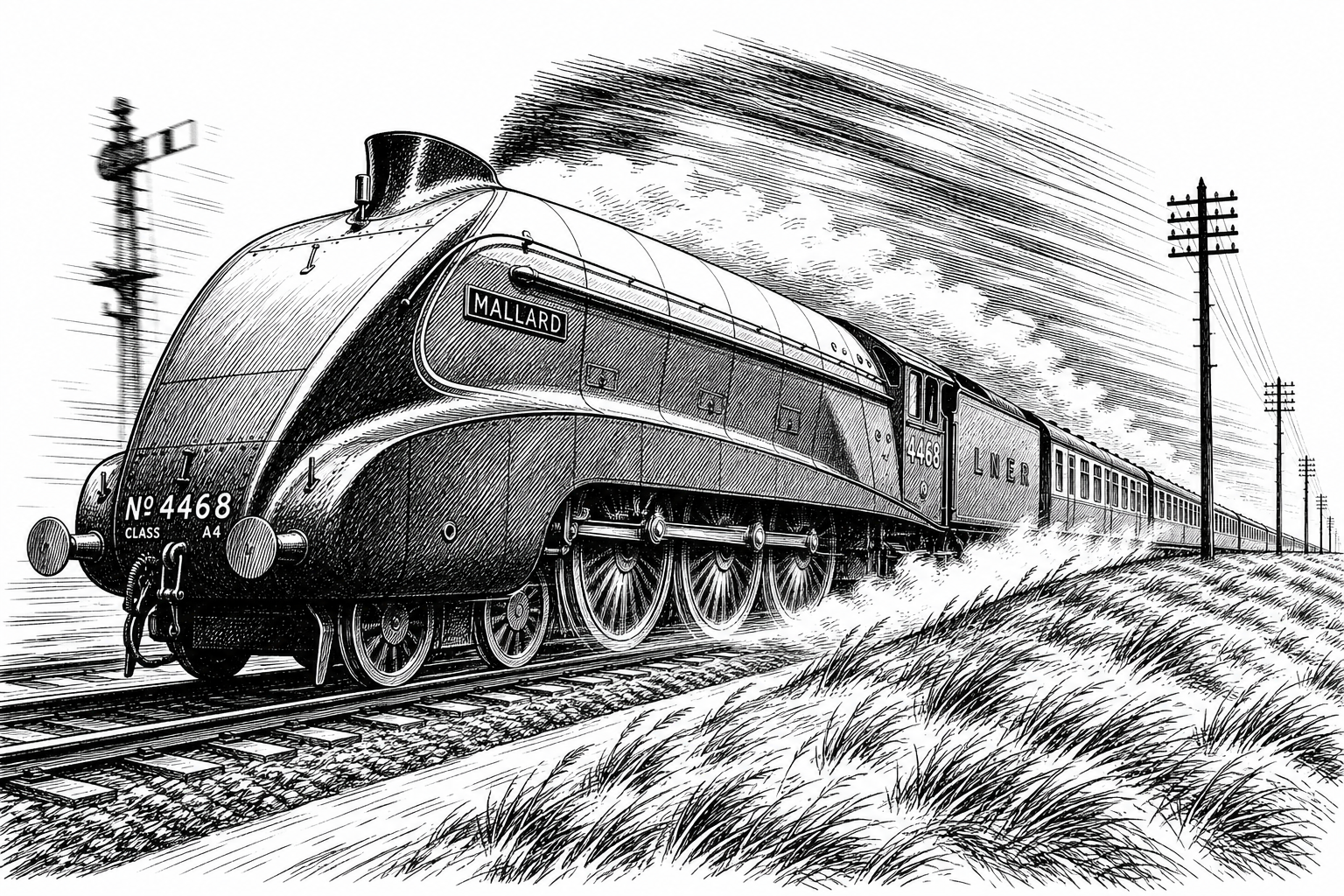
Lead illustration

LNER A4 Pacific No. 4468 Mallard hammering down Stoke Bank at maximum speed, Lincolnshire, England, July 3, 1938. The long streamlined nose fills the left of the frame, cutting a hard diagonal. Exhaust and steam blast backward in dense horizontal hatching, almost horizontal against the sky. Motion blur on the driving wheels rendered as tight radial lines. The smooth art-deco casing cross-hatched deep on the shadow underside, the boiler crown left in clean white paper. A chalk embankment rises in the right foreground, grasses bent flat by the slipstream. A single lineside signal post whips past in the background. Telegraph poles recede into the far distance in sharp perspective. No color, no gradients — bold confident ink lines on white ground, strong diagonal composition, newspaper op-ed editorial style.

The dynamometer car had already clocked 120 mph when driver Joe Duddington and fireman Thomas Bray knew the LMS record — the British best at 114 mph — was gone.1 What remained, for a few hundred yards on Stoke Bank in Lincolnshire, was the German record: 124.5 mph, set by the DRG Class 05 two years earlier. And there was still a window before the Essendine curves would force them to brake.

They pushed.

For a quarter-mile on July 3, 1938, the dynamometer car confirmed 126 mph.1 Sir Nigel Gresley's LNER A4 No. 4468 Mallard had beaten the German record. No steam locomotive anywhere has exceeded that speed since. The record is 88 years old today.

The locomotive nearly didn't survive it. The force exerted by the brakes being applied caused Mallard's big-end bearing to run hot; the crew had to crawl to Peterborough on the way back to prevent the engine from being written off entirely.1 In the dining car behind them, the crockery had smashed. Cinders blown from the stack broke windows at Little Bytham station.

Gresley wanted more. He planned a September 1939 run with the explicit target of 130 mph.1 The Second World War cancelled it — and with it, any chance of knowing how much faster the A4 design could go.

Mallard retired from service in 1963 and has been at the National Railway Museum in York since 1975, one of only six surviving A4 Pacifics, still in garter blue.1 The record was set in a quarter-mile, by a crew that had a few seconds of clear track and decided to use them. No one has found a better one.

Sources
  1. Mallard's World Speed Record — National Railway Museum railwaymuseum.org.uk Jul 3, 2020

↑ Back to top

THE LONG READ

Built for the Hard Cases: Epic Bets a New Language on Game Development

↩ Developing story — first reported Jun 19 · previously Jun 20

At the State of Unreal presentation on June 17 in Chicago, Epic Games executive vice president of development Marcus Wassmer described Verse as "the foundation of Epic's future programming model."1 That framing was doing real work. Verse is not simply a scripting layer — Epic is betting that a language designed from the ground up for game development will outcompete general-purpose languages for the specific class of problems that make large multiplayer games hard.

Kurtis Schmidt, Epic's framework technical director for Unreal Engine, made the argument explicitly in an interview with GamesBeat on June 18: "We're designing Verse specifically around the problems of game development, and really large-scale multiplayer game development — the things that are frankly just hard in games. Other languages that are focused on pure language design — they're going to be targeting general programming, and we're targeting video game programming."1 The implicit target is C++ and, to a lesser extent, C#. Neither was designed with game-state synchronisation, deterministic simulation, or the kind of hot-reload iteration loops that studios live inside.

The immediate vehicle is Unreal Engine 5.8, which Epic has positioned as the likely final UE5 release before Unreal Engine 6 arrives in early access — currently targeting late 2027.1 Wassmer hedged in the way executives hedge when they know the plan could slip: "Three months from now, if we discover for some reason that we really need to pull this stuff back and make a 5.9, we could. So we're not making a definitive statement that is absolutely guaranteed and signed in blood."1 But 5.8 is what the engineering org is building toward as the handoff point.


The other piece of infrastructure shipping in 5.8 is Lore, Epic's homegrown version control system — and this one is quietly interesting for anyone who has tried to run Git on a project where half the assets are 2GB texture packs. Lore is open-source, already in use by Unreal Editor for Fortnite creators, and designed around what Mattias Jansson, Epic's technical director and Lore architect, calls a "two-button workflow": check in changes, sync changes.1 Complexity is layered on demand — branches, self-hosted servers, and the underlying distributed storage model are available when you want them, invisible when you don't. The bet is that version control has been too hostile to non-engineers, which is true, and that the solution is progressive disclosure rather than a better GUI on top of Git LFS.

What ties Verse and Lore together is the larger strategic play: Unreal Engine 6 is designed to merge two currently separate user populations. On one side, UEFN creators — people who build Fortnite islands and have been programming in Verse for years. On the other, traditional game developers who use Unreal Engine 5 and write C++. In UE6, Verse becomes the shared language of both groups, and their economies literally connect: starting with cosmetic items, objects built for Fortnite experiences will be portable into UE6-based games, and vice versa. Fortnite outfits work in third-party games; custom items built in those games work inside Fortnite proper.1

For UEFN creators, the prospect is unsettling in the way any expanded market is unsettling — they go from competing within a curated platform to competing against every studio that knows how to ship a product. Wassmer's read was optimistic: "They might be a little trepidatious, but I'm not, really — because they're a really smart, great, driven bunch, and they'll be with us as we add every single thing. When we get to that point, they'll be the experts on those systems, not necessarily the triple-A devs."1 That may be right. It may also be that Epic's vision for a unified creator economy changes the competitive dynamics of both groups in ways nobody has fully modeled yet.

Sources
  1. How Epic Games Plans to Unify Its Developer and Creator Ecosystems Using Verse, Lore, and Unreal Engine 6 gamesbeat.com Jun 22, 2026

↑ Back to top

THE FUNNIES

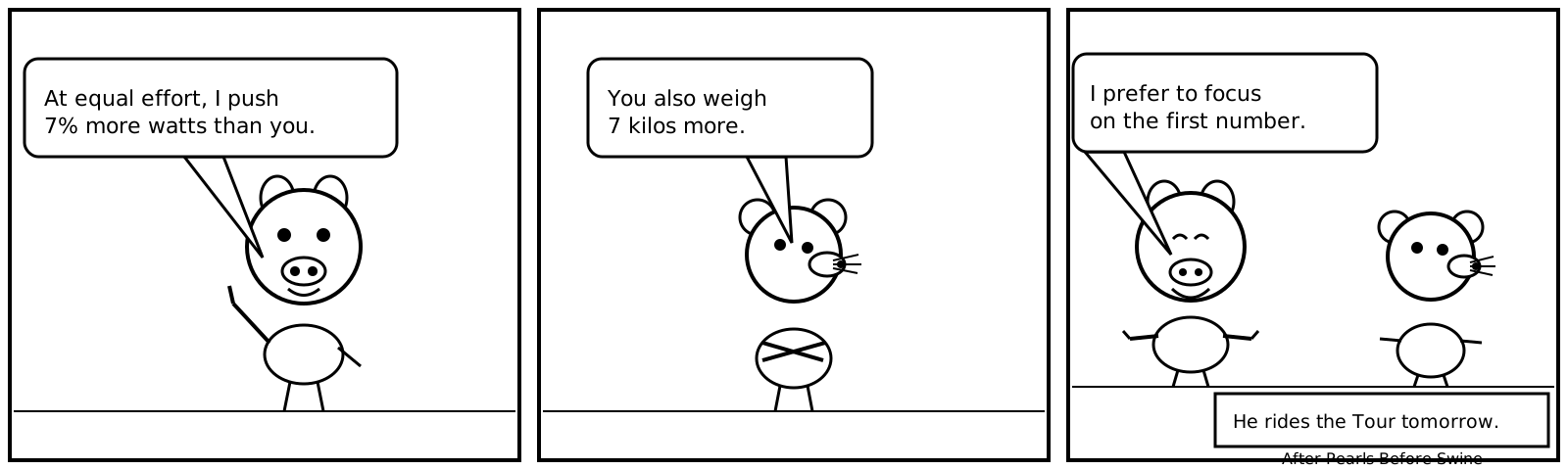
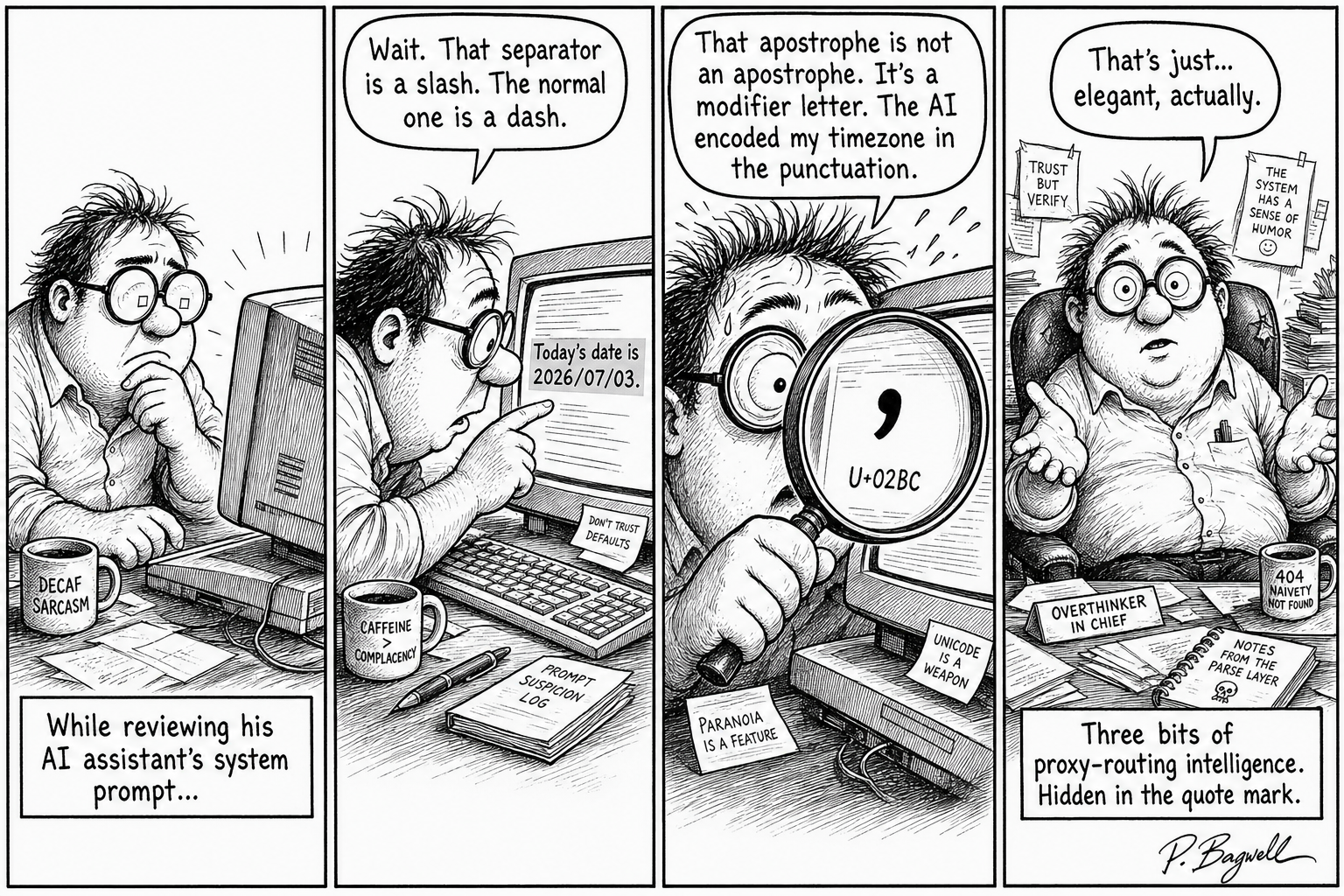
Watts, Weight, and Unicode

*After Pearls Before Swine* — on the Tour de France physiology dispatch: a round-headed pig character finds the "7% more raw watts at identical effort" number considerably more useful to emphasize than the other half of the equation. *After Bloom County* — on the LAB section's account of hidden Unicode codepoints inside an AI assistant's system prompt, where the apostrophe in "Today's date" was quietly encoding a three-bit timezone report in the punctuation.

Hand-drawn parody comic strip
AI-rendered parody comic strip

↑ Back to top

ALSO NOTED

Also Noted

↑ Back to top

THE QUESTION

The Specialist Wins Only on Their Terrain

Specialization beats scale only when the terrain forces it — and most terrain doesn't.

As THE PELOTON reports today, at identical watts-per-kilogram, Pogačar's roughly five extra kilograms mean approximately 7 percent more raw power at any given relative effort.1 Vingegaard's physiological architecture favors steep terrain, where w/kg dominates absolute output. On everything else — which is most of three weeks — the rider with the larger engine sets the pace.

THE LONG READ describes a parallel wager: Epic is building Verse, a programming language designed from the ground up for the hard problems of large-scale multiplayer game development, against languages that accumulated decades-long ecosystem advantages precisely because they were designed for general programming rather than any particular class of problem.2 Epic's claim is that the specific problems of game development are specific enough, and hard enough, that purpose-built design can overcome that scale gap.


Both bets depend on the same condition: that the terrain where the specialist wins is common enough, and arrives reliably enough, to matter. Vingegaard needs gradients steep enough that weight-to-power ratio dominates. Verse needs the hard problems of game development to be hard in ways that general-purpose languages genuinely cannot address through libraries, idioms, and ecosystem mass.

The archive offers a data point. On July 3, 1938, Nigel Gresley's Mallard — a streamlined locomotive purpose-built for high-speed running — beat the German DRG Class 05's record by 1.5 mph on a quarter-mile of Stoke Bank.3 The specialist won, definitively. Then the big-end bearing ran hot on the way home, the crockery in the dining car smashed, and Gresley's planned 130 mph run was cancelled by the Second World War.3 The record has stood 88 years not because subsequent machines couldn't be built, but because the window for running the experiment didn't reopen. Whether specialization could have delivered more was never answered.

The question worth carrying through the day: when your design optimizes for specific terrain, how certain are you the race actually goes there — and how long can you afford to wait?

Sources
  1. Pogačar vs Vingegaard: A Physiological Head-to-Head Where the Battle Will Be Won at the Tour de France cyclingnews.com Jul 3, 2026
  2. How Epic Games Plans to Unify Its Developer and Creator Ecosystems Using Verse, Lore, and Unreal Engine 6 gamesbeat.com Jun 22, 2026
  3. Mallard's World Speed Record — National Railway Museum railwaymuseum.org.uk Jul 3, 2020

↑ Back to top

Investigator Report

Investigator report — 2026/07/03

Verdict

A strong edition built around a rare editorial alignment — Tour de France eve, a significant ongoing tech story, and a genuine on-date archive find — let down in two precise places: THE QUESTION violated its own collision rule by sharing the GamesBeat source with THE LONG READ and recapping that section's argument, and THE LONG READ itself should not have shipped at priority 35 ("Passable") when the section focus explicitly says to hold rather than fill with something mediocre. The pipeline had a more serious structural failure: the art director hit the 32K output token cap three times and the orchestrator had to write frontpage.html directly. The frontpage that shipped is correct and reads well, but it cost two extra art director invocations and manual orchestrator intervention that added cost and wall-clock time.

Frontpage

The deployed PNG looks like a credible newspaper front page. Visual hierarchy is clear: the 60px PELOTON headline dominates; THE LAB takes the left column at a legible 40px; the right column carries THE WORLD (headline-only) and THE QUESTION in a sensible two-slot arrangement; the bottom rail gives FROM THE ARCHIVE the lead image slot, THE LONG READ the centre column, and ALSO NOTED the right column as a bullet list. The Mallard illustration (OpenAI image) is well-placed and reads clearly at frontpage size — strong silhouette, good contrast against white. No clipping, no font shrinkage, no overlapping elements visible. The "Today's Ride" strip correctly shows the afternoon decision above the fold.

The art director priority ordering is correct at first look: PELOTON (88) leads zone 1, LAB (82) takes the dominant left column in zone 2. FROM THE ARCHIVE (40) correctly leads THE LONG READ (35) within the bottom rail. THE QUESTION appears below THE WORLD in the right column despite having higher priority (78 vs. 62); this is by frontpage_display: "headline_only" design — THE WORLD sits as a slim header, THE QUESTION fills the remaining space. No mismatch.

The long-form index.html has 8 articles in correct tier order per section_tiers. No duplicates, no missing sections.

One cosmetic note: the PELOTON zone fade-out gradient clips the second paragraph mid-sentence on the rendered PNG ("Before the first rider rolls, the numbers are already doing their work. CyclingNews published a physiological breakdown of Tadej Pogačar and Jonas Vingegaard..."). This is expected behaviour for the zone1 overflow pattern and is not a layout error.

Priority ranking

SectionPriorityArticle words (est.)ImageNotes
THE PELOTON88~1,450noTdF eve — defensible lead
THE LAB82~1,150noongoing thread, good story
THE QUESTION78~490nosee editorial finding #1
THE WORLD62~980 (incl. trail)nosolid local + global mix
FROM THE ARCHIVE40~250yes (lead image)strong on-date find
THE LONG READ35~600nosee editorial finding #2
ALSO NOTED10~500 (9 bullets)norich sweep
THE FUNNIES8prose descriptionnosection rendered as image

The PELOTON at 88 is earned — Tour de France first stage tomorrow, physiological analysis plus Schleck/Froome/UAE sub-stories is exactly what this paper is for on this day. THE LAB at 82 is correct for a continuing story with new technical depth. The spread from 88 to 35 over six sections is healthy; the art director had real gradient to work with.

THE QUESTION at 78 deserves scrutiny. The priority_scale says 75–94 is "Exceptional question." The cross-domain bridge (cycling physics + Verse language + Mallard) is intelligent, but the Mallard arm does not cleanly connect: Mallard's 88-year-old record stands because WWII cancelled the next experiment, not because the specialization failed on its own terrain. The question the paper actually frames — "how certain are you the race goes to your terrain?" — is answered differently for a bicycle race (the route is published) than for a programming language (adoption is uncertain). The bridge holds on two of three legs. Priority 65–70 would be more accurate; 78 puts it above THE WORLD, which carried genuinely significant local news (Seattle transit ballot measure, Iran talks, Venezuelan earthquake). This is mild priority inflation.

Editorial reading

Finding 1 — THE QUESTION violates the COLLISION RULE

Newspaper.yaml states explicitly: "THE QUESTION may not share primary sources with THE LONG READ on the same day." THE QUESTION's second citation is the same GamesBeat Verse/UE6 article that is THE LONG READ's sole source. More concretely, the text says: "THE LONG READ describes a parallel wager: Epic is building Verse, a programming language designed from the ground up for the hard problems of large-scale multiplayer game development, against languages that accumulated decades-long ecosystem advantages…" — this is THE LONG READ's central argument reprinted in paraphrase, with the same GamesBeat citation. The question writer's dropped array shows awareness of the dedup rules (the Claude Code story was correctly excluded), but the collision with THE LONG READ was not caught. With seven sections to draw from, a question that bridges only cycling and the archive (without THE LONG READ) would have avoided the collision and produced a tighter piece. The preflight tests, as written in the config, do not check for THE LONG READ source overlap explicitly — they check proper-noun repetition and declarative form — so the writer could have passed the preflight and still violated the rule.

Finding 2 — THE LONG READ should not have shipped at priority 35

The GamesBeat article (Jun 22, eleven days before edition date) covers a specific conference presentation from June 17–18 — a State of Unreal keynote and follow-up interview. This is event-driven news coverage, not evergreen technical analysis. The section's evergreen_ok: true exception is designed for timeless essays and technical writing without expiry dates; a conference recap with named speakers and a specific product launch date is not timeless. The recency cap is 7 days; this article is at 11. The writer correctly scored it at priority 35 ("Passable") — and then shipped it. The section focus says explicitly: "Hold the section rather than filling it with something mediocre. Quality over cadence." Priority 35 is the definition of "Passable" in the scale. An empty LONG READ would have been the correct call; the section is marked optional nowhere in the config, but the focus text authorizes holding it. Shipping a 35-priority piece undermines the section's value proposition.

Finding 3 — THE LAB's source monoculture

The Claude Code steganography story is the strongest technical story in the edition — a four-step Unicode fingerprinting pipeline with documented version ranges, specific XOR keys, and independent verification. But four of the article's six citations (notes 1–4) all point to the same TechTimes secondary article. The article correctly names thereallo.dev as the original analysis and Adnane Khan's GitHub report as the confirmation — but cites neither directly. Every specific technical claim in the lede (XOR key 91, 147-entry domain list, 11 keyword strings, the four Unicode codepoints, the SOCKS5 null-byte flaw across 130 releases) is attributed solely through TechTimes. The fact-checker caught and corrected an attribution reversal (paragraph 2 had thereallo.dev and Adnane Khan swapped), but did not flag the single-source dependency. If TechTimes misreported any of these technical specifics, this paper has no independent check. The VENDOR-SOURCE RULE's spirit — require at least one independent source for vendor-origin claims — applies here in reverse: for third-party research claims, the writer should have cited the primary researchers, not just the trade-press summary.

Finding 4 — Daily decision: "AFTERNOON" is not supported by the visible forecast

The meta.json files a decision of "AFTERNOON" with summary "Morning drizzle clears; ride after noon, summer kit." The NWS forecast for Friday July 3 in research.md reads: "Friday: Partly sunny, with a high near 73°F. Southwest wind around 5 mph." No precipitation is mentioned in the Friday period. The overnight is "Mostly cloudy" but also without precipitation. The kit note appended to the weather block says "28% precip chance on the Alps" — a probability, not a morning-drizzle event. The DECISION RULES say Rule 2 applies only when "Rain only in the morning, clearing by midday." The word "drizzle" does not appear in the NWS data. July 3 is also the federal observed Independence Day — the reader likely has the full day free, making the ride-timing call particularly important. OUTSIDE with "partly sunny, 73°F" would be the rule-driven call from the visible forecast. The meta-writer appears to have weighted the 28% precipitation note into a morning-rain scenario the NWS did not actually forecast.

Pipeline observations

Critical: Art director failed three times with the same API error

All three art director runs (agent-a2d764de6f612cc1c, agent-a30eb63f7197e911a, agent-a6cb997399340edb3) terminated with: API Error: Claude's response exceeded the 32000 output token maximum. The orchestrator's own diagnosis in session.jsonl (line 433): "The article text in content.json totals ~30k chars — the art-director is pasting full articles, blowing the limit." The art director reads content.json (which embeds full article HTML) and then tries to write frontpage.html in a single tool call whose response exceeds the 32K cap. The orchestrator fell back to writing frontpage.html directly, a manual procedure that produced a correct result but adds undocumented cost and delay. The fix is to strip article body text from the version of content.json the art director reads, or to have the art director receive only headlines, slugs, priorities, and lede sentences. Three failed invocations at ~$0.61 average plus orchestrator hand-write time is meaningful overhead on every edition where article text is long enough to hit the cap.

Funnies agent ran longer than all section writers

The Draw today's TWO parody comic strips for agent (agent-a8e27f63f432a7e6c) ran for 1,443 seconds at $1.06 — more expensive than THE WORLD, THE PELOTON, or THE LAB writers. The output in section-funnies.md is a two-paragraph prose description of comic concepts (After Pearls Before Swine and After Bloom County); the rendered image is handled separately by fetch_lead_image.py via the OpenAI API (another $0.22). The 1,443-second wall-clock suggests the agent struggled or generated significant intermediate content that didn't ship. The agent name also appears to be the prompt prefix, not a clean display name, suggesting the invocation mechanism sets the name from the prompt string.

Orchestrator is the single largest cost center

The orchestrator at $4.10 is more expensive than the researcher ($2.11) and more than double the next-costliest agent (THE WORLD at $1.14). This includes the orchestrator's manual frontpage.html write, its reading of all section files for priority normalization, and 452 session events total. The orchestrator's high cost relative to agents is a signal that significant context is being handed back to the parent rather than delegated.

Procyclingstats.com blocked — served from cache

The race calendar fell back to the July 2 cached version, correctly noted in the article's calendar table footer ("Calendar from Jul 2, 2026 — primary source blocked today"). This is expected and handled; no section impact.

All other agents ran cleanly. Each writer, fact-checker, meta-writer, thread-editor, and illustrator produced a final response. No missing agents, no unrecovered tool errors in any non-art-director run. The fact-checker for THE LAB correctly caught and fixed the attribution reversal between thereallo.dev and Adnane Khan. Starting commit fd0dcb2 (Investigator: 2026-07-02, 13:47 UTC) is same-day relative to the run — no stale worktree concern.

Trace highlights

The researcher at $2.11 / 2,490 seconds dominates the productive pipeline. For a run where the lead story (TdF eve) was well-signalled in the feeds and the trail picks required reading actual WTA reports, this cost is understandable — the researcher is doing genuine synthesis across many sources. It is not disproportionate.

THE WORLD writer ran 1,177 seconds at $1.14 — the most expensive section writer by a significant margin. This is explained by the ON THE TRAIL subsection: the writer had to read WTA trip reports, cross-reference per-region NWS forecasts, evaluate six candidate picks against five criteria, and write a detailed weekend picks section. That work is expensive and the result is substantive.

Three Art Director runs totaling ~$1.82 with zero productive output are the clearest pipeline waste. The third invocation was described as "high token limit" but hit the same 32K cap, confirming the fix requires shortening the agent's input, not raising the output limit.

The illustrator (OpenAI) ran for 51 seconds at $0.06 for the lead image. The Mallard image is visually strong — this is one of the most effective lead images in recent editions for the cover impression it makes.

Trace summary

Dispatch 2026-07-03 (model: claude-sonnet-4-6)

AgentDurInputOutputCache ReadCache 5mCache 1hCost
Scout585s102691624038141649930$ 0.77
Researcher2490s48354236571252550880$ 2.11
THE WORLD1177s115391574912895860$ 1.14
THE PELOTON401s841102527919700$ 0.38
THE LAB348s984125742768900$ 0.33
THE LONG READ115s612453757188490$ 0.09
FROM THE ARCHIVE119s612859596221540$ 0.10
FC: THE LONG READ155s720589289356110$ 0.16
FC: FROM THE ARCHIVE130s73792852243900$ 0.12
Meta-Writer86s6393850505243460$ 0.17
Illustrator51s2311372000$ 0.06
FC: THE LAB304s734118410406420$ 0.19
FC: THE PELOTON455s735139574578180$ 0.26
FC: THE WORLD510s1389319193584530$ 0.32
THE QUESTION251s614771797389060$ 0.17
FC: THE QUESTION225s733106568367690$ 0.17
ALSO NOTED263s14159430418664200$ 0.38
Draw today's TWO parody comic strips for1443s15325962392431329420$ 1.06
FC: ALSO NOTED326s841180485557690$ 0.26
Funnies (OpenAI)137s4715488000$ 0.22
Art Director2143s1332130117391167480$ 0.92
Update story threads for today's edition407s5177221922920$ 0.35
Art Director2050s1336105791179040$ 0.45
Art Director2162s13141106001179920$ 0.45
Orchestrator1854198787386340141386$ 4.10
TOTAL11385123105151771591936532141386$14.72

Suggestions for next edition

The art director input problem needs a targeted fix: the orchestrator (or an assembly step) should strip article body text from the copy of content.json that the art director reads, leaving only headline, slug, priority, lede sentence, and image path. The current content.json embeds full article HTML (~30K chars of article text) which fills the art director's response budget before it can write even a short frontpage. This is a code change in the dispatch pipeline, not an agent prompt change.

When THE QUESTION cites a source also used by THE LONG READ, the fact-checker for THE QUESTION should explicitly check THE LONG READ's citation list for overlap. The collision rule is in the config but the checker currently does not verify it mechanically. Adding a step — "read section-longread.md sources and confirm none appear here" — to the fact-checker's preflight would catch this class of violation before it ships.

THE LONG READ's section focus says "Hold the section rather than filling it with something mediocre" — but the writer's priority scale goes down to 25–49 ("Passable"), which signals uncertainty about whether to ship. Consider adding a hard floor to the LONG READ writer's instructions: if the writer assigns priority below 40, the section ships empty rather than at "Passable." This would force the section to be what it claims to be.

Review the daily decision prompt and the weather data the meta-writer receives. The July 3 call of "AFTERNOON / Morning drizzle clears" on a "Partly sunny, 73°F" day suggests the meta-writer is inferring precipitation from a probability percentage rather than an explicit forecast event. The prompt decision rules would benefit from a clarification: "Rule 2 applies only when the NWS forecast text explicitly states morning rain or precipitation, not when the precipitation probability is above a threshold."