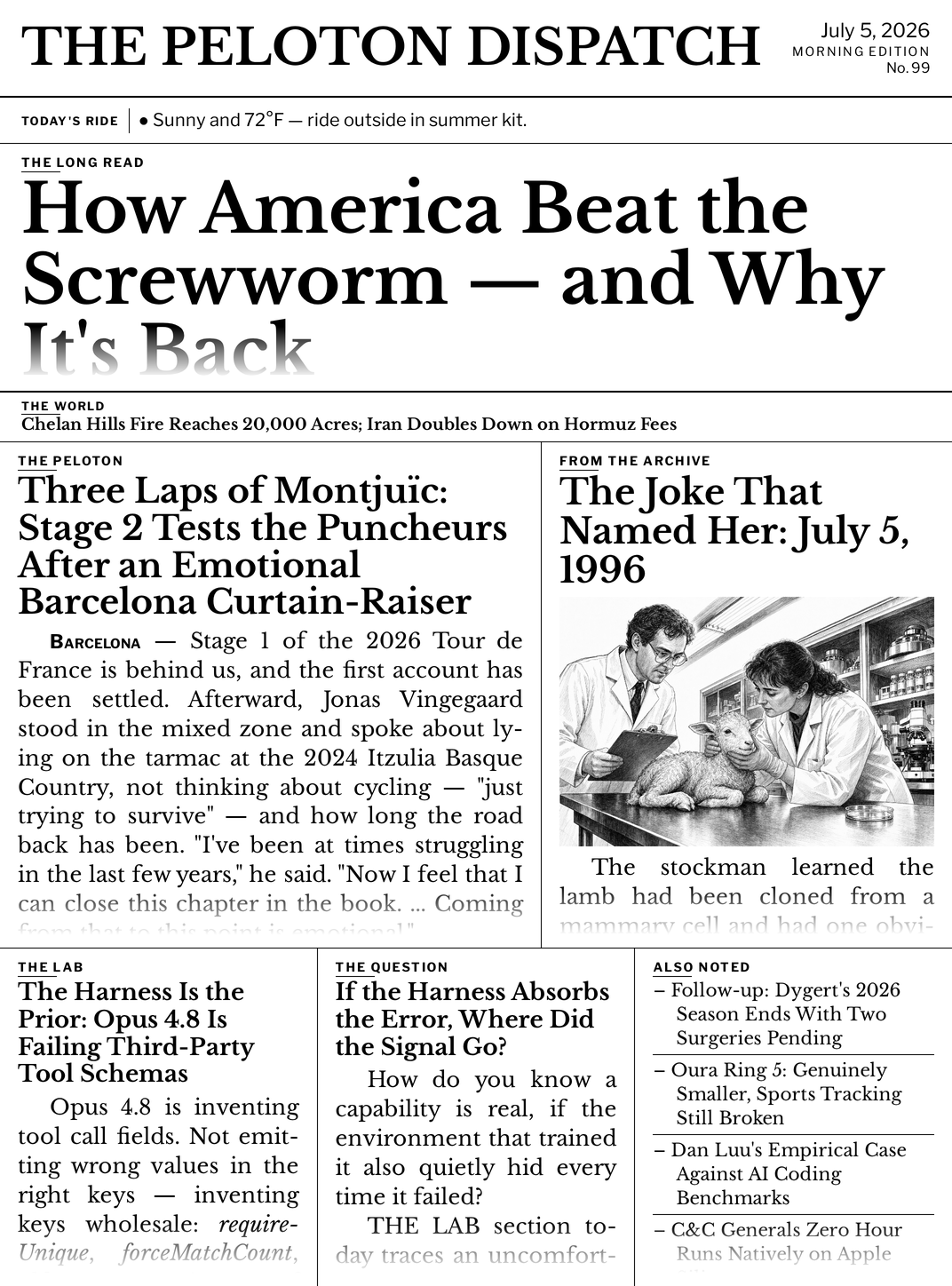
Front page — July 5, 2026
The Peloton Dispatch July 5, 2026 No. 99
● Sunny and 72°F — ride outside in summer kit. · summer kit

THE PELOTON

Three Laps of Montjuïc: Stage 2 Tests the Puncheurs After an Emotional Barcelona Curtain-Raiser

↩ Developing story — first reported Jul 02 · previously Jul 03, Jul 04

— Stage 1 of the 2026 Tour de France is behind us, and the first account has been settled. Afterward, Jonas Vingegaard stood in the mixed zone and spoke about lying on the tarmac at the 2024 Itzulia Basque Country, not thinking about cycling — "just trying to survive" — and how long the road back has been. "I've been at times struggling in the last few years," he said. "Now I feel that I can close this chapter in the book. ... Coming from that to this point is emotional."1

Visma-Lease a Bike built their team time trial around a clean division of labor: put the powerful rouleurs on the front over Barcelona's flat opening kilometers, shelter the climbers until Montjuïc, then let the legs speak. It worked as designed. Matteo Jorgenson was seen at the team bus punching the air.

Tadej Pogačar moved through the mixed zone quickly, noting he was "just super happy the day is over" — a TTT extracts its toll not in 20 minutes of racing but in hours of waiting, preparation, and anticipation beforehand. He did not leave empty-handed, posting the fastest split on the final two Montjuïc climbs.2 "Good news: I have climbing legs," he laughed, before pivoting to Sunday. "We will fight for yellow in the next days, maybe already tomorrow. Tomorrow is a super hard, tricky stage, and I think we are ready, but we go day by day."

He is right. Stage 2 covers 168.5 kilometers from Tarragona to Barcelona, finishing with three ascending laps of the Côte de Château de Montjuïc. The kicker averages 9.3 percent and spikes to 13 at its sharpest; sprinters have nothing to race for here.3 Mathieu van der Poel, Tom Pidcock, and Mattias Skjelmose are the natural stage hunters on a circuit this explosive. GC leaders, exposed on a technical, punchy finish after a complicated final approach, could drop crucial seconds before the race has left Spain.

The race's first abandonment has already arrived: Clément Berthet (Groupama-FDJ United) will not start Stage 2 after crashing in Saturday's TTT.4 Groupama lose a climber before the Pyrenees.


ASO's course director has his eye on what follows. Wildfires are burning in Catalonia, tens of kilometers from the Stage 3 finish at Les Angles. Thierry Gouvenou described the situation plainly: "It is a major concern for us."5 Smoke development, emergency service deployments, and road access are all potential bottlenecks independent of the heat itself. Stage 4, from Carcassonne to Foix through Occitanie — the driest, hottest region of France in recent weeks — carries a local forecast of 40°C with a northwest headwind. Temperatures are expected to ease after Stage 5. Regional prefects hold formal authority to shorten or cancel stages if conditions demand it; that authority was established before the race left Barcelona.

At Saturday's TTT, UCI commissaires were running a parallel operation at the start ramp: stopping riders to confiscate ice socks stuffed down the back of skinsuits — cut-down tights packed with ice cubes, one of the peloton's oldest warm-weather tools. UCI Article 1.3.032 forbids items that modify a rider's morphology, and a commissaire explained to Cyclingnews that drawing a line, however small, is the only defensible position: allow a little and riders take more. Victor Campenaerts was among those stopped. Red Bull-Bora-Hansgrohe's head of engineering Dan Bigham noted the rule was already explicitly in force; Visma-Lease a Bike's head of performance equipment Jenco Drost put it simply: "Since last year, they're quite sharp on items under your suit."6 Enforcement had been uneven at the Tour de Suisse. In Barcelona on Saturday, it was not.


The ITA has put a date on cycling's long-pending power passport: 2028.7 Oliver Banuls, the ITA's head of testing, told Velo that researchers are already analyzing historical race and training files from more than 60 riders across five professional teams, with live data collection beginning next year through a study with the University of Kent and University College London. The tool would not directly sanction athletes — instead, unexplained shifts in a rider's longitudinal power profile would guide targeted testing, sample re-analysis, and intelligence investigations. "The purpose is getting the full picture," Banuls said. The idea has been around since 2015; Banuls acknowledged the technology simply wasn't ready then. "It won't be a revolution. It will be a great evolution."

Elise Chabbey (FDJ United-SUEZ) confirmed this week she will not start the Tour de France Femmes or race again in 2026. She has been absent since Liège-Bastogne-Liège in April, where she finished seventh as teammate Demi Vollering won. The reason, posted to Instagram: she is pregnant. "A little frog is growing inside me," she wrote.8 Chabbey, who won Strade Bianche in March and is a medical graduate who competed in kayak at the London Olympics, is expecting in January 2027 with partner Antoine Robin. She is signed with FDJ United-SUEZ through 2028.

On the Road Ahead
Calendar from Jul 4, 2026 — primary source blocked today
DateRaceCountry
Sun Jul 5 – Sun Jul 26Tour de France, Stages 2–21 (ongoing)Spain / France
Sat Aug 1Clásica San SebastiánSpain
Mon Aug 3 – Sun Aug 9Tour de PolognePoland
Sun Aug 16ADAC Cyclassics HamburgGermany
Sat Aug 22 – Sun Sep 13La Vuelta a EspañaSpain
Show Results

STAGE 1 — TTT, Barcelona–Montjuïc (19.6km): WINNER: Visma-Lease a Bike (Jonas Vingegaard, yellow jersey) PODIUM: 1. Visma-Lease a Bike 2. Netcompany-Ineos (+0:08) 3. UAE Team Emirates-XRG (+0:12)

GC AFTER STAGE 1: 1. Jonas Vingegaard (Visma-Lease a Bike) 2. Filippo Ganna (Netcompany-Ineos) +0:08 3. Tadej Pogačar (UAE Team Emirates-XRG) +0:12

NOTABLE: Egan Bernal (Netcompany-Ineos) in green jersey into Stage 2 after Ineos led at the first intermediate checkpoint. Pogačar holds the polka-dot jersey for fastest split on the final Montjuïc climbs. Clément Berthet (Groupama-FDJ United) DNS Stage 2 after crashing in Stage 1. XDS-Astana lost three riders to a mid-stage crash.

Sources
  1. Vingegaard Closes Chapter on Itzulia Trauma with First Yellow Jersey Since 2023 cyclingnews.com Jul 4, 2026
  2. Pogačar: 'We Will Fight for Yellow — Maybe Already Tomorrow' cyclingnews.com Jul 4, 2026
  3. Tour de France Stage 2 Preview: A Prime Opportunity for the Puncheurs velo.outsideonline.com Jul 4, 2026
  4. Tour de France 2026 Abandons Tracker cyclingnews.com Jul 5, 2026
  5. Tour de France Organisers Express Concerns: Heat, Forest Fires, and a Red Alert Could Impact the Race idlprocycling.com Jul 4, 2026
  6. UCI Bans Tour de France Riders from Using Ice Socks in Stage 1 Team Time Trial cyclingnews.com Jul 4, 2026
  7. Anti-Doping Watchdog Targets 2028 Rollout for Cycling's Power Passport velo.outsideonline.com Jul 5, 2026
  8. Elise Chabbey Confirms Her 2026 Season Is Over — She Is Pregnant cyclingnews.com Jul 5, 2026
  9. Egan Bernal Claims the Race's First Maillot Vert cyclingnews.com Jul 5, 2026

↑ Back to top

THE WORLD

Chelan Hills Fire Reaches 20,000 Acres; Iran Doubles Down on Hormuz Fees

↩ Developing story — first reported Jun 29 · previously Jul 01, Jul 03


ON THE TRAIL

PART 1 — WEEKEND PICKS

This coming weekend (Sat July 11 – Sun July 12). Independence Day 2026 fell on Saturday July 4; the federal observed holiday was Friday July 3. The long weekend (Fri–Sun, July 3–5) wraps up today — next trip window is next weekend.

Pick 1 — 1-night: Lower Tuscohatchie Lake via Pratt Lake

Pick 2 — 2-night: De Roux Creek to Gallagher Head Lake

PART 2 — REGIONAL SNAPSHOT

Sources
  1. Chelan Hills Fire Spreads to 15,000–20,000 Acres; Level 3 Evacuations Near Orondo kiro7.com Jul 5, 2026
  2. Iranian Diplomat Says Country Will "Definitely" Collect Hormuz Fees, Defying US timesofisrael.com Jul 4, 2026
  3. Council Amendments Would Slash Transit Funding Plan, Subject Measure to Annual Vote publicola.com Jul 3, 2026
  4. Lower Tuscohatchie Lake Trip Report wta.org Jul 4, 2026
  5. De Roux Creek to Gallagher Head Lake Trip Report wta.org Jul 4, 2026
  6. WTA Trip Reports (recent PNW) wta.org

↑ Back to top

THE LAB

The Harness Is the Prior: Opus 4.8 Is Failing Third-Party Tool Schemas

Opus 4.8 is inventing tool call fields. Not emitting wrong values in the right keys — inventing keys wholesale: requireUnique, forceMatchCount, oldText2, event.0.additionalProperties, a rotating zoo of names that changes with each invocation. The actual oldText and newText values are byte-correct. The schema around them is not.1

A post at lucumr.pocoo.org traced this to a Pi editor issue filed against Opus 4.8 and Sonnet 5. Older Anthropic models don't show it. Codex models tested so far don't either. It only surfaces in multi-turn agentic histories — the model has read files, formed a diagnosis, is composing a multi-line edit — and even then only in some transcripts. A fresh single-turn prompt doesn't reproduce it. In one affected session, continuing the conversation caused Opus 4.8 to produce malformed calls roughly 20% of the time.1 Stripping extended thinking blocks from history halved the failure rate. Enabling Anthropic's strict tool invocation eliminated it.

The failure lands exactly where you'd expect if this were a training artifact. Pi's edit tool uses a nested edits[] array, each element with oldText and newText. Claude Code's own edit tool is flat: file_path, old_string, new_string, one optional flag. After generating several hundred tokens of escaped newText content inside a nested JSON object, the model faces a binary decision: } or , "something". Opus 4.8's prior says an edit call looks like Claude Code's schema — possibly with one extra field. It has no trained name for Pi's nested shape, so it samples a plausible-sounding key fresh each time. That's why the failures don't cluster on a single stable wrong alias: the model has no consistent wrong answer, only a strong prior that something probably goes there.

The mechanism is documented in Claude Code's own minified, closed-source client. The harness silently drops unknown keys. It aliases old_str to old_string and path to file_path. It has Unicode escape repair for broken sequences. It has retry logic for malformed calls.1 When reinforcement learning happens in an environment that absorbs this much slop without penalizing it, there is no gradient against adding a stray field — the model emits "requireUnique": true, the harness absorbs it, the task completes, the reward registers. Meanwhile, Anthropic's strict mode — which would constrain the sampler to the declared schema — imposes complexity limits on tool definitions that cause API requests to fail, which is presumably why Claude Code itself doesn't use it.

The uncomfortable implication is that tool schemas are no longer neutral contracts. Some shapes are on-distribution for these models; others are increasingly off. The more post-training concentrates in one dominant, forgiving, opaque harness, the more every other harness has to either closely match it or rely on strict-mode constraints as a workaround. You cannot inspect the harness to know how far off-distribution your schema is. You observe the symptoms after the fact — a 20% corruption rate in production, a zoo of invented keys, a model that was better at this six months ago.


Simon Willison shipped sqlite-utils 4.0rc2 today, the bulk of it written by Claude Fable across 37 prompts, 34 commits, and +1,321/-190 lines across 30 files.2 The model's first significant find in 4.0rc1 was a data-loss bug: Table.delete_where() ran its DELETE with no atomic() wrapper, leaving connection.in_transaction = True. Every subsequent atomic() call then took the savepoint branch and never committed — meaning the delete, and any writes following it, were silently rolled back when the connection closed. Willison notes the bug would have been fixable in a 4.0.1 point release rather than requiring a major version bump, but is glad he didn't ship it.

The more durable methodological note is the cross-model review. Willison prompted Codex Desktop and GPT-5.5 to review the changes and confirm the changelog was current. GPT-5.5 found two more issues: db.query() raising ValueError after already committing a write as a side effect (the rejection arriving too late to be a rejection), and INSERT ... RETURNING only committing once the generator was fully exhausted — contradicting the changelog's guarantee that writes take effect without iteration. He pasted the findings into a fresh Fable session to confirm and fix both. His summary: "I've started habitually having Anthropic's best model review OpenAI's work and vice versa, because I've had that turn up interesting results often enough to be valuable."

The estimated unsubsidized API cost for the sessions was $149.25 — $141.02 in the main session, the remainder split across five sub-agents.2 The July 7 deadline looms: Anthropic ends subsidized Fable access for Max subscribers and reverts to full API pricing.


One data point from Epoch.ai: high- and critical-severity CVE counts jumped more than 3.5x in June compared to the previous monthly record, in the period following Anthropic's April 2026 Claude Mythos Preview announcement and the subsequent Glasswing and Daybreak vulnerability-discovery launches from Anthropic and OpenAI.3 Epoch frames this as correlation with the announcements — whether the spike reflects AI-accelerated discovery, a shift in researcher reporting patterns, or both is not established by the analysis.

Trending today: dominated by Claude Code CLAUDE.md skills collections, caveman-prompt token reducers, and AI agent wrappers — the one technically substantive outlier is ammaarreshi/Generals-Mac-iOS-iPad, a native macOS/iOS/iPadOS port of C&C Generals Zero Hour built on the EA GPL v3 source via GeneralsX with a DXVK/MoltenVK renderer (primary gaming coverage in ALSO NOTED today).

Sources
  1. Better Models: Worse Tools lucumr.pocoo.org Jul 4, 2026
  2. sqlite-utils 4.0rc2, Mostly Written by Claude Fable (for about $149.25) simonwillison.net Jul 5, 2026
  3. CVE Severity Spike Following AI Vulnerability Discovery Announcements epoch.ai Jul 3, 2026

↑ Back to top

THE LONG READ

How America Beat the Screwworm — and Why It's Back

On June 3 of this year, screwworms were found in a three-week-old calf near La Pryor, Texas.1 Dozens more cases have since been confirmed in Texas and New Mexico. Outside a minor 2016 outbreak in the Florida Keys that was quickly stamped out, this is the first confirmed screwworm infestation on US soil since the 1980s. The fly is back.

Most people alive today have no memory of what that means. The New World Screwworm (Cochliomyia hominivorax) does something unusual among flies: its larvae feed not on dead tissue but on living flesh. A female lays her eggs on any open wound — a nick from a fence post, a freshly branded hide, a navel on a newborn calf. The eggs hatch into worms that burrow inward as they eat, enlarging the wound, drawing more flies, until the infection is fatal. Ranchers in 1930s Texas hired hands whose sole job was checking livestock every two days. "People would not leave home for more than a day," one history of the era notes, "for fear of finding their animals had been eaten alive while they were away." A 1935 USDA survey found more than 1.2 million infections and 180,000 dead livestock in Texas alone — and acknowledged the true totals were likely far higher.1 In the same decade, an estimated 60 to 80 percent of white-tailed deer in Texas died from the fly. By the early 1960s the pest was inflicting more than $100 million in annual damage in the Southwest.

The solution, when it arrived, was one of the most audacious ideas ever applied to pest control.

Edward Knipling joined the USDA in 1931 and spent the following years studying screwworms in exhaustive, sometimes ridiculous, detail — at one point staking out a wounded goat from dawn to dusk for a week straight, marking individual females with fingernail polish to track their movements. By the late 1930s, stationed at Raymond Bushland's laboratory in Texas, Knipling had noticed something useful: despite the millions of infections screwworm caused, the actual number of wild flies in any given area was surprisingly small — roughly 100 per square mile. Meanwhile, Bushland had developed an artificial growth medium (hamburger, blood, water, and a little formaldehyde to delay putrefaction) that let them raise screwworms by the thousands in a lab. The combination pointed at a question neither had fully articulated yet: what if you could overwhelm the wild population with sterile males?

Female screwworm flies mate only once. If sterile males vastly outnumber wild males, most females will produce no viable offspring. Sustain that imbalance long enough, and the population breeds itself out of existence. When Knipling and Bushland floated the idea to colleagues, the reaction was derision. "Who ever heard of castrating flies?" The two kept it to themselves.

The missing piece arrived in 1950. Knipling read a paper by Hermann Muller, who had won the Nobel Prize for demonstrating that radiation induces heritable mutations. The paper was a warning against nuclear warfare; Knipling saw a sterilization tool. He contacted Muller, who replied: "I know nothing of screwworms but your theory is sound." Bushland, working nights and weekends with no dedicated research funds, got access to an Army hospital X-ray machine at no cost, then borrowed a sample of highly radioactive cobalt-60 from Oak Ridge National Lab. High enough doses left male screwworms completely sterile while otherwise intact and functional — they would still seek out females and mate, they would simply produce nothing.

The decisive field trial was on Curaçao, a Dutch Caribbean island off the coast of Venezuela that was overrun with screwworm and, crucially, isolated enough to test whether full elimination was actually achievable. In the summer of 1954, a USDA team began dropping boxes of sterilized flies from a small plane over the island. The first weeks were poor: too few flies, too little effect. When the density was raised from 100 to 400 flies per square mile, results improved rapidly. Within 14 weeks, no viable screwworm offspring could be found anywhere on the island. In November 1954, Curaçao was declared screwworm-free.1

Florida followed. In April 1958, while cold temperatures had confined screwworms to the southern half of the state, USDA planes began dropping sterile flies across a 100-mile-wide corridor through the center — a barrier. They then pushed south, aided by a new factory in Sebring capable of producing 50 million sterilized flies a week. By September, infections in the southeast had fallen to near zero. By February 1959, cases were zero.

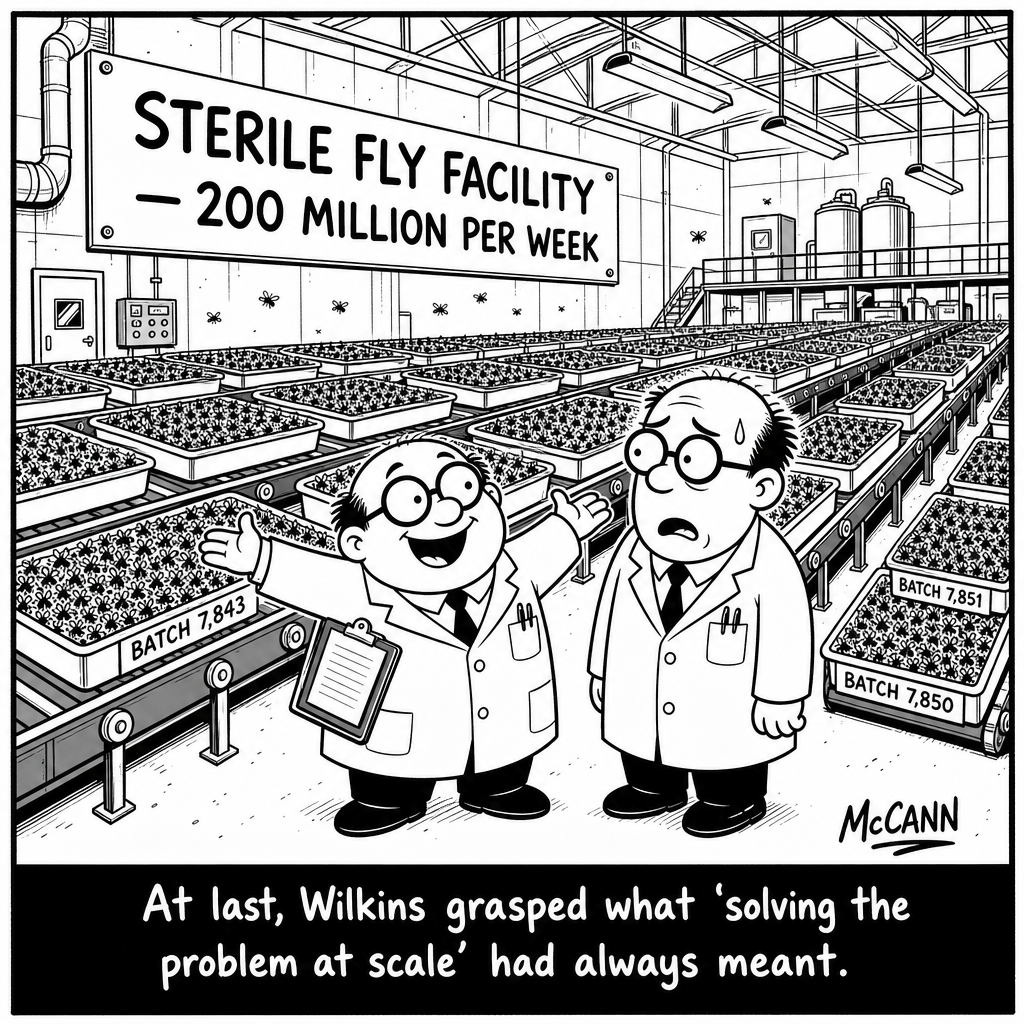
Texas was another matter. Florida is surrounded on three sides by water; Texas shares more than a thousand miles of border with Mexico, where screwworm survives year-round. The USDA officially concluded in 1959 that Southwest eradication "did not appear feasible." What broke the logjam was money and political will: a coalition of Texas ranchers organized, raised millions in voluntary donations, persuaded the state legislature to fund a program, and ultimately got Vice President Lyndon Johnson — a ranch owner who knew the scourge personally — to force the federal government's hand. A new insectary was built at an abandoned Air Force base near Mission, Texas: a 76,000-square-foot operation running 24 hours a day, 365 days a year, producing more than 200 million sterilized screwworm flies a week.1 The facility was described by observers as a grotesque marvel — trays of blood and meat moving through the building on a monorail, timed to the fly's lifecycle, "a seething mass that is difficult to believe unless you've seen and smelled it." By 1966, the screwworm had been eliminated from the entire United States.

What followed over the next two decades was an extension of the barrier southward, decade by decade, through Mexico and then through Central America — Guatemala in 1988, Belize the same year, Honduras, El Salvador, and Nicaragua in 1991, Costa Rica in 1993, Panama in 1994. The logic was relentless: the farther south the barrier, the narrower the land. At the Darien Gap, the dense and roadless jungle on the Colombia-Panama border, the barrier needed to be only 60 miles wide. A joint US-Panamanian organization called COPEG took over administration. The program cost about $15 million a year to operate. For that price, the entire livestock industry of North and Central America was shielded from a parasite that had once killed animals by the millions.

Then, sometime around 2023, the barrier failed.

The causes are multiple and, viewed together, predictable. COVID-19 kept inspectors home, disrupted vehicle maintenance, cut supply chains; power outages at the Panama production facility killed millions of sterilized flies. The Darien Gap itself, once dense rainforest essentially impassable to cattle, has been steadily cleared for grazing — a transformation driven partly by absentee ranchers paying insufficient attention to their herds, partly by narcotics cartel money-laundering operations that traffic hundreds of thousands of cattle through Central America outside any inspection regime. Screwworms, the evidence suggests, were moving by truck. By 2023, there were 6,500 screwworm cases in Panama despite the barrier; by 2024, 18,000 in Panama, 8,600 in Costa Rica, 3,300 in Nicaragua. By 2025, reported cases in Mexico exceeded 12,000 and have since passed 30,000.1

The deeper failure is institutional. The Mexican production facility at Tuxtla Gutiérrez, which once produced more than 400 million sterile flies a week, was shut down in 2012 — over COPEG's objections — because the Darien Gap barrier was working so well that the extra production capacity seemed redundant.1 Panama's production was allowed to decline to the level needed to maintain the barrier, not to respond to any breach of it. What had been a heavily resourced, vigilant program became a thin operation calibrated for steady-state conditions. When those conditions collapsed, there was no reserve capacity to respond.

The USDA is now rebuilding. In 2026 it broke ground on a new facility at Moore Air Force Base in Texas, designed to produce 300 million sterile flies a week. A $100 million "Grand Challenge" has been announced for new eradication and treatment methods. But experts caution that re-eradicating screwworm from North and Central America will require "close to a decade of sustained work." The fly spread north by truck; getting it back out will happen by plane, drop by drop, week after week, for years.

The screwworm story is a case study in how completely a problem can be solved, and how completely that solution can be undone by its own success. A program that had protected an entire continent for four decades and cost virtually nothing relative to the damage it prevented was allowed to atrophy because the threat it held back had become invisible. No one alive remembered what $100 million in annual losses to a flesh-eating parasite looked like. They are about to find out.

Sources
  1. The Fall and Rise of Screwworm construction-physics.com Jul 3, 2026

↑ Back to top

FROM THE ARCHIVE

The Joke That Named Her: July 5, 1996

Lead illustration

A fluorescent-lit research laboratory at the Roslin Institute, Edinburgh, 1996. A newborn lamb — damp wool still curling, legs folded beneath her — lies on a stainless steel examining table at the center of the frame. Two scientists in lab coats lean in from either side: one holds a clipboard at chest height, the other reaches forward with gloved hands steadying the lamb's head. Glass-fronted equipment cabinets crowd the background — centrifuge rotors, microscope stands, rows of labeled specimen vials — all rendered in tight parallel hatching. Overhead strip lighting throws hard downward shadows across the scientists' faces and the steel table edge. On the bench behind, a single glass petri dish sits alone at the margin of the light, small against the creature it produced. The lamb's woolly coat is cross-hatched in loose curves, soft and alive against the rigid clinical geometry of the room. Strong diagonal composition from lower-left table corner to upper-right cabinet shelf. Black-and-white pen-and-ink editorial illustration. Confident linework, controlled hatching and cross-hatching in shadow areas, generous white space in upper corners. No color, no gradients, no text.

The stockman learned the lamb had been cloned from a mammary cell and had one obvious suggestion for her name. The joke stuck: 6LL3, the lab's internal code, became Dolly — after Dolly Parton — and the most consequential biological breakthrough of the decade was christened with a punchline.

She was born July 5, 1996, at the Roslin Institute outside Edinburgh: the first mammal successfully cloned from an adult somatic cell.1 The donor cell came from the udder of a six-year-old ewe. Scientists cultured it using microscopic needles adapted from human fertility techniques first developed in the 1970s, implanted the resulting embryo into a surrogate, and 148 days later Dolly arrived.1 The Roslin team sat on the news for seven months before announcing publicly in February 1997.1 When they did, the controversy was immediate — supporters pointed to xenotransplantation and therapeutic cloning for degenerative diseases like Alzheimer's and Parkinson's; critics worried about safety and the obvious next step no one was supposed to say aloud.

Dolly mated with a ram named David and produced four lambs.1 In January 2002 arthritis appeared in her hind legs, raising early questions about whether the cloning process had introduced genetic abnormalities. A progressive lung disease followed. She was put down on February 14, 2003, at six years old — the same age as the ewe whose udder cell had made her.1

She was stuffed and placed on display at the National Museum of Scotland in Edinburgh, where she remains.

Sources
  1. Dolly the sheep becomes first successfully cloned mammal | July 5, 1996 | HISTORY history.com Feb 9, 2010

↑ Back to top

THE FUNNIES

Ice Socks and Fly Factories

After Peanuts — on the UCI commissaire who confiscated a rider's ice sock on a forty-degree stage day, then stood in the sun without one. After The Far Side — on the USDA sterile-fly facility that ran around the clock producing two hundred million flies a week, and what it looked like to the person who finally saw it in person.

Hand-drawn parody comic strip
AI-rendered parody comic strip

↑ Back to top

ALSO NOTED

Also Noted

↑ Back to top

THE QUESTION

If the Harness Absorbs the Error, Where Did the Signal Go?

How do you know a capability is real, if the environment that trained it also quietly hid every time it failed?

THE LAB section today traces an uncomfortable answer in Opus 4.8: the model invents tool call fields during multi-turn agentic sessions, and the mechanism appears to trace to Claude Code's own training harness — which aliases wrong keys, drops unknown fields, retries malformed calls, and generally absorbs schema errors rather than penalizing them.1 When reinforcement learning happens in that environment, there is no training signal against inventing a stray field. The task completes; the reward registers; the behavior goes uncorrected. You observe the consequence only after deployment: invented keys that change with every invocation, a corruption rate that surfaces only under extended multi-turn load, a model that was more reliable a few months ago and no clear account of why.

The structure appears elsewhere today. THE LONG READ is about screwworm, not software, but the failure mode is identical. A decades-long eradication program rendered the fly invisible across North and Central America — which is precisely why reserve production capacity was allowed to wind down. The Mexican sterile-fly facility was shut down because the barrier was working so well that extra capacity seemed redundant.2 When conditions collapsed simultaneously, there was no reserve to deploy. The program's success had made the backup infrastructure feel wasteful; when the success ended, the infrastructure was gone.

In both cases, the absorber — the training harness, the eradication barrier — is also the instrument measuring the system's health. The harness absorbs schema errors, so model performance looks fine in the environment where you measure it. The barrier suppresses screwworm, so the livestock sector looks healthy in a world where the threat has been made invisible. Both measurements are accurate in the narrow sense. Neither gives you any signal about how much underlying capacity remains.

The question to carry: for any system that succeeds by absorbing errors rather than eliminating them, how far into atrophy does the underlying capability get before the absorber gives way? The signals tend to arrive late and cluster. In the fly case, it was thousands of confirmed cases in Panama despite an operational barrier — already a lagging indicator of a problem developing for years.2 In the tool-schema case, it's a 20% corruption rate in extended sessions, a rotating zoo of invented keys, and the quiet note that strict mode would fix it but strict mode breaks API requests.1 By the time the failure is legible, the reserve that would have caught it has already been dismantled.

Sources
  1. Better Models: Worse Tools lucumr.pocoo.org Jul 4, 2026
  2. The Fall and Rise of Screwworm construction-physics.com Jul 3, 2026

↑ Back to top

Investigator Report

Investigator report — 2026/07/05

Verdict

A strong edition. The screwworm longread is the best single piece this paper has run in the past week — genuinely hard to put down, well-paced, a real story rather than a summary. THE PELOTON and THE QUESTION are both above average. The pipeline ran cleanly in a long but otherwise uneventful 1763s for the art director. Two fact-checker misses stand out: the WORLD bullet word cap was ignored, and the QUESTION's source-collision rule went unchecked. Both are correctible in the fact-checker prompts.

Frontpage

The deployed PNG at pd.thep3000.com/2026/07/05/frontpage.png is clean. "How America Beat the Screwworm — and Why It's Back" fills the lead zone legibly at 76px. The daily ride strip is uncluttered. The Dolly lab illustration — two scientists, a wet-wooled lamb on a steel table — reads well at frontpage size and is precisely in the pen-and-ink editorial style requested.

One layout tension worth naming: FROM THE ARCHIVE (priority 38) occupies the mid-right column alongside THE PELOTON (priority 83), giving it equal vertical real estate to a section rated more than twice as high. THE LAB (priority 71) and THE QUESTION (priority 67) are pushed to the cramped bottom zone. This is a structural consequence of triggers_meta: true on the archive section — the meta-writer assigns the lead image to FROM THE ARCHIVE by rule, and the art director then places the image-carrying section in the visually prominent mid-right slot. The image is beautiful, but it elevates a priority-38 story above a priority-71 story in the visual hierarchy. If this bothers you, the fix is in newspaper.yaml (allow other sections to carry an image) rather than in the art director.

The web index.html section order — PELOTON, WORLD, LAB (tier 0), then LONGREAD, ARCHIVE (tier 1), FUNNIES (tier 2), ALSO NOTED (tier 3), QUESTION (tier 4) — matches section_tiers as configured. No duplicates, no missing sections.

Priority ranking

SectionPriorityLengthImageNotes
THE LONG READ851,458 wordsLead story
THE PELOTON83875 wordsTdF Day 1 TTT + Stage 2 preview
THE WORLD75602 wordsChelan fire + Iran Hormuz + Seattle transit + ON THE TRAIL
THE LAB71884 wordsTool schema failures + sqlite-utils + CVE spike
THE QUESTION67427 wordsCross-domain bridge LAB×LONGREAD
FROM THE ARCHIVE38245 wordsyesDolly the sheep, July 5, 1996
ALSO NOTED9562 words9 items
THE FUNNIES7SVG + OpenAI render

THE LONG READ at 85 edging out THE PELOTON at 83 is defensible: the screwworm piece is exceptional, and the Tour de France has 21 stages ahead. The priority spread of 85−7=78 gives the art director clear hierarchy. The orchestrator's managing-editor step bumped THE PELOTON from its writer-submitted 78 to 83; that bump was correct given opening-day Tour coverage. No priority inflation.

Editorial reading

1. THE WORLD — Seattle Transit bullet violates the 25-word hard cap.

The section rules in newspaper.yaml say "each bullet ≤ 25 words" with explicit annotation: "HARD CAPS — not style guidelines." The Seattle Transit bullet body runs 39 words: "The transit measure amendment hearing is Monday July 6 at 11am. Saka's most provocative move would subject Metro's funding to annual Seattle City Council approval — effectively holding county bus service hostage year-by-year; full council vote expected July 16." The Chelan bullet runs 21 words; the Iran bullet runs 18 words. The Transit bullet is nearly twice the allowed length and it shows — it reads like a paragraph that wandered in from the full article page. The WORLD fact-checker checked 28 claims but did not check word counts.

2. THE QUESTION — COLLISION RULE: shares a primary source with THE LONG READ.

Newspaper.yaml states explicitly: "THE QUESTION may not share primary sources with THE LONG READ on the same day." Today's QUESTION cites construction-physics.com twice (citations 1 and 2, snippets "harness fully absorbs the error" and "Tuxtla factory closed in 2012"). THE LONG READ cites construction-physics.com six times — it is the sole source for the entire longread. The QUESTION fact-checker ran 26 messages and added sources and corrected one factual claim but did not check the collision rule. The cross-domain bridge (training harness :: eradication barrier) is the best structural angle in this edition; the rule violation doesn't undercut the argument but it does mean the QUESTION leans on the same single source the LONGREAD already exhausted.

3. THE LONG READ — single-source dependency not signaled to the reader.

All six citations in section-longread.md point to the same URL: https://www.construction-physics.com/p/the-fall-and-rise-of-screwworm. The article is written as original synthesis — datelines, narrative voice, no "according to" construction — but the entire 1,458-word piece is drawn from one Substack post published July 3. A reader who clicks citation 1 and citation 4 will notice they land on the same page; a reader who doesn't click citations may not realize this. The screwworm source is well-researched and reliable, but secondary sources (USDA historical records, the original Knipling-Bushland papers, the Curaçao field trial data) are in the source and could have been surfaced to signal independent grounding. The writer should have flagged the single-source constraint in the dropped field or lede attribution.

4. THE PELOTON — headline promises Stage 2, lede delivers Stage 1.

The headline is "Three Laps of Montjuïc: Stage 2 Tests the Puncheurs After an Emotional Barcelona Curtain-Raiser." This frames the article as a Stage 2 preview with Stage 1 as context. But the article opens with three paragraphs of Vingegaard's emotional Stage 1 retrospective — the strongest material in the piece — before pivoting to Stage 2. The article is better than its headline: the Vingegaard "just trying to survive" quote and the Jorgenson-punching-the-air note are the right emotional lead for the Tour's first day. A headline that leads with the emotional resonance ("Vingegaard Closes the Chapter: Yellow After Three Years and One Crash") would match what the article actually delivers rather than teasing the preview it only partially develops.

Pipeline observations

Fact-checker rules compliance: Two misses in this run.

The WORLD fact-checker (agent-a044484701e1d9b46.jsonl, 30 messages) corrected a real factual claim ("homes destroyed" → "homes and buildings burned") but did not check the 25-word bullet cap rule. The section's word-count constraint is the most prominent rule in the WORLD section's focus block — "HARD CAPS — not style guidelines" — and went unchecked.

The QUESTION fact-checker (agent-ad610a94e84be6ac9.jsonl, 26 messages) corrected "six months ago" → "a few months ago" and added missing sources to the empty sources field (the writer submitted section-question.md with no sources), but did not check the COLLISION RULE. The collision rule is in the section's own focus block in newspaper.yaml; the fact-checker should read section rules, not only factual claims.

THE QUESTION writer left sources empty. The writer submitted the reflector section with an empty sources array. The fact-checker caught and corrected this, but the writer should supply sources — the fact-checker's role is verification, not authorship of the sources block.

Parse error in section-question.md: At orchestrator step [366], the assembly step failed on a YAML parse error (colon in source title unquoted). The orchestrator caught and fixed it at step [370/377] before retry at step [379]. Self-healed, but a writer quality gap — the YAML frontmatter should not require orchestrator repair.

ProcyclingStats blocked six consecutive days. The race calendar cached from 2026/07/04 (fetch_results.json method: direct → curl → proxy → proxy-js → cached-from-2026/07/04). The cached fallback is working, and the calendar is day-stable, but six consecutive blocks suggests this source should be reconsidered or supplemented.

Starting commit: f80ddce (paywalled_domains.txt update from the 2026-07-04 run). Same-day-adjacent; no substantive gap between that commit and the run.

Agent set: All expected agents ran — scout, researcher, five writers, writer-sweep, comic-strip, meta-writer, six fact-checkers, illustrator, art-director, thread-editor. No dedup subagent in the JSONL directory, consistent with yesterday's run; covered.json is built by build_coverage_index.py as a script step, not a subagent. All agents ended with proper Done: final messages. No tool errors in recovered fetches.

Trace highlights

Art director owned the wall clock. At 1763s (29 min) with only 15 messages, the art director spent the most time of any agent on per-message generation — 32,023 output tokens producing the zone-layout HTML. The resulting frontpage is correct and clean, but the time suggests the zone-layout prompt is doing a lot of iterative work inside single large completions. If the art director's wall-clock time becomes a bottleneck, a pre-built HTML template with parameterized zones would eliminate most of this generation overhead.

The researcher cost 13× the LAB writer. Researcher: $2.67, 2,488s. THE LAB writer: $0.20, 282s. The researcher brief was clearly useful — the LAB writer drew three distinct stories from it — but the cost ratio signals that the researcher is generating more detail than the writers consume. The LAB section's three items all came from sources the researcher had already fetched and characterized; the writer's marginal cost in accessing them was minimal.

Comic-strip at $1.16 is the third-most-expensive subagent. The "Draw today's TWO parody comic strips" agent ran 1,075s at $1.16, producing an SVG comic concept plus the description passed to the OpenAI renderer. Two-comic mode doubles the generation work; on days with a lighter edition this cost stands out more than on a day where the total run reached $14.50.

THE QUESTION writer left sources empty, signaling a potential prompt gap. The fact-checker had to add sources post-hoc — an unusual correction that shows up as the fact-checker writing to the section file rather than purely verifying. If the reflector agent consistently forgets to populate sources, the prompt should make the sources field mandatory in the output template.

Trace summary
AgentDurInputOutputCache ReadCache 5mCache 1hCost
Scout459s8987168437003841120$ 0.48
Researcher2488s5520930138284643654300$ 2.67
THE WORLD526s8871538821416150$ 0.58
THE PELOTON447s79177565952770$ 0.38
THE LAB282s65280571475260$ 0.20
THE LONG READ226s772162300664310$ 0.30
FROM THE ARCHIVE102s65670979264240$ 0.12
Meta-Writer207s18516449171403150$ 0.29
FC: FROM THE ARCHIVE139s8126118615371850$ 0.18
FC: THE LONG READ392s881170975599780$ 0.28
FC: THE LAB336s765145264537570$ 0.25
Illustrator118s2995488000$ 0.22
FC: THE PELOTON557s111262585281045260$ 0.47
FC: THE WORLD413s875198826736730$ 0.34
THE QUESTION231s638181737422070$ 0.19
FC: THE QUESTION219s891161055483070$ 0.23
ALSO NOTED396s111413440451097550$ 0.52
Draw today's TWO parody comic strips for1075s20330506986111225390$ 1.16
FC: ALSO NOTED483s8323365645731001700$ 0.55
Funnies (OpenAI)68s2901756000$ 0.07
Art Director1763s1432023805131921590$ 1.23
Update story threads for today's edition496s659354731262850$ 0.49
Orchestrator1583231570910520116302$ 3.31
TOTAL16245116456152092021937671116302$14.50

Suggestions for next edition

The WORLD and QUESTION fact-checkers should be prompted to check section rules — word caps, collision rules — not only factual claims. Both misses this run were rule-compliance failures, not factual ones; the current fact-checker prompts appear to focus exclusively on claim verification.

The LONGREAD writer should signal single-source articles explicitly: either a single_source: true frontmatter flag or a brief parenthetical in the dropped field. This would let downstream readers (and the investigator) calibrate quickly rather than having to count citation URLs.

The PELOTON headline formula ("Stage N Tests the X After a Y") is reappearing across consecutive editions — Jul 3 was "Seven Percent and One Tactic: The Physics Behind Tomorrow's Tour de France," Jul 5 is "Three Laps of Montjuïc: Stage 2 Tests the Puncheurs After an Emotional Barcelona Curtain-Raiser." Three weeks of Grand Tour coverage is a good time to push the writer toward emotional or character-led headlines rather than tactical-preview constructions.

The ProcyclingStats calendar has been blocked for six consecutive days; the cached fallback is holding but the note "Calendar from Jul 4, 2026 — primary source blocked today" is accumulating as a visible warning in the race calendar display. Consider identifying an alternative calendar source as a secondary option for when the primary stays blocked across a week.