
Front page — August 13, 2026
The Peloton Dispatch August 13, 2026 No. 138
● Sunny and 79°F — ideal summer kit day. · summer kit

THE LAB

The WAL-Reset Bug Had Been in SQLite for 16 Years. Tailscale Found It the Hard Way.

↩ Developing story — first reported Jun 17

Nineteen separate corruption incidents. Six months of forensics. Several theories ruled out in sequence. At the end of it: a data race in SQLite's checkpointing code that had been sitting there, dormant, for at least 16 years.1

Tailscale published the full postmortem on Aug 12. The company has been running SQLite as its primary database since 2022 — each shard of its control plane gets a dedicated database, with a single Go process as sole writer. That is the textbook single-writer setup SQLite is built for. The deviation was in checkpointing: rather than letting SQLite decide when to flush WAL pages back to the main database file, Tailscale took manual control and ran checkpoints aggressively, to keep backups fast and consistent. That step off the standard path was their exposure.

The bug lives in how SQLite tracks which WAL pages have been checkpointed. In WAL mode, new database pages go to the write-ahead log; the checkpoint process copies them back to the main database file in a separate pass. The WAL-Reset race fires when a write transaction hits the checkpoint process at exactly the wrong moment: the checkpointer gets confused about the state of the WAL file — it believes more pages have been written to the database than actually have been — and abandons pages that were never persisted. The data disappears. No error is raised. The database file is now corrupt because other structures (indexes, for instance) reference the missing pages.

The bug was nearly impossible to reproduce outside of production. It showed no correlation with specific shards, customers, workload patterns, or time of day. There was even a six-week gap between October and December that looked like resolution and turned out to be a quiet interval. Tailscale brought in the SQLite core team under a professional support contract and worked through the theories — broken POSIX locks, memory mismanagement, threading issues — ruling each one out as telemetry accumulated from the live environment.

What finally nailed it was a VFS shim. The SQLite developers wrote a wrapper around the Unix virtual filesystem layer, called tmstmpvfs, that added checkpoint tracing to every I/O operation. SQLite's virtual filesystem is the last stop before disk access; instrumenting that layer gave visibility into exactly what the checkpoint process was doing at the moment of failure. Deployed to production and left waiting, it caught the race condition on the next incident. The fix — an additional check inside the checkpoint function that detects when the WAL has been reset by another thread — shipped in SQLite 3.51.3.1

There was an extra stumble on the way out. SQLite 3.52.0, which also contained the WAL-Reset fix, subtly changed how the engine rounds text-to-floating-point conversions. Tailscale was storing high-precision timestamps as text and exposing them through a virtual generated column computed as a float. The changed rounding invalidated the indexes. When Tailscale rolled out 3.52.0 to canary shards, the backup integrity monitor lit up reporting corruption in 13 databases — all false positives, but alarming. SQLite withdrew 3.52.0; the WAL-Reset patch went out separately in 3.51.3. Tailscale worked around the rounding issue by reducing timestamp precision to integer seconds, where text-to-integer conversion is unambiguous. SQLite 3.53.0 later added a self-healing index feature to address the stale expression index class of problems more broadly.

The lesson Tailscale drew, verbatim from the postmortem: "Running boring technology in a non-standard way is a risk. The common paths and standard configurations are incredibly well-tested and reliable."1 Everything they were doing was documented and supported. The risk was not in doing something undocumented — it was in stepping just far enough from the common operational path that a 16-year-old latent race condition finally had the conditions to fire.


xAI shipped Grok 4.6 (vendor-sourced), reporting that it matches GPT-5.6 Sol on the Artificial Analysis Intelligence Index at a composite score of 61, up from Grok 4.5 High's 56. The training run was longer than 4.5's, with model-generated SFT data filtered by model-based checks and agentic RL across kernel optimization, web development, and computer-aided design environments. Pricing is $2/M input and $6/M output, with a faster variant at double that.2 It is available via API, Cursor, and Grok Build. Cursor is the relevant detail for this week: SatNews reports that SpaceX has finalized the regulatory procedures to formally close its $60B acquisition of the company — the thread this paper opened in June on a deal that had been in regulatory limbo since announcement.3

The quieter release was DeepSeek V4 Pro 0813, now available via API. Simon Willison flagged it with the caveat that DeepSeek posted no announcement — "I had to link to OpenRouter because DeepSeek don't have any obvious announcement page for their new model." The benchmark provenance is a comedy of distribution: figures first appeared in an official DeepSeek WeChat group, were copied to a Reddit post the moderators deleted for being low-effort, and finally landed as an ASCII-art table in a Hacker News comment thread. Willison noted one genuine technical curiosity: at low, medium, and high reasoning levels, the model generates distinctly different pelican renderings — a degree of reasoning-level output divergence he had not observed from any other model.4 Open weights have not been announced, though both the April DeepSeek-V4-Pro and July DeepSeek-V4-Flash-0731 weights are publicly available on Hugging Face.

Zed has introduced Delta, a multiplayer coding environment built on DeltaDB, a replicated database that keeps agent conversations and worktrees synchronized across participants in real time (vendor-sourced: zed.dev/blog). The application is a Rust binary compiled to WebAssembly and rendered through WebGL — the same executable runs in the native desktop client and in the browser, no separate JavaScript build required.5 It integrates with Claude Code: a running terminal session syncs live into a Delta thread, where teammates can attach comments to individual diff lines, steps in an agent's plan, or the agent's thinking blocks. The first private beta invites have gone out.

Trending today: GitHub is saturated with CLAUDE.md skill-file collections and generic AI-agent wrappers — no technical novelty cleared the bar.

Sources
  1. How Tailscale Tracked Down the 16-Year-Old SQLite WAL-Reset Bug tailscale.com Aug 12, 2026
  2. Grok 4.6 x.ai Aug 12, 2026
  3. SpaceX Finalizes Regulatory Procedures to Close $60 Billion Acquisition of AI Platform Cursor satnews.com Aug 13, 2026
  4. DeepSeek V4 Pro 0813 (on OpenRouter) — Simon Willison simonwillison.net Aug 12, 2026
  5. Introducing Delta — Zed zed.dev Aug 13, 2026
↑ Back to top

THE PELOTON

Roglič's Field of Suitors Collapses to One

↩ Developing story — first reported Aug 10 · previously Aug 12

Q36.5 is out. Movistar is out. UAE Team Emirates-XRG is out. As this paper reported Wednesday, Het Laatste Nieuws had placed Lotto-Intermarché at the front of the queue for Primož Roglič's 2027 services; what the intervening day has added is names. All three of the other reported suitors have fallen away, and Cyclingnews understands Bahrain Victorious was never a realistic option despite appearing in earlier speculation.1 Sources close to both Roglič and the Belgian squad confirm talks are underway. The four-time Vuelta winner's exit from Red Bull-BORA-hansgrohe — which he joined in a shock move from Visma in 2024 — is treated as a virtual certainty.

The logic is structural on both sides. Lotto faces 2027 without Lennert van Eetvelt or Arnaud De Lie, leaving a genuine vacuum at the top of the GC roster. Roglič, at 36, would not have to fight for race leadership the way he would at a squad already carrying Remco Evenepoel and Florian Lipowitz. His stated targets fit the calendar: the Tour de Suisse — the one major stage race absent from his palmarès — and a return to the Tour de France at a team willing to build around him. Jarno Widar, Lotto's emerging GC prospect, could develop in Roglič's slipstream rather than bearing the full weight of the team's ambitions.

The Vuelta question remains open and separate. Roglič has not raced since the Slovenian time trial championship in late June, having been forced out of both the Clásica San Sebastián and the Vuelta a Burgos by a training crash. *Gazzetta dello Sport*'s Ciro Scognamiglio put the Monaco time trial start odds at 50-50 last week; Spanish newspaper AS reported a decision could come as late as early next week — days before the August 22 start gun.

Wout van Aert has confirmed his Sunday start at the Belgian Gravel National Championships in Grobbendonk — the last competitive outing on his calendar before the Vuelta. After sealing the Tour de Denmark GC in early August, van Aert is using the 163.2 km gravel race as a fitness check rather than a title chase, though the field is not soft: defending champion Niels Vandeputte (Alpecin-Premier Tech Development), Tim Merlier (Soudal-QuickStep), Greg van Avermaet, and Daan Soete — fresh from winning Heathland Gravel last Sunday — are all in.2 In the elite women's race over 108.8 km, defending champion Marthe Truyen (Fenix-Premier Tech) lines up alongside runner-up and teammate Lotte Claes, 2024 champion Alana Castrique (AG Insurance-Soudal), and road and cyclocross racer Julie Brouwers. National titleholders earn UCI Gravel World Championships selection for Nannup, Australia on October 10–11.


The sprint field has split cleanly ahead of August 22. The Vuelta's seven summit finishes and 58,156 metres of climbing — a record among this year's three Grand Tours, beating the Tour's 54,450 and the Giro's 49,150 — have pushed almost every headline sprinter toward Belgium and the Renewi Tour instead.3 Tim Merlier, Jasper Philipsen, Olav Kooij, Jonathan Milan, Biniam Girmay, Dylan Groenewegen, and Søren Wærenskjold all head to Diest. Alpecin-Premier Tech manager Christoph Roodhooft called the Vuelta "simply unfeasible" for Philipsen four weeks out of the Tour. Soudal-QuickStep CEO Jurgen Foré put it more plainly: the Vuelta is "just a little too tough" for Merlier, who would wait ten stages for a credible bunch sprint.

The Vuelta sprint field is a different animal — riders who can survive the mountains and still win on terrain that isn't flat. Mads Pedersen takes the Tour green jersey to Spain; Visma co-deploys van Aert and 21-year-old Matthew Brennan as co-leaders with sprint utility built in; and Kaden Groves (Alpecin-Premier Tech) — reportedly in his final Grand Tour with the squad before a Tudor move materializes — will target the points jersey. Groves and Pedersen are each two-time Vuelta points winners. Neither will have an easy route to sprints this year.

Georg Steinhauser is joining Red Bull-BORA-hansgrohe from EF Education-EasyPost on a multi-year deal from 2027. The 24-year-old German won a mountain stage at the 2024 Giro d'Italia, posted a Paris-Nice podium in the white jersey this spring, and finished his first Tour de France this July after a 2025 season gutted by Lyme disease. Sport chief Zak Dempster called him "still far from reaching his full potential";4 EF boss Jonathan Vaughters shared similar confidence, predicting Steinhauser would become "one of the top stage racers in the world." At Red Bull he joins a GC queue behind Evenepoel, Lipowitz, Jai Hindley, Dani Martínez, Giulio Pellizzari, and incoming teenager Lorenzo Finn — which suggests his near-term role will be aggressive stage-hunting rather than overall ambition.

Marco Brenner signed a contract extension keeping him at Tudor Pro Cycling through the end of 2030 — one of the longest-running deals in professional cycling.5 The 23-year-old German won the Tour de Pologne general classification, his first stage race GC, in the days before the extension was announced. The contract sits behind only Isaac del Toro's UAE deal to 2031 and Visma's lifetime agreements with van Aert and Marianne Vos in length. Brenner missed four months of 2025 with serious shoulder and knee injuries from a stage 19 crash at the Giro d'Italia; he will start the Vuelta next week.

Lidl-Trek has two young riders down. Albert Withen Philipsen, 19, crashed in training Monday and was discharged from hospital with three fractures: left wrist, elbow, and shoulder.6 It is his second major setback of 2026, following an earlier spring training crash that cost him most of the season. He had been signed by Lidl-Trek through 2028 on the strength of a 2025 that included Paris-Roubaix Espoirs victory and second place behind Pogačar at Tre Valli Varesine. No return timeline has been given. Thibau Nys, 23, contracted toxoplasmosis during a July training camp in Spain and has been ill since. Father and cyclocross team manager Sven Nys told Sporza the infection has passed and Thibau is logging more than 24 hours of training a week again — putting the Vuelta probability at "90 percent," with a final call due Friday or Saturday.7 If he doesn't start, Sven Nys indicated an alternative programme of Renewi Tour and Deutschland Tour to protect the cyclocross season.

*La Gazzetta dello Sport*'s calculation of what this Vuelta is worth to Tadej Pogačar: €500,000 in performance bonuses for winning it, on top of an €8 million base salary that already makes him the sport's highest-paid rider. A successful Worlds defence in Montréal adds another €250,000. His fifth Tour de France win in July triggered €1 million; finishing the season ranked No. 1 in the world — essentially locked up — adds €500,000 more. Total potential 2026 earnings, per La Gazzetta figures reported by Velo: €13.75 million, roughly $16 million.8 The meter started running in January.

On the Road Ahead
Updated Aug 13, 2026
DateRaceCountry
Sun Aug 16ADAC CyclassicsGermany
Wed–Sun Aug 19–23Renewi TourBelgium
Sat Aug 22 – Sun Sep 13Vuelta a EspañaSpain
Sun Aug 30Bretagne ClassicFrance
Fri Sep 11GP Cycliste de QuébecCanada
Sources
  1. 2027 Transfer Drama: Primož Roglič Reportedly Eyes Lotto-Intermarché Move cyclingnews.com Aug 12, 2026
  2. Wout van Aert and Tim Merlier Among Starters for Belgian Gravel Championships cyclingnews.com Aug 13, 2026
  3. Where Are All the Vuelta Sprinters? They're in Belgium cyclingnews.com Aug 13, 2026
  4. Georg Steinhauser Moves to Red Bull-BORA-hansgrohe from EF cyclingnews.com Aug 13, 2026
  5. Marco Brenner Signs Tudor Pro Cycling Until 2030 cyclingnews.com Aug 13, 2026
  6. Albert Philipsen Faces Recovery After Training Crash: Three Fractures cyclingnews.com Aug 13, 2026
  7. Thibau Nys Toxoplasmosis Could Jeopardise Vuelta a España Return cyclingnews.com Aug 12, 2026
  8. Tadej Pogačar's Monster Win Bonuses: The Full Payday Breakdown velo.outsideonline.com Aug 13, 2026

↑ Back to top

THE WORLD

Recall Petition Filed Against Mayor Wilson; Council Bans Rental Junk Fees

↩ Developing story — first reported Aug 09 · previously Aug 10, Aug 11, Aug 12


The Seattle City Council voted 8-0 Tuesday to ban rental junk fees — pet rent, administrative service charges, package fees — effective July 2027. Councilmember Dionne Foster sponsored the bill; Mayor Wilson, who championed it as a core affordability priority, said she will sign it. An Urban Institute study cited during the vote found junk fees can inflate total rental costs by 10–30%, with the burden falling hardest on Black residents and those on fixed incomes. Source

A Seattle resident named Melinda Jacobson and her husband filed a recall petition against Mayor Wilson on August 11, King County Elections confirmed. The petition cites public safety grievances — particularly Wilson's decision to request police chief Shon Barnes's resignation during the Bite of Seattle murder investigation — as well as her opposition to using security cameras in high-crime areas. The King County Superior Court must now review whether the petition advances; if a judge approves it, recall sponsors would have 180 days to collect enough signatures to put the question before voters. Source

As this paper has reported, the Grand Park 2 fire continues to hold Rainier's White River entrance and Sunrise road closed. A hotshot crew arrived at the Sunrise Visitor Center area on August 12 and has been removing potential fuels — but forecasters are watching Thursday afternoon thunderstorms that could bring lightning to active fire zones. Source

Three people were arrested Thursday for allegedly firing on Seattle police officers. Source


ON THE TRAIL

WEEKEND PICKS: Aug 15–16

Pick 1 — 1-night: Kendall Katwalk / Ridge Lake I-90 / Snoqualmie Pass — 35–55 min from Issaquah

A Tuesday Aug 11 report describes the trail as "completely snow-free and very well maintained," with bugs "not a big issue overall" (some activity near wildflower patches), uncrowded conditions throughout, no water crossings, and trail tread that is "wide and stable." The full route to Ridge Lake and back is ~25 km / 15.5 mi; as a 1-night backpack split at Ridge Lake camp, expect roughly 12.5 km each day. Per-day elevation gain is not given in the source report. Weather: Sat 75°F / 53°F / 16% | Sun 75°F / 53°F / 4%. Saturday's slim storm chance (down sharply from Friday's 48%) is the only flag — Sunday is excellent. Note: smoke from Three Queens Fire is being blown away from the pass; an Aug 12 report recorded AQI of 5 at the trailhead. Three Queens closures affect Cle Elum Ranger District trails east of the crest; Kendall Katwalk is in the Mt. Baker-Snoqualmie NF and was confirmed clear and open Aug 11. WTA report

Pick 2 — 2-night: Independence and North Lakes Mountain Loop Highway — 90–120 min from Issaquah

An Aug 11 report counts only 7 people on the entire trail — "one less traveled. Quiet." The trail is more overgrown than typical Mountain Loop routes ("not terrible") with occasional spiders, but "not bad." Water is accessible at Independence Lake. No water fords are mentioned; the steepest section is described as "like stairs" rather than technical scrambling. Distance and elevation figures are not given in the source report, but the reporter characterizes effort as comparable to Mt. Si. Weather is the best in the region this weekend: Sat 78°F / 52°F / 2% | Sun 78°F / 53°F / 1%. If nothing else clears, this is your weather window. WTA report

---

REGIONAL SNAPSHOT

Sources
  1. Two Soldiers Killed When Army Apache Helicopter Crashes in Texas — KIRO 7 kiro7.com Aug 12, 2026
  2. Morning Briefing Aug 13, 2026 — Anadolu Agency aa.com.tr Aug 13, 2026
  3. Seattle Council Passes Wilson's Junk Fee Ban, Aiding Renters — The Urbanist theurbanist.org Aug 12, 2026
  4. Petition Filed to Recall Mayor Katie Wilson — KIRO 7 kiro7.com Aug 13, 2026
  5. Hotshot Crew Arrives at Mount Rainier Fire — Issaquah Reporter issaquahreporter.com Aug 12, 2026
  6. 3 Arrested for Shooting at SPD Officers — KIRO 7 kiro7.com Aug 13, 2026
  7. WTA Trip Report — Kendall Katwalk / Ridge Lake, Aug 11 wta.org
  8. WTA Trip Report — Independence and North Lakes, Aug 12 wta.org
  9. WTA Trip Reports — Washington Trails Association wta.org Aug 13, 2026

↑ Back to top

THE LONG READ

The Nose Problem: What a Fields Medalist Thinks LLMs Still Can't Do

A few days after OpenAI published proofs of ten major unsolved problems — including the first construction of a non-sofic group and a superexponential lower bound for multicolour Ramsey numbers — Timothy Gowers sat down and asked the more uncomfortable question: fine, but what can't they do?1

Gowers is a Cambridge mathematician and Fields Medal laureate. He writes with the specificity of someone who has actually tried to use these systems for research, not someone opining from a distance. His post from yesterday is not a dismissal of what happened, and it is not hype. It is something rarer: a working expert trying to build a coherent model of the new landscape, written while acknowledging that the model will probably be obsolete in a month.

The puzzle he starts with is distributional. The most dramatic LLM results — the non-sofic group, the Ramsey bound, and earlier the Jacobian conjecture and unit distance conjecture — have almost all been what mathematicians call examples or counterexamples: objects that exist, proving that some hoped-for universal statement fails. Why this clustering? Is there something about existential statements that suits LLMs, or is something else going on?

He spends considerable time unpacking why the naïve version of this idea fails. The logical form of a statement doesn't determine whether it's a "counterexample." Vinogradov's three-primes theorem — every sufficiently large integer is a sum of three primes — can be cast as an existence statement, but it is obviously a theorem. Gluskin's determination of the diameter of the Banach-Mazur compactum can be cast as a universal statement, but it is obviously an example. What matters is which variable is doing the interesting work. In Vinogradov, the challenge is making the three primes add up to the given n. In Gluskin, the dimension is trivially matched; the challenge is making two normed spaces far apart. This distinction — which quantified variable actually drives the proof — is mathematically meaningful but resists clean formalization.

Even the non-sofic group fits awkwardly. Gowers notes that experts had largely stopped believing all groups were sofic, so "OpenAI found a counterexample to the soficity conjecture" is less accurate than "OpenAI found the first example of a non-sofic group." The "counter" feeling depends on prior expectations, not logical structure. Similarly for the Ramsey result: Gowers himself had worked on the equivalent coloring problem and had been pushing in the direction the proof ultimately went, so for him it landed as a confirmation, not a surprise.


The more useful frame, Gowers proposes, comes from thinking about proof-finding strategies. He lists eight: checking off-the-shelf examples, building from standard examples via products or quotients, deploying metavariables (commit to nothing about your object, then let the proof requirements constrain it), trying to prove the opposite statement as a way of identifying what would be needed, successive approximation, just-do-it inductive constructions, the probabilistic method, and generic examples via measure or category.1

LLMs, he argues, are probably very good at the first, the sixth, the seventh, and the eighth. These are all strategies where wide knowledge and the willingness to explore many branches of a search tree pay off. What they appear weaker at — for now — are the strategies requiring what he calls "nose": the ability to judge whether the direction you're pursuing is actually promising, and to prune ruthlessly rather than branch forever.

This is where the piece gets specific in a way a summary can't fully capture. He describes his own interactions with "5.6 Pro" on open problems: the model offers approaches that sound good until you think carefully, and has a habit of concluding that it has "reduced the problem to a much narrower question" — which it then repeats five times without visible progress.1 The problem, he suspects, is structural. Human mathematicians develop nose partly by doing — by experiencing the full texture of dead ends, not just reading tidied-up proofs. LLMs train on the finished product. They see the map, not the territory.

There is also an incentive problem. Humans prune the search tree ruthlessly because combinatorial explosion is existentially threatening to a researcher with one career. LLMs working at machine speed, with access to the full literature, have no such pressure. It is at least possible, Gowers writes, that the successes so far have been achieved by methods "that for a human would be considered extremely inefficient, but that because of their superior speed and knowledge, the combinatorial explosion these methods will lead to has not yet become apparent." The real test comes when the problems get harder.

His benchmark is precise: he will believe LLMs have cleared the nose hurdle when one produces a proof "as surprising to me as the solution of the cap-set problem was in 2016."1 That result, he writes, completely eclipsed previous bounds, used a method utterly different from anything he had thought about trying, and launched a new line of research. The proof was not lurking in the literature. It was genuinely new. He doesn't say LLMs will never get there — he expects they will, probably soon. But he thinks there is a real hurdle, and it hasn't been cleared yet.

The post is careful not to be the piece that claims AI will never do X. It is something more useful: a detailed map of where we actually are, written by someone whose professional life gives him the standing to draw it. Worth reading in full.

Sources
  1. What Sort of Maths Are LLMs Good At? gowers.wordpress.com Aug 12, 2026

↑ Back to top

FROM THE ARCHIVE

Barbed Wire Before Breakfast: August 13, 1961

The number that tipped the balance was 2,400 — the East Germans who crossed into West Berlin on August 12, 1961, the largest single-day defection in the history of the GDR.1 The day before, 16,000 had already crossed in the first eleven days of the month. Before that, 30,000 in July. Before that, 19,000 in June. For months the flood had been accelerating; since the end of the Berlin blockade, nearly three million people had left the East — doctors, teachers, engineers, the skilled workforce the GDR could not afford to lose.

Khrushchev gave the order on August 12. Work began early the next morning.

By August 13, East German soldiers, police, and volunteer construction workers were unrolling barbed wire across the city. Berliners had been crossing this border without restriction for years — for work, for shopping, for a movie or a restaurant or a subway connection. The trains and subway lines still ran both ways. The city felt like one city. It stopped feeling that way before breakfast on a Sunday.

In two weeks, the barbed wire hardened into concrete block and wall. Twelve checkpoints went up along the barrier. Diplomats and officials could pass through three of them — Checkpoint Alpha at Helmstedt, Checkpoint Bravo at Dreilinden, Checkpoint Charlie in the center of Berlin at Friedrichstrasse — but ordinary Berliners rarely could.1

Two months later, on October 22, an American official tried to get to the opera in East Berlin. An East German border guard demanded his papers. By afternoon, American and Soviet tanks were facing each other across the wire. They held that position for sixteen hours. One observer called it "a nuclear-age equivalent of the Wild West Showdown at the O.K. Corral."1 The photographs from Friedrichstrasse that afternoon became some of the most recognizable images of the Cold War — two armored columns, pointing at each other, neither willing to move.

Sources
  1. The Berlin Wall: History, Construction & Fall history.com Dec 15, 2009

↑ Back to top

THE FUNNIES

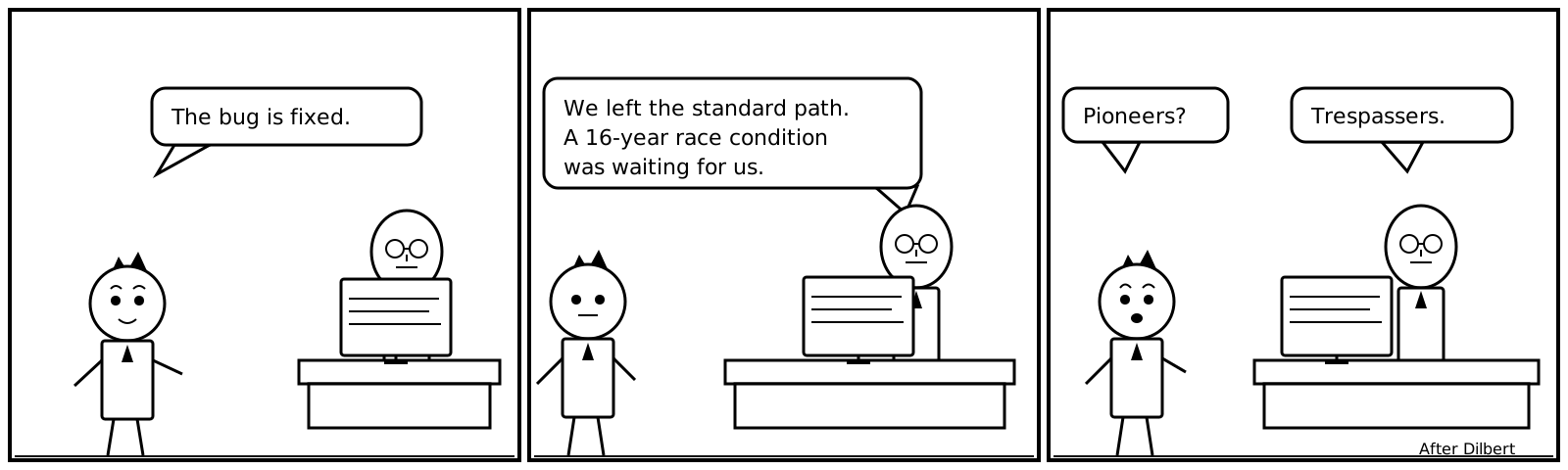
Trespassers / Dead End

*After Dilbert — on the SQLite postmortem's parting lesson: "running boring technology in a non-standard way is a risk." A boss announces the fix; the engineer provides the precise classification. After Calvin and Hobbes — on the Fields Medal laureate's essay about what AI still can't do: prune a mathematical search tree with "nose." The tiger has a theory.*

Hand-drawn parody comic strip

↑ Back to top

ALSO NOTED

Also Noted

↑ Back to top

THE QUESTION

Reliability Is on Loan From the Crowd

What protected the standard SQLite checkpointing configuration from a sixteen-year-old race condition wasn't better code — it was collective coverage. As THE LAB reports today, Tailscale's postmortem traced nineteen corruption incidents to a data race in SQLite's WAL-Reset path that had been sitting dormant for at least sixteen years.1 It never fired on the standard configuration not because the standard path was immune but because every SQLite user running the default had, unknowingly, been contributing test coverage. Tailscale's deviation was small, documented, and legal. The exposure was real. Their postmortem put it precisely: "The common paths and standard configurations are incredibly well-tested and reliable."1 That is not a claim about code quality. It is a claim about borrowed trust — the reliability is on loan from the crowd, and the loan ends when you leave it.


The sprint field's absence from this year's Vuelta makes the same point from the opposite direction. As THE PELOTON reports today, Merlier, Philipsen, Kooij, Milan, Girmay, Groenewegen, and Wærenskjold are all heading to Belgium and the Renewi Tour instead — a collective opt-out from a route designed with 58,156 metres of climbing, a record among this year's three Grand Tours.2 The sprinters did not wait to discover the configuration was unviable. Their community has been running the parameter space long enough to recognize a non-viable route on sight. Their absence is itself the test result. They're not discovering the hard way what Tailscale discovered after six months of forensics; they're reading accumulated collective wisdom and acting on it in advance.

That gap — between the crowd that has already run the test and the practitioner who discovers the answer late — is where the harder question sits. When a major AI model enters circulation with no announcement page, no changelog, no formal benchmark release — just a WeChat message, a Reddit post the moderators deleted, and an ASCII-art table in a Hacker News comment thread, as Simon Willison documented with DeepSeek V4 Pro this week — who is doing the collective stress-testing?3 The crowd that would normally converge on a shared configuration doesn't know it has a job to do. Usage scatters across isolated pockets. Each practitioner who notices something unusual has no obvious place to report it. The bugs will surface eventually. They'll just find fewer witnesses on the way.

The sprinters read the route card and went to Belgium. The question for today is whether, in domains moving faster than collective wisdom can accumulate, we still have a route card to read.

Sources
  1. How Tailscale Tracked Down the 16-Year-Old SQLite WAL-Reset Bug tailscale.com Aug 12, 2026
  2. Where Are All the Vuelta a España Sprinters? They're All in Belgium Instead cyclingnews.com Aug 13, 2026
  3. DeepSeek V4 Pro 0813 (on OpenRouter) — Simon Willison simonwillison.net Aug 12, 2026

↑ Back to top

Investigator Report

Investigator report — 2026/08/13

Verdict

A strong edition that reads well front-to-back: THE LAB's SQLite postmortem is dense and sourced cleanly, THE PELOTON handles a busy pre-Vuelta news cycle with the right structural logic, and THE LONG READ is the best piece in the paper. The main failures are operational (no lead image, no OpenAI credits), editorial (THE QUESTION's lede breaks its own rules), and pipeline (the researcher under-fetched ALSO NOTED candidates, losing six items the reader would want). The run was efficient and recovered gracefully from the OpenAI credit failure.

Frontpage

The deployed PNG looks clean: clear visual hierarchy, readable type, no clipping. THE LAB's headline dominates the top-left at the correct scale, THE PELOTON runs right, THE WORLD sits below it as headline-only. THE LONG READ runs in row 1 with a strong 44px headline. The bottom row balances ALSO NOTED bullets against THE QUESTION.

One prominent absence: there is no lead image anywhere on the page. The meta.json specifies a Berlin Wall lead image in landscape aspect (FROM THE ARCHIVE), and the section-archive.md carries image: true, but no image file was generated — OpenAI credits were exhausted before the illustrator ran. The right column of row 1 is all text. For a page with a historically significant archive entry, this is a visible gap.

The tier system correctly places THE PELOTON/THE LAB/THE WORLD in the top row per section_tiers. On this particular day, the highest-priority piece in the paper (THE LONG READ, priority 87) sits in row 1 below a database bug story (THE LAB, priority 80). The art director followed the rules correctly, but editors should be aware the tier lock can visually demote the day's strongest piece.

Priority ranking

SectionPriorityLengthImageNotes
THE LONG READ87~650 wordsHighest priority, row 1 per tier rules
THE LAB80~750 wordsLeads front page (tier 0)
THE QUESTION77~400 wordsCross-domain bridge; lede fails form test
THE PELOTON73~900 wordsDense pre-Vuelta day, well sourced
THE WORLD66~1,000 wordsON THE TRAIL inflates body count
FROM THE ARCHIVE42~350 wordsintendedImage planned, not produced
ALSO NOTED10~350 wordsFive bullets; six more lost to fetch gap
THE FUNNIES8caption onlySVG produced; OpenAI render failed

The spread from 10 to 87 gives the art director real range — no priority compression. The FROM THE ARCHIVE cap at 45 is correctly respected (42). The only debatable call is THE QUESTION at 77 over THE PELOTON at 73: the question is well-constructed, but it draws so heavily from THE LAB's story that a reader who just read that section may not feel the question adds much. A 71–73 range would be more defensible for a piece that bridges two sections without adding new reporting.

Editorial reading

THE QUESTION's lede breaks its own rules. The section prompt specifies a strict FORM TEST: the opening sentence must be STRUCTURAL-QUESTION, not DECLARATIVE-EVENT. The article opens: "What protected the standard SQLite checkpointing configuration from a sixteen-year-old race condition wasn't better code — it was collective coverage." That is a declarative statement of finding. The structural question ("who is doing the collective stress-testing?") doesn't arrive until paragraph 3, by which point the writer has recapped THE LAB's story for the second time in the paper. The article eventually lands on an interesting cross-domain bridge between the SQLite/cycling/DeepSeek threads, and the final paragraph's formulation — "whether, in domains moving faster than collective wisdom can accumulate, we still have a route card to read" — is the question this piece should have opened with. The lede preflight that the prompt requires would have caught this.

ON THE TRAIL Pick 2 is missing required metrics. The rules mandate "Per-day mileage AND elevation gain to/from camp" with estimates when the source doesn't supply them. Pick 1 (Kendall Katwalk / Ridge Lake) at least gives an inferred 12.5 km per day, while noting that per-day elevation is missing from the source — acceptable partial compliance. Pick 2 (Independence and North Lakes, 2-night) gives neither mileage nor elevation gain for any day; the only sizing reference is "comparable to Mt. Si." The reader planning a 2-night backpack needs numbers to size the days against fitness and pack weight. A brief note like "≈ 7 mi in / 2,200 ft gain (estimate, from WTA hike page)" would comply.

The SPD shooting item adds noise, not signal. In the local block of THE WORLD: "Three people were arrested Thursday for allegedly firing on Seattle police officers." This is the complete reporting. No location, no context, no injury status, nothing to hang the reader's attention on. The source (KIRO7) was not fetched, so the writer had only a headline. Either fetch enough to report a fact worth reporting, or drop the item. A sentence with no qualifying detail is worse than silence.

THE ARCHIVE is well-written but leaves the scene too soon. The piece earns its emotional weight in the third paragraph ("The city felt like one city. It stopped feeling that way before breakfast on a Sunday."), but it then pivots immediately to checkpoint geography and the October tank confrontation. The entire piece draws from a single 2009 history.com explainer. A first-person account, a detail from East German radio transcripts, or the specific neighborhoods where wire first went down would differentiate it from a good Wikipedia summary. The archive section's stated goal is to feel like "a genuine find" — the writing quality is there, the source depth is not.

THE LONG READ earns its priority. No findings here worth surfacing. The Gowers piece is the right choice (fresh, authoritative, untrendy), the article does not over-summarize or editorialize past its standing, and the "nose" frame is the correct spine for the article. The single-source setup (Gowers' blog post) is appropriate given the piece is inherently a commentary on that post. The section does what it should.

Pipeline observations

OpenAI credits exhausted — no lead image, no funnies raster. The fetch_lead_image.py call returned HTTP 429 (credit_balance_exhausted) when the illustrator tried to render the Berlin Wall prompt. The orchestrator logged "OpenAI credits exhausted — pipeline continues without lead image (per dispatch.md)" and correctly skipped to the art director. A second failure hit render_funnies.py for the same reason; the SVG comic from the comic-strip agent is functional, but the OpenAI-rendered funnies variant was also blocked. The error is logged in funnies-openai.error.txt. No data loss; the paper shipped. But the lead image absence is visible to the reader. The credits need a top-up.

Researcher under-fetched ALSO NOTED — six items lost. The research brief lists ten items for ALSO NOTED, of which only three were added to the fetch manifest (pages/noted/). The remaining seven were marked "[NEW — not fetched]." The sweep writer dropped them all as "source unverifiable" because it had no pages to read. Several of these are legitimate misses for this reader:

The "source unverifiable" drop reason is a symptom of missing fetches, not an actual credibility judgment. The sources are all verifiable; the pages just weren't fetched. The researcher should increase the ALSO NOTED fetch allocation, or the sweep writer should be allowed to include items from clearly reputable domains (signal.org, linebender.org, cbsnews.com) even when the page wasn't pre-fetched.

Tim Sweeney fresh YouTube content noted but not fetched. The researcher flagged "Unreal Fest Chicago 2026 fresh remarks at https://www.youtube.com/watch?v=t2ek_FJDjtQ (Aug 2026) available directly" as an alternative to the stale PCGamer article. The PCGamer article (Jun 24, 50 days stale) was correctly dropped by THE LAB writer. But the fresh YouTube content was never added to the fetch manifest. Tim Sweeney is a named key person in newspaper.yaml. A fresh on-stage Unreal Fest interview in August should not be left unfetched when it's explicitly identified in the brief.

Fetch results: one failure, recovered. fetch_results.json shows one blocked URL (the Cyclingnews Movistar/Bloomberg story), which triggered a fallback to cyclinguptodate.com (the original Jun 12 thread story). The writer correctly dropped the stale fallback rather than forcing it into the Peloton article. Clean recovery.

Agent set complete. All expected agents ran: scout, researcher, five section writers, one sweep writer, one meta-writer, one comic-strip agent, six fact-checkers (one per non-empty section), one thread-editor, one art-director. No missing or duplicate agents. The illustrator step ran as an orchestrator bash call (not a subagent), failed cleanly, and was properly skipped. Starting commit (7954136, Investigator 2026-08-12, same-day) is current — no staleness concern.

Trace highlights

THE WORLD writer cost $0.95 at 990 seconds — three times any other regular writer. The next most expensive section writer (THE LAB) was $0.49. The premium traces directly to ON THE TRAIL: parsing per-region NWS forecasts, reading the WTA trip-report listing, applying the six backpacker criteria across multiple candidates, and generating the regional snapshot requires sustained multi-source reasoning. The output quality justifies the cost. This is expected behavior, not waste.

THE LONG READ produced the highest-priority article in the edition at $0.07 in 94 seconds. Researcher and fact-checker (FC: THE LONG READ, $0.17) together spent more than twice what the writer did. A well-structured source article and a clear assignment made this possible. The $0.17 fact-check is appropriately light for a single-source analytical piece.

Thread-editor ran for 1072 seconds at $0.78 — more expensive than the researcher's subagent per-second rate. A thread update that costs nearly as much as the PELOTON fact-check ($0.27) suggests the thread-editor is processing a lot of context (full research brief, all section outputs). If the thread-editor's context can be trimmed to only the section content and the prior threads.json, there is likely $0.30–0.40 of savings available per run.

Orchestrator cost $2.91 — 25% of total. The orchestrator's 6M cache-read tokens reflect how much context is being passed back up from subagents. This is within normal range for an 8-section run, but it's worth noting that as the section count and thread list grow, orchestrator cost could become the dominant line item. The 112K cache-1h reads suggest the orchestrator is benefiting from hot-start caching on its own prompt.

Trace summary

Dispatch 2026-08-13 (model: claude-sonnet-4-6)

AgentDurInputOutputCache ReadCache 5mCache 1hCost
Scout310s7483286021765480$ 0.32
Researcher1078s15581839828608281377690$ 1.66
THE WORLD990s1039956142455780$ 0.95
THE PELOTON404s922197693694070$ 0.29
THE LAB326s815331135635585590$ 0.49
THE LONG READ94s62144549160280$ 0.07
FROM THE ARCHIVE111s62456771199590$ 0.09
FC: THE LONG READ179s72695585381000$ 0.17
FC: FROM THE ARCHIVE182s83617116097257680$ 0.19
Meta-Writer76s62147311235580$ 0.10
FC: THE LAB420s8496128149564380$ 0.26
FC: THE PELOTON491s1054215169535200$ 0.27
FC: THE WORLD499s8554748297234592110$ 0.38
THE QUESTION344s73871311775340$ 0.31
FC: THE QUESTION132s61868166306510$ 0.14
ALSO NOTED266s1052199893643340$ 0.30
Draw today's TWO parody comic strips for532s931101234766819110$ 0.84
FC: ALSO NOTED239s838137263380230$ 0.18
Art Director1240s113871055089830560$ 0.91
Update story threads for today's edition1072s82457982075900$ 0.78
Orchestrator1452744460736620112112$ 2.91
TOTAL3442140453111226041463542112112$11.61

Suggestions for next edition

Top up the OpenAI credits before the next run. The Berlin Wall image prompt was excellent; the edition shipped without it. The funnies raster also failed. $20–50 in credits prevents both failures.

The researcher should allocate 5–7 fetch slots to ALSO NOTED candidates, not 3. The "not fetched" label in the research brief should be reserved for items the researcher genuinely can't reach, not items it simply chose not to prioritize. fearless_simd, Signal key verification, and the JPEG rendering piece all deserved pages.

Require THE QUESTION to pass the form test before writing. The prompt already contains the LEDE PREFLIGHT instruction. On this edition it was not followed — the opening sentence is declarative-event. The fact-checker does not catch structural lede failures. Consider adding the form-test check to the fact-checker's prompt for THE QUESTION specifically.

ON THE TRAIL's per-day metrics rule should be enforced harder. Two of two picks lacked required elevation data. When the WTA source doesn't supply elevation, the WTA hike page for that trail (linked in most reports) usually does. The writer should be prompted to consult the hike page directly when the trip report is missing the number, before falling back to "not given in source."