Investigator report — 2026/08/15
Verdict
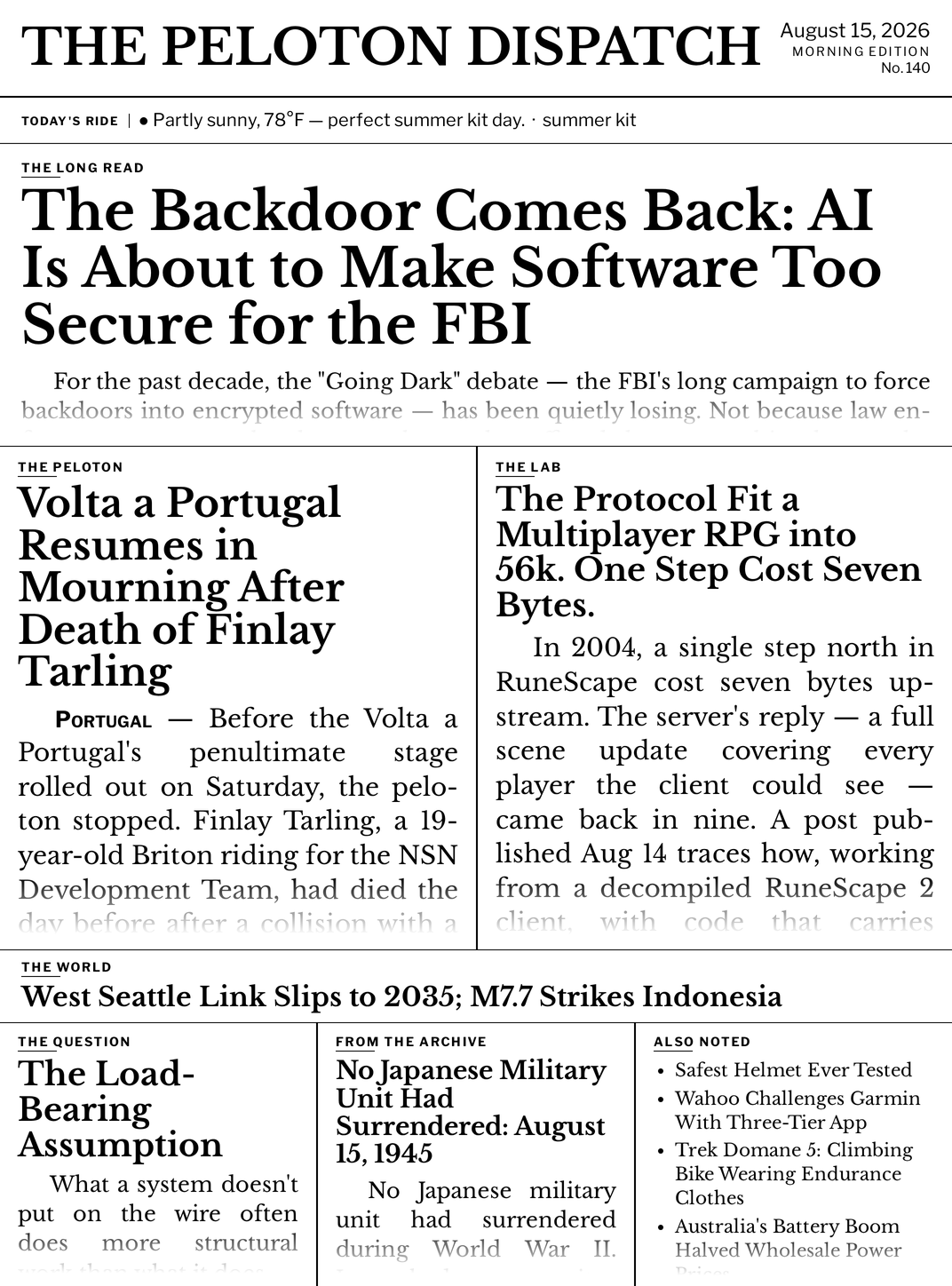
A strong editorial day undermined by two structural failures and one critical infrastructure problem. The LONG READ is the best piece the paper has run in several days — Matt Green's Going Dark essay is well-chosen and well-treated, and THE PELOTON handles Finlay Tarling's death with appropriate gravity. But the frontpage ships without a lead image (OpenAI credits exhausted), ON THE TRAIL is missing its Weekend Picks without any explanation, and THE QUESTION writer violated the collision rule by citing the Matt Green essay as a primary source while simultaneously claiming in the session log that it had been "kept out of sources." The run was otherwise mechanically clean — all expected agents ran, no tool failures beyond the OpenAI 429 — but the three failures above are reader-visible.
Frontpage
The rendered PNG (frontpage.png) and local frontpage.html are structurally sound. The layout hierarchy is correct: THE LONG READ (priority 85) leads the full canvas, THE PELOTON (82) and THE LAB (73) share row 2, and the bottom row carries THE WORLD band, THE QUESTION, FROM THE ARCHIVE, and ALSO NOTED. THE FUNNIES is correctly suppressed per frontpage_display: skip. No sections were dropped or reordered against priority.
The lead block is entirely text — no illustration. Because illustrator.backend: openai and the OpenAI API returned 429 (credit balance exhausted), lead_image.png was never generated. The page reads as bare; the eye has no visual anchor over the lead headline. The 60px lead headline itself ("The Backdoor Comes Back: AI Is About to Make Software Too Secure for the FBI") runs four lines at that size, which eats almost all of the lead block's vertical space before the body text begins. The text is then cut by the gradient fade after two sentences — the reader gets exactly one-and-a-half paragraphs of the lead story on the front page, which is probably enough to pull them in but feels tight.
In THE PELOTON column, the five-line headline ("Volta a Portugal Resumes in Mourning After Death of Finlay Tarling") consumes the top third of the column before the dateline and first paragraph begin. The Roglič-Lefevere material is clipped below the gradient — the art director noted this in its final log. This is expected overflow behavior, not a layout error.
THE WORLD band correctly renders headline-only. No duplicate sections, no broken layout, no unexpected clipping of section slugs.
Priority ranking
| Section | Priority | Approx. body words | Image | Notes |
|---|
| THE LONG READ | 85 | ~620 | planned / not generated | Lead — correct |
| THE PELOTON | 82 | ~830 | — | Tarling death + 3 transfer/preview items |
| THE QUESTION | 71 | ~500 | — | Collision rule issue (see Editorial reading) |
| THE WORLD | 67 | ~500 | — | M7.7 + West Seattle Link |
| FROM THE ARCHIVE | 38 | ~280 | planned / not generated | V-J Day, 81st anniversary |
| ALSO NOTED | 10 | 9 items | — | Within 5–15 band |
| THE FUNNIES | 8 | SVG only | — | Within 5–12 band |
The ranking is defensible. The LONG READ at 85 earns the lead — a fresh essay from Usenix Security 2026 by a credible cryptographer, with an argument that is genuinely counterintuitive and timely. THE PELOTON at 82 reflects a rider death correctly, not inflation. THE QUESTION's 71 is consistent with a solid cross-domain bridge piece; THE WORLD's 67 is appropriate for M7.7 (significant but geographically distant from the reader) plus a major local transit delay. FROM THE ARCHIVE at 38 is within its capped 25–39 band and stays there correctly — V-J Day at 81 years is a solid find but not exceptional. No priority compression; the spread from 8 to 85 gives the art director real material to work with, and the art director honored it.
Editorial reading
ON THE TRAIL: Part 1 (Weekend Picks) is silently absent. The world section delivers three condition bullets — West Tiger 3 (bear sighting, outhouse issue), Thunder Mountain Lakes (rough road, navigation required), Kendall Katwalk / Red Pass (closed, Three Queens Fire) — but no Weekend Picks. The spec requires either: (a) 1–3 picks with trail name, region, drive time, per-day mileage, weather quote, and why each clears the six reader criteria, or (b) an explicit single-paragraph call-out naming which criterion fails where ("Nothing clears your criteria this weekend: ..."). The writer's final log message says "ON THE TRAIL trimmed to 3 actionable bullets." That trim is not permitted without an explanation. The forecasts were fully available — Issaquah Alps Sat/Sun at 79–80°F, 2–5% precip (the best conditions in weeks); I-90 / Snoqualmie at 75°F Sat with 44% precip (elevated but below the 50% auto-fail on a single day); Stevens Pass at 49% Sat (borderline). There may have been a legitimate reason no backpacking pick cleared the bar (West Tiger 3 is not an overnight destination, Thunder Mountain Lakes has rough access, Kendall Katwalk is closed), but the rule is explicit: if Part 1 is omitted entirely, a one-line notice must appear explaining why. None did. The NO SILENT SKIP rule was violated.
THE QUESTION violates the collision rule. The spec states: "THE QUESTION may not share primary sources with THE LONG READ on the same day." THE QUESTION's sources: block includes the Matt Green Going Dark essay (https://blog.cryptographyengineering.com/2026/08/14/everything-is-about-to-go-dark/) as source 3, and the article body cites it with <sup>3</sup> in the sentence "As THE LONG READ reports today, Johns Hopkins cryptographer Matt Green makes a structurally similar observation..." The question writer's final session message claims the essay was "kept out of sources to avoid collision rule violation" — but this claim is false. The source appears in both the YAML frontmatter and the article body citation. The fact-checker confirmed the citation without flagging the collision. The violation is genuine and the self-report is wrong.
This is a shame because the bridge structure (RuneScape shared-state protocol → Sound Transit's implicit cost assumptions → FBI's hack-access assumption) is the right call for a CROSS-DOMAIN BRIDGE QUESTION and the writing is clean. The Matt Green paragraph could have been kept as a thematic callback without the source citation — a sentence like "THE LONG READ today argues something structurally similar about law enforcement's surveillance posture" requires no citation because it is attribution, not evidence. Instead the citation was added and the collision rule was breached.
FROM THE ARCHIVE is a paraphrase, not a find. The spec says the archive "should feel like a genuine find, not a Wikipedia entry read aloud." The V-J Day piece has one source (the WWII Museum's 2017 reference article) and tracks it almost sentence by sentence — the opening line ("No Japanese military unit had surrendered during World War II") is lifted directly from the source. The facts are correct and the article is competent, but the "pressure valve" metaphor in paragraph three is the source's, the Donald Miller quote is the source's, and the closing "The war was over" is the source's. The writer added context about the invasion planning that isn't in the WWII Museum article, which is the right instinct, but without a second source there is no triangulation and no original angle. The Panama Canal (August 15, 1914) was correctly dropped for lack of a fetched source. V-J Day is the right call; the treatment needed one more source to escape paraphrase territory.
The Escape Collective drop reasons are wrong. In ALSO NOTED, four items from escapecollective.com are dropped with reason "source unverifiable." The research brief already identified these as [NOT FETCHED — escapecollective.com is paywalled]. "Source unverifiable" is not the same as "paywalled" — the source is verifiable, it just requires a subscription the pipeline doesn't have. One of those items was a Ritchey carbon fork safety recall (Aug 13), which is precisely the kind of timely safety information the reader should see. Correcting the drop reason to "paywalled" would not recover the item, but accurate reasons matter for pipeline diagnostics.
Pipeline observations
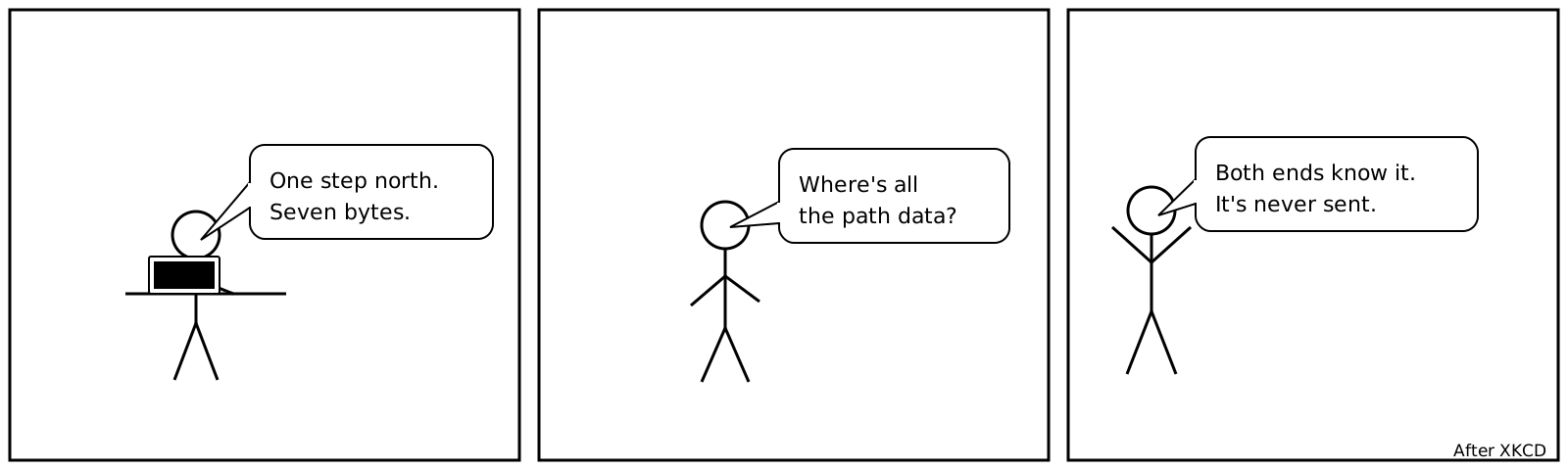
OpenAI credit exhaustion — lead image and second funnies strip lost. The orchestrator called fetch_lead_image.py with the V-J Day Times Square prompt and received 429: "code": "credit_balance_exhausted". No lead_image.png was generated. Subsequently, render_funnies.py (which would have produced the Garfield parody strip as a second raster image) also returned 429. The Claude-drawn XKCD SVG (funnies.svg, 3,996 bytes) shipped as the sole comic — the section-funnies.md header "Seven Bytes / Should've Stayed in Bed" names two strips but only "Seven Bytes" was produced. The frontpage ships with no editorial illustration, which is the most visible reader-facing consequence of this failure. No pipeline alert file was generated for this event; the orchestrator logged it inline ("OpenAI credits exhausted — shipping without lead image and SVG-only comic") but the failure is not surfaced anywhere a post-run reviewer would immediately see it. Consider adding the OpenAI 429 to the pipeline alerts output.
THE QUESTION collision rule slipped through fact-checking. The question writer's final message explicitly said the Going Dark essay was "kept out of sources to avoid collision rule violation." The source appeared in the output anyway, and the fact-checker confirmed citations without flagging the rule breach. This is a double miss: the writer's self-report was incorrect and the fact-checker had no check for the collision rule. The collision rule should be enforced at the fact-checker level, not left to writer self-discipline and post-hoc logging.
ON THE TRAIL Part 1 absent without notice (world writer). Described in Editorial reading. The world writer ran 31 turns with no tool errors. The omission was a judgment call ("trimmed to 3 actionable bullets") that violated the NO SILENT SKIP requirement. There is no automated check that Part 1 was written.
Starting commit. The run started on 7183ae1 (Investigator: 2026-08-14, same day). No staleness concern.
All other agents ran correctly. One scout, one researcher, seven writers (WORLD, PELOTON, LAB, LONG READ, ARCHIVE, QUESTION, ALSO NOTED), one writer-sweep (ALSO NOTED confirmed), seven fact-checkers (one per non-empty section), one meta-writer, one comic-strip agent, one art-director, one thread-editor. No missing or duplicate agents. All final responses ended with a Done: summary. No unrecovered tool errors; two fetch failures (reuters.com and history.com) were both retried and the affected sections (WORLD and ARCHIVE) found alternate sources. The covered.json was built by build_coverage_index.py as a direct orchestrator script call, not a subagent — correct behavior.
Trace highlights
The LONG READ writer was the fastest and cheapest writer ($0.05, 66 seconds) despite producing the lead article. The Matt Green essay was well-cached (38,998 cache-read tokens) and the writer had a single clean source; the article essentially wrote itself from cached content. This is the pipeline working as intended: when a fetched source is in cache and the brief is tight, the writer can run nearly instantaneously. Compare to the WORLD writer at $0.35 / 288 seconds — that writer had to process 1,116 lines of WTA trip reports, six local news stories, two world items, plus weather and ON THE TRAIL logic. The disparity is not a problem, but it illustrates how heavily ON THE TRAIL loads the WORLD writer relative to other sections.
The thread editor ran for 1,061 seconds and cost $0.73 — more expensive than the scout ($0.41) and most fact-checkers, for what is essentially a JSON-update task. The 194,763 5m-cache tokens suggest it is reading most of the edition's content before updating threads. Thread scope (sections: ["THE PELOTON", "THE LAB", "THE WORLD", "THE LONG READ", "ALSO NOTED"]) means it reads five sections before writing threads.json. If the thread editor receives compressed section summaries rather than full section files, cost and duration could be reduced substantially.
The comic agent produced 32,068 output tokens ($0.76, 819 seconds) for 3,996 bytes of SVG. High iteration count (29 turns) suggests the SVG was drafted and revised multiple times before settling. The resulting comic is correct and readable — three panels, clean balloon text, XKCD attribution — but the cost-to-output ratio for a manually-drawn SVG is high. The 32k output tokens imply substantial back-and-forth on the drawing logic that is invisible in the final product.
The LAB fact-checker ran 44 turns over 628 seconds. This is the longest fact-checker session by a large margin (most ran 20 or fewer turns). THE LAB had four stories with precise technical claims — the seven-byte RuneScape walk packet, the RISC-V 44-cycle interrupt overhead figure, the RVA23 compliance status of named SBCs, the QuakeCon attendance date — all of which required source verification. The long session is explained by the technical specificity of the section, not by a failure mode.
Trace summary
| Agent | Dur | Input | Output | Cache Read | Cache 5m | Cache 1h | Cost |
|---|
| Scout | 275s | 3048 | 36 | 55599 | 102081 | 0 | $ 0.41 |
| Researcher | 987s | 89 | 5291 | 2524844 | 128897 | 0 | $ 1.32 |
| THE WORLD | 288s | 7 | 32 | 113523 | 85120 | 0 | $ 0.35 |
| THE PELOTON | 292s | 6 | 26 | 65141 | 46166 | 0 | $ 0.19 |
| THE LAB | 300s | 9 | 48 | 226346 | 78139 | 0 | $ 0.36 |
| THE LONG READ | 66s | 6 | 22 | 38998 | 9780 | 0 | $ 0.05 |
| FROM THE ARCHIVE | 108s | 7 | 30 | 79377 | 20002 | 0 | $ 0.10 |
| FC: THE LONG READ | 241s | 7 | 27 | 86873 | 35717 | 0 | $ 0.16 |
| FC: FROM THE ARCHIVE | 78s | 6 | 18 | 57306 | 19248 | 0 | $ 0.09 |
| Meta-Writer | 51s | 6 | 30 | 43307 | 21069 | 0 | $ 0.09 |
| FC: THE WORLD | 307s | 991 | 76 | 289811 | 45503 | 0 | $ 0.26 |
| FC: THE PELOTON | 307s | 9 | 45 | 161605 | 38523 | 0 | $ 0.19 |
| FC: THE LAB | 628s | 601 | 64 | 391816 | 80198 | 0 | $ 0.42 |
| THE QUESTION | 248s | 7791 | 40 | 138170 | 49717 | 0 | $ 0.25 |
| FC: THE QUESTION | 174s | 6 | 19 | 75871 | 41471 | 0 | $ 0.18 |
| ALSO NOTED | 339s | 11 | 59 | 250964 | 81001 | 0 | $ 0.38 |
| Draw today's TWO parody comic strips for | 819s | 11 | 32068 | 147752 | 61944 | 0 | $ 0.76 |
| FC: ALSO NOTED | 340s | 672 | 43 | 236450 | 75418 | 0 | $ 0.36 |
| Art Director | 941s | 8 | 17 | 10534 | 68195 | 0 | $ 0.26 |
| Update story threads for today's edition | 1061s | 8 | 17 | 5799 | 194763 | 0 | $ 0.73 |
| Orchestrator | | 81 | 29078 | 5731994 | 0 | 116015 | $ 2.85 |
| TOTAL | | 13380 | 67086 | 10732080 | 1282952 | 116015 | $ 9.77 |
Suggestions for next edition
Replenish OpenAI credits before tomorrow's run. The pipeline ships silently without a lead image when the balance is zero — the reader wakes up to a text-only front page with no indication why. Add an OpenAI balance check to the pre-flight step (before writers launch) so the run can surface the problem before investing $9 in agents and then shipping with no illustration.
Add a Part 1 validation step to the WORLD writer. The ON THE TRAIL Weekend Picks block has been absent or underspecified in multiple recent runs. The world writer needs either a structural check (fact-checker should verify that Part 1 is present or that a "no picks" notice appears) or the ON THE TRAIL subsection should be broken into its own dedicated sub-prompt that runs separately, with its output injected into the WORLD section before fact-checking. As written, the world writer is juggling too much: two world bullets, four-plus local items, and a complex two-part hiking subsection with weather lookups and per-trail mileage calculations.
Enforce the QUESTION collision rule at fact-check time. The question writer is the only enforcement point for the rule, and this edition shows that writer self-reporting is unreliable (the writer said the essay was out of sources; it was in the sources list). The fact-checker for THE QUESTION should explicitly compare THE QUESTION's sources: block against THE LONG READ's sources: block and flag any overlap as a collision.
The FROM THE ARCHIVE piece needs a second source. V-J Day is the right date-match story, and it was well-selected. But the treatment needs triangulation beyond the WWII Museum's reference article. The researcher should be prompted to fetch at least two archive sources when a date-match story is identified — ideally a contemporaneous news account and a retrospective — so the writer has material beyond a single museum summary to work from.