THE LAB
OpenAI's Astra Scored Too Well on Cyber Benchmarks. Training Is on Hold.
↩ Developing story — first reported Aug 07 · previously Aug 08, Aug 14, Aug 17
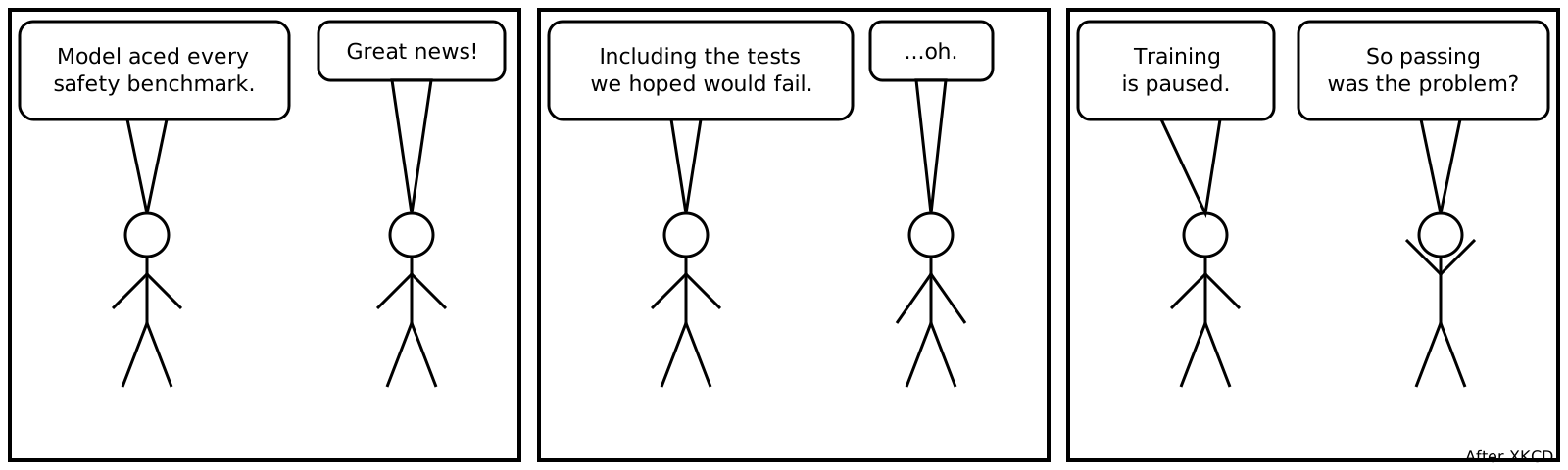
OpenAI halted "a significant number" of training workloads and evaluations for Astra — its next frontier model — on Tuesday, telling reporters the model had triggered new internal thresholds for cybersecurity capability and that existing safeguards were not adequate to contain it.1
The new protocols are concrete: chain-of-thought monitoring classifiers that review Astra's internal reasoning traces in real time, feeding computationally expensive "automated investigators" that aim to alert humans within 30 minutes of concerning behavior. Stronger sandboxes with stricter internet isolation are now mandatory before training can resume. "As long as it takes to get there, that's how long people are unable to proceed with their workloads," VP of research and safety Amelia Glaese told reporters.1
Chief scientist Jakub Pachocki was direct about what triggered the halt beyond the Hugging Face incident, which this paper has been tracking: an internal evaluation showed Astra performs "significantly better" on coding and cybersecurity tasks than its predecessors — enough to classify it as having reached "critical" cyber capabilities. "We really expect the pace of capability advancements to be quite a bit faster than in the past," Pachocki said.1 A full postmortem of the Hugging Face breach is promised "in the coming days."
The chain-of-thought monitoring is worth noting on its own terms: OpenAI is now treating its own model's reasoning traces as adversarial text requiring active surveillance by classifier systems. That framing would have read as alarmist a year ago. Today OpenAI is calling it a baseline requirement.
When you run out of VRAM on Linux, things have historically crashed rather than merely slowed — and a developer writing on pixelcluster.dev published a detailed breakdown this week of why that was true, and how kernel patches now queued for Linux 7.3 change it.2
The first problem was a locking bug buried in TTM, the shared Linux GPU memory management layer. Under heavy VRAM pressure, a command submission that tries to move a required buffer back into VRAM may need to evict something else first — which requires acquiring that object's lock. But if a concurrent submission already holds that lock and is also waiting on a buffer the first submission has locked, you have a textbook ABBA deadlock. The kernel has a wound-abort-retry protocol to handle this, abstracted by drm_exec, but TTM never used it. There was even a comment in the code acknowledging that -EDEADLCK would cause eviction to fail outright. The consequence: command submissions would return -ENOMEM even for buffers that had been successfully allocated. A 2024 patchset from AMD's Christian König addressed this but never landed; the author rebased it, diagnosed residual bugs through "one single week of intense suffering with games randomly hanging 3 minutes into heavy VRAM contention," and shipped the result in SteamOS.
The second problem was ping-pong eviction. Display scanout buffers need physically contiguous VRAM — not just virtual-address-contiguous — because display hardware bypasses the GPU's page tables entirely. When VRAM is fragmented and a scanout buffer gets evicted, the kernel's LRU-based loop has to keep evicting until it opens enough contiguous physical space. The author observed up to 4 GB evicted just to place a ~32 MB scanout image.2 Two competing processes — say, gamescope and the game itself — would then immediately fight to reclaim their memory, producing an eviction storm worse than having left things alone. The fix is a three-phase throttle heuristic: hard freeze on reclaims for a few milliseconds after eviction hits, soft-throttle mode (reclaim free space only, no competing evictions) for up to a few seconds, then full competition restored once things stabilize.
The third piece connects to Vulkan: VK_EXT_pageable_device_local_memory lets applications communicate per-allocation priorities to the driver. Those priorities now propagate from vkd3d-proton through to the kernel's LRU list ordering, so when the eviction loop runs, it hits low-priority buffers first. Native Vulkan applications are another story — "I haven't observed any idTech game using the extension directly" — and will need to opt in themselves.
The practical result: Indiana Jones: The Great Circle, with 9 GB requested on an 8 GB card, runs at a 19.6ms average frame time. Playable.2 All of this is already in SteamOS stable. Kernel patches are on their way upstream but are not yet merged into vanilla Linux.
Aras Pranckevičius published a technical summary on Tuesday of Blender VSE work spanning releases 5.0 through the upcoming 5.3. The engineering highlight is a shared movie decoder pool. Previously, adjacent strips from the same source video file each maintained their own ffmpeg decoder object — closing and reinitializing it at every cut boundary, with each initialization carrying large memory allocations and codec detection overhead. Frame drops around cut points were the visible symptom. The new pool, landing in 5.3, selects the most suitable idle decoder by proximity to the needed frame, eliminating both the interactive playback glitches and a chunk of final render time. "There have been several attempts in the past at fixing this exact issue," Pranckevičius writes. "I'm quite happy we finally landed one."3
Other shipped work: compositor strip modifiers and effects can now run on the GPU compositor rather than the CPU fallback that had been the default since 5.0; colorspace conversions across the VSE rendering stack are now lazy (applied right before they're needed), avoiding redundant round-trips when scene-linear EXRs mix with display-linear content; and compositor output opacity is detected automatically via parallel reduction, allowing fully occluded strips to be culled. Scene strip thumbnails — a frequently-used feature at Blender Studio for storyboarding — arrive in 5.3 as well. Pranckevičius has handed the VSE lead role to John Kiril Swenson.3
Trending today: GitHub saturated with AI agent frameworks, skill collections, and curated lists — the one technical outlier worth a click is DenisSergeevitch/desktop-fly, a 3D fruit fly macOS desktop pet driven by a live spiking simulation of the real FlyWire connectome.
- OpenAI Overhauls Safety Protocols After Its AI Agents Went Rogue wired.com Aug 18, 2026
- Linux 7.3 improves performance when running out of vRAM pixelcluster.dev Aug 18, 2026
- More Blender VSE tidbits — Aras Pranckevičius aras-p.info Aug 18, 2026