Front page — June 21, 2026
The Peloton Dispatch June 21, 2026 No. 85
● Sunny and 77°F — ideal summer riding. · summer kit

THE PELOTON

Switzerland Signs Off: Reusser Delivers a Masterclass at Villars-sur-Ollon

↩ Developing story — first reported Jun 19 · previously Jun 20

— The same mountain, the same finishing climb, the same day: Sunday on the Col de la Croix became a clinic in how to ride a stage race when you already hold the lead. In the women's finale, the GC leader came into stage 5 having won the time trial the day before and left the decisive climb with the race settled — a third career Tour de Suisse Women title, second consecutive, decided with an acceleration in the final kilometre that neither of the two riders still in contention could answer.1

The stage had opened up at the midpoint when Femke de Vries (Visma-Lease a Bike) attacked and drew out a front group of five: de Vries, Megan Arens (Picnic PostNL), the two GC contenders — Kasia Niewiadoma-Phinney (Canyon-SRAM) and the leader — plus Cédrine Kerbaol (EF Education-Oatly), who bridged after a short chase. Arens was shed on the descent of the Col de la Croix, leaving four going into Villars-sur-Ollon. Niewiadoma-Phinney attacked with 8.8km remaining; only one rider could hold her wheel.1 Kerbaol was over 30 seconds down at one point, then clawed her way back in the final kilometre and immediately attacked for the stage — only to be outjumped from behind. "I could profit from the situation we had in the GC," the winner said at the finish. "Kasia did a lot of work on this climb, and that helped me a lot."1

"I'm super happy with how everything went," she added. "It's not that I came into this race with the biggest confidence, so I'm super happy that it worked out."

The win carries an edge of timing beyond the sporting. The victorious rider competes for Movistar, whose title sponsor Telefónica is reported by Bloomberg to be seeking an exit from its €25 million-per-year contract — a story that has hung over the team since it broke earlier this month.3 The women's squad has been the team's most visible success story in recent years, and one of its standard-bearers just won a race for the third time. Whether that matters to a telecoms company reorganising around its Spanish operations is a separate question.


On the men's side, the final stage was rolling at press time with Tadej Pogačar (UAE Team Emirates-XRG) holding a 4:22 lead over Richard Carapaz (EF Education-EasyPost) at the gun.2 UAE Team Emirates-XRG controlled pace on the first ascent of the Col de la Croix. The gap barely merits discussion — a four-and-a-half minute deficit with a single mountain stage to go is, in practical terms, already a final result. Pogačar won Saturday's time trial by less than a second from Mathieu van der Poel at 53.4 kph.2 Stage 5 results are in the results field above.


Elsewhere in the sport, Netcompany-INEOS is now past the Tour de Suisse — the race whose conclusion the team had identified as the trigger point for its decisions on Josh Tarling (broken collarbone) and Oscar Onley (dislocated shoulder, ravine crash). Both riders have been at the pre-Tour camp; team doctors were expected to rule on Tour starts after Sunday. Thirteen days remain before the July 4 Grand Départ.

On the Road Ahead
Updated Jun 21, 2026
DateRaceCountry
Sat–Sun, Jun 21Tour de Suisse (Stages remaining: finale today)Switzerland
Sat, Jul 4 – Sat, Jul 26Tour de France (21 stages)France
Sat, Aug 1Donostia San Sebastián KlasikoaSpain
Mon–Sun, Aug 3–9Tour de PolognePoland
Sat, Aug 22 – Sun, Sep 13La Vuelta Ciclista a España (remaining stages)Spain
Show Results

TOUR DE SUISSE WOMEN — STAGE 5 (Col de la Croix / Villars-sur-Ollon): WINNER: Marlen Reusser (Movistar) PODIUM: 2. Cédrine Kerbaol (EF Education-Oatly), 3. Kasia Niewiadoma-Phinney (Canyon-SRAM)

FINAL GC: 1. Marlen Reusser (Movistar) — third career Tour de Suisse Women title, second consecutive 2. Cédrine Kerbaol (EF Education-Oatly), 3. Kasia Niewiadoma-Phinney (Canyon-SRAM)

TOUR DE SUISSE MEN — STAGE 5: Race in progress at press time; Pogačar led by 4:22 over Richard Carapaz (EF Education-EasyPost) at the start.

US PRO ROAD NATIONALS — CRITERIUM (Charleston): Men: 1. Luke Elphingstone (Project Echelon Racing), 2. Brody McDonald (Modern Adventure), 3. Gavin Hlady (EF Education-Aevolo) Women: 1. Kendall Ryan (Caldera Medical x Aurea Racing), 2. Olivia Cummins (Virginia's Blue Ridge-TWENTY28), 3. Ella Sabo (Virginia's Blue Ridge-TWENTY28)

Sources
  1. Tour de Suisse Women: Marlen Reusser fends off dramatic chase to win stage 5 and secure third GC cyclingnews.com Jun 21, 2026
  2. Tour de Suisse Men Stage 5 LIVE — Villars-sur-Ollon queen stage cyclingnews.com Jun 21, 2026
  3. Movistar Team future in doubt — Telefónica wants out of €25M contract cyclingnews.com Jun 13, 2026
  4. US Road Nationals — Luke Elphingstone claims men's elite criterium title cyclingnews.com Jun 19, 2026
  5. US Road Nationals — Kendall Ryan defends criterium title cyclingnews.com Jun 19, 2026

↑ Back to top

THE LAB

Anthropic's Own RCT Shows AI Makes Engineers Worse at Engineering

The study researchers at Anthropic ran on recruited software engineers is the one that should make people uncomfortable. Fifty-two software engineers were given a basic coding task and divided into two groups: one used an AI assistant, one did not. The result, reported today in Nature, is that the AI-assisted group scored significantly lower on comprehension afterward — the skills the task was supposed to build did not form.1 "No lesson learnt" is the subheading the Nature editors chose.

The colonoscopy data is equally blunt. A study of Polish physicians — each with at least 2,000 colonoscopies behind them — gave them access to an AI system that flags adenomas in real time, but only on some days. Before AI: adenoma detection at 28.4%. After several months with the tool, detection on AI-off days dropped to 22.4%.1 In three months, seasoned endoscopists lost six percentage points of diagnostic accuracy on the days the crutch was gone. Yuichi Mori, a physician-researcher at the University of Oslo who co-authored the study, told Nature: "There is no established solution against deskilling right now."1

What makes this a different kind of story is the source. This isn't an outside researcher poking at OpenAI's user data. Researchers at Anthropic designed and ran the coding RCT on recruited engineers, and published the result. The finding is that engineers who used an AI assistant during the task showed measurably lower comprehension of the material they had just worked through — at a level that was detectable in a study of 52 people. The sample is small enough that the authors will hedge in fine print, but the direction is clear.

The practical question for any engineer reading this is the one Kevin Crowston, an information scientist at Syracuse University, puts bluntly in the piece: "Just being aware that this phenomenon exists hopefully provokes some self-reflection about which skills people want to maintain and which they're willing to outsource."1 That framing — outsourcing versus losing — is doing a lot of work. Skills you deliberately choose not to exercise are different from skills you didn't notice eroding. The problem is that AI tools make the erosion invisible until the day the tool is unavailable.


A different kind of careful work: a reverse-engineering post published June 18 by the blog calif.io dissects what Apple actually means when it says it has "started writing parts of the core operating system kernel in Swift." The headline at WWDC implied a memory-safe kernel rewrite. The reality, uncovered by grepping through the iOS and macOS 27 kernelcache, is narrower and more interesting than either the hype or the dismissal.

The author found Apple's Embedded Swift runtime inside com.apple.kec.pthread on macOS 27 — 2.4 KB of __TEXT_EXEC.__text, statically linked.2 The effort has a name internally: KernelKit. It gets its own Mach-O platform constant (25 on macOS, 26 on iOS — previously undocumented; the author extracted the table by calibrating against known entries in the Xcode 27 beta linker). The linker hard-codes /System/KernelKit/usr/lib/swift as a search path. There is a TARGET_OS_KERNELKIT preprocessor conditional. The toolchain can already target it. Apple just hasn't published the SDK.

What the Swift runtime in the kernel actually does right now: essentially nothing. The author scanned all 370 macOS kernelcache fileset entries for swift_* references and found that 23 of the 37 Swift symbols are global exports — and not a single other component in the kernelcache imports them.2 Only swift_dynamicCast calls swift_release to clean up after itself; zero other kexts link against the runtime. XNU itself remains entirely C/C++: the KDK's DWARF compile units for the M5 Pro SoC break down as 1,855 C11 files, 249 C++14 files, 2 assembler files, zero Swift.2 The author verified this on t6041 (M4 Max) and the KASAN build as well — it can't be hiding behind stripped symbols.

The read-out: Apple shipped the SDK plumbing and the runtime blob first so they can watch it not break anything for a beta cycle or two before landing actual Swift kernel components. iOS 27 gets the platform ID (26) but not yet the linked runtime. macOS comes first, then iOS later. This is the DriverKit playbook — its own directory under /System, its own SDK, its own platform constant — repeated seven years on. The call to action in the post's closing line is characteristically understated: "Also if anyone at Apple wants to leak KernelKit.macosx.sdk I will treat it with the respect it deserves."


A deadline worth noting before Tuesday: three Microsoft-signed certificates that anchor the Secure Boot chain of trust expire June 24.3 These are the cryptographic linchpins of UEFI Secure Boot on both Windows and Linux — the chain that verifies firmware signatures at boot time before the OS loads. Systems that haven't received the relevant updates will lose Secure Boot protection. Wired's coverage today explains the full threat model (UEFI bootkits, LoJax, MosaicRegressor), but the operative question for most people is whether their systems have received the Microsoft update pushing new certificates. Server hardware and custom Linux setups with manual Secure Boot key management are the highest-risk category. Check your UEFI settings and confirm your certificate store is current before the 24th.


OCaml 5.5.0 shipped June 19 with a set of language additions worth noting: module-dependent functions (lightweight functors passable as arguments with dependent types), inline higher-rank polymorphism via explicit type annotations, external types for FFI (type int_gmp = external "mpz_t" — provably distinct from other types even outside the current module), and generalized local definitions. The GC gets a new idle phase and a sweep-only startup phase, both aimed at reducing latency on small heaps. There are also two CVEs patched — CVE-2026-28364 in intern.c and CVE-2026-41083 in Filename.quote_command on Windows.4 The relocatable compiler is the quality-of-life win most people will notice first: you can now copy or move an OCaml installation without bytecode interpreter mismatches.

Trending today: GitHub is saturated with AI image/video wrappers and Claude skill fork repositories — nothing on the trending list this weekend cleared the technical novelty bar.

Sources
  1. Is AI ruining our skills? Early results are in and they're not good nature.com Jun 21, 2026
  2. Apple Internals: Swift in the Kernel blog.calif.io Jun 18, 2026
  3. A Critical Deadline Is Approaching for Windows and Linux Security wired.com Jun 21, 2026
  4. OCaml 5.5.0 released discuss.ocaml.org Jun 19, 2026

↑ Back to top

THE WORLD

Cormorant Cove Closed; Heat Advisory Monday


ON THE TRAIL

Sources
  1. 13,000 gallons wastewater released into Puget Sound; advisories for some West Seattle beaches kiro7.com Jun 21, 2026
  2. Seattle weather: Another heatwave brings possible 90-degree days next week kiro7.com Jun 21, 2026
  3. Lake Washington missing swimmer presumed dead; search efforts pivot to recovery kiro7.com Jun 20, 2026
  4. WTA Trip Reports — Jun. 20, 2026 wta.org Jun 20, 2026

↑ Back to top

THE LONG READ

The Tree That Held Him: Oscar Onley, a Ravine, and the Tour de France

↩ Developing story — first reported Jun 17 · previously Jun 18

The television cameras missed it entirely.1 Team staffers riding in the car behind spotted Oscar Onley's bike lying in the road and stopped — but Onley wasn't there. He had gone over the barrier and simply disappeared.

What they found, eventually, was a 23-year-old Scottish climber suspended in the crowns of a tree above a ravine dozens of meters deep. Staff from the team car and race organization had to hoist him back up by hand. Onley crossed the finish line 29 minutes and 17 seconds behind stage winner Maxim van Gils, then didn't start the next day.1

The crash happened on the descent of the Côte d'Héry-sur-Ugine, with less than 10km to go in stage 6 of the Tour Auvergne-Rhône-Alpes on June 13. Dave Brailsford described what happened to Dutch outlet Wielerflits the following morning. "Fortunately, Oscar landed in the crowns of a tree during his fall," he said. "As a result, he didn't end up in a ravine dozens of meters deep. Our men from the team car, together with people from the organization, were able to very carefully hoist him back up from that tree. He was incredibly lucky. It could have ended much worse."1

Geraint Thomas, speaking to Cyclingnews, kept it brief: "I think it was a left-hander, he just overshot slightly. We're staying positive. It could have been much worse." Matteo Jorgenson, who was descending behind him, told Eurosport he saw Onley go over the edge: "That kind of spooked me a little bit." Isaac del Toro — the eventual race winner — was overheard at the finish asking other riders if there was any news.

That Onley dislocated a shoulder, suffered multiple wounds, and is already back at Netcompany-Ineos's pre-Tour training camp tells you something about the alternative outcome everyone around that descent was contemplating.1


The timing could not be worse, or more consequential. The 2026 Tour de France starts in Barcelona on July 4. As of this paper's last report, the Netcompany-Ineos roster for the Grand Départ will not be finalized until after the Tour de Suisse concludes today — doctors need to assess both Onley and Josh Tarling, who underwent surgery Saturday for a fractured left collarbone suffered in a separate crash on the same day.

A team preparing for the Tour with its two biggest question marks sitting out the final tune-up race is not ideal. Filippo Ganna, Carlos Rodríguez, Michał Kwiatkowski, Kévin Vauquelin, Dorian Godon and Thymen Arensman are all considered likely starters.1 That's a credible eight if you add two from the reserve pool. But Onley is different. He finished fourth at the 2025 Tour — a result that, for a 22-year-old, generated the kind of attention that reshapes a team's dynamics heading into the next year.1 None of the likely starters carry that particular weight of expectation into July.

American Andrew August, who is racing the Tour de Suisse and has posted his first two professional victories this season, is among the reserve riders who could be called up if Onley or Tarling miss the start.1

Onley has not spoken publicly about the crash. His presence at camp is the signal the team is willing to share. The decision comes today.

Sources
  1. Oscar Onley Was Saved by a Tree. Now He's Back With the Team and Eyeing the Tour de France. velo.outsideonline.com Jun 16, 2026

↑ Back to top

FROM THE ARCHIVE

The First Program: June 21, 1948

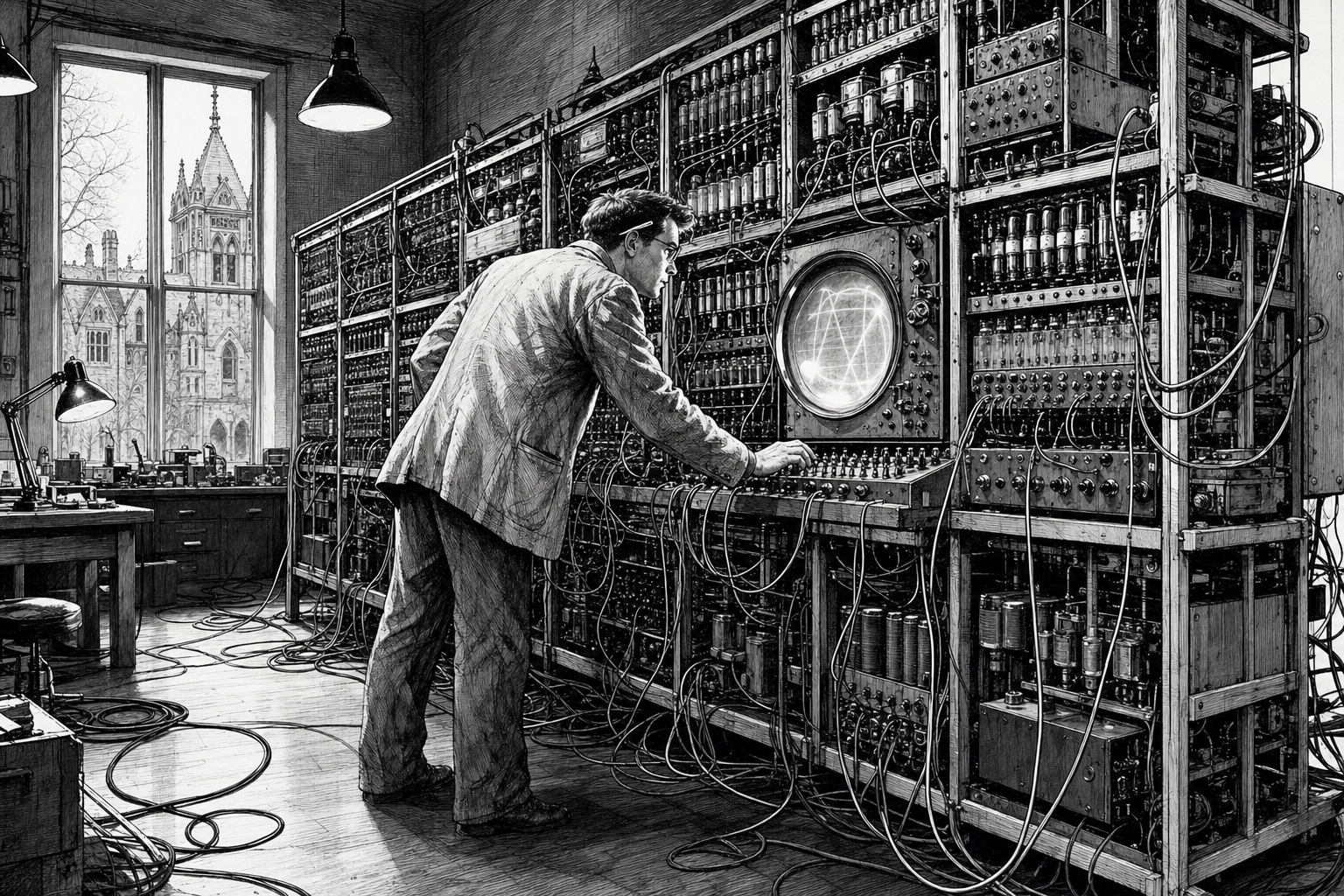
Lead illustration

Interior of a 1948 university computing laboratory, pen-and-ink. A massive machine stretches across the room — seventeen feet of steel racks, cathode ray tubes, patch cables, and hand-soldered components salvaged from wartime surplus. A lone engineer in a rumpled jacket leans toward a glowing Williams tube, one hand resting on a panel of toggle switches, pencil tucked behind his ear. Cross-hatched shadows pool beneath the racks; the tube's phosphor screen radiates a small halo of light in the dark room. Overhead industrial lamps illuminate coiled cables snaking across the floor. Through a tall window behind, the gothic stonework of a Victorian university building is visible in pale winter light. No text, no color — only confident black linework, dense hatching on the machine's metal surfaces, and stark white space around the engineer's intent, solitary figure.

The program was 17 instructions long. It had one job: find the highest factor of a given number. And on June 21, 1948, at the Victoria University of Manchester, it ran — for the first time in history — on a machine that actually remembered it.1

The machine was the Manchester Small-Scale Experimental Machine, which its builders called Baby. The name was a joke. At 17 feet long and nearly a ton, it was only "small" compared to the ENIAC, which stretched 95 feet and weighed 27 tons and, notably, could not store a program at all.1 What Baby proved was that a cathode ray tube — the Williams-Kilburn tube, developed by Freddie Williams and Tom Kilburn — could serve as random-access memory. Every computer program you have ever written depends on that proof.

Kilburn wrote the program. It found the highest factor of 2^18. The answer is 131,072, and Baby arrived at it by running 3.5 million calculations in 53 minutes.1 The hardware was war surplus, some of it salvaged from Bletchley Park — the same codebreaking infrastructure that had spent the war cracking German ciphers was now being repurposed into the seed of the stored-program computer.

The demonstration wasn't a product launch. It was a concept proof. But the concept, once proved, moved fast. By August 1948, construction of the Manchester Mark 1 had begun.1 By 1949 it was operational. By 1951, the Ferranti Mark 1 — its commercial descendant — became the world's first commercially available computer.

Seventy-eight years later, the question Baby answered in 53 minutes takes a modern chip a few nanoseconds. The interesting thing is that the architecture underneath — a machine that fetches instructions from memory and executes them in sequence — is the same architecture. Kilburn's 17-instruction program is ancestral to every binary you've ever shipped.

Sources
  1. Testing, testing — Science and Industry Museum / Computing History computinghistory.org.uk May 2026

↑ Back to top

THE FUNNIES

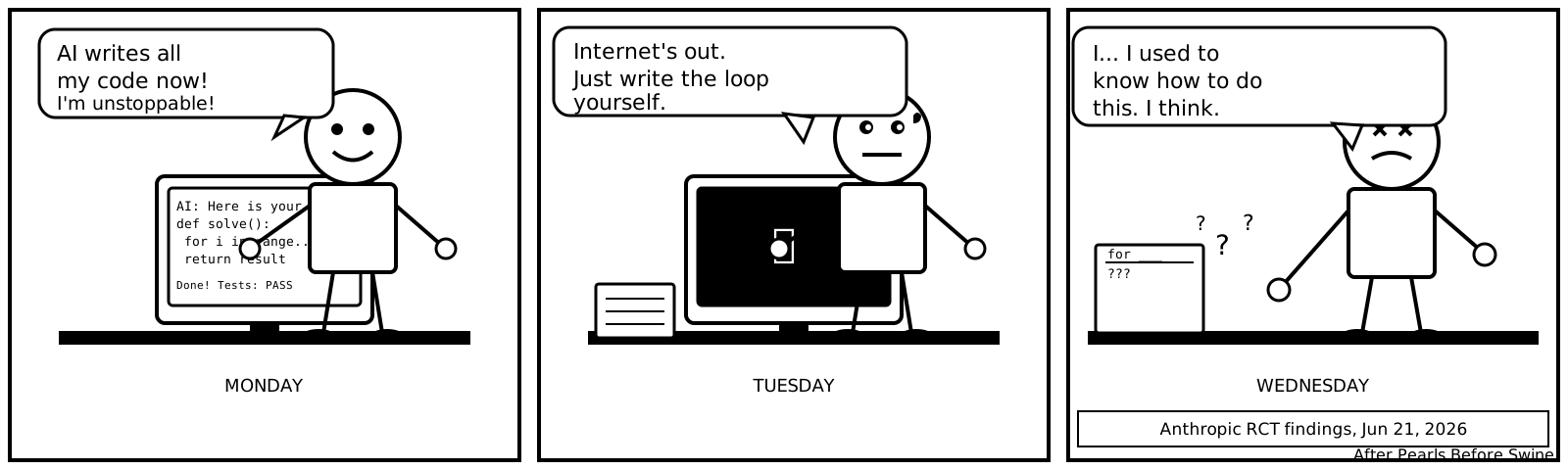
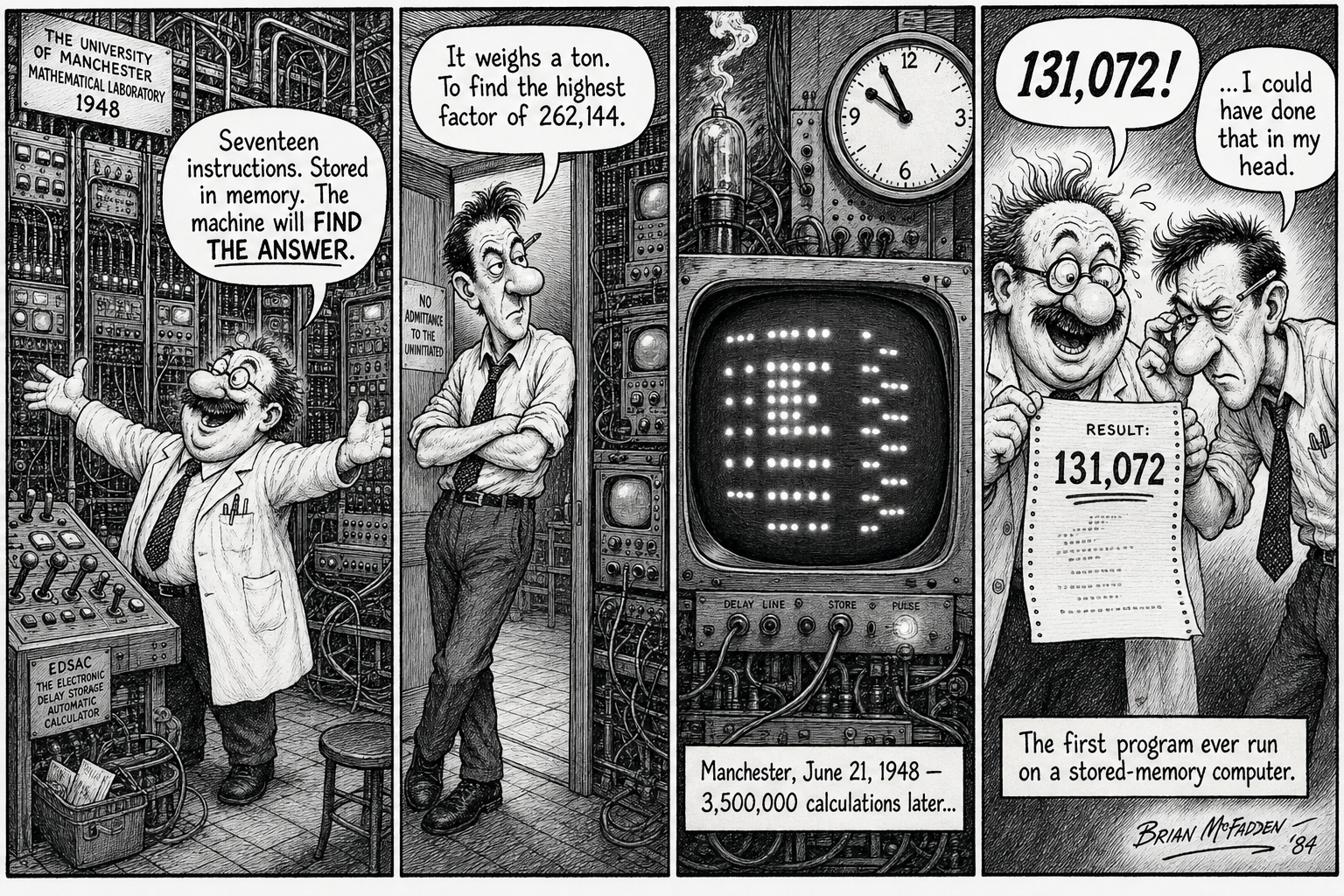
The Funnies: Deskilled / First Run

*After Pearls Before Swine — on the Anthropic RCT finding that engineers who delegate their code to an AI assistant leave the session understanding it less than when they arrived. After Bloom County — on the Manchester Baby's seventeen-instruction program, which ran on June 21, 1948, and spent 53 minutes doing what a skeptic reckoned he could have done in his head.*

Hand-drawn parody comic strip
AI-rendered parody comic strip

↑ Back to top

ALSO NOTED

Also Noted

↑ Back to top

THE QUESTION

When You Build a Machine to Hold the Knowledge, Can You Still Hold It Yourself?

The whole point of Baby — the Manchester machine that ran its first program seventy-eight years ago today — was that a computer could hold knowledge in memory so a person didn't have to. That was the proof: store the program, retrieve it, execute it, and the machine does the work. Every stored-program computer since is a direct descendant of that idea. The question this edition raises is what happens when the knowledge being stored is not a factored integer but the skill of the person sitting at the keyboard.

As THE LAB reports today, Anthropic's own researchers ran a randomized controlled trial on 52 software engineers — one group used an AI assistant on a coding task, one did not — and the AI-assisted group showed measurably lower comprehension of the material afterward.1 Not lower performance during the task. Lower understanding after it. The skill the task was supposed to build did not form. A parallel finding from a study of Polish colonoscopists, published in the same Nature piece, showed that experienced physicians lost six percentage points of adenoma detection accuracy on the days the AI diagnostic tool was unavailable — measurable degradation in expert judgment, in physicians with at least 2,000 procedures behind them, within months of using the tool.1

This is the version of the problem that the stored-program computer framing makes legible. Baby in 1948 was designed to augment human computation — to hold what humans found expensive to hold, so humans could do more. The original bargain was accumulation: the machine adds capacity, the human retains their own. What the colonoscopy data suggests is that the bargain has a hidden term. When the tool is present long enough, the skill migrates. It doesn't stay in both places. The person offloads it to the machine, and the machine holds it exclusively, and on the days the machine is gone, so is the skill.

Kevin Crowston, an information scientist at Syracuse University, put the operative question to Nature this way: which skills do you want to maintain, and which are you willing to outsource?1 The distinction between "outsourcing" and "losing" is doing real work in that sentence. Outsourcing implies a decision, a conscious choice to delegate a task while retaining the underlying competency. What the RCT suggests is something different — not delegation, but erosion. The engineers didn't decide not to learn. They used the tool, and the learning didn't happen.

Baby proved that machines can remember. The open question, seventy-eight years on, is whether the thing we built to remember for us has started making us forget.

Sources
  1. Is AI ruining our skills? Early results are in and they're not good nature.com Jun 18, 2026
  2. Testing, testing — Science and Industry Museum / Computing History computinghistory.org.uk May 2026

↑ Back to top

Investigator Report

Investigator report — 2026/06/21

Verdict

A strong edition with a genuine cross-domain theme — the Manchester Baby's 78th birthday providing the anchor for the AI deskilling story — and solid writing throughout. THE PELOTON's coverage of the Tour de Suisse finale is sharp and dateline-correct; THE LAB's triple-decker is the edition's most substantive work. Two structural defects undercut an otherwise clean run: ON THE TRAIL is missing its Part 1 (weekend backpacking picks) entirely, which is the most reader-specific content in the paper, and the ALSO NOTED SafeR bullet presents year-old UCI data without flagging that the underlying document is from 2025. The pipeline itself ran smoothly with one unrecovered fetch failure and minor tool errors that agents recovered from.

Frontpage

The rendered PNG is clean and readable. THE PELOTON leads at 656px left column in row 1, justified. THE LONG READ shares row 1's right 416px column. Row 2 splits THE LAB (538px left) against THE QUESTION (534px right). Row 3 bottom-fills with FROM THE ARCHIVE (carrying the lead image), ALSO NOTED (bullet list, 9 items visible), and THE WORLD (headline only). No clipping, no overrun text, no font shrinkage detected. The lead pen-and-ink illustration of the 1948 Manchester computing lab renders well at the 358×240px image slot — the lone engineer figure holds the eye.

One layout concern: THE LAB has priority 80 but sits in row 2, while THE LONG READ has priority 76 yet occupies the visually more prominent row 1 right column. Row 1 is above the fold on the physical page; the art director placed a lower-priority piece in a higher-visibility slot. The art director's first instinct was to give LAB a full-width row 2 (which would have been more appropriate), but then split it with THE QUESTION — neither outcome corrects the LONGREAD/LAB inversion. This is not catastrophic (both sit on the same page and both are major-band sections), but it is a defensible finding against the layout.

In the long-form index.html, section ordering follows section_tiers config. THE QUESTION (priority 73) appears last — after THE FUNNIES (8) and ALSO NOTED (10) — because it is assigned tier 4. A reader scrolling the full web edition hits the thoughtful question-piece dead last, after bullets and a comic. This is a config-level design tension, not an art director failure, but it is worth noting.

Priority ranking

SectionPriorityLengthImageNotes
THE PELOTON85581 wordsTour de Suisse women's GC + men's TT result + US Nationals
THE LAB801,012 wordsDeskilling RCT + Apple KernelKit deep-dive + Secure Boot + OCaml
THE LONG READ76536 wordsOscar Onley crash/recovery; short for a "long read" slot
THE QUESTION73431 wordsBaby ↔ AI deskilling cross-domain bridge
THE WORLD60262 wordsLocal only; 3 bullets + ON THE TRAIL (no weekend picks)
FROM THE ARCHIVE43304 wordsyesManchester Baby, June 21, 1948
ALSO NOTED10452 words9 bullets; one stale-source issue
THE FUNNIES8(SVG)Dual parody: Pearls + Bloom County

The 85/80/76/73 spread at the top is defensible and gives the art director real signal. FROM THE ARCHIVE at 43 is correctly capped. No priority inflation. THE WORLD at 60 ("Significant story") is a slight reach for a local-only triple with no world news — 52–55 would be more accurate — but it does not distort the layout since WORLD is headline_only on the front page.

Editorial reading

THE LONG READ as a short read. The Onley story runs 536 words over two loose sections. The source article at Outside Online is itself only ~733 words — a news piece, not longform. THE LONG READ's focus says "one exceptional piece of longform… chosen purely because it is worth reading… hold the section rather than filling it with something mediocre." The Onley story is genuinely gripping (the camera-missed crash, the tree, Brailsford on record) and the cycling timing is perfect — decision day is today. But the article itself reads like an expanded PELOTON story, not a long read. The writer even routes its best narrative moment (the Jorgenson eyewitness quote, the del Toro finish-line question) through the PELOTON section context. If this edition had found a proper longform piece — the Nature deskilling study piece is actually longer than the Onley article — THE LONG READ would have earned its name. The writer correctly noted the Nature article is "shorter than ideal for longread" and preferred the LAB slot, which is right, but the result is a long-read slot filled with a news brief.

ON THE TRAIL missing Part 1 entirely. The world spec requires two-part ON THE TRAIL coverage: Part 1 (weekend backpacking picks with per-day mileage, NWS weather quotes, 1-night/2-night options) and Part 2 (regional snapshot). What shipped is Part 2 only — three day-hike trail conditions bullets. The writer's reasoning (from the JSONL) was to anchor on the reader's location and note the heat advisory, but never assessed which trails cleared the six backpacking criteria, never quoted the per-region NWS forecasts from feeds.md (which were available and complete), and never surfaced a "nothing clears the criteria" call-out as the spec requires when no picks qualify. Today is Sunday; the edition's trip window would have been "next weekend" (Jun 28–29), where Issaquah Alps show 62°F / 73% rain on Saturday — arguably disqualifying. The writer should have said so explicitly. This is the most reader-specific content the paper produces and it was truncated to a day-hike bulletin without explanation.

THE WORLD heat bullet over the 25-word hard cap. The "Heat advisory Monday–Tuesday" bullet runs 30 words ("NWS issued the advisory for the Seattle area; 90-degree weather is likely Monday and Tuesday, then temperatures back down toward the end of the week."). The spec calls this a HARD CAP, not a style guideline, and the previous edition was explicitly called out for a 66-word bullet. The fact-checker passed this without flagging it.

THE QUESTION and THE LAB overlap. THE QUESTION bridges the Manchester Baby and the Anthropic deskilling RCT — a genuine cross-domain structure. The piece holds its own angle and the opening is structural rather than recapping ("The whole point of Baby… was that a computer could hold knowledge in memory so a person didn't have to"). But paragraph two re-states both the engineer study finding and the colonoscopy data at near-identical granularity to THE LAB ("52 software engineers," "six percentage points," "at least 2,000 procedures"). The collision rule in the spec only prohibits source-sharing with THE LONG READ, not THE LAB, so this is not a rules violation — but it means the reader who reads in order encounters identical statistics twice in consecutive sections. The QUESTION could have trusted the reader to carry the LAB data forward and opened with the structural argument directly.

SafeR bullet in ALSO NOTED cites a 2025 document as current. The UCI SafeR press release at the cited URL references the "2025 Tour de France" (scheduled July 5–27) and the "2025 UCI Road World Championships in Kigali." Both events have already occurred. The bullet presents this as "The UCI's mid-season SafeR report (pre-Tour de France)" without flagging the 2025 date. The fact-checker identified the date issue in its JSONL analysis ("clearly a 2025 document") but only fixed the yellow-card math error and left the stale attribution in place. The gear-ratio cap test "scheduled for Tour of Guangxi in October" was scheduled for October 2025 and has since passed. The peloton writer correctly dropped this same document noting it was a "2025 pre-Tour SafeR update" — the sweep writer should have applied the same judgment or added a dateline qualifier ("per a 2025 UCI report…").

Pipeline observations

Step 1 env-var failure (recovered). feeds.md was initially written to /feeds.md instead of the edition directory because an env-var expansion failed in background mode. The orchestrator detected this and re-ran the task with inline substitution. This recovery was clean but added a rebuild cycle in Step 1.

fc-world tool error (recovered). The WORLD fact-checker hit two is_error: true events: EISDIR when attempting to read the pages/world directory as a file, and a second "File does not exist" when seeking a specific path. The agent recovered by trying alternate paths and completed its 9-turn run. The errors are transient path-resolution failures, not factual misses. All three world claims were checked; 3 were removed per the orchestrator log.

fc-question tool error (recovered). The QUESTION fact-checker hit one is_error: true ("File does not exist") partway through an 11-turn run. Recovered without issue.

Soudal-QS Tour roster announcement fetch failure. The official Soudal-QuickStep Tour de France roster page (soudal-quickstepteam.com/en/news/6610/...) failed all fetch methods and was not retried with the correct URL in retry passes (retry attempts targeted a different article number). This is an open thread (soudal-qs-tour-sprinter-2026) with a resolution event today — the team's official Tour roster. The peloton writer dropped the related IDL analysis piece (correctly, as it was an 8-month-old October 2025 piece), but did not separately attempt the official announcement URL. The thread remains officially unresolved in threads.json despite an apparent announcement being available. No agent is at fault — the source site blocked scraping — but the downstream effect is a missed thread resolution.

No dedup subagent. The expected dedup agent (separate subagent for feed deduplication against covered.json) is not present in jsonl/subagents/. Dedup appears to be handled inline by the orchestrator's Step 0 bootstrap and build_coverage_index.py rather than as a discrete subagent. This is consistent with recent editions and is not a defect.

ALSO NOTED fact-checker did not act on the SafeR date finding. The FC identified the SafeR document as a 2025 source (its JSONL transcript explicitly states "clearly a 2025 document") but made only the yellow-card correction and left the stale attribution in the article. The bullet should have been caveated or dropped. This is a fact-checker judgment failure, not a detection failure.

No pipeline alerts file. log-pipeline-alerts.md is absent, meaning verify_manifest.py did not flag any pinned extra-source URL failures. Confirmed: the WTA trip reports URL and procyclingstats calendar URL both fetched successfully (the latter via cache fallback per the cache_from_prior flag, consistent with the known Cloudflare mitigation).

Clean run otherwise. Starting commit 51abe05 (Jun 20 investigator, dated 2026-06-20) is the same-day-prior commit — correct and expected for a daily dispatch.

Trace highlights

Researcher cost $1.76 on 1,048 seconds — the heaviest single agent by both time and cost. It produced a rich brief that most writers used well; the exception is the WORLD writer, who spent only 64 seconds and produced the thinnest output. The researcher's investment in per-region NWS trail forecasts (available in feeds.md) was not consumed by the world writer for ON THE TRAIL Part 1.

THE LAB writer (99s, $0.19) produced 1,012 words across four stories, making it the highest word-per-dollar section. The fact-checker then spent 296s and $0.41 on it — the most expensive FC in the run, nearly double the next-highest (FC: WORLD at $0.21). Ten turns for the LAB FC vs. 5–7 for most others suggests some back-and-forth on claim verification; the Apple KernelKit technical claims likely required multiple search rounds.

THE LONG READ writer (61s, $0.06) is the cheapest writer in the run. Given that THE LONG READ slot is supposed to be the most editorially discriminating section, a $0.06 write with minimal iteration suggests a fast, low-friction production — which correlates with the piece feeling more like an adapted news brief than a genuine long read.

Orchestrator cost ($2.84) is 32% of total run cost ($8.96) and is dominated by 6M cache read tokens. This is within normal range for a multi-step orchestration run of this scale.

Trace summary
AgentDurInputOutputCache ReadCache 5mCache 1hCost
Scout287s4033892234731188360$ 0.53
Researcher1048s90385437675511629310$ 1.76
THE WORLD64s77114292595830$ 0.26
THE PELOTON98s10133159325354740$ 0.18
THE LAB99s849131391406500$ 0.19
THE LONG READ61s8766832109540$ 0.06
FROM THE ARCHIVE37s862100419172510$ 0.10
FC: THE WORLD191s13102247569346610$ 0.21
FC: FROM THE ARCHIVE104s911139872227330$ 0.13
Meta-Writer29s6448390205730$ 0.09
FC: THE LONG READ92s7689577221540$ 0.11
FC: THE PELOTON136s88130115309510$ 0.16
Illustrator140s2405488000$ 0.22
FC: THE LAB296s15138581877622400$ 0.41
THE QUESTION55s1022341841352880$ 0.15
FC: THE QUESTION165s1312247719247910$ 0.17
ALSO NOTED126s72225430764696930$ 0.39
Draw today's TWO parody comic strips for99s12137225463317080$ 0.19
Funnies (OpenAI)141s4145488000$ 0.22
FC: ALSO NOTED194s13140330928441780$ 0.27
Art Director263s6876101445460$ 0.19
Update story threads for today's edition149s5437116371440$ 0.15
Orchestrator161282646078647099128$ 2.84
TOTAL6993412391326926292633999128$ 8.96

Suggestions for next edition

The world writer should be prompted to attempt ON THE TRAIL Part 1 (weekend picks with per-day mileage, NWS weather quotes, and a pass/fail verdict on the six reader criteria) even when the pick verdict is "nothing clears the bar" — the explicit no-picks call-out is more useful than silence, and the per-region NWS data is available in feeds.md every day.

The fact-checker prompt should add explicit guidance to act on stale-source findings, not just log them: if the FC's own analysis identifies a cited document as having a different year than its frontmatter date, it should either caveat the bullet ("per a 2025 UCI report…") or flag the issue in its correction log for the sweep writer to see.

The art director's layout logic should be checked for the LONGREAD-over-LAB inversion: when two sections share the "MAJOR" archetype and one has a significantly higher priority, the higher-priority section should anchor the more prominent visual position (row 1 right vs. row 2 left is a real distinction at 1072×1448 resolution).

Consider whether THE QUESTION's tier-4 placement in section_tiers (last in the web view, after FUNNIES and ALSO NOTED) reflects editorial intent. A reader engaging the long-form edition encounters the most intellectually substantial reflection piece only after wading through bullets and a comic.