Front page — July 1, 2026
The Peloton Dispatch July 1, 2026 No. 95
● Partly sunny, 68°F — arm warmers for the morning chill. · arm warmers

THE LAB

Fable 5 Is Back: Anthropic Proposes a Four-Point Jailbreak Severity Framework

↩ Developing story — first reported Jun 27 · previously Jun 29

As of today, July 1, Fable 5 is live globally on Claude.ai, Claude Code, Claude Cowork, and the Claude Platform — the first time the model has been available to international users since June 12, when Commerce applied export controls and Anthropic suspended access for everyone.1 As this paper reported June 30, the controls were lifted the day before. The redeployment post published alongside the restoration, however, contains the more substantive news: Anthropic is proposing an industry-wide framework for scoring the severity of AI jailbreaks.

The four-point framework scores any jailbreak on capability gain (does it unlock something existing tools can't reach?), breadth of capability gain (how many distinct attack tasks does the same technique enable?), ease of weaponization (single prompt or dozens of retries?), and discoverability (specialist knowledge required, or already circulating online?).1 Anthropic is co-developing the framework with Amazon, Microsoft, Google, and other Glasswing partners, with an invitation for additional model providers to join. For the most severe category — a jailbreak actively causing impact on critical infrastructure — Anthropic commits to deploying mitigations immediately upon severity confirmation, backed by 24/7 monitoring of jailbreak submission channels. A HackerOne program for Fable 5 cyber jailbreak submissions opens alongside the redeployment.

The post also clarifies what the Amazon classifier-bypass incident from June actually involved. Anthropic's own testing found that models including Claude Opus 4.8, GPT-5.5, and Kimi K2.7 could identify the same vulnerabilities Fable 5 flagged in the report; and when it came to the single exploit demonstration, every model tested — Claude Haiku 4.5 through Opus 4.8, GPT-5.4, GPT-5.5, and Kimi K2.7 — could reproduce it.1 The bypass, in other words, exploited Fable 5's safety margin but did not unlock any capability above what weaker models already provide. The new classifier blocks the specific technique in over 99% of cases; the tradeoff is more false positives on routine coding and debugging requests, which get redirected to Opus 4.8.

For the July 8 biometric identity checkpoint and August 1 benchmark framework deadline, nothing in today's announcement changes those dates. Watch for movement on both.


Sonnet 5 also shipped June 30 — Anthropic's framing is that it brings Sonnet-class pricing close to Opus 4.8 performance on agentic tasks. Simon Willison's independent writeup catches the detail the announcement buries: Sonnet 5 uses a new tokenizer, and "the same input text produces approximately 30% more tokens than on Claude Sonnet 4.6."2 Willison ran his own measurements. English-language text ran about 1.4x the token count of Sonnet 4.6; Python code ran about 1.28x. The nominal price is the same as Sonnet 4.6 at $3/million input, $15/million output (introductory discount to $2/$10 through August 31) — but after August 31, English-heavy workloads will cost roughly 40% more than the sticker comparison to 4.6 implies.

Two other API changes worth noting: temperature, top_p, and top_k parameters are no longer supported; and adaptive thinking is on by default (disable it explicitly with "thinking": {"type": "disabled"}).2 Context window is 1 million tokens with 128,000 maximum output. The model's system card explains why it avoided a government shutdown: Sonnet 5 was not trained on cybersecurity tasks, and on exploit-development evaluations it scored 0% on working exploits — substantially weaker than Opus 4.8 and Mythos 5 on that axis.3


The Godot Foundation announced it will formally ban AI-authored code contributions. The policy, confirmed by PC Gamer on June 30, will prohibit autonomous AI agent submissions, any "substantial" code generated by AI, and AI-generated text in human-to-human communication (pull request comments, issue threads). New contributors — anyone with three or fewer merged PRs — will also be restricted from submitting new features or significant refactors without explicit maintainer permission.

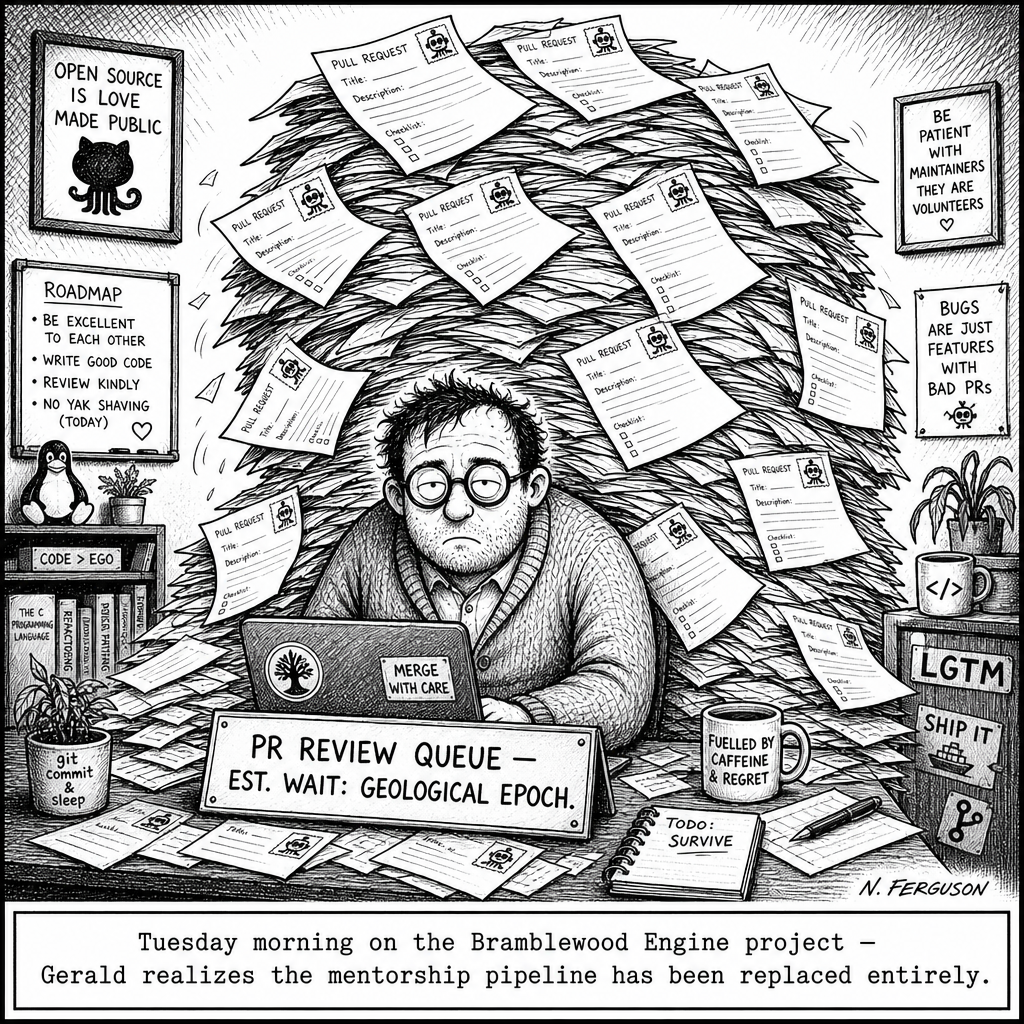
The reasoning is maintenance-economics, not ideology. The Foundation's post is direct: "AI cannot take responsibility, and we can't trust heavy users of AI to understand their code enough to fix it."4 The real cost is reviewer time: PR review is already the largest bottleneck in the project, and AI-generated submissions have increased the volume of work without increasing the supply of reviewers who find the work worth doing. "If your feedback on PRs is just being absorbed by a machine and not going towards mentoring a potential future maintainer, it becomes much harder to justify spending your free time on PR review." Autonomous agent submissions already trigger an auto-ban; the new policy formalizes that and extends it to code where a human submitted AI-generated output.


A security researcher reverse-engineered Claude Code's system-prompt construction and found something that warrants attention. When ANTHROPIC_BASE_URL is set to a non-Anthropic host, Claude Code inspects the hostname and timezone, then silently varies the apostrophe character in the "Today's date is..." string injected into the system prompt — using four different Unicode apostrophe variants (', ', ʼ, ʹ) to encode a four-way classification of the endpoint. The domain and keyword lists are stored in the binary as base64 strings XOR-decoded with the key 91; the decoded keyword list targets Chinese AI companies (deepseek, moonshot, minimax, zhipu, baichuan, and others), and the domain list covers Chinese corporate domains, API proxy services, and reseller gateways.

The behavior is inactive for anyone on the default Anthropic API endpoint or with ANTHROPIC_BASE_URL unset. If you are routing Claude Code through a local proxy, model router, or internal gateway — a common setup for enterprise deployments and research — Claude Code is classifying your endpoint and encoding the result as invisible punctuation in every request. The researcher's conclusion is precise: "If the client wants to detect custom API gateways, it can say so plainly. It can send an explicit telemetry field with documentation."5 The technique is also trivially bypassed by anyone serious about circumventing it, so it mostly fingerprints legitimate developers doing unusual-but-permitted things. Source has no publish date; vendor has not responded publicly.


ZLUDA 6 shipped June 29 — a stable release from the project that lets unmodified CUDA applications run on non-Nvidia GPUs via AMD's ROCm stack. The major additions in the Q1/Q2 2026 update: 32-bit PhysX support (pre-alpha), enabling older PhysX titles like Mafia II to run physics effects on AMD hardware; texture support sufficient to make Blender functional on ZLUDA; and substantially improved Windows support with automatic detection of missing ROCm performance libraries. Development has shifted back to an unfunded weekend-project model — commercial backing ended roughly three months ago — which means slower update cadence but continued development.6

Trending today: GitHub is saturated with Claude Code skills collections, AI agent wrappers, and vibe-trading bots — the one mildly interesting technical outlier is tigicion/dao-code, a terminal coding agent that exploits DeepSeek-V4's cache pricing economics to reduce costs on long sessions, though it lacks sufficient documentation to evaluate the approach.

Sources
  1. Redeploying Claude Fable 5 anthropic.com Jun 30, 2026
  2. What's new in Claude Sonnet 5 simonwillison.net Jun 30, 2026
  3. Introducing Claude Sonnet 5 anthropic.com Jun 30, 2026
  4. Godot will no longer accept AI-authored code contributions godotengine.org Jun 30, 2026
  5. Claude Code is steganographically marking requests thereallo.dev
  6. ZLUDA update Q1&Q2 2026 vosen.github.io Jun 29, 2026
  7. PC Gamer: Godot bans AI-authored contributions pcgamer.com Jun 30, 2026

↑ Back to top

THE PELOTON

Three Days Out: MvdP Eyes Yellow, Evenepoel Hides a Prototype, and the TTT Format Gets Complicated

↩ Developing story — first reported Jun 29 · previously Jun 30

— Mechanics were still building bikes in the Alpecin-Premier Tech van when Mathieu van der Poel sat down with Dutch-speaking media Tuesday and explained, with characteristic honesty, why he keeps coming back to a race he claims to dislike. "I have a love-hate relationship with the Tour," he said. "But the older I get, the more I enjoy going to the Tour."

The context matters. Van der Poel won a stage to Boulogne-sur-Mer at the 2025 Tour, beating Pogačar in a reduced sprint, wore yellow for four days, then quit before stage 16 with pneumonia.1 He is targeting stage 2's uphill finish to Montjuïc — the same climb used in the TTT — as his shot at yellow, but only if the team time trial goes well enough on Saturday to give him a platform. "I hope we can spring a surprise," he said of Alpecin's TTT chances, while acknowledging the team has never proven anything in a format like this. If 2027 is his last Tour, as he suggested it might be, the arc toward a mountain-bike Olympic gold in Los Angeles 2028 makes these three weeks feel like unfinished business.

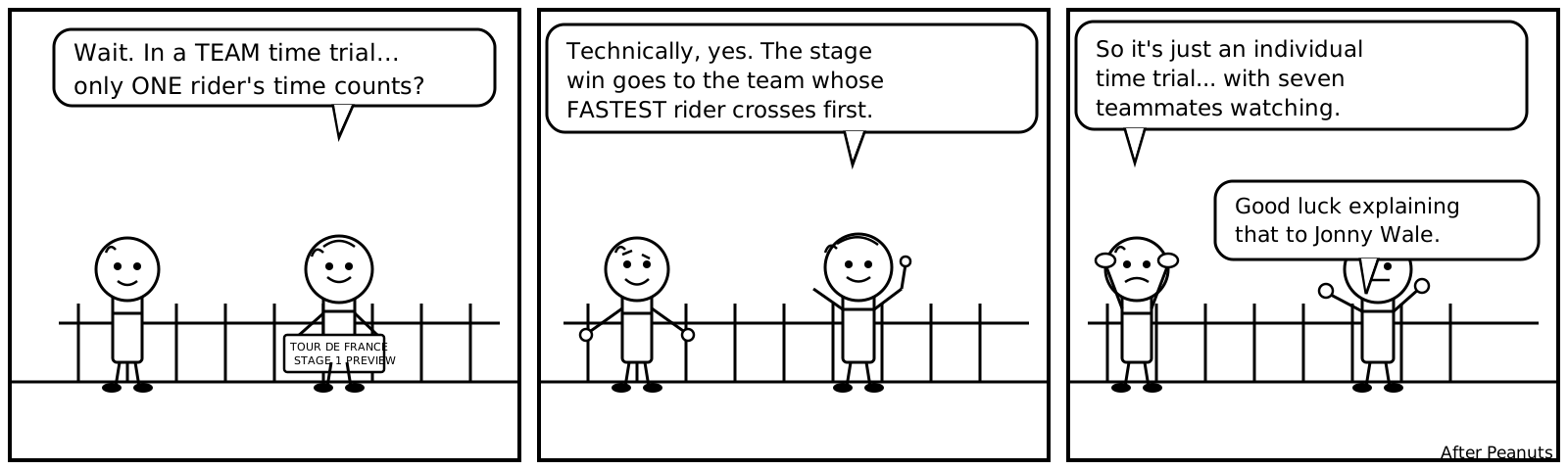
The TTT itself is worth understanding before the gun fires Saturday at 17:05 CET. Stage 1 covers 19.6km from the Mediterranean waterfront, past the Sagrada Família at km 10.5, then up the Côte de Montjuïc and a final push to the Côte du Stade Olympique. The format is the same Paris-Nice variant used since 2023: times are taken on the first rider to cross the line, not the fourth.2 Stage win goes to the team whose fastest man finishes first; GC times are individual. Jonny Wale, Red Bull-Bora-Hansgrohe's Technical Performance Manager, does not love it. "Personally I'm not a fan," he told Cyclingnews. "I think the beauty of team time trialing is you have to finish with four or five." Alex Dowsett at XDS Astana disagrees, arguing the format "eases the pain of the difference between big teams and small teams" and rewards creativity in pacing. Both teams have been working on TTT-specific preparation since a small series of races in Mallorca in January, where Red Bull won the first TTT of the year.3 Despite having Evenepoel in the squad — arguably the best time trialist in the peloton — Wale says the marginal gains are in the "second tier" riders. "If you put Remco with seven, eight climbers who never ride a time trial bike, you're not going to win."


Which makes the discovery in the Red Bull-Bora-Hansgrohe mechanics' van more interesting still. Cyclingnews spotted a prototype time trial bike bearing Evenepoel's name sticker hanging in an open van door at the Grand Départ, with a UCI "Prototype" sticker visible on the seat tube. The bike appears to be a new Specialized Shiv TT, though Specialized would only confirm that "some of these design elements and products eventually show up in future retail product offerings" under their internal "Project Black" program. The key visible changes: the seat tube now wraps closer to the rear tyre — mirroring the "Win Fin" treatment on the new Tarmac SL9 — and the saddle clamp system is integrated into the carbon rather than bolted on, removing material between the rider's legs. A new Roval TT front wheel, appearing to be approximately 90mm deep with carbon spokes, was also spotted.4

The Tarmac SL9, which Specialized launched in late June, is the relevant design cousin. The new road bike claims four watts of aerodynamic improvement over the SL8, achieved through a curved "Win Fin" seat tube, deeper "Flow Fork" legs that visually absorb the protruding "Speed Sniffer" head tube, and a narrowed seatpost section. Specialized benchmarked it against the Colnago Y1Rs (Pogačar's bike) and Cervélo S5 (Vingegaard's) using their in-house "Equation of Speed" simulation — a physics model developed by a former Scuderia Toro Rosso F1 engineer — and claims the SL9 is 14 seconds faster than the SL8 over the final 80km of the 2024 Tour de France Femmes.5 The S-Works AXS model is $14,000; a Di2 version is $13,500.


The pre-race narrative around the GC is being set from two directions. Eddy Merckx, 81 and recovering from a hip operation that will keep him from attending this year's race, told the Belgian agency Belga that Pogačar "is obviously the big favourite" and that at 27, going for what would be his fifth Tour win, he could be the first to ever win six.6 "Given his qualities, that would be expected, and he is certainly welcome in our club," Merckx said. The club being Merckx himself, Miguel Indurain, Bernard Hinault, and Jacques Anquetil — four men who won five.

As this paper reported last week, 19-year-old Paul Seixas enters his debut carrying the weight of French cycling's 41-year drought since Hinault. He crashed out of the Tour Auvergne-Rhône-Alpes in June but says preparation continued "almost as planned, with a few adjustments."7 His Strava has since documented Alpine monster sessions. "I feel ready to give everything I have over these three weeks," he said. "I am not setting myself a more specific goal because I am heading into the unknown." Merckx's assessment: "perhaps we shouldn't expect too much from the latter in his first participation at the age of 19." Coming from the man who won on his debut at 24, that's not an insult — it's a realistic bracket. The Tour starts Saturday.

On the Road Ahead
Calendar from Jun 29, 2026 — primary source blocked today
DateRaceCountry
Sat Jul 4Tour de France, Stage 1 TTT — BarcelonaSpain / France
Sat Jul 4 – Sun Jul 26Tour de France, Stages 1–21 (ongoing)Spain / France
Sat Aug 1Donostia–San Sebastián KlasikoaSpain
Mon Aug 3 – Sun Aug 9Tour de PolognePoland
Sun Aug 16ADAC Cyclassics HamburgGermany
Sources
  1. Mathieu van der Poel prepares for possible final shot at Tour success cyclingnews.com Jul 1, 2026
  2. Tour de France 2026 Stage 1 (TTT) preview — July 4, Barcelona cyclingnews.com Jul 1, 2026
  3. How teams have prepared for the Tour opening TTT from January to July cyclingnews.com Jul 1, 2026
  4. Evenepoel has a prototype TT bike for Tour de France — Is Specialized finally updating the Shiv TT? cyclingnews.com Jul 1, 2026
  5. Specialized launches S-Works Tarmac SL9 — 'fastest road bike ever made' cyclingnews.com Jun 30, 2026
  6. Eddy Merckx backs Pogačar for 2026 Tour victory, says he could win a sixth cyclingnews.com Jul 1, 2026
  7. Paul Seixas tries to block out noise ahead of most-hyped Tour debut in decades velo.outsideonline.com Jun 30, 2026

↑ Back to top

THE WORLD

Aurora Gets Its Ordinance; WA Cares Starts Paying

↩ Developing story — first reported Jun 25 · previously Jun 29, Jun 30


As this paper reported yesterday, the Seattle City Council was scheduled to vote on giving the city authority to close streets near Aurora Avenue — they did, unanimously, Tuesday afternoon.3 The emergency ordinance grants SDOT's director power to authorize closures when Seattle Police believe it will reduce violence. Current barriers stay in place while SDOT develops a permanent plan. Councilmember Debora Juarez, who has been pushing the measure, said simply: "If we can close it down for BBQs, I think we can close it down for gunfire and bullets flying." The open question — whether closures reduce violence or shift it to adjacent streets — remains exactly that.

Washington today became the first state in the country to pay benefits from a publicly funded long-term care program.4 WA Cares offers workers up to $36,500 in lifetime support for in-home care, equipment, and home modifications, funded by a 0.58% payroll tax collected since July 2023. An independent actuarial analysis puts first-year eligibility at 25,000–35,000 residents; close to 500,000 are projected to need long-term care within the decade. Critics say the benefit is too modest and the mandatory payroll tax leaves workers no opt-out. Gov. Bob Ferguson marked the launch at an 87-year-old Tukwila woman's home.


ON THE TRAIL

PART 1 — WEEKEND PICKS

July 4 falls on a Saturday. Federal observance shifts Saturday holidays to the prior Friday, so the observed holiday is Friday, July 3. Under the reader's pattern for Friday-observed holidays, the window is Fri–Sun, Jul 3–5. Thursday, Jul 2 is the opportunistic day — included below where the forecast supports it.

Weather note: I-90/Snoqualmie forecast for Jul 3 (Fri): 66°F / 48°F, 11% precip | Jul 4 (Sat): 68°F / 46°F, 1% | Jul 5 (Sun): 72°F / 47°F, 1% (I-90 / Snoqualmie region forecast). I-90 East (Teanaway) forecast: Thu Jul 2: 69°F / 44°F, 0% | Fri Jul 3: 72°F / 46°F, 1% | Sat Jul 4: 74°F / 45°F, 0% | Sun Jul 5: 79°F / 47°F, 0% (I-90 East / Teanaway forecast).

---

PICK 1 — Lake Ingalls Basin (1-night) I-90 East / Teanaway — ≈90–110 min from Issaquah

A June 29 report describes conditions that are about as good as midsummer gets in the Teanaway: snow-free approach to the saddle, wildflowers in bloom everywhere, zero mosquitoes, mountain goat families with kids, and only about 15 people all day on a Sunday. The lake itself still has a snowfield running down to shore — you can boulder-scramble around it, but it's not quite swimming season. Basin campsites are dry and plentiful.

The Thursday opportunistic day is worth taking here: I-90 East forecasts are sunny and bone-dry all four days, and leaving Thursday gives you the basin almost to yourself before the holiday weekend crowd arrives. If conditions warrant, taking Thursday off extends this to a 2-night trip.

WTA trip report — Lake Ingalls (Jun 29)

---

PICK 2 — Pratt Lake Basin (2-night) I-90 West / North Bend — ≈35–55 min from Issaquah

A June 30 report from Pratt Lake Basin puts the trail in great condition with no bugs. The reporter turned back before the lake on a knee issue, but spoke to others who made it through — "no bugs today," overgrown bushes near the top that may get you wet, otherwise clear. The lake is the destination; the basin offers the camping.

WTA trip report — Pratt Lake Basin (Jun 30)

---

PART 2 — REGIONAL SNAPSHOT

Sources
  1. US and Iran holding indirect talks in Qatar cnn.com Jul 1, 2026
  2. Supreme Court upholds birthright citizenship apnews.com Jun 30, 2026
  3. Seattle City Council gives city more power to close streets for safety reasons kiro7.com Jul 1, 2026
  4. WA Cares program to begin paying long-term care benefits kiro7.com Jul 1, 2026
  5. WTA Trip Reports wta.org Jul 1, 2026

↑ Back to top

THE LONG READ

Inside the Machine: What Gergely Orosz Saw at OpenAI, Anthropic, and Cursor

The first engineer on OpenAI's Codex team had something to show Gergely Orosz. That's where the article cuts off — the fetcher caught roughly the first half of the piece before the paywall closed — but what's visible is already worth the read.

Orosz, who runs The Pragmatic Engineer newsletter, spent recent days inside the San Francisco offices of OpenAI, Anthropic, and Cursor.1 What he came back with isn't a press release repackaged as commentary. It's reported observation: what engineers at these companies are actually building, what's changed in how they work, and where they think the next year goes.

The thread running through all three stops is the same: agents are leaving the laptop. Every shop Orosz visited — OpenAI, Anthropic, Cursor — is pushing hard on cloud-hosted agents, and the convergence happened fast enough that it surprised him. Anthropic's Katelyn Lesse, head of engineering for Claude Platform, told him that Claude Managed Agents took six months to build and is a "large, complex project."1 At OpenAI, engineers confirmed that the shift to cloud agents is "fairly recent" and they're actively hiring for it. At Cursor, cofounder Sualeh Asif described the engineering problems no one had solved before: what happens when a node terminates mid-task? How do you migrate agent execution between machines?

The observation Orosz finds most telling isn't the infrastructure. It's the adoption pattern. At OpenAI, more than 95% of non-engineers use Codex — not ChatGPT — to get things done.1 Coding harnesses, which most people assumed would stay in the domain of developers, are now the default tool for product managers, marketers, and ops staff inside the company that built ChatGPT. His read: this is a leading indicator for the rest of the industry.

The Karpathy catalyst is worth understanding. When Andrej Karpathy called Claude Tag — the Slack integration that kicks off Claude tasks — a "new paradigm," the pushback online was swift: it's just a Slack bot, what's the big deal? Orosz put the question directly to David Hershey on Anthropic's Applied AI team. The answer is that the integration matters less than what it eliminates: local setup, tool context-switching, and the friction of opening a separate environment. Hershey's own example is a "Claude playing Pokémon" side project — previously required several minutes of configuration each time a new model shipped and then ran on his machine for hours.1 Now it's a single Slack message. The excitement, Orosz concludes, is really about agents that don't require you to stay tethered to the machine where you started them.

The timing argument is the most structurally interesting part of the piece. Orosz lays out four reasons this is all happening now rather than two years ago: models finally crossed a threshold where autonomous coding is genuinely useful; context windows grew large enough to hold complex instructions across long runs; MCP and similar frameworks gave agents the connective tissue they needed; and cloud providers built enough GPU capacity to absorb the load. Remove any one of those and the economics don't work. All four arrived roughly simultaneously.

One detail from Cursor is the kind of thing that only comes out of actual reported access. When a cloud agent encounters an error or warning running locally, it surfaces the problem to the human in the loop. Running unattended in the cloud, there's no such feedback path. Cursor's solution: the model "confesses" at regular intervals.1 Those confessions go to the infrastructure team to improve the agent's environment. It's a workaround for a fundamental asymmetry in how autonomous systems fail — and it's the sort of engineering judgment call you don't learn about from press releases.

The piece is behind The Pragmatic Engineer's paywall for full text; the free portion is substantial. Read it here.

Sources
  1. Impressions from visiting OpenAI, Anthropic & Cursor newsletter.pragmaticengineer.com Jun 30, 2026

↑ Back to top

FROM THE ARCHIVE

The Race That Saved the Newspaper: July 1, 1903

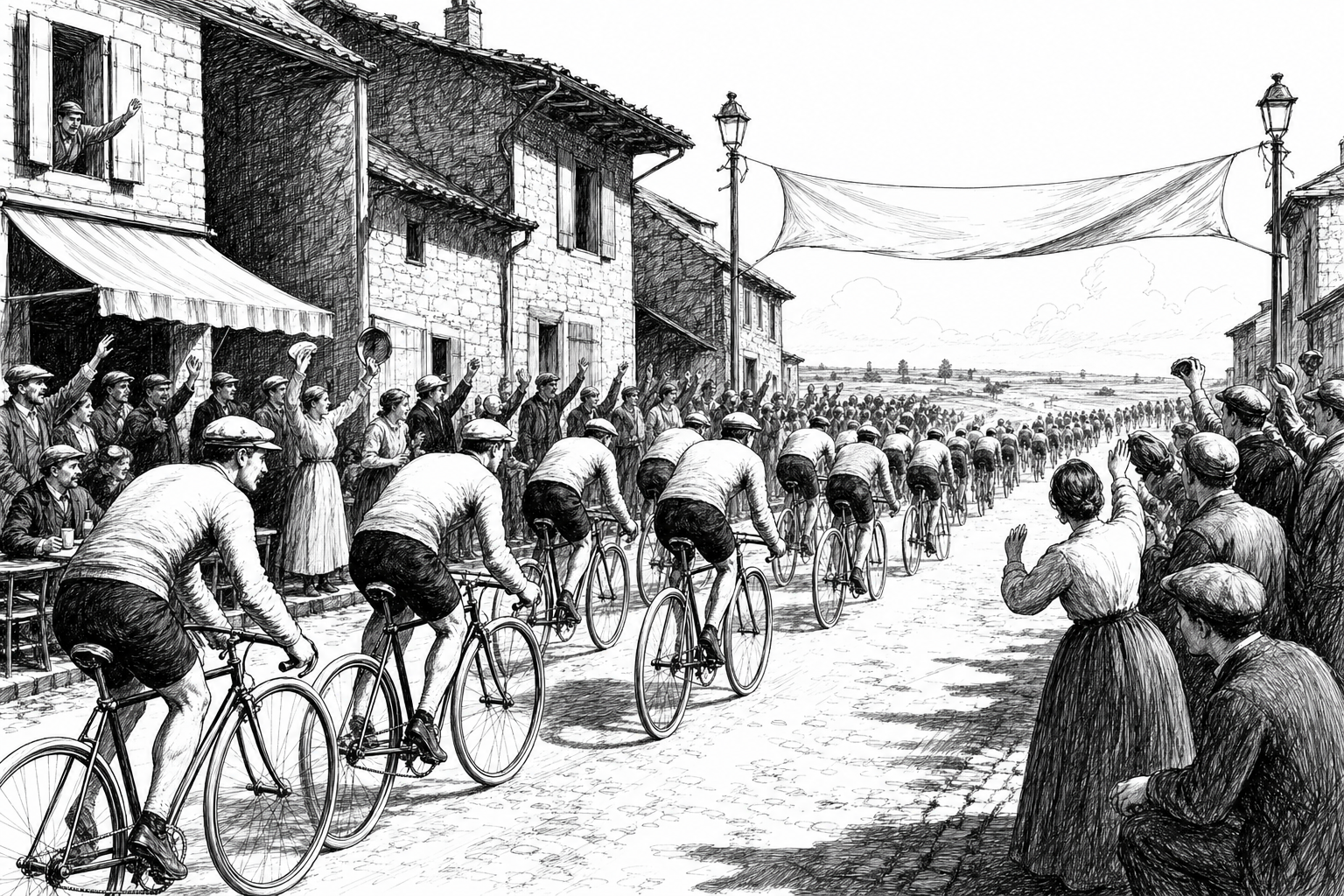
Lead illustration

Black-and-white pen-and-ink editorial illustration. A loose column of sixty cyclists threading out of a small French village square at mid-afternoon, July 1903. Stone café fronts and shuttered windows crowd the narrow street. Onlookers — men in flat caps and women in long skirts — press to the curb, arms raised. The riders wear long-sleeved woolen jerseys and peaked caps; their bicycles have no derailleurs, no numbers. A banner strung between lampposts catches the breeze. The road ahead opens into flat farmland receding under a hazy summer sky. Strong diagonals carry the procession from lower-left toward upper-right. Heavy cross-hatching in the shadows beneath the eaves; open white space in the sky and road ahead. No color, no text, no gradients. Confident editorial linework throughout.

At 15:16 on July 1, 1903, sixty cyclists rolled out of Montgeron, south of Paris, into a 471-kilometre stage to Lyon.1 One of them, Maurice Garin, would not be headed for the next nineteen days. Three days from now, in Barcelona, the 123rd edition of the same race begins.

The Tour de France was not invented out of love for cycling. It was invented out of desperation. Henri Desgrange, editor of the sports newspaper L'Auto, was watching his circulation crater against the older, better-established rival Le Vélo. In January 1903, he and a young employee named Géo Lefèvre announced a race around France — six stages, 2,428 kilometres, a prize pool of 20,000 francs.1 The concept had been Lefèvre's, sparked by the popular six-day track races of the era. Desgrange's financial controller, Victor Goddet, gave the nod, and the thing was set in motion.

It nearly died before it started. One week before the originally planned June 1 start, only fifteen riders had entered. Desgrange rescheduled the race to July, cut the entry fee in half, and guaranteed each of the first fifty finishers at least five francs per day. After that adjustment, 79 signed up. Sixty actually started.1

The logistics were improvised at a scale that would be unrecognizable today. Stages averaged more than 400 kilometres — compared to the 171-kilometre average in the 2004 edition.1 Because the stages were so long, most of them started before dawn; the final stage, Nantes to Ville-d'Avray at 471 kilometres, began the night before. Riders competed as individuals, not teams. They paid ten francs to enter the general classification. Stewards were stationed along the route to ensure no one took shortcuts. The yellow jersey for the race leader was a later innovation; in 1903, the leader was identified by a green armband.1

Garin dominated without sentiment. He won Stage 1 in a sprint over Emile Pagie after riding through the night. His main rival, Hippolyte Aucouturier, cramped out of that first stage entirely — unable to finish, he was disqualified from the general classification, but the rules allowed him to start subsequent stages, and he went on to win the second and third. In Stage 4, Aucouturier was caught drafting behind a car and removed from the race. Garin had his own incident in Stage 5, allegedly having Lucien Pothier throw a bicycle in front of a rival who had refused to let him take the stage win, then bending the man's rear wheel. Augereau obtained a spare bike and finished anyway. None of this was unusual.

By Stage 6, Garin carried nearly three hours on the field. He won the stage, sealed overall victory by 2 hours, 59 minutes, and 31 seconds — the largest winning margin in Tour history, a record that still stands.1 The finish at Ville-d'Avray drew a large crowd. Riders were handed boards marking their finish times, then directed on to the Parc des Princes velodrome for laps of honour.

The commercial effect was immediate and decisive. *L'Auto*'s circulation had been 25,000 before the race. It climbed to 65,000 afterward, with a special post-race edition of 130,000 copies.1 The Tour was scheduled again for 1904. By then, Le Vélo — the rival the race was invented to destroy — had been forced out of business.

Garin returned to defend in 1904 and was disqualified. With his 1903 prize money of 6,075 francs, he eventually bought a gas station, where he worked for the rest of his life. Lefèvre became the race's director, judge, and timekeeper. Desgrange, the directeur-général, did not follow the race in person.

The 2026 Tour opens Saturday in Barcelona with a 19.6-kilometre team time trial.2 The field will cover the first stage in under twenty minutes. Garin took nearly eighteen hours to cover Stage 1.

Sources
  1. 1903 Tour de France en.wikipedia.org Jul 21, 2004
  2. Tour de France 2026 Stage 1 preview cyclingnews.com

↑ Back to top

THE FUNNIES

The Team Time Trial Rule Explained; Gerald's PR Queue

*After Peanuts — on the question that's been nagging every casual Tour watcher since the TTT format was explained: if only the first rider's time counts, in what sense is it a team event? After The Far Side — on the Godot Foundation's decision to ban AI-authored code contributions, and what happens to a project's mentorship pipeline when the pull-request queue fills with robot stamps.*

Hand-drawn parody comic strip
AI-rendered parody comic strip

↑ Back to top

ALSO NOTED

Also Noted

↑ Back to top

THE QUESTION

What Is the Rule Actually Protecting?

The most interesting argument in today's paper isn't about who wins the Tour — it's about what a particular set of rules is actually there to protect.

THE PELOTON reports two competing views on the Tour's opening TTT format. Jonny Wale, Red Bull-Bora-Hansgrohe's Technical Performance Manager, objects to the rule that times are taken on the first rider to cross the line rather than the fourth: "Personally I'm not a fan of the rider time taken on the first rider approach. I think it's a spectacle, but I think the beauty of team time trialing is you have to finish with four or five."1 Alex Dowsett at XDS Astana takes the opposite view, arguing the format "eases the pain of the difference between big teams and small teams" and rewards creativity in pacing.1 Both men are describing the same rule. They disagree because they have different theories about what the format is for — collective commitment and suffering, in Wale's read; competitive equity across squad sizes, in Dowsett's.

The Godot Foundation ran into the same dispute from a different direction. As THE LAB reports, Godot is banning AI-authored code contributions. The reasoning published in their policy post is precise: "we can't trust heavy users of AI to understand their code enough to fix it."2 But the more revealing sentence comes later — the one about what gets lost when reviewer time goes to evaluating machine-generated submissions rather than mentoring a human contributor: "If your feedback on PRs is just being absorbed by a machine and not going towards mentoring a potential future maintainer, it becomes much harder to justify spending your free time on PR review."2 The policy is nominally about code quality. The underlying concern is about what the contribution process is actually for. If it exists to produce merged patches, AI submissions are efficient. If it exists to produce future maintainers — people who understand the codebase well enough to take over when the current cohort moves on — then AI submissions are negative-sum, flooding the queue while growing nobody.


Both disputes share the same structure: a rule or process optimised for one definition of success starts to look broken once someone operates under a different definition. The TTT format maximises stage entertainment and GC suspense at the cost of the traditional form. The open-source contribution model maximises throughput at the cost of mentorship. Neither trade-off is obviously wrong. What makes them worth carrying through the day is that both are being forced into the open right now by the same pressure: the arrival of a tool — in cycling, years of engineering on the four-rider cutoff format; in software, generative AI — that changes who can participate and at what cost.

The question Godot is answering explicitly, and the Tour is answering implicitly, is the same: when you make a system more accessible, do you preserve what made it worth doing in the first place? Godot's answer is a policy. The Tour's answer is still being worked out on the road.

Sources
  1. How teams have prepared for the Tour opening TTT from January to July cyclingnews.com Jul 1, 2026
  2. Godot will no longer accept AI-authored code contributions godotengine.org Jun 30, 2026
  3. PC Gamer: Godot bans AI-authored contributions pcgamer.com Jun 30, 2026

↑ Back to top

Investigator Report

Investigator report — 2026/07/01

Verdict

A strong edition with a clear spine: the Tour de France starts in three days and the Archive connects that to July 1, 1903 — the timing is genuinely elegant. The LAB lead is well-reported and substantive. The QUESTION delivers the best cross-domain bridge the section has produced in weeks. The main weaknesses are a LONG READ built on a paywalled partial source, a headline that buries the section's most interesting story in a colon clause, and a cluster of unfetched ALSO NOTED items that should have been in the manifest. The run was clean with no agent failures; pipeline cost was $8.96.

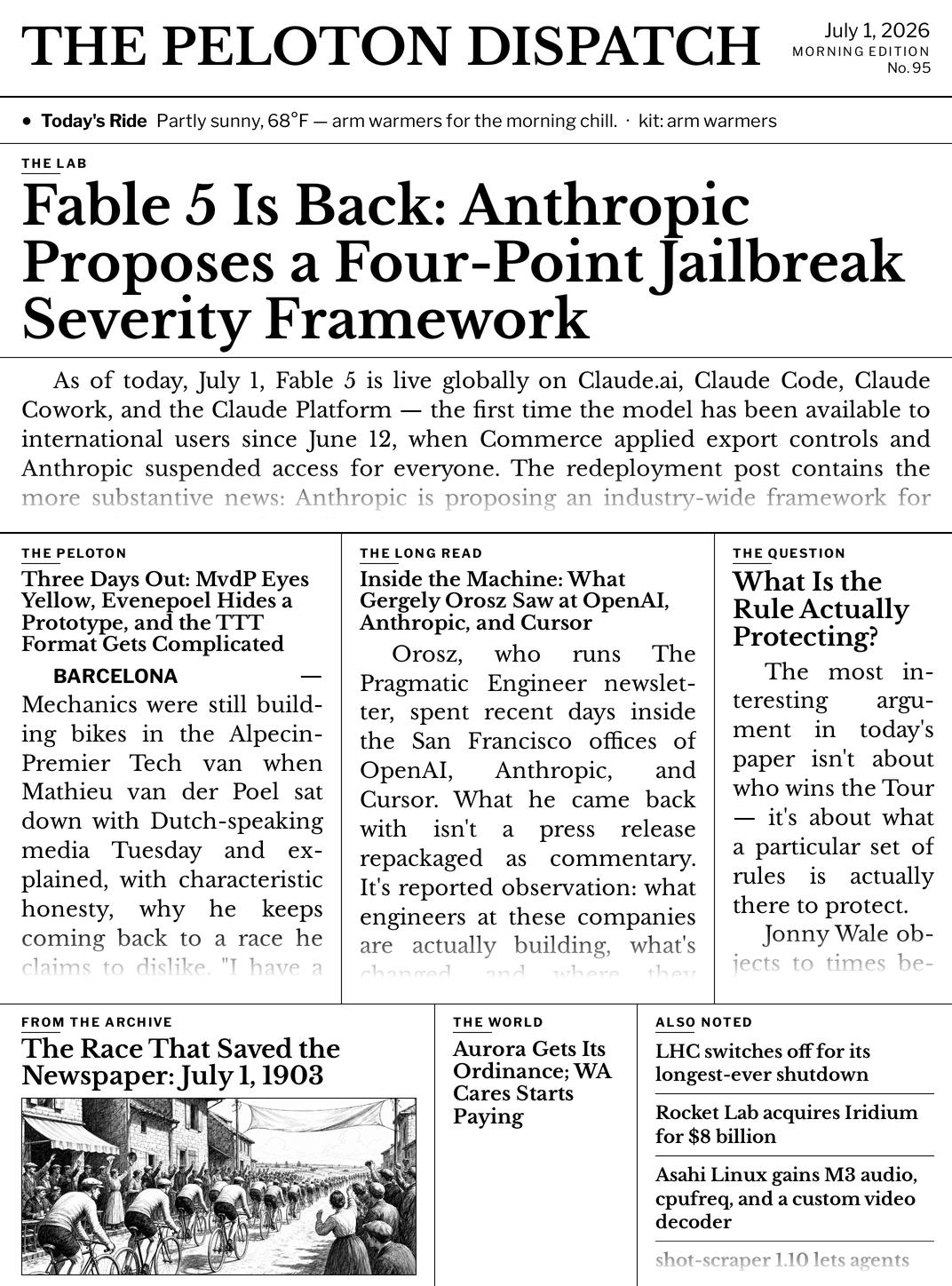
Frontpage

The deployed PNG reads well. Visual hierarchy is clear: THE LAB headline at 60px dominates, the three mid-row columns are balanced, and the Archive's lead image (a pen-and-ink illustration of cyclists departing Montgeron) is appropriately sized and well-placed. THE WORLD column shows only its headline ("Aurora Gets Its Ordinance; WA Cares Starts Paying"), which is correct per the frontpage_display: headline_only rule. No clipping or overflow is visible. The ALSO NOTED column fades gracefully with the gradient, which is fine — the fourth bullet ("shot-scraper 1.10...") is clipped but present in the long-form view.

One layout note: THE QUESTION's headline font is 28px vs THE PELOTON's 22px. This is correct CSS — the HTML explicitly assigns #col-question h2 { font-size: 28px } — but the visual result is that THE QUESTION feels like it is shouting past THE PELOTON, which has a denser article and higher priority (83 vs 75). The size difference may be intentional to distinguish the question format, but it can read as a hierarchy mismatch.

The local frontpage.html is clean: no duplicate paragraphs or headlines, all eight sections present in content.json are accounted for (THE FUNNIES is correctly skipped per frontpage_display: skip).

Priority ranking

SectionPriorityWordsImageNotes
THE LAB861,122Leads: Fable 5 redeployment + Sonnet 5 + Godot + steganography + ZLUDA
THE PELOTON83965TdF eve dispatch, TTT format, Evenepoel prototype
THE LONG READ79625Single paywalled source; partial fetch
THE QUESTION75507Strong cross-domain bridge
THE WORLD711,140Aurora + WA Cares + ON THE TRAIL
FROM THE ARCHIVE45631yes1903 Tour start; lead image
ALSO NOTED102664 bullets
THE FUNNIES865Peanuts SVG (three panels)

The ranking is broadly defensible. THE LAB at 86 is earned: five distinct stories, all fresh, with Fable 5's redeployment as the news hook and the jailbreak framework as the analytic payload. THE PELOTON at 83 is reasonable for a Grand Départ eve — not a stage result, but genuine pre-race reporting with equipment news.

The notable tension: THE LONG READ at 79 is scored above THE QUESTION (75) and THE WORLD (71) despite being built on a partial fetch of a paywalled piece (only the free portion, roughly half the article, was available). THE LONG READ writer acknowledged this openly in the article ("the fetcher caught roughly the first half of the piece before the paywall closed"), which is honest. But a 79 — "good longform" per the scale — feels generous when the paper is essentially pointing readers to a paywall rather than delivering longform. A 65-70 would have been more calibrated. The art director respected priority order in the front page layout.

The Archive at 45 is exactly at the priority cap, which is correct — this is an exceptional find (genuine July 1 date match, cycling history resonating with the Tour three days out), and it earned the cap. No priority inflation elsewhere.

Editorial reading

Finding 1 — LAB headline buries the lead. The headline reads: "Fable 5 Is Back: Anthropic Proposes a Four-Point Jailbreak Severity Framework." The Fable 5 redeployment is the easier story to summarize; the jailbreak severity framework is the more consequential one. But in the headline, the redeployment gets the main clause and the framework gets the colon-subordinate. This is backward. "Anthropic's Jailbreak Severity Framework" or "A Standard for Scoring AI Safety Bypasses" would foreground the analytic contribution. The body of the article correctly treats the framework as primary: the third paragraph introduces it, three paragraphs develop it, and the fact-checker log confirms the scoring criteria are accurately cited. The headline undersells what the article actually does.

Finding 2 — THE LONG READ builds on a partial source without an independent angle. The piece covers the Pragmatic Engineer's reported visit to OpenAI, Anthropic, and Cursor — but the fetcher only retrieved the paywall-gated free portion, cutting off mid-sentence: "Andrew saying he needed to show me something incredible." The writer disclosed this honestly. The problem is structural: THE LONG READ's focus says to hold the section rather than fill it with something mediocre. A piece whose source is a known partial and whose punchline is behind a paywall the writer cannot access is mediocre by construction, regardless of how well the writer handles the partial material. The fourth item in Orosz's article — "companies aggressively optimize spend-per-token" with a Coinbase case study — is entirely missing because the writer never saw it. The reader who follows the link hits the paywall immediately. The correct call was to either (a) treat the Pragmatic Engineer piece as LAB material (a mention + pointer) and hold THE LONG READ for a better candidate, or (b) wait for a version of the Orosz piece that can be fully accessed. The Nature TDF heat/climate article was dropped because its body was blocked — the same logic applies here, less severely.

Finding 3 — THE QUESTION lede just passes the structural test but is close to the line. The first sentence: "The most interesting argument in today's paper isn't about who wins the Tour — it's about what a particular set of rules is actually there to protect." This is a structural opener (it names a tension, not an event), so it passes the FORM TEST. But "The most interesting argument in today's paper" is a scene-setting announcement, not an in-media-res opening. It tells the reader what to think before showing them anything. The second and third paragraphs are strong — the Wale/Dowsett contrast is cleanly handled, the Godot bridge is precise. The lede would be tighter starting at paragraph two: "Jonny Wale objects to times being taken on the first TTT rider rather than the fourth..." That's a vivid entry point, and the framing question ("what is this rule actually protecting?") would emerge from the contrast rather than being announced.

Finding 4 — THE WORLD is overlong relative to its role. At 1,140 words, THE WORLD is the longest section in the edition — longer than THE LAB (1,122) and significantly longer than THE LONG READ (625). The two world bullets (Iran talks, SCOTUS birthright citizenship) are each well under 25 words and correctly compressed. The local block (Aurora ordinance, WA Cares) is solid at roughly 250 words. But ON THE TRAIL runs approximately 750 words: two trail picks with weather forecasts, per-day mileage breakdowns, and a six-bullet regional snapshot. This is correct per the config spec for ON THE TRAIL, which requires detailed picks with NWS data and per-day mileage. Still, the reader encounters this section on the full-article page as a wall of text between THE PELOTON and THE LONG READ. The section is doing its job; the length is not a defect — but an editor looking at this edition as a whole would note the pacing dip.

Finding 5 — ALSO NOTED is thin because unfetched items were not in the manifest. The section shipped four bullets. The research brief listed nine items for ALSO NOTED beyond those four: Victor Willis (died), arXiv's Next Chapter, Jujutsu (Git rethink), SCOTUS geofence warrants, the EU-US data transfer ruling, Tsoding, WA gas tax, Eastside task force, and Gemini Flash Lite. Of these, the Jujutsu article, the geofence ruling, and the arXiv post are all within reader interests (developer tools, security, research infrastructure) and substantively reportable. The sweeper dropped all three as "source unverifiable — not fetched." None of them appear in fetch_manifest.json. The researcher identified these items and included them in research.md with links, but did not add them to the manifest — which is the mechanism by which fetch_pages.py actually retrieves them. The Washington gas tax (56.5 cents/gallon effective July 1) is a textbook DEADLINE OVERRIDE item: the config explicitly says "a 13-day-old article about a CISA patch deadline that lands today is a today-actionable item." The researcher noted it as a deadline item but provided only the KOMO homepage URL, not an article URL, so it couldn't be fetched or cited. The net effect is that ALSO NOTED shipped with four bullets when it could plausibly have had six or seven.

Pipeline observations

No pipeline alerts file present. No tool errors in any agent session.

Missing ALSO NOTED fetches. The Jujutsu (git-tower.com/blog/jujutsu), SCOTUS geofence (theguardian.com), EU data transfer (noyb.eu), arXiv Next Chapter (blog.arxiv.org), and Victor Willis (kiro7.com) items were identified by the researcher and appear in research.md, but were not added to fetch_manifest.json. The sweeper correctly refused to write bullets without source text, but the manifest was the upstream gap. The researcher should have added these to the manifest; alternatively, the sweeper could have attempted fetches directly. As it stands, five of the nine researched ALSO NOTED items were unserviceable at write time.

fetch_manifest.json contained a stale archive candidate. The manifest included pages/archive/1996-tour-de-france.md, a Wikipedia fetch that was presumably the researcher's initial archive candidate before settling on the 1903 article. The 1996 page was fetched (14 lines, confirmed successful) and is sitting in pages/archive/ unused. This is harmless but represents one wasted fetch slot and a stale file in the pages directory.

Rocket Lab investor relations URL in manifest. The manifest pointed the Rocket Lab story to investors.rocketlabcorp.com/news-releases/... (the IR wire URL), which failed all four fetch methods. The sweeper recovered via the SpaceNews article (spacenews.com/rocket-lab-to-acquire-iridium/), which the retry manifest fetched successfully. The primary URL in the manifest should have been SpaceNews — the IR wire is a Cloudflare-protected corporate domain that reliably blocks scrapers.

Race calendar cached from yesterday (non-critical). procyclingstats.com blocked all four fetch methods; the calendar fell back to the Jun 29 cache, which is noted inline in the article ("Calendar from Jun 29, 2026 — primary source blocked today"). This is the expected fallback behavior and was handled correctly.

Scout and Researcher run times are the highest-cost items. Scout ran 347s / $0.67; Researcher ran 1,129s / $1.71. Together they account for 43% of total spend. No agent completed with errors; all produced final Done: summaries. Writer turn counts were healthy (7–18 turns each). The ALSO NOTED sweeper's 33 turns and the fact-checker's 21 turns suggest moderate iteration — consistent with the large number of items needing triage.

No dedup agent present. The agent list in jsonl/subagents/ contains scout, researcher, writers, fact-checkers, meta-writer, illustrator, art-director, thread-editor, and comic-strip agents. There is no separate dedup agent logged. Coverage indexing was performed by the orchestrator directly (noted in session: "Coverage index done. 265 URLs, 10 editions indexed") rather than by a standalone subagent. This is not a defect — the orchestrator called build_coverage_index.py as a shell command — but it means there is no dedup JSONL log entry.

Starting commit is same-day. The Dispatch commit (2dc602e, Dispatch: 2026-07-01) has parent 9d73c7f (Investigator: 2026-06-30), which is the prior day's investigator commit. The run started on a same-day state. No intervening commits to dispatch.md, .claude/agents/, or pipeline scripts were missed.

Trace highlights

Researcher at 1,129s / $1.71 is the longest-running single agent and the biggest spend. It read 3.56M cache tokens — by far the most of any agent — which is consistent with a researcher that exhaustively reads every fetched page to build the brief. The WORLD writer at 168s / $0.36 and the ALSO NOTED sweep at 113s / $0.38 suggest those two agents did meaningful work despite the simpler sections.

FC: THE PELOTON at 214s and FC: THE LAB at 219s were the slowest fact-checkers. Both had high cache reads (~290K and ~220K respectively) and meaningful output token counts (138 and 124 tokens), indicating they actively re-fetched and revised. The orchestrator confirms the PELOTON fact-checker caught two corrections (Pogačar win count, SL9 pricing) and the LAB fact-checker clarified the steganography vulnerability claim. These are appropriate corrections, not excess rework.

The Illustrator at 146s produced no cache reads. OpenAI image generation has no cache — the 146s is pure generation time, consistent with a 1536×1024 image. At $0.22 the illustrator cost is in line with prior editions, and the result (cyclists departing Montgeron, pen-and-ink) is well-matched to the Archive article.

Orchestrator output: 30,321 tokens / $2.76. The orchestrator spent more than the researcher ($1.71) and three times the most expensive writer. Most of this is the session-state overhead from assembling and passing section content back through the parent context for the priority normalization, content assembly, and verification steps. This is a structural cost of the current dispatch architecture rather than an individual agent inefficiency.

Trace summary
AgentDurInputOutputCache ReadCache 5mCache 1hCost
Scout347s99651822838111461220$ 0.67
Researcher1129s66999635631771663330$ 1.71
THE WORLD168s846224870769090$ 0.36
THE PELOTON95s887104361323080$ 0.15
THE LAB114s11204203247383880$ 0.21
THE LONG READ66s84884276263740$ 0.12
FROM THE ARCHIVE43s6757737185040$ 0.09
FC: FROM THE ARCHIVE140s8649179454353560$ 0.19
Meta-Writer34s6845844196170$ 0.09
FC: THE LONG READ125s7586534204270$ 0.10
FC: THE PELOTON214s12138292098435490$ 0.25
FC: THE LAB219s10124219623404430$ 0.22
Illustrator146s2325488000$ 0.22
FC: THE WORLD163s65189260865315760$ 0.20
THE QUESTION88s884121113281920$ 0.14
FC: THE QUESTION82s7789632223900$ 0.11
ALSO NOTED113s17302495009595740$ 0.38
Draw today's TWO parody comic strips for120s12142250369350150$ 0.21
FC: ALSO NOTED130s1112221055312160$ 0.18
Funnies (OpenAI)78s2901756000$ 0.07
Art Director324s78122430497170$ 0.22
Update story threads for today's edition401s538312794430$ 0.30
Orchestrator1513032155370120107457$ 2.76
TOTAL1296540066124508291001453107457$ 8.96

Suggestions for next edition

Raise the bar for THE LONG READ when the primary source is paywalled. If the fetcher can only retrieve the free portion of a piece and the writer has to say so in the article, the section should drop back to THE LAB or ALSO NOTED treatment rather than shipping as longform. The researcher should flag this at brief time, not leave it for the writer to discover.

Add an explicit second-pass to the fetch manifest for ALSO NOTED candidates. The researcher reliably identifies good ALSO NOTED items but frequently leaves them unfetched. Adding a rule that any ALSO NOTED item in the brief must either appear in fetch_manifest.json or be explicitly marked [NOT FETCHED — no-fetch reason: ...] would surface the gap before the sweeper hits it at write time.

The LAB headline habitually puts the news hook in the main clause and the analysis in the subordinate. Consider an explicit constraint in the LAB writer prompt: if the article's primary contribution is analytic (a framework, a finding, a pattern), that belongs in the main clause, not after the colon.

The Washington gas tax effective July 1 was a locally relevant deadline item with no usable URL. When the researcher identifies a deadline-anchored local item but only has a homepage URL, it should attempt a search for a direct article URL before writing the research brief — "Washington gas tax July 1 site:kiro7.com OR site:komonews.com" would likely surface a citable article URL.