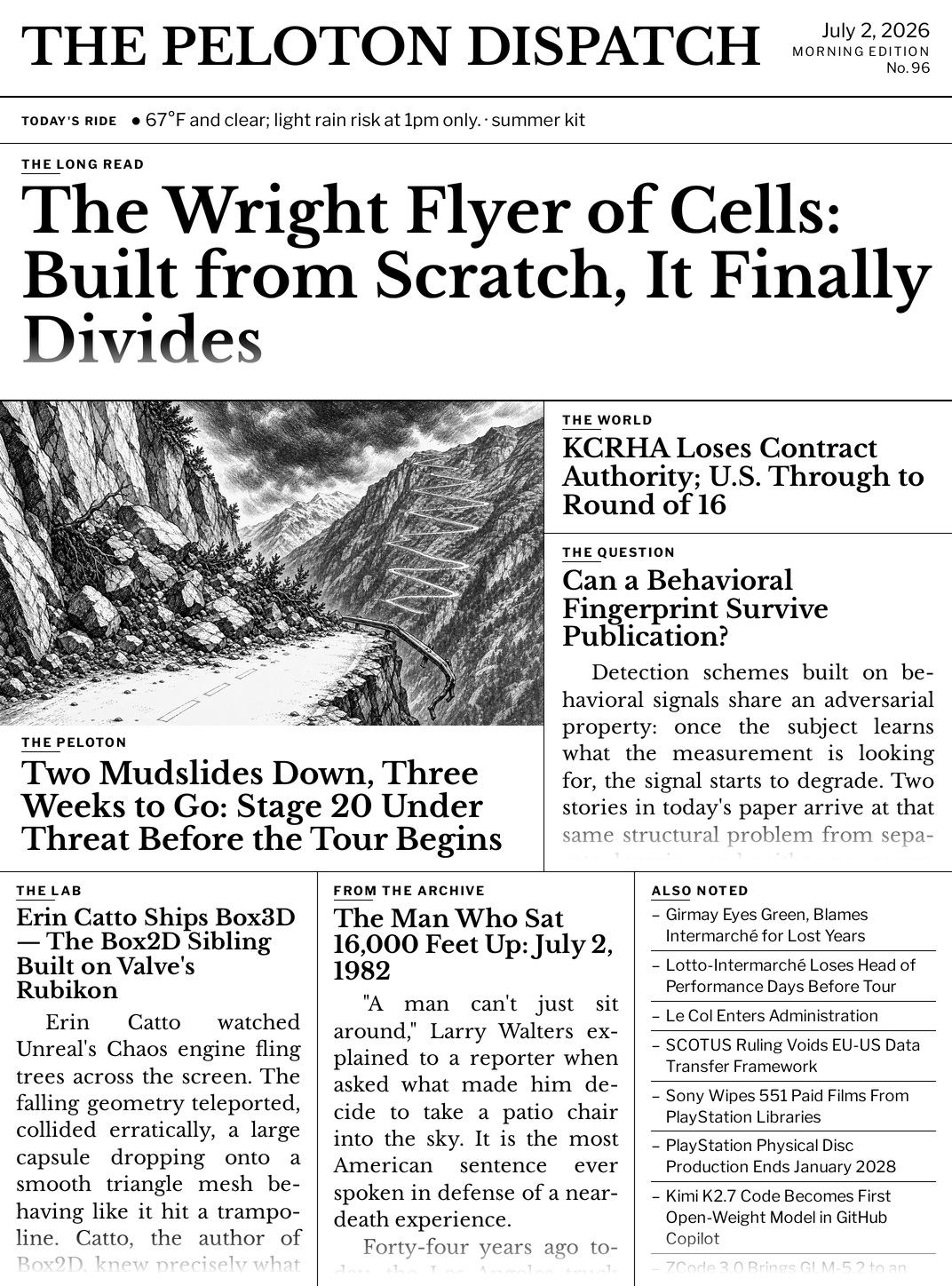
Front page — July 2, 2026
The Peloton Dispatch July 2, 2026 No. 96
● 67°F and clear; light rain risk at 1pm only. · summer kit

THE PELOTON

Two Mudslides Down, Three Weeks to Go: Stage 20 Under Threat Before the Tour Begins

↩ Developing story — first reported Jun 28
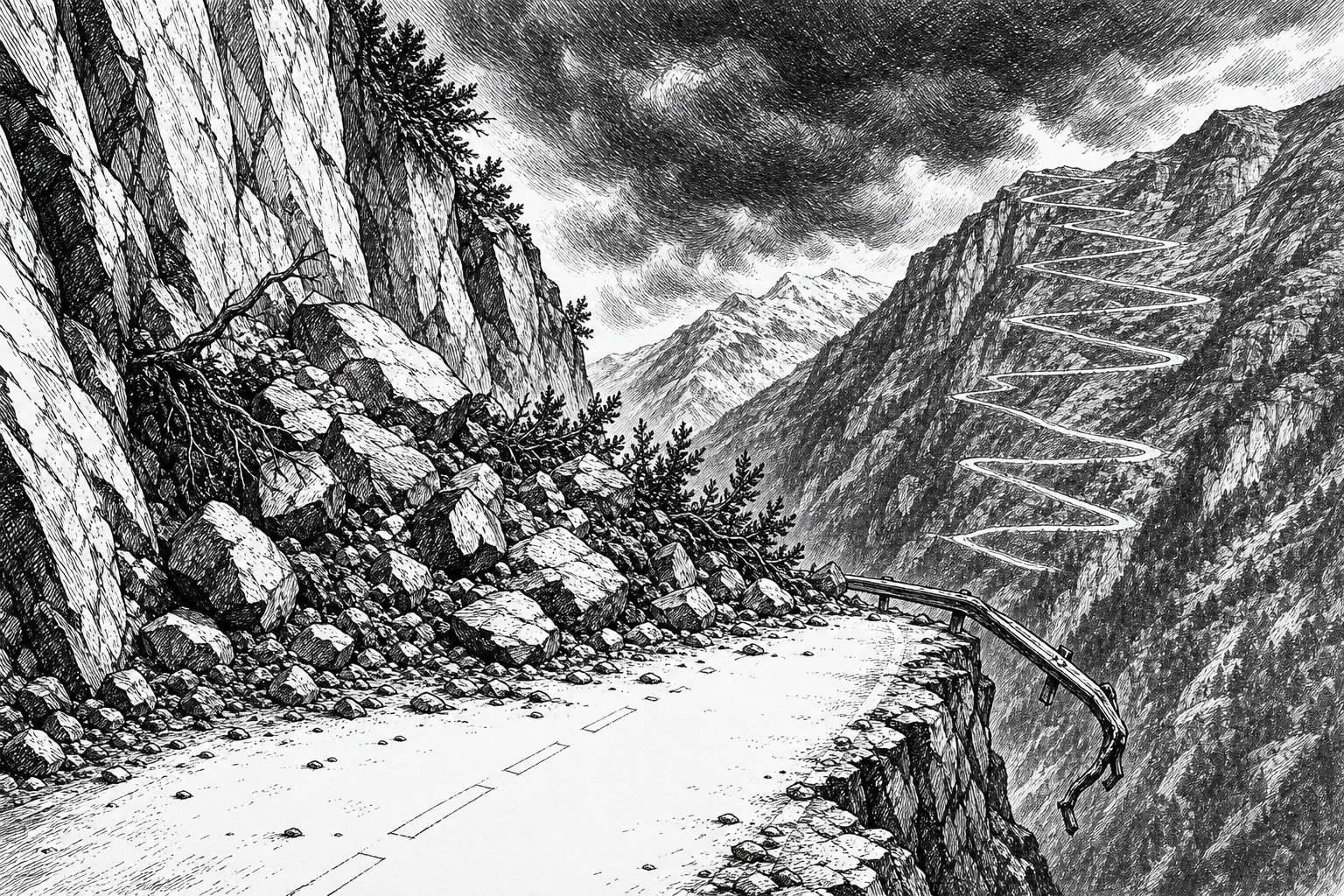
Lead illustration

A wide fan of grey boulders and stripped earth sprawls across a narrow Alpine road, cutting off both lanes entirely. Jagged rock edges and uprooted scrub pine jut from the rubble mound. The road is carved into a sheer cliff face on the left; a steep open valley drops away to the right. High above in the far background, the switchback hairpins of Alpe d'Huez climb the opposite wall of the valley, empty and silent. Storm clouds press down from above, rendered in dense cross-hatching. A section of bent guardrail dangles off the crumbling road edge. No riders, no machinery — just the mountain reclaiming the racecourse. Strong diagonal composition from lower-left debris fan to upper-right hairpins. Pen-and-ink with bold linework, controlled hatching in shadows, generous white space on the road surface.

— The road to the Col de Sarenne has been struck by two separate mudslides in the past week. Road crews cleared the first; a second hit on Monday, kicked off by thunderstorms that followed a June heat wave across Western Europe. Severe weather remains in the forecast, and Stage 20 — the second of back-to-back summit finishes atop Alpe d'Huez, scheduled for July 25 — is not yet secure.1

Tour technical director Thierry Gouvenou told L'Equipe on Tuesday that the compound problem "concerns us greatly," adding that "this time it's even more pressing because we've already just gone through two difficult periods in May and June."1 Environmental groups had already filed protests over the Sarenne's inclusion due to its proximity to a nature preserve and its fragile ecosystem — the mudslides add a logistical argument to the ecological one. Tour director Christian Prudhomme was candid about the organisers' ceiling: with 28,000 police and gendarmes mobilised on fixed authorisations, significant modifications are not available on short notice. "You can shorten the route by fifteen kilometres or start half an hour earlier. But that's only done in exceptional circumstances." Crews have more than two weeks before the peloton arrives — but the forecast is not cooperating, with temperatures expected to reach 37°C or higher by the end of the first Alpine week.


Two days out in Barcelona, most of the pre-race noise has been about Paul Seixas. He was on the cover of Thursday's L'Equipe, subject of a three-page interview and a special documentary, while publishers hunt for photographs of him winning races as a schoolboy and Paris Match reportedly tried to doorstep his mother at the school where she teaches. Les Temps compared him to Kylian Mbappé and Victor Wembanyama. He will be the youngest rider to debut at the Tour since 1937, more than two years younger than any other starter in the race, and France appears to be treating his appearance as something approaching a national event.2

Seixas flew to Barcelona on Tuesday and took his first training ride with Decathlon teammates on Wednesday. He is either genuinely unbothered or performing an extremely convincing impression of it. "I wouldn't say my life changed that much. I don't even know if I'd say it changed at all," he told L'Equipe. His stated ambition is "the best possible overall result, to learn, to see where I stand as the days go by" — GC throughout, without the word. Decathlon's decision to include Olav Kooij gives the team a sprint card that, in Seixas's telling, "takes some of the pressure off" while Kooij serves double duty as a GC domestique when the terrain suits. On the contract situation — Pinarello-Q36.5's reported €13 million approach, Decathlon's counter-effort — Seixas offered nothing. He gives the impression he has decided not to think about it until after Paris.

Josh Tarling broke his collarbone on June 12 and is riding the Tour regardless. He went straight to Germany for surgery the same day, spent two days on a turbo trainer, and told international media on Wednesday that he is "back to normal." Typical recovery time for a fractured clavicle is six to twelve weeks; Tarling managed three.3 Netcompany Ineos named him to their eight-man stage-hunting squad alongside Filippo Ganna and Tobias Foss — two former individual TT world champions — giving the team a formidable engine for Saturday's opening TTT in Barcelona. GC leader Kévin Vauquelin is the race's centrepiece; Tarling, Ganna, and Foss are the instruments that will try to put yellow on his back from kilometre zero.

UAE Team Emirates-XRG Head of Performance Jeroen Swart provided the most technically detailed pre-race interview of the week. The key number: after 4,500 kilojoules of energy expenditure — the threshold where most pelotons fragment on long Alpine stages — Pogačar loses less than 1% of his fresh-state power output. The mechanism is low-cadence torque work preserving late-stage muscle contractility. The nutritional side runs in parallel: a glucose-to-fructose ratio of 1-to-0.8 plus lactate supplementation pushes carbohydrate absorption to 110-120 grams per hour. Swart also described UAE's AI-integrated performance monitoring: 40 monthly reports, each running to 20-plus pages, generated in an hour. The system surfaces unprompted temporal cross-relationships across power data, heart rate variability, sleep metrics, blood results, and clinician notes — pointing to conclusions like "don't train this athlete again until HRV exceeds 150 for three days in a row" without waiting for a human to ask the right question. "It is a game-changer," Swart told Cyclingnews. "It gives us so much more clarity in terms of why we should do things and what we should do."4


The ITA has already conducted more than 360 out-of-competition controls ahead of Saturday's Grand Départ and will deploy more than 40 officials across the three-week race, targeting more than 600 in-competition samples. New this year: blood serum steroid profiles and hormone markers tied to human growth hormone abuse. The agency is coordinating with Spanish and French police and customs for the Barcelona stages before the race crosses into France on Stage 3. The power-data feasibility study — 60 riders from four WorldTeams and one ProTeam, run with the University of Kent and University College London — continues alongside it. The last rider to return an in-competition positive during the Tour was Luca Paolini in 2015.5

Elsewhere in the sport's administrative machinery, former Lidl-Trek team manager Luca Guercilena has been confirmed as general director of RCS Sport's cycling division, effective September 1.6 The role spans the Giro d'Italia, Milan-San Remo, Il Lombardia, Strade Bianche, Tirreno-Adriatico, Giro Women, Giro Next Gen, and several associated properties. He replaces Mauro Vegni, who retired in February after presenting the 2026 route. Guercilena, 52, ran Lidl-Trek for 16 years. The team he leaves is being remade in parallel: Andy Schleck arrives as CEO, Grischa Niermann from Visma-Lease a Bike as Chief Sporting Officer, and Dan Lorang from Red Bull-Bora-Hansgrohe as Head of Performance.

On the Road Ahead
Calendar from Jun 29, 2026 — primary source blocked today
DateRaceCountry
Sat Jul 4 – Sun Jul 26Tour de France (Stages 1–21)Spain / France
Sat Aug 1Donostia San Sebastián KlasikoaSpain
Mon Aug 3 – Sun Aug 9Tour de PolognePoland
Sat Aug 22 – Sun Sep 13La Vuelta Ciclista a EspañaSpain
Sat Oct 10Il LombardiaItaly
Sources
  1. Storms spark mudslides on Tour de France stage route to Col de Sarenne near Alpe d'Huez cyclingnews.com Jul 1, 2026
  2. Paul Seixas embraces Tour de France hype: 'I hope to thrill the French this summer' cyclingnews.com Jul 2, 2026
  3. Josh Tarling: from broken collarbone surgery to Tour de France debut in three weeks cyclingnews.com Jul 1, 2026
  4. Tadej Pogačar's performance coach on AI training tools and Tour preparation cyclingnews.com Jul 2, 2026
  5. How Tour de France anti-doping is changing for 2026 velo.outsideonline.com Jul 2, 2026
  6. Luca Guercilena to take over Giro d'Italia boss role at RCS Sport after Tour cyclingnews.com Jul 2, 2026

↑ Back to top

THE WORLD

KCRHA Loses Contract Authority; U.S. Through to Round of 16

↩ Developing story — first reported Jun 30


As this paper reported earlier this week, the April forensic audit found a $44.7 million negative cash position and $8 million in unreconcilable receivables at KCRHA; the corrective action plan the authority submitted came back "insufficient."1 Yesterday Zahilay moved to resolution: King County and Seattle will reclaim all city- and county-funded homelessness service contracts from KCRHA through a phased transition beginning January 2027. KCRHA survives as a narrower entity, retaining the federal Continuum of Care distribution role and getting an independent financial compliance team embedded in it.1 Zahilay's framing — "stabilize, right-size, and reset" — avoids saying disband, but stripping KCRHA of its contracting work removes most of what it did.

On Tuesday, The Athletic ranked Seattle's Lumen Field No. 1 among all 16 World Cup venues for stadium experience; the Action Network ranked Seattle the top U.S. host city overall.2 Sound Transit is tracking toward its first-ever 5 million boarding month, led by a record 280,000 light rail rides on June 19.2 At a press event Tuesday at Overlook Walk below Pike Place Market, Mayor Wilson floated making Pioneer Square's temporary pedestrianization permanent and said Seattle should bid for the 2031 Women's World Cup.2


ON THE TRAIL

Part 1 — Weekend Picks

Independence Day falls Saturday, July 4. The federal observed holiday is Friday, July 3 (Saturday shifts to prior Friday). The reader's long weekend runs Fri July 3 – Sun July 5; Thursday July 2 is opportunistic.

---

Pick 1 — 1-night: Sheep Lake / Sourdough Gap

---

Pick 2 — 2-night: Rachel Lake / Rampart Ridge

---

Part 2 — Regional Snapshot

Sources
  1. King County, Seattle to take on unhoused organization following audit issaquahreporter.com Jul 1, 2026
  2. Seattle Is Winning at Hosting the World Cup theurbanist.org Jul 1, 2026
  3. WTA Trip Reports — July 1–2, 2026 wta.org Jul 2, 2026
  4. FIFA World Cup 2026: US advances with 2-0 win in knockout round kiro7.com Jul 2, 2026
  5. Recording: Paramedics responded to 'cardiac arrest' call at Mitch McConnell's home kiro7.com Jul 2, 2026

↑ Back to top

THE LAB

Erin Catto Ships Box3D — The Box2D Sibling Built on Valve's Rubikon

↩ Developing story — first reported Jun 29 · previously Jul 01

Erin Catto watched Unreal's Chaos engine fling trees across the screen. The falling geometry teleported, collided erratically, a large capsule dropping onto a smooth triangle mesh behaving like it hit a trampoline. Catto, the author of Box2D, knew precisely what a well-behaved physics engine felt like and what he was getting wasn't it. The result is Box3D, released this week as open source on GitHub. At its core Box3D is Box2D's sibling: same C API, written in C17, same sub-stepping solver architecture, same graph coloring for large simulation islands, same wide SIMD contact solver — extended into 3D with triangle mesh collision, height-field collision, and a baked compound system designed for streaming large scenes without the per-body memory overhead.1

The backstory involves Valve. Catto's friend Dirk Gregorius, who shipped Half-Life: Alyx's custom physics engine (called Rubikon), offered a personal home fork — "Rubikon-Lite" — as a starting point. Catto hooked it into Unreal, got gyroscopic torques working (an algorithm he presented at GDC 2015), and watched trees fall naturally for the first time. He then replaced Rubikon-Lite's internals piecemeal with Box2D v3.0 code and new work until the two converged into what is now Box3D. Some convex hull generation and a handful of collision algorithms still trace back to Rubikon-Lite.1 Meanwhile Gregorius has continued developing Rubikon proper into a new engine called Ragnarok; Catto notes to watch for it in future Valve games.1

The practical demands of Kintsugiyama's in-development survival game, The Legend of California, shaped the feature set. The server runs hundreds of thousands of entities — falling redwoods, ragdolls, voxel terrain, saloon doors, tumbleweeds — and needed a broad-phase Catto trusted enough to build around rather than treat as middleware. The baked compound collision system specifically addresses streaming: a stronghold with 50,000 separate collision meshes gets cooked into a single optimized structure loadable as one uber-shape, eliminating the overhead of thousands of individual bodies.1 The voxel mesh builder uses median split because voxels are grid-like and mesh generation has to happen at runtime. Box3D is currently alpha; Catto plans to tag v0.1 shortly and considers the feature set already in a good place.1 The repo at erincatto/box3d trended to the top of game-dev listings on GitHub this week — the only technically substantive project on the chart, which was otherwise dominated by AI agent frameworks and coding wrappers.2


Wired fills in the technical mechanics behind Fable 5's restoration, adding detail beyond what this paper reported yesterday. What Anthropic agreed to add is a routing guardrail keyed to a specific behavior called out in an Amazon research paper: users who framed restricted requests as "fix this code" — rather than "identify security issues in this code" — could reach Fable 5's full capability set, bypassing the existing cybersecurity guardrail. The administration treated this as a jailbreak; security analysts generally didn't. Under the new safeguard, requests touching that behavior get routed to Opus 4.8 rather than Fable 5, and the user is notified of the block.3 Commerce's Center for AI Standards and Innovation reviewed the updated safeguards and cleared the model.3 But Pete Hegseth has told advisers there is no clear path to lifting his February 28 order designating Anthropic a supply chain risk — meaning the company's deepest regulatory exposure is not the Commerce impasse, which is resolved, but the Defense Department designation, which isn't.3


Sean Goedecke published a useful primer on why the EU AI Act's Article 50 — the requirement, enforceable in August 2026, that AI-generated text be "detectable as artificially generated" — is structurally incompatible with how text works.4 SynthID watermarks manipulate token sampling to leave a statistical fingerprint in vocabulary choices; homoglyph-based watermarks swap visible characters for Unicode equivalents (U+0020 space → U+2004 three-per-em space).4 Both are trivially stripped: normalizing Unicode removes homoglyphs; asking any un-watermarked model to paraphrase removes the SynthID vocabulary signal. The Act also requires watermarking to be "interoperable," which means publishing the scheme — eliminating the security-by-obscurity these approaches depend on. Goedecke's prediction is that EU-deployed inference stacks get a SynthID layer and offer a cheap verification endpoint, and that technically competent users strip it within minutes of any tool shipping. The deadline is about a month out.

Alan Wolfe (demofox) posted a guide to what it actually takes to get hired as a graphics programmer — the CPU/GPU split framed as two distinct jobs, the argument for a path tracer as the foundation for understanding real-time approximations, PBR as the thing that ended the era of per-asset lighting hacks, and C++ plus HLSL as the default stack. His ML take is measured: useful for talking through math or algorithms where it's easy to sanity-check, limited for code generation where you end up spending as much time understanding the output as you'd have spent writing it.5

Sources
  1. Box3D: a 3D physics engine for games — Erin Catto box2d.org Jun 30, 2026
  2. erincatto/box3d — GitHub Trending github.com Jul 2, 2026
  3. Anthropic's new identity verification security measure to restore Fable 5 access — Wired wired.com Jul 1, 2026
  4. Text AI watermarks will always be trivial to remove — Sean Goedecke seangoedecke.com Jul 1, 2026
  5. What to learn to be a real-time graphics programmer — Alan Wolfe (demofox) blog.demofox.org Jul 1, 2026

↑ Back to top

THE LONG READ

The Wright Flyer of Cells: Built from Scratch, It Finally Divides

The hard part was never feeding a synthetic cell. It wasn't replicating its DNA, either. The hard part — the thing that stumped synthetic biologists for years — was getting the cell to divide. A living cell reorganizes its cytoskeleton to halve its DNA and split; no one had figured out how to replicate that process in a cell built from scratch, out of non-living components. Katarzyna Adamala figured out how to skip it entirely.

Working at her lab, Adamala came across a paper describing a mechanism by which protein tags attached to a cell membrane attract other proteins, which crowd around and physically bend the membrane until it divides. No cytoskeleton required. She tweaked a cell-membrane protein and tested it in her protocells. "I wasn't allowing myself to believe it for a while," she told Quanta Magazine. "It was like, 'Holy shit, did I actually make a dividing cell?'"1

She had. By combining three independently developed systems — DNA replication, feeder liposomes that supply raw materials, and these swarming division-inducing proteins — her team built a synthetic cell that can grow and divide. They named it "spudcell." The name came from Adamala's students, who had started calling them "Adamala cells" until she insisted on anything else; she jokingly suggested potatoes. "I'm Polish, I'm mostly made of potatoes, so that's fine with me."

The achievement was technical rather than poetic. What Adamala's team actually built is a blob. It looks like nothing special under the microscope. Its genome is far smaller than a bacterial genome. It cannot make its own ribosomes — those have to be supplied — which limits how self-sustaining it can be. The division mechanism works but wastes energy: the crowding proteins are an inefficient substitute for a proper cytoskeleton, which the team thinks they'll eventually need to add back in. Jack Szostak, Adamala's doctoral adviser, noted that a cell unable to generate its own ribosomes is still a long way from anything resembling a bacterium.

And yet. John Glass at the J. Craig Venter Institute called the work "a watershed event for the synthetic-cell field and biology in general."1 Job Boekhoven at the Technical University of Munich, who was not involved in the study, called the division mechanism demonstration "a huge achievement." Michael Lynch, an evolutionary biologist at Arizona State University, called the overall result "a synthetic biology tour de force" — while also cautioning against over-hyping a cell that isn't yet self-sustaining.

Adamala herself reached for an engineering analogy. The modern cell is a Boeing 787 Dreamliner. What her team built is a Wright flyer — "the first bike frame with wings that flies 100 feet."1


The next frontier is evolution, and there's a problem. After demonstrating division, Adamala's team introduced genetic variation into the cell population and found that cells that grew bigger also produced more daughter cells — a first step toward selection. But it wasn't natural selection. The team had to create the variation synthetically because the enzyme that builds new DNA strands is too faithful: it doesn't introduce meaningful mutations. Finding an enzyme that makes mistakes at the right rate — enough to generate variation, not enough to destroy function — is the next research challenge. "Biology needs to change fast enough, but not too fast," Adamala said, invoking the biochemist Stuart Kauffman's concept of the "edge of chaos."

Alongside publishing the results, Adamala and other synthetic biologists announced a nonprofit called Biotic, which will release their data and methods so other labs can build on the work.1 The longer arc they're pointing toward: plastics without fossil fuels, novel fertilizers, new drugs. And further back still — past the applications, past the engineering — the question of where life came from in the first place. Life on Earth began from molecules far simpler than the ones spudcells use. But demonstrating that you can drive chemistry across the threshold into biology, under controlled conditions, from the ground up, brings the question of origins closer to being answerable in a lab.

"If you want to understand what life is," Boekhoven said, "you need to first build life."1

Sources
  1. For the First Time, a Cell Built from Scratch Grows and Divides quantamagazine.org Jul 1, 2026

↑ Back to top

FROM THE ARCHIVE

The Man Who Sat 16,000 Feet Up: July 2, 1982

"A man can't just sit around," Larry Walters explained to a reporter when asked what made him decide to take a patio chair into the sky.1 It is the most American sentence ever spoken in defense of a near-death experience.

Forty-four years ago today, the Los Angeles truck driver strapped himself into a Sears lawn chair he had named Inspiration, attached more than 40 helium weather balloons to the frame, and launched from his backyard. He expected to rise about 100 feet and enjoy the view. He ended up at 16,000 feet, drifting through controlled Los Angeles airspace, where passing airline pilots radioed in reports of a man in a lawn chair.1

Walters had planned for this. He brought a pellet gun to pop balloons and manage his descent. He popped a few. Then he dropped the gun. To slow his fall, he dumped ballast — plastic jugs of water he had strapped to the chair. Inspiration eventually came to earth by snagging power lines, and the LAPD extracted him.

He gave the chair to a neighborhood kid named Jerry Fleck. Three decades later, Fleck donated it to the National Air and Space Museum.1 It is now on display at the Steven F. Udvar-Hazy Center — the chair that crossed Los Angeles at flight altitude, surrounded by SR-71s and space shuttles.1

Sources
  1. How the Balloon-Borne "Flying Lawn Chair" Got Into the Smithsonian airspacemag.com Aug 27, 2019

↑ Back to top

THE FUNNIES

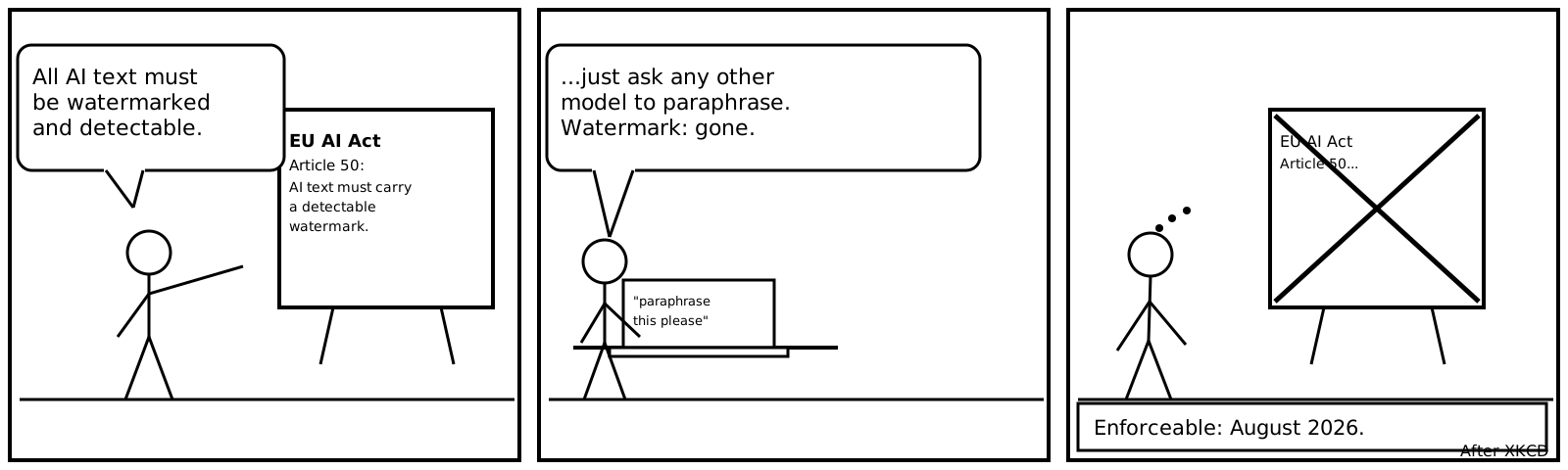
Watermark Defeated in Thirty Seconds / A Man Who Could Not Just Sit Around

*After XKCD — on the EU AI Act's Article 50 watermark requirement and the thirty-second paraphrase that defeats it. After Garfield — on Larry Walters, the Los Angeles truck driver who on this date in 1982 tied forty-five helium balloons to a lawn chair and accidentally crossed controlled airspace at 16,000 feet.*

Hand-drawn parody comic strip
AI-rendered parody comic strip

↑ Back to top

ALSO NOTED

Also Noted

↑ Back to top

THE QUESTION

Can a Behavioral Fingerprint Survive Publication?

Detection schemes built on behavioral signals share an adversarial property: once the subject learns what the measurement is looking for, the signal starts to degrade. Two stories in today's paper arrive at that same structural problem from separate domains, and neither one seems to be designed to solve it.

As THE LAB reports, the EU AI Act's Article 50 — enforceable in August — requires AI-generated text to be watermarked and detectable.1 The mechanism is either a vocabulary fingerprint embedded in token sampling, or Unicode homoglyph substitutions scattered through the text. The Act also requires the scheme to be "interoperable," which means published. That requirement is what defeats it: normalizing Unicode removes homoglyphs; paraphrasing strips the vocabulary signal. Publishing the scheme instructs the remover exactly how to strip it.


As THE PELOTON reports, the UCI's power-data feasibility trial runs the same structural bet on sport. Sixty riders across four WorldTeams and one ProTeam are contributing data to a two-year study with the University of Kent and UCL, testing whether power output profiles can reliably separate doped performance from legitimate variation.2 CPA head Adam Hansen's objection is partly technical — variance from rider specialization and physiology is large enough that any threshold generates false positives at scale. But there is a second problem the technical objection understates: if the trial produces a validated model and mandatory adoption follows, coaches will have a precise description of what a "clean" profile must look like. Unlike watermarked text, gaming a power profile takes months of careful training management rather than minutes in a text editor — but the structural problem is the same. Publishing the threshold teaches the subject what to optimize for.

The question worth carrying through the day is whether any behavioral detection scheme can be designed so that suppressing the signal also degrades the performance it's protecting — where the cheat cannot hide without also losing what they're cheating for. That's the harder problem, and neither the EU's watermark requirement nor the UCI's power passport appears to be solving for it.

Sources
  1. Text AI watermarks will always be trivial to remove seangoedecke.com Jul 1, 2026
  2. How Tour de France Anti-Doping Is Changing for 2026 velo.outsideonline.com Jul 2, 2026

↑ Back to top

Investigator Report

Investigator report — 2026/07/02

Verdict

A strong edition anchored by two excellent pieces: THE LONG READ (synthetic cell / Lawnchair Larry combination adds pleasant symmetry with the archive) and a genuinely sharp QUESTION that bridges AI watermarks and UCI doping detection into a single structural argument. THE PELOTON delivers a solid pre-Tour roundup and the pen-and-ink mudslide illustration is distinctive. The run's primary editorial failure is procedural: the triggers_meta: true rule on FROM THE ARCHIVE was ignored — the lead image should have depicted the archive story, not the peloton story. THE QUESTION's structural insight is the best angle in recent editions but the delivery re-narrates sibling sections more than the rules allow. Pipeline ran clean with one YAML hiccup caught by the orchestrator; the art director's 24-minute wall time is worth monitoring.


Frontpage

The deployed PNG reads cleanly as a newspaper front page. The 68px LONG READ headline dominates Zone 1; the mudslide illustration anchors Zone 2 alongside a scaled-down PELOTON headline. THE WORLD and THE QUESTION share the right column of Zone 2 and are legible at frontpage size. Zone 3 gives equal columns to THE LAB, FROM THE ARCHIVE, and ALSO NOTED; all text is readable without zooming.

One layout anomaly: THE QUESTION (priority 68) sits in Zone 2's right column while THE LAB (priority 76) is pushed to Zone 3. THE QUESTION text is visible above THE LAB, inverting their editorial ranking in the reader's first scan. This appears to be a template decision by the art director rather than an error (the right column of Zone 2 functions as a commentary rail), but the higher-priority section is effectively buried below a lower-priority one.

The ALSO NOTED column's last bullet ("ZCode 3.0 Brings GLM-5.2 to an-") is clipped by the zone boundary — not readable at the bottom edge of the PNG. This is a cosmetic overflow artifact, not a rendering error; the full item appears in the long-form index.html.

The long-form index.html renders all eight sections in section_tiers order (PELOTON → WORLD → LAB → LONG READ → ARCHIVE → FUNNIES → NOTED → QUESTION), which is correct per the config. No duplicate paragraphs or missing sections found.


Priority ranking

SectionPriorityLength (approx.)ImageNotes
THE LONG READ88~520 wordsLeads Zone 1; image-eligible but no image assigned
THE PELOTON82~670 wordsyes (lead)Zone 2 left with mudslide illustration
THE WORLD79~180 words (bullets + local) + ON THE TRAILheadline_only on frontpage; correct
THE LAB76~450 wordsZone 3 col 1; placed below THE QUESTION
THE QUESTION68~300 wordsZone 2 right col — above THE LAB despite lower priority
FROM THE ARCHIVE38~250 wordsZone 3 col 2
ALSO NOTED1110 bulletsZone 3 col 3; last bullet clipped
THE FUNNIES8minimalCorrectly skipped on frontpage

The ranking is defensible. THE LONG READ at 88 is a genuine watershed-event story (John Glass at the Venter Institute called it exactly that). THE PELOTON at 82 reflects the Tour de France starting in two days plus the mudslide threat — that's the top of the "Major stage win / Monument" band for a pre-race roundup, which is a mild stretch, but the Seixas storyline and the Swart technical interview give the section enough weight. THE QUESTION at 68 is appropriately scored for a structural bridge piece. No priority inflation; no 95 that didn't earn it.


Editorial reading

1. triggers_meta: true rule ignored — the lead image should have been the archive story.

newspaper.yaml sets triggers_meta: true on FROM THE ARCHIVE with the comment "meta-writer's lead image must match this section." Today's archive is Lawnchair Larry — a man in a Sears lawn chair at 16,000 feet above Los Angeles, spotted by airline pilots, named _Inspiration_, now in the Smithsonian. The meta-writer chose THE PELOTON (mudslide on Alpe d'Huez) instead, and meta.json records lead_image_section: "THE PELOTON". The mudslide illustration is excellent; a Lawnchair Larry pen-and-ink (man in lawn chair, 40 balloons, controlled airspace, SR-71s and space shuttles in the background museum scene) would also have been excellent and would have followed the rule. No log entry explains the override. This is a repeatable mis-execution if the meta-writer prompt doesn't adequately surface the triggers_meta constraint.

2. THE QUESTION re-narrates its source sections beyond the "sentence or two" rule.

The section's own rules state: "A sentence or two of context is fine; a second full recap of a story already in THE LAB / THE PELOTON / THE LONG READ is not." The QUESTION's middle two paragraphs run five sentences each. Paragraph 2 reproduces THE LAB's full mechanistic explanation of AI watermarks (vocabulary fingerprints, Unicode homoglyphs, interoperability defeat). Paragraph 3 reproduces THE PELOTON's power-data trial summary with the CPA objection and the coaching-optimization consequence. These are not hints toward sibling sections — they are summaries of them. The structural insight — "publishing a detection scheme instructs the subject exactly how to strip it" — is the sharpest QUESTION angle in several recent editions; it doesn't need two recap paragraphs to establish it. One sentence naming each triggering event would satisfy the rule and let the structural argument carry the piece.

3. McConnell bullet adds speculative framing the source doesn't support.

THE WORLD bullet reads: "Scanner audio shows paramedics responding to 'cardiac arrest' at McConnell's DC home June 14 — the day he was hospitalized; identity of the unconscious person unconfirmed." The source (KIRO7) reports scanner audio of a cardiac arrest call at McConnell's home on the day of his hospitalization. Adding "identity of the unconscious person unconfirmed" implies the scanner audio doesn't establish who had the cardiac arrest, which is technically true but frames the bullet as if the subject's identity is in dispute. A reader could reasonably interpret this as suggesting the event may not have involved McConnell, which the source does not support. The phrasing should either report what the audio establishes and stop there, or note that the scanner audio did not name the individual — without the "unconscious person" framing that creates unwarranted ambiguity.

4. THE PELOTON's Guercilena transition is boilerplate.

The article's final section opens: "Elsewhere in the sport's administrative machinery, former Lidl-Trek team manager Luca Guercilena has been confirmed as general director of RCS Sport's cycling division." The style guide calls for media res openings; "Elsewhere in the sport's administrative machinery" is precisely the wire-service catch-all phrasing the guide argues against. The Guercilena story is substantively interesting — RCS controls the Giro, Lombardia, Milan-San Remo, and Strade Bianche; a 16-year team manager moving to that portfolio is a structural shift in how Italian cycling is administered. A single contextualizing sentence would justify calling this out rather than treating it as administrative noise. The "what this means" is entirely absent.

5. THE LONG READ article is the edition's best work; source use is clean.

The piece maintains accurate balance between Adamala's genuine achievement and the skeptics' notes (Szostak on ribosomes, Lynch on self-sustainment). The "Wright Flyer" analogy earns its place because it's Adamala's own framing, not the writer's. The source (Quanta Magazine) is the right primary here. The article has a point of view and maintains it without hedging. No LLM hedge prose detected. The only minor note: "The hard part was never feeding a synthetic cell. It wasn't replicating its DNA, either." — the lede's double negation is slightly elongated but functional, and the payoff in paragraph three earns it.


Pipeline observations

YAML parse error in ALSO NOTED sweep. The orchestrator logged: "ALSO NOTED has a YAML parse error — unquoted colon in a snippet. Fixing it." The orchestrator caught and repaired the error before assembly, so nothing shipped broken. But the ALSO NOTED writer produced invalid YAML frontmatter on first pass. The fact-checker for ALSO NOTED (470s, 28 events) ran after this point; it's unclear whether the YAML error contributed to its long runtime.

Art Director wall time 1,483s (≈24 minutes). This is the longest non-researcher agent in today's run by a wide margin. The agent had 11 total events (8 assistant turns) — not many turns for 24 minutes. The output is a well-formed 447-line HTML. No tool errors appear in its JSONL. The long time is likely a single long-running initial generation pass for the full layout. Compare to the 2026-07-01 run for context if available. If this pattern repeats, the art director may be hitting a generation bottleneck on complex layouts.

triggers_meta: true constraint not enforced by meta-writer. The meta-writer ran in 90s and produced a well-formed meta.json, but it selected THE PELOTON for lead_image_section instead of FROM THE ARCHIVE as the rule requires. This points to a gap in the meta-writer prompt rather than a pipeline structural failure.

Starting commit is current. The session's initial git fetch/reset synchronized to 2dc602e (Dispatch: 2026-07-01) then the run wrote 37aee0a (Dispatch: 2026-07-02). No meaningful lag between origin and working tree.

All expected agents ran. One each of: scout, researcher, five section writers, two reflectors (THE QUESTION, THE FUNNIES), five fact-checkers, ALSO NOTED sweep, meta-writer, illustrator (OpenAI backend), art director, thread-editor. No duplicates, no missing agents, no mid-run stops.

Fetch: clean. All 30 manifest entries succeeded. No retry results file. The procyclingstats.com race calendar was served from the June 29 cache per the cache_from_prior: true fallback, and the article correctly notes this with "Calendar from Jun 29, 2026 — primary source blocked today."

Thread layer updated correctly. The threads.json added tdf-heat-safety-2026 (updated), fable5-government-shutdown (updated), kcrha-review-2026 (resolved), tarling-tdf-fitness (opened), and uci-power-passport-trial (updated), all matching today's reporting. Open thread count is 12, at the max_open: 12 cap.


Trace highlights

THE LONG READ writer (74s, $0.05) was the fastest and cheapest writer and produced the best article in the edition. The researcher handed it a single strong Quanta Magazine source and 40KB of cache context. The writer used it efficiently. Compare to THE WORLD writer (492s, $0.68) — that runtime and cost is appropriate given the ON THE TRAIL subsection requires reading WTA reports, per-region NWS forecasts, and applying the six-criteria filter to trip picks. The cost gap between the two is a signal about task complexity, not writer quality.

Art Director (1,483s, $0.55) consumed the most wall time of any agent by a wide margin, with a surprisingly low turn count (11 events). The researcher (1,315s) took almost as long but ran 123 events across 74 assistant turns. The art director's 8 assistant turns in 1,483s means it spent most of that time generating, not iterating. Long single-pass generation on complex HTML layouts may be intrinsic to the task; the output quality suggests no degradation.

Orchestrator ($3.00) cost more than the researcher ($1.66) and all writers combined (≈$1.28 for 5 writers + 2 reflectors). The orchestrator's 26,986 output tokens suggest substantial in-session writing (step narration, relay of subagent outputs, coordination). Its 6.4M cache read tokens dwarfs even the researcher. This is worth watching: if the orchestrator is accumulating and relaying completed section content to coordinate downstream agents, that's avoidable context overhead.

FC: THE PELOTON (508s) and FC: THE LAB (438s) ran longer than their respective writers. THE PELOTON writer took 243s; its fact-checker took 508s — more than double. THE LAB writer took 170s; its checker took 438s. In both cases the fact-checker was fetching and reading source pages to verify claims. The PELOTON article covers six distinct story threads with multiple technical claims (Swart's nutrition numbers, the power-data trial participant count, recovery time data for Tarling); the extended checking time is consistent with thorough sourcing rather than rework.

Trace summary

Dispatch 2026-07-02 (model: claude-sonnet-4-6)

AgentDurInputOutputCache ReadCache 5mCache 1hCost
Scout315s76503573677799440$ 0.35
Researcher1315s1421467325984702217970$ 1.66
THE WORLD492s7331268991722010$ 0.68
THE PELOTON243s62559930370950$ 0.16
THE LAB170s62955865285170$ 0.12
THE LONG READ74s6263963191820$ 0.05
FROM THE ARCHIVE85s73383808186960$ 0.10
FC: THE LONG READ237s73395693409070$ 0.18
FC: FROM THE ARCHIVE76s62563227207510$ 0.10
Meta-Writer90s62550879249550$ 0.11
FC: THE LAB438s733107045853950$ 0.35
Illustrator53s2341372000$ 0.06
FC: THE PELOTON508s143866268797597670$ 0.31
FC: THE WORLD366s733874941299830$ 0.51
THE QUESTION251s736103239375270$ 0.17
FC: THE QUESTION178s845132476299180$ 0.15
ALSO NOTED264s14226377217716100$ 0.39
Draw today's TWO parody comic strips for976s14673623161091980$ 0.52
FC: ALSO NOTED470s1168362345754630$ 0.39
Funnies (OpenAI)55s3861372000$ 0.06
Art Director1483s11135117401438660$ 0.55
Update story threads for today's edition359s55986061914150$ 0.35
Orchestrator1642698664575390109709$ 3.00
TOTAL2422131974115243481488187109709$10.32

Suggestions for next edition

1. Fix the meta-writer's handling of triggers_meta: true. The rule is unambiguous — when FROM THE ARCHIVE ships content, the lead image must depict the archive story. Today's Lawnchair Larry at 16,000 feet is exactly the kind of subject that translates to strong editorial pen-and-ink. The meta-writer prompt should surface this constraint explicitly rather than letting it be overridden by the more cinematic peloton story.

2. Add a word-budget enforcement step to the QUESTION writer. The pattern of summarizing sibling sections at length has now appeared in multiple recent editions. A hard structural test — "count the number of sentences in this article that restate facts already in a sibling section; if more than two, rewrite" — built into the writer or fact-checker prompt would catch it before delivery.

3. Investigate the art director's wall time on complex layouts. 24 minutes for a one-pass HTML generation is long. If the agent is generating the full HTML in a single completion rather than iterating, there may be a way to restructure the prompt as a template-fill task (layout structure fixed, content slots populated) that would be faster and produce more predictable output.

4. Push back on the ALSO NOTED writer's YAML generation. The YAML parse error on a snippet with an uncolon is a sign the writer isn't running a validation step before emitting. A self-check instruction ("before writing the frontmatter, verify the YAML parses cleanly by listing all keys and values") would catch this at source rather than relying on the orchestrator to repair it.