Investigator report — 2026/08/16
Verdict
A technically solid run that produced two genuinely memorable pieces — the Unicode ghost character longread and the transatlantic cable archive story — and linked them through a sharp cross-domain question about foundations and ceilings. The writing is tightest in the sections with the most at stake. The critical pipeline problem is external: OpenAI credit exhaustion killed the lead image before the edition shipped, leaving the frontpage entirely text-based on a day that had a vivid illustration prompt queued. A thread-count violation adds a second CRITICAL alert. Neither problem touches the prose, but both touch what the reader actually sees.
Frontpage
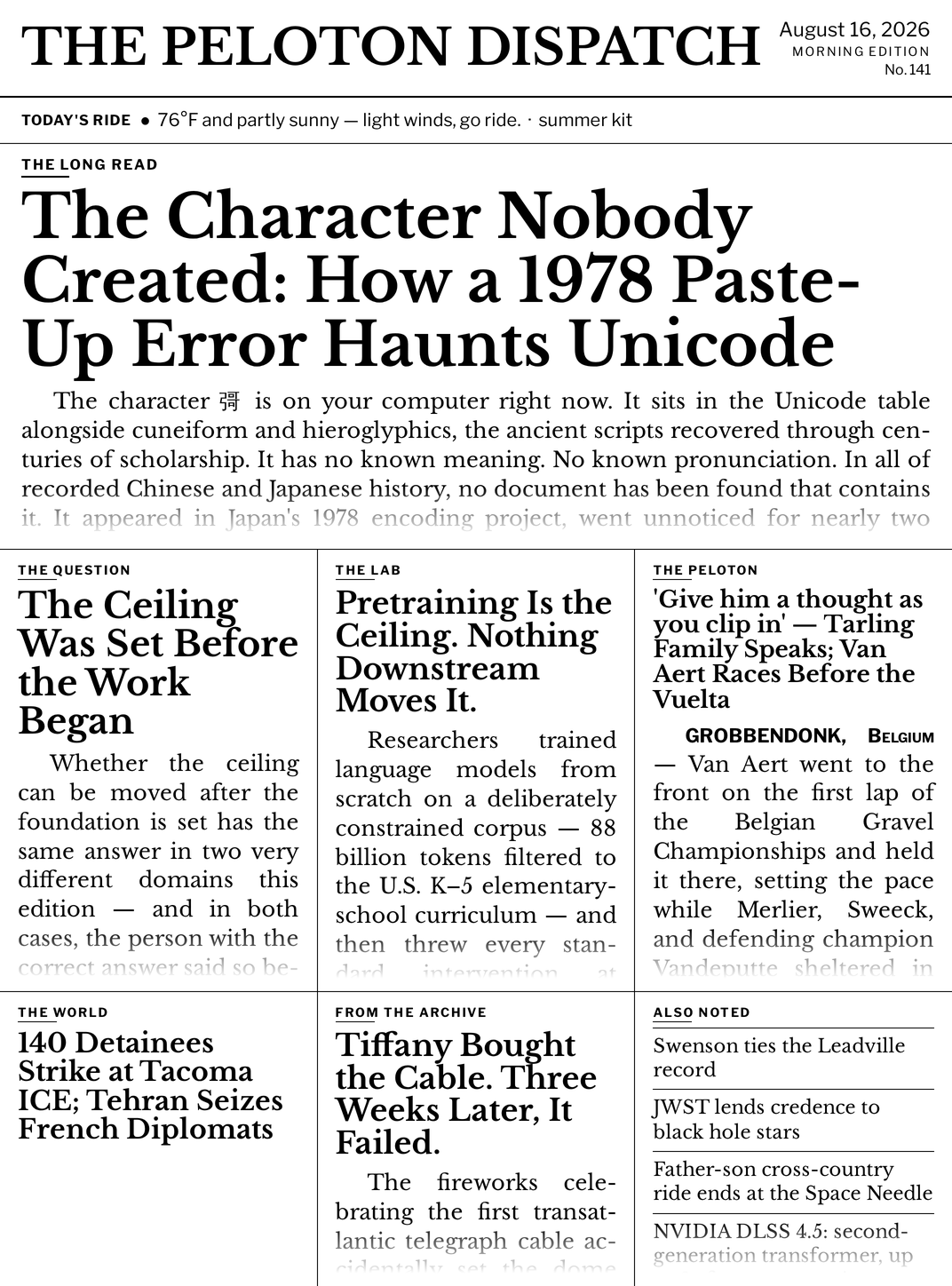
The rendered PNG looks like a real newspaper. Visual hierarchy is clear: THE LONG READ headline runs in roughly 68px bold at the top and dominates the page. The mid-row columns follow in descending headline sizes (THE QUESTION ~40px, THE LAB ~34px, THE PELOTON ~26px). The bot-row is balanced: THE WORLD carries a large-body headline with no article text (correct per frontpage_display: "headline_only"); FROM THE ARCHIVE gets a 34px head with two paragraphs of body; ALSO NOTED fills its column with six bullet items in readable type.
Missing lead image. lead_image.png does not exist in the edition directory. The meta.json called for a Victorian naval ships illustration tied to FROM THE ARCHIVE. funnies-openai.error.txt confirms the failure: fetch_lead_image: OpenAI returned 429: credit_balance_exhausted. The FROM THE ARCHIVE column in the bot row shows text only; the frontpage carries no illustration whatsoever. funnies.svg exists as a Claude-drawn fallback for the comic strip, but no equivalent fallback is available for the lead image. On a day where the archive story is visually rich and the prompt was specific and strong, this is a noticeable gap.
THE PELOTON headline at 26px in the narrow right column is the tightest fit on the page. The quote-headline "'Give him a thought as you clip in' — Tarling Family Speaks; Van Aert Races Before the Vuelta" works emotionally but runs long for the space it occupies.
Priority order is correct. THE LONG READ (80) leads. Mid-row: THE QUESTION (76), THE LAB (74), THE PELOTON (72). Bot-row: THE WORLD (63), FROM THE ARCHIVE (37), ALSO NOTED (8). The art director respected the ranking exactly. No sections are missing from the rendered page. No duplicate headlines or paragraphs.
Priority ranking
| Section | Priority | Length (words) | Image | Notes |
|---|
| THE LONG READ | 80 | 582 | — | leads page; earned |
| THE QUESTION | 76 | 289 | — | strong cross-domain bridge |
| THE LAB | 74 | 689 | — | three stories under one headline |
| THE PELOTON | 72 | 965 | — | longest section; Tarling story + racing + rider news |
| THE WORLD | 63 | 1,023 | — | includes full ON THE TRAIL |
| FROM THE ARCHIVE | 37 | 479 | yes (missing) | lead_image planned but not generated |
| ALSO NOTED | 8 | 356 | — | six items |
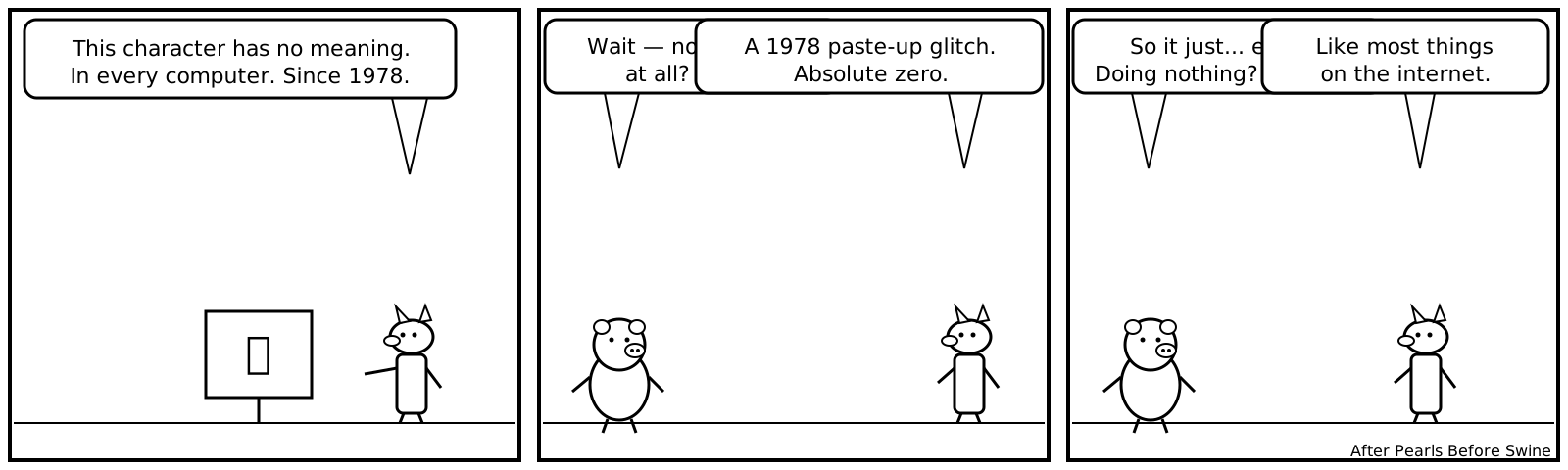
| THE FUNNIES | 7 | 62 | — | text description only; SVG in funnies.svg |
The ranking is defensible. THE LONG READ at 80 over THE PELOTON at 72 puts a Unicode curiosity story above coverage that includes a 19-year-old rider's death and his family's first public statement. That call is defensible — the Tarling news broke Friday, and today's coverage is the family's follow-up statement rather than the initial event — but the gap feels slightly inflated. A priority-75 for THE LONG READ and 74 for THE PELOTON would have been tighter. No priority inflation visible overall; the spread (7 to 80) is healthy and the art director has clear guidance.
Editorial reading
Finding 1 — THE WORLD headline overstates the Iran story. The headline reads "140 Detainees Strike at Tacoma ICE; Tehran Seizes French Diplomats." The article says Iran's intelligence ministry detained two French diplomats "during a Saturday security operation, then handed them over to the French ambassador." Detained-and-immediately-released is not a "seizure." "Seizes" implies an ongoing hostile act or incident with diplomatic consequence, which the source does not support. "Briefly Detains" or "Holds and Releases" would have been accurate. A reader who reads only the headline carries a materially wrong impression of the incident.
Finding 2 — THE LAB headline covers only the lead story; the section covers three. "Pretraining Is the Ceiling. Nothing Downstream Moves It." is an excellent headline for the LittleLearner paper. But two more stories follow under the same slug: the Debian LLM ballot and a custom game engine case study. The section reads naturally in sequence, but a reader scanning the frontpage sees a headline about pretraining limits and then finds the Debian vote and Elias Farhan's C++ engine writeup as unannounced additions. The compound structure is common in daily sections; a secondary kicker or "also: Debian, Custom Engines" line in the deck would set expectations. As written, the headline is a promise the full article only partly keeps.
Finding 3 — Simon Willison dropped from THE LAB on a person-level, not story-level, dedup. The writer's dropped entry for CORS Chat reads: "Willison covered Aug 10 within dedup window (same person); source is three sentences, too thin to build around." The Aug 10 piece and the Aug 15 CORS Chat are different stories. The dedup rule exists to avoid re-running the same story, not to rate-limit prolific key persons. Willison is explicitly listed in key_persons — the section focus says to check his blog daily. The "same person" reasoning is an over-application of the dedup logic. The CORS Chat made it to ALSO NOTED as a bullet, which is an acceptable fallback, but the stated reason for exclusion from THE LAB is editorially weak and sets a bad precedent for how key-person coverage is filtered.
Finding 4 — THE QUESTION re-narrates its source sections more heavily than the focus allows. The section focus says "a sentence or two of context is fine; a second full recap of a story already in THE LAB / THE LONG READ is not." THE QUESTION gives two full sentences to the LittleLearner finding ("models trained from scratch… None of it meaningfully improved performance") and two full sentences to the telegraph cable ("Thomson specified the right design… After 732 messages, the line went silent"). Together these four sentences account for roughly half the article's length and reproduce both stories' central facts. The cross-domain bridge — costly-incorrect-foundation-decisions echo across a century — is the best available angle in this edition, and the writer found it. But the connective tissue drowns in recap. A reader who has already moved through THE LAB and FROM THE ARCHIVE arrives at THE QUESTION having already read the evidence being marshalled. The structural question ("who bears the cost of that gap?") could have launched from a single framing sentence per domain rather than a full evidence summary.
Finding 5 — THE LONG READ is the standout piece. The lede is the best in the edition: "The character 彁 is on your computer right now." No announcement, no setup, immediate strangeness. The piece builds cleanly through history, the paste-up explanation is satisfying and concrete, and the final observation — that reversing the error would break things, so the ghost stays — lands with appropriate weight. The single-source nature (one 2018 blog post) is a risk the evergreen_ok: true rule explicitly permits for timeless essays, and this one earns the exception.
Pipeline observations
CRITICAL — OpenAI API credit exhaustion, lead image absent. funnies-openai.error.txt records: render_funnies failed (exit 1) / fetch_lead_image: OpenAI returned 429: {"error": {"message": "You have no credits remaining..."}}. lead_image.png does not exist in the edition directory. The meta.json planned a lead illustration for FROM THE ARCHIVE (Victorian naval ships, strong prompt). The frontpage shipped with zero imagery. funnies.svg exists as Claude drew the comic SVG directly; there is no equivalent fallback for the lead image. This is the most visible defect in the delivered edition.
CRITICAL — Thread count violation. log-pipeline-alerts.md flags 13 open threads against threads.max_open=12. The thread-editor's final message explicitly acknowledged the violation: "Open count lands at 13 (one over max_open 12). No existing open thread is resolvable today, and the debian revive is mandatory under the workflow rules." The thread-editor revived debian-llm-vote-2026 from dormant to open (voting started Aug 15) but did not dormant any existing thread to compensate. The thread most eligible for dormanting was ai-reasoning-trace-decode (last updated Aug 11, five days ago, approaching the dormant_after_days: 7 threshold). The agent acknowledged the violation and filed no remedial action, leaving the pipeline alert to surface it.
Agent set. All expected agents ran: scout, researcher, meta-writer, 6 writers (THE WORLD, THE PELOTON, THE LAB, THE LONG READ, FROM THE ARCHIVE, THE QUESTION), 1 writer-sweep (ALSO NOTED), 1 comic-strip, 7 fact-checkers, 1 thread-editor, 1 art-director. No missing or duplicate agents.
Fetch results. All 32 primary fetch results and 3 retry results returned ok: true. Three race results (Hamburg Cyclassics, Arctic Race stage 4, BK Gravel final result) were unavailable at fetch time — expected given Sunday race timing. The PELOTON writer correctly flagged these in the dropped array with "no race result indexed at fetch time."
World-block per-bullet word count. The Iran bullet ("Iran's intelligence ministry detained two French diplomats during a Saturday security operation, then handed them over to the French ambassador.") and the Morocco bullet ("Moroccan forces blocked roughly 300 migrants from crossing into Spain's Ceuta enclave Saturday; authorities cited intensive security deployments as effective.") each run to 26 words. The focus block states a hard cap of "each bullet ≤ 25 words." Both exceed it by one word. The total block (96 words) is well within the 120-word ceiling, making this a minor compliance slip.
Orchestrator comic-strip prompt. The trace labels the comic-strip agent "Draw today's TWO parody comic strips for" — but newspaper.yaml specifies "A short single-image parody comic." The dispatched prompt asked for two strips (and the section-funnies.md article text references both "Pearls Before Swine" and "Bloom County" styles for two separate stories). Whether this produced a single SVG with two tonal panels or two separate SVGs is not visible without parsing funnies.svg, but the prompt language contradicts the config's "pick one famous comic strip at random" instruction.
Starting commit. The dispatch ran against commit c2861d0 (Investigator: 2026-08-15, same-day baseline). No changes to .claude/agents/, newspaper.yaml, or Python scripts between that commit and the dispatch. Clean start.
Trace highlights
1. Researcher at $1.92, LAB writer at $0.16. The researcher spent 1494 seconds and $1.92 assembling the brief; the LAB writer spent 219 seconds and $0.16 producing the article. A 12x cost ratio between briefing and writing is unusual. This is not necessarily a problem — the brief was thorough and the writer used it efficiently — but it raises a question about whether the researcher is doing more synthesis than necessary. The LAB article covers exactly three items from the brief, in the same order the researcher listed them.
2. THE PELOTON writer and fact-checker near parity. The PELOTON writer ran 580 seconds at $0.53; its fact-checker ran 560 seconds at $0.41. That near-parity suggests the fact-checker did substantial review work. Looking at the fact-checker's output tokens (266 vs. the writer's 59), the checker was doing real work — likely re-verifying race standings, the Tarling family statement language, and the Vingegaard/Woods/Vollering rider details across nine sources.
3. Thread-editor ($0.79) more expensive than several writers. The thread-editor processed the full threads.json with its 50+ threads (5,755 cache read tokens but 210,336 cache creation tokens), producing only an updated threads.json — and still exceeded the thread cap. The cost-to-output ratio signals the agent is doing expensive context-building to produce relatively constrained output. The violation suggests the constraint logic is advisory rather than enforced.
4. Orchestrator at $3.23 (25% of run cost). With 6.8M cache read tokens and 118K cache creation (1h), the orchestrator is doing the expected coordination work. This is proportionate for a 20-agent run. No unusual concentration.
Trace summary
Dispatch 2026-08-16 (model: claude-sonnet-4-6)
| Agent | Dur | Input | Output | Cache Read | Cache 5m | Cache 1h | Cost |
|---|
| Scout | 686s | 14415 | 165 | 905268 | 195809 | 0 | $ 1.05 |
| Researcher | 1494s | 1558 | 7956 | 2791803 | 255752 | 0 | $ 1.92 |
| THE WORLD | 426s | 8 | 43 | 146529 | 138432 | 0 | $ 0.56 |
| THE PELOTON | 580s | 10 | 59 | 181297 | 126767 | 0 | $ 0.53 |
| THE LAB | 219s | 6 | 25 | 59670 | 36678 | 0 | $ 0.16 |
| THE LONG READ | 119s | 6 | 26 | 45195 | 18355 | 0 | $ 0.08 |
| FROM THE ARCHIVE | 96s | 6 | 26 | 66116 | 26513 | 0 | $ 0.12 |
| Meta-Writer | 51s | 6 | 144 | 52670 | 25833 | 0 | $ 0.11 |
| FC: FROM THE ARCHIVE | 257s | 8 | 34 | 140288 | 43478 | 0 | $ 0.21 |
| FC: THE LONG READ | 245s | 10 | 50 | 190981 | 33220 | 0 | $ 0.18 |
| FC: THE LAB | 471s | 1235 | 26 | 86245 | 99280 | 0 | $ 0.40 |
| FC: THE WORLD | 371s | 8 | 34 | 110985 | 110042 | 0 | $ 0.45 |
| FC: THE PELOTON | 560s | 12 | 266 | 402424 | 77338 | 0 | $ 0.41 |
| THE QUESTION | 313s | 7 | 33 | 108578 | 43186 | 0 | $ 0.20 |
| FC: THE QUESTION | 214s | 7 | 26 | 106121 | 36152 | 0 | $ 0.17 |
| ALSO NOTED | 378s | 16 | 119 | 519750 | 77048 | 0 | $ 0.45 |
| Draw today's TWO parody comic strips for | 1070s | 20 | 33048 | 646041 | 102691 | 0 | $ 1.07 |
| FC: ALSO NOTED | 588s | 915 | 53 | 275759 | 68372 | 0 | $ 0.34 |
| Art Director | 934s | 8 | 32010 | 10526 | 67844 | 0 | $ 0.74 |
| Update story threads for today's edition | 1050s | 8 | 18 | 5755 | 210336 | 0 | $ 0.79 |
| Orchestrator | | 160 | 32136 | 6793106 | 0 | 118847 | $ 3.23 |
| TOTAL | | 18429 | 106297 | 13645107 | 1793126 | 118847 | $13.18 |
Suggestions for next edition
1. Top up OpenAI API credits. The credit exhaustion that killed the lead image was not logged anywhere until the edition had already assembled without it. Add a pre-run credit check (a small probe call to the OpenAI API before the pipeline starts) and bail early with a clear error rather than silently proceeding without the illustration.
2. Enforce thread cap in the thread-editor, not just in the alert. When adding a new thread would push the open count above max_open, the agent should be required to dormant the thread with the oldest updated date rather than filing a pipeline alert and exceeding the limit anyway. The thread-editor's judgment ("the debian revive is mandatory") is reasonable but the cap is a hard rule; voluntary compliance is not enough when the alert rate is this high.
3. Tighten the Willison dedup logic in the LAB writer. Key persons should be deduped by story URL, not by person within the recency window. A prolific author's separate story on a separate day is a new story, not a repeat. The current logic silently rate-limits key-person coverage to roughly one piece per week, which contradicts the section focus ("check Simon Willison's blog daily").
4. Fix the comic-strip orchestrator prompt. newspaper.yaml specifies one comic strip; the orchestrator dispatched a prompt asking for "TWO parody comic strips." Align the prompt with the config — or if two-strip runs are intentional, update the config to document it.