Front page — August 20, 2026
The Peloton Dispatch August 20, 2026 No. 145
● Sunny at 79°F, light wind. Summer kit. · summer kit

THE LAB

The Tab Was Muted. AliExpress's Audio Fingerprint Wasn't.

↩ Developing story — first reported Jun 19 · previously Jun 20, Jul 03, Jul 04

Opening an AliExpress tab in Firefox broke Bluetooth multipoint audio — the phone fell silent, nothing audible played on the PC, and muting the tab changed nothing. Closing the tab fixed it immediately. That last part — mute failing — turned out to be the diagnostic.

An engineer documented the investigation on their blog. The usual suspects came up empty: no <audio> or <video> elements, no HTMLMediaElement.play() calls, no active Media Session state, no media network requests. The problem appeared only after the page had been idle several seconds, ruling out inline autoplay. Wrapping the AudioContext constructor to log every instantiation caught the culprit: the AliExpress homepage creates two running AudioContext objects, both connected to AudioContext.destination, originating from heavily obfuscated scripts under Alibaba's AWSC anti-abuse bundle: collina.js and fireyejs.js.1

Both scripts build the same signal chain — sawtooth oscillator → AnalyserNode → ScriptProcessorNode → GainNode (gain set to zero) → destination — and read frequency data from the analyser after the browser's audio stack has processed it. The zero-gain node is why the user hears nothing. The connection to destination is why it still matters. Browsers actively process any graph wired to the system audio endpoint regardless of output volume, and that processing is enough to hold the Bluetooth audio path open, preventing multipoint headphones from switching back to the phone. Tab mute does nothing because there is no media element — only a live audio-processing graph that the browser's mute control has no handle on.

The audio measurement is one signal in a comprehensive device fingerprint. The AWSC scripts also query canvas rendering output, WebGL renderer info, extensions and shader precision, screen and viewport dimensions, device pixel ratio, hardware concurrency, device memory, installed plugins, supported audio and video formats, WebRTC behavior, performance timing, mouse and touch interaction, device motion sensors, and properties associated with browser automation. Results are serialized, encrypted, and transmitted to Alibaba telemetry endpoints via fetch() or sendBeacon(). The anti-fraud rationale is real — fingerprints outlast cleared cookies, and behavioral signals help distinguish automated purchasing from legitimate traffic. But running a comprehensive sensor sweep on the general shopping homepage, via deliberately unreadable code, before any sensitive user action, with a concrete hardware side effect that the browser's own controls cannot stop — that is a different thing from fraud prevention. The author provides narrow uBlock Origin rules targeting the two AWSC script paths, scoped to aliexpress.com, though blocking anti-fraud scripts may produce extra CAPTCHAs at login and checkout.1


Tim Sweeney spoke at Unreal Fest Seoul today in a roundtable with local media — the thread's first substantive UE6 update since it went dormant in early July. The headline figure is Early Access targeting late 2027, roughly 18 months out.2 Sweeney described UE6's core architectural additions around cross-game digital ownership: items and outfits moving between titles without platform friction, with Verse as the scripting layer and Epic Online Services as the runtime glue for standalone games that want to participate in the open ecosystem. On AI tooling, Sweeney said Epic is in discussions with Claude, Gemini, and graph models to support Verse-based development, and that voice and 3D modeling are the near-term targets because they don't require billion-parameter models — an implicit invitation to smaller Korean AI shops. The anti-Apple posture was unchanged: iOS third-party stores remain blocked in Korea even as Japan allows them, and Apple charges a 15% fee on those stores and their payment systems. Sweeney called Apple's practice of collecting fees on transactions it has no direct involvement in "truly bizarre." UE6 general availability remains unscheduled; late 2027 for Early Access was the only concrete date offered.


Simon Willison tasked Claude Fable 5 running in Claude Code for web with evaluating smolmachines as a sandboxed runtime for untrusted Python and JavaScript. The model hit a hard constraint immediately: the Claude Code container is itself a Firecracker guest with no /dev/kvm and no virtualization CPU flags, so smolvm machine run failed as expected. Rather than stopping, the model identified that GitHub Actions ubuntu runners expose /dev/kvm, wrote a temporary test-runner workflow, committed it to a branch, ran the full test battery on the Actions runner, collected logs, then cleaned up the workflow in the final commit.3 The writeup, posted Aug 19, frames it as a clean example of the model being "relentlessly proactive" within environmental constraints rather than failing closed.

The Go team shipped 1.27 on Aug 19 with three language changes: generic methods (type parameters on receiver methods, not just free functions), direct initialization of fields in nested and embedded struct literals using their selector name, and generalized function type inference that now applies in composite literals, type conversions, and channel sends.4 The go fix tool gains four new modernizers; go doc accepts package@version queries.

Trending today: GitHub is saturated with AI agent harnesses, CLAUDE.md skill collections, and LLM wrapper forks — the one technical outlier is AprilNEA/OpenLogi, a native macOS Logitech Options+ replacement in Rust that speaks HID++ directly with no account or telemetry.

Sources
  1. AliExpress webpage keeping Bluetooth multipoint from switching blog.laserphile.com Aug 2026
  2. Tim Sweeney: In the Unreal Engine 6 era, we expect great things from Korean developers invenglobal.com Aug 20, 2026
  3. Simon Willison: smolmachines / smolvm as a sandbox for untrusted Python & JavaScript simonwillison.net Aug 19, 2026
  4. Go 1.27 is released go.dev Aug 19, 2026

↑ Back to top

THE PELOTON

Three Races Start; Vaughters Tells the BBC This Is Preventable

↩ Developing story — first reported Jun 20 · previously Aug 17, Aug 18, Aug 19

Three races opened across Belgium, Germany, and Britain on Wednesday, each setting its own week in motion with three days until the Vuelta a España lights up the Monaco seafront.

The Renewi Tour's first stage compressed into exactly the kind of photo finish the race's flat, Benelux parcours tends to produce. Crosswinds and echelons threatened to splinter the peloton through the middle passages, but the sprint trains absorbed everything in the final kilometers and drove around 105 riders to the line in the same time. The stage came down to millimeters.1

In Nuremberg, the Deutschland Tour prologue covered the top three in five seconds. UAE Team Emirates-XRG set the early pace — Isaac del Toro, who supported Pogačar through the Tour de France's GC stages this summer, clocked 3:08, with Soudal-QuickStep stacking two riders just behind him.2 UAE lines up in Monaco on Saturday as the Vuelta's dominant force; a prologue won to the hundredth of a second is the kind of thing the team files quietly.

The Tour of Britain Women opened in Lancashire under different terms. SD Worx-Protime positioned five riders in the 32-rider reduced peloton that survived a day of narrow roads and progressive selection — their sprint specialist, two GC threats (Lotte Kopecky and Mischa Bredewold), and two more capable of disrupting any breakaway. Sport director Christian Kos explained the team's patience: "Once a strong group had gone clear and we had the right riders in there, we waited for quite a long time to see whether or not the stage could be decided from a breakaway. When it became clear that this wouldn't be the case, we made the decision to keep the race together." Chiara Consonni (Canyon-SRAM) acknowledged afterward that SD Worx "can plan different things, not only the sprint."3 Stage 2 heads to Blackpool.

In France, Ewen Costiou rode clear solo on Tour du Limousin stage 2.


The Vuelta starts Saturday in Monaco. As this paper reported Tuesday, Red Bull–BORA–hansgrohe has named stage wins — not GC — as Roglič's target, and UAE arrives as the race's undisputed centerpiece. What Thursday brought was the arithmetic.

Philippa York's pre-race analysis for Cyclingnews put a number to what the peloton privately suspects: if Pogačar decides to press, second place at the finish in Granada on September 13 could arrive roughly 10 minutes down.5 She was careful to flag why total domination is unlikely — Pogačar still has the Worlds in Montréal and Il Lombardia ahead, reasons to manage his effort — but her structural argument was harder to dismiss. João Almeida and Jay Vine arrive at the Vuelta fresh, with no Grand Tour in their legs this season, "super motivated to impress everyone," in York's words. Both would be outright leaders at any other team in the race. Their presence absorbs podium duties and media obligations from Pogačar, making a controlled performance easier to execute, not harder. For the rest of the GC field, the question is not whether to follow Pogačar but when to start racing each other for what remains.

The route provides the stage. Race director Javier Guillén has written 58,156 meters of climbing into 21 stages — seven summit finishes, 51 categorized climbs, and a final block planted entirely in Andalucía where heat can push into the mid-30s Celsius and beyond.6 The queen stage (Stage 20) ends atop the Collado del Alguacil, 8.3km averaging 9.8%, a summit the Vuelta has not used before. ProCyclingStats data puts the race's recent average at 2,649 vertical meters per stage, against 2,426 at the Tour de France. Guillén called it one of the toughest editions in the race's history, which is not a claim he made lightly.

While the peloton assembles in Monaco, Pogačar's agent Alex Carera confirmed to Velo that contract extension talks are underway.7 His current deal runs through 2030, when he will be 32. No new agreement has been signed; no term length decided. Further talks are expected in Monaco in the coming days — the race's start city, where the team will be in any case. Del Toro recently extended through 2031. UAE is planning for the long term.


Jonathan Vaughters spoke to the BBC on Wednesday to say what teams have been thinking since Finlay Tarling was killed by a car during the Volta a Portugal last week: this is preventable, and the UCI is the one who needs to fix it. "What I'm really not enjoying is this sentiment that's coming from very powerful people in cycling, that says: 'What can you do? Sometimes cars just end up on the road,'" said the EF Education-EasyPost CEO. "That is not true."

Vaughters named rolling enclosures — standard practice at smaller events like the Volta a Portugal, both Tours of Britain, and many 2.1-ranked races — as the structural failure. Full closures seal the route; rolling enclosures move a safety bubble with the race. When the peloton fragments into groups, T-junctions can open. A car moving at 100kph into a group still racing at 50kph creates a closing speed of 150kph. The economics compound the problem: teams chasing UCI ranking points feel pressure to race at events that cannot afford the safety infrastructure those points implicitly require. "If you are forcing teams to fight for ranking points at this event then you damn well better make sure the event is up to standard," he said. His proposed remedy was structural: cut UCI-sanctioned race days from roughly 700 to 100.4

The interview ran the same morning news came from Tennessee. Two Milligan University student cyclists — Haylan Engdahl and Brayden Rogers, both sophomores — were killed and seven others injured when a driver struck their 11-rider training group on a rural stretch of Highway 19 in Hampton.8 Driver John Benfield, 69, was charged with two counts of vehicular homicide and five counts of aggravated assault. Milligan's men's squad had won the collegiate national championships team time trial earlier this summer. The crash falls entirely outside UCI jurisdiction. Vaughters' argument doesn't need it to.

On the Road Ahead
Updated Aug 20, 2026
DateRaceCountry
Wed–Sun, Aug 19–23Renewi Tour (ongoing)Belgium / Netherlands
Sat Aug 22 – Sun Sep 13Vuelta a EspañaSpain
Sun, Aug 30Bretagne ClassicFrance
Fri, Sep 11Grand Prix Cycliste de QuébecCanada
Sun, Sep 13Grand Prix Cycliste de MontréalCanada
Show Results

RENEWI TOUR — STAGE 1: WINNER: Jonathan Milan (Lidl-Trek) PODIUM: 1. Jonathan Milan (Lidl-Trek) 2. Olav Kooij (Decathlon CMA CGM) 3. Tim Merlier (Soudal Quick-Step)

DEUTSCHLAND TOUR — PROLOGUE (Nuremberg): WINNER: Isaac del Toro (UAE Team Emirates-XRG) — 3:08 PODIUM: 1. Isaac del Toro +0:00 2. Paul Magnier (Soudal-QuickStep) +0:02 3. Laurenz Rex (Soudal-QuickStep) +0:05

TOUR OF BRITAIN WOMEN — STAGE 1: WINNER: Lorena Wiebes (SD Worx-Protime) PODIUM: 1. Lorena Wiebes (SD Worx-Protime) 2. Chiara Consonni (Canyon-SRAM) 3. Josie Nelson (Picnic-PostNL)

TOUR DU LIMOUSIN — STAGE 2: WINNER: Ewen Costiou (solo breakaway; takes overall lead)

Sources
  1. Renewi Tour: Jonathan Milan edges out Olav Kooij in photo finish to win a messy opening stage cyclingnews.com Aug 19, 2026
  2. Deutschland Tour: Isaac del Toro blasts to prologue victory ahead of Paul Magnier cyclingnews.com Aug 19, 2026
  3. SD Worx-Protime prevail on opening stage at Tour of Britain Women cyclingnews.com Aug 19, 2026
  4. Jonathan Vaughters calls for calendar reform following death of Finlay Tarling cyclingnews.com Aug 19, 2026
  5. Tadej Pogačar could win the Vuelta by 10 minutes but total domination is unlikely — Philippa York analysis cyclingnews.com Aug 20, 2026
  6. The 2026 Vuelta a España Packs 58,000 Meters of Climbing and 7 Summit Finishes velo.outsideonline.com Aug 20, 2026
  7. Tadej Pogačar Could Race Beyond 2030 as UAE Contract Extension Talks Begin velo.outsideonline.com Aug 19, 2026
  8. Two College Cyclists Killed and Seven Injured After Driver Strikes Team in Tennessee velo.outsideonline.com Aug 20, 2026

↑ Back to top

THE WORLD

US Debt Hits $40 Trillion; Wilson Recall Hearing Set for Aug. 31

↩ Developing story — first reported Aug 13 · previously Aug 17


ON THE TRAIL

Sources
  1. US national debt passes $40 trillion milestone kiro7.com Aug 20, 2026
  2. Pilot killed, 2 injured after plane collides with Pennsylvania State Police helicopter kiro7.com Aug 20, 2026
  3. Seattle Mayor Katie Wilson responds to recall effort as hearing date approaches kiro7.com Aug 20, 2026
  4. Renton places one-year moratorium on data centers issaquahreporter.com Aug 19, 2026
  5. Pinpoint Alert: Saturday thunderstorm threat across Washington state kiro7.com Aug 20, 2026
  6. NPS proposes reopening bridge to Grove of Patriarchs at Mt. Rainier issaquahreporter.com Aug 19, 2026
  7. WTA Trip Reports wta.org

↑ Back to top

THE LONG READ

The Glue Code Was Always the Problem: How LLMs Change the Case for Extensible Software

The reason most web software doesn't have a plugin system isn't that developers don't want one. It's that the glue code — the logic a user needs to connect two systems, customize a behavior, or automate a workflow — has always been the hard part. Writing it requires a developer. Debugging it requires a developer. Maintaining it requires a developer. For most products serving most users, that math never made sense.

Jeremy Morrell, a Cloudflare engineer, published a piece Tuesday arguing that LLMs change that math. Not because they make plugin architectures technically easier to build — the host-side work remains substantial — but because they finally solve the authorship problem on the user side. If a non-programmer can describe what they want and a model can extrude working code in seconds, the long tail of unmet user needs becomes addressable in a way it simply wasn't before. "Your users have suddenly acquired the ability to speak code into existence," Morrell writes. "Most existing software can't leverage this."1

It's a clean thesis, and the piece earns it through the details. Morrell's diagnosis of why extensibility has been hard on the web is more precise than most takes on the subject. Local software — game mods, IDE plugins, Obsidian extensions — achieves real extensibility because the stakes are bounded. The user trusts the software enough to let it run arbitrary code on their machine. Obsidian's plugin model can do basically anything, and Morrell acknowledges this is probably the right tradeoff for a notes app with a self-selected technical audience. But the moment you want that same extensibility in software holding other people's data — customer records, financial transactions, private messages — the trust model collapses.

The technical bulk of the piece is a survey of what a viable isolation primitive needs to do: economical cold starts (single-digit milliseconds if the extension sits on the critical path), hard resource limits, genuine security isolation including protection against Spectre-class speculative execution attacks, and a controlled capability surface. That last requirement is the most interesting. Morrell makes a strong case against the standard approach of handing untrusted code an API key and filtering its requests in a proxy layer. The problem is that you're starting with full access and trying to restrict it, and "keeping that up-to-date as the backing API evolves" quickly produces proxy logic that's impossible to test comprehensively.

His preferred alternative is the object-capability model: instead of handing the extension a credential, you hand it a narrow function reference. The extension receives getApprovedEmail() — not an email API key. It can call that function; it cannot do anything else with the underlying credential because the credential is never exposed. No ambient I/O means no exfiltration path. The code can only take actions via the references it's been passed.1 This is strictly easier to reason about, and as Morrell notes, generating code against a TypeScript capability definition is also more token-efficient for the LLM writing the extension than handing it an OpenAPI spec.1

The most surprising section is the Salesforce case study. Salesforce has been running user-supplied code in multi-tenant isolation since 2007 — before AWS EC2 was a year old.1 They built a custom compiler, a Java-adjacent language called Apex, a runtime, a debugger, integrated SQL, and an entire educational ecosystem around it, because they had no better options and the problem was real enough to justify the investment. Morrell's point is not that anyone should copy Salesforce's architecture. It's that the feasibility question was settled nearly two decades ago; the only question is which 2026 primitives fit the job better than a bespoke compiler did in 2006. He surveys the options — embedded interpreters like QuickJS or Lua, V8 isolates, microVMs, WASM+WASI — with enough technical specificity to actually be useful, then makes the unsurprising pivot to Cloudflare's Dynamic Workers.

The Cloudflare plug is the piece's genuine weakness, and Morrell is at least upfront about it: he discloses his employer and notes that his exposure to Cloudflare's design thinking has shaped his views. The Dynamic Workers section reads accordingly — it's accurate, but it's also marketing. The architectural arguments that precede it stand on their own; whether Dynamic Workers are specifically the right implementation is a separate question the piece can't answer without conflict.

What the piece does well, and what makes it worth reading even for skeptics of the conclusion, is the problem framing. Web software has been stuck in a particular design assumption: you build features for the top of the demand curve, you accept that the long tail goes unserved, and you add webhooks as a concession to power users who want to wire things together themselves. Webhooks are a high bar — they require operating a separate service, handling delivery failures, and writing the integration logic that nobody wanted to write in the first place. LLMs don't make platform-building easy. The host-side work — isolation primitives, capability design, observability, multi-tenant data storage — remains hard, and Morrell doesn't pretend otherwise. But the user-side barrier, the one that kept most of the web's potential plugin ecosystems from ever shipping, now looks much lower than it did. That's a real structural shift, and the piece makes a credible case that software design hasn't caught up with it yet.

Sources
  1. Extensible Software in the Age of LLMs jeremymorrell.dev Aug 18, 2026

↑ Back to top

FROM THE ARCHIVE

The Signal Is Still Coming In: August 20, 1977

Forty-nine years ago today, Voyager 2 lifted off from Cape Canaveral. Over the next twelve years it made close observations of Jupiter (1979), Saturn (1981), Uranus (1986), and Neptune (1989) — a sequence no other spacecraft has matched.1 It remains the only human-made object ever to visit all four outer planets.

Then it kept going. In 2026, Voyager 2 is in interstellar space, 49 years into a journey that had no defined endpoint. It is still transmitting.2 The signal is still arriving.

Sources
  1. Voyager Mission Overview — NASA Science science.nasa.gov
  2. Hats off to the Voyagers in 2026: The little spacecraft that could! usgs.gov
  3. August 20 in History — Voyager 2 Launch (verified) history.com

↑ Back to top

THE FUNNIES

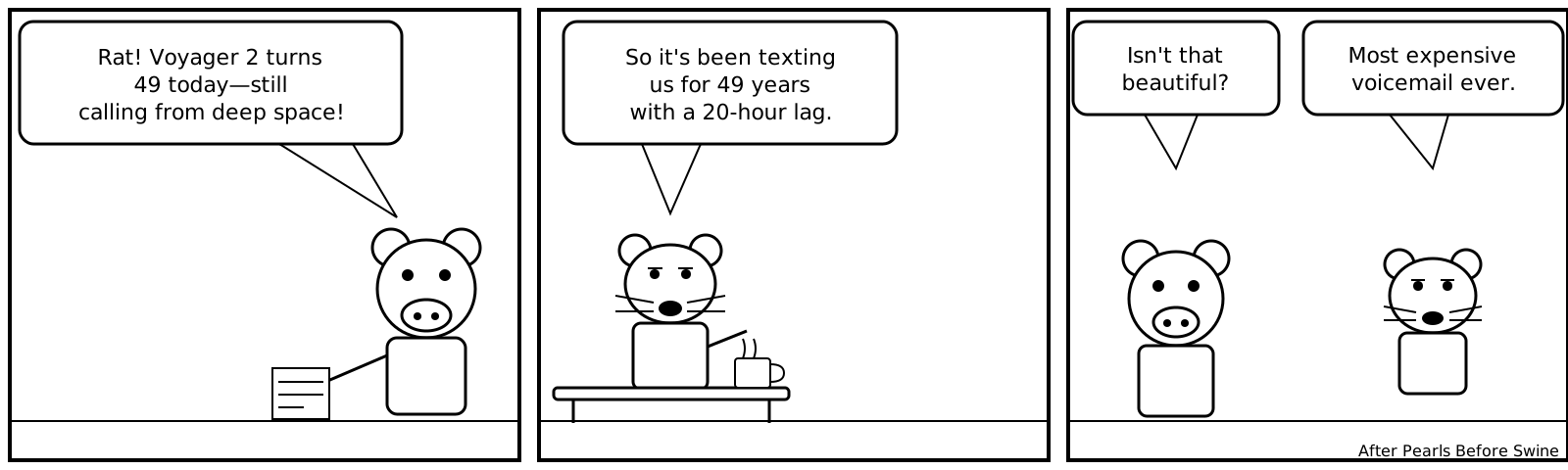
The Most Expensive Voicemail; I Just Wanted Socks

*After Pearls Before Swine* — on Voyager 2 turning 49 today and still transmitting from interstellar space, where every reply takes twenty hours. *After Bloom County* — on the AliExpress tab you muted that wasn't really muted, and the silent audio graph inside it that held your Bluetooth headphones hostage.

Hand-drawn parody comic strip

↑ Back to top

ALSO NOTED

Also Noted

↑ Back to top

THE QUESTION

The Certificate Doesn't Expire When the Use Case Does

The question today's edition keeps raising, in different vocabularies, is about what protection mechanisms are actually certified to cover.

As THE PELOTON reports, Vaughters made the case explicitly after a second fatal crash put the UCI's safety framework back under pressure: rolling enclosures — the lower-cost alternative to full road closures — weren't designed for pelotons that fragment into groups.1 The CPA spent two years raising the gap inside UCI working structures. The mechanism was in place. It simply didn't cover the actual use case.

THE LAB's lead story is a different rendering of the same problem. The browser's mute control was designed for media elements. An AudioContext graph wired to the system audio endpoint isn't a media element — it's a processing pipeline the browser sustains regardless of what the mute icon shows, and that the browser's own controls have no handle on.2 The gap between what the control covers and what the threat looks like was invisible until Bluetooth audio stopped switching.

The structural question is this: certification tests a mechanism against known scenarios. When the scenario changes — faster racing speeds, a different audio architecture — the mechanism remains certified. The certificate doesn't expire when the use case does. And the options available are the same in both cases: a workaround that doesn't touch the underlying design (a uBlock rule scoped to two script paths;2 a proposal to cut UCI-sanctioned race days from 700 to 100),1 or sustained advocacy inside an institution that had no mechanism to act on the gap until the failure made it visible. Vaughters' deeper argument is that fixing the standard without fixing the economics is treating the symptom — teams chase ranking points at underfunded events because the points system requires it, and the points system doesn't ask whether the event can afford to close its roads. The anti-fraud rationale for the browser fingerprinting is equally real; the question isn't whether the mechanism exists, but whether it should be running on a general shopping page, through deliberately unreadable code, causing a hardware side effect users cannot stop. Both arguments point at the same thing: a protection mechanism adequate for the scenario it was certified against, operating in a scenario it wasn't.

Sources
  1. Jonathan Vaughters calls for calendar reform following death of Finlay Tarling cyclingnews.com Aug 19, 2026
  2. AliExpress webpage keeping Bluetooth multipoint from switching blog.laserphile.com Aug 2026

↑ Back to top

Investigator Report

Investigator report — 2026/08/20

Verdict

A strong editorial day that found a genuine cross-domain structural question — the cycling safety failure and the browser audio-control failure turn out to be the same problem in two vocabularies — and followed it cleanly from THE LAB to THE PELOTON to THE QUESTION. Writing quality is mostly sharp. Two pipeline failures hurt the edition silently: OpenAI credits were exhausted when the lead image ran, leaving FROM THE ARCHIVE without its illustration, and the WORLD writer tripped on missing source files, producing a malformed ON THE TRAIL (weather warning instead of the required weekend-pick structure). The run cost $9.90 with the orchestrator taking 35%.


Frontpage

The rendered PNG is clean and legible. Visual hierarchy is correct: THE LAB's 68px headline dominates at top, the mid-row puts THE PELOTON on the left two-thirds and THE QUESTION on the right, and the four-column bottom row (THE WORLD headline-only, THE LONG READ, FROM THE ARCHIVE, ALSO NOTED) gives the page a credible broadsheet feel. No headline clipping, no overflow. The lead strip ("Today's Ride ● Sunny at 79°F") renders neatly. FROM THE ARCHIVE renders without an illustration — the Voyager 2 artwork was supposed to appear here (triggers_meta: true, image: true) but the OpenAI lead-image call failed. The section is present but naked. In the long-form index.html the FROM THE ARCHIVE article similarly has no image; the funnies SVG renders correctly in THE FUNNIES section with no duplication.


Priority ranking

SectionPriorityLength (words, approx.)ImageNotes
THE LAB78~600Art-director correctly leads with this
THE PELOTON74~750Strong multi-race + safety day
THE QUESTION71~240Cross-domain bridge; well-earned
THE WORLD65~250 body + trailLocal is solid; ON THE TRAIL malformed
THE LONG READ60~700Single-source; Cloudflare plug disclosed
FROM THE ARCHIVE38~90yes (failed)Priority cap respected; very thin
ALSO NOTED115 itemsGood sweep; correct
THE FUNNIES7SVG fallbackOpenAI failed; Claude SVG recovered

The ranking is defensible. THE LAB at 78 beating THE PELOTON at 74 on a day with three race openers and a fatal-crash policy story is a judgment call worth noting — a reasonable editor could argue the Vaughters/Tarling story has more human weight than the AliExpress audio-fingerprint investigation, but the LAB story is the more technically original piece. Priority compression between THE QUESTION (71) and THE WORLD (65) is tight, though the art director appropriately placed THE QUESTION in the mid-row rather than the bottom tier. No priority inflation — the 95-100 band sits empty correctly.


Editorial reading

ON THE TRAIL is structurally absent. The spec requires Part 1 (Weekend Picks) and Part 2 (Regional Snapshot). What shipped is three condition bullets: a Saturday weather warning, a PCT closure note, and a berry-conditions note. None of these constitute weekend picks or a formal "nothing clears criteria" callout. The WTA trip-reports page was fetched and contained viable reports (Three Fingers Aug. 19, Chair Peak/Kaleetan/Melakwa Aug. 19, Glacier Basin Aug. 19). The Saturday thunderstorm disqualifies Saturday, but the spec requires explicit per-criterion analysis: the writer should have evaluated Sat–Sun as a window, noted that Saturday fails the weather criterion (dry lightning, high fire-start risk), explained what the Sunday forecast looked like for candidate areas, and either offered a Friday–Saturday or Sunday-only option or delivered the required "Nothing clears your criteria this weekend: [specific reasons]" paragraph. Instead the reader got a weather advisory dressed as trail coverage. The spec is explicit: "A skip with no explanation is a defect" and "If NO trip clears all five criteria, lead with an explicit single-paragraph call-out naming WHICH criterion fails where."

THE QUESTION partially re-narrates its source sections. The lede clears the structural-question test. But paragraphs 2 and 3 are miniature recaps of THE PELOTON and THE LAB respectively: "Vaughters made the case explicitly after a second fatal crash put the UCI's safety framework back under pressure: rolling enclosures — the lower-cost alternative to full road closures — weren't designed for pelotons that fragment into groups. The CPA spent two years raising the gap inside UCI working structures. The mechanism was in place. It simply didn't cover the actual use case." This restates the Peloton story rather than drawing from it structurally. The final paragraph does arrive at genuine structural analysis ("certification tests a mechanism against known scenarios… the certificate doesn't expire when the use case does"), but the reader has to wade through a recap of what they just read to get there. The middle section could have been collapsed to a clause and the structural argument foregrounded sooner.

FROM THE ARCHIVE is two paragraphs and done. The headline is excellent. "The signal is still arriving" lands. But the article stops at the fact sheet — Voyager 2 launched, visited four planets, now in interstellar space, still transmitting. The archive section's stated purpose is to "feel like a genuine find, not a Wikipedia entry read aloud." This reads like a Wikipedia entry. Unused material was readily available: the gravity-assist trajectory design (the grand tour of the solar system was a one-in-176-year alignment that expired in 1977 and won't recur for generations); what "interstellar space" actually means operationally; the signal-strength arithmetic after 49 years (a 22.4-watt transmitter, 20+ hour signal delay, NASA's Deep Space Network pointed at a source 12 billion miles out). The two-paragraph body underserves the story.

THE LAB's Tim Sweeney item reports but doesn't interpret. The paragraph is factually complete — Early Access late 2027, cross-game digital ownership via Verse, AI tooling discussions, Apple fee complaints. But the section's focus says "have a point of view." The most interesting angle in the Sweeney roundtable is structural: the cross-game ownership pitch (items moving between titles without platform friction) is the Epic Games Store play reapplied at the engine level, and Verse-as-universal-scripting is a bet that an Epic-owned language wins against WASM or JavaScript in a game-runtime context. Neither observation surfaces. The item reads like a press-release distillation.

The AI anti-doping story deserved a dedicated slot. The Cyclingnews feature on AI-designed doping agents (the same platforms that produced the first AI-designed drug in human trials) was dropped by THE PELOTON writer ("long-form science piece tagged as Long Read candidate; better placed there") and by THE LONG READ writer ("Better suited to THE PELOTON per the brief's own annotation; feature-length magazine piece, not longform"). It ended up in ALSO NOTED with one sentence. This reader's interest list includes both cycling and AI — a story where generative AI chemistry threatens to outpace the biological passport is a direct intersection. The Cyclingnews piece was apparently feature-length; the inter-section routing dispute left a genuinely interesting story to the sweep rather than either giving it a full write-up.


Pipeline observations

Lead image failed silently. No lead_image.png was generated for this edition. FROM THE ARCHIVE has image: true and triggers_meta: true, and the meta-writer produced a compelling Voyager 2 illustration prompt. The illustrator.backend is openai. The OpenAI API returned 429 (credit balance exhausted) when the funnies call ran; the lead image call — which runs via fetch_lead_image.py as a Python script, not a subagent — apparently failed the same way and left no lead_image.* file on disk. No error log for the lead image failure exists (unlike the funnies, which has funnies-openai.error.txt). The orchestrator continued without it, the art director built the frontpage around a text-only layout, and the FROM THE ARCHIVE section rendered without any illustration. The funnies recovered via the Claude SVG fallback; the lead image has no such fallback path. Two distinct OpenAI credit failures in one run signals the account is critically underfunded — adding credits is blocking lead image generation on every future run until resolved.

WORLD writer exhausted six source reads on wrong paths. Agent agent-a44e1a966d4818540 (THE WORLD writer) attempted pages/world/us-debt-40T.md, pages/world/tsunami-model.md, pages/world/noted/us-debt-40T.md, pages/world/noted/tsunami-model.md, and twice tried pages/local/wilson-recall-response.md before finding it at pages/world/wilson-recall-response.md. The actual files for the debt and tsunami stories were in pages/noted/, placed there by the fetch pipeline when it routed them to the ALSO NOTED section hint. The WORLD writer dropped the tsunami model story with reason "Source file not found on disk" — accurate but avoidable. The Alaska tsunami model story (24-foot waves at Westport, 3.5-hour warning window, Seattle 2 feet) was material the reader cares about and ended up only in ALSO NOTED because the WORLD writer couldn't find it. The fact-checker for THE WORLD (agent agent-afd57e660d0d61751) also hit EISDIR errors trying to read the pages/world and pages/local directories rather than individual files; it recovered and completed its checks. The file-path miss rate for the WORLD section is high enough to be a recurring pattern worth investigating in the writer prompt.

Funnies OpenAI call failed (429, credit exhausted); recovered via Claude SVG. The funnies-openai.error.txt records the failure explicitly: "You have no credits remaining." The comic-strip agent produced a functional 3-panel Claude-drawn SVG fallback (funnies.svg, 128 lines) covering both the Voyager 2 and AliExpress angles. The recovery path works; the credit account does not. Note: the funnies SVG is a single 3-panel strip, while the section-funnies.md describes two conceptually distinct "After X" strips. The SVG blends both angles into one strip rather than presenting them as two separate panels or sequences — minor format deviation, consequence of the OpenAI fallback.

LD 41 primary results and Sammamish Town Center pivot dropped for fetch failures. Two local Eastside stories — King County's final LD 41 primary results (directly relevant to Issaquah-area readers) and the Sammamish Town Center growth pivot — were dropped because fetches returned no article content. Both had valid URLs in the research. These are the kind of local civic stories the paper's local beat exists to cover; the fetch failures represent gaps against the stated local_beat: "Seattle / Eastside (Issaquah, Bellevue, Seattle)".

Starting commit is same-day (e08144f → 5a28b86); no stale worktree concern.


Trace highlights

The comic-strip agent cost $0.92 and emitted 32,059 output tokens — the highest non-orchestrator output count by a factor of 4, and nearly as expensive as the researcher. The agent was prompted to draw "TWO parody comic strips," which appears to have produced substantial work crafting an OpenAI prompt (saved to funnies-openai-prompt.json) and then, when the API rejected it, generating a full Claude SVG fallback. Both paths ran in sequence, accounting for the 1,058-second wall time. This is a meaningful cost center for what the reader sees as a text caption and a simple SVG.

The researcher ran 957 seconds and cost $1.13 against writers averaging $0.20. The researcher's 3,918 output tokens and 1,987,629 cache reads suggest a large brief, but the WORLD writer still couldn't find two of the source files the brief presumably referenced. The brief's file-path guidance for world/local sources may not be specific enough, or the writer is not reading it carefully enough — both are worth investigating.

FC: THE WORLD emitted 8,359 output tokens in 343 seconds — by far the most output of any fact-checker. It caught three material corrections (dating "today" to "this week" for the debt milestone, correcting the Pennsylvania collision timing, correcting the Renton moratorium vote day). High output counts from a fact-checker usually indicate significant rewriting rather than targeted corrections; the article may have arrived at fact-check with more temporal imprecision than the three noted fixes suggest.

The orchestrator claimed $3.45 (35% of the $9.90 total). Its 7,494,971 cache reads and 126,580 one-hour cache creations are both large. No obvious pathology — the orchestrator is doing significant coordination across 20 agents — but this ratio is worth tracking across editions to watch for drift.

Trace summary

Dispatch 2026-08-20 (model: claude-sonnet-4-6)

AgentDurInputOutputCache ReadCache 5mCache 1hCost
Scout238s62451744730360$ 0.29
Researcher957s142391819876291252820$ 1.13
THE WORLD312s10404184237599720$ 0.29
THE PELOTON501s964120576982590$ 0.41
THE LAB250s842100234355920$ 0.16
THE LONG READ99s73271327214670$ 0.10
FROM THE ARCHIVE112s62253752183440$ 0.09
FC: THE LONG READ158s6670761570378480$ 0.26
FC: FROM THE ARCHIVE146s838102924226600$ 0.12
Meta-Writer63s620944558218680$ 0.10
FC: THE LAB289s730106911380030$ 0.18
FC: THE WORLD343s708359138653381200$ 0.31
FC: THE PELOTON344s72781297887340$ 0.36
THE QUESTION221s845122326346690$ 0.17
FC: THE QUESTION322s73099420365990$ 0.17
ALSO NOTED227s1165226164520040$ 0.26
Draw today's TWO parody comic strips for1058s11320591727481022110$ 0.92
FC: ALSO NOTED177s72798134341930$ 0.16
Art Director434s51010595546310$ 0.21
Update story threads for today's edition1070s81758632099850$ 0.79
Orchestrator1732940774949710126580$ 3.45
TOTAL52281536113356331203477126580$ 9.90

Suggestions for next edition

Top the OpenAI account. Two separate $0.00-balance failures in one run (lead image + funnies) blocked the illustration that FROM THE ARCHIVE's triggers_meta flag specifically exists for. Every future run will silently skip the lead image until credits are added.

Fix the WORLD writer's ON THE TRAIL format. The writer prompt or the section focus block should state the Part 1 / Part 2 structure requirement more explicitly, including the mandatory "nothing clears criteria" callout format. The writer treated the spec's weather-disqualification criteria as permission to issue a weather advisory and skip the picks analysis entirely. Adding a concrete example of the "no match" output to the focus block would close the gap.

Route the AI/cycling intersection stories explicitly. The AI anti-doping story (generative chemistry outpacing the biological passport) is a direct reader-interest intersection that bounced between THE PELOTON and THE LONG READ and landed in ALSO NOTED. Consider adding "AI×sport science / AI×anti-doping" to the researcher's routing notes, or flagging stories that cross both cycling and lab section hints for explicit treatment rather than leaving the bounce to writer discretion.

Investigate the WORLD writer's source-path confusion. The writer consistently looked for source files in pages/world/ subdirectories that the fetch pipeline had placed in pages/noted/. Adding fetch manifest guidance — or having the researcher explicitly name the actual on-disk path for each source — would reduce the six-error miss rate and prevent stories from being dropped as "source file not found on disk" when the file exists on a different path.